French for Busy Professionals: 15-Minute Daily Routine

French for Busy Professionals: A 15-Minute Daily Routine You Can Actually Stick To

If your routine needs motivation every day, it is already broken. This guide gives you a 15-minute system that survives bad days, late meetings, and a brain that is already done for the evening.

French for busy professionals with a practical 15-minute daily routine
A usable French routine starts by respecting the way work actually consumes time and attention.
🧱 Language Foundations 🌿 All Levels

Why most French routines collapse after a few weeks

The failure point is rarely motivation. It is design. Most French learning plans are built for people with spare time, predictable energy, and enough cognitive margin to decide every day what to study. Busy professionals do not have that setup. They have fragmentation, interruptions, and a calendar that can destroy a habit by Wednesday.

The real bottleneck is not discipline

Main issue: too many decisions, too much friction, and sessions that are too long to survive pressure.

Practical consequence: the routine gets skipped for two days, then four, then quietly disappears while the app still sends cheerful reminders.

Why 15 minutes works better than longer study blocks

Longer does not automatically mean better. It often means harder to repeat. A 90-minute session feels productive once. A 15-minute session feels repeatable. Repetition wins. Fifteen minutes is too short to negotiate with and large enough to matter if it happens every day.

Routine typeWhat it looks likeWhat usually happens
Big weekly blockOne or two long sessionsEasy to cancel, hard to restart, progress feels unstable
App-only habitRandom exercises when convenientStreak survives, speaking and listening often do not
Fixed 15-minute routineSame structure every dayLower friction, better retention, easier recovery after missed days
You’re building a French habit that survives real work pressure.
The Briefing gives you one daily French moment. Pre-selected, leveled, quiz included. Zero decisions.
📰 Read The French Briefing
Free. No account.

The 15-minute French routine that survives real workdays

The routine has one job: remove choices. You are not deciding what to study every evening. You are running the same three-part sequence. Decision fatigue kills more language learning than difficulty does.

  1. 1
    Minutes 1-5: review practical vocabularyUse the Learning Center articles by situation (work, admin, travel, exams). Pick one article per week, review the glossary and .pair translations daily. No random browsing. Relevance increases repetition. Repetition increases retention.
  2. 2
    Minutes 6-10: listen to understandable FrenchThe French Briefing is built for this exact slot: daily, pre-selected, leveled, with a quiz to check comprehension. One segment, repeated if needed. Not a wall of native audio you cannot follow. If you need more depth, the Pass adds weekly audio with CEFR tracking.
  3. 3
    Minutes 11-15: produce FrenchSay something out loud. Shadow an audio segment. Write 3-5 sentences. Record yourself for one minute. Output is where passive confidence gets tested. Use phrases from the article you reviewed in minutes 1-5.

Why this structure works with FTE content specifically

The three blocks map directly to the content ecosystem:

Your daily content pipeline

Vocabulary (min 1-5): Learning Center articles are organized by real-life situation (work, admin, exams, travel, food, culture). Each article has a glossary, .pair translations, and contextual prose. Pick one per week. Review its vocabulary daily. That is your source. No searching.

Listening (min 6-10): The French Briefing delivers daily. Pre-written, leveled, with a quiz built in. For audio depth, the Pass provides weekly audio segments with CEFR tracking. That is your listening. No hunting for podcasts.

Output (min 11-15): take the phrases you reviewed in minutes 1-5 and say them out loud. Describe your day using the vocabulary from that week’s article. Record yourself answering one of the Briefing quiz questions in a full sentence. That is your output. No app needed.

How to adapt the routine to your level

The structure stays fixed. What changes is the difficulty of the material inside it.

Beginner (A1-A2): make the routine embarrassingly simple

Use Learning Center articles from the Travel & Everyday or Language Foundations categories. Focus on survival phrases, basic present tense, introductions, dates, numbers, polite requests. Start with introductions, travel phrases, or politeness rules. For listening, the Briefing quiz at the end of each article gives you a daily micro-check. Take the Level Quiz first to confirm where you actually are.

🇫🇷 Pouvez-vous répéter, s’il vous plaît ? / Je ne comprends pas encore bien. 🇺🇸 Can you repeat, please? / I don’t understand very well yet. — Two of the most valuable beginner lines because they keep the interaction alive.

Intermediate (B1-B2): from phrases to operating language

Use Learning Center articles from the Professional & Expat Life or Society & Culture categories. Focus on interview vocabulary, email and office register, business expressions, or admin situations. For listening, the Pass weekly audio stretches you harder than the Briefing. Your output block should shift from isolated phrases to short spoken summaries.

Advanced (B2-C1): refine speed, register, and accuracy

Use Learning Center articles on political vocabulary, exam strategy, or culture-heavy topics. For listening, the Pass weekly audio at higher CEFR levels. Your 5 minutes of output should become 5 minutes of deliberate speaking: summarize the Briefing in your own words, record yourself, listen back, correct. At this level, a small disciplined system prevents drift better than sporadic “immersion.”

Passive immersion that does not steal more time

Passive immersion is useful when it replaces something you already do in English. It is useless when it becomes another task on your list.

A better framingYou are not “finding extra time for French.” You are swapping some of your existing English input for French during commutes, walks, airport time, or the soft edge of the workday when your brain is too tired for hard study but still available for exposure.

Passive immersion that helps

Repeatable audio, familiar topics, short segments, low-friction access. The Briefing during your commute. A Pass audio segment during a walk. An RFI Journal en français facile episode during housework.

Passive immersion that wastes time

Background noise you never process, content far above your level, or resources that require 10 minutes of searching before you press play.

The mistakes that quietly kill consistency

Using motivation as the engine. A routine powered by motivation works only on good days. Same slot, same sequence, same tools. Motivation can help but cannot be the fuel source.

Changing the method every week. New app. New channel. New notebook. New pronunciation hack. This feels active. It is often just disguised avoidance. The routine needs continuity long enough to generate evidence.

Measuring progress too emotionally. Some days French feels easier. Some days you feel clumsy. Neither feeling is a reliable metric. A better measure: is the routine still happening? Does yesterday’s audio feel slightly less opaque? Can you produce lines you could not produce last month?

Skipping output. Professionals stay too long in input mode because it feels efficient and low-risk. Output exposes the cracks. That is why it matters. If you skip the last 5 minutes, you are reviewing French, not building it.

Your 7-day rollout

  1. 1
    Day 1: Take the Level Quiz. Choose one fixed time slot and one backup.
  2. 2
    Day 2: Pick one Learning Center article for the week. Bookmark the Briefing.
  3. 3
    Day 3: Run the full 15 minutes even if it feels clumsy.
  4. 4
    Day 4: Repeat the same Briefing segment instead of chasing new material.
  5. 5
    Day 5: Say the final five minutes out loud, not silently.
  6. 6
    Day 6: Test whether the routine still works on a messy day.
  7. 7
    Day 7: Keep the structure. Change only the LC article if needed.

The only rule that matters tomorrow. Do the full 15 minutes before you try to improve the routine. A routine you run imperfectly is more valuable than a beautiful plan you keep redesigning. “For sure.” 🕶️

Study glossary: work French for your first routine week

FrenchEnglishWhen you’ll need it
La réunionThe meetingCore workplace vocabulary
Le délai / l’échéanceThe deadline / due dateProject planning and delivery
Le compte-renduThe summary or minutesPost-meeting follow-up
Le dossierThe file or case fileAdministrative and project contexts
Le retourFeedback or responseEmail and collaboration language
Prévoir / validerTo plan / to approveScheduling and decision-making
Je vous envoie le document cet après-midiI’m sending you the document this afternoonEmail standard
Je vous tiens au courantI will keep you informedProfessional follow-up
Comme convenuAs agreedEmail and meeting recap
Pouvez-vous préciser ?Could you clarify?Meetings and calls
J’ai besoin d’un peu de tempsI need a bit of timeBuying time without sounding lost
Nous devons finir avant vendrediWe have to finish before FridayDeadline communication
$19/mo

Less than one coffee a week.

The routine works. The Pass fills it: weekly audio, CEFR tracking, full archives. No more searching for content at the end of a long day.

✓ WEEKLY AUDIO✓ CEFR TRACKING✓ FULL ARCHIVES
📈 GET THE PASS · $19/MO
Zero contract. Liquidate in 2 clicks.
100% Free. Zero friction.

French Phrases for Visiting Paris: Beginner Guide

Visiting Paris? The Only French Survival Phrases You Need

You do not need to speak French to survive Paris. You need about 40 phrases, the confidence to use them badly, and the understanding that Parisians are not judging your accent. They are judging whether you said bonjour. This guide gives you everything you need, situation by situation, from the moment you land to the moment you leave.

Essential French phrases for visiting Paris as a tourist
Paris does not require fluent French. It requires bonjour, s’il vous plaît, and the willingness to try.
☕ Travel & Everyday 🌱 Beginner (A0-A2)

🤝 The golden rule that changes everything in Paris

Every interaction in Paris starts with the same word. Not merci. Not parlez-vous anglais. Bonjour. That single word determines whether the next 30 seconds of your life in Paris will be pleasant or frosty. Walk into a shop without saying it and the staff becomes cold. Say it first, even with a terrible accent, and something shifts. The door opens. The person behind the counter becomes a human being who wants to help you instead of a wall.

This is not a cultural quirk. It is the foundation of the entire French politeness system. Americans especially underestimate it because in the US, walking into a store and immediately asking a question is normal. In France, it is rude. Not aggressively rude. Just enough to make the interaction start wrong and never fully recover.

🇫🇷 Bonjour ! 🇺🇸 Hello! — Say this FIRST. Before anything else. Every time you enter a shop, a café, a museum, a bakery, a pharmacy, a taxi. Every. Single. Time.
🇫🇷 Au revoir ! 🇺🇸 Goodbye! — Say this when you LEAVE. Even if you bought nothing. Even if the interaction was awkward. It closes the exchange properly.
🇫🇷 S’il vous plaît 🇺🇸 Please — Attach this to every request. It turns broken French into polite broken French, which is a completely different experience.
🇫🇷 Merci / Merci beaucoup 🇺🇸 Thank you / Thank you very much — You cannot overuse this in Paris.
🇫🇷 Excusez-moi 🇺🇸 Excuse me — Use before asking a stranger anything. On the street, in the metro, at a counter. It is the polite door-opener.

The real reason Parisians seem cold to tourists

It is almost never about your French level. It is almost always about skipping bonjour. A tourist who says “Bonjour, excusez-moi, est-ce que vous parlez anglais ?” with a terrible accent will receive warmer treatment than a tourist who walks up and says “Do you speak English?” in perfect pronunciation. The difference is not language. It is acknowledgment. The guide to why French people don’t smile at strangers explains the deeper cultural logic.

You’re preparing for a real trip to Paris.
The Briefing builds daily French contact before you go. Same structures you’ll hear on the ground. Quiz included.
📰 Read The French Briefing
Free. No account.

🚇 The Paris metro: getting around without panic

The Paris metro is one of the densest urban transit systems in the world. 16 lines, 300+ stations, trains every 2-4 minutes. It is also, once you understand the logic, one of the easiest ways to move around any major city. The system is designed for volume, not for hand-holding. Announcements are fast. Signs are in French. Ticket machines have an English option but the staff at the guichet may not. Here is what you actually need.

🇫🇷 Un ticket, s’il vous plaît. / Un carnet, s’il vous plaît. 🇺🇸 One ticket, please. / A booklet of 10 tickets, please. — The carnet saves money if you will ride more than 3-4 times.
🇫🇷 Je cherche la ligne six. / C’est quelle direction ? 🇺🇸 I’m looking for line 6. / Which direction is it? — Say the line number in French if you can: un, deux, trois, quatre, cinq, six, sept, huit…
🇫🇷 Pour aller à Montmartre, s’il vous plaît ? 🇺🇸 To get to Montmartre, please? — Works for any destination. Replace the place name.
🇫🇷 C’est direct ou il faut changer ? 🇺🇸 Is it direct or do I need to change? — Extremely useful. Saves wrong-direction rides.
🇫🇷 Pardon ! / Excusez-moi, je descends. 🇺🇸 Excuse me! / Excuse me, I’m getting off. — Rush hour on line 13 is not the time to be politely quiet. Say it loud enough to be heard.

The train ticket vocabulary guide covers the full SNCF system if your trip extends beyond Paris to other French cities. The transaction logic is the same: bonjour, destination, s’il vous plaît, pay, merci, leave.

Download offline maps before you go. Google Maps and Citymapper both work offline for Paris metro routing. Your French SIM card will handle data, but offline maps work even in tunnels where signal drops.

🍽️ Cafés, bakeries, and restaurants: the phrases that feed you

This is where Paris happens. Not at the Eiffel Tower. At the café terrace where you sit with a coffee and watch the street go by. At the bakery where the smell of butter hits you at 7am. At the restaurant where the waiter does not rush you because dinner in France is not a transaction. It is a social event. And the French you need for all three is surprisingly small.

☕ At the café

The full café culture guide covers the rules in depth. Here is the survival version: sit down, wait to be served (do not flag the waiter frantically), order with s’il vous plaît, and never rush.

🇫🇷 Un café, s’il vous plaît. / Un café crème, s’il vous plaît. 🇺🇸 An espresso, please. / A coffee with milk, please. — “Un café” = espresso by default. If you want something bigger, ask for un café allongé.
🇫🇷 Un thé, s’il vous plaît. / Un chocolat chaud, s’il vous plaît. 🇺🇸 A tea, please. / A hot chocolate, please.
🇫🇷 L’addition, s’il vous plaît. 🇺🇸 The bill, please. — The waiter will not bring it until you ask. This is not neglect. It is respect for your time at the table.
🇫🇷 Je peux payer par carte ? 🇺🇸 Can I pay by card? — Most places accept cards now, but some small cafés have a minimum (often 10-15€).

🥐 At the bakery

French bakeries are the single best place to practice French as a nervous beginner. The interaction lasts 30 seconds. The script is almost always the same. And the reward is warm bread. The bakery culture guide covers the full etiquette, but here is what gets you through the door.

🇫🇷 Bonjour ! Une baguette, s’il vous plaît. 🇺🇸 Hello! One baguette, please. — Start here. This is the easiest French interaction in existence.
🇫🇷 Et un pain au chocolat, s’il vous plaît. / Et deux croissants. 🇺🇸 And a pain au chocolat, please. / And two croissants. — Add items naturally. No need for a full sentence.
🇫🇷 C’est combien ? 🇺🇸 How much is it? — If you did not catch the price, this saves you. Numbers in French are covered in the numbers and dates guide.
🇫🇷 C’est tout, merci ! 🇺🇸 That’s all, thanks! — Clean closing. Works everywhere.
Your first Parisian bakeryYou walk in. “Bonjour !” The person behind the counter says bonjour back. “Une baguette tradition, s’il vous plaît.” They grab it. “C’est tout ?” You say “Oui, c’est tout, merci.” You pay. “Au revoir, bonne journée !” You walk out holding warm bread. Total French used: four phrases. Total joy: immeasurable.

🍷 At the restaurant

Restaurant French is slightly more complex but still manageable. The restaurant booking and ordering guide has the full version. Here is what keeps you alive on your first Parisian dinner.

🇫🇷 Bonjour, on a une réservation au nom de [name]. 🇺🇸 Hello, we have a reservation under the name [name].
🇫🇷 Une table pour deux, s’il vous plaît. 🇺🇸 A table for two, please.
🇫🇷 La carte, s’il vous plaît. / Qu’est-ce que vous recommandez ? 🇺🇸 The menu, please. / What do you recommend? — Asking for a recommendation is socially excellent. It shows trust and curiosity.
🇫🇷 Je vais prendre le plat du jour. 🇺🇸 I’ll have the daily special. — Often the best value and the freshest option.
🇫🇷 C’est quoi, ça ? / Il y a du [allergène] dedans ? 🇺🇸 What is this? / Is there [allergen] in it? — Essential for dietary restrictions. Replace with: gluten, noix (nuts), lait (dairy), fruits de mer (shellfish).
🇫🇷 C’était très bon, merci ! 🇺🇸 That was very good, thank you! — The simplest compliment. Waiters appreciate it. It costs nothing.

Tipping in Paris. Service is included in the price by law (service compris). You do not need to tip. Leaving 1-2€ in coins on the table for good service is a nice gesture but never obligatory. Do not tip 20% like in the US. It would be bizarre. The cheese culture guide covers the fromage plateau that might appear at the end of your meal, because yes, cheese comes before dessert in France.

🛍️ Shopping, markets, and getting what you need

🏪 In shops

🇫🇷 Bonjour, je cherche… 🇺🇸 Hello, I’m looking for… — Then point, gesture, or say the item. Perfectly acceptable.
🇫🇷 Vous avez ça en [taille/couleur] ? 🇺🇸 Do you have this in [size/colour]? — Useful in clothing stores.
🇫🇷 Je peux essayer ? / Où sont les cabines ? 🇺🇸 Can I try it on? / Where are the fitting rooms?
🇫🇷 C’est trop cher pour moi. 🇺🇸 That’s too expensive for me. — Honest. Socially acceptable. Nobody will be offended.
🇫🇷 Je vais réfléchir. 🇺🇸 I’ll think about it. — Polite way to leave without buying. Works in every shop in France.

🍅 At a market

Paris markets (Marché d’Aligre, Marché des Enfants Rouges, Rue Mouffetard) are some of the best experiences in the city. The vendors are fast, the displays are beautiful, and the French is surprisingly simple because the interaction follows a tight script.

🇫🇷 Je voudrais un kilo de tomates, s’il vous plaît. 🇺🇸 I’d like a kilo of tomatoes, please. — At markets, you typically ask for quantities. Un kilo, un demi-kilo, une barquette (a punnet).
🇫🇷 C’est mûr ? / C’est pour manger aujourd’hui. 🇺🇸 Is it ripe? / It’s to eat today. — Vendors will choose the best ones for you. This interaction is deeply French and deeply satisfying.
🇫🇷 Qu’est-ce que c’est ? / Je peux goûter ? 🇺🇸 What is this? / Can I taste? — Markets are one of the rare places where asking to taste is normal and welcome.

🧭 Asking for directions and finding things

🇫🇷 Excusez-moi, je cherche la Tour Eiffel / le Louvre / la station de métro. 🇺🇸 Excuse me, I’m looking for the Eiffel Tower / the Louvre / the metro station.
🇫🇷 C’est par où ? / C’est loin d’ici ? 🇺🇸 Which way is it? / Is it far from here?
🇫🇷 À gauche / à droite / tout droit 🇺🇸 Left / right / straight ahead — If someone gives you directions, these three words cover 90% of what you need to understand.
🇫🇷 Où sont les toilettes, s’il vous plaît ? 🇺🇸 Where are the toilets, please? — You will need this. Paris public toilets exist but are not always obvious. Cafés are the backup plan (order a coffee first).

🆘 When things go wrong: the phrases that save you

Most Paris trips go perfectly. But sometimes your wallet disappears, your phone dies, you get lost at 11pm, you need a pharmacy, or you genuinely do not understand what is happening. These phrases exist for those moments.

🇫🇷 J’ai besoin d’aide, s’il vous plaît. 🇺🇸 I need help, please.
🇫🇷 Je suis perdu(e). 🇺🇸 I’m lost. — Add (e) if you are female. Most people will not notice either way.
🇫🇷 Je ne comprends pas. / Vous pouvez répéter, s’il vous plaît ? 🇺🇸 I don’t understand. / Can you repeat, please? — Not shameful. Normal. Use them without apology.
🇫🇷 Parlez-vous anglais ? 🇺🇸 Do you speak English? — Use this AFTER bonjour and excusez-moi. Never as the opening line.
🇫🇷 Où est la pharmacie la plus proche ? 🇺🇸 Where is the nearest pharmacy? — French pharmacies (green cross sign) can help with many minor medical issues without a doctor visit.
🇫🇷 J’ai perdu mon portefeuille / mon téléphone / mon passeport. 🇺🇸 I lost my wallet / my phone / my passport. — For serious loss, head to the nearest commissariat de police. They deal with tourist theft reports regularly.
🇫🇷 Appelez la police / une ambulance, s’il vous plaît. 🇺🇸 Call the police / an ambulance, please. — Emergency number in France: 112 (European) or 15 (SAMU medical) or 17 (police).

Emergency numbers in France. 112 works from any phone including locked phones. 15 = SAMU (medical emergency). 17 = police. 18 = fire brigade (pompiers, who also handle medical emergencies). Operators on 112 often speak English.

✨ The phrases that turn a trip into something better than tourism

These are not survival phrases. These are the phrases that make Parisians smile, that open conversations, and that turn a visit into a story instead of a checklist. You do not need them. But if you use them, Paris feels different.

🇫🇷 J’apprends le français. / C’est ma première fois à Paris. 🇺🇸 I’m learning French. / It’s my first time in Paris. — Both sentences make people want to help you.
🇫🇷 C’est magnifique ici. / J’adore ce quartier. 🇺🇸 It’s beautiful here. / I love this neighbourhood. — Simple. Genuine. Effective.
🇫🇷 Vous pouvez me prendre en photo, s’il vous plaît ? 🇺🇸 Can you take a photo of me, please? — Works everywhere. Follow with merci beaucoup and a smile.
🇫🇷 Bonne journée ! / Bonne soirée ! 🇺🇸 Have a nice day! / Have a nice evening! — Say this when leaving any interaction. It closes the loop beautifully and Parisians genuinely appreciate it.
🇫🇷 Je reviendrai ! 🇺🇸 I’ll come back! — Say this to a waiter, a shopkeeper, a bakery. It is the nicest thing a tourist can say. And if you mean it, even better.

If you want your introduction to sound less like a textbook and more like a real person arriving in a real city, the register for Paris is simple: Moi, c’est [name]. Je suis américain(e). C’est ma première fois. J’adore Paris. That is enough to start a conversation that neither of you expected.

🗼 What to know before you go: practical Paris intel

Things Americans do not expect

Shops close on Sunday. Most of them. Plan accordingly. Bakeries usually open Sunday morning but close Monday instead.

Lunch is 12h-14h. Many restaurants stop serving at 14h sharp. If you arrive at 14h05, the kitchen is closed. This is not rudeness. It is the schedule.

Water is free. Ask for une carafe d’eau (a jug of tap water). It is free and perfectly drinkable. Do not order Evian unless you want to pay 5-7€ for the same water in a different bottle.

Waiters are not ignoring you. They are giving you space. In France, a waiter who hovers is annoying. A waiter who waits for your signal is professional. To get attention: make eye contact and raise a finger slightly. Do not wave, snap, or call out.

The French holiday calendar will affect your trip. May is particularly dense with public holidays. Some businesses close for an entire bridge weekend (le pont).

📋 Your Paris French cheat sheet

FrenchEnglishWhen you’ll need it
Bonjour / BonsoirHello / Good eveningFIRST word. Every interaction. Non-negotiable.
Au revoir / Bonne journéeGoodbye / Have a nice dayLAST word. Every interaction. Closes the loop.
S’il vous plaît / MerciPlease / Thank youAttach to everything. Free politeness upgrade.
Excusez-moiExcuse meBefore any question to a stranger.
Parlez-vous anglais ?Do you speak English?After bonjour. Never as opener.
Un café / un café crèmeEspresso / coffee with milkCafé = espresso by default in France.
Une baguette, s’il vous plaîtA baguette, pleaseBakery. Your easiest French win.
L’addition, s’il vous plaîtThe bill, pleaseWaiter won’t bring it until you ask.
Une carafe d’eauA jug of tap water (free)Restaurant. Free. Always available.
C’est combien ?How much is it?Shops, markets, anywhere.
Où est / Où sont ?Where is / Where are?Metro, toilettes, pharmacie, anything.
À gauche / à droite / tout droitLeft / right / straight aheadUnderstanding directions.
Je ne comprends pasI don’t understandRescue phrase. Use without shame.
J’ai besoin d’aideI need helpEmergencies and genuine confusion.
C’était très bon, merciThat was very good, thanksEnd of meal. Costs nothing. Means everything.

The only rule that matters. Bad French with bonjour beats perfect English without it. If you take one thing from this guide, take that. Paris opens for people who try. It closes for people who assume. “For sure.” 🕶️

$19/mo

Less than one coffee a week.

You just packed 40 Paris phrases. The Pass builds the French behind them weekly: real audio, real situations, CEFR tracking. So next time you go, you order without looking at this guide.

✓ WEEKLY AUDIO✓ CEFR TRACKING✓ FULL ARCHIVES
📈 GET THE PASS · $19/MO
Zero contract. Liquidate in 2 clicks.
100% Free. Zero friction.

Best French Music to Learn French: 12 Artists Ranked by Difficulty Level

Best French Music to Learn French: 12 Artists Ranked by Difficulty Level

French music helps where textbooks fail: rhythm, sound recognition, repeated exposure, and phrases that stay in your head because they arrive with emotion. This guide ranks 12 artists from A1 to C1, gives you a practical reason to use each one, and adds YouTube listening routes so you can build a real progression instead of another playlist you never use.

Best French music artists for learning French by level
Learn French by level, not by random playlist luck.
🍷 Society & Pop Culture 🌿 All Levels (A1-C1)

Why music works differently from textbooks

Music solves a problem many English speakers do not identify clearly enough. They think they need more grammar when they actually need more contact with living French sound. Songs give you repeated phrasing, stable melody, memorable rhythm, and enough emotional charge that lines stop feeling like exercises and start feeling like language. French listening is not just about knowing words. It is about catching chains of sound: liaison, swallowed vowels, repeated chunks, phrase endings, and breath groups. Music does not replace serious study, but it often makes serious study finally land.

If your listening base is still fragile, pairing music with the pronunciation and listening guide gives you the sound system that makes songs stop being beautiful noise and start being decipherable French. And if you are the kind of learner who freezes when real French audio moves too fast, that is the same problem the shy beginners guide addresses from the speaking side.

Best use of this guide. Pick artists by listening level, not by taste alone. You can like an artist and still not be ready to learn efficiently from them yet. Not sure of your level? The Level Quiz takes three minutes and saves you from picking the wrong starting point.

You’re training your ear with music. Good.
The Briefing adds daily written French to the mix. Same structures, different channel. Quiz included.
📰 Read The French Briefing
Free. No account.

Beginner artists (A1-A2): clear pronunciation, stable structure

1. Stromae

Stromae is one of the easiest serious entry points into modern French music. The diction is unusually clean, the rhythmic patterns are easy to revisit, and the choruses carry vocabulary even when the verses still move too fast. He is Belgian, which connects to the Belgian French expressions that sometimes sound different from standard Parisian French.

Start with: Papaoutai (YouTube), Formidable, Tous les mêmes, Carmen. What you learn: high-frequency everyday French, repeated phrase structures, better sound recognition for modern pop French without drowning in slang. Full Stromae channel.

2. Zaz

Zaz helps because her delivery opens the sounds up. You hear phrase shape more clearly than in most contemporary pop. Especially useful for learners who know the words on paper but still miss them in real audio.

Start with: Je veux (YouTube), On ira, Éblouie par la nuit. What you learn: clear vowel distinction, repeated first-person structures, more intuitive phrase flow. Full Zaz channel.

3. Calogero

Sits in a productive middle zone. The songs feel more natural than ultra-slow learner material, but still clean enough to train comprehension without collapsing into blur.

Start with: En apesanteur (YouTube), Face à la mer, Si seulement je pouvais lui manquer. What you learn: emotional language, repeated everyday structures, a natural bridge from beginner pop into fuller French phrasing. Full Calogero channel.

4. Kids United

For raw beginners, Kids United does something useful that cooler artists do not. The language is accessible fast enough to create wins. That matters more than stylistic prestige when your listening confidence is still weak. If you are the kind of learner described in the shy beginners guide, start here without shame. Wins build momentum.

Start with: On écrit sur les murs (YouTube), Tout le bonheur du monde, L’Oiseau et l’Enfant. What you learn: repeated sentence patterns, clear choruses, enough recognisable French to stop feeling locked out immediately. Full Kids United channel.

Once those artists stop feeling slow, you need music that sounds less pedagogical and more like actual contemporary French life. That is also the point where French podcasts on Spotify become a useful parallel track: same ear training, different format, more talking speed.

Intermediate artists (B1-B2): natural speed, richer vocabulary

5. Angèle

Angèle is strong because the themes feel current without becoming unreadably dense. You hear modern vocabulary, social references, and young-adult phrasing without the full compression of faster rap. If you also watch French shows on Netflix, Angèle’s register is the same one you hear in contemporary series dialogue.

Start with: Balance ton quoi (YouTube), Tout oublier, Flou, Nombreux. What you learn: modern conversational French, current social vocabulary, better tolerance for more natural pacing. Full Angèle channel.

6. Indila

Ideal for learners who need stronger narrative listening. The songs carry images and movement clearly enough that meaning can often be inferred even before every line is fully understood.

Start with: Dernière danse (YouTube), Tourner dans le vide, Love Story, S.O.S. What you learn: emotional lexicon, narrative flow, stronger recognition of repeated phrases across verses and chorus. Full Indila channel.

7. Édith Piaf

Piaf will not teach you contemporary slang. She will teach you something else: classic phrasing, emotional weight, and the controlled delivery of older chanson. If you are reading about French holidays and cultural traditions, Piaf songs are often playing in the background. She is cultural infrastructure.

Start with: La Vie en rose (YouTube), Non, je ne regrette rien, Milord. What you learn: slower dramatic diction, classic vocabulary, one of the central reference points of French song culture. Full Piaf channel.

8. Jacques Brel

Brel brings you toward denser French without the closed texture of some advanced rap. The pronunciation remains workable, the emotional drive is strong, and the language carries more literary force than most pop. He is Belgian too, which means his French sometimes carries the same flavour as the Belgian expressions guide. At this level, you are also ready for French BD (comics) as a parallel input channel: visual + text + culture at the same time.

Start with: Ne me quitte pas (YouTube), Amsterdam, Quand on n’a que l’amour. What you learn: sophisticated phrase-building, emotional emphasis, more expressive French than most modern chart music. Full Brel channel.

Advanced artists (B2-C1): speed, slang, density, cultural references

9. Orelsan

One of the best advanced recommendations because he gives you intelligent, contemporary French without being totally inaccessible. If you are following French political vocabulary or reading French news sources, Orelsan’s social commentary will feel familiar. Same France, different format.

Start with: Basique (YouTube), Tout va bien, La Terre est ronde, Suicide social. What you learn: current spoken vocabulary, faster information processing, layered social commentary. Full Orelsan channel.

10. MC Solaar

MC Solaar is difficult in the right way. Not just fast. Dense, playful, and layered. Strong recommendation for learners who already follow French fairly well and now need more lexical sophistication. The wordplay in his lyrics overlaps with the kind of double meanings covered in the French words that don’t translate to English guide.

Start with: Caroline (YouTube), Nouveau Western, La Belle et le Bad Boy. What you learn: richer phrasing, literary references, how French can stay musical while doing much more semantic work per line. Full MC Solaar channel.

11. Serge Gainsbourg

Gainsbourg becomes useful when you are ready for language that refuses to stay literal. Not the first stop for clean acquisition. The point where French starts becoming interesting at the level of suggestion, irony, and play. If you are into French cultural depth, pair him with the cheese culture guide and the why French people don’t smile at strangers article. Same cultural universe.

Start with: La Javanaise (YouTube), Poupée de cire, poupée de son, Initials B.B.. What you learn: ambiguity, layered meaning, culturally loaded French. Full Gainsbourg channel.

12. Louane

Not the hardest artist here, but one of the most useful for learners who want emotionally direct modern French without slipping back into beginner clarity. Works especially well after the first pop layer is comfortable. Couples learning French together often use Louane as shared listening material because the emotional register is universal and the pace is manageable for mixed levels.

Start with: Avenir (YouTube), Jour 1, Donne-moi ton cœur, Si t’étais là. What you learn: current emotional French, relational language, natural repeated phrases. Full Louane channel.

How to use songs for French instead of just enjoying them

The three-listen method

First listen: no pressure, no pausing, no translation. Just catch the mood and the repeated sounds. Second listen: read the lyrics and identify what keeps returning. Third listen: sing or shadow. Even badly. Your mouth has to learn French rhythm physically, not just intellectually. This is the same shadowing technique the 15-minute routine uses in its output block: repeat after audio to build the physical reflex of speaking.

What actually creates progress

Passive listening: useful for familiarity. Active listening: where most of the learning happens. Shadowing: where pronunciation and rhythm start changing in your own speech. If you need more structured pronunciation work, the pronunciation guide gives you the sound system that makes shadowing more effective.

Do not move up levels too early

If Stromae still feels hard, do not jump to Orelsan because you are bored by the label “beginner.” Difficulty is not prestige. It is just load. The realistic timeline guide covers how long each CEFR level actually takes, which prevents the frustration of expecting B2 comprehension on an A2 ear.

Use songs alongside structured input

Music is excellent for sound, rhythm, and phrase memory. It is weaker for systematic explanation. That is why songs work best when paired with structured guidance. The Learning Center is the obvious complement. If you want more reading input between songs and native media, the French books guide gives you a cleaner bridge than random searching. For screen-based input, the Netflix guide and the French TV channels guide extend the same logic: structured difficulty, not random immersion.

Your progressive French music plan

  1. 1
    Week 1: Pick one artist at your level and one song only. Listen 3x using the three-listen method.
  2. 2
    Week 2: Add lyrics, mark repeated phrases, shadow the chorus. Read the Briefing daily for parallel written exposure.
  3. 3
    Week 3: Add a second song by the same artist. Try speaking the lyrics out loud, not just singing.
  4. 4
    Week 4: Move to a neighboring artist in the same level band. If you are still translating every line to English, stay at this level one more week.

Three mastered songs teach more French than thirty vaguely familiar songs you never worked with actively. That principle is dull, which is exactly why it works. “For sure.” 🕶️

Study glossary: French music vocabulary

FrenchEnglishUsage
Les parolesThe lyricsJe cherche les paroles de cette chanson
Le refrain / le coupletThe chorus / the verseLe refrain est facile à retenir
La prononciationPronunciationSa prononciation est très claire
Chanter / écouter / répéterTo sing / to listen / to repeatJ’écoute de la musique française chaque jour
La chanson / l’artisteThe song / the artistC’est ma chanson préférée
Le rythme / la mélodieThe rhythm / the melodyLa mélodie est entraînante
ComprendreTo understandJe comprends mieux avec la musique
$19/mo

Less than one coffee a week.

Songs train your ear. The Pass trains your comprehension weekly: real audio, CEFR tracking, full archives. Different channel, same progression.

✓ WEEKLY AUDIO✓ CEFR TRACKING✓ FULL ARCHIVES
📈 GET THE PASS · $19/MO
Zero contract. Liquidate in 2 clicks.
100% Free. Zero friction.

How to think in French (stop translating from English) – practical guide

How to Think in French and Stop Translating From English: Practical Guide for Adult Learners

Every sentence still takes the same hidden route: French comes in, gets converted into English, then English sends an answer back out dressed in French. That system cannot carry real fluency. This guide shows how to break it.

How to think in French and stop translating from English practical guide
Direct French thinking starts long before fluency feels elegant.
🧱 Language Foundations 🌳 Intermediate (A2-B2)

Why you still translate in your head

Translation is not proof that you are bad at French. It is proof that your brain is still protecting speed and certainty by using the strongest system it already has, which is English. For an absolute beginner, that is normal. For a learner who already knows common verbs, daily vocabulary, and basic sentence patterns, it becomes expensive.

The cost is not only speed. Translation distorts meaning. English and French do not cut reality in the same places. The English speaker wants to say “I am cold,” then searches for a French equivalent. The language does not want that sentence. It wants j’ai froid. The learner who keeps building from English first does not just move slowly. They keep trying to force French to obey a foreign architecture. That same mismatch shows up across dozens of expressions covered in the false friends guide and the 10 most common mistakes.

The goal is not to erase English

The goal is to make French available earlier, faster, and more often. Thinking in French does not mean thinking perfectly. It means the sentence begins in French often enough that English is no longer the only launch point.

You’re rewiring how your brain processes French.
The Briefing gives you daily French input at the right level. Read in French first, check understanding after. Quiz included.
📰 Read The French Briefing
Free. No account.

What thinking in French actually looks like

People imagine some dramatic transformation where one morning the internal voice has become Parisian. That is not how it works. Direct French thinking appears in fragments before it appears in systems.

At first, it is a few stable units. You see the coffee machine and café arrives before “coffee.” Someone asks how you are and ça va feels faster than any English equivalent. Then it widens. Daily actions, weather, food, directions, routine preferences, small reactions. Only later do more abstract thoughts begin to move directly in French.

The three stages

Stage one: isolated high-frequency words and chunks appear without translation.

Stage two: short daily sentences begin directly in French.

Stage three: entire familiar situations can be processed in French without constant English support.

If you believe “thinking in French” means full native-like internal fluency, you will miss the real progress happening much earlier. The useful measure is how often French appears before English gets there first.

The core method: internal narration

If one technique does the most work for adult learners, it is internal narration. You take ordinary life and start attaching French to it before English has time to formalize everything.

You narrate a routine in French while you do it. Mentally is enough. The point is to connect action, object, and sensation directly to French language instead of to English commentary about French language.

Morning routine exampleJe me lève. Je vais dans la cuisine. Je prépare le café. L’eau chauffe. Je suis fatigué. Je dois partir dans vingt minutes. — None of this is advanced. That is exactly why it works.

Internal narration has three advantages most classroom tasks do not. First, it uses your real life, so meaning is always present. Second, it repeats the same vocabulary domains again and again, which builds automaticity. Third, it trains retrieval under low pressure. No grade. No audience. Just repetitions that slowly stop feeling foreign. If you freeze when speaking out loud, internal narration is the safest bridge because nobody is watching.

Do not wait until you can narrate elegantly. Start with ugly, simple French. Clean French comes later. Direct French comes first. If a word is missing, describe around it: le truc pour ouvrir les bouteilles instead of going silent because you forgot tire-bouchon.

Mind games that force the switch

Internal narration builds the base. These techniques push further. They are deliberate cognitive tricks that make your brain default to French in specific moments, even when English is still available. None of them require a classroom, a partner, or a trip to France. They require a decision and about five minutes.

The language lock: pick one activity and make it French-only forever

Choose one daily activity and declare it permanently French. Not “I will try to think in French while cooking.” That is a suggestion. It will last two days. Instead: “Cooking is now French. Every time. No exceptions.” Your grocery list is in French. Your recipe reading is in French. Your internal narration while chopping onions is in French. Je coupe les oignons. Où est le sel ? Il faut encore dix minutes. The restriction is what makes it work. When there is no option to fall back to English for this one activity, your brain stops negotiating and starts producing.

After cooking feels natural, add a second lock. Walking. Then showering. Then commuting. Each lock is a permanent French zone that never goes back to English. Over months, the locked zones expand until French is the default internal language for large parts of your day.

The 60-second sprint: set a timer and think only in French

This one sounds trivial. It is surprisingly hard and surprisingly effective. Set a timer for 60 seconds. During those 60 seconds, every thought must stay in French. If English appears, do not fight it. Just notice it and return to French. Like meditation, but for language.

Most people cannot do 60 seconds cleanly on their first try. That is the point. The exercise makes you aware of how often English hijacks your internal monologue without permission. Over time, 60 seconds becomes 2 minutes, then 5, then you stop needing the timer because French starts holding territory on its own.

The emotional anchor: attach French to feelings, not just facts

Most learners connect French to information. La table = the table. Le chien = the dog. That works for objects. It does not work for the moments when you think fastest, which are emotional reactions. Surprise. Frustration. Relief. Amusement. Hunger. Those micro-moments are where your brain defaults to English most stubbornly because emotions feel too urgent for a second language.

The fix: deliberately override the emotional default. When you stub your toe, force aïe, merde instead of “ow, shit.” When something is funny, push c’est trop drôle before “that’s hilarious” arrives. When you are hungry, make j’ai faim the first thought, not a translation of “I’m hungry.” These micro-switches rewire the deepest layer of language because they attach French to the moments where your brain is most automatic and least analytical. Over time, French stops being the language you use for exercises and becomes the language you react in.

The dream rehearsal: replay your day in French before falling asleep

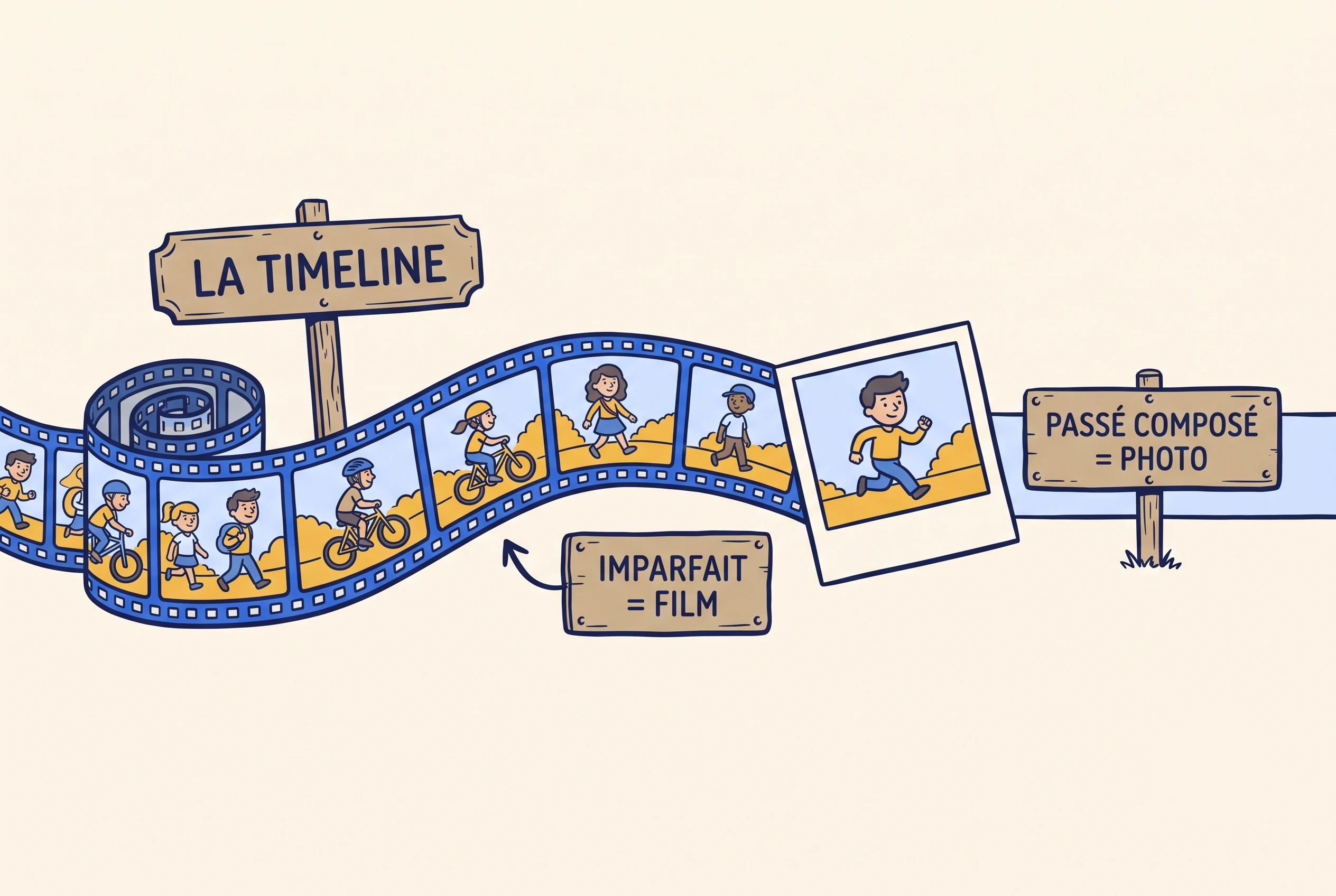
Lie in bed. Close your eyes. Replay your entire day from morning to now, but narrate it in French. Ce matin je me suis levé tard. J’ai pris le métro. Il y avait du monde. Au travail, j’ai eu une réunion longue. J’ai déjeuné avec Marie. L’après-midi était calme. Maintenant je suis fatigué. This does three things at once: it reviews real vocabulary from your actual day (not a textbook), it builds the past tense naturally (passé composé and imparfait appear organically because you are describing what happened), and it trains your brain to process experience through French right before sleep, which is when memory consolidation is strongest.

The label game: rename everything in your environment

Look at any room. Name every object you can see. In French. No English. La fenêtre, le mur, la chaise, le tapis, l’écran, le stylo, la tasse, les clés. When you hit a word you do not know, describe it: le truc noir sur la table (the black thing on the table). Do not stop to look it up. The point is continuous French production, not accuracy. Look up the missing word later. During the game, the only rule is: no English enters the room.

Advanced version: do not just label. Connect. La tasse est sur le bureau. Le bureau est près de la fenêtre. La fenêtre est ouverte parce qu’il fait chaud. Now you are building sentences, not just listing nouns. That is the difference between vocabulary and language.

The phone switch: change your phone language to French

This one is older advice but most people still have not done it. Change your phone’s system language to French. Not your computer if that would slow down work. Just the phone. Every notification, every menu, every settings label becomes French. Réglages. Luminosité. Notifications. Rechercher. You will look things up for two days. Then you will stop because your brain will have memorized the positions. That passive exposure is worth more than it sounds because you touch your phone 80-150 times a day. That is 80-150 micro-contacts with French that cost zero effort after the first week.

If you also switch your French SIM card to a French carrier, you start receiving SMS, voicemail prompts, and customer service messages in French too. That is accidental immersion built into admin.

The inner debate: argue with yourself in French

Pick a question. Any question. Est-ce que je devrais déménager ? Est-ce que ce film était bon ? Est-ce que je travaille trop ? Then argue both sides. In French. Out loud or in your head. D’un côté, mon appartement est trop petit. De l’autre, le loyer est pas cher. Mais le quartier est bruyant. Par contre, je suis près du métro. This technique forces complex thinking in French: cause and effect, comparison, weighing options, conditional reasoning. It is the hardest exercise here because it requires French to handle ambiguity, not just description. But it is also the one that, when it starts working, signals that your French is becoming a thinking language, not just a labeling language.

Start with one technique. Not all seven. Pick the one that fits your day most naturally. Do it for two weeks before adding a second. The techniques compound, but only if each one becomes automatic before you stack the next.

How to consume French without feeding the translation habit

Many learners believe they are doing immersion while they are actually training bilingual dependence. French audio, English subtitles. French article, constant English dictionary checks. The brain never has to remain inside French long enough to stabilize there.

The useful rule: stay in French longer than feels comfortable. Let context do more work. Let partial comprehension stand. Let uncertainty remain alive a little longer before you kill it with translation. The French Briefing is built for exactly this: daily French input at a readable level where you can process in French first, then check understanding after.

Better immersion sequence

Step 1: listen or read for general meaning. Step 2: infer as much as possible from context. Step 3: only then check key unknown items. Step 4: stay in French for the explanation if your level allows it.

Content choice matters. If the material is too hard, your brain runs back to English. If it is too easy, there is no stretch. The podcast guide ranks French audio by difficulty so you can match your level. French shows on Netflix work the same way if you use French subtitles instead of English. And the French music guide ranks 12 artists from A1 to C1 with the same principle: difficulty should match your ear, not your ambition.

Build vocabulary that leads to direct French

The classic English-to-French flashcard trains the exact reflex many learners later want to dismantle. See English, retrieve French. That helps on a test. In life, the goal is to see a thing and have French arrive directly.

Concrete words are the easiest place to start. Dog should become chien tied to an actual dog, not just to the English word “dog.” Hunger should become j’ai faim tied to the bodily feeling, not just to a translation note. And words stored in clusters survive better than words stored alone: not just ennuyeux = boring but ce film est ennuyeux, je m’ennuie, l’ennui. The words that don’t translate guide is especially useful here because those are the concepts that cannot be reached through English at all. They force direct French acquisition by design.

Create monolingual moments on purpose

A lot of learners wait for life to force French on them. A more reliable approach: create short periods where French becomes the only internal language allowed.

Choose a short time window. Fifteen minutes is enough. During that window, all internal speech stays in French. If a word is missing, describe around it. If grammar is clumsy, keep going. Morning preparation, walking, cooking, commuting. These are not practice sessions. They are zones where French becomes the medium, not the subject.

If your monolingual blocks keep collapsing because you lack basic daily-life phrasing, the problem is often solved faster through situation-specific articles: café culture, bakery vocabulary, train ticket phrases, or restaurant booking language. Each one fills a gap that was breaking your French block.

How to measure progress without lying to yourself

Thinking in French is not an all-or-nothing event. The better measure is domain by domain. Can you handle breakfast in French? Commuting? Weather? Basic feelings? Small plans for the day? Those are real wins. They count because they show that French is occupying mental space directly.

In the first month, the main win is habit. Internal narration feels less artificial. In the second month, familiar routines begin producing more French automatically. In the third month, some comprehension and some self-generated speech start happening without English first. The realistic timeline guide covers how long each CEFR level takes so you do not mistake normal speed for failure.

The good sign is not the total absence of English. The good sign is that French begins arriving before English more often in familiar moments. That is enough. That is the shift. “For sure.” 🕶️

Study glossary: thinking and learning vocabulary

FrenchIPAEnglish
Penser/pɑ̃se/To think
Traduire/tʁadɥiʁ/To translate
Comprendre/kɔ̃pʁɑ̃dʁ/To understand
La pensée/la pɑ̃se/Thought / thinking
Le cerveau/lə sɛʁvo/Brain
La fluidité/la flɥidite/Fluency
Un réflexe/œ̃ ʁeflɛks/A reflex
Automatique/ɔtɔmatik/Automatic
S’améliorer/sameljɔʁe/To improve
L’immersion/limɛʁsjɔ̃/Immersion
Contourner/kɔ̃tuʁne/To work around (a missing word)
Le déclic/lə deklik/The click / the breakthrough moment
$19/mo

Less than one coffee a week.

Translation breaks when French input is regular enough to become familiar. The Pass gives you that weekly: real audio, CEFR tracking, full archives.

✓ WEEKLY AUDIO✓ CEFR TRACKING✓ FULL ARCHIVES
📈 GET THE PASS · $19/MO
Zero contract. Liquidate in 2 clicks.
100% Free. Zero friction.

How many French books do you really need at A1, A2 and B1? (minimalist guide)

How Many French Books Do You Really Need at A1, A2, and B1? (Minimalist Guide)

Most French learners do not have a book shortage. They have a sequencing problem. One textbook feels too slow, so they buy another. Then a graded reader, then a pronunciation manual, then something “more immersive.” The shelf grows. Progress does not. This guide answers the real question: how many books do you actually need at each level if you want fast, sane progression without drowning in materials?

How many French books do you need at A1 A2 B1 minimalist guide
A small, coherent French book stack beats a large, nervous one every time.
🧱 Language Foundations 🌿 All Levels (A1-B1)

The textbook hoarding problem, and why it quietly destroys progress

French book hoarding looks respectable from the outside. The learner seems committed. They own a method book, a grammar drill book, a pronunciation guide, some readers, maybe a verb handbook, maybe a DELF prep title they are nowhere near ready for. It all looks serious. The hidden problem is that seriousness of purchase is not seriousness of use.

What actually happens: the learner starts a book, gets enough friction to feel uncertain, then switches resources instead of staying long enough for the first one to become useful. They do not need another explanation. They need more contact with the same explanation until it stops feeling foreign. The same pattern shows up in shy beginners who keep preparing instead of speaking: buying feels productive, but it is actually avoidance in a bookshop costume.

The minimalist rule most people resist first

The average stalled learner does not need better books. They need fewer active books. One core method used thoroughly beats three methods sampled nervously. Every time.

You’re building a study system. Add daily French contact to it.
The Briefing gives you real French every day. Complements any book. Quiz included.
📰 Read The French Briefing
Free. No account.

Why fewer books work better

French is cumulative. A chapter on pronouns makes more sense because previous chapters already built verbs, sentence order, and recognition of common patterns. If you keep switching books, you keep re-entering the language through slightly different doors without ever staying long enough inside one house. The realistic timeline guide explains how long each CEFR level actually takes, which prevents the impatience that drives most bad purchases.

The Library is useful here not because it offers “more books” but because it already sorts by level and purpose: Top 3 Picks, Beginner Textbooks, Graded Readers, Pronunciation & Listening Mastery, and DELF Preparation Guides. That structure is better than most people invent on their own. Not sure where you stand? The Level Quiz takes three minutes and prevents you from buying books above or below your actual level.

How many French books you actually need at A1

A1 minimalist target: 1 or 2 books

One structured beginner path, plus optional very controlled reading once the floor exists. That is it.

A1 is where learners buy too much because they feel the least stable. The irony is that A1 is exactly where you need the least variety. At this stage, one structured course is doing almost all the real work. Your job is not to optimize the method. Your job is to survive the first coherent block of French.

What your main A1 book must do

Give you basic present tense structure, core vocabulary, sentence formation, articles, gender exposure, and enough repetition that you stop feeling like every sentence is a brand-new event. That is the whole brief. Inside the Library, the beginner section already narrows the field to proven options like Assimil: New French With Ease (intuitive, audio-heavy, long runway) and Easy French Step-by-Step (explicit, structured, reassuring for nervous beginners).

The optional second book at A1

If you are actually moving through the main book, one reading supplement can help. Not because beginners need “more content” but because they need a second mode of contact with the same language. A title like Short Stories in French only becomes useful if the main textbook has already done structural work first. If pronunciation is the real bottleneck, the pronunciation and listening guide is more useful than buying another general textbook.

Best A1 formula. One main structured book. Then, only once the foundations hold, one controlled reading stream from the Library. Do not build a shelf. Build a habit.

📚 From the Library — A1 picks

Assimil New French With Ease
A0 → B1 · Intuitive · Audio-heavy
~$35 Amazon →
Easy French Step-by-Step
A0 → A2 · Structured · Grammar-first
~$18 Amazon →
Living Language French
A0 → A1 · Complete kit · Native audio
~$45 Amazon →

How many French books you actually need at A2

A2 minimalist target: 2 or 3 books

Continue your core method, add one stable reference if needed, and increase reading volume. Reading now carries real weight, not just moral weight.

A2 is where learners become impatient with textbooks without being strong enough to leave them fully behind. If you react by buying multiple “intermediate” books, you usually end up duplicating explanations instead of building range. The Library‘s Graded Readers section makes more sense at A2 than at raw beginner level because the learner can now benefit from repeated contextual exposure.

For reference, Collins Easy Learning 3-in-1 works as a compact lookup tool: grammar, verbs, and vocabulary in one volume. Not glamorous. Often useful precisely because of that.

Where the Learning Center starts mattering more than another book

At A2, many learners do not need a new course. They need better sorting around the course they already have. Instead of buying a new book each time a friction point appears, route the friction to the right article. The Learning Center is organized exactly for this: common mistakes when one error keeps recurring, false friends when English interference is the issue, passé composé vs imparfait when tenses collapse, café culture or bakery vocabulary when you need real-life phrases that textbooks flatten.

A2 overbuying trap. If your first instinct at A2 is “I need more textbooks,” pause. You probably need more reading and better topic-specific clarification, not more method books.

How many French books you actually need at B1

B1 minimalist target: 3 or 4 books

Keep one reference, maybe one structured path, then move increasingly toward real reading and level-appropriate specialization.

B1 is the hinge level. Up to now, books mainly teach. At B1, books increasingly expose. Choosing books by label starts mattering less than choosing them by function: exposure, consolidation, reference, or exam preparation.

Your first serious reading expansion

This is the stage where the Library stops being a supplement and starts becoming central. Graded Readers still matter, but now more advanced options start becoming realistic: Short Stories Intermediate, Penguin Readers: Les Misérables, and parallel-text options. For cultural reading that complements books, the media guides work as a different input channel: podcasts on Spotify, French shows on Netflix, French music ranked by level, and French BD (comics) all extend reading into listening and visual input.

📖 From the Library — Readers & B1 tools

Short Stories in French
A1 → B1 · 8 stories · Comprehension Q&A
~$14 Amazon →
Complete French Grammar
A2 → B1 · DELF prep · Exercises
~$23 Amazon →
501 French Verbs
A1 → B2 · Reference · Conjugation bible
~$18 Amazon →

When specialized books finally make sense

B1 is the first point where the Library‘s specialized sections become more than aspirational. The DELF A2 and B1 Preparation Guides start mattering if exam format is becoming real. The TCF vs DELF comparison should come before any exam book purchase because buying the wrong prep guide wastes both money and time. Books like Complete French Grammar and 501 French Verbs finally have a proper use-case here, but only if your goals justify them.

If your B1 goal is relocation rather than exam prep, the book needs are different. The moving to France guide explains which language level each visa requires (naturalisation = B2 since 2024, carte de séjour pluriannuelle = A2). The job interview vocabulary and work culture guide cover the professional French that no general textbook will give you.

What books will not teach you

Books build structure, vocabulary density, reading stamina, and reference stability. They do not automatically give you listening tolerance, social intuition, or contextual judgment. That is why relying on books alone eventually creates a strange kind of half-competence: the learner knows a lot but still freezes when French speeds up or shifts register.

The think in French guide addresses this directly: the habit of translating everything through English persists even with strong book knowledge because books train the eye, not always the internal monologue. The 15-minute daily routine shows how to combine book study with output practice in a schedule that actually fits adult life. And when the problem is not knowledge but courage, the shy beginners guide exists for exactly that gap between knowing and doing.

The minimalist French book setup from A1 to B1

LevelBooksWhat they doWhat fills the gaps
A11-2One structured path + optional light readerBriefing for daily contact, Quiz to verify level
A22-3Keep path, add reference, start reading via LibraryLearning Center for specific friction points
B13-4Reference + readers + optional exam prepMedia input: podcasts, Netflix, music

The real diagnostic question. If you own many French books but cannot name the role of each one, you do not have a study system. You have a pile. One core book. One reference if needed. Reading routed through the Library. Topic-specific support routed through the Learning Center. That is enough. “For sure.” 🕶️

Study glossary: book and learning vocabulary

FrenchEnglishContext
Un manuel / un livreA textbook / a bookLe manuel est votre outil principal
Un cahier d’exercicesA workbookComplément, pas remplacement
La grammaire / le vocabulaireGrammar / vocabularyLes deux piliers de tout niveau
Un niveau (A1, A2, B1)A levelVérifiez avec le Quiz avant d’acheter
Débutant / intermédiaireBeginner / intermediateLabels sur les livres, pas toujours fiables
Apprendre / étudier / réviserTo learn / to study / to reviewTrois actions différentes
Comprendre / mémoriserTo understand / to memorizeComprendre ≠ retenir
$19/mo

Less than one coffee a week.

Books build the foundation. The Pass builds the system on top: weekly audio, real situations, CEFR tracking. Fewer books, more structure.

✓ WEEKLY AUDIO✓ CEFR TRACKING✓ FULL ARCHIVES
📈 GET THE PASS · $19/MO
Zero contract. Liquidate in 2 clicks.
100% Free. Zero friction.

Emily in Paris — all the French mistakes and cultural inaccuracies exposed

Emily in Paris French Mistakes Exposed: All the Language Errors, Cultural Inaccuracies, and Paris Stereotypes Explained

Emily in Paris French mistakes are not a minor side issue. They are the engine of the whole fantasy. The series sells Paris as a frictionless set, French people as stylish obstacles, and cultural ignorance as a quirky personality trait. This matters for learners because the show creates false expectations about French language, French work culture, Paris cost of living, and how Americans are actually received when they arrive assuming charm can replace competence.

Emily in Paris French mistakes cultural inaccuracies and Paris stereotypes explained
Emily in Paris works perfectly as fantasy. It falls apart the second you ask whether any of it sounds, costs, or behaves like actual France.
🍷 Society & Pop Culture 🌳 Intermediate (B1-B2)

What Emily in Paris is, and why this critique matters for French learners

Emily in Paris presents itself as light romantic comedy. The real issue is that it also functions, for many viewers, as accidental cultural education. People do not finish the series thinking “What a lovely cartoon.” They finish it carrying fragments of fake France in their heads. Fake Paris. Fake work culture. Fake bilingualism. Fake consequences.

The premise: Emily Cooper, an American marketing executive, lands in Paris to bring “American perspective” to a French luxury agency. The show assumes a French luxury environment, one of the most globally dominant sectors in the world, somehow needs enlightenment from an outsider who does not speak French, does not understand the codes, and does not appear especially qualified beyond American self-belief. French viewers disliked the series for obvious reasons. It caricatures them as rude, sexually chaotic, innovation-resistant, and permanently waiting to be corrected by cheerful American improvised wisdom.

The same flattening shows up in softer forms when people try to learn about France through fiction instead of through grounded material like the guide to moving to France from the USA, where the administrative reality appears much less photogenic and much more useful. Or through the French politeness system guide, where you learn that the entire social friction Emily experiences is not about rudeness. It is about rules she never bothered to learn.

Emily in Paris French mistakes: the language problems start immediately

The show wants Emily linguistically helpless enough to stay adorable, but magically competent enough to follow scenes, win arguments, pitch ideas, and keep the plot moving. Those two goals contradict each other. The series solves the contradiction by ignoring it.

Error 1: Emily’s French stays absurdly weak for absurdly long

Emily lives and works in Paris. She has professional incentive, daily exposure, and repeated embarrassment. In real life, that combination creates progress. Maybe not elegant progress. Progress. Yet the show keeps her stuck in the same safe, comic beginner zone far longer than immersion would allow. The realistic French timeline guide shows exactly how fast comprehension actually rises with daily exposure. Not sure of your own level? The Level Quiz takes three minutes and gives you a more honest answer than four seasons of Emily ever will.

What real immersion does

Reality: comprehension rises before speaking confidence does. The shy beginners guide describes this exact gap: you understand more than you can say, and that is normal.

Show logic: Emily speaks badly forever, but understands whatever the scene needs her to understand. Convenient. Ridiculous.

Error 2: Pronunciation treated like a cute accessory

Emily mispronounces basic words, keeps a thick American rhythm, and barely seems to care. French listeners do not expect perfection. They expect effort. The pronunciation and listening guide covers the specific sounds English speakers struggle with. The effort to fix them is what changes how French people respond to you. Emily never makes that effort because effort is less glamorous than breezy incomprehension in designer clothes.

Error 3: French colleagues speaking English to each other

French colleagues in a French office speak French to each other. Constantly. Informally. Fast. Messily. They may adapt when addressing the non-French speaker. They do not remodel their private office language to protect a foreign protagonist from subtitles. The work culture and email guide shows what real French office communication actually sounds like. It is fast, coded, and assumes you can keep up.

Worst false lesson in the series. If you move to France expecting colleagues to flatten the linguistic environment around you, you are setting yourself up for isolation. The adaptation burden lands on you.

Error 4: No real code-switching, no immersion fatigue, no bilingual residue

People who live in another language start showing it. They search for the English word they now know only in French. They use French fillers. They shift register accidentally. They start thinking in topic-specific French fragments. None of this appears in Emily’s speech. That absence is one of the clearest signs the show is simulating immersion without wanting to deal with how immersion actually feels.

Emily in Paris workplace inaccuracies are even worse than the language

Myth 1: Emily would be hired at all, in that role, on that profile

No French luxury agency needs a random mid-level American to explain marketing modernity. The real French hiring process involves language verification, sector competence, and employer justification. The job interview vocabulary guide covers the actual sequence: brut annuel negotiation, cadre vs non-cadre classification, conventions collectives, and the structural weight of a CDI contract. Emily skips all of this because the show wants tourism with payroll, not employment.

Myth 2: French colleagues are hostile to innovation, until Emily fixes them

What French offices resist is not innovation. It is poorly framed innovation, culturally clumsy innovation, or grandstanding without legitimacy. The business expressions guide shows the register difference: an idea presented with the right phrasing and the right hierarchy acknowledgment gets heard. The same idea presented Emily-style (loud, unframed, self-congratulatory) gets dismissed. Not because France is backward. Because the delivery was wrong.

Myth 3: Work-life balance is treated like French laziness

France has stronger labor norms, more regulated working time, and a more defended idea of private life than the US. That is not laziness. It is a different political and social settlement. The French holiday calendar (11 public holidays plus 5 weeks minimum vacation) and the political vocabulary guide both explain why: French institutions were built around different assumptions about labor, leisure, and the state’s role in protecting both. Emily’s American urgency is not competence. It is a different reflex wearing the wrong costume.

Myth 4: Emily succeeds without adaptation, and the series treats that as inspiring

Emily does not adapt seriously. She improvises, offends, oversteps, misses context, and still gets rewarded. The series does not simply show mistakes. It rewards the refusal to learn. Anyone who has actually relocated to France knows the opposite: the full relocation guide describes a chain of bureaucratic gates where charm does not clear paperwork, adaptation does.

Paris in Emily in Paris is not Paris. It is a luxury screensaver.

🏠 The apartment fantasy

Emily’s apartment is one of the most mocked inaccuracies for a reason. Size, location, charm, light, and implied affordability all belong to a fantasy economy. The rental guide shows what actually happens when you try to rent in Paris: dossier culture, garant requirements, three months of pay slips, and landlords who want a CDI before they return your call. Emily skips all of this because the show prefers décor over documentation.

☕ The café and restaurant fantasy

The series turns daily consumption into soft luxury wallpaper. Meals, terraces, drinks, views, little moments. Constantly. No budget arithmetic. No grocery trade-offs. No home cooking. Real French social habits make more sense through the café culture guide (where you learn that “un café” means espresso, not a latte, and that the waiter is not ignoring you, he is respecting your time), the bakery vocabulary (where you learn that the interaction lasts 30 seconds and follows a script), and the cheese culture guide (where you learn that the fromage plateau comes before dessert, not as an Instagram prop).

🚇 The “everyone speaks English” fantasy

Emily in Paris creates the impression that English will float you through Paris. Tourist zones, maybe sometimes. Daily life, no. Administrative life, definitely not. Medical, banking, housing, préfecture? Absolutely not. The Paris survival phrases guide covers what you actually need, situation by situation, from the metro to the pharmacie. The SIM card guide covers the practical infrastructure. The admin vocabulary guide covers the préfecture language. None of these exist in Emily’s world because in Emily’s world, systems bend to charm. In France, they do not.

Romance in Emily in Paris is stereotype management with better lighting

The romantic structure relies on old export clichés: French men as perpetual seducers, affairs as effortless texture, jealousy without ordinary fallout. French culture may be more discreet in some ways than American culture. The guide to why French people don’t smile at strangers explains the broader pattern: French social reserve is not coldness, hostility, or sexual mystique. It is a different default distance that the show keeps misreading as atmosphere.

🇫🇷 La discrétion française sur la vie privée n’est pas une validation automatique de l’infidélité. 🇺🇸 French discretion about private life is not automatic approval of infidelity.

The series keeps acting as if those were the same thing. They are not even close.

What Emily in Paris actually gets right (and why it still doesn’t save it)

Paris is beautiful. French style does matter. Directness in communication exists. Long lunches, stronger food culture, and a more defended personal life are real. The problem is not that the ingredients are fake. The problem is what the show does with them: selective truth in service of a false structure that rewards American ignorance, French caricature, and fantasy economics.

If you want real French media instead of the export version, the options are better than ever. French shows on Netflix are ranked by difficulty level for learners. French TV channels (Canal+, Arte, France 2) produce series where characters sound like they actually live in France. French podcasts on Spotify give you real spoken French by real people. French music ranked by level trains your ear with actual rhythm and emotion. All of these replace the fantasy with something that builds real competence. Couples watching together can use any of these as shared material and actually learn instead of absorbing myths.

How to actually succeed in France, unlike Emily

Real success in France begins with an unromantic sequence: learn more French than feels comfortable, observe before correcting, understand cost structures early, and assume administrative friction is not personal. Emily does none of this. Here is what works instead.

1. Learn French before arrival, then keep learning

Not because France is hostile. Because life is denser than tourism. The 15-minute daily routine fits into any schedule. The French Briefing gives you daily real French contact. The think in French guide teaches you to stop translating every sentence through English. And the TCF vs DELF comparison matters because since January 2024, naturalisation requires B2 and the carte de séjour pluriannuelle requires A2. Official French certification is no longer optional if you plan to stay.

2. Adapt first, judge later

French work culture, social codes, and communication style make more sense once you understand the institutional logic behind them. The political vocabulary guide and the holiday calendar both explain why France works the way it does. Emily does not wait for understanding. She improvises judgment first and still gets rewarded. That is not adaptation. It is fantasy citizenship.

3. Prepare for Paris specifically

Paris is not a generic European city. It has specific codes, specific rhythms, specific traps for first-time visitors and relocators. The Paris survival phrases guide covers every real situation from the metro to emergencies. Knowing that bonjour changes everything, that shops close Sunday, that lunch ends at 14h, that une carafe d’eau is free, and that the waiter is not ignoring you: these are not trivial details. They are the difference between Emily’s fantasy and your actual experience.

🗼
🗼
Actually going?
The Paris Ready Pack
Order a coffee without pointing. Navigate the metro without data. Survive a restaurant without Google Translate. Handle a market vendor, a lost wallet, a pharmacie visit. Know why bonjour changes everything and why the waiter isn’t ignoring you.
☕ Cafés 🥐 Bakeries 🚇 Metro 🍷 Restaurants 🛍️ Shopping 🆘 Emergencies
$47
One purchase. Yours forever. Not a subscription.
🗼 Get ready for Paris · $47

4. Expect an adjustment curve, not instant belonging

Real expats have a honeymoon phase, then a friction phase, then a recalibration phase. That is normal. The full relocation guide covers the 12-month timeline honestly. The show hates this curve because it slows the sparkle. Real life does not care about sparkle.

The verdict: is Emily in Paris useful for French learners?

Yes, but only if used defensively. As a list of expectations to distrust. As a case study in stereotype export. As a reminder that glossy representation hides the real labor of adaptation. Not useful as language input. Not useful as workplace preparation. Not useful as Paris realism. The clean conclusion: watch it if you want pretty unreality. Do not confuse that unreality with France. And do not build your French around it unless your goal is to arrive underprepared and overconfident, which is rarely the winning combination. “For sure.” 🕶️

Study glossary: work, culture, and media vocabulary

FrenchEnglishEmily context
S’adapterTo adaptWhat Emily never does and the show never punishes
Le choc culturelCulture shockEmily’s permanent state, repackaged as charm
Un clichéA stereotypeThe show’s primary construction material
Le code du travailLabour lawWhy French colleagues protect their boundaries
L’équilibre vie pro / vie privéeWork-life balanceWhat the show codes as laziness
Le luxe / une marqueLuxury / a brandThe sector Emily claims to serve
Les réseaux sociauxSocial mediaEmily’s actual skill, one the show never questions
L’intégrationIntegrationThe process Emily skips entirely
Un expatrié(e)An expatWhat Emily technically is, without the admin reality
La vie parisienneParisian lifeThe fantasy the show sells vs the reality it hides
$19/mo

Less than one coffee a week.

Emily learned nothing in four seasons. You can learn more in four weeks. Real audio, real French, CEFR tracking, nobody pretending the system bends to charm.

✓ WEEKLY AUDIO✓ CEFR TRACKING✓ FULL ARCHIVES
📈 GET THE PASS · $19/MO
Zero contract. Liquidate in 2 clicks.
100% Free. Zero friction.

Moving to France from USA guide — work visas, job search, and expat life (complete 2026 guide)

Moving to France From the USA: Work Visas, Job Search, and Expat Life (Complete 2026 Guide)

Moving to France from the United States is not one decision. It is a chain of decisions where every next step depends on the previous one being clean. Visa type, employer strategy, contract type, housing, healthcare, language level. This guide keeps the practical order intact with all official 2026 figures, verified sources, and the real sequencing that turns a fantasy into a functioning French life.

Moving to France from USA work visa and expat guide 2026
Moving to France is less about one big leap than about surviving a chain of bureaucratic gates in the right order.
💼 Professional & Expat Life 🌳 Intermediate (B1+)

Why Americans move to France and where they misread it

France attracts Americans for obvious reasons: healthcare, work-life balance, cultural prestige, public infrastructure, 5 weeks minimum paid vacation, 35-hour work weeks, and distance from parts of US life they no longer want to normalize. The draw is real. The fantasy version is real too, which is the problem. People imagine a lifestyle first and a system second. France does not work like that. The system arrives first.

The dream usually includes cafés, long lunches, protected time off, and a less brutal work culture. Fine. Much of that exists. The café culture is real. The cheese culture is real. The holiday calendar (11 public holidays plus 5 weeks vacation) is real. The part people underweight is what the move feels like when every next step depends on a document, a waiting period, a rule nobody explained clearly, or a bank account you cannot open because another document is still missing.

Successful relocation usually belongs to people with one of three advantages: a strong enough professional profile that an employer tolerates the visa burden, a pre-existing connection to France (study, family, language), or enough financial margin to survive bureaucratic drag without panicking. The number of Passeport Talent visas issued nearly doubled between 2020 and 2024, from 12,590 to 23,979, which confirms France is actively trying to attract international professionals. But “actively trying” does not mean “making it easy.”

Who actually relocates successfully

Common profiles: highly skilled workers (tech, engineering, finance), intra-company transfers, researchers, entrepreneurs with real business plans, students converting status, and Americans with French or EU family links.

What they share: leverage, paperwork readiness, or a financial buffer. Often all three.

You’re preparing to live in France. Start reading it.
The Briefing gives you daily French exposure on real topics: politics, society, admin. The same structures you’ll encounter at the préfecture. Quiz included.
📰 Read The French Briefing
Free. No account.

French work visa types for Americans (2026 official data)

France does not offer one generic “move here and work” path. Different profiles map to different visa logics. The name matters less than the structural question: are you arriving as a highly paid skilled worker, a standard employee, a founder, a transfer, or a researcher? All salary thresholds below are from the arrêté du 21 août 2025 (published in the Journal Officiel), confirmed active through 2026 by Welcome to France.

Talent: Salarié Qualifié (Qualified Employee)

This is the cleanest route for most Americans with a strong professional profile. The category was restructured by Décret n°2025-539 (13 June 2025), which merged six former “passeport talent” subcategories into a unified “talent” framework under the loi n°2024-42 du 26 janvier 2024.

Criteria2026 requirement
Minimum salary39,582€ brut/year (fixed by arrêté, no longer indexed on SMIC)
DiplomaMaster’s degree or equivalent (French or foreign). Mastère Spécialisé / MSc labellisé CGE also qualifies.
ContractCDI or CDD of at least 3 months with a French employer
DurationUp to 4 years, renewable
CostVisa: 99€. Titre de séjour: 225€. From 1 May 2026: new tariffs apply (150-350€ depending on type).
FamilySpouse receives “Talent – Famille” card with unlimited work access. Children included.
Work authorizationThe carte de séjour itself IS the work authorization. No separate permit needed.

The 39,582€ threshold represents an 8% decrease from the previous SMIC-based calculation, which makes the category more accessible than before for mid-level international hires. For context, the 2026 SMIC is 21,876€ brut/year (1,823.03€/month), so the Talent threshold is roughly 1.8x SMIC.

Talent: Carte Bleue Européenne (EU Blue Card)

Criteria2026 requirement
Minimum salary59,373€ brut/year (1.5x the 39,582€ reference salary)
DiplomaBachelor’s degree minimum (bac+3) or 5+ years equivalent professional experience
ContractCDI or CDD of at least 6 months
DurationUp to 4 years
EU mobilityAfter 12 months, can transfer to another EU member state under simplified rules

The Blue Card is worth targeting if your salary clears the higher threshold because it offers intra-EU mobility that the standard Talent card does not. Updated under EU Directive 2021/1883, transposed into French law by the same 2025 décret.

Talent: Porteur de Projet (Entrepreneur / Company Creator)

Criteria2026 requirement
InvestmentMinimum 30,000€ in the business project
ResourcesPersonal resources at least equal to SMIC annuel brut (21,876€)
Business planMust demonstrate economic viability and innovation. Attestation from the Ministry of Economy for innovative enterprises, or JEI (Jeune Entreprise Innovante) status.
French Tech VisaStreamlined path within this category for tech founders connected to the French Tech ecosystem

Americans drift toward this route because it sounds flexible. Flexible, yes. Easy, no. France wants to see that the activity is economically credible, not that you would personally enjoy living there while invoicing clients abroad.

ICT (Intra-Company Transfer)

For employees moving from a multinational’s US office to its French branch. Up to 3 years. Corporate support and clearer employer sponsorship. Requires 3+ months of prior employment in the company. The downside: your right to remain feels welded to that specific employer.

Talent: Chercheur (Researcher)

For academics, postdocs, and R&D professionals entering recognized French institutions. Requires a convention d’accueil (hosting agreement) from the research institution. France processes researchers more coherently than many ordinary employers process international hires. If your profile fits, use that advantage.

There is no clean “digital nomad” visa for Americans. People keep looking for a remote-work visa with US income. It usually does not exist in a neat legal category. Working remotely in France on a tourist visa creates tax and residency problems. The entrepreneur route or the new “profession libérale” path may work for some, but both require a real French business basis, not just a laptop and a café preference.

Step-by-step visa application process

The process looks mysterious when viewed as one block. It gets manageable when treated as a dependency chain. The official platform is France-Visas. Validation after arrival happens on the ANEF platform (Administration Numérique pour les Étrangers en France).

  1. 1
    Secure the basis of your fileA real job offer, a defensible business plan, or a formal transfer structure. No basis, no file. Everything else is noise until this exists.
  2. 2
    Gather documents in the right orderPassport, forms, contract, qualifications, accommodation proof, finances, background documents, certified translations, apostilles where required. The file must be coherent before it is complete. An incoherent file with every paper is still a weak file.
  3. 3
    Apply via France-Visas and book the consular appointmentYou apply through the French consular jurisdiction linked to your US state of residence. This jurisdiction rule is strictly enforced. Start the application at most 3 months before your intended arrival date.
  4. 4
    Attend the consular interviewBring originals and copies. Expect questions about employment, plans, language, and coherence. This is a plausibility check, not a dramatic interrogation. Your French interview vocabulary helps here because some consulates conduct part of the interview in French.
  5. 5
    Wait for processingProcessing time: typically 3-8 weeks depending on the consulate and period. Silence looks like failure. Usually it is just silence. The admin vocabulary guide covers the language of waiting, requesting, and following up.
  6. 6
    Validate your visa within 3 months of arrivalThe move is not finished when the visa sticker lands in your passport. After arriving in France, you must validate the VLS-TS online via the ANEF platform within 3 months. Then apply for your carte de séjour pluriannuelle “Talent” through the same platform. The préfecture determines the final duration.

Build the timeline backwards from your move date. Not from optimism. From document delays, translation delays, apostille delays, and consular wait times. Then add margin. If every step takes the maximum possible time, can you still make it? That is a real plan.

Finding employment in France from the USA

Finding a job from the United States is often harder than the visa filing itself because you are asking a French employer to choose uncertainty over local simplicity. If a company can hire an equally plausible EU-based candidate without immigration friction, it usually will. You get hired under specific conditions: strong demand sector, rare skill set, international company, internal transfer logic, or enough credibility that the employer decides the burden is worth it.

Where to look

PlatformBest forLink
LinkedInRecruiter visibility, direct professional signaling, international roleslinkedin.com
Welcome to the JungleStartups, tech, younger companies with English-friendly culturewelcometothejungle.com
APECProfessional and management-level roles (cadre positions)apec.fr
Indeed FranceBroad listing coverage across all sectorsindeed.fr
Talent.ioTech roles where scarcity creates employer tolerance for visa burdentalent.io
France Travail (ex-Pôle Emploi)Government job board, useful for public-sector or regulated rolesfrancetravail.fr

Employers worth targeting: multinationals with French offices (they understand visa sponsorship), firms with English-speaking teams, and sectors with genuine skills shortages: tech, engineering, research, consulting, some finance, and selected startup environments. Recruitment agencies like Michael Page, Hays, and Robert Walters already understand cross-border hiring better than most individual employers do.

Your French CV looks different from an American resume. The work culture and email etiquette guide covers the professional register. And if your application involves a phone screening with a French recruiter, the first French phone call guide exists for that exact scenario. Not sure of your current level? The Level Quiz takes three minutes and tells you whether you can claim B1 honestly or need to keep studying.

What French employers actually screen for

Officially: fit, skills, language, experience.

In practice: whether hiring you creates more value than administrative friction. A company may like you and still decide you are not worth the procedural drag. That is not personal. That is the system.

Understanding French employment contracts and salary

American assumptions about employment do not travel well to France. The job interview guide covers the full cadre/non-cadre system, conventions collectives, and the brut-to-net gap in detail. Here is the structural summary.

CDI vs CDD

CDI (Contrat à Durée Indéterminée)

Permanent open-ended contract. Stronger legal protection. Better long-term stability. Essential for housing applications, bank credibility, and long-term immigration logic. This is the contract you actually want.

CDD (Contrat à Durée Déterminée)

Fixed-term contract. Useful as an entry point. Less ideal for long-term immigration stability. Often postpones the real stability problem by a few months.

The salary reality: France is not cheap, but it is structured differently

The 2026 SMIC is 1,823.03€ brut/month (21,876€/year), which translates to approximately 1,443€ net/month after social charges of ~22-23%. Source: Ministère du Travail. For a Talent visa holder earning the minimum threshold of 39,582€ brut, expect roughly 30,000-31,000€ net/year depending on specific charges and mutuelle. That sounds lower than a comparable US salary. It is lower in raw number. But the comparison only makes sense once you include what is already covered:

What your French salary includes that your US salary did not: healthcare (Sécurité sociale + mandatory employer mutuelle), 5 weeks minimum paid vacation, RTT (additional days off under the 35h system), employer-funded retirement contributions (Agirc-Arrco for cadres), unemployment insurance, and labour protection that means your employer cannot fire you at will. The job interview guide breaks down the full package: participation, intéressement, tickets restaurant, CSE benefits.

Practical aspects of relocating

🏠 Finding accommodation

French housing is document-heavy. Paris is the extreme case. The dossier landlords expect: proof of identity, 3 months of pay slips, employment contract, tax return, guarantor logic (garant), and sometimes a Visale guarantee (free government-backed guarantee for certain profiles). The complete rental guide covers the vocabulary and process in detail.

Main platforms: LeBonCoin, SeLoger, PAP (particulier à particulier), Lodgis (expat-oriented). Temporary housing first is often the saner route: Airbnb, résidence services, or furnished sublets while you build the dossier for a long-term lease.

🏦 Banking and finances

You need a French bank account for salary, rent, utilities, reimbursements, and administrative normality. But getting it depends on address proof, which depends on housing, which depends on income proof, which depends on the job already running. This circular logic makes new arrivals think the system is broken. It is not broken. It just does not care that you arrived yesterday. The bank account guide covers the process, the vocabulary, and the documents you need.

🏥 Healthcare

Legal employment brings you into the French Sécurité sociale system. Your employer must also provide a mutuelle (complementary health insurance). But there is often a lag between arrival and full everyday ease. During the gap, your employer’s mutuelle usually covers you. After the administrative dust settles, the French healthcare system is excellent and structurally cheaper than the US system for comparable outcomes.

📱 Phone, SIM, connectivity

The SIM card guide covers every operator, every price, and every situation. Short version: French mobile plans cost 3-5x less than the US for comparable data. Free’s 350 Go 5G plan is 19.99€/month (prix gelé until 2027). No credit check. No SSN. Sans engagement. Your French number goes on every admin form from day one.

🗣️ Language: the thing that determines whether you are living in France or stationed there

Can you survive with weak French? Yes, in some cities and some professional bubbles. Should you plan around that? No. English may get you through the job. It does not reliably get you through housing applications, bank accounts, doctors, préfecture logic, or the social layer that determines whether you are actually building a life or merely occupying a position.

The Level Quiz tells you where you stand right now. The realistic timeline tells you how long it takes to get from there to where you need to be. The TCF vs DELF guide matters because since January 2024, naturalisation requires B2 (not B1), and the carte de séjour pluriannuelle requires at least A2. Those thresholds changed with the loi n°2024-42. Official French certification is no longer optional if you plan to stay long-term.

Your daily French exposure matters as much as formal study. The French Briefing gives you daily real French on real topics: politics, society, culture, admin. The same structures you will encounter at the préfecture, in the service des impôts, and in work meetings where the code switches from English to French when the real decisions happen.

Realistic timeline and costs

  1. 1
    Months 1-6: Preparation and job searchLanguage improvement, market research, networking, applications. The 15-minute daily routine fits here even when you are still in the US. Build the habit before you need it.
  2. 2
    Months 7-9: Job offer and visa applicationContract negotiation, dossier building, apostilles, certified translations, consular appointment. “We have an offer” is not the same as “we are done.”
  3. 3
    Months 10-11: Approval and relocationVisa approval, travel booking, temporary housing, arrival, ANEF validation.
  4. 4
    Months 12+: Establishment and integrationPermanent housing, banking, healthcare activation, social rebuilding. This is where many people realize what the move actually cost in energy.

Budget reality

ScenarioEstimated budgetWhat it covers
Frugal solo move$10,000-15,000Visa fees, flights, 2-3 months temp housing, deposits, admin costs. Tight but possible if you travel light.
Comfortable solo move$20,000-30,000Above + shipping, longer overlap period, buffer for delays, professional translation/legal fees.
Family relocation$35,000-50,000+Above + school research, larger housing deposits, family visa costs (99€ per visa + 225€ per titre de séjour per family member), expanded buffer.

Do not budget for the visa only. The visa fee (99€) is rarely the expensive part. The expensive part is the transition period: temporary housing, deposits, overlap costs, administrative lag, and the cash cushion that keeps small delays from becoming large problems. The titre de séjour costs are also changing: from 1 May 2026, new tariffs apply (150-350€ depending on type, per Welcome to France).

Essential resources and expat communities

Official sources (verified March 2026)

SourceWhat it coversLink
France-VisasOfficial visa application portalfrance-visas.gouv.fr
Service-Public.frCarte de séjour Talent conditions (verified 1 Jan 2026)service-public.gouv.fr
Welcome to FranceSalary thresholds, process guides, updated tariffswelcometofrance.com
ANEF PlatformOnline visa validation and titre de séjour application after arrivalANEF
LégifranceFull text of Décret 2025-539 and Arrêté 21 août 2025legifrance.gouv.fr

Expat communities

Reddit: r/IWantOut, r/expats, r/france, r/paris. Publications: Expatica, The Local France, The Connexion. Networking: InterNations France. Official sites give the rules. Communities tell you where the rules become painful in practice.

Study glossary: work and immigration French

FrenchEnglishWhy it matters
Carte de séjour pluriannuelle “Talent”Multi-year Talent residence permitThe actual name since 2025 (no longer “passeport talent”)
CDI / CDDPermanent / fixed-term contractCDI = stability for housing, banking, and immigration
Salaire brut / netGross / net salary22-23% gap. Your US reflexes will underestimate it.
Charges socialesSocial contributionsFund healthcare, retirement, unemployment. Not optional.
Convention d’accueilHosting agreement (researchers)Required for the Talent-Chercheur route
PréfectureAdministrative authority issuing residence permitsWhere your file lives after arrival
GarantGuarantor (for housing)Often required. Visale can substitute for some profiles.
DossierApplication fileThe word you will hear more than any other in France.
Titre de séjourResidence permitThe physical card you carry. Not the visa sticker.
MutuelleComplementary health insuranceMandatory for employers to provide since 2016.

If you are serious about this move, the next bottleneck is usually not visa theory anymore. It is the French you need once the paperwork spills into real work life. The business expressions guide and the email and office register guide cover the professional French that matters from day one. And the politeness rules explain why your first interaction at the préfecture will go better if you say bonjour before anything else. “For sure.” 🕶️

$19/mo

Less than one coffee a week.

You’re moving to France. Your French needs to be ready when you arrive. The Pass builds it weekly: real audio, real situations, CEFR tracking.

✓ WEEKLY AUDIO✓ CEFR TRACKING✓ FULL ARCHIVES
📈 GET THE PASS · $19/MO
Zero contract. Liquidate in 2 clicks.
100% Free. Zero friction.

Best Canal+ French series — where to watch legally (Dix pour cent, Baron Noir, Le Bureau)

Best Canal+ French Series: Where to Watch Legally (Dix pour cent, Baron Noir, Le Bureau)

Canal+ made French television cinematic, morally ambiguous, and internationally watchable without sanding off the Frenchness. These series give you adult French under pressure: politics, espionage, entertainment, hospitals, social conflict. This guide ranks the essential titles, tells you where to watch each one legally by country, and explains which kind of French each show actually trains.

Best Canal Plus French series where to watch guide
Canal+ French series offer some of the richest prestige-TV French available to learners who want more than simplified media language.

What Canal+ is and why it matters for your French

Canal+ is not simply another French channel with a premium logo. It helped create the space where French television could become more cinematic, more morally ambiguous, and less dependent on the explanatory tone that makes mainstream broadcast TV easier but flatter. For decades, Canal+ occupied the cultural position that let writers and directors build series for adults rather than for broad family consensus.

The old business model matters. Canal+ grew as a subscription channel, which meant more freedom in content: stronger language, darker themes, denser plots, and more room for social or political cynicism. Most viewers who call Canal+ “too hard” are not blocked by vocabulary. They are blocked by compression, hierarchy, and subtext landing at the same time. That is the same density you hear in real French political debate and real radio discussions. Canal+ trains your ear for that register.

What Canal+ gives you that simpler French TV does not

Main advantage: adult registers that sound socially and professionally real.

Learning effect: you hear how French works in pressure zones: institutions, media, prestige workplaces, morally tense conversations.

You’re training your ear on prestige French. Good.
The Briefing adds daily written French to the mix. Same institutions, same political vocabulary, different channel. Quiz included.
📰 Read The French Briefing
Free. No account.

The essential Canal+ series: the flagship titles

If you only watch three Canal+ productions, the shortlist still holds: Dix pour cent, Le Bureau des Légendes, and Baron Noir. They are not identical in difficulty or purpose, but together they show what Canal+ does best. Start with the title whose register you can survive long enough to enjoy, because enjoyment keeps the exposure repeating.

📺 Dix pour cent (Call My Agent!) — B1-B2

4 seasons, 24 episodes (2015-2020). Created by Fanny Herrero. Set inside a Paris talent agency where agents handle demanding stars, professional betrayals, romantic instability, and the constant fear that the agency may not survive. Each episode brings a real French actor playing an exaggerated version of themselves.

Why start here: this is the best Canal+ entry point. The dialogue moves fast but the emotional context and visual cues keep the French legible. You hear office French, emotional bargaining, industry politeness, irritation, and reputation-management language. It is the same professional register as the work culture guide, but dramatized. If you are watching with a partner, the couples learning guide explains how to make shared viewing actually productive instead of just pleasant.

🕵️ Le Bureau des Légendes (The Bureau) — B2-C1

5 seasons, 50 episodes (2015-2020). Created by Éric Rochant. Guillaume Debailly, known as Malotru, returns to Paris after years undercover abroad and struggles to re-enter the intelligence apparatus without losing the psychological habits that made his secret life possible.

Why it matters: Canal+ at full power. The show does not glamorize espionage. It corrects the glamor within five minutes, then goes straight back to procedure, fatigue, secrecy, and the human cost of sustained deception. The writing is controlled but dense: formal speech, strategic understatement, bureaucratic phrasing, intelligence jargon, and French perspectives on international affairs. It rewards close listening, not casual background consumption.

🏛️ Baron Noir (Black Baron) — B2-C1

3 seasons, 24 episodes (2016-2020). Created by Éric Benzekri and Jean-Baptiste Delafon. Philippe Rickwaert, a ruthless political strategist from northern France, gets pushed out by allies he helped elevate and fights his way back through manipulation, ideological compromise, and raw appetite for power.

Why it matters: for anyone trying to understand why French political coverage sounds so rhetorically dense, this series is invaluable. It dramatizes party logic, media pressure, electoral calculation, regional identity, and the distance between public discourse and private motive. It also explains the institutional world described in the French political system better than any textbook.

Best first choice if you want one safe entry point: Dix pour cent. It gives you prestige writing without immediately forcing the most compressed institutional registers. People skip it because they want to sound ambitious. Bad move. It is usually the one that keeps them watching.

More exceptional Canal+ series beyond the trio

The second tier is where Canal+ becomes more interesting as a catalogue. Different registers, different listening environments.

⚖️ Engrenages (Spiral)

8 seasons (2005-2020). Police and judicial drama. A long-running, gritty look at the French criminal justice ecosystem: police, magistrates, lawyers, institutional friction. Excellent for legal and police French with heavy procedural texture.

🏥 Hippocrate

2 seasons (2018-2021). Medical drama. Less sentimental than most hospital shows, more interested in exhaustion, system failure, and professional ethics. Strong if you want French tied to public institutions and human pressure.

⛪ Ainsi soient-ils (The Churchmen)

3 seasons (2012-2015). Contemporary religious life: seminarians, doubt, vocation, sexuality, faith, institutional pressure. Introduces a slower, more reflective register than the faster prestige thrillers.

🔫 Braquo

4 seasons (2009-2016). Dark crime thriller about police crossing into criminality. Pushes harder toward brutality and moral collapse than Engrenages. Harsh tonal register, street pressure, corrupted institutions.

📖 Vernon Subutex

2 seasons (2019-2020). Adapted from Virginie Despentes. Marginal Paris: homelessness, precarity, artistic residue, social collapse, class fracture. One of the better Canal+ examples if your interest includes the France not designed to export neatly.

😬 Platane

3 seasons (2011-2017). Social-cringe comedy. Embarrassment, self-sabotage, media vanity, sustained discomfort. Humor depends on timing and tone, not easy punchlines. Niche but rewarding.

Where to watch Canal+ series legally — by country

Streaming rights shift. Platform advice is a route map, not a promise. The smart move: search the title near your viewing date using JustWatch (free, covers 50+ countries, shows every legal option per title). That said, here are the durable patterns as of March 2026.

Series🇺🇸 USA🇬🇧 UK🇫🇷 France🇨🇦 Canada🌍 Verify
Dix pour centNetflixNetflixCanal+NetflixJustWatch
Le Bureau des LégendesParamount+Paramount+Canal+Paramount+ / PrimeJustWatch
Baron NoirPrime Video (purchase)Prime / Walter PresentsCanal+Prime VideoJustWatch
Engrenages (Spiral)Prime / MHz ChoiceBBC iPlayer (selected)Canal+Prime VideoJustWatch
HippocrateMHz Choice / PrimeWalter PresentsCanal+Prime VideoJustWatch

Rights change faster than reputations. Always verify via JustWatch before subscribing to a platform for one specific show. The link for each series above takes you directly to its JustWatch page.

Useful streaming platforms for French series by country

PlatformBest forCountriesLink
Canal+Full catalogue, direct source, French market🇫🇷 France (primary), some internationalcanalplus.com
NetflixDix pour cent, selected French originals🌍 Globalnetflix.com
Paramount+The Bureau (Le Bureau des Légendes)🇺🇸🇬🇧🇨🇦🇦🇺paramountplus.com
Prime VideoPurchase/rent many Canal+ titles, Walter Presents channel🌍 Globalprimevideo.com
MHz ChoiceCurated European/French drama (Spiral, Hippocrate)🇺🇸mhzchoice.com
Walter PresentsCurated foreign-language drama via Channel 4🇬🇧channel4.com/walter-presents
France.tvFree French public TV (not Canal+, but complements it)🇫🇷 (some international)france.tv
Arte.tvFree, high-quality Franco-German programming🇫🇷🇩🇪 (much content free globally)arte.tv
JustWatchFind any title’s legal availability by country🌍 50+ countriesjustwatch.com

If Canal+ feels too dense as a first immersion lane, that does not mean failure. It usually means the platform is slightly ahead of your current listening stability. The French shows on Netflix guide ranks easier options by level. The French TV channels guide maps the broader ecosystem. And Arte is free, excellent, and often streams internationally.

Using Canal+ series for French learning

Canal+ series are excellent for learning, but only if you resist two bad instincts. The first is passive prestige watching, where you tell yourself that difficult French is helping simply because it is present. The second is forensic over-analysis, where every episode gets killed by constant pausing. The productive zone is in between.

The strongest titles recycle useful language by domain. Dix pour cent gives you entertainment and status-management French. Baron Noir gives you argument, maneuver, rhetoric, and public framing. Le Bureau gives you caution, hierarchy, secrecy, and strategic inference. Once you identify the dominant register, the show becomes easier to use deliberately. The think in French guide covers the same principle: stop translating every line and start processing directly.

Best learning use of Dix pour cent

Main value: socially dynamic contemporary French with strong visual support.

Best for: B1-B2 viewers who want better listening without the most compressed institutional language.

Best learning use of Le Bureau

Main value: disciplined, high-level listening under professional tension.

Best for: B2-C1 learners ready to work on political, bureaucratic, and strategic inference.

The two-pass method. First watch for narrative. Then rewatch one dense scene and extract repeated status phrases, not random vocabulary. This keeps the series alive while making it pedagogically useful. Pair it with the podcast guide for a different listening channel, and the music guide for rhythm training. Three input channels beats one used passively.

Not sure you are ready for B2-C1 content? The Level Quiz takes three minutes and tells you whether you should start with Dix pour cent or whether the Netflix guide has better options for your current ear. “For sure.” 🕶️

Study glossary: television and series vocabulary

FrenchEnglishContext
Une série / une saison / un épisodeA series / a season / an episodeBasic viewing structure
Le scénarioThe script / screenplayWriting quality discussions
Le réalisateur / la réalisatriceThe directorCredits and quality debates
Le doublage / les sous-titresDubbing / subtitlesPlatform settings and learning advice
La version originale (VO)Original versionWatching in the source language
La VOST / VOSTFROriginal version with subtitlesCommon shorthand in French viewing culture
Le streaming / une plateformeStreaming / a platformNetflix, Canal+, Prime, etc.
Un abonnementA subscriptionPaid access to streaming services
Le replayCatch-up TVRecently broadcast content watched later
Un cliffhangerA cliffhangerReviews, recaps, episode discussion
Un polar / un thriller politiqueA crime show / a political thrillerGenre classification in French
Le PAF (paysage audiovisuel français)The French TV landscapeIndustry term for the whole ecosystem
$19/mo

Less than one coffee a week.

Canal+ trains your ear. The Pass trains your comprehension weekly: real audio, real structures, CEFR tracking. The system behind the series.

✓ WEEKLY AUDIO✓ CEFR TRACKING✓ FULL ARCHIVES
📈 GET THE PASS · $19/MO
Zero contract. Liquidate in 2 clicks.
100% Free. Zero friction.

How to order drinks in French bars — regional alcohols and essential phrases

How to Order Drinks in French Bars: Terrace Phrases, Apéro Etiquette, and Regional Drinks Explained

Ordering drinks in a French bar becomes stressful at exactly the wrong moment: the server arrives, the terrace is busy, and everyone else already knows the rhythm. The problem is not just vocabulary. It is tone, timing, regional specifics, and knowing what sounds natural in France versus what sounds like a phrasebook read aloud.

How to order drinks in French bars and on French café terraces
On a French terrace, the hard part is rarely the drink itself. It is getting the tone right quickly enough to sound relaxed.

How to order without sounding abrupt

French bar service is less performative than American service and less chatty than many visitors expect. That does not mean it is rude. It means you are expected to be clear, polite, and low-drama. The politeness system applies here exactly as it does everywhere else in France: bonjour first, request second, s’il vous plaît attached. Skip that sequence and the interaction starts wrong before you have even named the drink.

The momentYou finally get eye contact with the server. They are holding three coffees, two glasses of rosé, and they clearly do not want a speech. If your phrase takes ten seconds to start, you are already late.
🇫🇷 Bonjour, je voudrais un verre de vin rouge, s’il vous plaît. 🇺🇸 Hello, I would like a glass of red wine, please. — The safest default. Polite, simple, works everywhere.
🇫🇷 Bonsoir, je vais prendre une bière pression. 🇺🇸 Good evening, I’ll have a draft beer. — Slightly more direct than je voudrais, without becoming rude. Natural spoken register.
🇫🇷 Pour moi, ce sera un spritz. 🇺🇸 For me, it’ll be a spritz. — Common in group orders. Sounds social, not textbook.
🇫🇷 Vous avez quelque chose de local ? 🇺🇸 Do you have something local? — Stronger than asking for a random recommendation. Invites regional context.

If the ordering moment itself makes you freeze, that is the same nervous system response described in the shy beginners guide. Pre-decide your phrase before you sit down. Write it on your phone if you need to. The 3-second rule works at the bar exactly like it works at the bakery.

You’re learning the social French that textbooks skip.
The Briefing gives you daily French on real culture, real situations. Same register as a terrace conversation. Quiz included.
📰 Read The French Briefing
Free. No account.

What to say on a café terrace

A French terrace has its own rhythm. You are ordering in public, within earshot of other tables, and usually under mild time pressure. The café culture guide covers the full code, but the terrace version is simpler: order in units the place already expects. Beer size, wine by the glass, standard terrace drinks. Move faster than your anxiety.

🇫🇷 Un café allongé et une carafe d’eau, s’il vous plaît. 🇺🇸 A long coffee and a jug of tap water, please. — Good for daytime. The carafe d’eau is free by law.
🇫🇷 Un demi, s’il vous plaît. 🇺🇸 A small draft beer, please. — Un demi = 25cl. The word appears on every bar terrace in France. Learn it early.
🇫🇷 Un verre de rosé bien frais. 🇺🇸 A chilled glass of rosé. — Sounds natural in warm weather. Nobody will judge you for ordering rosé in France. They invented it.
🇫🇷 On peut avoir deux spritz et un diabolo menthe ? 🇺🇸 Can we get two spritzes and a mint diabolo? — Direct group ordering is normal as long as the order stays clear.
🇫🇷 Vous avez du vin blanc au verre ? 🇺🇸 Do you have white wine by the glass? — Better than guessing the serving format, especially in smaller places.

The same transaction logic applies at the bakery and the restaurant: bonjour, order, s’il vous plaît, merci, au revoir. The words change. The frame does not.

Apéro, toasting, and paying without getting the tone wrong

L’apéro is not just “drinks before dinner.” It is a social transition. People meet, settle, snack lightly, and talk before the meal begins. If you understand that, French drinking situations become less mysterious. If you treat it like a quick drink stop, you will misread the whole event. The cheese culture guide covers what often appears alongside the apéro: saucisson, olives, comté, and the fromage board that follows dinner.

🇫🇷 On prend un apéro avant de dîner ? 🇺🇸 Shall we have a pre-dinner drink? — One of the most useful social invitations to recognize.
🇫🇷 Santé ! / À la vôtre. 🇺🇸 Cheers! / Here’s to you. — Santé is universal. À la vôtre is slightly more formal. Both work. Make eye contact when you clink.
🇫🇷 L’addition, s’il vous plaît. 🇺🇸 The bill, please. — The waiter will not bring it until you ask. This is respect, not neglect.
🇫🇷 Je conduis ce soir. / Juste un verre pour moi, merci. 🇺🇸 I’m driving tonight. / Just one drink for me, thanks. — The cleanest refusals. No drama, no explanation spiral.

Tipping at bars. Service is included (service compris). Leaving 1-2€ in coins for good service is appreciated but never expected. Do not tip 20%. The Paris survival guide covers the same logic for restaurants.

Regional drinks worth knowing: where they come from and what makes them different

You do not need an encyclopedia of French alcohol. You need a small regional map. Certain drinks carry immediate cultural associations. Ordering one at the right moment sounds natural. Ordering it blindly sounds like you read one paragraph about France on the train. Here is the map, with enough context to sound oriented rather than random.

🍸 Pastis — Marseille and the entire south

Pastis is anise-flavoured, served with water that you add yourself (it turns milky), and is essentially the social signature of Provence and the Midi. It was created in the 1930s after absinthe was banned, and it never left. Ricard and Pastis 51 are the two dominant brands. Henri Bardouin is the artisanal option. Ordering pastis in Marseille is the most natural thing in the world. Ordering it in a Parisian wine bar in January is less obvious, but nobody will stop you.

🇫🇷 Un pastis, s’il vous plaît. / Un Ricard. 🇺🇸 A pastis, please. / A Ricard. — In the south, saying “un Ricard” is like saying “a Coke” instead of “a cola.” Brand-as-generic.

How it is served: a small glass of pastis arrives neat. A carafe of cold water arrives separately. You pour the water yourself. Ratio: roughly 1 part pastis to 5 parts water. Adding ice is optional and debated. Locals have opinions.

🍷 Kir — Burgundy origin, national drink

A kir is white wine (traditionally Bourgogne Aligoté) mixed with crème de cassis (blackcurrant liqueur). It was named after Félix Kir, the mayor of Dijon who popularized it after WWII. A kir royal replaces the white wine with Champagne. It is the most common apéro order in France after wine and beer, and it works everywhere from a village café to a Parisian brasserie.

🇫🇷 Un kir, s’il vous plaît. / Un kir royal. 🇺🇸 A kir, please. / A kir royal. — Classic. Simple. Safe. The kir royal is slightly more festive.

Buy the ingredients: Crème de cassis de Dijon on Amazon. The real thing comes from Burgundy. Lejay-Lagoute and L’Héritier-Guyot are the classic producers.

🥂 Champagne — Champagne region only (legally)

Champagne can only be called Champagne if it comes from the Champagne region (northeast of Paris). Everything else is crémant or mousseux. This is not snobbishness. It is French AOC law. Ordering une coupe de champagne (a glass of Champagne) at a bar is perfectly normal for celebrations or just because it is Tuesday. France does not require a reason to drink Champagne.

🇫🇷 Une coupe de champagne, s’il vous plaît. 🇺🇸 A glass of Champagne, please. — Coupe = flute glass serving. The word “coupe” is standard bar French.

🍾 Crémant — the affordable Champagne alternative from 8 regions

Crémant is sparkling wine made with the same traditional method as Champagne but from other regions: Alsace, Burgundy, Loire, Bordeaux, Jura, Limoux, Die, and Savoie. Crémant d’Alsace and Crémant de Bourgogne are the most widely available. It typically costs 8-15€ per bottle versus 25-50€+ for Champagne. Many French people drink crémant more often than Champagne for exactly this reason.

🇫🇷 Vous avez du crémant au verre ? 🇺🇸 Do you have crémant by the glass? — Shows you know the difference. Bartenders appreciate it.

Try it: Crémant d’Alsace on Amazon — the most popular crémant in France.

🍷 Rosé de Provence — the summer default

Provence produces more rosé than any other French region. The pale, dry style (Côtes de Provence, Bandol rosé, Coteaux d’Aix) is what you see on every terrace from May to September. It is not a “light” wine or a “women’s drink” in France. It is the default warm-weather wine across all demographics. Ordering rosé in France is exactly as normal as ordering red.

🇫🇷 Un verre de rosé de Provence, s’il vous plaît. / Un rosé bien frais. 🇺🇸 A glass of Provence rosé, please. / A nicely chilled rosé. — Very safe in warm weather. Nobody will raise an eyebrow.

🍺 Bière pression — the draft beer landscape

France is not Belgium, but French craft beer has exploded since 2015. In Paris alone there are hundreds of microbreweries. On a standard bar terrace, you will typically find Kronenbourg 1664 (the default lager, originally from Alsace, now ubiquitous), Leffe and Grimbergen (Belgian abbey beers on most French taps), and increasingly local craft options. Un demi = 25cl. Une pinte = 50cl. Un galopin = 12.5cl (rare but exists).

🇫🇷 Qu’est-ce que vous avez en pression ? 🇺🇸 What do you have on tap? — Better than guessing. The tap list changes and is not always visible.

🍹 Monaco, Panaché, Diabolo — the light/mixed drinks

These appear constantly in casual French drinking and confuse tourists because they are not on the cocktail menu. They are standard bar vocabulary:

Un Monaco = beer + lemonade + grenadine (slightly sweet, pink, low-alcohol). Un panaché = beer + lemonade (shandy, the lightest option). Un diabolo menthe = lemonade + mint syrup (non-alcoholic, green, very common for kids and people not drinking). Un diabolo grenadine = lemonade + grenadine syrup (non-alcoholic, pink-red).

🇫🇷 Un Monaco, s’il vous plaît. / Un panaché. 🇺🇸 A Monaco, please. / A shandy. — Perfectly normal to order. Not “less serious” than wine or beer.

🌿 Absinthe — legal again since 2011

Absinthe was banned in France from 1915 to 2011. It is back, and it is real (wormwood-based, high alcohol, served with a sugar cube and cold water dripped slowly through). You will not find it on every bar menu, but specialist bars and some brasseries in Paris (especially around Pigalle, Belleville, and the Marais) serve it properly. If you see fontaine à absinthe on the counter, the bar knows what it is doing.

🍇 Vin chaud — winter markets only

Mulled wine appears at Christmas markets (November-December) across France, especially in Alsace (Strasbourg, Colmar, Mulhouse) where the tradition is strongest. It is red wine heated with spices (cinnamon, clove, star anise, orange peel, sugar). Ordering it outside winter market season would be strange. During market season, it is one of the most popular drinks in the country.

🇫🇷 Un vin chaud, s’il vous plaît. 🇺🇸 A mulled wine, please. — At the Christmas market stand. Nowhere else.

🥃 Calvados, Armagnac, Cognac — the digestif trio

These are after-dinner drinks (digestifs), not apéro drinks. Calvados = apple brandy from Normandy. Armagnac = grape brandy from Gascony (southwest). Cognac = grape brandy from the Cognac region (Charentes). All three are sipped slowly, usually neat, after the meal. Ordering a Cognac before dinner is technically allowed. It marks you as someone who does not know the rhythm. The restaurant ordering guide covers the full meal sequence including when digestifs appear.

🇫🇷 Un petit calva, s’il vous plaît. / Un Armagnac. 🇺🇸 A small Calvados, please. / An Armagnac. — After dinner. Always after dinner.

Try them: Calvados Pays d’Auge on Amazon · Armagnac VSOP on Amazon

🍊 Spritz and cocktails — the new terrace default

The Aperol Spritz became the dominant French terrace cocktail around 2018-2020 and it has not left. It is now as standard as rosé on warm-weather menus. Other common cocktails on French terraces: mojito (ubiquitous), gin tonic (increasingly popular), and Moscow mule (copper mug, appearing more often). French-origin options include St-Germain (elderflower liqueur, Parisian, often mixed with prosecco or champagne) and Suze (gentian-based, bitter, very French, served on ice with tonic or soda).

🇫🇷 Un spritz, s’il vous plaît. / Vous faites des cocktails ? 🇺🇸 A spritz, please. / Do you make cocktails? — Not every bar does cocktails. Ask first.

The regional move that always works. Instead of memorizing every drink, learn one phrase: “Vous me conseillez quoi de la région ?” (What would you recommend from the region?). It sounds curious, adaptable, and local. It works in Provence, Burgundy, Alsace, Normandy, Bordeaux, and everywhere else. The server will do the rest.

Study glossary: drinks and bar vocabulary

FrenchEnglishContext
Un verreA glass / a drinkWine, water, most standard orders
Une bière pression / un demi / une pinteDraft beer / small (25cl) / pint (50cl)Know the sizes before you order
Le vin rouge / blanc / roséRed / white / rosé wineThree words that cover 80% of wine orders
Un pichetA carafe (house wine)Casual places, cheaper than bottles
Un pastis / un RicardPastis / Ricard (brand-as-generic)South of France, apéro classic
Un kir / un kir royalWhite wine + cassis / Champagne + cassisMost common apéro after wine and beer
Une coupe de champagneA glass of ChampagneCelebrations or Tuesdays
Un crémantSparkling wine (non-Champagne)8 regions, fraction of the price
Un Monaco / un panachéBeer+lemonade+grenadine / shandyLight, common, not “lesser”
Un diabolo mentheLemonade + mint syrupNon-alcoholic, green, kids and adults
L’apéroPre-dinner drinks ritualSocial transition, not just “drinks”
Un digestifAfter-dinner spiritCalvados, Armagnac, Cognac. After the meal.
Santé ! / À la vôtreCheers! / Here’s to youEye contact when you clink. Always.
L’additionThe billWaiter won’t bring it until you ask
Sans alcoolNon-alcoholicDiabolo, jus de fruit, eau pétillante
TrinquerTo clink glasses / toastFrench drinking ritual, look people in the eye

If ordering drinks now feels manageable but the broader social code still feels hard to read, the next issue is usually not vocabulary. It is the rhythm of the place itself: when to sit, when to signal, when to leave. The café culture guide covers exactly that. And if your trip includes food beyond the bar, the restaurant ordering guide, the bakery vocabulary, and the Paris survival phrases complete the circuit. “For sure.” 🕶️

$19/mo

Less than one coffee a week.

Terrace French is social French. The Pass builds it weekly: real audio, real situations, the register that makes you sound like you have been here before.

✓ WEEKLY AUDIO✓ CEFR TRACKING✓ FULL ARCHIVES
📈 GET THE PASS · $19/MO
Zero contract. Liquidate in 2 clicks.
100% Free. Zero friction.

AZERTY vs QWERTY keyboards — why France uses different layout and best French keyboards to buy

AZERTY vs QWERTY Keyboards: Why France Uses a Different Layout and How to Type French Accents

If you cannot type é, è, ç, or à without stopping, written French stays slower than spoken French. This guide explains why France uses AZERTY, what changes under your fingers, and how to make French typing feel normal instead of improvised.

AZERTY vs QWERTY French keyboard differences explained
AZERTY vs QWERTY becomes much easier once you separate layout changes from accent access.

Why France uses AZERTY in the first place

AZERTY did not appear because French wanted to be difficult. It appeared because early keyboards were adapted to the writing habits of different languages. English typewriters settled around QWERTY. French kept the same broad idea but changed key positions so common French characters were easier to reach. The result is not perfect. It matches French writing better than plain QWERTY does.

Most beginner advice gets this wrong by treating the question as a shopping problem. The real issue is typing friction. If every accented vowel forces a workaround, you write less, hesitate more, and your French stays stuck in copy-paste mode. The same friction pattern shows up in the common mistakes guide: small mechanical obstacles that feel trivial individually but compound into avoidance.

What AZERTY really solves

Main point: it reduces friction for common French characters, especially accents and punctuation tied to French writing.

Why that matters: if writing feels slower than thinking, learners avoid writing. Layout design quietly affects practice volume.

🇫🇷 Le clavier français utilise la disposition AZERTY. 🇺🇸 The French keyboard uses the AZERTY layout.
🇫🇷 Les accents comptent dans l’écriture française. 🇺🇸 Accents matter in written French. — They are not decoration. They change spelling, clarity, and sometimes meaning.
You’re setting up your French writing tools. Smart.
The Briefing gives you daily written French to practice with. Real topics, real accents, quiz included.
📰 Read The French Briefing
Free. No account.

AZERTY vs QWERTY: what actually changes under your fingers

The famous change is the name: QWERTY begins Q-W-E-R-T-Y, AZERTY begins A-Z-E-R-T-Y. But the beginner shock comes from three things together: letters moving, numbers needing Shift, and French accents becoming easier than symbols you used to type automatically.

CriteriaQWERTYAZERTY
Top-left letter keysQ and WA and Z
Number row defaultNumbers firstSymbols first on many layouts
French accent accessIndirect or via layout tricksMuch more natural
Main beginner problemAccents feel slowMuscle memory feels wrong
🇫🇷 Sur AZERTY, les lettres A et Q changent de place. 🇺🇸 On AZERTY, the letters A and Q swap positions. — This single swap causes most early frustration.
🇫🇷 Sur AZERTY, la lettre é a souvent sa propre touche. 🇺🇸 On AZERTY, the letter é often has its own key. — That is the payoff. French starts feeling writable.

Typing French on QWERTY: what works and what stays annoying

You do not need a physical French keyboard to type French. A QWERTY keyboard can produce correct French if the system layout changes, if you use an international keyboard, or if your OS gives you accent shortcuts. The issue is speed and mental load, not possibility. For regular journaling, emails, or homework, the friction starts to matter more than people expect.

🇫🇷 Un clavier international peut aider sans changer de matériel. 🇺🇸 An international keyboard layout can help without changing hardware. — The cheapest good solution for most learners at the start.

Start with the cheapest test. Before buying hardware, switch your computer to a French or international layout for three days. If accents suddenly feel easier, the layout is helping. If the letter swaps drive you crazy, stay in software first.

The same pattern shows up when learners rely too heavily on tools that “fix” French for them. The Google Translate habits guide covers exactly that: shortcuts that feel efficient until they start replacing your own output.

How to set up AZERTY without making a mess

The safest approach is reversible setup. Add the French layout. Keep your original. Switch between them on purpose.

  1. 1
    Add the French layout Go to keyboard/language settings and add French as an input source instead of replacing your current layout.
  2. 2
    Keep the layout switch visible Show the input menu in the menu bar or taskbar so you always know which layout is active.
  3. 3
    Test in a blank document first Type the same short sentence in both layouts before using the new setup in real messages.
  4. 4
    Use one task in French only Pick one small activity (journaling, flashcards, short messages) and do it only with the French layout for a week.

Do not buy the keyboard before testing the layout. The expensive mistake is buying hardware before discovering whether AZERTY fits your routine. Test the software layout first.

How long AZERTY takes to learn

Shorter than most people fear, longer than most people hope. The first days feel clumsy because your hands replay old QWERTY habits. The first breakthrough comes when accents stop feeling like separate operations and start feeling like part of the word. The timeline follows the same logic as broader French progress: the realistic learning timeline applies to physical skills too.

🇫🇷 Les accents deviennent automatiques avec la répétition. 🇺🇸 Accents become automatic with repetition. — This is the moment AZERTY starts making sense emotionally, not just logically.

If you decide to buy: keyboards and stickers worth considering

Test the software layout first. If AZERTY sticks and you want physical labels, these are the options that actually work without wasting money on novelty hardware.

⌨️ Cheapest real test: AZERTY stickers (~$5-8)

Transparent stickers that go over your existing QWERTY keys. You keep your keyboard, gain visual French labels, and find out whether AZERTY works for you before spending more. Apply in 10 minutes. The smartest first move for anyone unsure.

AZERTY transparent stickers (white letters) on Amazon
AZERTY opaque stickers (black background) on Amazon

⌨️ Best budget USB keyboard (~$15-25)

A basic wired AZERTY keyboard that you plug in alongside your QWERTY. Works for dedicated French typing sessions. No drivers, no configuration. Plug, switch system layout, type. Keep your QWERTY for everything else.

French AZERTY wired USB keyboard on Amazon

⌨️ Quality daily driver: Cherry KC 6000 Slim (~$40-50)

Cherry is the German keyboard brand that makes the switches inside most serious keyboards. Their AZERTY slim keyboard is quiet, flat, USB, and built for daily professional use. If you write French every day and want something that feels as good as your English keyboard, this is the reference.

Cherry KC 6000 Slim AZERTY on Amazon

⌨️ Professional option: Kensington Advance Fit (~$30-40)

Laptop-style scissor keys, USB 3.0, quiet typing. Good for shared offices where noise matters. Full AZERTY layout with number pad. Slim profile (19mm). The kind of keyboard that looks invisible on a desk, which is exactly what a daily tool should look like.

Kensington Advance Fit AZERTY on Amazon

The smart sequence. Stickers first ($5). If you use them for two weeks and still write French daily, upgrade to a dedicated keyboard. If not, you saved $40 and learned something about your actual habits.

Study glossary: French keyboard vocabulary

FrenchEnglishContext
Un clavier / une toucheA keyboard / a keyThe device and each individual key
La disposition AZERTY / QWERTYAZERTY / QWERTY layoutFrench vs English keyboard arrangement
La touche MajusculeThe Shift keyCapitals, symbols, numbers on AZERTY
Un accent aigu / grave / circonflexeAcute / grave / circumflex accenté, è/à/ù, ê/ô
Un tréma / une cédilleA diaeresis / a cedillaë/ï/ü, ç
Le pavé numériqueThe numeric keypadNumber block on full-size keyboards
La barre d’espaceThe space barLong key at the bottom

If this fixed the layout problem but you still feel slow when French becomes audio, the next bottleneck is usually decoding sound. The pronunciation and listening guide covers exactly that. And if the real problem is not technical but motivational, the 15-minute daily routine shows how to combine writing practice with other inputs in a schedule that actually fits adult life. “For sure.” 🕶️

$19/mo

Less than one coffee a week.

The keyboard is the tool. The Pass is the system: weekly audio, real situations, CEFR tracking. What you type starts mattering more.

✓ WEEKLY AUDIO✓ CEFR TRACKING✓ FULL ARCHIVES
📈 GET THE PASS · $19/MO
Zero contract. Liquidate in 2 clicks.
100% Free. Zero friction.

[contextual_ctas]