
Updated on September 15, 2026
French Café Etiquette: Ordering, Prices and the Bill
Learn how to order in a French café, read service-area prices and ask for the bill. Compare practical phrases and common customs with examples.
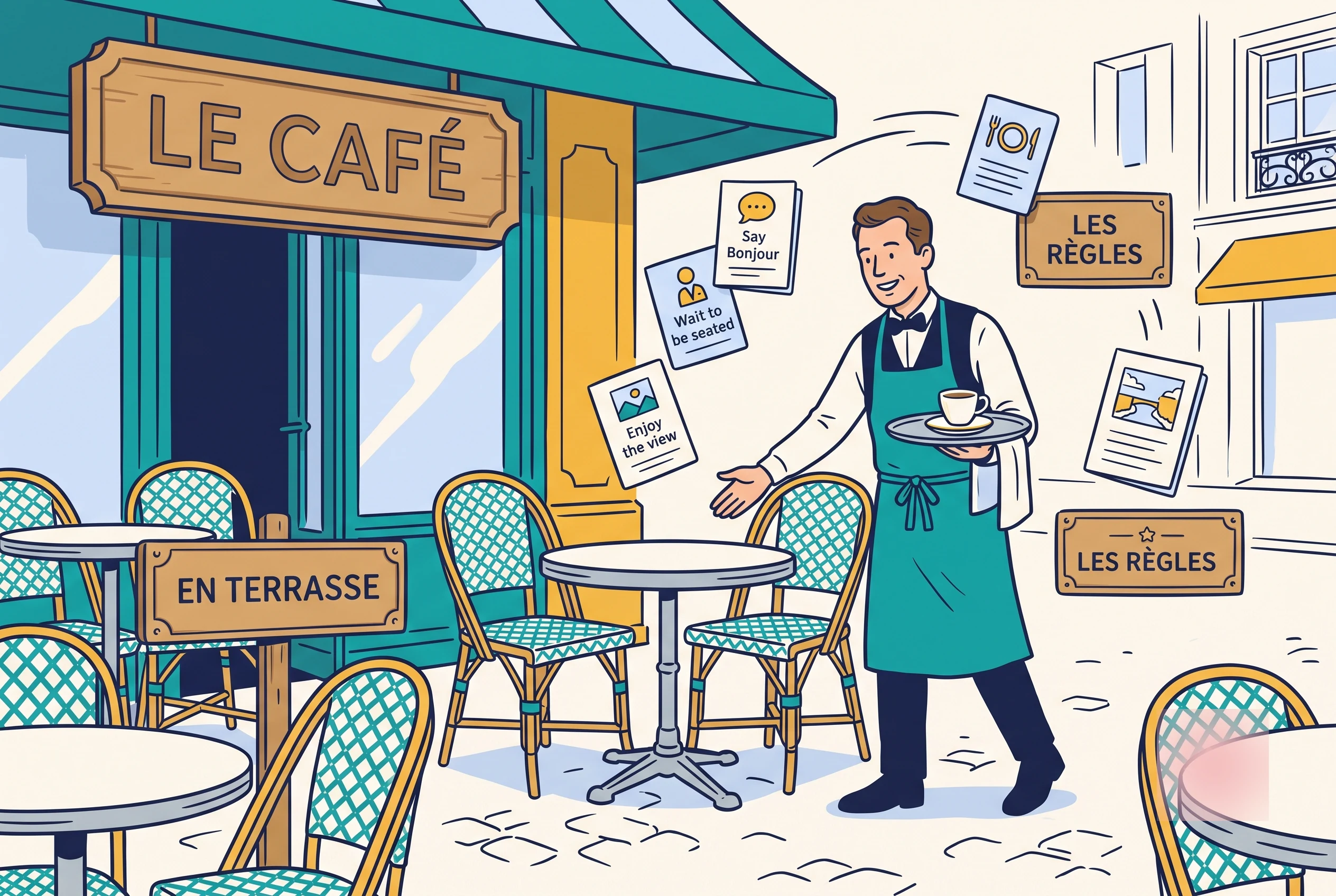
Café customs and prices vary by establishment and service area. Read the menu and use the phrases to ask what is available, place an order and request the bill rather than relying on one fixed rule.
The three-price system: comptoir, salle, terrasse
The same espresso costs ~1.50€ standing at the bar, ~2.50€ sitting inside, and ~4.50€ on the terrace. You are not paying for better coffee. You are paying for space, service, and the right to sit for as long as you want. That third price buys you the table until you decide to leave, which is what French cafés have sold for over a century.
Look for the price board labeled Tarifs or Nos Prix with three columns. Tourist-area cafés charge double. Neighbourhood cafés charge half. The coffee is identical. Restaurants and bakeries price by the same logic, and the Paris survival guide sorts it out before you order.
Why the café is not a coffee shop
American coffee culture optimizes for speed and turnover. French café culture optimizes for staying. You are not buying fuel. You are renting territory. The café is an extension of the living room, the office, the meeting point, and the social club. Sartre wrote Being and Nothingness at Café de Flore. Nobody asked him to order a second coffee.
Ordering etiquette: the greet-before-you-speak rule
Two customers ahead of you at the comptoir, both of them greeting the server before anything else. You reach the counter and lead with “un café”, and your accent is the least of what just went wrong. You will object that you added s’il vous plaît, and you did, at the end, once the server had already filed you. Order is the whole mechanism: our politeness page sets out the sequence Americans most often invert. “Bonjour” is not decoration on the request. It is the condition attached to it.
The politeness is carried by one verb form, “voudrais”, the conditional, which is what keeps the same order from landing as a demand:
“Un café” = espresso: a small black cup, never drip, never Americano. Ask for un café allongé (espresso plus hot water) or un café crème (with steamed milk) if you want volume; “a regular coffee” gets a blank look. So what do you order at five, between coffee and dinner? The bar takes over there, apéro and regional bottles included.
If the ordering moment makes you freeze, that is the same response described in the shy beginners guide. Pre-decide your phrase before you walk in. The 3-second rule: inhale, say bonjour, deliver the order. Done.
The phrases that get you served
You just learned the cafe ritual: greet first, then order. The words that follow work the same way at bakeries, shops, and counters across France, and our free sheet gives you 100 of them grouped by moment. Enter your email and the free 100 Survival Phrases sheet downloads right away.
What you must never do in a French café
These are not preferences. They are rules nobody writes down but everyone enforces through silent judgment. Break one and the server remembers. Break two and you become the anecdote they tell other servers.
- 1Never skip the greeting No bonjour, no respect. The interaction starts wrong and never recovers.
- 2Never snap fingers or wave aggressively Make eye contact, raise a hand slightly, or say “Excusez-moi” at moderate volume. That is it.
- 3Never ask for the bill prematurely Request “L’addition, s’il vous plaît” only when you are ready to leave. The sentence means you are going, and the server hears it that way whatever your reason for saying it.
- 4Never sit at an uncleared table A dirty table means unavailable. Wait for it to be cleared.
- 5Never bring outside food or drinks This causes genuine offense, even with water. Applies at every French establishment.
How do you leave a table where nobody will ever hint that your time is up?
The server is not rude. You did not say bonjour.
The server is not being cold. No check-ins every five minutes, no dessert pitch, no bill you did not ask for: what an American reads as neglect is, on this side, the polite refusal to intrude on your table. Americans find that distant. The French find American service intrusive. Both are right about the other, and the same reserve is what keeps strangers from smiling at you in the street.
The laptop question. Parisian cafés tolerate laptop workers less than American coffee shops. It is not forbidden, but it violates the spirit of the café as social space. If you must work: order regularly, avoid peak hours, choose larger cafés, and read the room.
The terrasse: why chairs face the street and not each other
The café terrasse is the most iconic image of Parisian life: wicker chairs, small round tables, people watching the city pass. The chairs face outward. That arrangement enables the essential Parisian activity: watching street life as entertainment. Sitting side by side observing the theatre of the city is a perfectly acceptable alternative to conversation.
This one comes at you rather than from you, and your answer sets the price before the coffee is poured.
Tap water is free by law in any French establishment. The jug still does not arrive unless somebody at the table asks:
It orders nothing, asks for nothing, settles nothing, and it is still the most French sentence at the table.
Tipping in French cafés
Service is included in every price by law (service compris); the server draws a full wage regardless. Tipping stays optional: round up, or leave 0.50 to 2€ in coins for a coffee. Percentage tips are not expected, and a large one can read as condescension rather than generosity. Sit down to a full meal and the sums change, which is a matter for the meal itself, from the booking call to the addition.
Budget hack. Take the morning espresso au comptoir, standing, elbow on the zinc: ~1.50€, two minutes, the ritual as locals actually perform it. Keep the terrasse for the afternoon, when sitting still is the entire point. Breakfast runs on the same split: a croissant is 1.20€ at the boulangerie counter, where the whole exchange takes thirty seconds, and 3.50€ once a waiter carries it to your table.
Study glossary: French café vocabulary
| 🇫🇷 French | 🇺🇸 English | 💡 Context |
|---|---|---|
| Un café | Espresso | Default. Not drip coffee. |
| Un café crème | Coffee with steamed milk | The “latte” equivalent |
| Un café allongé | Americano | Espresso + hot water |
| Un noisette | Espresso + drop of milk | Between espresso and crème |
| La terrasse / en salle / au comptoir | Terrace / inside / at the bar | Three price tiers |
| L’addition | The bill | Only comes when you ask |
| Le pourboire | Tip | Optional. Small coins on the saucer. |
| Service compris | Service included | By law in all French prices |
| Le serveur / la serveuse | Waiter / waitress | Not rude. Reserved. |
| Sur place / emporter | For here / takeaway | Determines which price column applies |
| Une carafe d’eau | Jug of tap water (free) | Your legal right. Ask without hesitation. |
| L’apéro | Pre-dinner drinks | The sacred 6-7pm ritual on the terrasse |
If the café code now makes sense but the broader social rhythm still feels opaque, the next step is usually the restaurant ordering guide (the full meal version of the same protocol), the bakery guide (the morning version), and the drinks guide for everything stronger than coffee.
The board is on the wall, Tarifs or Nos Prix, three columns, and no server will ever point at it. The coffee in all three is the same coffee. What changes is what you are buying: two minutes upright at the zinc, or a chair facing the street that nobody will ask you to give back.
Prefer to keep it free today? Read the French Briefing →
The French Gamebook
Practise the French behind everyday exchanges.
For English speakers practising French
Work on common mistakes before your next conversation. Play a Gamebook round, check the answers and try saying a few corrected sentences aloud.
- 21 lessons with explanations
- 40 practice rounds · 2,000 questions
300 pages · Play on your computer or print
Get the Gamebook · $9 Read a preview before you buyOne payment · Instant PDF download
Try the French with someone who can reply.
Bring a sentence you found difficult. Ask a tutor to help you say it naturally, then try it in a short conversation.
Find a French tutor →Paid lessons. Compare tutors and prices before booking.
Affiliate link: we may earn a commission when you book.
📚 Keep building in the Learning Center
French Travel Phrases for Hotels, Shops and Cafés
Practise French travel phrases for hotels, cafés, shops and transport. Learn follow-up replies and polite ways to ask…
Read →French Phone Call Phrases: Answer, Ask and Clarify
Prepare for French phone calls with phrases for answering, asking for repetition, leaving voicemail and ending a call,…
Read →Book a Restaurant in French: Phrases and Replies
Book a restaurant table in French, understand common replies and change a reservation. Practise phone, arrival and ordering…
Read →