
Updated on September 15, 2026
French Business Expressions: Meetings, Emails and Deadlines
Use French business expressions for meetings, emails, negotiations and deadlines. Compare register and meaning through translated examples.
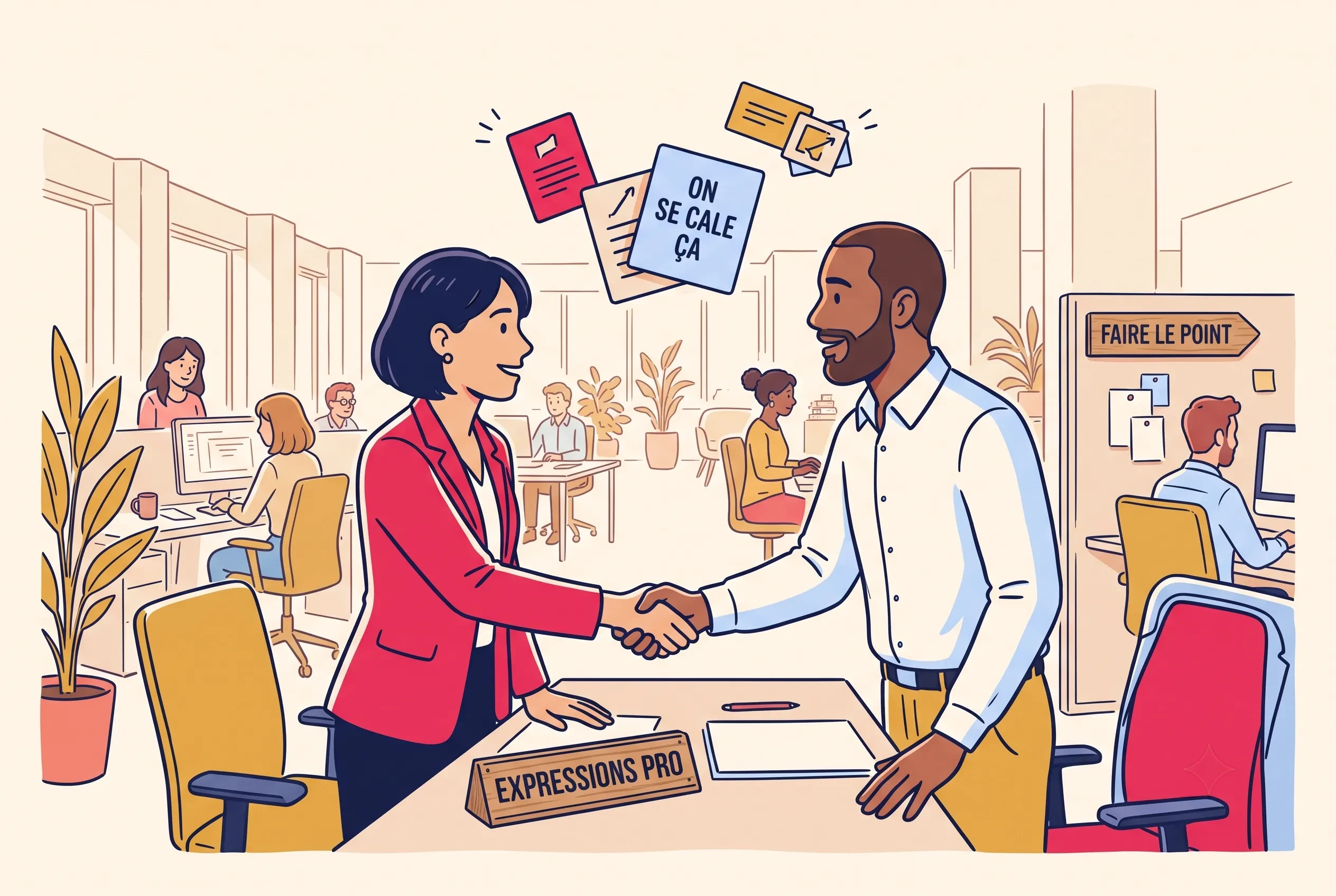
Business expressions are useful when you understand the action they imply. Work through meetings, requests and deadlines, checking the register before using an expression in an email or discussion.
French business language runs on hierarchy, precision, and the conditional tense
American business culture rewards directness. Say what you mean, get to the point, waste nobody’s time. French business culture rewards precision, hierarchy awareness, and the demonstration that you understand the protocol. These are not preferences. They are operating systems. Running American software on a French machine produces errors that look like competence gaps even when the underlying skill is strong.
The formality is structural: French corporate hierarchy is steeper than American hierarchy, and the language carries the difference. You do not email the CEO the way you email a colleague, or a client the way you address a teammate. English has those distinctions too, but as optional norms that younger companies happily ignore. In French business they are load-bearing walls, and removing them reads as broken rather than modern. One of those walls is too big for this page: the pronoun itself. Which pronoun you owe a person, and how the switch to tu actually gets authorized, is a social system with its own grey zones, so it lives elsewhere. What follows here is the vocabulary.
The conditional tense is the single most important grammatical structure in French business communication. “Pouvez-vous” (can you) is a question. “Pourriez-vous” (could you) is a professional request. The two-letter difference between present and conditional is the difference between a colleague and a subordinate issuing orders. Every request, every suggestion, every disagreement in professional French uses the conditional. Anglophones who skip it sound blunt in a culture that reads bluntness as aggression.
The register gap that damages careers
French professionals judge competence partly through language register. An executive who says “tu peux m’envoyer ça” in an email to a client has revealed more about their professional formation than any CV can hide. The correct version, “pourriez-vous me faire parvenir ce document,” signals mastery of the code. In French corporate culture, the code is the credibility. It does not stop at the mailbox: the greeting, the meeting, and who gets copied in.
Meeting expressions: where anglophones lose credibility fastest
Meeting vocabulary is the highest-stakes area because errors happen live, in front of colleagues, with no edit button. Using the wrong expression does not cause confusion. It causes the specific kind of silence where everyone in the room knows you got it wrong but nobody corrects you. That silence is the French professional equivalent of a red underline. The correction never comes verbally. It comes in how seriously your next proposal is taken.
Faire le point: the expression every anglophone mistranslates
“Faisons le point sur l’avancement du projet.” This means “let us review the status of the project.” It does not mean “let us make a point about the project.” The English cognate “point” pulls anglophones toward “make a point” (which is “souligner” or “insister sur” in French). “Faire le point” is a status review, a stock-taking, a moment to assess where things stand. It appears in every French meeting agenda. Getting it right signals that you have attended French meetings before. Getting it wrong signals that you have not.
Reporter: the false friend that creates scheduling chaos
“Nous devons reporter la réunion à jeudi.” This means “we need to postpone the meeting to Thursday.” Not “we need to report on the meeting.” The verb “reporter” in French means to postpone, to push back, to defer. “To report on” is “faire le compte rendu de.” Using “reporter” to mean “give a report” in a French meeting creates immediate scheduling confusion: you have just told the room the meeting is being moved, not that someone will summarize it. The compound error (wrong verb + wrong meaning) requires its own correction meeting to untangle.
Assurer le suivi: the professional alternative to Franglais
“Je vais assurer le suivi de ce dossier.” This means “I will follow up on this file.” Not “je vais faire un follow-up.” Franglais (French-English hybrid) is common in French tech companies but reads as amateur in traditional corporate, legal, financial, and government contexts. “Assurer le suivi” is the native French expression. Using it signals professional fluency. Using Franglais signals that you learned business French from English-language management books translated badly. In sectors where precision matters (law, finance, government), the distinction between native expression and Franglais calque is a credibility marker.
More meeting expressions that matter
A full table, the director still mid-sentence, and you have something worth adding.
French managers say it about the person who turns up with a solution attached to every problem:
English uses the borrowed word for the list of topics. French saved it for the pocket diary in your bag:
Email formulas: the written record you cannot take back
French professional emails are longer, more formal, and more structured than English ones. The opening is ceremonial. The closing is a full sentence. Between them, every request is wrapped in conditional politeness. Anglophones who write short, direct emails in French sound rude without knowing it. The email is a written record of your register competence, and unlike a spoken slip in a meeting, it can be forwarded, printed, and referenced months later.
The opening hierarchy
The way you open a French professional email signals everything about how you perceive the relationship. Get it wrong and the recipient reads the rest of your email through a filter of “this person does not know the code.”
| Context | French opening | English equivalent |
|---|---|---|
| Unknown recipient | Madame, Monsieur, | Dear Sir/Madam, |
| Known recipient, formal | Madame Dupont, / Monsieur Martin, | Dear Ms. Dupont, / Dear Mr. Martin, |
| Known colleague | Bonjour Madame Dupont, | Hello Ms. Dupont, |
| Close colleague | Bonjour Sophie, | Hi Sophie, |
| Never acceptable for first contact | Bonjour, / Salut, | Hey, / Hi there, |
The closing hierarchy
French email closings are the single biggest culture shock for anglophones. They are full sentences. They sound absurd translated literally. They are mandatory. Skipping them or abbreviating them reads as either ignorance or deliberate rudeness.
| Context | French closing | English equivalent |
|---|---|---|
| Maximum formality (unknown, senior) | Je vous prie d’agréer, Madame/Monsieur, l’expression de mes salutations distinguées. | Yours faithfully, |
| High formality (known, professional) | Veuillez agréer mes salutations distinguées. | Yours sincerely, |
| Standard professional | Cordialement, | Best regards, |
| Warm professional | Bien cordialement, | Kind regards, |
| Colleague you know well | Bonne journée, / Bien à vous, | Have a good day, / Best, |
Key email expressions
The first line of the body pins the reply to a dated message, so the thread can be filed and found later.
Ask it in the present tense instead and the same request lands as an order from someone with no standing to give one.
The “Bonjour” trap. “Bonjour” as an email opening is fine for colleagues you already know. For first contact it never is: “Madame, Monsieur,” is the default. Get that wrong on an application and you are gone before anyone opens the CV. If you are sending applications, that register runs all the way through: the questions you will get, the contract vocabulary, and the salary you are expected to name in brut annuel.
Negotiation and deadline expressions: precision French for professionals
You can read this as ceremony, and many anglophones do until a meeting goes cold. French negotiation runs on indirect suggestion: “we need this by Friday” lands as aggression, and the conditional does the softening. None of it is decoration. French politeness runs on respect, not friendliness, which is why the warmest American phrasing still reads as rude. The vocabulary below is the negotiation half.
Diplomatic disagreement
French professionals disagree by proposing an alternative. Direct contradiction is reserved for crises; indirection is the everyday protocol. The standard disagreement opener is “Je comprends votre point de vue, cependant…” (I understand your view, however…). What comes after it argues with the data, never with the person. This formula is so standard that skipping it reads as either aggression or ignorance of the code.
Which preposition tells a French colleague that Friday is the last acceptable day, not the day the work starts?
The verb for the moment a file has no owner yet and you want to be the one holding it:
CV and job interview expressions: the French HR register
French CVs and cover letters use a register that does not exist in American English. The cover letter (lettre de motivation) is a formal exercise in structured argumentation, not a casual pitch. The vocabulary signals whether you have operated in French professional environments or are translating from English.
Do not picture a cover letter with French words in it. The document underneath runs on a three-part argument:
Same HR vocabulary, one step further, and this one names something a French employee can actually claim.
The three false friends that cost meetings
“Actuellement” means currently, not actually. “Nous travaillons actuellement sur ce projet” = “we are currently working on this project.” “Éventuellement” means possibly, not eventually. “On pourrait éventuellement décaler la date” = “we could possibly change the date.” “Demander” means to ask, not to demand. “Je vous demande de bien vouloir confirmer” = “I am asking you to kindly confirm.” These three appear in every business conversation. Getting one wrong changes your commitment, your timeline, or your tone. The Google Translate fails guide shows why machines get them wrong too.
Register shortcut. Add “pourriez-vous” at the front of any informal request and “s’il vous plaît” at the end. “Tu peux m’envoyer ça ?” becomes “Pourriez-vous me faire parvenir ce document, s’il vous plaît ?” That leaves the harder case: a verb you suspect is too familiar, without proof. Where do you check register, when a bilingual list will not say? Ranked tools, and the lookup that answers in thirty seconds.
Print gives you the register with a pause button: Les Echos runs this exact vocabulary every morning, and reading it builds the passive recognition you need before a meeting. Interviews give you none of that. France Culture and France Inter at conversational speed is where the same phrases stop being vocabulary and become something somebody just said.
Complete glossary: French business expressions
| 🇫🇷 French | 🇺🇸 English | 💡 Context |
|---|---|---|
| Faire le point | Review status | Meetings, project updates |
| Reporter | Postpone (NOT report) | “Reporter la réunion à jeudi” |
| Assurer le suivi | Follow up | Project management, emails |
| Prendre la parole | Take the floor | Formal meetings |
| Rendre compte | Report to, be accountable | Hierarchy verb |
| Être force de proposition | Be proactive with ideas | CVs, performance reviews |
| Monter en compétence | Upskill | Performance reviews |
| Suite à | Following (email opener) | Professional email replies |
| Dans l’attente de | Awaiting | Email closing formula |
| Je me permets de | I take the liberty of | Cold outreach, first contact |
| Transmettre / faire parvenir | Forward / send (formal) | Professional documents |
| Accuser réception | Acknowledge receipt | Professional confirmation |
| Cordialement | Best regards | Standard closing (colleagues) |
| Terrain d’entente | Common ground | Negotiation |
| Feu vert | Green light | Approvals |
| Dans les meilleurs délais | ASAP (diplomatic) | Deadline requests |
| D’ici (vendredi) | By (Friday) | Deadline preposition |
| Revenir vers vous | Get back to you | Professional follow-up |
| Être en phase | Be aligned | Agreement in meetings |
| Prendre en charge | Take ownership of | Action/responsibility |
| Compte rendu | Meeting minutes/report | Post-meeting documentation |
| Ordre du jour | Agenda (NOT “agenda”) | Meeting programme |
| Cadre | Executive/manager (legal status) | NOT “framework” |
| Stage | Internship (NOT “stage”) | Professional training period |
| Polyvalent(e) | Versatile, multi-skilled | Job descriptions |
| Bilan de compétences | Skills assessment | Institutional French right |
| Lettre de motivation | Cover letter (formal) | Three-part argument format |
Business French is a register: the vocabulary is specific, the formality is structural, and the wrong choice gets paid for in how seriously your next proposal is taken. The method guide builds the system that develops this register. The think in French guide helps you stop translating business English into French and start producing business French directly.
The closing sentence on a first email to a senior stranger runs Je vous prie d’agréer, Madame, Monsieur, l’expression de mes salutations distinguées, and English gets the same job done with Yours faithfully. Send Cordialement instead and nothing is said, but the reply comes back pitched at the register you chose rather than the one you meant.
Prefer to keep it free today? Read the French Briefing →
The French Gamebook
Practise the basics behind clearer French.
For English speakers practising French
Review the common mistakes that can slip into your sentences. Use the Gamebook explanations and rounds alongside practice with your own emails and conversations.
- 21 lessons with explanations
- 40 practice rounds · 2,000 questions
300 pages · Play on your computer or print
Get the Gamebook · $9 Read a preview before you buyOne payment · Instant PDF download
Try the French with someone who can reply.
Bring a sentence you found difficult. Ask a tutor to help you say it naturally, then try it in a short conversation.
Find a French tutor →Paid lessons. Compare tutors and prices before booking.
Affiliate link: we may earn a commission when you book.
📚 Keep building in the Learning Center
Moving to France from the US: A Practical First-90-Days Plan
Your first 90 days in France involve overlapping tasks, from housing and banking to everyday conversations. Use this…
Read →French Health Insurance for Expats: The Vocabulary Behind the Paperwork
French health insurance arrangements for expats depend on status and circumstances. Distinguish eligibility, registration, evidence of cover and…
Read →Can Americans Retire in France? Eligibility Explained
Explore what Americans need to retire in France: residence status, resources, insurance and later requirements. Follow links to…
Read →