Updated on September 15, 2026
French Words with No Exact English Equivalent: 20 Examples
Explore 20 French words without a single exact English equivalent. Compare meanings, situations and translated examples to choose natural wording.
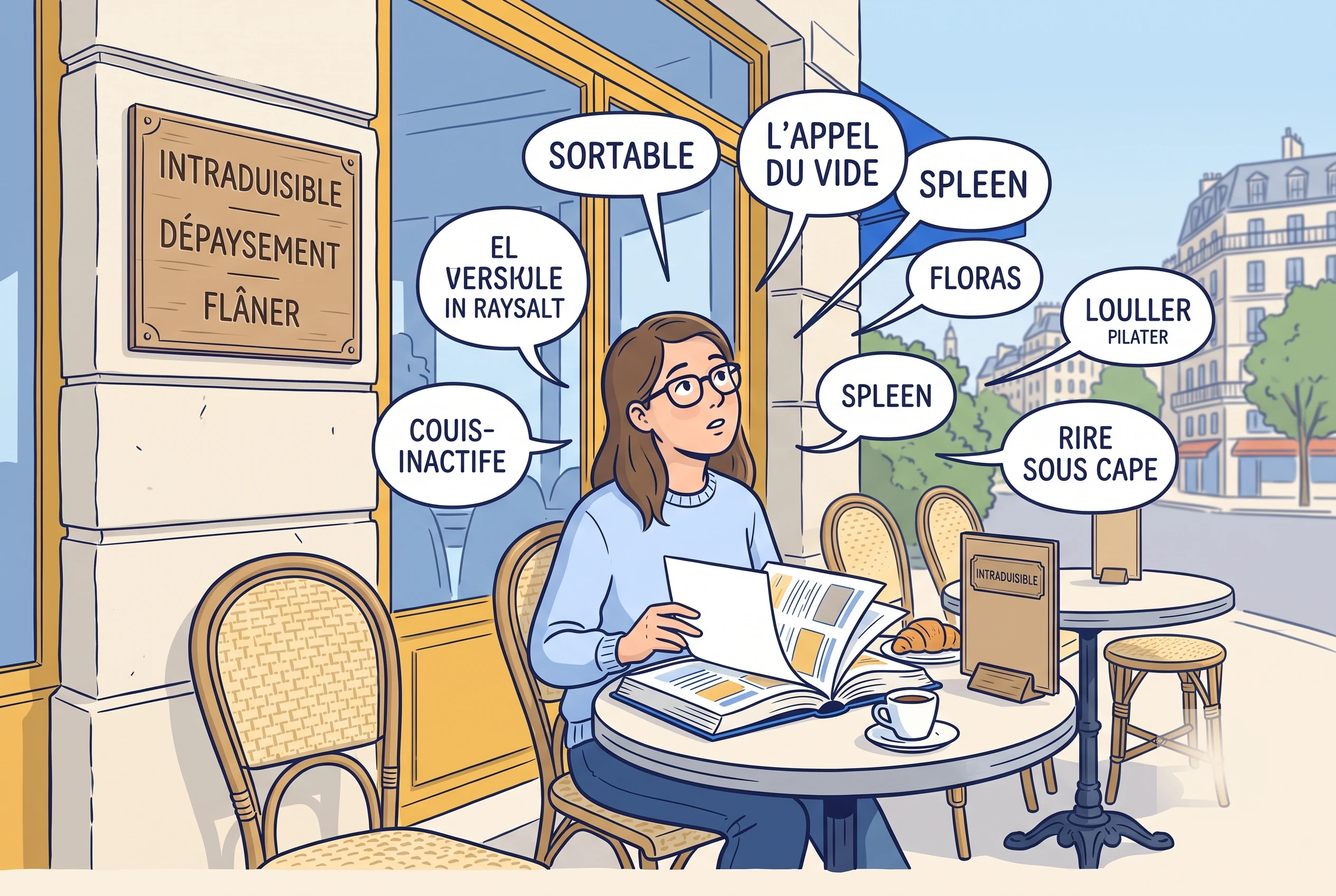
No exact one-word equivalent does not mean a word is impossible to translate. Read the situation as well as the definition, then compare how English can express the same idea with a phrase.
Some French words have no English equivalent, and that is not a translation problem. It is a cultural one. A language only builds a single word for something its speakers do often enough to need a shortcut. France named the pleasure of walking with no destination, the exact melancholy that arrives with no cause, and the polite non-excuse you give when you cancel a plan. English never did, because English-speaking cultures never organised daily life around those moments in quite the same way.
For a learner, these words are worth more than their frequency suggests. Each one is a small window into how French speakers actually think, and using one correctly signals that you understand the culture and not just the grammar. This guide breaks down twenty of the most useful untranslatable French words by theme: feelings, lifestyle, food and craft, and daily life. For each you get the pronunciation, a sentence you can reuse today, and the reason English left the gap open. After the list, we cover why these gaps exist, how to learn the words without translating in your head, and the mistakes to avoid.
Feeling and experience: French words English cannot capture
These words describe internal states that English breaks into multiple phrases. French packs them into one. That is not efficiency, it is a different way of seeing the world, and it pays once you stop running every French word back through English before you use it. Translate “dépaysement” and you have lost what made it useful. The word list is the easy half of this page; the habit is the rest.
The strange part is that nobody wants it cured, which is what separates it from every clinical word English offers.
Why English does not have these words
Language reflects what a culture needs to name. French developed “flâner” because Paris built wide boulevards and café terrasses for aimless observation. English-speaking cities built for commerce, not contemplation. No practice, no word. The terrasses are still there, and the chairs still face the street instead of each other, which tells you what the seat is for.
Lifestyle and social concepts: the words you will use most
This is the group to learn first. These words describe how French culture approaches pleasure, leisure, and living well, and they turn up in conversation far more often than the poetic ones. Master them and you sound less like a textbook and more like someone who actually lives here.
That was the kind of person. This is what that person is doing with an afternoon:
Food, place, and craft: the words English already stole
English speakers already use some of these without knowing they are untranslatable. “Terroir” appears on wine labels. “Savoir-faire” appears in business contexts. The words exist in English precisely because English could not create its own version.
One syllable does the work of a place, an owner, and the relationship between you and them:
Communication and daily life: the gaps you discover in France
These are the small, practical words that quietly go missing the moment you try to speak French in France. None of them are literary. All of them save you a clumsy paraphrase several times a week, from cancelling a plan to admitting you cannot be bothered.
Cancel in English and you owe a reason. Cancel in French with this word and the subject closes itself.
Practice method. For each word, learn one sentence you would actually say. “J’ai la flemme.” “On se retrouve chez moi.” “Profitez-en !” Sentences beat definitions. The shy beginners guide helps if producing these out loud feels intimidating.
The real lesson behind untranslatable words
Every untranslatable word is a permission slip to stop translating. The moment you accept that “dépaysement” is dépaysement and not “culture shock,” you have made the cognitive shift that separates A2 from B1. It sounds like a decision you can make, and it is not: it holds only on top of a four-part daily system, and if you check the words that look translatable and are not first.
Why some French words refuse to translate
Translation is easy when two languages point at the same thing and only argue about the label. “Chien” is “dog.” The trouble starts when the concept itself lives in one culture and not the other. Linguists call this a lexical gap, and between French and English there are dozens of them. The word is missing in English because the need was missing first. Three patterns explain almost every untranslatable French word you will meet.
The culture built a habit English speakers never did
“Flâner” is the clearest case. Paris spent the nineteenth century building wide boulevards, covered arcades, and café terraces designed for exactly one activity: watching the city go by with nowhere to be. A culture that does that every weekend eventually needs a verb for it. English-speaking cities grew around commerce and the commute, so English kept “stroll,” “wander,” and “loiter,” none of which carry the deliberate, unhurried pleasure that “flâner” takes for granted. No habit, no word.
French draws a line where English leaves a blur
English is comfortable letting one word cover a range. French often insists on splitting it. “Reunion” names an event; “retrouvailles” names the specific feeling of seeing someone again after a long absence, and it only ever appears in the plural. “Gourmand” and “gourmet” are two different relationships with food, and folding them into “foodie” erases a distinction French speakers hear instantly. Where English rounds off, French keeps the sharp edge.
French folds a whole situation into one word
Some French words are not really words, they are folded-up social contracts. “Empêchement” tells the other person that something came up, that it is legitimate, and that you are not obliged to say what it was, all at once. “Chez” packs a location, a possession, and a relationship into a single syllable: “chez moi,” “chez le médecin,” “chez Renault.” English has to unfold each of these into a full phrase, which is exactly why they feel so efficient once they are yours.
How to use these words without translating in your head
The slow way to learn an untranslatable word is to memorise its English approximation and then hunt for the French version whenever the approximation pops up. That keeps English in the driver’s seat, and the French word always arrives a beat too late. The words on this page are worth learning the other way round: from the situation straight to the French.
Tie the word to a moment, not a definition
“J’ai la flemme” is not “I can’t be bothered” filed away in a list. It is the thing you say, out loud, on a grey Sunday when the idea of going out collapses. Attach the word to that moment and it will surface on its own the next time the moment returns. Definitions live in the part of your memory you have to search. Situations live in the part that fires automatically. A French-only dictionary helps here for the same reason, and our guide to the best French dictionaries online covers when to make that switch.
Match the register before you use it
Most of these words are casual. “Ras-le-bol,” “flemme,” “craquer,” and “yaourter” belong in conversation with friends, not in a cover letter or a first meeting with your landlord. “Savoir-faire,” “terroir,” and “douceur de vivre” go the other way and can sound pretentious dropped into small talk. Learning the word is half the job. Learning where it belongs is the other half.
Three mistakes English speakers make with these words
Untranslatable words are satisfying to learn, which is exactly why learners overreach with them. A few predictable traps:
Reaching for the fancy ones too early
“Douceur de vivre” and “joie de vivre” are lovely and very easy to overuse. Sprinkled into every third sentence, they stop sounding French and start sounding like a tourism brochure. Native speakers use them rarely and on purpose. So should you.
Translating them back out loud
The whole point of “dépaysement” is that it does not reduce to “culture shock.” If you explain the French word in English every time you use it, you never let it stand on its own, and you stay stuck at the stage where French is a decoding exercise. Say the word, let it mean what it means, and keep going.
Assuming an English loanword still means what English thinks
English borrowed “terroir” and “savoir-faire,” then quietly narrowed both. In marketing English, “terroir” often just means “region.” In real French it carries soil, climate, tradition, and human knowledge together. When you use the word in France, reach for the full French sense, not the thinner English copy.
Complete list: French words that do not translate
| 🇫🇷 French | 🤖 Approximation | 🎯 Why it fails |
|---|---|---|
| Dépaysement | Disorientation abroad | Includes excitement, not just confusion |
| Retrouvailles | Joyful reunion | The emotion, not the event |
| L’esprit de l’escalier | Staircase wit | Comeback after the conversation ends |
| Spleen | Vague melancholy | Romantic, almost pleasurable |
| Ras-le-bol | Fed up | Explosive, not mild |
| Coup de foudre | Love at first sight | Applies to places and objects too |
| Flâner | Aimless strolling | Walking with purpose defeats it |
| Joie de vivre | Zest for life | Active enthusiasm, not passive |
| Bon vivant | Epicurean | No negative connotation |
| Profiter | Enjoy fully | Active command, not passive state |
| Douceur de vivre | Sweetness of living | A feeling, not a metric |
| Sortable | Presentable | One adjective, one social judgment |
| Terroir | Sense of place | Soil + climate + tradition + taste |
| Savoir-faire | Know-how | Includes elegance, not just competence |
| Bricolage | DIY | DIY follows instructions, bricolage improvises |
| Chez | At someone’s place | Location + possession + relationship in 2 letters |
| Flemme | Can’t be bothered | Situational, not a character trait |
| Craquer | Give in / fall for | Three meanings, one word |
| Empêchement | Unforeseen obstacle | Legitimacy without justification |
| Yaourter | Fake-sing lyrics | Universal action, only French named it |
Astérix loses its puns in English, Brel loses his syllable count. Comics ranked for beginners and twelve artists ranked by difficulty are two doors into that gap. Neither feels like homework.
French untranslatable words: your questions
What is the most famous untranslatable French word?
“Dépaysement” is the one most often cited: the mix of disorientation and quiet excitement you feel somewhere unfamiliar. “Flâner” and “terroir” are close behind. All three come up constantly in articles about untranslatable words because each names an experience English speakers clearly have but never labelled.
Is “flâner” really untranslatable?
You can approximate it with “to stroll,” but the approximation misses the point. “Stroll” is just a slow walk. “Flâner” is a deliberate refusal to have a destination, a small act of resistance against efficiency. The activity is cultural, which is why the one-word version only exists in French.
Why does English use French words like terroir and savoir-faire?
Because it had no home-grown equivalent and needed one. When a concept matters and the local language has no single word for it, borrowing beats inventing. English narrowed both words as it adopted them, so the French originals still carry more meaning than the English versions do.
How many French words have no English equivalent?
There is no fixed number, because “no equivalent” is a spectrum rather than a yes-or-no. This guide covers twenty of the most useful in everyday life. Push into food, law, and regional dialects and the list runs into the hundreds.
How should a beginner learn untranslatable words?
Learn one full sentence per word instead of the definition, and tie it to a real situation you will meet: “J’ai la flemme,” “on se retrouve chez moi,” “profitez-en.” Say them out loud until they arrive before the English does, and start with the casual ones you will actually use.
Are these words used in everyday French?
Most of them, yes. “Chez,” “profiter,” “flemme,” “craquer,” and “empêchement” appear in ordinary conversation every day. A few, like “spleen” or “douceur de vivre,” are more literary and used sparingly. The guide flags which is which.
Prefer to keep it free today? Read the French Briefing →
The French Gamebook
Catch the French mistakes you keep making.
For English speakers practising French
Work through a short lesson, choose your answers and check the explanations. Use a practice round to see which basics need another try.
- 21 lessons with explanations
- 40 practice rounds · 2,000 questions
300 pages · Play on your computer or print
Get the Gamebook · $9 Read a preview before you buyOne payment · Instant PDF download
Try the French with someone who can reply.
Bring a sentence you found difficult. Ask a tutor to help you say it naturally, then try it in a short conversation.
Find a French tutor →Paid lessons. Compare tutors and prices before booking.
Affiliate link: we may earn a commission when you book.
📚 Keep building in the Learning Center
French Reflexive Verbs: Daily Routine and Word Order
Build a daily routine in French with reflexive pronouns, negatives and infinitives. Compare translated examples, listen and practise.
Read →Futur Proche vs Futur Simple: Examples and Practice
Compare futur proche and futur simple in French plans, promises and announcements. Learn the forms and practise choosing…
Read →Agree and Disagree in French: D’accord and Alternatives
Compare ways to agree and disagree in French, and understand why être d’accord differs from English agree. Read…
Read →