Updated on September 15, 2026
Learn French as a Couple: Activities and Study Habits
Build a French study routine with your partner. Compare shared activities, different learning speeds and ways to give useful feedback.
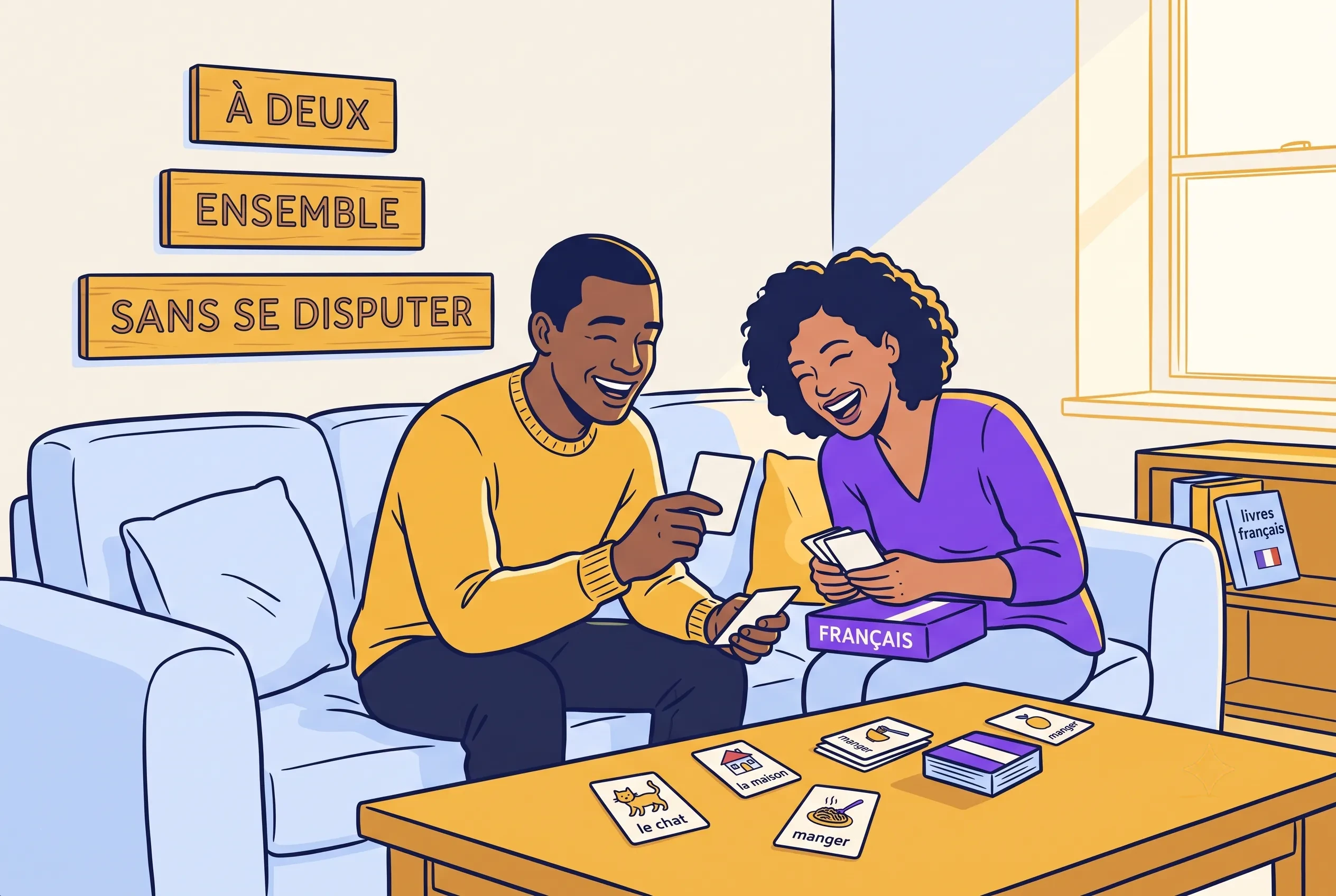
Partners do not need to progress at the same speed to practise together. Choose activities with a shared purpose, agree how to correct each other and leave room for individual study alongside the joint routine.
What actually gets tense when couples learn French together
Most guides treat learning French as the challenge and the relationship as a pleasant extra. That is backwards. The French is often manageable. The couple dynamic is what becomes unstable first. One partner corrects too much. One partner hears every correction as criticism. One works ahead in secret and comes back stronger. The other starts feeling measured even when nobody says anything obvious.
The actual problem is rarely “French is hard”
Main issue: language learning magnifies existing couple patterns fast: competition, sensitivity to criticism, unequal effort, different tolerance for mistakes.
Practical result: if you do not set rules early, French stops feeling romantic and starts feeling like admin with feelings attached.
The four rules couples need before they “study together”
Treat these as rules. Without them, the same pattern repeats: enthusiasm, mismatch, correction, defensiveness, avoidance, quiet resentment.
Rule one: do not correct your partner unless they explicitly ask
This rule alone prevents a surprising amount of damage. People think correction is help. In a relationship, unsolicited correction often feels like ranking, not support.
Rule two: assume different speeds permanently
One person will move faster. Always. Maybe because of previous language study. Maybe because of confidence. Maybe because one of you quietly practices on the commute. If you treat speed difference as a temporary glitch to “fix,” you create tension. If you treat it as normal, you build around it.
Rule three: separate solo study from couple practice
Solo study is where each partner works at their level, with their own pace, without performing. Couple practice is where you do activities that are safe for both of you. When people merge these two things, they create a tiny classroom inside the relationship.
Rule four: never measure progress against each other
That includes the joke version and the disguised version, the “You still do not know that one?” delivered with a smile. Progress comparison is acid in this context. Track personal progress only.
What the faster learner should do (and not do)
If you are the stronger learner, you are in the more dangerous position. Not because you are wrong for progressing. Because you have more power to make the dynamic unpleasant without meaning to.
What feels helpful
Explaining grammar, correcting pronunciation, finishing sentences, jumping in when your partner struggles.
What usually lands better
Modeling French naturally, staying quiet unless asked, taking the harder task without showing off, protecting your partner from comparison pressure.
If what you really need is more input and momentum than the couple can sustain together, do your serious progression in solo time. That is exactly why a smaller structured French routine that survives real schedules works better than trying to force every useful minute into couple time.
What the slower learner should do
The slower learner often internalizes the difference too fast. Then every French interaction becomes evidence that they are disappointing, holding the other person back, or not trying hard enough. That interpretation is usually false and still emotionally powerful.
The slower learner usually benefits more from structured safe situations than from abstract conversation practice. That is why speaking strategies built for anxious beginners are surprisingly relevant inside couple learning too. The same applies when you are stuck translating instead of thinking in French.
The best French activities for couples
Good couple activities let both people contribute at different strengths without making the difference the point of the moment.
French restaurant challenge
Order the meal in French, ask one question, request the bill, leave alive. That is enough. Decide roles before entering: who handles greeting, who orders, who asks the harder follow-up.
French movie night with a task
Do not “just watch a French film together” and call it study. Give each person a task: one tracks repeated expressions, one notices question forms, one follows the plot. Talk about it afterwards. Shared attention, no classroom. The pick matters more than the task: a C1 political thriller with an A2 partner in the room is how movie night becomes the thing nobody suggests again, so choose from the series ranked by listening difficulty. Netflix is not the whole map. Thirty free French channels stream from anywhere, no subscription and no algorithm deciding for you.
Planning a trip together in French
Hotels, neighborhoods, reservations, transport, cafés, museum hours. Real language, real task, real payoff. The train ticket vocabulary and restaurant booking phrases are exactly the kind of shared couple tasks where both people contribute without one dominating. Overlaps naturally with beginner travel phrases for Paris and everyday situations.
Cooking from a French recipe together
Strong because the outcome is not linguistic purity. The outcome is dinner. The French cheese culture guide doubles as couple material because cheese boards are social, low-pressure, and generate vocabulary arguments that are actually fun.
The French politeness rules guide is also surprisingly good couple material. Politeness mistakes are usually the first thing a partner notices and corrects, so understanding the real rules prevents arguments before they start.
One card for the restaurant, the street, and the shop
You just went through the couple activities where real French happens: ordering, asking for the bill, booking a table, asking for help. The free 100 Survival Phrases sheet gathers those situational lines in one place, so either partner can find the one they need before walking in. Enter your email and the free 100 Survival Phrases sheet downloads right away.
The four fights that destroy most couple language projects
“You are not taking this seriously”
Usually not about French. One partner wants fluency. The other wanted a shared project and some travel French. Those are not the same goal. Name the mismatch explicitly. Scale the shared part to what both people actually want.
“Stop correcting me”
If your partner did not ask, do not correct. If you already broke that rule repeatedly, say so plainly and stop doing it.
“You make me look stupid in front of French people”
Happens in restaurants, shops, or travel when the stronger learner takes over too early. Fix: decide roles before entering the interaction.
“I feel stupid compared to you”
The most dangerous one because it often stays unspoken. If you are the stronger learner, the move is not reassurance alone. It is redesign. Fewer direct comparisons. More separate study. More shared tasks where difference matters less.
Relationship-first rule. If a French activity reliably creates tension, change the activity. Do not defend the activity just because it seems educational. Your relationship is not the tuition fee for better grammar.
Romantic and practical French couples can use right away
Romantic French
None of these will raise anyone’s level, and they are the ones that get remembered anyway.
Practical couple French
The four lines a couple needs on the same afternoon, in a restaurant, a street, and a shop:
Study glossary: couple French worth remembering
| 🇫🇷 French | 🇺🇸 English | 💡 When to use it |
|---|---|---|
| Mon amour / mon coeur | My love / my heart | Terms of endearment |
| On apprend ensemble | We are learning together | Shared project framing |
| Je vais à mon rythme | I’m going at my own pace | Healthy learning boundary |
| Tu veux que je te laisse essayer ? | Do you want me to let you try? | Respectful support from stronger learner |
| Tu veux que je te corrige ? | Do you want me to correct you? | Consent before correction |
| On a une réservation | We have a reservation | Restaurant, hotel, museum |
| Pour nous deux | For both of us | Shared order or request |
| On cherche… | We are looking for… | Travel and practical situations |
| Aidez-nous, s’il vous plaît | Help us, please | When the interaction starts collapsing |
| On peut commander ? | Can we order? | Shared restaurant interaction |
| On peut avoir l’addition ? | Can we have the bill? | End of restaurant interaction |
| Je préfère pratiquer des choses simples | I prefer to practice simple things | Protecting the slower learner |
Best weekly structure for couples. Solo study during the week. One shared French activity on the weekend. No corrections unless asked. No level comparisons at all. That structure works better than trying to be each other’s language coach every day.
Prefer to keep it free today? Read the French Briefing →
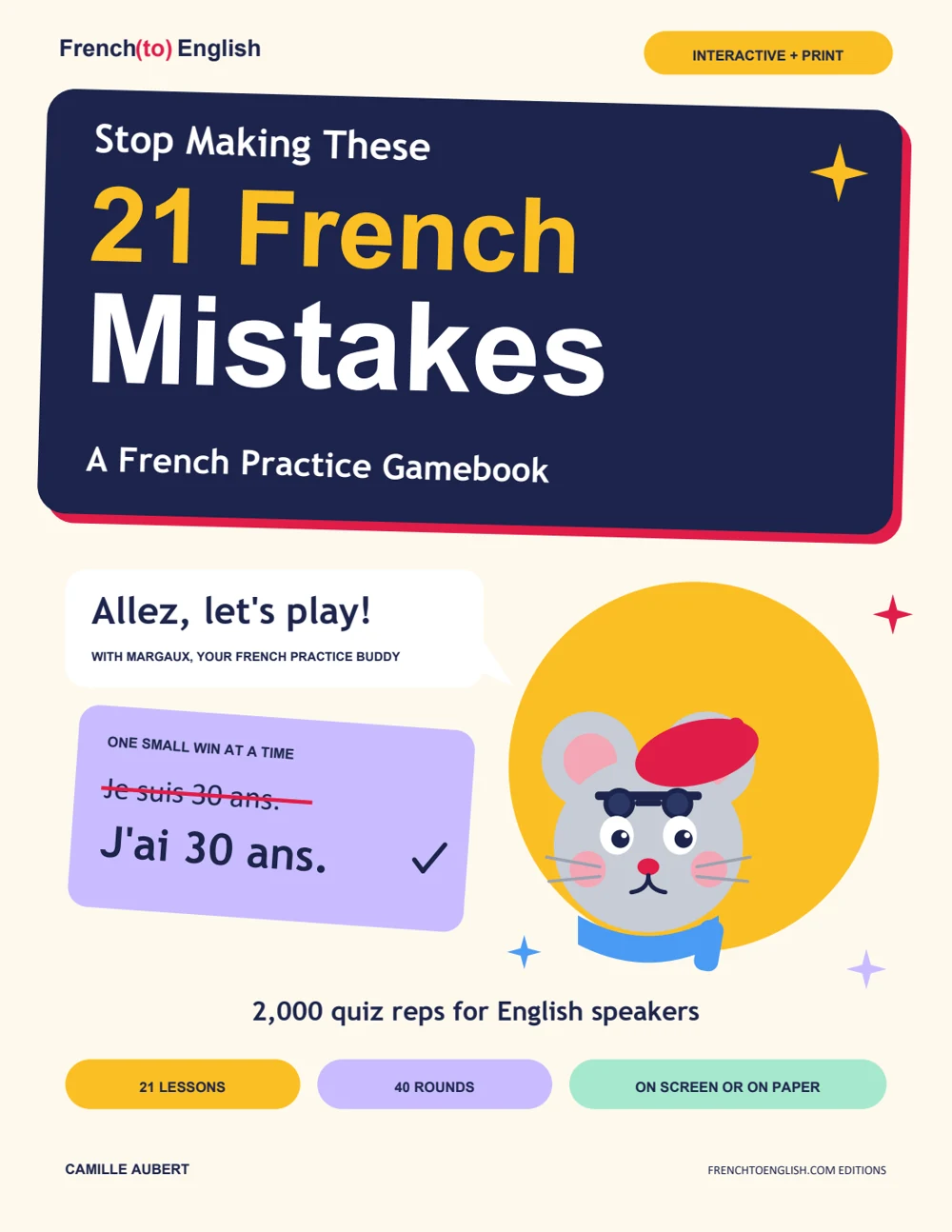
The French Gamebook
Check the small slips in otherwise good French.
For English speakers practising French
Use the Gamebook to revisit common mistakes, spot a gap and practise the point again. A review of the fundamentals to sit alongside your advanced reading and conversation.
- 21 lessons with explanations
- 40 practice rounds · 2,000 questions
300 pages · Play on your computer or print
Get the Gamebook · $9 Read a preview before you buyOne payment · Instant PDF download
Try the French with someone who can reply.
Bring a sentence you found difficult. Ask a tutor to help you say it naturally, then try it in a short conversation.
Find a French tutor →Paid lessons. Compare tutors and prices before booking.
Affiliate link: we may earn a commission when you book.
📚 Keep building in the Learning Center
French Learning Games for Adults: Pick a Format That Fits Your Life
French games for adults work best when the task feels useful and everyone can participate. Plan cooperative or…
Read →Learn French with a Game: Turn One Round into a Useful Study Session
To learn French with a game, choose one small language goal and make the rules serve it. Build…
Read →French Books for A1, A2 and B1: A Minimal Study Setup
Choose a small set of French study books for your level. Compare textbooks, readers and reference tools, and…
Read →