
Updated on September 15, 2026
French Administrative Vocabulary: Forms and Appointments
Understand French administrative vocabulary for dossiers, online applications, appointments and follow-ups. Read examples with English translations.
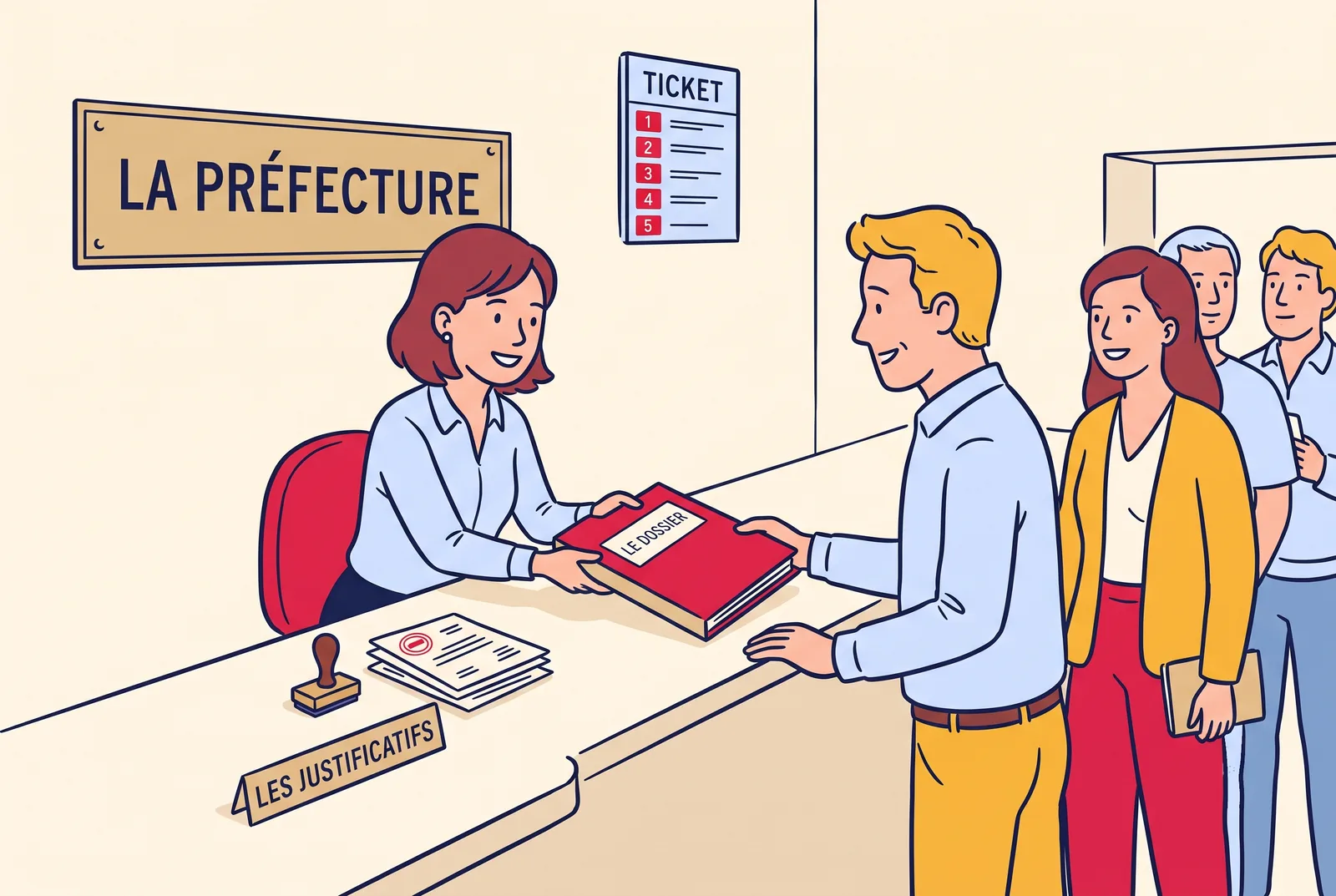
Administrative words describe both the documents you submit and the stage your application has reached. Follow the process from preparing a dossier to requesting an update, keeping copies and receipts as evidence of your steps.
The préfecture is not hostile. It is a filing system.
Every English speaker who has queued at a French administrative counter arrives with the same theory: someone in there has decided to make this difficult. It is a comforting theory. It is also wrong, and holding onto it will cost you months.
French administration does not process people. It processes files. The word that matters is dossier, and it is not a synonym for "paperwork". A dossier is a bounded object with a reference number, a state, and a list of required contents. When an agent looks at you and says the sentence below, they are not refusing you. They are telling you the object is incomplete.
🇺🇸 Your file is incomplete.
The distinction sounds academic until you notice what it changes. If the system were judging you, the correct response would be to explain your situation, your good faith, your circumstances. Americans and Britons do this constantly, at length, and it achieves nothing. If the system is filing an object, the correct response is to ask which item is missing and in what form. Those are different conversations, and only one of them ends with a stamp.
So the first vocabulary you need is not a word at all but a habit: asking a closed question instead of telling a story.
🇺🇸 Which document exactly is missing?
The shift that saves you a season
Stop asking why. Start asking which and in what form. French administrative agents almost always know the answer to the second question and almost never have authority to act on the first.
The vocabulary of the dossier
Six words carry most of the weight. Learn these and roughly eighty percent of any French administrative form becomes readable, whether you are at the préfecture, opening a bank account, or assembling a rental application.
Pièce justificative is the master term. It means a document that proves a claim. Not "supporting document" in the loose English sense of something helpful, but proof of one specific assertion. Every line of a French form maps to a pièce justificative, and the form tells you which.
🇺🇸 Please attach the requested supporting documents.
Justificatif de domicile is proof of address, and it is the one that ambushes people. It must usually be under three months old and in your name. A bank statement works. A phone bill works, which is one of several reasons the French SIM card and phone contract is worth sorting out in your first fortnight. A lease works. A letter from your employer does not, and neither does anything printed from an account someone else pays for.
Attestation means a formal written statement issued by someone with standing to issue it. An attestation is not a letter. It has a fixed shape and it is signed by an institution, an employer, or by you under the phrase sur l'honneur, which makes it a sworn declaration with legal weight.
🇺🇸 I, the undersigned, declare on my honour that the information is accurate.
That formula, je soussigné, appears on thousands of French documents and nowhere in ordinary speech. You will never say it out loud. You will write it a dozen times.
Then three words about the physical state of a document. Original means the original. Copie means a copy. Recto-verso means both sides, and a scan of only the front of your passport page or your carte de séjour will be rejected without comment, silently, weeks later. That is not pedantry from the agent. The instruction was on the form.
| French | What it actually demands | Where it bites |
|---|---|---|
| Pièce justificative | Proof of one specific claim | Generic documents get refused |
| Justificatif de domicile | Address proof, under 3 months, your name | Bills in a partner's name |
| Attestation sur l'honneur | Sworn statement, fixed formula | Writing a friendly letter instead |
| Original / copie | Literally which one | Bringing copies to an appointment |
| Recto-verso | Both sides, one file | Scanning only the front |
| Traduction assermentée | Sworn translator, from an official list | Using a translation agency |
The last one deserves a warning. A traduction assermentée is a translation by a translator registered with a French court of appeal. Your excellent bilingual colleague cannot produce one. Neither can a commercial translation service unless the individual translator is on the list. Birth certificates and marriage certificates almost always need one.
The words that only appear when you apply online
Since 2022, most residence permit procedures run through a portal called ANEF, the Administration Numérique pour les Étrangers en France. This changed the vocabulary in a way that catches out people who prepared using older guides, and it produces the single most common panic among foreign residents: your card expires, and nothing physical has arrived.
Here is what the portal issues, in order, and what each document actually permits.
-
1Attestation de dépôtConfirmation that your application was filed. It proves you applied. It is not a residence document and it does not, on its own, keep you legal.
-
2Attestation de prolongation d'instructionIssued when your permit or visa is about to expire while the file is still being examined. This is the one that keeps you legal. It is only valid alongside your expired document, and it is renewed until a decision is made. If your previous permit allowed you to work, that right continues during its validity.
-
3Attestation de décision favorableIssued once the préfecture has decided in your favour and the physical card is being produced. It covers you while you wait, authorises work if your permit does, and allows you to cross Schengen borders. Again, only valid with your visa or previous permit.
-
4Titre de séjourThe card itself, collected in person.
Notice the pattern. Three of those four documents are worthless on their own and become valid only when presented with an expired card. Foreign residents throw away the old permit the moment the new attestation arrives, which is the most expensive tidying-up decision available in France.
🇺🇸 This attestation is only valid together with your expired permit.
One more piece of timing. For many permits handled through ANEF, the renewal window opens four months before expiry and closes two months before it. Early is not rewarded and late is penalised. If you are still working out which procedures apply to you at all, the visa and residence sequence for arrivals from the United States lays out the order of the gates.
The language of waiting, requesting, and following up
Most of the time you spend inside French bureaucracy is spent waiting, and the waiting has its own register. It is polite, impersonal, and unmistakably formal. Getting it right is the difference between a reply and silence.
The state of your file is described with a small set of phrases. En cours d'instruction means it is being examined. It is the answer you will receive most often and it contains no information about when. En cours de traitement is the softer, more administrative cousin used by banks and utilities.
🇺🇸 Your application is being examined.
When you chase, the verb is relancer, and the noun une relance. This is a normal, expected, non-aggressive act in French administrative culture. English speakers hesitate to chase because chasing feels rude. It is not rude here. It is procedure, and a file that is never chased can sit still for a very long time.
🇺🇸 I am following up on my application submitted on 12 March.
That opening, je me permets de, is the workhorse of French administrative correspondence. It translates roughly as "I am taking the liberty of", and it lets you make a demand while performing deference. Use it and you sound like someone who has done this before.
Two closing formulas do almost all the remaining work. Dans l'attente de votre retour is the standard sign-off before the politeness formula. And the politeness formula itself is fixed, long, and non-negotiable.
🇺🇸 Looking forward to your reply, yours faithfully.
The French runs four times longer than the English, and shortening it is not an option. A French administrative email that ends with Cordialement to an institution you have never dealt with reads as slightly abrupt, and one that ends with Merci alone reads as foreign. The same instinct governs spoken exchanges, which the guide to French politeness rules Americans misunderstand covers in the social register rather than the written one.
One term protects you more than any other: accusé de réception, an acknowledgement of receipt. Ask for it, keep it, quote its number. A registered letter with acknowledgement, lettre recommandée avec accusé de réception, abbreviated LRAR, is the instrument of last resort and it works. It converts an unanswered request into a dated fact.
"J'ai déposé mon dossier il y a quatre mois." "Vous avez l'accusé de réception ?" "Non." "Alors pour nous, vous ne l'avez pas déposé."
That exchange is the system stating its own rule out loud: what is not documented did not happen.
Numbers are where it actually goes wrong
Vocabulary errors get corrected. Number errors get your file rejected, and they are the most common failure among otherwise competent French speakers.
Dates are written day, month, year. 04/09/2026 is 4 September, not 9 April. On forms this is rarely ambiguous because the boxes are labelled, but in emails and in speech it is a genuine trap, and a wrong date of entry into France on a residence application is not a typo you can casually correct later.
Decimals use a comma and thousands use a space or a full stop. 1 250,50 € is one thousand two hundred fifty euros and fifty cents. The euro sign goes after the number, with a space.
Then the two words that decide whether you have understood a French salary or a French bill at all: brut and net. Gross and net. French job offers and payslips quote brut by default; what lands in your account is net, and the gap is large. The same logic runs through French job interviews and salary conversations, where quoting the wrong figure marks you immediately as new.
🇺🇸 Is the amount shown gross or net?
Finally, your identifiers. A numéro de dossier is your file reference. A numéro étranger, sometimes called the AGDREF number, identifies you across residence procedures. Your numéro de sécurité sociale is thirteen digits plus a two digit key and encodes your sex, birth year, birth month and birth department. Quote the right number and the conversation starts. Quote none and it does not start at all.
Say the number first
Open every phone call and every email with your file reference, before your name and before your problem. It is the only thing that lets the person on the other end see what you see.
At the counter and on the phone
Written French administration is formal and predictable. Spoken French administration is faster and considerably less patient, and this is where preparation collapses. A useful trick: the counter exchange has maybe eight moves, and you can rehearse all of them.
🇺🇸 Hello, I am here about renewing my residence permit.
🇺🇸 I have an appointment at 2pm under the name Miller.
🇺🇸 Could you repeat that more slowly, please?
That third one is the single most useful sentence in this article, and the people who refuse to say it are the people who leave with the wrong information. Nobody at a French counter thinks less of you for asking. They think considerably less of you for nodding at something you did not understand and coming back next month with the wrong document.
By phone it is harder, because you lose the gestures and the counter agent's screen. If institutional phone calls are the part that genuinely frightens you, and for most people they are, the guide to surviving your first French phone call handles the mechanics separately.
What about the moment you are refused outright? You ask for it in writing.
🇺🇸 Could you confirm that in writing, please?
A verbal refusal cannot be appealed. A written one can, and everyone at the counter knows it.
Which counter actually handles your problem
A large share of wasted French administrative time is spent in the right queue at the wrong institution. The préfecture is not a general-purpose town hall, and the mairie cannot renew a residence permit. Learning the division of labour saves more hours than learning another fifty words.
The préfecture handles residence permits and the status of foreign nationals. That is close to the whole of its relevance to you. Driving licences and vehicle registration moved online years ago to a body called the ANTS, and turning up at a préfecture counter for a licence is now a wasted morning.
The mairie, your town hall, handles civil status: birth, marriage, PACS, death, plus school enrolment and the electoral roll. If a form asks for an acte de naissance and you were born in France, the mairie of your place of birth issues it, not the one where you live now. That distinction catches almost everyone once.
🇺🇸 I would like to request a birth certificate.
Health sits with the CPAM, the local branch of the health insurance system, whose online face is ameli. That is where a carte Vitale and a numéro de sécurité sociale come from. Family benefits and housing assistance sit with the CAF. Tax matters go to the centre des finances publiques, and self-employed contributions to the URSSAF, whose vocabulary the guide to French property taxes touches from the property side.
| Institution | What it decides | What it will not do |
|---|---|---|
| Préfecture | Residence permits, status of foreign nationals | Anything about health, tax or civil status |
| Mairie | Civil status, PACS, schools, electoral roll | Residence permits |
| CPAM / ameli | Carte Vitale, reimbursement, social security number | Family benefits |
| CAF | Family benefits, housing assistance | Health cover |
| Centre des finances publiques | Income tax, property tax | Social contributions for the self-employed |
| ANTS | Driving licence, vehicle registration | Anything in person |
One phrase gets you redirected quickly and without embarrassment when you have picked wrong.
🇺🇸 Is this the wrong department? Who should I go to?
When the answer is no
Refusals happen, and the French system treats them as a stage rather than an ending. What matters is that the clock starts the moment a written decision reaches you, and that clock is short.
You generally have two months from notification to contest an administrative decision. Three routes exist, and they can be combined.
-
1Recours gracieuxYou ask the authority that decided to reconsider. For a residence permit, that means the préfet. Plain paper is enough, and a registered letter with acknowledgement of receipt is what makes it count.
-
2Recours hiérarchiqueYou ask the authority above. For préfecture decisions, the Ministry of the Interior. Same form, same two month window.
-
3Recours contentieuxYou go to the tribunal administratif. This is the judicial route and the one where a lawyer starts to matter.
🇺🇸 I am filing a formal request for reconsideration of your decision of 14 May.
Silence is also a decision, which is the part outsiders find hardest to accept. On a residence permit application, silence from the préfecture beyond four months counts as an implicit refusal, and on a recours gracieux or hiérarchique, silence beyond two months counts the same way. Nothing arrives in the post to tell you. The deadline simply starts running.
If an institution is simply not responding at all, and the ordinary routes have failed, the Défenseur des droits is an independent authority that can be contacted free of charge about a public service that has stopped answering. It is not a court and it will not overturn a decision, but it moves stuck files more often than people expect.
None of this requires perfect French. It requires the right word at the top of the letter, the date, and the file reference. The reasoning underneath can be plain.
The vocabulary, in one table
| French term | English translation | Usage context |
|---|---|---|
| le dossier | the file, the case | The unit of everything. Not "paperwork" |
| une pièce justificative | a supporting document | Proof of one specific claim |
| un justificatif de domicile | proof of address | Under 3 months, in your name |
| une attestation | a formal certificate or statement | Issued by an institution, or sworn by you |
| sur l'honneur | on my honour, sworn | Makes a self-declaration legally binding |
| je soussigné(e) | I, the undersigned | Opens any sworn declaration |
| recto-verso | both sides | Scans and photocopies |
| une traduction assermentée | a sworn translation | Court-registered translator only |
| en cours d'instruction | under examination | The standard status of a pending file |
| relancer / une relance | to follow up / a follow-up | Expected, not rude |
| je me permets de | I am taking the liberty of | Opens a polite administrative request |
| un accusé de réception | an acknowledgement of receipt | Your proof that something happened |
| LRAR | registered letter with receipt | The formal escalation |
| un récépissé | a receipt of application | Interim document, in-person procedures |
| le titre de séjour | the residence permit | The card itself |
| brut / net | gross / net | Salaries, quotes, benefits |
| un numéro de dossier | a file reference number | Say it first, always |
| une pièce d'identité | proof of identity | Passport or national ID |
None of this makes French bureaucracy pleasant. It makes it legible, which is a different and more achievable goal. The people who cope best in France are not the ones with the best French. They are the ones who understood earliest that the counter is not judging them, and who learned to ask which document, in what form, by when.
Your French should serve your life rather than a curriculum. If you are unsure which level you are actually working from before you take on this register, the Level Quiz gives you a straight answer in a few minutes.
One habit outlasts every word on this page. Write down the date you filed, add four months, and put that date in your diary. If nothing has arrived by then, the préfecture has refused you in silence, and the two months you have to contest it have already started running. Nobody will write to tell you.
Prefer to keep it free today? Read the French Briefing →

Your First 90 Days in France
Understand the request. Prepare your reply.
For English speakers getting settled in France
Work through everyday appointments and administrative exchanges. Prepare your questions, practise asking which document is needed and adapt a message to follow up.
- Everyday administration and appointment language
- Messages, dialogues and practice questions
About 180 pages per edition · Interactive + Print A4 included
Get the 90-day guide · $9 Practise the missing-document replyOne payment · Instant PDF download
Rehearse the appointment that is on your calendar.
Bring the wording you need help with, without sensitive personal details. Ask a tutor to help you phrase your question and understand a possible reply.
Find a French tutor →Paid lessons. Compare tutors and prices before booking.
Affiliate link: we may earn a commission when you book.
📚 Keep building in the Learning Center
Moving to France from the US: A Practical First-90-Days Plan
Your first 90 days in France involve overlapping tasks, from housing and banking to everyday conversations. Use this…
Read →French Health Insurance for Expats: The Vocabulary Behind the Paperwork
French health insurance arrangements for expats depend on status and circumstances. Distinguish eligibility, registration, evidence of cover and…
Read →Health Insurance for a France Long-Stay Visa: Read the Certificate and Ask Better Questions
Insurance for a French long-stay visa needs to match the instructions for your application. Compare certificates, dates and…
Read →