
Updated on September 15, 2026
10 Common French Mistakes English Speakers Make
Understand ten common French mistakes involving gender, verbs, prepositions and pronunciation. Compare examples and practical corrections.
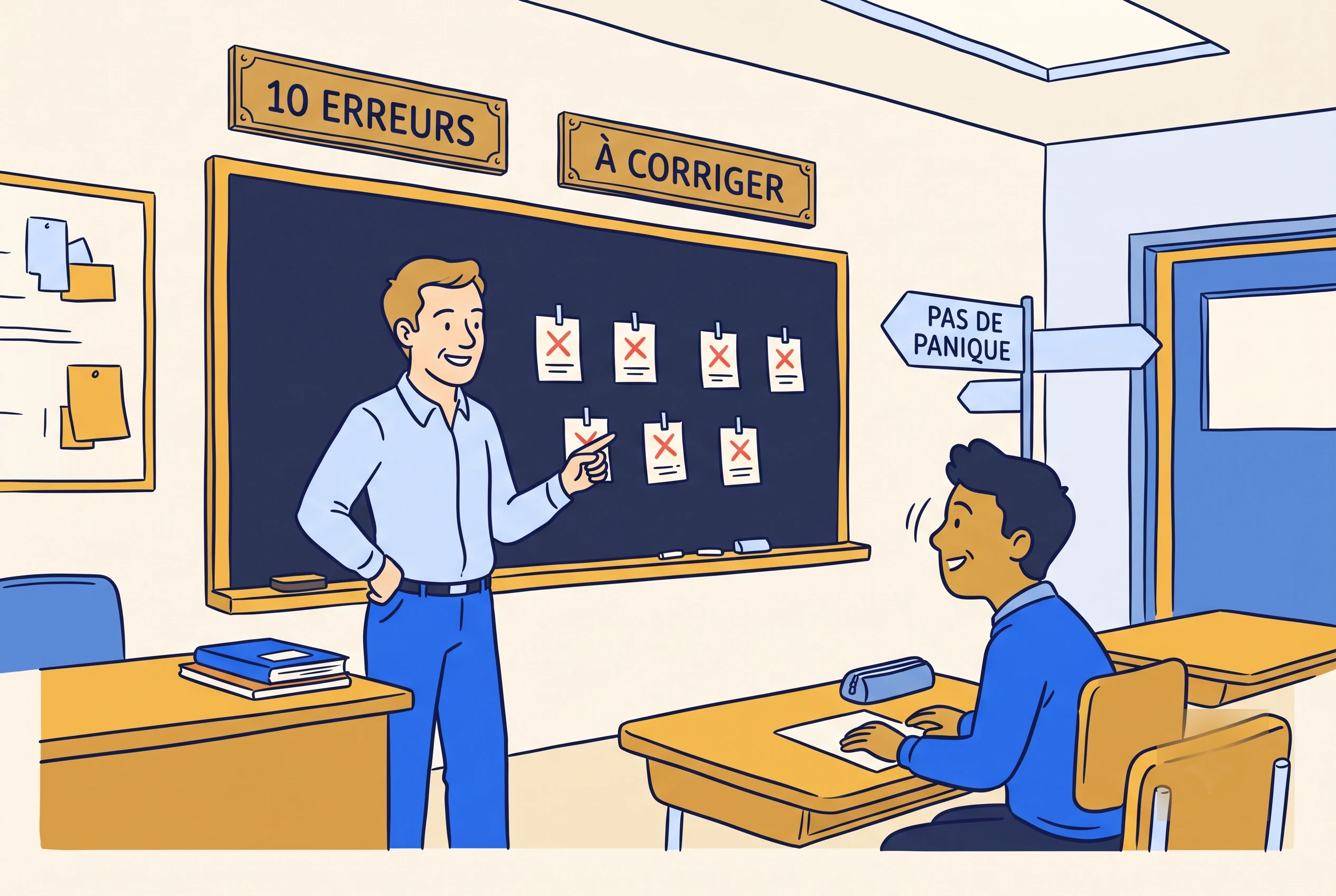
An error becomes easier to fix when you understand the contrast behind it. Read each explanation before the examples, and choose one recurring mistake to notice in your own writing or speech.
English speakers keep making the same French mistakes, and the reason is structural
English speakers do not make random mistakes in French. They make systematic mistakes. That is the good news and the bad news. The good news is that once you identify the pattern, you can fix it faster. The bad news is that the same pattern tends to reappear across dozens of different topics, so one wrong reflex can contaminate your grammar, pronunciation, listening, and confidence all at once.
The main reason is simple: English and French organise meaning differently. English relies heavily on word order, fewer visible agreement markers, and simpler everyday tense choices. French asks you to track gender, agreement, register, verb structure, liaison, and prepositions that often do not map cleanly onto English.
The learners who improve fastest are not the ones who never make mistakes. They are the ones who start recognising their own mistake patterns early enough to interrupt them before they become part of their identity in French.
This article focuses on the mistakes that create the most confusion and the biggest gap between “I know French” and “I can actually sound normal in French.” Several overlap directly with bigger issues in learning to stop translating from English while you speak, because translation is the hidden engine behind a lot of these errors.
Mistake #1: mixing up masculine and feminine nouns
This is one of the first mistakes English speakers meet and one of the last they fully stop making. The problem is not that French gender is “hard” in some mystical way. The problem is that English gives you almost no grammatical habit for it.
💡 Best habit: store nouns as chunks, not isolated words. Treat the article as part of the noun, not decoration around it.
There are patterns, of course. Words ending in -tion are often feminine. Words ending in -age are often masculine. But “often” is not “always.” The safer long-term strategy is repeated exposure plus active recall. That same method becomes even more important in faux amis and deceptive familiar-looking French words.
Mistake #2: trusting false friends too much
False friends are dangerous because they reward confidence. You see a French word that looks like English, assume meaning, use it immediately, and often do not realise the problem until the reaction arrives.
⚠️ High-confidence mistakes are the hardest to fix. False friends survive because learners say them with conviction. That conviction delays correction.
Mistake #3: using tu and vous badly
English gives you only one everyday “you.” French does not. So English speakers arrive in French with no instinctive feel for distance, formality, hierarchy, or social caution encoded inside pronouns.
Use tu first with
Family, close friends, children, many classmates, many younger people in informal settings, and people who clearly invite it.
Use vous first with
Strangers, older adults, teachers, bosses, doctors, police, officials, shop staff in formal interactions, and basically any unclear situation.
This is not just about grammar. It is social positioning. The wrong pronoun overlaps heavily with the broader issue in French politeness rules that English speakers misread.
Mistake #4: dropping the full negation too early
English negates with a single word. French builds it in two halves, and only one of them survives in fast speech:
💡 Simple memory trick: French negation is a two-part structure. Do not memorise the second half only. Build the whole frame until it feels boring.
Mistake #5: using the wrong preposition because English logic feels obvious
One of these prepositions belongs to countries, the other to cities, and it is the destination that decides, never the verb.
| Pattern | Wrong reflex | Correct chunk | Why English speakers slip |
|---|---|---|---|
| Countries | a France | en France | English “to France” feels universal |
| Cities | en Paris | a Paris | Learners overgeneralise en |
| Avoir besoin | besoin a | besoin de | English “need” does not force an equivalent pattern |
| Penser | penser de toi | penser a toi | Literal English mapping feels more reasonable than it is |
Mistake #6: using etre where French wants avoir
Pick the wrong verb here and the sentence still works, except that it is now a statement about your character:
💡 Useful reset: learn whole everyday states as fixed French expressions: avoir faim, avoir peur, avoir chaud, avoir … ans. Do not build them from English every time.
Mistake #7: putting adjectives in the wrong place
Colour, shape and nationality land after the noun in French, and a small group of very common adjectives does not.
Mistake #8: confusing passe compose and imparfait
Was it one thing that happened once, or a background that simply went on for years?
Use passe compose for
Completed actions, one-time events, narrative steps, and moments that move the story forward.
Use imparfait for
Descriptions, repeated habits, ongoing background, emotional or physical states, and context around completed actions.
If this still feels unstable, that is normal. Past tense choice becomes much easier once you see it as viewpoint instead of translation. The full breakdown is in the timeline method for imparfait vs passe compose. The French Briefing uses both tenses in every story, so the pattern becomes visible through daily exposure.
Mistake #9: translating English idioms literally
Every word can be correct French and the whole sentence can still mean nothing, which is what makes the pause afterwards so long.
Mistake #10: pronouncing letters French does not want you to pronounce
A taxi rank, a city name said out loud, and one final letter that nobody around you pronounces:
Pronunciation is where reading-only learners often discover the price of avoiding audio for too long. This is exactly why targeted work on French pronunciation and listening at A1-B1 changes more than just accent. It changes comprehension.
Keep all ten fixes on one desk
You just went through the ten mistakes English speakers repeat most, from gender and tu/vous to passe compose and silent letters. The cheat sheet pack gives you a clean one-page reference for each pattern, so you can check yourself before you write or speak instead of guessing. Enter your email and the free cheat sheet pack downloads right away.
How to fix these French mistakes without becoming afraid to speak
- 1Track recurring mistakes, not every mistakeOne accidental error matters less than the pattern you repeat ten times a week. Your recurring mistakes are your real curriculum.
- 2Replace, do not just “notice”Noticing that excite is dangerous is not enough. You need a replacement ready: j’ai hate, je suis impatient.
- 3Practice the correct chunk in real contextsFixing one sentence in isolation is weak. Reusing the correct form across five real situations is what builds a reflex.
- 4Keep speaking while you repairAccuracy matters. So does momentum. If correction destroys spontaneity, you are solving one problem by creating another.
💡 Best mindset: treat correction as pattern training, not as personal failure. Every repeated error marks a spot where English still has too much control.
Study glossary: common French mistake patterns
| 📋 Mistake type | ❌ Wrong | ✅ Correct | 🧠 What to remember |
|---|---|---|---|
| Gender | ❌ une problème | ✅ un problème | Learn nouns with articles, never alone |
| False friend | ❌ actuellement = actually | ✅ en fait = actually | Familiar-looking words are the most dangerous |
| Formality | ❌ tu with strangers | ✅ vous first | Start formal when unsure |
| Negation | ❌ je veux pas | ✅ je ne veux pas | Build the full structure before dropping anything |
| Preposition | ❌ a France | ✅ en France | Memorise full chunks, not isolated words |
| Etre vs avoir | ❌ je suis froid | ✅ j’ai froid | Many everyday states use avoir |
| Adjective order | ❌ une rouge voiture | ✅ une voiture rouge | Most adjectives come after the noun |
| Past tense | ❌ quand j’ai ete jeune | ✅ quand j’etais jeune | Imparfait handles background and repeated past |
| Idiom | ❌ literal English idiom | ✅ French equivalent | Do not trust direct translation |
| Pronunciation | ❌ pronounce final consonants | ✅ respect silent endings | French sound and spelling do not map like English |
The real goal is not perfection. It is reducing the number of mistakes that keep repeating after you already know better. That is what makes your French sound more stable, more natural, and more confident faster than another random list of new words ever will.
For a closer look at pas, jamais and plus, continue with French Negation: Say Not, Never and No Longer.
Prefer to keep it free today? Read the French Briefing →
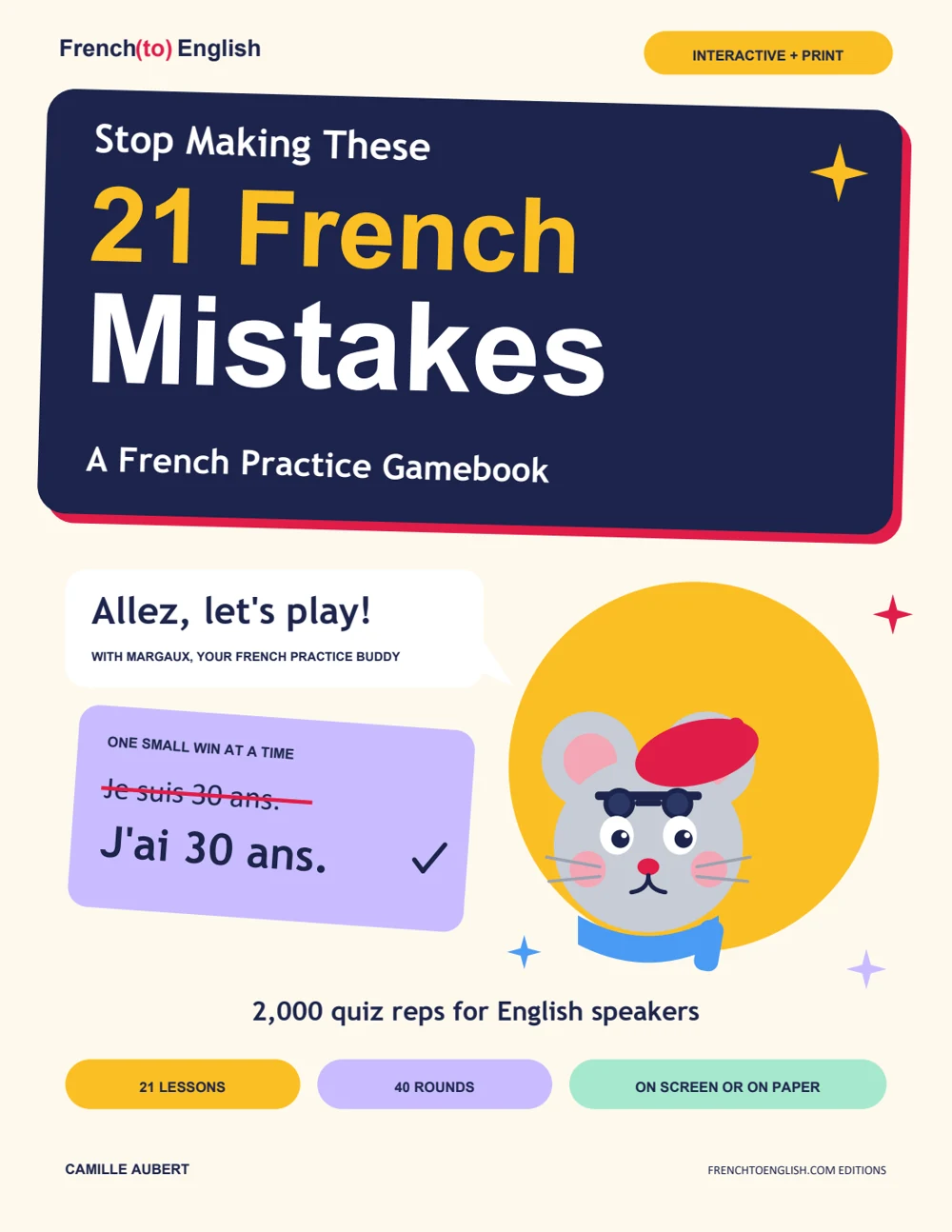
The French Gamebook
Catch the French mistakes you keep making.
For English speakers practising French
Work through a short lesson, choose your answers and check the explanations. Use a practice round to see which basics need another try.
- 21 lessons with explanations
- 40 practice rounds · 2,000 questions
300 pages · Play on your computer or print
Get the Gamebook · $9 Read a preview before you buyOne payment · Instant PDF download
Try the French with someone who can reply.
Bring a sentence you found difficult. Ask a tutor to help you say it naturally, then try it in a short conversation.
Find a French tutor →Paid lessons. Compare tutors and prices before booking.
Affiliate link: we may earn a commission when you book.
📚 Keep building in the Learning Center
French Reflexive Verbs: Daily Routine and Word Order
Build a daily routine in French with reflexive pronouns, negatives and infinitives. Compare translated examples, listen and practise.
Read →Futur Proche vs Futur Simple: Examples and Practice
Compare futur proche and futur simple in French plans, promises and announcements. Learn the forms and practise choosing…
Read →French Nominalisation: Examples and Clear Writing
Turn French verbs into nouns without hiding the actor or losing the time reference. Compare examples and practise…
Read →