
Updated on September 26, 2026
Opening a Bank Account in France: Prepare the Documents and the Conversation
Opening a bank account in France involves checking eligibility, identity, address evidence and the services you need. Prepare questions, compare current terms and practise French for appointments, account documents and everyday payments before choosing an account.
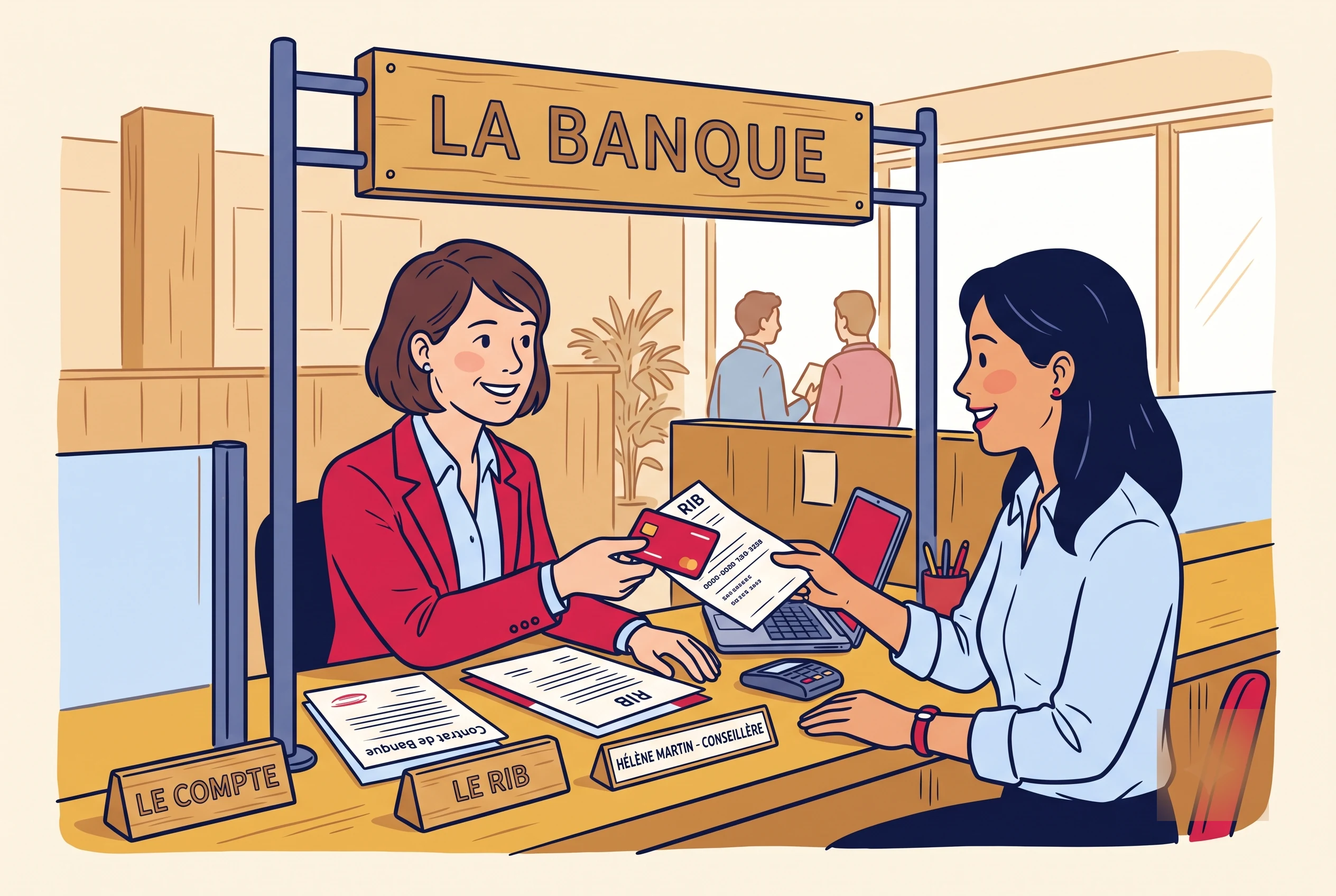
Opening a bank account involves explaining your circumstances and understanding what the bank requests. A useful first conversation establishes whether the provider can consider your situation, which evidence it needs and what the next step will be. It does not end with a vague promise to “bring the usual documents”.
Requirements can vary with the provider and your circumstances. Ask for the current list and describe your nationality, residence and intended account use accurately. This page offers language preparation, not a recommendation of a bank or a guarantee of account opening.
For the broader arrival sequence, read the first-90-days plan.
Ask for the right appointment
State what you want and the relevant facts. If you have recently arrived, say so. If your housing is temporary, describe that accurately. The point is to establish which process applies before travelling to an appointment with an unsuitable file.
Write down whether the answer concerns a preliminary appointment or the actual opening procedure. Ask how the bank will confirm the booking. Keep the branch address and adviser details with the document list.
Describe the account you are asking about
An opening request becomes easier to route when you can name the intended account and its purpose. If you want an individual account for ordinary personal payments, say that. If your question concerns a different situation, describe it accurately rather than borrowing a model sentence that no longer fits.
Make a short English note before translating: who will hold the account, what you expect to use it for and what you need to ask today. You are not trying to predict the bank's decision. You are preparing enough context for it to explain the relevant process and evidence.
Avoid adding promises about income, residence or future activity simply because they seem likely to make the conversation easier. A language template should help you state facts, not encourage a more convenient version of them. If a detail is uncertain, say what you know and ask how the bank wants you to describe the situation.
Make an appointment note that someone else could understand
Write the branch name, full address, date, time and purpose together. An appointment notification may contain several locations or contact details, so check which address refers to the actual meeting. If it is remote, identify the official route for joining and any preparation requested.
Next, record what the bank says the appointment will accomplish. Is it an initial discussion, document review or another stage? Do not rename it “account opened” in your task list before that has happened. A clear label helps you organise what comes afterwards without assuming the outcome.
If the appointment changes, replace the calendar entry and keep the new confirmation with it. In a practice exercise, ask a partner to change the day but keep the time. Repeat both details in your answer. This is harder than memorising the original sentence because it requires you to listen for the changed information.
Prepare a short opening instead of a life story
Your opening can contain three parts: greeting, purpose and one relevant circumstance. For example, you have recently arrived and would like to know which documents to prepare. Leave the detailed history for questions that require it. A concise opening gives the adviser an opportunity to guide the conversation.
Practise saying the opening naturally enough that you can stop when the other person responds. Reading a long paragraph without pausing can make it difficult to hear the answer. If the adviser asks a question halfway through, respond to that question before returning to your prepared points.
Prepare one repair sentence as carefully as the opening. “Could you repeat the last question?” is useful when you miss a detail. Pretending to understand may produce an inaccurate answer on a form or in the adviser's notes. The goal is a clear exchange, not uninterrupted French.
Learn the replies that change your plan
An adviser might say that an appointment is available, that more information is needed first or that another service handles the request. Those replies call for different next steps. Practise recognising the action in each rather than listening only for familiar words such as compte and rendez-vous.
For an available appointment, confirm the time and preparation. For a request for information, ask exactly which information and how to provide it. For a referral, ask how to reach the appropriate service. In each case, your final sentence should reflect what the adviser actually said.
Make three reply cards in English and ask a partner to express them in simple French. Shuffle them between rounds. If you practise alone, record the replies separately and play one without looking at its label. Use invented details; the purpose is to practise adapting your next question.
Clarify the document list
“Justificatif de domicile” is a category of evidence, not the name of one universal document. Ask which evidence is appropriate to your housing situation. If you are staying with someone, do not assume that a document accepted for another procedure will automatically satisfy this one.
Read the requested dates and names carefully. Check whether a copy, original or additional item is needed. Keep identity documents secure and use the bank's designated channel for transmission.
If a form asks about tax residence or identification, answer accurately and ask the bank to explain a field you do not understand. Do not guess that nationality and tax residence are the same question. Individual tax questions may require qualified advice.
Turn categories into a preparation table
A useful table has four columns: wording from the bank, document you intend to use, condition to check and status. Copy the bank's wording accurately in the first column. The second column is your proposed response, which may still need confirmation. Keeping those columns separate prevents your interpretation from becoming an invented requirement.
For example, the bank may ask for evidence related to your address. You can record the document you have and ask whether it is accepted for your particular housing situation. Do not turn a document accepted by one provider into a universal rule for every bank.
The condition column might concern a date, a name or the need for an original. The status column can say “question sent”, “confirmed by bank” or “still to obtain”. Avoid a single tick that could mean any of these. A precise status makes the table usable on the morning of the appointment.
Explain temporary housing clearly
If you are staying in temporary accommodation, describe the arrangement as it is. You may need to ask which evidence the provider accepts and whether further information is required. The answer should come from that provider's current process, not from a language exercise or a friend's experience with another branch.
Once you receive an answer, note any qualifications. If the adviser says a document must include additional information, write that condition beside the document's name. “They accept my document” would be an incomplete summary if acceptance depends on something it does not yet contain.
For practice, change the fictional housing situation and ask the question again. Notice which parts of the sentence remain useful and which facts need replacing. The exercise is successful when you can explain the new situation accurately, not when you recite the original example word for word.
Ask about names and formatting without changing the facts
Names and addresses can appear differently across documents because of formatting, abbreviations or the order of fields. If a difference raises a question, ask the bank what it needs to reconcile the records. Do not edit an official document yourself to make it resemble another one.
You can practise describing a harmless fictional discrepancy: a middle name appears on one sample but not another, or an address uses an abbreviation. Point to the two fields and explain the difference. Then ask which supporting explanation or document the bank requires, if any.
The useful language includes “sur ce document”, “dans ce champ” and “l'orthographe de mon nom”. These expressions let you identify the exact issue without accusing anyone of an error before you know what happened. Keep the question specific enough that the adviser can compare the relevant entries.
Distinguish a form question from advice about your situation
If you do not understand a field, ask what information it requests. That is different from asking someone to decide a complex personal tax or legal question for you. Nationality, address and tax residence are not interchangeable labels, so do not answer one merely by copying your answer to another.
For an unfamiliar field, read its title and any instructions. Explain the word or part you do not understand. The bank can clarify its form and tell you what it requires; a question about your substantive position may need advice from an appropriately qualified person.
As a language exercise, take a fictional form with separate fields for country of birth, nationality and current address. Explain each field in English and supply invented answers. This trains careful reading without encouraging guesses on a real financial declaration.
Check the transmission instructions before sending files
Ask how documents should be supplied and use the bank's designated route. If a message directs you somewhere unfamiliar, verify the route through an established contact rather than relying only on the message's appearance. Keep copies of what you actually submitted in your private records.
Check that each file opens and contains the intended pages. A filename is not proof that the correct scan is inside. If you are replacing an unreadable copy, make sure the replacement resolves that problem before sending it. This reduces avoidable exchanges without implying that the bank will accept the document.
Record submission and receipt separately. A document uploaded successfully may still need review. If the bank asks for something further, compare the new request with the earlier list and identify what changed. The next question should address that difference rather than repeat the whole original enquiry.
Ask about services and costs
Before agreeing to an offer, identify the services you actually need and ask where the fees and conditions are documented. An account, a payment card and an optional package may have different terms. Ask whether an item is required or optional.
For an international move, you may also need to ask about receiving transfers, currency conversion and practical access to the account. Compare the actual terms for your use, rather than treating a promotional headline as the full cost.
Make a list of the services you expect to use
Before comparing an offer, write down the actions you expect to perform: receive payments, make transfers, pay by card or obtain a bank details document. These are questions to discuss, not a universal list of services every reader needs. Your circumstances determine which features matter to you.
For each action, ask where its conditions and price are explained. If a service appears in a package, establish whether it is included in that package and whether other charges can still apply in the circumstances you describe. Record the relevant document or page rather than relying on a remembered promotional phrase.
This approach makes a conversation more concrete. “What would this transfer cost under these conditions?” is easier to investigate than “Is this account cheap?” You may still need professional guidance for a particular decision, but you will have identified the actual question and the terms that need reading.
Separate a product name from what it includes
Banks may use commercial names for packages or cards. A name alone does not tell you the complete terms. Ask which services it includes, which are optional and where the conditions are written. If a feature is important to you, confirm that it applies to the offer being discussed rather than another product with a similar name.
When taking notes, keep the bank's product name and your plain-English description in separate columns. This helps you compare the correct document later. If the adviser switches to a different offer during the conversation, mark that change instead of combining the features of both into an offer that does not exist.
In a practice exercise, invent two packages with different fictional features. Ask your partner which feature belongs to which package and request clarification when the answer is ambiguous. The exercise develops comparison language without making claims about any real provider.
Read frequency and conditions alongside the amount
A price needs a unit and a period. A monthly fee, an annual fee and a fee per transaction cannot be compared simply by looking at the smallest number. Likewise, a temporary promotional amount may not describe the cost after the stated period.
Use a fictional worksheet with three amounts: one per month, one per year and one per use. Label them clearly and calculate a sample year's total using an invented number of uses. This is arithmetic practice, not an estimate of what a real French bank will charge.
On an actual offer, ask which conditions apply to the figure you are discussing. If a price depends on usage, eligibility or a promotional period, keep that condition next to the amount in your notes. An accurate comparison preserves the qualification rather than removing it to make the table look simpler.
Ask about international use through a concrete example
An international move may involve payments in more than one currency or transfers between countries. Describe the actual type of transaction you are asking about and request the relevant terms. Different charges or exchange arrangements may be involved, so a broad statement about “international transfers” may not answer your specific question.
You might ask who receives the payment, which currencies are involved and where the applicable costs are documented. If the answer depends on information you have not supplied, identify that missing information. Do not substitute a figure from a different transaction because it sounds similar.
This guide does not recommend a transfer provider or financial product. Its role is to help you ask clearly and preserve the conditions in the reply. For a consequential choice, use the actual current documents and appropriate advice, especially when your situation involves questions beyond the ordinary language of the appointment.
Confirm practical access before assuming everything is ready
Account access can involve instructions separate from the opening conversation. Ask what confirmation to expect and where the bank explains the next steps for the services you selected. Do not assume that every feature is usable merely because one part of the process has been completed.
For a role-play, imagine that you have received a confirmation but still do not understand the next instruction. State what you have received and ask what to do next. Avoid saying that the whole account is blocked unless that is what the bank has actually told you.
Keep passwords, codes and identity details out of the practice. You can rehearse the sentence “I cannot complete this step” with a fictional screen description. Real access problems should be handled through the bank's verified support process, using the information it legitimately requests through the appropriate channel.
Respond to a missing document or refusal
A request for another document and a refusal are different outcomes. Ask which applies and obtain the information needed for the next step. Keep a record of what you provided and when.
For people meeting its conditions, the French droit au compte procedure can provide a route after refusal. The Banque de France explains eligibility, evidence and the process. Use that official guidance to check your position; it does not mean every provider must accept every ordinary commercial application.
Identify the outcome before choosing a response
Imagine three fictional replies. The first asks for a clearer copy. The second says the request is still being examined. The third states that the bank refuses the opening. Your next action should differ in each case. Resending a document may address the first, but it is not automatically the right response to the other two.
Read the exact wording and ask for clarification when necessary. A learner may hear a negative phrase and assume a final refusal, even when the adviser is saying that an appointment is unavailable that day. Conversely, a polite closing sentence does not erase an explicit refusal earlier in the message.
Write a one-line summary supported by the actual reply. Keep interpretations separate. “The adviser requested another document” is an observation; “the bank will certainly open the account once I send it” is a prediction. The latter should not appear as a confirmed status in your preparation notes.
Use the right-to-an-account information for the right question
The Banque de France describes a formal procedure for eligible people after refusal, with conditions concerning residence or nationality and the absence of an individual account in one's own name, including relevant closure situations. Check the official eligibility and procedure page for the precise current requirements. The procedure is not the same as an ordinary request for a chosen commercial package.
If you need help understanding the page, separate the language question from the eligibility question. You can ask what a term means, then confirm how the conditions apply to your situation through the appropriate official route. Do not interpret an example in this article as a personal determination of eligibility.
Keep evidence associated with a refusal or application in your private folder. If you later consult the official procedure, that record helps you identify what you have and what remains required. A language notebook should contain only the vocabulary and harmless practice examples needed to rehearse the exchange.
Write a focused clarification message
An original practice message for an unclear outcome might read:
Use this only when the status is genuinely unclear. If the bank has already given an explicit decision, acknowledge that decision and ask the relevant next question instead. A template should not make the recipient repeat information simply because you have not adapted the text.
For practice, rewrite the message for a readable-copy problem. The question should then ask about the replacement document, not whether a decision is final. This forces you to connect the wording to the actual issue rather than treating a formal tone as sufficient.
Keep a useful record without collecting unnecessary copies
Your record can list the request date, documents supplied, reply received and next action. Link each entry to the relevant file or message. You do not need multiple identical copies scattered across folders to make the record thorough; you need to know which version was used and what happened next.
If a document changes, identify the new version clearly. If you resend it, record the date and route. This helps you answer a later question accurately without relying on memory. It also makes it easier to see when a request concerns an older version rather than the file you most recently supplied.
Keep the record private and proportionate to the task. When rehearsing with another person, replace real references and identity details with invented ones. The learning benefit comes from explaining the sequence and asking the next question, not from exposing the contents of a real financial file.
Practise the complete exchange
Role-play three stages: ask for the document list, clarify one item and confirm the next action. Have your partner change one detail, such as the date or submission channel. Your final sentence should repeat that detail correctly.
Useful phrases to keep
Finish by writing a short follow-up: the appointment date, the documents requested and the one question still unresolved. That note turns the practice into a usable preparation sheet.
Run a first round with a clear outcome
Give the adviser a fictional instruction sheet: an appointment is available on Thursday, one specified document is needed and the branch address must be confirmed. The newcomer starts with the opening request and listens for those three details. The adviser should answer naturally rather than reading every detail in a single uninterrupted sentence.
At the end, the newcomer repeats the appointment and preparation. Compare the summary with the instruction sheet. Score the exercise by whether the important facts match, not by how sophisticated the vocabulary sounded. A simple clarification question that prevents a wrong date is a successful part of the exchange.
Repeat with one change. Move the appointment to Friday or replace the fictional document. Keep the rest stable so you can tell whether the learner responds to the changed detail. If they repeat the old version automatically, practise the reply separately before trying the full exchange again.
Add one complication at a time
For the next round, the newcomer cannot attend the proposed time. The task is to explain that and ask about another slot. In a later round, the newcomer does not have the document mentioned and must ask which evidence the bank accepts in the fictional situation. Do not combine every complication immediately.
This gradual approach gives each language problem a clear purpose. You might need availability phrases in one round and document vocabulary in another. Once both feel manageable, combine them in a longer exchange. The aim is adaptable conversation, not a performance of a script whose answer is always known.
Keep the fictional bank's instructions clearly labelled as invented. They are teaching materials, not a statement of real requirements. Before an actual appointment, replace the practice facts with the current information supplied by your provider and retain the clarification phrases that help you check it.
Finish with a written follow-up
After the role-play, write three sentences: the purpose of the appointment, what you will prepare and what remains unresolved. Compare them with your spoken summary. If the written version contains a new promise or assumption, remove it unless the adviser actually stated it during the exercise.
Read the French version aloud once. This reveals places where a sentence has become too long to manage comfortably. Split it if necessary. Clear, ordinary French is appropriate for a practical follow-up; you do not need to imitate complicated administrative prose to ask a precise question.
For a real exchange, use the bank's appropriate contact route and include the relevant reference only where needed. Check the recipient and attachments before sending. Then record the message as sent, leaving the underlying question open until the reply resolves it.
Decide which kind of help you need next
If you can explain your purpose but struggle to understand replies, practise listening with changed dates and conditions. If you understand the conversation but do not know which evidence the bank accepts, ask the bank. If the uncertainty concerns your personal financial or tax position, seek suitable advice rather than expecting a phrasebook to decide it.
A settlement language guide is useful when you want more scenarios and model questions for everyday tasks. It is not an account-opening service and cannot guarantee a provider's decision. Choosing the right kind of help keeps your next step connected to the problem you actually face.
Before the appointment, return to your one-page preparation sheet. Confirm the purpose, location, current document list and unresolved questions. Put the clarification phrases where you can find them quickly. That compact preparation is the practical result of the exercises in this guide.
Check your understanding with a short final exercise
Read these three fictional statements and decide which question would be useful next. First: the adviser can offer an appointment but has not named the branch. Second: the adviser names a document but you do not know whether a copy is sufficient. Third: the adviser describes a charge but does not say how often it applies.
For the first, ask where the appointment will take place and confirm the address. For the second, ask whether an original or a copy is required for that step. For the third, ask about the charging frequency and where the terms are documented. None of these questions requires you to understand every word of a long explanation; each targets one missing detail.
Now turn each answer into a note. A useful note contains the new fact and its context. “Thursday” alone is ambiguous. “Appointment at the named branch on Thursday at the confirmed time” connects the detail to the event. Apply the same discipline to document conditions and charges.
In the last round, the adviser cannot answer immediately and refers the question to another service. Record that outcome honestly. Your next action is to contact the specified service or wait through the stated channel, depending on the instructions given. Do not fill the gap with an assumption just to make the worksheet look finished.
Keep the free guide and paid resource in proportion
You can use this page to prepare a single appointment without buying anything. Save the phrases that match your situation and practise the likely replies. If you want a broader collection of settlement conversations, a structured guide may save you the work of assembling those scenarios yourself.
The product decision is therefore about learning format and convenience. It does not change the bank's requirements, provide financial advice or create a right to a particular account. Keep that distinction clear when deciding whether more written practice is what you need now.
Transfers, direct debits, and the payment words that cause real confusion
This is one of the most important distinctions in the whole article because English speakers flatten too many payment ideas into one vague mental category. French does not. And when you are setting up rent, utilities, phone bills, subscriptions, or salary transfers, that distinction becomes practical very fast.
This means you are sending money. You initiate it. You control the amount and the timing unless you create a recurring version yourself.
This is how salary commonly arrives, and sometimes how landlords or individuals prefer to receive rent or reimbursement.
This means an organisation takes money from your account once you authorise it. Utilities, insurance, subscriptions, internet bills, and many recurring services use this system.
Here is the key logic. With a transfer, you send. With a direct debit, they take. If you blur that distinction, conversations with landlords, energy providers, and telecom companies become much more confusing than they need to be.
| Payment term | Who starts it | Best use case | Common misunderstanding |
|---|---|---|---|
| Virement | You | Rent, one-off payments, sending money to another account | People assume any recurring payment is automatically a prélèvement |
| Virement permanent | You | Fixed monthly rent or regular personal transfers | Confused with subscriptions where the amount changes |
| Prélèvement automatique | The company after your authorisation | Utilities, phone, internet, insurance, subscriptions | People think it is safer because it is automatic, then forget to monitor it |
| Dépôt | You | Cash or cheque deposit | New arrivals forget some banks make this easier in branch than online-only banks |
The mistake is rarely academic. It shows up when someone says your rent can be paid by virement and you assume they mean they will pull it automatically from your account. Or when you authorise a prélèvement for a variable bill and then act surprised that the amount changes every month. French banking is not especially mysterious here. It is precise. Precision just feels hostile when nobody warned you in advance.
⚠️ Automatic does not mean harmless. Direct debits are convenient, but they deserve monitoring. New arrivals often trust the setup more than the follow-through and only notice a problem after several billing cycles.
And because France still preserves systems many anglophone newcomers use less often at home, you may also encounter cheques, branch deposits, and card settings that feel oddly old-fashioned beside a slick mobile app. The country is very capable of mixing 2026 user experience with 1998 paperwork logic in the same institution.
Useful phrases to keep
| 🇫🇷 French | 🇺🇸 English | 💡 Context |
|---|---|---|
| un compte individuel | an individual account | Choosing an account type |
| un relevé d’identité bancaire | a bank details document, often called a RIB | Providing bank account details |
| les frais de tenue de compte | account maintenance fees | Comparing recurring account fees |
| un virement | a bank transfer | Sending a bank transfer |
| un prélèvement automatique | a direct debit | Authorising a recurring debit |
| un justificatif de domicile | proof of address | Preparing address evidence |
| une attestation de refus | a certificate of refusal | Asking for written refusal evidence |
| un compte courant | current account | Main daily account for salary, bills, rent, and card payments |
| une pièce d'identité | identity document | Passport or official ID used to verify your identity |
| un titre de séjour | residence permit | Relevant for many non-EU applicants |
| un RIB | bank details document | Used for salary, direct debits, rent setup, and admin paperwork |
| un IBAN | international bank account number | Main detail shared for transfers and payment setup |
| un prélèvement automatique | direct debit | A company or organisation takes money after authorisation |
| un bénéficiaire | payee or recipient | Person or account you add in order to make transfers |
| le solde | balance | Amount currently available in the account |
| un relevé de compte | bank statement | Downloaded or printed proof of account activity |
| une carte bancaire | bank card | Standard French card for payments and withdrawals |
| faire opposition | to block the card | Used if the card is lost, stolen, or compromised |
| un découvert autorisé | authorised overdraft | Allowed negative balance under agreed conditions |
| les agios | overdraft charges | Fees or interest related to negative balance |
Your First 90 Days in France
Prepare the French for your first weeks.
For English speakers getting settled in France
A viewing, a bank appointment, a phone call: start with the situation you face next. Read the steps in English, rehearse the French dialogue and adapt a message before you use it.
- 30 everyday situations to rehearse
- 90 practice questions with explanations
About 180 pages per edition · Interactive + Print A4 included
Get the 90-day guide · $9 Read a preview before you buyOne payment · Instant PDF download
Rehearse the conversation before the appointment.
Tell a tutor what you need to do in France. Practise the questions, try an unexpected reply and ask for the words you were missing.
Find a French tutor →Paid lessons. Compare tutors and prices before booking.
Affiliate link: we may earn a commission when you book.
📚 Keep building in the Learning Center
Moving to France from the US: A Practical First-90-Days Plan
Your first 90 days in France involve overlapping tasks, from housing and banking to everyday conversations. Use this…
Read →French Health Insurance for Expats: The Vocabulary Behind the Paperwork
French health insurance arrangements for expats depend on status and circumstances. Distinguish eligibility, registration, evidence of cover and…
Read →French Administrative Vocabulary: Forms and Appointments
Understand French administrative vocabulary for dossiers, online applications, appointments and follow-ups. Read examples with English translations. Administrative words…
Read →