
Updated on September 15, 2026
Order Drinks in French: Bar Phrases and Apéro Vocabulary
Order drinks in French, ask about sizes and ingredients, and request the bill. Learn bar vocabulary and regional drink names with examples.
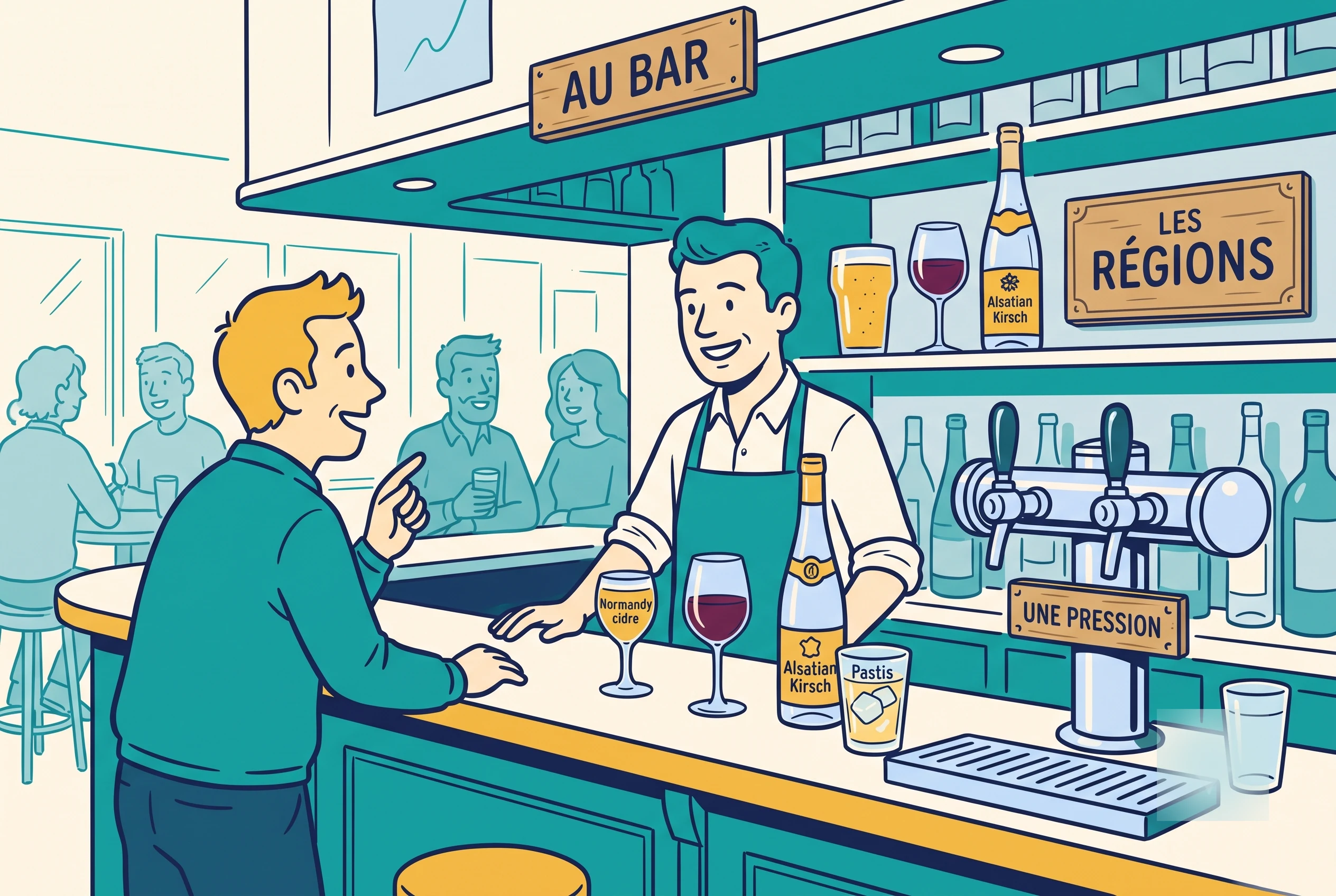
Ordering becomes easier when you can specify the drink and ask a follow-up question. Begin with the basic exchange, then use the vocabulary for sizes, ingredients and the bill as needed.
To order in a French bar without sounding blunt, open with a greeting and a soft conditional: « Bonjour, je vais prendre un café, s’il vous plaît » or « Je voudrais une pression, s’il vous plaît. » Never fire the drink name on its own. On a terrace you settle up at the end, un demi is a small draught beer, and un café means an espresso, not a mug of filter coffee.
How to order without sounding abrupt
French bar service is less performative than American service and less chatty than many visitors expect. That does not mean it is rude. It means you are expected to be clear, polite, and low-drama. The politeness system applies here exactly as it does everywhere else in France: bonjour first, request second, s’il vous plaît attached. Skip that sequence and the interaction starts wrong before you have even named the drink.
Polite, unremarkable, and it works whether you are standing at the counter or sitting outside:
One notch more direct than the conditional above, and still nowhere near rude. That is the register people actually speak in.
A table of friends, the server going round clockwise, and your turn arrives faster than you expected:
Skip this and you drink exactly what you could have ordered at home, and the regional bottle stays behind the bar.
If the ordering moment itself makes you freeze, that is the same nervous system response described in the shy beginners guide. Pre-decide your phrase before you sit down. Write it on your phone if you need to. The 3-second rule works at the bar exactly like it works at the bakery.
What to say on a café terrace
A French terrace has its own rhythm. You are ordering in public, within earshot of other tables, and usually under mild time pressure. The full café code, seating, timing, and how long a drink holds a table, is a separate matter; the terrace version is short. Order in units the place already expects: beer size, wine by the glass, standard terrace drinks. Move faster than your anxiety.
The daytime version rather than the evening one, and the water half of it is free by law everywhere in France:
Every bar pours this one, the glass holds twenty-five centilitres, and it is the first word to have ready.
Hot afternoon, and you want what the rest of the terrace is already drinking, served properly cold?
Ordering for the table is fine as long as the order stays clear:
Better than guessing the serving format, especially in smaller places:
The same transaction logic applies at the bakery and the restaurant: bonjour, order, s’il vous plaît, merci, au revoir. The words change. The frame does not.
Keep the ordering phrases in your pocket
You now have the greeting, the request, and the terrace timing that keep you sounding relaxed instead of rehearsed. The free sheet gathers 100 ready-to-say phrases like these in one place, so you can pull up the exact line at the bar instead of hunting for it. Enter your email and the free 100 Survival Phrases sheet downloads right away.
Apéro, toasting, and paying without getting the tone wrong
L’apéro is not just “drinks before dinner.” It is a social transition. People meet, settle, snack lightly, and talk before the meal begins. Yes, there is food on the table. No, that is not the meal, and clearing the saucisson and the olives because you arrived hungry is the classic misread. What is on that plate, and what comes back out after dinner, is worth knowing before your first invitation: the comté, the board, the order it is eaten in.
The oven is on, the table is not laid yet, and this is the question that fills the space in between:
English lets you toast looking anywhere at all. Here you hold the other person’s eyes through the clink, and the second option is a shade more formal:
Nobody is ignoring you. The table stays yours until you say otherwise, which is generous right up until you have a train to catch.
Same evening, earlier in it, when the next round starts and you would rather stop, with no explanation owed:
Tipping at bars. Service is included (service compris). Leaving 1-2€ in coins for good service is appreciated but never expected. Do not tip 20%. If that feels rude, the Paris survival guide settles the restaurant version too.
Regional drinks worth knowing: where they come from and what makes them different
You do not need an encyclopedia of French alcohol. You need a small regional map. Certain drinks carry immediate cultural associations. Ordering one at the right moment sounds natural. Ordering it blindly sounds like you read one paragraph about France on the train. Here is the map, with enough context to sound oriented rather than random.
🍸 Pastis — Marseille and the entire south
Pastis is anise-flavoured, served with water that you add yourself (it turns milky), and is essentially the social signature of Provence and the Midi. It was created in the 1930s after absinthe was banned, and it never left. Ricard and Pastis 51 are the two dominant brands. Henri Bardouin is the artisanal option. Ordering pastis in Marseille is the most natural thing in the world. Ordering it in a Parisian wine bar in January is less obvious, but nobody will stop you.
English does the same thing with Coke and cola. In the south one brand name has quietly swallowed the whole category:
How it is served: a small glass of pastis arrives neat. A carafe of cold water arrives separately. You pour the water yourself. Ratio: roughly 1 part pastis to 5 parts water. Adding ice is optional and debated. Locals have opinions.
🍷 Kir — Burgundy origin, national drink
A kir is white wine (traditionally Bourgogne Aligoté) mixed with crème de cassis (blackcurrant liqueur). It was named after Félix Kir, the mayor of Dijon who popularized it after WWII. A kir royal replaces the white wine with Champagne. It is the most common apéro order in France after wine and beer, and it works everywhere from a village café to a Parisian brasserie.
One word turns the white wine into Champagne, which is the entire distance between an ordinary evening and a celebration.
Buy the ingredients: Crème de cassis de Dijon on Amazon. The real thing comes from Burgundy. Lejay-Lagoute and L’Héritier-Guyot are the classic producers.
🥂 Champagne — Champagne region only (legally)
Champagne can only be called Champagne if it comes from the Champagne region (northeast of Paris). Everything else is crémant or mousseux. This is not snobbishness. It is French AOC law. Ordering une coupe de champagne (a glass of Champagne) at a bar is perfectly normal for celebrations or just because it is Tuesday. France does not require a reason to drink Champagne.
“Coupe” is the standard word for a serving of Champagne at the bar:
🍾 Crémant — the affordable Champagne alternative from 8 regions
Crémant is sparkling wine made with the same traditional method as Champagne but from other regions: Alsace, Burgundy, Loire, Bordeaux, Jura, Limoux, Die, and Savoie. Crémant d’Alsace and Crémant de Bourgogne are the most widely available. It typically costs 8-15€ per bottle versus 25-50€+ for Champagne. Many French people drink crémant more often than Champagne for exactly this reason.
Worth asking anywhere outside the Champagne region, and the bartender will hear that you know which is which:
Try it: Crémant d’Alsace on Amazon — the most popular crémant in France.
🍷 Rosé de Provence — the summer default
Provence produces more rosé than any other French region. The pale, dry style (Côtes de Provence, Bandol rosé, Coteaux d’Aix) is what you see on every terrace from May to September. It is not a “light” wine or a “women’s drink” in France. It is the default warm-weather wine across all demographics. Ordering rosé in France is exactly as normal as ordering red.
Naming the place buys you nothing in Provence, where the same pale glass arrives either way, and everything once you leave it.
🍺 Bière pression — the draft beer landscape
France is not Belgium, but French craft beer has exploded since 2015. In Paris alone there are hundreds of microbreweries. On a standard bar terrace, you will typically find Kronenbourg 1664 (the default lager, originally from Alsace, now ubiquitous), Leffe and Grimbergen (Belgian abbey beers on most French taps), and increasingly local craft options. Un demi = 25cl. Une pinte = 50cl. Un galopin = 12.5cl (rare but exists).
The tap list is rarely written up anywhere, so the default lager wins by silence more often than by choice.
🍹 Monaco, Panaché, Diabolo — the light/mixed drinks
These appear constantly in casual French drinking and confuse tourists because they are not on the cocktail menu. They are standard bar vocabulary:
Un Monaco = beer + lemonade + grenadine (slightly sweet, pink, low-alcohol). Un panaché = beer + lemonade (shandy, the lightest option). Un diabolo menthe = lemonade + mint syrup (non-alcoholic, green, very common for kids and people not drinking). Un diabolo grenadine = lemonade + grenadine syrup (non-alcoholic, pink-red).
Low in alcohol and faintly sweet, and nobody at the table will treat the order as less serious than wine.
🌿 Absinthe — legal again since 2011
Absinthe was banned in France from 1915 to 2011. It is back, and it is real (wormwood-based, high alcohol, served with a sugar cube and cold water dripped slowly through). You will not find it on every bar menu, but specialist bars and some brasseries in Paris (especially around Pigalle, Belleville, and the Marais) serve it properly. If you see fontaine à absinthe on the counter, the bar knows what it is doing.
🍇 Vin chaud — winter markets only
Mulled wine appears at Christmas markets (November-December) across France, especially in Alsace (Strasbourg, Colmar, Mulhouse) where the tradition is strongest. It is red wine heated with spices (cinnamon, clove, star anise, orange peel, sugar). Ordering it outside winter market season would be strange. During market season, it is one of the most popular drinks in the country.
What do you order standing in the cold at a Christmas market in December, and rarely anywhere else?
🥃 Calvados, Armagnac, Cognac — the digestif trio
These are after-dinner drinks (digestifs), not apéro drinks. Calvados = apple brandy from Normandy. Armagnac = grape brandy from Gascony (southwest). Cognac = grape brandy from the Cognac region (Charentes). All three are sipped slowly, usually neat, after the meal. Ordering a Cognac before dinner is technically allowed. It marks you as someone who does not know the rhythm. Where a drink sits in the evening is a question about the meal it follows, and the meal belongs to another page: booking the table, then entrée, plat, dessert in the order the room expects. A bar page stops at the glass.
The evening has one more move in it, and the polite size to ask for is a small one:
Try them: Calvados Pays d’Auge on Amazon · Armagnac VSOP on Amazon
🍊 Spritz and cocktails — the new terrace default
The Aperol Spritz became the dominant French terrace cocktail around 2018-2020 and it has not left. It is now as standard as rosé on warm-weather menus. Other common cocktails on French terraces: mojito (ubiquitous), gin tonic (increasingly popular), and Moscow mule (copper mug, appearing more often). French-origin options include St-Germain (elderflower liqueur, Parisian, often mixed with prosecco or champagne) and Suze (gentian-based, bitter, very French, served on ice with tonic or soda).
Not every bar makes cocktails, so it’s worth asking first:
The regional move that always works. Instead of memorizing every drink, learn one phrase: “Vous me conseillez quoi de la région ?” (What would you recommend from the region?). It sounds curious, adaptable, and local. It works in Provence, Burgundy, Alsace, Normandy, Bordeaux, and everywhere else. The server will do the rest.
Study glossary: drinks and bar vocabulary
| 🇫🇷 French | 🇺🇸 English | 💡 Context |
|---|---|---|
| Un verre | A glass / a drink | Wine, water, most standard orders |
| Une bière pression / un demi / une pinte | Draft beer / small (25cl) / pint (50cl) | Know the sizes before you order |
| Le vin rouge / blanc / rosé | Red / white / rosé wine | Three words that cover 80% of wine orders |
| Un pichet | A carafe (house wine) | Casual places, cheaper than bottles |
| Un pastis / un Ricard | Pastis / Ricard (brand-as-generic) | South of France, apéro classic |
| Un kir / un kir royal | White wine + cassis / Champagne + cassis | Most common apéro after wine and beer |
| Une coupe de champagne | A glass of Champagne | Celebrations or Tuesdays |
| Un crémant | Sparkling wine (non-Champagne) | 8 regions, fraction of the price |
| Un Monaco / un panaché | Beer+lemonade+grenadine / shandy | Light, common, not “lesser” |
| Un diabolo menthe | Lemonade + mint syrup | Non-alcoholic, green, kids and adults |
| L’apéro | Pre-dinner drinks ritual | Social transition, not just “drinks” |
| Un digestif | After-dinner spirit | Calvados, Armagnac, Cognac. After the meal. |
| Santé ! / À la vôtre | Cheers! / Here’s to you | Eye contact when you clink. Always. |
| L’addition | The bill | Waiter won’t bring it until you ask |
| Sans alcool | Non-alcoholic | Diabolo, jus de fruit, eau pétillante |
| Trinquer | To clink glasses / toast | French drinking ritual, look people in the eye |
If ordering drinks feels manageable but the wider social code still does not, the problem is rarely vocabulary. It is the rhythm of the place: when to sit, when to signal, when to leave. The café page goes through that hour in order. Read it before the next terrace, not after it. The food side of the same trip splits three ways: booking and holding a table, the counter where the queue moves in seconds, and the phrases Paris throws at you first. Same frame every time: bonjour, request, merci.
« Vous me conseillez quoi de la région ? » One question, and the server does the work: a Ricard in Marseille, a kir in Dijon, a crémant in Alsace, a vin chaud at a Strasbourg market in December and odd in almost any other month. Nobody expects you to have memorised the map. They expect you to drink what comes back.
Prefer to keep it free today? Read the French Briefing →
The French Gamebook
Practise the French behind everyday exchanges.
For English speakers practising French
Work on common mistakes before your next conversation. Play a Gamebook round, check the answers and try saying a few corrected sentences aloud.
- 21 lessons with explanations
- 40 practice rounds · 2,000 questions
300 pages · Play on your computer or print
Get the Gamebook · $9 Read a preview before you buyOne payment · Instant PDF download
Try the French with someone who can reply.
Bring a sentence you found difficult. Ask a tutor to help you say it naturally, then try it in a short conversation.
Find a French tutor →Paid lessons. Compare tutors and prices before booking.
Affiliate link: we may earn a commission when you book.
📚 Keep building in the Learning Center
French Travel Phrases for Hotels, Shops and Cafés
Practise French travel phrases for hotels, cafés, shops and transport. Learn follow-up replies and polite ways to ask…
Read →French Phone Call Phrases: Answer, Ask and Clarify
Prepare for French phone calls with phrases for answering, asking for repetition, leaving voicemail and ending a call,…
Read →Order at a French Bakery: Bread, Pastries and Phrases
Order bread and pastries in French, ask about types and slicing, and handle payment. Listen to practical bakery…
Read →