
Updated on September 15, 2026
French Politeness: Bonjour, Tu, Vous and Requests
Learn French politeness through greetings, tu and vous, requests and everyday etiquette. Compare situations and useful translated phrases.
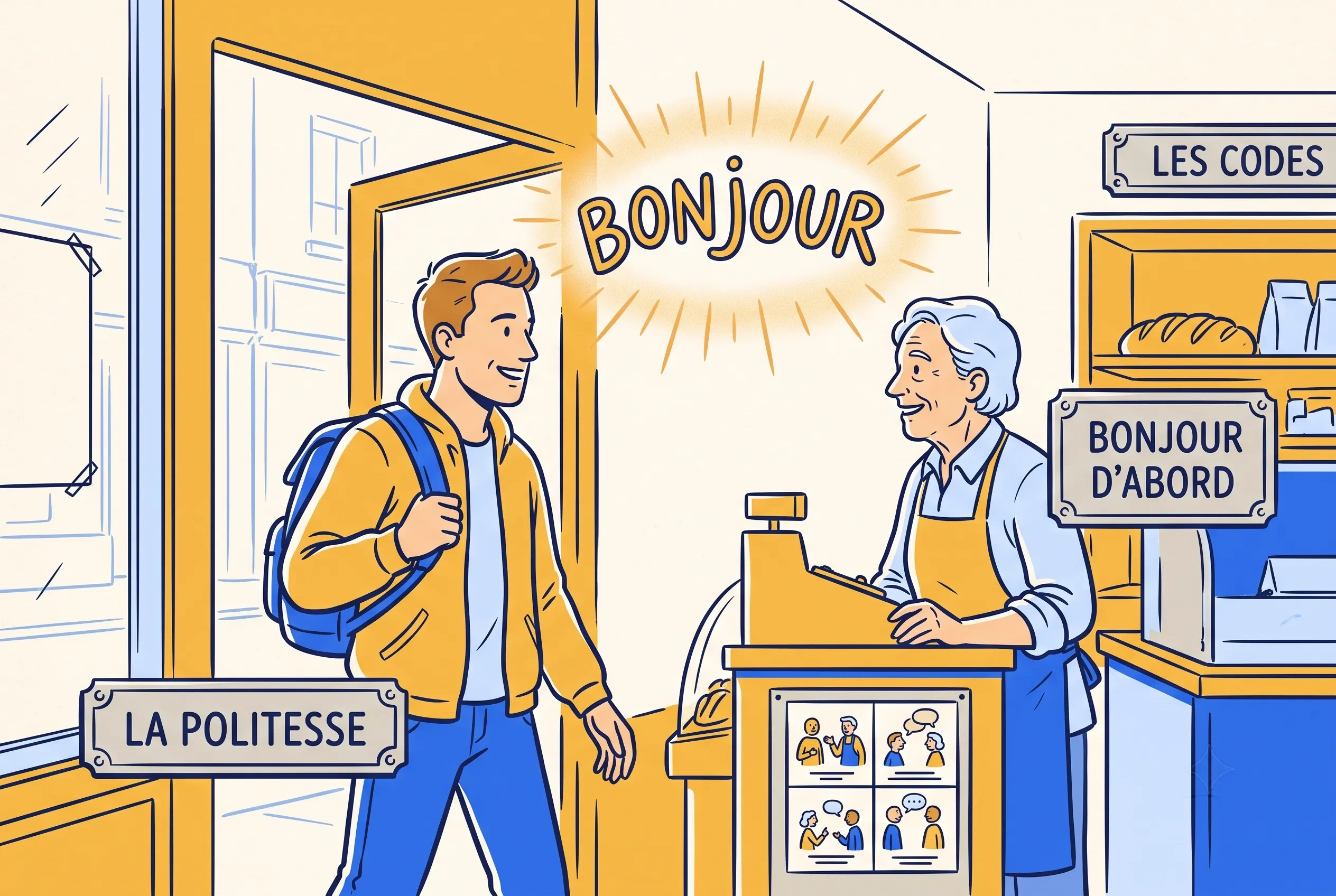
Politeness depends on the relationship, the setting and the wording of a request. Start with greetings and forms of address, then compare the examples to choose a level of formality that fits the interaction.
Start an interaction with bonjour
The most important French politeness rule is also the one Americans violate most often: you must say bonjour before doing almost anything in a shared service or social space. Not eventually. Not after your question. Not as background noise while already making a request. First. In France, bonjour is not decorative friendliness. It is the entry ticket into civil interaction. Skip it, and the rest of the conversation starts damaged.
This is where Americans often misread the situation completely. They enter a bakery or cafe, smile warmly, ask politely for what they want, and think the interaction should go well because by American standards they have already been nice. From the French perspective, they began by ignoring the human being in front of them and moving straight to the transaction. The warmth does not cancel that mistake. The smile does not cancel it. The “please” does not cancel it.
The structure matters. First greeting. Then request. When leaving, the same logic applies in reverse: thank, close, exit.
💡 Safe rule: if you enter a shop, waiting room, office, elevator, reception area, or other enclosed shared space, lead with bonjour. In the evening, switch to bonsoir.
⚠️ Very common American error: starting with “Excuse me” or the request itself. In French politeness order, bonjour comes before the transaction.
This same social principle appears in many other French interactions. Ritual acknowledgment comes before efficiency. That is why people who struggle with French live interactions often also struggle on the phone, in shops, and in administration. If that feels familiar, this pairs very naturally with how to survive your first French phone call, where the opening ritual matters just as much.
Greetings, respect and the setting
One of the deepest differences between American and French politeness is what each culture is trying to signal first. American politeness often tries to show friendliness, openness, and good intentions fast. French politeness often tries to show respect, self-control, and correct distance first. This is why Americans often interpret French behavior as cold while French people often interpret American behavior as overfamiliar, noisy, or socially unstructured.
In French culture, you do not need to look delighted by everyone around you to be polite. You do not need to perform warmth at full volume. You do not need to ask strangers casual personal questions to seem human. In fact, doing too much too fast can make the interaction feel less respectful, not more. French politeness often begins with boundaries. Warmth comes later, once the relationship or context justifies it.
What French people often mean: normal, professional, respectful interaction with no fake intimacy.
Choose tu or vous for the relationship
English has one “you.” French has two. That alone creates a whole layer of politeness Americans are not trained to handle. Vous is the formal or respectful form. Tu is informal, intimate, familiar, or socially closer. Americans, used to first-name informality with almost everyone, often underestimate how much social meaning this choice carries in French. Choosing tu too early can sound childish, intrusive, or disrespectful.
That is the safe default with strangers, shopkeepers, waiters, receptionists, doctors, teachers, neighbors you do not know well, new colleagues, and adults in almost any formal or semi-formal context.
That sentence matters because it shows something crucial: the shift to tu is often proposed, not assumed. And until it is clearly socially available, vous remains the intelligent default. The full tu/vous guide covers this in depth with more examples and edge cases.
| Use vous with | Use tu with |
|---|---|
| Strangers, professionals, older adults, service staff, new colleagues, formal contacts | Close friends, children, family, peers once mutual informality is established |
This is one reason French social life can feel slower to Americans. The boundaries are not necessarily higher forever, but they are usually clearer at the beginning. If you want a broader practical example of how these politeness layers affect real life, you can also see them inside opening a French bank account, where formal register matters far more than many English speakers expect. The French Briefing puts these register decisions in real news context daily.
Make a request with the conditional
Another major misunderstanding comes from how Americans ask for things. In English, “I want a coffee” can sound normal in casual speech. In French, je veux un café is much more direct and can sound rude depending on context. French politeness strongly favors softened request forms, especially the conditional.
The more formal or socially distant the context, the more these softened structures matter. French politeness is not only about tone. It is built into grammar.
Choose small talk that fits the situation
Americans often use small talk as social lubrication. It proves goodwill, fills silence, and creates instant low-level friendliness. French people do small talk too, but not in all the same places and not with the same automaticity. A cashier does not need to ask how your day is going. A person in an elevator does not need to chat to prove they are nice. A stranger on public transport does not need to smile at you as a sign of harmlessness.
The difference is that American politeness often tries to reduce distance quickly. French politeness often preserves it until there is a reason to reduce it. That means strangers can be perfectly polite without becoming conversationally available.
French politeness often says: “I respect your space.” American politeness often says: “I want you to feel comfortable with me immediately.” Both aim at civility. They just travel by different roads.
Directness is not automatically rudeness in French culture
Another area of constant misreading is direct feedback. American communication often cushions criticism with positivity. French communication is often more willing to say what is wrong, what does not work, or what is not good, without wrapping it in a layer of emotional padding first. To an American ear, this can sound harsh. To many French speakers, it sounds clear and adult.
Neither sentence is automatically aggressive in French. Context matters, of course, but bluntness itself is not always impolite. Americans often confuse “less softened” with “more hostile.” That is not always true. American fiction set in Paris tends to flatten the whole register into rudeness, which is one of the places the show everyone quotes gets the culture wrong.
💡 Better reaction to French bluntness: listen for the content before judging the tone by American standards. Sometimes the message is direct because that is how the speaker thinks useful clarity works.
Table manners when you are a guest
French table manners are one of the most efficient ways to reveal that you do not know the local code. Americans often think table manners are mostly about saying thank you, complimenting the food, and not being gross. In France, the rules go further and remain more visible, especially in formal meals or family dinners.
One classic rule Americans miss is hand visibility. In French table culture, both hands are generally kept visible above the table rather than hidden in the lap. Another difference concerns bread. Bread is not treated exactly the way Americans treat a side roll. It is usually placed directly on the tablecloth or beside the plate depending on context, torn rather than cut casually with a knife.
If you want to understand this layer more deeply, it connects very closely with French cheese culture, where the rules around serving, cutting, and sequencing reveal the same broader logic: pleasure has form.
⚠️ Especially visible mistake: treating the French table like an American casual dining environment where efficiency and comfort override ritual. In France, ritual is part of the comfort.
Smiling, volume and personal space
American public behavior often includes smiling at strangers, speaking at a relatively high volume, and using visible friendliness as reassurance. French public behavior usually asks for less emotional display and less noise in shared space. Many Americans interpret that as unfriendliness. The tension is not about morality. It is about calibration. This dynamic is explored in depth in why French people don’t smile at strangers.
How to adapt without feeling fake
Many Americans resist French politeness because they think it requires becoming a different kind of person: colder, more formal, less expressive. That is the wrong frame. Adapting to French politeness does not require changing your personality. It requires learning the French code for respect. You can still be warm, funny, curious, and generous. You just do not begin by performing intimacy where the local system expects structure first.
- 1Start every service interaction with bonjourGreeting is not optional, and it comes before the request.
- 2Default to vousLet informality arrive later, not immediately.
- 3Use the conditional for requestsJe voudrais and pourriez-vous make a huge difference.
- 4Do not mistake neutrality for hostilityFrench politeness often looks less cheerful but remains fully polite.
- 5Respect ritual before seeking warmthStructure first, closeness later.
Study glossary: essential French politeness vocabulary
| 🇫🇷 French term | 🇺🇸 English translation | 💡 Usage context |
|---|---|---|
| bonjour | hello / good day | Mandatory opening in most daytime interactions |
| bonsoir | good evening | Used later in the day instead of bonjour |
| vous | you (formal) | Default with strangers and formal contacts |
| tu | you (informal) | Used with close friends, children, and familiar contacts |
| vouvoyer | to use “vous” | Describes formal address |
| tutoyer | to use “tu” | Describes informal address |
| je voudrais | I would like | Core polite request structure |
| pourriez-vous | could you | Polite conditional for requests |
| s’il vous plaît | please | Formal politeness marker |
| merci beaucoup | thank you very much | Strong closing courtesy marker |
| excusez-moi | excuse me | Formal attention-getter or apology opener |
| pardon | sorry / pardon me | Useful in minor interruptions and apologies |
Practise greetings and requests in context
French politeness becomes much less mysterious once you stop judging it by American friendliness standards. It is not built to make strangers feel instantly at ease through enthusiasm. It is built to show respect through form, language, sequence, and social distance. Once you know the rules, interactions become more predictable, service often improves, and social life feels less hostile because you are no longer accidentally signaling the wrong things.
Prefer to keep it free today? Read the French Briefing →
The French Gamebook
The Gamebook has a lesson on polite French.
For English speakers practising French
Work through the lesson and its practice pages, then meet the same pattern again in the 40 rounds. Answers included.
- 21 lessons with explanations
- 40 practice rounds · 2,000 questions
300 pages · Play on your computer or print
Get the Gamebook · $9 Read a preview before you buyOne payment · Instant PDF download
Try the French with someone who can reply.
Bring a sentence you found difficult. Ask a tutor to help you say it naturally, then try it in a short conversation.
Find a French tutor →Paid lessons. Compare tutors and prices before booking.
Affiliate link: we may earn a commission when you book.
📚 Keep building in the Learning Center
French Instagram Captions: Meanings and Pronunciation
Find French Instagram captions for travel, food, love and everyday moments. Check their meaning, tone and pronunciation before…
Read →French News for Beginners: Sources by Difficulty
Find French news sources suited to your reading and listening skills. Compare learner resources, authentic news and a…
Read →Emily in Paris: French Language and Culture Reviewed
Explore French language choices and cultural stereotypes in Emily in Paris. Separate the show’s fiction from useful learning…
Read →