
Updated on September 15, 2026
French Public Holidays: Dates, Closures and Le Pont
Understand French public holidays, bridge weekends and regional differences. Learn the vocabulary and check closures before making plans.
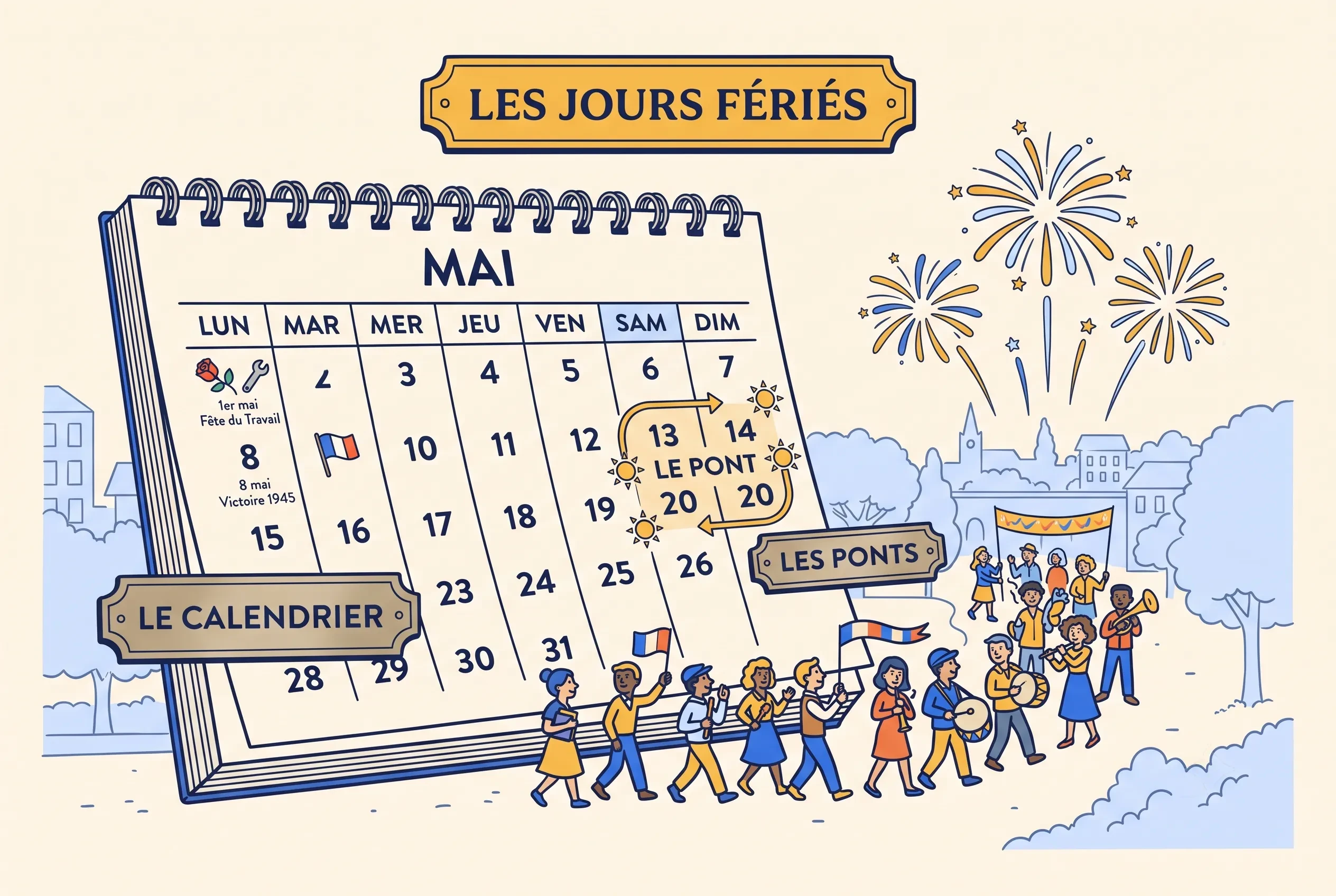
A public holiday does not mean every business closes, and some dates differ by region. Use the overview to understand the calendar, then check the opening hours and local arrangements relevant to your plans.
What French public holidays close that UK and US holidays leave open
For many English speakers, the first real shock of French public holidays is not the holiday itself but the level of closure around it. In the UK and especially in the US, a holiday often means reduced hours, some offices closed, and plenty of normal commercial life continuing. In France, a jour férié often means something much stronger: a collective pause. Banks close. Government offices close. Many shops close. Transport runs differently. Some towns feel deserted.
That difference matters because many newcomers keep treating French public holidays as if they were only symbolic. They are not. They have real scheduling power. They can make a work week collapse, shift meeting culture, distort business response times, and create whole mini-vacation periods when combined with weekends.
Once you understand that jour férié implies real operational consequences, the culture starts making more sense. And this is part of a larger French pattern: systems are expected to rest. Constant availability is not the ideal. That same cultural logic appears in work-life boundaries, long lunches, vacation culture, and the relative seriousness of time off.
This is why French holiday awareness is not just trivia for tourists. It matters for business travel, remote collaboration, apartment logistics, appointments, school schedules, and daily life in France. The same practical adaptation mindset also shows up in surviving a first French phone call and handling administrative situations like opening a bank account, because the real challenge is often not language alone but understanding the rhythm of the system you are dealing with.
The 11 official French public holidays
France has 11 official nationwide public holidays. Some are fixed dates. Others move because they are tied to Easter. Several are religious in origin, which surprises many English speakers because France is officially secular. But French secularism does not erase historical Catholic structure from the calendar. It simply coexists with it.
1. Jour de l’An: January 1
New Year’s Day is quiet, family-oriented, and logistically dead for most normal errands. The real social event is often the réveillon on the night of December 31, but January 1 itself is still a formal holiday and not a good day for expecting services to operate normally.
2. Lundi de Pâques: Easter Monday
Easter Monday extends Easter weekend rather than concentrating everything into Easter Sunday. This makes sense inside French labor logic because Sunday is already socially special. The Monday creates a more visible holiday effect in work and school calendars.
3. Fête du Travail: May 1
Labor Day is one of the most powerful closure days in France. It is associated with workers’ rights, union tradition, and the lily of the valley flower, muguet, which people give for luck. It is also one of the worst possible days to assume normal commerce will continue.
4. Victoire 1945: May 8
This holiday marks the end of World War II in Europe. For many English speakers, May 8 does not carry the same reflexive recognition as it does in France. But in French historical memory it matters deeply, and it has practical calendar effects beyond its symbolic role.
5. Ascension: moving Thursday
Ascension is one of the most operationally important French holidays because it always falls on a Thursday. That almost automatically creates the possibility of a bridge to the weekend. This is one reason Ascension is not just a religious holiday on the calendar but a structural event in French scheduling culture.
6. Lundi de Pentecôte: Whit Monday
Pentecost Monday is slightly complicated in practice because of labor arrangements around the “solidarity day” concept, but it still matters culturally and logistically enough that it should always be treated as a serious calendar marker.
7. Fête Nationale: July 14
Bastille Day is France’s national holiday and one of the most publicly visible holidays of the year. Parades, fireworks, dances, and civic ceremony make it feel more collectively performed than many other French holidays. In 2026 the Paris fireworks moved off the 14th entirely, for reasons that had nothing to do with the calendar: read why the capital rearranged its national day around a Franco-American anniversary.
8. Assomption: August 15
Assumption sits in the middle of the French summer holiday period, which means that even beyond the holiday itself, you are operating inside the broader August vacation culture that already affects work and city life.
9. Toussaint: November 1
All Saints’ Day is quieter and more reflective. It is associated with family cemetery visits and chrysanthemums. It is not a playful autumn holiday in the American Halloween sense.
10. Armistice 1918: November 11
This marks the end of World War I and remains solemn in tone. It is part of France’s public relationship with remembrance and war memory, which has different historical depth than in countries where the wars were not lived on national soil in the same way.
11. Noël: December 25
Christmas is major, but with an important cultural nuance: Christmas Eve often carries more ritual meal importance than English speakers expect, while December 26 is not a national French holiday the way Boxing Day matters in the UK.
These greeting phrases matter because French holiday wishes are often reciprocated rather than merely acknowledged. A bare “merci” can feel a little thin if someone offers a festive greeting warmly. Mirroring the greeting is usually safer.
Carry the phrases, not just the calendar
You just picked up the greetings and everyday phrases that keep French holidays running smoothly, from Bonne année to les magasins sont fermés pour le jour férié. Our free survival-phrase cheat sheet keeps a hundred lines like these in one place, ready for shops, transport, and small talk anywhere in France. Enter your email and the free 100 French Survival Phrases downloads right away.
Why May is a scheduling disaster in France
If one month teaches foreigners to respect the French holiday calendar, it is May. May is where several public holidays cluster, often creating broken weeks, long weekends, and a national atmosphere of partial disappearance. Trying to schedule anything important in France in May without checking the calendar is one of the most common avoidable mistakes made by English speakers, especially in business.
May 1 and May 8 are fixed. Ascension usually lands in May. Pentecost often lands close enough to continue the feeling of fragmentation. Add weekends, school breaks in some contexts, and the French instinct to maximize holiday continuity when possible, and May stops behaving like a normal work month.
⚠️ Practical rule: if something is important, avoid scheduling it in France in May unless you have already checked the holiday layout and confirmed the availability of the people involved.
What “faire le pont” means and why it matters so much
The concept that confuses English speakers most is probably faire le pont, literally “to make the bridge.” This means taking an extra day off between a public holiday and the weekend, usually when the holiday falls on a Thursday or Tuesday, in order to create a longer continuous break.
For English speakers, this can sound like an improvised trick. In France, it is much more normalized than that, especially around certain holidays. Entire teams or businesses may effectively assume the bridge. Schools may be affected. Small companies may close. The French Briefing covers these calendar disruptions in real time when they hit.
💡 Best question before scheduling: Y a-t-il un pont ce jour-là ?: “Is there a bridge that day?” This instantly shows you understand how French holiday rhythm really works.
What actually closes on French public holidays
One of the most useful things to know is not just which days are holidays, but what those days do to everyday services. The answer is not identical for every holiday, but there are strong patterns.
Usually closed
- Banks
- Post offices
- Government offices and administrative services
- Most schools
- Many non-touristic shops
- A large number of restaurants outside major tourist zones
May remain open, but not normally
- Hospitals and emergency services
- Pharmacies on rotating duty schedules
- Some bakeries, often with reduced hours
- Some supermarkets in tourist or high-density areas
- Transport, but often on Sunday/holiday schedules
- Restaurants in major tourist cities, but with reduced options
Open does not mean open as usual. On a public holiday the Sunday hours take over, on the bus panel and on the shop door.
The Alsace-Moselle exception: when France is not uniform
France often presents itself as administratively centralized and nationally consistent, but there are exceptions. One of the most important holiday exceptions is Alsace-Moselle, where two extra public holidays exist because of historical legal inheritance from the period when those territories were under German control.
How to navigate French holiday culture intelligently as an outsider
- 1Check the holiday calendar before schedulingEspecially for May, summer, and year-end periods.
- 2Assume a holiday affects the day around itBridges, reduced staffing, slower responses, and altered schedules are common.
- 3Prepare the day beforeCash, groceries, medicine, and transport checks become more important than usual.
- 4Respect the tone of the holidayDo not treat a solemn remembrance day like a festive social occasion.
- 5Use the rhythm instead of fighting itFrench holiday culture makes more sense once you stop expecting constant availability.
💡 Best survival habit: twenty-four hours before any French public holiday, ask yourself what you might need tomorrow that will be harder to access. That one habit prevents a surprising amount of frustration.
Study glossary: French holiday vocabulary
| 🇫🇷 French term | 🇺🇸 English translation | 💡 Usage context |
|---|---|---|
| un jour férié | a public holiday | The standard term for an official holiday |
| faire le pont | to make the bridge | Taking an extra day off to extend a holiday |
| un pont | a bridge / long weekend extension | The extended break created around a holiday |
| fermé pour jour férié | closed for public holiday | Common sign on shops and services |
| horaires dimanche et fêtes | Sunday and holiday schedules | Used especially for transport |
| le réveillon | New Year’s Eve or Christmas Eve celebration | Important for year-end festivities |
| Bonne année ! | Happy New Year! | Standard seasonal greeting |
| Joyeuses Pâques ! | Happy Easter! | Easter greeting |
| Bonne fête nationale ! | Happy National Day! | Greeting for July 14 |
| Joyeux Noël ! | Merry Christmas! | Christmas greeting |
| les congés | time off / vacation days | Used for leave and days off |
| un jour chômé | a non-working day | Used in work and labor contexts |
French holidays make more sense once you stop expecting constant availability
French public holidays frustrate English speakers mostly when they are treated as inconveniences imposed on a system that should obviously stay open. But that assumption is exactly what French holiday culture does not share. In France, public holidays are part of a social rhythm that protects pauses, honors memory, preserves tradition, and legitimizes collective time off in ways many English-speaking countries have weakened. Once you understand that, the closures and long weekends stop looking random.
The practical outcome is simple: learn the dates, check the bridges, respect May, prepare the day before, and never schedule anything important blindly. And the holiday is never just the day itself, because in France it radiates outward into the days around it, the travel patterns around it, and the collective energy around it. That is the real calendar you need to read.
Prefer to keep it free today? Read the French Briefing →
The French Gamebook
Enjoy the French. Practise the tricky bits.
For English speakers practising French
After a film, a book or a cultural detour, spend a session on the mistakes you keep noticing. Choose a Gamebook lesson and check your answers as you go.
- 21 lessons with explanations
- 40 practice rounds · 2,000 questions
300 pages · Play on your computer or print
Get the Gamebook · $9 Read a preview before you buyOne payment · Instant PDF download
Try the French with someone who can reply.
Bring a sentence you found difficult. Ask a tutor to help you say it naturally, then try it in a short conversation.
Find a French tutor →Paid lessons. Compare tutors and prices before booking.
Affiliate link: we may earn a commission when you book.
📚 Keep building in the Learning Center
French Instagram Captions: Meanings and Pronunciation
Find French Instagram captions for travel, food, love and everyday moments. Check their meaning, tone and pronunciation before…
Read →French News for Beginners: Sources by Difficulty
Find French news sources suited to your reading and listening skills. Compare learner resources, authentic news and a…
Read →French TV Series to Learn French: Canal+ and Beyond
Compare French series by subject and listening difficulty, including Canal+ productions. Check legal availability and practise with scenes.…
Read →