
Updated on September 15, 2026
French Political Vocabulary: Elections and Government
Learn French vocabulary for elections, government, parliament and political debate. Compare key terms and translated examples from public life.
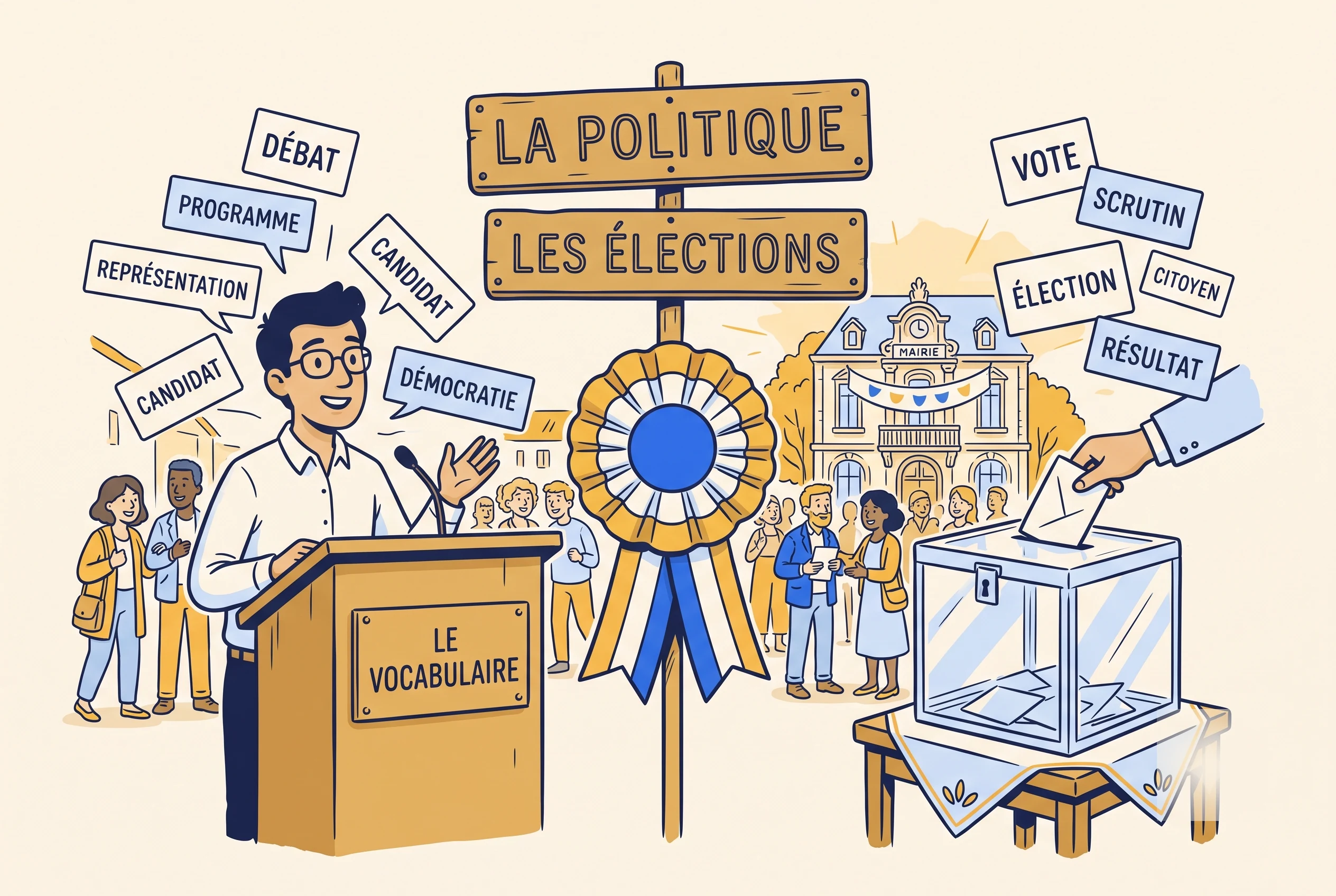
Political terms name institutions as well as positions in a debate. Learn the institutional vocabulary first, then compare the examples to understand who is acting and what a headline actually claims.
The executive branch: why France has both a president and a prime minister
Most anglophone professionals assume “le président” works like the American president or “le premier ministre” works like the British PM. Neither assumption holds. France runs a hybrid system called a semi-presidential republic, where the president holds supreme executive authority on foreign policy, defence, and institutional direction, while the prime minister handles day-to-day governance, parliamentary relations, and domestic policy implementation. The president is elected directly by citizens for a five-year term called “un quinquennat.” The prime minister is appointed by the president but must maintain the confidence of the National Assembly, meaning the PM can be removed by parliament even though the president chose them. This dual executive creates power dynamics that have no equivalent in purely presidential (US) or purely parliamentary (UK) systems.
The PM is NOT elected by citizens. The president appoints them. This confuses Americans who expect direct election for all top positions and confuses Brits who expect the PM to be the dominant figure.
Key ministerial positions include “le ministre de l’Intérieur” (Interior Minister, closest to Home Secretary), “le ministre des Affaires étrangères” (Foreign Affairs, equivalent to Secretary of State), and “le ministre de l’Économie” (Economy Minister, closest to Treasury Secretary). French media refers to these by their abbreviated names constantly.
French media uses “l’Élysée” and “Matignon” as metonyms for the president and PM respectively. “L’Élysée a déclaré…” means the president’s office said. “Matignon a répondu…” means the PM’s office responded. Knowing these shortcuts is essential for reading headlines in The French Briefing or any French newspaper.
La cohabitation: the concept with no English equivalent
Cohabitation occurs when the president and the prime minister come from opposing political parties. It happened three times in modern French history: 1986-88, 1993-95, and 1997-2002. During cohabitation, the president focuses on foreign policy and defence while the PM controls domestic affairs, creating institutionalised tension at the top of the executive. The 2000 constitutional reform that aligned presidential and legislative election calendars was specifically designed to make cohabitation less likely, but it remains theoretically possible and is a concept every French political commentator references when discussing power dynamics. If you read a French headline mentioning “cohabitation,” now you know why no translator can hand you a one-word equivalent.
The legislative branch: Assemblée nationale, Sénat, and how laws actually pass
France has a bicameral parliament, but the power balance between the two chambers is nothing like the US Senate-House relationship. The Assemblée nationale (National Assembly) holds primary legislative power: 577 députés elected directly by citizens for five-year terms in single-member constituencies using a two-round voting system. The Sénat (Senate) reviews and amends legislation but is subordinate: 348 sénateurs elected indirectly by local officials for six-year terms. When the two chambers disagree, the Assemblée nationale has the final say on most legislation. This asymmetry means that following French political news requires tracking the Assemblée far more closely than the Sénat.
Nobody in the street elects these 348. Local officials do, six years at a time.
Its counterpart houses the chamber that reviews, amends, and usually gives way:
“Le Palais Bourbon a voté…” means the National Assembly voted. Recognising palace names as institutional shorthand is essential for reading headlines.
How laws pass: the vocabulary of the legislative process
The legislative process has vocabulary that appears in every political news article. “Un projet de loi” is a bill proposed by the government. “Une proposition de loi” is a bill proposed by a member of parliament. The distinction matters because government bills receive priority scheduling and carry the executive’s political weight. Confusing the two reveals unfamiliarity with how the system works.
Miss this word and you will think the law that passed is the one that was first proposed.
American English files everything under executive order. French keeps two words, and the legal weight is not the same:
L’article 49.3: the nuclear option. This constitutional provision allows the prime minister to pass legislation without a parliamentary vote. The bill is considered adopted unless the Assemblée passes a motion de censure (no-confidence motion) within 24 hours. It is controversial, frequently used, and guaranteed to appear in every French political discussion. Elisabeth Borne used it eleven times on the 2022 budget bills alone (and once on the 2023 pension reform). When someone mentions “le 49.3,” they are talking about executive overreach vs parliamentary gridlock, and everyone in the room has an opinion.
The president can dissolve the Assemblée and force new legislative elections. Macron did this in June 2024 after the European election results. The decision shocked France and reshaped the parliamentary balance entirely. This vocabulary was on every French screen for weeks.
The entire institutional architecture described above rests on the Constitution of the Fifth Republic, established in 1958 specifically to give the president enough power to govern without parliamentary paralysis. Professionals who understand why the Fifth Republic was designed this way grasp the logic behind 49.3, cohabitation, and the presidential dominance that puzzles anglophones accustomed to separated powers.
Elections and the voting system: how the two-round system changes everything
The French electoral system uses a two-round format for both presidential and legislative elections. In the first round, all candidates compete. If no candidate wins more than 50% of the vote (which almost never happens in presidential elections), the top two candidates face each other in a second round two weeks later. This system fundamentally changes political strategy compared to American winner-take-all: French voters can vote their conscience in the first round (supporting a minor party or protest candidate) and vote strategically in the second round (choosing the “lesser evil” between two frontrunners). The common French expression “au premier tour on choisit, au second tour on élimine” (in the first round you choose, in the second round you eliminate) captures this logic perfectly.
Election night talk runs on these two words from the moment the first estimates flash on screen:
The physical voting process
French voting is physical in a way that surprises anglophones used to electronic systems. You enter the polling station, pick up printed ballot papers for each candidate from a table, enter the voting booth (l’isoloir), place your chosen ballot in an envelope, then deposit the envelope in a transparent ballot box (l’urne) while the official announces “a voté” (has voted). The transparency of the box, the physical act of choosing paper ballots, and the public announcement are deliberate design choices meant to reinforce democratic participation as a visible civic act.
The envelope drops into the transparent box, the official calls it out, and the whole room hears.
“Voter blanc” is a deliberate political statement in France: showing up, taking a ballot, putting it in the box empty. It says “I participated but rejected all candidates.” French media reports blank vote percentages separately from abstention rates, and high blank vote numbers generate their own political commentary. This distinction matters for reading election night coverage.
Anglophone professionals consistently ask the same question during election season: why does the outcome of the first round matter if a second round always follows? Because the first round reveals the real political landscape. Who is rising, who is collapsing, which alliances form between rounds. The second round is binary. The first round is the diagnostic.
This concept became central in 2002 when Chirac faced Le Pen, and again in 2017 and 2022 when Macron faced Marine Le Pen. The phrase appears in every election cycle and is essential for understanding second-round dynamics.
Political parties and the French spectrum: why “libéral” doesn’t mean what you think
The French political spectrum runs from extreme left to extreme right with more distinct positions than the American two-party system allows. Centre-left, centre-right, far-left, far-right, ecologist, centrist: each occupies a recognisable position with specific vocabulary, historical references, and cultural associations. French parties also change names, merge, split, and rebrand with a frequency that confuses even French voters. The spectrum vocabulary is permanent even as party names shift.
None of these three tells you who is in charge this year, which is exactly why they outlast the party names.
Current major formations from left to right: La France Insoumise (radical-left / left-populist, Mélenchon), le Parti Socialiste (centre-left), Les Écologistes (ex-Europe Écologie Les Verts; green/left), Renaissance (centrist, presidential party, Macron), Les Républicains (centre-right conservative, historically Gaullist), Rassemblement National (far-right, Marine Le Pen, formerly Front National). These names change frequently: the Rassemblement National was called Front National until 2018, the presidential party has been renamed three times since 2016. Learning the position vocabulary (gauche, droite, centre, extrême) is more durable than memorising current party names.
The “libéral” false friend. In French politics, “libéral” means economically liberal: supporting free markets, privatisation, reduced government intervention. This is closer to American “libertarian” or British “classical liberal,” NOT American “liberal” (which translates as “de gauche” or “progressiste” in French). Saying “je suis libéral” in France means “I support free-market capitalism.” This confusion derails cross-cultural political conversations constantly and produces genuine misunderstandings in professional settings.
The vocabulary that reveals your political awareness
Using the right party names signals that you follow French politics actively. Calling the Rassemblement National “le Front National” (its former name) reveals you have not updated your political knowledge since 2018. Using “la majorité” correctly (meaning the coalition supporting the president, not 50%+1) shows you understand parliamentary dynamics. Distinguishing “projet de loi” from “proposition de loi” tells French colleagues you understand how the system works, not just the words. These vocabulary choices function as competence signals in every professional conversation about French politics.
Campaigns, protests, and political discourse: the vocabulary of French public life
French political culture includes strikes, protests, and demonstrations as normal democratic expression, not exceptional events. “Une manifestation” (a demonstration) is a standard political tool that French unions, students, and citizens deploy regularly. “Une grève” (a strike) is constitutionally protected and culturally accepted in ways that surprise anglophones. Understanding this vocabulary means understanding that when your train is cancelled because of “un mouvement social” (industrial action), you are witnessing French democracy functioning as designed, not malfunctioning.
The poll tells you who is ahead. What tells you what they intend to do?
Official announcements reach for the second one precisely because it never names the stoppage.
“La réforme des retraites” (pension reform) is the phrase that has launched more protests than any other in modern French history. When French news says “réforme,” expect controversy. The word is never neutral in political context.
Laïcité is not just “secularism.” It is a foundational principle of the French Republic that affects school policy, public employment, political debate, and cultural identity. It appears in news headlines constantly and is the subject of ongoing national controversy. Understanding this word is understanding a fault line in French public life.
Discussion vocabulary for political conversations
French professional culture expects political awareness. Dinner conversations with clients, networking events, even office small talk routinely include political topics. Avoiding politics signals disengagement, not neutrality. The framing phrases below are what French speakers use to express, qualify, and challenge political positions in conversation. Using them correctly signals that you understand the register of intellectual exchange, not just the vocabulary of political institutions.
One step further, when you want to hold two positions in the same breath:
The weekly news habit that compounds. Follow one French political story per week through The French Briefing: same story, increasing vocabulary each week. Political vocabulary compounds faster than any other domain because the same terms recur across stories, creating natural spaced repetition that textbooks cannot replicate. With the 2027 presidential election approaching, every week of practice now pays double later.
Why political vocabulary is professional vocabulary in France
The executive who can discuss “la réforme des retraites” at a client dinner earns trust in ways that no amount of technical competence replaces. Political vocabulary is not optional for professional integration in France. It is the baseline of what educated adults are expected to know, and the absence of it creates a social gap that no business card compensates for. You do not need strong opinions. You need enough vocabulary to follow the conversation, ask informed questions, and demonstrate the cultural competence that French professionals associate with credibility.
Study glossary: essential French political vocabulary
| 🇫🇷 French | 🇺🇸 English | 💡 Usage context |
|---|---|---|
| Le président | The President | Head of state, supreme executive |
| Le Premier ministre | The Prime Minister | Head of government, appointed |
| Le quinquennat | The five-year term | Presidential mandate since 2000 |
| L’Assemblée nationale | National Assembly | Lower house, 577 députés |
| Le Sénat | The Senate | Upper house, 348 sénateurs |
| Un(e) député(e) | An MP | Directly elected representative |
| Le scrutin | The ballot / election | “Le scrutin présidentiel” |
| Le premier / second tour | First / second round | Two-round voting system |
| La gauche / la droite | Left / right | Political orientation |
| L’extrême droite | The far right | Rassemblement National |
| Une loi / un projet de loi | A law / a government bill | Legislative vocabulary |
| Une proposition de loi | A parliamentary bill | Proposed by an MP |
| La motion de censure | No-confidence motion | Can topple the government |
| La dissolution | Dissolution | President dissolves Assemblée |
| L’article 49.3 | Article 49.3 | Pass law without vote |
| Le front républicain | Republican front | Tactical anti-extreme alliance |
| Une manifestation | A demonstration | Standard democratic tool |
| Une grève | A strike | Constitutionally protected |
| La cohabitation | Cohabitation | President/PM from opposing parties |
| La laïcité | Secularism (French-specific) | Foundational Republic principle |
| Un sondage | A poll | “Les sondages donnent…” |
| Voter blanc | To cast a blank ballot | Deliberate rejection of all candidates |
That is the complete map. Not every French political word, just the ones that appear in headlines, debates, office conversations, and every election cycle from municipal to presidential. The 2027 presidential election will test every term in this article in real time.
Prefer to keep it free today? Read the French Briefing →
The French Gamebook
Check the small slips in otherwise good French.
For English speakers practising French
Use the Gamebook to revisit common mistakes, spot a gap and practise the point again. A review of the fundamentals to sit alongside your advanced reading and conversation.
- 21 lessons with explanations
- 40 practice rounds · 2,000 questions
300 pages · Play on your computer or print
Get the Gamebook · $9 Read a preview before you buyOne payment · Instant PDF download
Try the French with someone who can reply.
Bring a sentence you found difficult. Ask a tutor to help you say it naturally, then try it in a short conversation.
Find a French tutor →Paid lessons. Compare tutors and prices before booking.
Affiliate link: we may earn a commission when you book.
📚 Keep building in the Learning Center
French Instagram Captions: Meanings and Pronunciation
Find French Instagram captions for travel, food, love and everyday moments. Check their meaning, tone and pronunciation before…
Read →French News for Beginners: Sources by Difficulty
Find French news sources suited to your reading and listening skills. Compare learner resources, authentic news and a…
Read →French Podcasts on Spotify: Choose by Topic and Level
Explore French podcasts on Spotify by topic and listening difficulty. Find a manageable starting point and practise with…
Read →