Updated on September 15, 2026
Speaking French as a Shy Beginner: Practical Steps
Practise speaking French through small, manageable exchanges. Find starter phrases, rehearsal methods and a gradual plan for shy beginners.
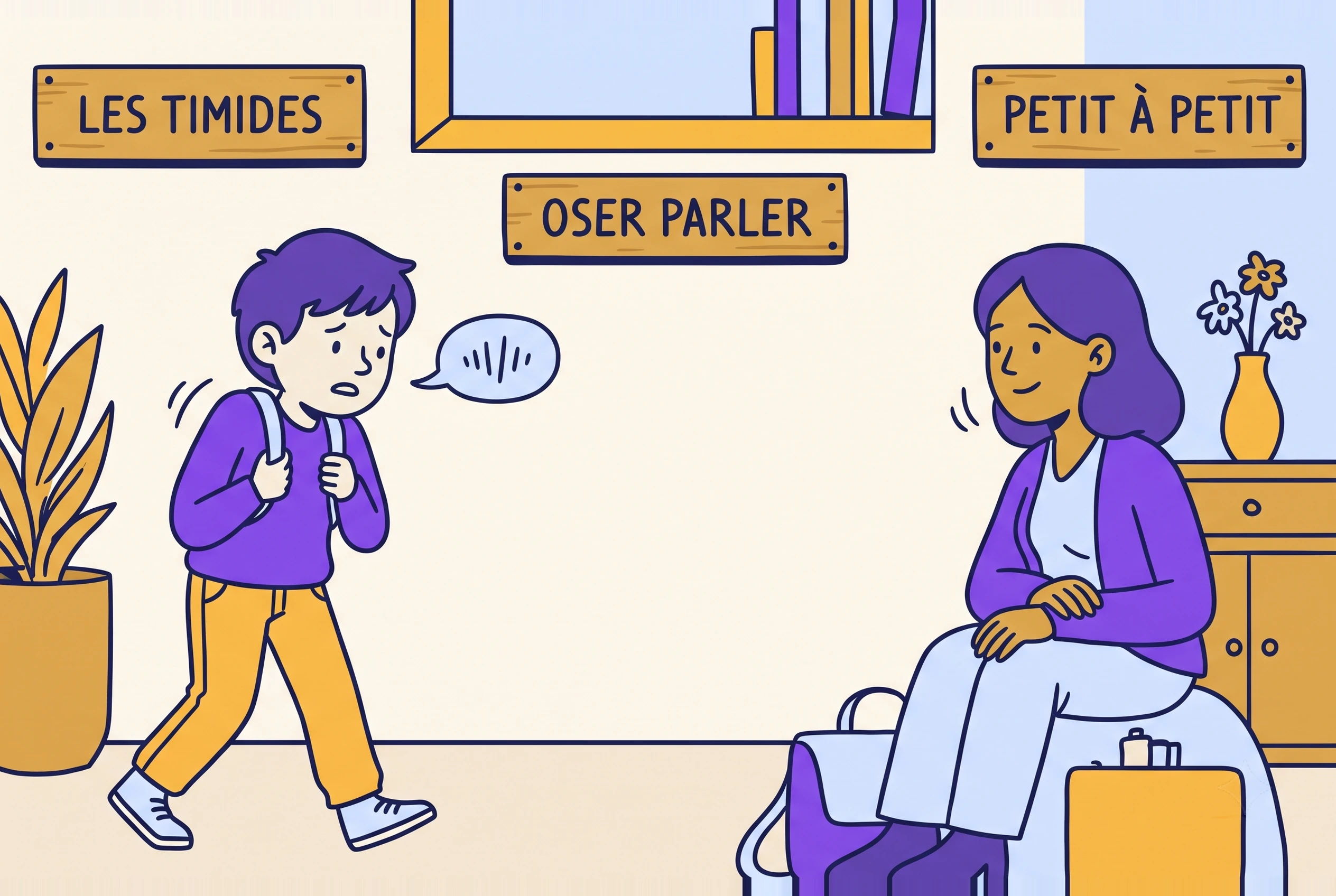
A short exchange is a useful practice task in its own right. Begin with a situation you can rehearse, prepare a way to ask for repetition and increase the challenge gradually as the routine becomes familiar.
The freeze that stops shy beginners who already know the words
Shy beginners do not stay silent because they are lazy, passive, or not serious. They stay silent because the speaking moment hits the brain like a small emergency. Vocabulary retrieval slows down. Working memory narrows. The sentence collapses halfway through. Then shame finishes the job. This is not a character flaw. It is a nervous system response. It happens to smart, motivated, hardworking people who would be perfectly articulate in English but cannot access their own knowledge when someone is looking at them and waiting.
The usual advice, “just speak more,” is like telling someone afraid of heights to “just relax on the ladder,” when willingness was never the missing piece. Not wrong. Useless. Fear reroutes your brain into monitoring danger instead of building sentences, so you cannot retrieve French cleanly, and then you misread that failure as proof you are not ready to speak. And you wait longer. And the avoidance gets stronger.
This is worth hearing clearly
If you understand French better than you speak it, that is not failure. That is normal. Comprehension always runs ahead of production. The gap is what the listening built, and it stays open until the speaking gets practice of its own.
The thing nobody says: this is not just about French
Many people who freeze in French also freeze in other situations: job interviews, phone calls, asking for directions, speaking up in meetings, returning something at a store, ordering at a restaurant when the waiter seems impatient. These are not separate problems. They are the same pattern in different rooms. French just makes it more visible because you have the added pressure of a second language on top of the social anxiety you were already managing.
That means fixing only the French part will not fix the pattern. And fixing only the anxiety part will not teach you French. You need both. And the good news is: working on one genuinely helps the other. Every time you survive a small French interaction, you are also training your nervous system that speaking up is survivable. That transfers. You spoke at the counter, the catastrophe you imagined did not arrive, and the meeting where you never speak up is the next room on that list.
Have the phrase ready before you open your mouth
You understand far more French than comes out when someone is standing there, waiting. A printable sheet of the phrases you actually need keeps them in one place, so you can pre-decide what to say and glance at it before you walk in. Enter your email and the free 100 French Survival Phrases sheet downloads right away.
Techniques that work in life, not just in French class
These are not “language hacks.” They are nervous system management tools that happen to make French speaking possible. If you struggle with social situations generally, these will help you beyond the language.
The 3-second rule: speak before your brain negotiates you out of it
When you feel the impulse to say something in French, you have about three seconds before your brain starts generating reasons not to. “Maybe I’ll get the gender wrong.” “They probably speak English.” “I should practice more first.” “They look busy.” That internal negotiation feels like careful thinking. It is actually avoidance dressed as preparation. The technique: when the impulse appears, count to three and open your mouth before you feel ready. The sentence does not need to be perfect. It needs to exist. Readiness is a feeling that arrives after you speak, not before.
Pre-decide what you will say, every single time
Shy people freeze partly because the moment requires both a social decision (should I speak?) and a language decision (what do I say?) at the same time. That is two cognitive loads stacked on top of anxiety. The fix: remove the language decision entirely. Before you enter the bakery, you already know you will say “Bonjour, une baguette tradition, s’il vous plaît.” Before you sit down at the café, you already know it is “Un café allongé, s’il vous plaît.” Before you reach the hotel desk, it is “Bonjour, j’ai une réservation au nom de [name].” This is not cheating. This is what confident speakers do unconsciously. You are just doing it deliberately until it becomes automatic.
Write it on your phone. Literally. Open your notes app, write the sentence you plan to say, read it three times, then walk in. Nobody will know. And by the third time, you will not need the phone.
Lower your success metric to something you can actually win
Most shy learners set an invisible standard of “say it perfectly and sound natural.” That standard is impossible at A1, and because it is impossible, every interaction feels like a failure, which makes the next one harder. New metric: did I open my mouth in French today? Not “did I sound good,” not “did they understand immediately,” not “did I use the subjunctive correctly.” Yes or no. If you spoke, you won today, and everything else is bonus. It sounds absurdly simple and it works for exactly that reason: confidence is not what gets you to speak, it is what a pile of small wins leaves behind.
Use the “worst case” technique before scary interactions
Before a French interaction that makes you anxious, ask yourself: what is the actual worst thing that could happen? You mispronounce something. The person switches to English. You forget a word and there is an awkward pause. That is the worst case. An awkward pause, and you have survived thousands of those already in English. Your brain treats French speaking like a threat because it has not yet accumulated enough evidence that the threat is survivable. Your job is to give it that evidence. One tiny interaction at a time.
The post-interaction reframe: what you tell yourself after matters more than the interaction itself
Shy people tend to replay interactions and focus on what went wrong. The mispronounced word. The hesitation. The confused look on the other person’s face. That mental replay is not neutral. It is training your brain to associate French speaking with failure. The reframe technique: immediately after a French interaction, deliberately name one thing that went right. “I said bonjour first.” “I ordered without switching to English.” “They understood me.” “I asked them to repeat instead of giving up.” It does not need to be impressive. It needs to be true. Over time, this rewires what your brain stores as the outcome of speaking French. Instead of “that was embarrassing,” it becomes “that was hard and I did it.”
You are not behind. You are building something real.
The people who look confident in French were not born that way. They got a word wrong at a counter, lost the next one halfway through a sentence, and felt stupid in meetings and on phone calls. The difference is they kept going, and talent had nothing to do with it: they refused to let the awkward phase become permanent. You are in the awkward phase. It is temporary. But only if you keep moving through it.
The first phrases shy beginners should use in real life
You do not start by “having conversations.” You start by proving that tiny French interactions can go well. That lowers the emotional cost of opening your mouth next time.
These are not “lesser” French. In France, the politeness system is the foundation of every interaction. Saying bonjour when you walk in and au revoir when you leave is social infrastructure: skip it and the rest of the exchange starts on the back foot. And it is the easiest win a shy beginner can get because these words are short, always correct, and universally appreciated.
Transactional French: the best training ground
Shy beginners improve faster when the conversation has rails. A café order. A bakery purchase. A simple request in a shop. These are not “lesser” speaking moments. They are the best possible speaking reps because the script is predictable and the social role is already defined.
Rescue phrases that keep you inside the interaction
When you freeze, you need backup language that keeps you in the conversation instead of ejecting you from it. Not apology spirals. Rescue tools.
These phrases are worth more than another 100 flashcards because they keep the conversation alive when your brain starts slipping. If the deeper problem is running every sentence through English before speaking, that translation reflex and the anxiety reflex feed each other. Fixing one helps the other.
What to do when you make a mistake and want to disappear
You will say the wrong article. You will mispronounce something badly enough that the other person squints. Good. The squint passes, you say pardon, you say it again, and the baker hands you the bread. The real skill is what happens in those three seconds.
What shy beginners do
Freeze, over-apologize, switch to English too fast, replay the mistake all day, use it as evidence they should wait longer.
What helps more
Acknowledge, correct if you can, keep moving, refuse to turn one mistake into a personal verdict. Then deliberately name one thing that went right.
Different shy learners need different strategies
Not all silence comes from the same place. Same surface problem. Different engine. Knowing which type you are changes which technique works fastest.
If you are a perfectionist
Your rule is “I’ll say it when I’m sure.” Replace it. New rule: if you are 70% sure, speak. 70% spoken beats 100% silent every time. The 10 most common mistakes are all survivable. None of them are fatal.
If you have social anxiety
Start with fixed roles, customer and server, passenger and ticket agent, student and teacher, since ambiguous social situations are harder than structured ones. The restaurant booking phrases and train ticket vocabulary are perfect because the script is almost the same every time.
If you are introverted
Do not force yourself into long exchanges. Convert the interactions you already have to French. Three short real moments are more sustainable than one long draining one. Solo practice matters too: shadowing a French podcast alone at home builds speaking reflexes without social cost. Watching a French show on Netflix with active repetition works the same way.
If you are a people-pleaser
You switch to English too quickly because you do not want to slow anyone down. That instinct feels polite. It is fear in a nice jacket. Basic French in a normal service interaction is not an unreasonable burden. The person behind the counter has heard worse French from native speakers who are just mumbling. You are fine.
If you are an expat and the stakes feel higher
When you live in France, every interaction feels like it counts because you are not just practicing. You are trying to build a life. The bank account, the apartment search, the préfecture paperwork, the phone calls. The anxiety is not irrational. The situations are genuinely important. What helps: prepare the specific vocabulary for each situation before you go. The Learning Center is organized by situation for exactly this reason.
Practice methods that bridge solo study and real life
Self-talk
Say what you are doing while you are doing it: je prépare le dîner, je cherche mes clés, je suis en retard. No audience, no stakes, and this is how automatic language starts building.
Shadowing
Repeat immediately after the audio, matching its rhythm and its melody, not to sound perfect but to get used to the physical act of speaking French without inventing every sentence. Copying is the point. Shadowing needs material short enough to use today, and the daily Briefing is that: read it, then say its sentences aloud. Longer audio only works when the level matches. Pick from the A1-A2 shortlist, ranked by difficulty, and B2 will not wash over you.
Recording yourself
Unpleasant at first. Useful fast. You hear where you hesitate, where you swallow endings, where you sound more frightened than confused. Then you redo it. This is much more valuable than endlessly imagining how you probably sound.
The solo-to-real-world bridge. Write one micro-script for a real situation. Read it aloud ten times. Record it twice. Then use it in a real place the same day. Preparation lowers fear. Same-day use turns preparation into progress.
Your 30-day plan if speaking French still feels terrifying
- 1Days 1-7: safety phrases onlyBonjour, s’il vous plaît, merci, excusez-moi, au revoir. Real places, real people, tiny stakes. That is it. Nothing else.
- 2Days 8-14: repeat one transaction dailySame coffee order, same bakery phrase, same checkout interaction. Remove novelty. Build automaticity.
- 3Days 15-21: add simple questionsWhere is, how much, do you have, can you repeat. Use the Paris survival phrases as your source. Do not chase complexity.
- 4Days 22-30: add one self-statement per interactionJ’apprends le français. C’est ma première fois. Je comprends un peu, mais je parle lentement. These open real interaction without requiring fluency. They are also covered in the introduction guide for different situations.
This works because the target is not confidence. Confidence is a side effect. The target is proof. Proof that the interaction can happen, that the mistake can be survived, that the next one does not need to be perfect either.
A note for people who feel like they are “too old” or “too slow” or “too far behind”
You are not. The person who starts at 25 feels behind the person who started at 18. The person who starts at 45 feels behind the person who started at 25. The person who starts at 65 feels behind everyone. And all of them are wrong. Because the only person you need to be ahead of is the version of you that did not start at all. French is not a race with a deadline. It is a skill that builds as long as you keep building it. The realistic timeline guide exists specifically to replace the fantasy timelines that make normal progress feel like failure.
If you picked up this article because speaking French genuinely scares you, you are already doing the hardest part. You showed up. You are reading a guide about the thing that frightens you instead of pretending it does not exist. That takes more courage than most people will ever give you credit for. So tomorrow, go say bonjour to someone in a shop or a bakery you were walking into anyway, and see what happens. Just once.
Study glossary: confidence-building French
| 🇫🇷 French | 🇺🇸 English | 💡 When to use it |
|---|---|---|
| J’apprends le français | I am learning French | Explains mistakes, invites patience |
| Je suis débutant(e) | I am a beginner | Sets expectations early |
| Je ne comprends pas bien | I don’t understand well | Signals a problem without panic |
| Vous pouvez répéter ? | Can you repeat? | Keeps the interaction alive |
| Vous pouvez parler plus lentement ? | Can you speak more slowly? | Manages fast speech |
| Comment dit-on… ? | How do you say…? | Asks for missing vocabulary |
| Je vais réessayer | I’m going to try again | Recovers after a mistake |
| Merci pour votre patience | Thank you for your patience | Acknowledges help warmly |
| Je cherche mes mots | I’m looking for my words | Buys time during a freeze |
| Je peux essayer en français ? | Can I try in French? | Opens the door with friendly people |
| Pouvez-vous écrire ça ? | Can you write that? | When listening breaks down |
| Je préfère parler simplement | I prefer to speak simply | Good mindset and good line |
Prefer to keep it free today? Read the French Briefing →
The French Gamebook
Give your study routine something to practise.
For English speakers practising French
Pick a lesson, play a round and note the mistakes you want to revisit. The Gamebook gives your next session a concrete task and answers to check.
- 21 lessons with explanations
- 40 practice rounds · 2,000 questions
300 pages · Play on your computer or print
Get the Gamebook · $9 Read a preview before you buyOne payment · Instant PDF download
Try the French with someone who can reply.
Bring a sentence you found difficult. Ask a tutor to help you say it naturally, then try it in a short conversation.
Find a French tutor →Paid lessons. Compare tutors and prices before booking.
Affiliate link: we may earn a commission when you book.
📚 Keep building in the Learning Center
French Learning Games for Adults: Pick a Format That Fits Your Life
French games for adults work best when the task feels useful and everyone can participate. Plan cooperative or…
Read →Learn French with a Game: Turn One Round into a Useful Study Session
To learn French with a game, choose one small language goal and make the rules serve it. Build…
Read →French Translation Mistakes: Checking Google Translate
Check French machine translations for context, idioms and register. Compare possible errors and follow a practical revision workflow.…
Read →