
Updated on September 16, 2026
French News Websites: Editorial Lines and Reading Level
Compare French news websites by editorial focus, access and reading demands. Choose an outlet and build a routine for understanding the news.
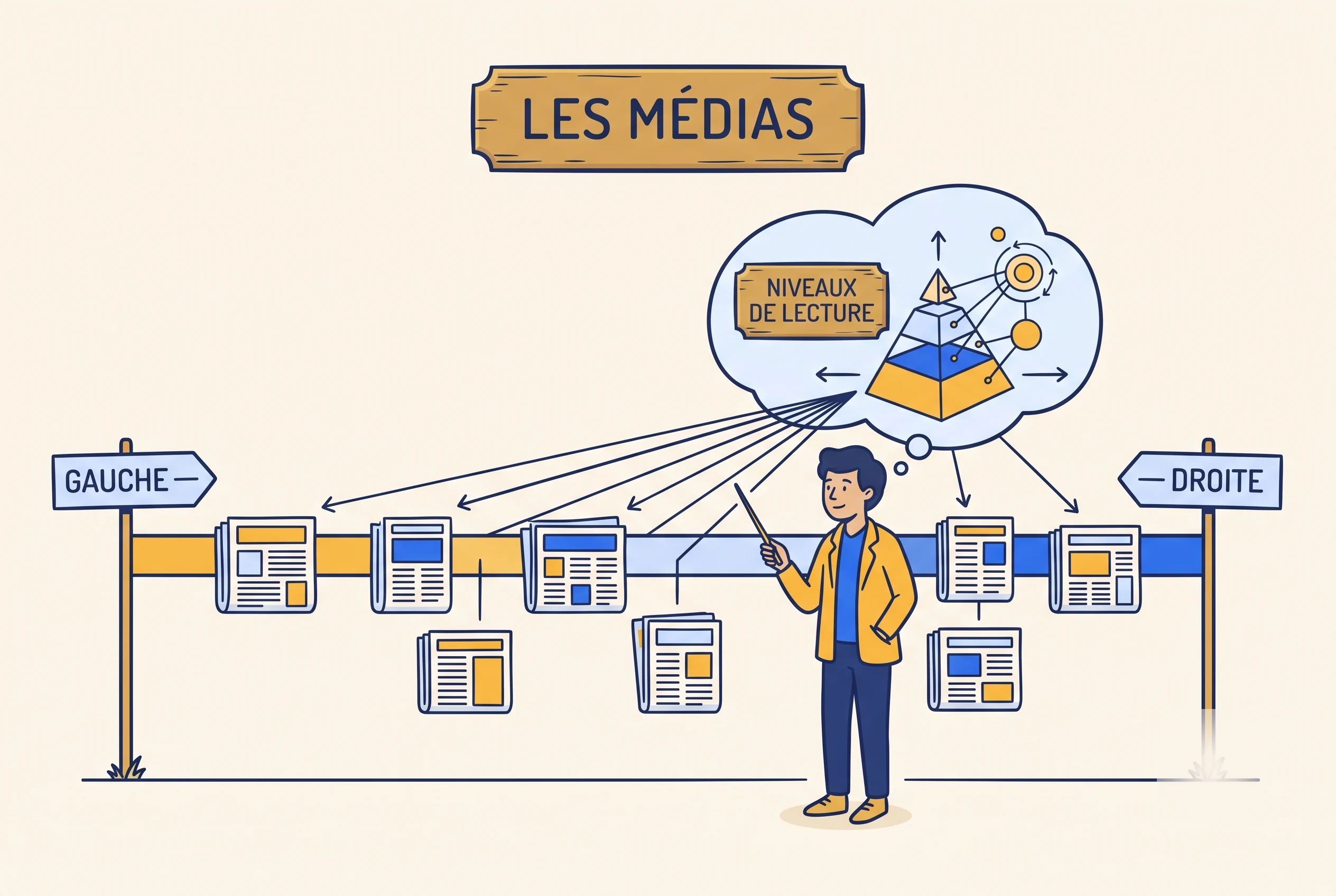
Editorial focus and reading difficulty are different questions. Compare the outlets as starting points, read more than one account of a story and check subscription terms before paying for regular access.
How the French media landscape differs from Anglo-American news
The Anglo-American ideal of strict journalistic objectivity barely exists in French media. French newspapers embrace clear political orientations, and readers select sources aligning with their perspectives rather than expecting one “neutral” outlet. This pluralism assumes informed citizens consume multiple sources. If you only read Le Monde, you get centre-left. If you only read Le Figaro, you get centre-right. Neither is wrong. Both are incomplete.
French journalism keeps reportage (news reporting), analysis (contextual interpretation) and éditorial (opinion) further apart than American media, where those boundaries blur. Knowing which one you are reading is what stops you taking an opinion for a fact. Print carries prestige here: the big papers set the agenda, and French intellectuals publish in them. So who is actually deciding? Every front page assumes you know: a directly elected president, a prime minister he appoints, an Assembly that can bring the government down. The full wiring diagram sits one page over.
Why reading French news accelerates learning
News vocabulary is the vocabulary of adult conversation in France. Politics, economics and society bring in terms no textbook prints, and they surface at every dinner table, every coffee machine, every argument about where the country is going. What this page gives you is where to read; scrutin, remaniement and the rest of that vocabulary are defined one term at a time, from the ballot to the reshuffle.
The full source map: every major French news outlet
Centre-left and progressive
| Source | Orientation | Level | Access | Best for |
|---|---|---|---|---|
| Le Monde | Centre-left, progressive | B2-C1 | ~5 free/month, €12.99/mo | Authoritative French, politics, culture, international |
| Libération | Left-wing, progressive | B1-B2 | Partial paywall | Cultural coverage, younger tone, accessible prose |
| Mediapart | Left, investigative | B2-C1 | Full paywall €11/mo | Investigative journalism, political scandals |
| L’Obs | Centre-left, social-democratic | B2 | Partial paywall | Weekly digest, longer-form analysis |
Centre-right and conservative
| Source | Orientation | Level | Access | Best for |
|---|---|---|---|---|
| Le Figaro | Centre-right, conservative | B2-C1 | ~limited free, €9.99/mo | Traditional journalism, literary sections, counterpoint to Le Monde |
| Les Échos | Centre-right, business | B2-C1 | Partial paywall | Business French, economics, finance |
| Le Point | Centrist, centre-right tendency | B2 | Partial paywall | Weekly format, balanced political analysis |
| Valeurs Actuelles | Far-right (national-conservative) | B1-B2 | Partial paywall | Understanding right-wing French discourse |
Centrist and neutral
| Source | Orientation | Level | Access | Best for |
|---|---|---|---|---|
| AFP | Neutral wire service | B1-B2 | Free | Factual reporting, concise prose, vocabulary building |
| France 24 | Centrist, state-funded | B1 | Completely free | Parallel FR/EN versions, international focus, video |
| franceinfo | Public service, balanced | B1-B2 | Free | Audio + text + video, educational approach |
| 20 Minutes | Mainstream, no strong lean | B1 | Free | Short articles, accessible vocab, daily habit |
Le Monde vs Le Figaro: same fact, two narratives
Read both on the same story and you see how identical facts become two distinct narratives depending on the editorial lens. Le Monde (centre-left, founded 1944, intellectual, dense) vs Le Figaro (centre-right, founded 1826, traditional, serious cultural sections). If reading Le Monde feels natural, you are B2+. Reading both on the same topic is the single best exercise for building political vocabulary and critical thinking simultaneously.
News sources ranked by reading level
A2-B1: start here
Journal en Français Facile (RFI) — ten minutes of daily audio news with full transcript. Simplified vocabulary, slow clear pronunciation. The single best entry point for French news as a learner. 1jour1actu — French children’s news, excellent for adult A2 learners. Complex topics explained without jargon. No shame in starting here: the French is real, and the vocabulary recurs in adult sources. France 24 — read in French, check in English. The lowest-pressure entry point for authentic adult French news.
B1-B2: expand here
20 Minutes and AFP for straightforward reporting. Libération for accessible left-wing prose. franceinfo for public service journalism that combines audio, text, and video. Which one to open first? The same four, ranked by difficulty, with a way into each. Those same stories arrive spoken too: BFM TV, franceinfo and LCI all stream free, and the channel map tells you which is which.
B2-C1: full landscape
Le Monde, Le Figaro, Mediapart, L’Obs, Les Échos — the complete spectrum. Read opinion pieces alongside news. Compare coverage across political orientations. Advanced reading means engaging with complex sentences, subtle connotations, and implied meanings that do not survive translation. The radio debates guide trains the oral version of the same register. Baron Noir dramatizes it.
Intermediate strategy. Start with France 24 or AFP for straightforward reporting, then progress to 20 Minutes or Libération. Use browser dictionary extensions for quick lookups without breaking reading flow. The jump from B1 to B2 in reading happens fastest through daily news exposure because the same terms recur across articles, creating natural spaced repetition.
Strategic reading techniques
Give the comparison a practical starting point. Choose a story from our latest French Briefing articles and use its context and French audio to get familiar with the topic. Then read coverage from one of the outlets above: compare the headline, the facts selected and the difference between reporting and opinion.
- 1Headline scanning — 10 minutes daily, 3 sources Rapid exposure builds vocabulary and current events awareness. Low pressure, high frequency. The daily habit that maintains French contact.
- 2Comparative reading — same subject, 3 orientations Le Monde + Le Figaro + AFP on the same story. See how framing changes meaning. Reinforces vocabulary through repetition while building media literacy.
- 3Vocabulary extraction by domain Maintain a notebook: politics, economics, society, culture, international. Le scrutin, l’Assemblée nationale, le remaniement, la grève, le pouvoir d’achat, la réforme, un sondage, la laïcité. Domain-organized vocabulary compounds faster than random word lists.
- 4Audio-text pairing France 24, franceinfo, and Le Monde all offer multimedia. Listen first, then read. Dual-mode exposure strengthens listening while text provides verification. The podcast guide adds more audio channels.
Paywall navigation. AFP, France 24, franceinfo, RFI, and 20 Minutes are completely free. Le Monde allows ~5 free articles/month. Many US public libraries provide free digital access to French newspapers through PressReader. Check your library’s digital resources before subscribing.
Fact-checking resources
Les Décodeurs (Le Monde) — political claims investigated. AFP Factuel — misinformation debunked. Both teach critical reading while building vocabulary through clear explanations.
Try 3 real Gamebook questions — answers included
From the book · no email needed
Three small choices. How would you answer?
Choose an answer in your head, then open the correction. These are questions 2, 3 and 10 from Round 1, “Arrival in Nice”, page 52. The explanations below are added for this preview.
1. Translate: “a suitcase”
- un valise
- le valise
- une valise
- la valise
Show answer & explanation
Valise is feminine. Une means “a”; la means “the”. Learn the noun with its article.
2. Translate: “She is 29 years old.”
- Elle est 29 années.
- Elle est 29 ans.
- Elle a 29 ans.
- Elle a 29 année.
Show answer & explanation
French uses avoir for age: elle a + a number + ans. English uses “is”, which makes this an easy habit to carry over.
3. Server: Bonjour. Vous désirez ? You want one coffee politely.
- Donne-moi un café.
- Je voudrais un café, s’il vous plaît.
- Je veux un café maintenant.
- Je voudrais une café, s’il vous plaît.
Show answer & explanation
Je voudrais makes a polite request, and café is masculine: un café. The other choices are too direct here or use the wrong article.
2,000 questions. 40 rounds. Click your answers in the PDF or print a round and grab a pen.
Play on your computer or print a round. Full refund within 30 days.
Study glossary: French news and media vocabulary
| 🇫🇷 French | 🇺🇸 English | 💡 Context |
|---|---|---|
| Un journal / un quotidien | A newspaper / a daily | Le Monde, Le Figaro = quotidiens |
| Un hebdomadaire | A weekly | L’Obs, Le Point = hebdomadaires |
| Les actualités / les infos | The news (formal / casual) | “Tu as vu les infos ?” |
| Un éditorial / une tribune | An editorial / an op-ed | Newspaper’s opinion vs external opinion |
| La une | The front page | “Faire la une” = make the front page |
| Selon | According to | The attribution word. You will read it 50 times per news session. |
| Le scrutin | Ballot / election | Every election article |
| Le remaniement | Cabinet reshuffle | Happens frequently in French politics |
| La grève | Strike | “Les cheminots sont en grève” |
| Le pouvoir d’achat | Purchasing power | Dominates every French election |
| La réforme | Reform (almost always controversial) | “La réforme des retraites” = pension reform |
| Un sondage | A poll | IFOP, IPSOS, BVA = major polling firms |
| La laïcité | Secularism (French-specific, untranslatable) | Governs debates on religion, education, identity |
| Un communiqué | A press release / official statement | “L’Élysée a publié un communiqué” |
| De gauche / de droite | Left-wing / right-wing | Political orientation |
| Une enquête | An investigation | Mediapart specialty |
The map is drawn. What is missing now is speed, and speed comes from three places: the sentence patterns French articles reuse every single day, the same stories read aloud on the evening bulletins, and the habit of reading without an English relay running underneath. Pick the one that matches tonight, not the one that sounds most virtuous.
Le Monde was founded in 1944, Le Figaro in 1826, and neither pretends to be neutral. Read both on the same story and the framing separates before the facts do. Le Monde gives you about five free articles a month, which is five comparisons, or one a week with one spare.
Prefer to keep it free today? Read the French Briefing →
The French Gamebook
Check the small slips in otherwise good French.
For English speakers practising French
Use the Gamebook to revisit common mistakes, spot a gap and practise the point again. A review of the fundamentals to sit alongside your advanced reading and conversation.
- 21 lessons with explanations
- 40 practice rounds · 2,000 questions
300 pages · Play on your computer or print
Get the Gamebook · $9 Read a preview before you buyOne payment · Instant PDF download
Try the French with someone who can reply.
Bring a sentence you found difficult. Ask a tutor to help you say it naturally, then try it in a short conversation.
Find a French tutor →Paid lessons. Compare tutors and prices before booking.
Affiliate link: we may earn a commission when you book.
📚 Keep building in the Learning Center
French Instagram Captions: Meanings and Pronunciation
Find French Instagram captions for travel, food, love and everyday moments. Check their meaning, tone and pronunciation before…
Read →French News for Beginners: Sources by Difficulty
Find French news sources suited to your reading and listening skills. Compare learner resources, authentic news and a…
Read →French News Vocabulary: Headlines, Quotes and Numbers
Read French news with vocabulary for compressed headlines, dates, numbers and attribution. Compare examples and identify the main…
Read →