
Updated on September 15, 2026
A 15-Minute French Routine for Busy Professionals
Build a manageable 15-minute French routine with listening, recall and speaking. Adapt the tasks to your level and track regular practice.
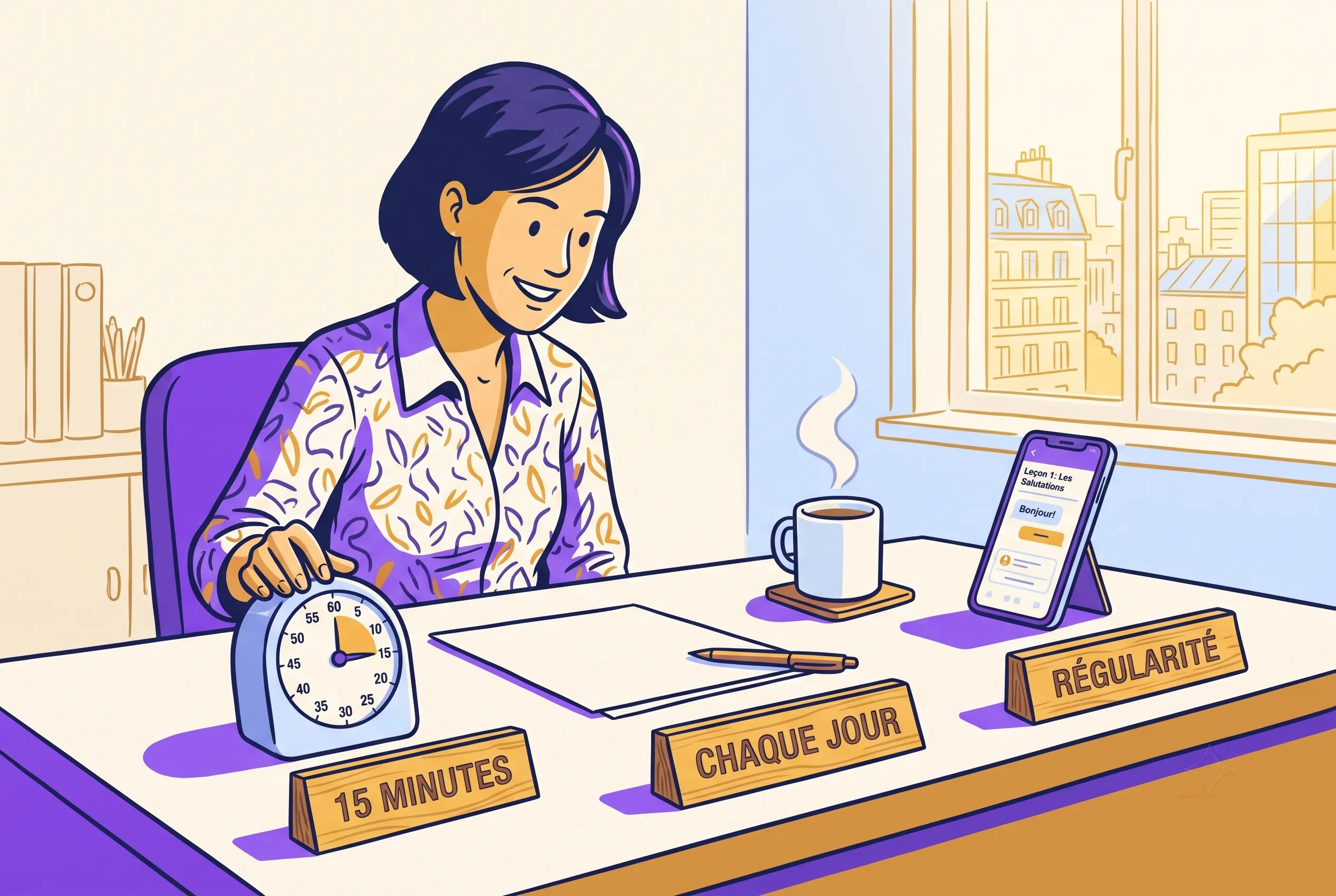
A short routine is useful when it is realistic enough to repeat. Divide the session into a few focused tasks and reuse familiar material. Adjust the difficulty and duration to fit your workday and learning needs.
Most French routines collapse after a few weeks, and the failure point is design
The failure point is rarely motivation. It is design. Most French learning plans are built for people with spare time, predictable energy, and enough cognitive margin to decide every day what to study. Busy professionals do not have that setup. They have fragmentation, interruptions, and a calendar that can destroy a habit by Wednesday.
The real bottleneck is not discipline
Main issue: too many decisions, too much friction, and sessions that are too long to survive pressure.
Practical consequence: the routine gets skipped for two days, then four, then quietly disappears while the app still sends cheerful reminders.
Why 15 minutes works better than longer study blocks
Longer does not automatically mean better. It often means harder to repeat. A 90-minute session feels productive once. A 15-minute session feels repeatable. Repetition wins. Fifteen minutes is too short to negotiate with and large enough to matter if it happens every day.
| Routine type | What it looks like | What usually happens |
|---|---|---|
| Big weekly block | One or two long sessions | Easy to cancel, hard to restart, progress feels unstable |
| App-only habit | Random exercises when convenient | Streak survives, speaking and listening often do not |
| Fixed 15-minute routine | Same structure every day | Lower friction, better retention, easier recovery after missed days |
The 15-minute French routine that survives real workdays
The routine has one job: remove choices. You are not deciding what to study every evening. You are running the same three-part sequence. Decision fatigue kills more language learning than difficulty does.
- 1Minutes 1-5: review practical vocabularyUse the Learning Center articles by situation (work, admin, travel, exams). Pick one article per week, review the glossary and .pair translations daily. No random browsing. Relevance increases repetition. Repetition increases retention.
- 2Minutes 6-10: listen to understandable FrenchThe French Briefing is built for this exact slot: daily, pre-selected, leveled, with a quiz to check comprehension. One segment, repeated if needed. Not a wall of native audio you cannot follow.
- 3Minutes 11-15: produce FrenchSay something out loud. Shadow an audio segment. Write 3-5 sentences. Record yourself for one minute. Output is where passive confidence gets tested. Use phrases from the article you reviewed in minutes 1-5.
Why this structure works with FTE content specifically
The three blocks map directly to the content ecosystem:
Your daily content pipeline
Vocabulary (min 1-5): choose the week’s article in advance, never inside the fifteen minutes. The Learning Center is filed by situation, work, admin, exams, travel, food, culture, so picking takes seconds: one article, its glossary, its .pair translations, its prose, reviewed daily for seven days. That is your source. No searching.
Listening (min 6-10): The French Briefing delivers daily. Pre-written, leveled, with a quiz built in. Listen to the French passages, then read them again. That is your listening. No hunting for podcasts.
Output (min 11-15): take the phrases you reviewed in minutes 1-5 and say them out loud. Describe your day using the vocabulary from that week’s article. Record yourself answering one of the Briefing quiz questions in a full sentence. That is your output. No app needed.
How to adapt the routine to your level
The structure stays fixed. What changes is the difficulty of the material inside it.
Beginner (A1-A2): make the routine embarrassingly simple
Use Learning Center articles from the Travel & Everyday or Language Foundations categories. Focus on survival phrases, basic present tense, introductions, dates, numbers, polite requests. Start with introductions, travel phrases, or politeness rules. For listening, the Briefing quiz at the end of each article gives you a daily micro-check. Take the Level Quiz first to confirm where you actually are.
Intermediate (B1-B2): from phrases to operating language
Use Learning Center articles from the Professional & Expat Life or Society & Culture categories. Focus on interview vocabulary, email and office register, business expressions, or admin situations. For listening, choose a short French recording about your field and listen again after checking the transcript. Your output block should shift from isolated phrases to short spoken summaries.
Advanced (B2-C1): refine speed, register, and accuracy
Use Learning Center articles on political vocabulary, exam strategy, or culture-heavy topics. For listening, choose a French interview or debate on the same topic. Your 5 minutes of output should become 5 minutes of deliberate speaking: summarize the Briefing in your own words, record yourself, listen back, correct. At this level, a small disciplined system prevents drift better than sporadic “immersion.”
Passive immersion that does not steal more time
Passive immersion is useful when it replaces something you already do in English. It is useless when it becomes another task on your list.
Passive immersion that helps
Repeatable audio, familiar topics, short segments, low-friction access. The Briefing during your commute. A Pass audio segment during a walk. An RFI Journal en français facile episode during housework.
Passive immersion that wastes time
Background noise you never process, content far above your level, or resources that require 10 minutes of searching before you press play.
The mistakes that quietly kill consistency
Using motivation as the engine. A routine powered by motivation works only on good days. Same slot, same sequence, same tools. Motivation can help but cannot be the fuel source.
Changing the method every week. A new app, a new channel, a new notebook and a new pronunciation hack all feel active, and the routine never runs long enough to generate evidence. Often it is disguised avoidance.
Measuring progress too emotionally. Some days French feels easier. Some days you feel clumsy. Neither feeling is a reliable metric. A better measure: is the routine still happening? Does yesterday’s audio feel slightly less opaque? Can you produce lines you could not produce last month?
Skipping output. Professionals stay too long in input mode because it feels efficient and low-risk. Output exposes the cracks. That is why it matters. If you skip the last 5 minutes, you are reviewing French, not building it.
Your 7-day rollout
- 1Day 1: Take the Level Quiz. Choose one fixed time slot and one backup.
- 2Day 2: Pick one Learning Center article for the week. Bookmark the Briefing.
- 3Day 3: Run the full 15 minutes even if it feels clumsy.
- 4Day 4: Repeat the same Briefing segment instead of chasing new material.
- 5Day 5: Say the final five minutes out loud, not silently.
- 6Day 6: Test whether the routine still works on a messy day.
- 7Day 7: Keep the structure. Change only the LC article if needed.
The only rule that matters tomorrow. Do the full 15 minutes before you try to improve the routine. A routine you run imperfectly is more valuable than a beautiful plan you keep redesigning.
Study glossary: work French for your first routine week
| 🇫🇷 French | 🇺🇸 English | 💡 When you’ll need it |
|---|---|---|
| La réunion | The meeting | Core workplace vocabulary |
| Le délai / l’échéance | The deadline / due date | Project planning and delivery |
| Le compte-rendu | The summary or minutes | Post-meeting follow-up |
| Le dossier | The file or case file | Administrative and project contexts |
| Le retour | Feedback or response | Email and collaboration language |
| Prévoir / valider | To plan / to approve | Scheduling and decision-making |
| Je vous envoie le document cet après-midi | I’m sending you the document this afternoon | Email standard |
| Je vous tiens au courant | I will keep you informed | Professional follow-up |
| Comme convenu | As agreed | Email and meeting recap |
| Pouvez-vous préciser ? | Could you clarify? | Meetings and calls |
| J’ai besoin d’un peu de temps | I need a bit of time | Buying time without sounding lost |
| Nous devons finir avant vendredi | We have to finish before Friday | Deadline communication |
Prefer to keep it free today? Read the French Briefing →
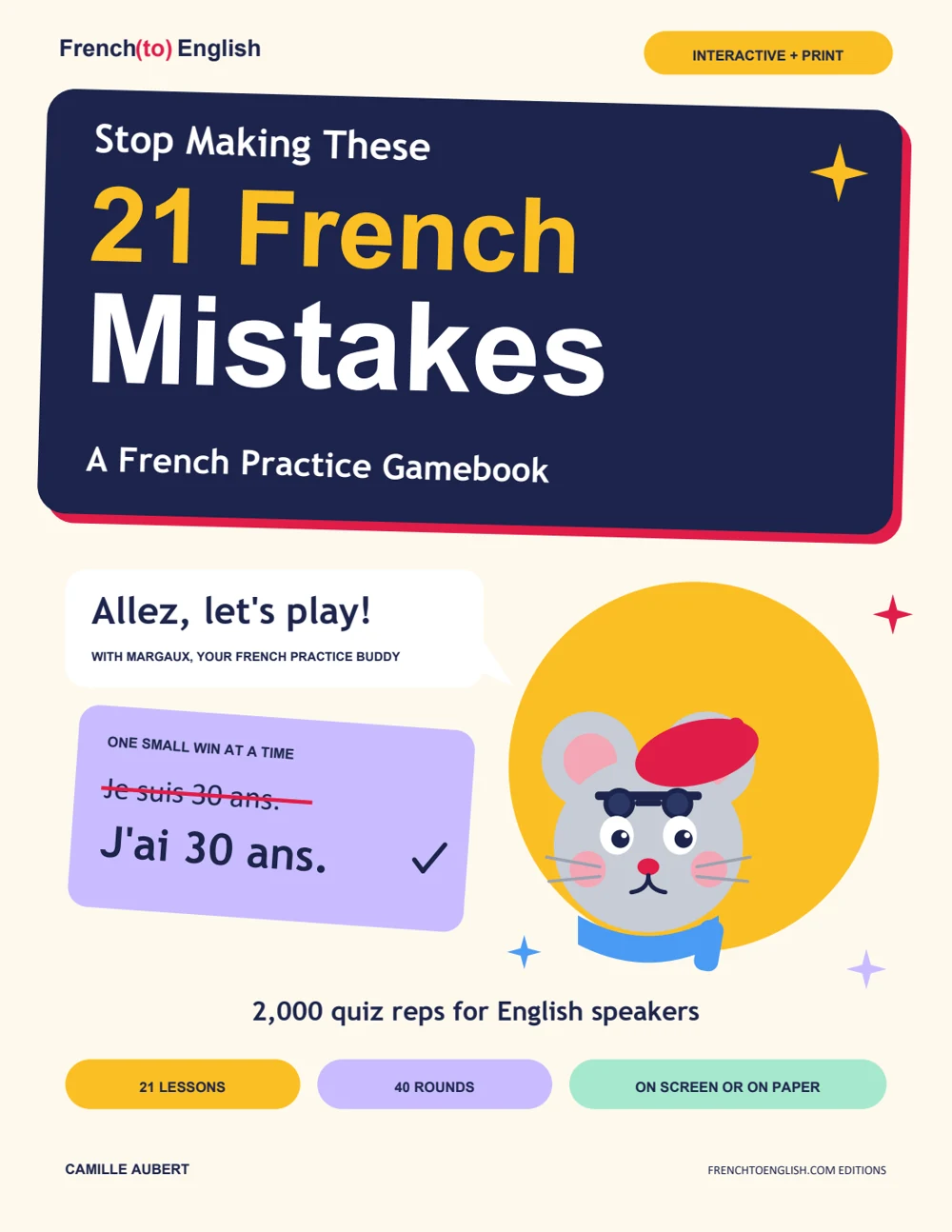
The French Gamebook
Check the small slips in otherwise good French.
For English speakers practising French
Use the Gamebook to revisit common mistakes, spot a gap and practise the point again. A review of the fundamentals to sit alongside your advanced reading and conversation.
- 21 lessons with explanations
- 40 practice rounds · 2,000 questions
300 pages · Play on your computer or print
Get the Gamebook · $9 Read a preview before you buyOne payment · Instant PDF download
Try the French with someone who can reply.
Bring a sentence you found difficult. Ask a tutor to help you say it naturally, then try it in a short conversation.
Find a French tutor →Paid lessons. Compare tutors and prices before booking.
Affiliate link: we may earn a commission when you book.
📚 Keep building in the Learning Center
French Learning Games for Adults: Pick a Format That Fits Your Life
French games for adults work best when the task feels useful and everyone can participate. Plan cooperative or…
Read →Learn French with a Game: Turn One Round into a Useful Study Session
To learn French with a game, choose one small language goal and make the rules serve it. Build…
Read →French Word Games: Five Ways to Practise More Than Spelling
French word games can help you notice spelling, word relationships and sentence choices. Explore activities for solo and…
Read →