
Updated on September 15, 2026
TCF vs DELF: Format, Validity and Which to Choose
Compare TCF and DELF by purpose, format and validity. Check which qualification your application accepts before choosing a test and preparing.
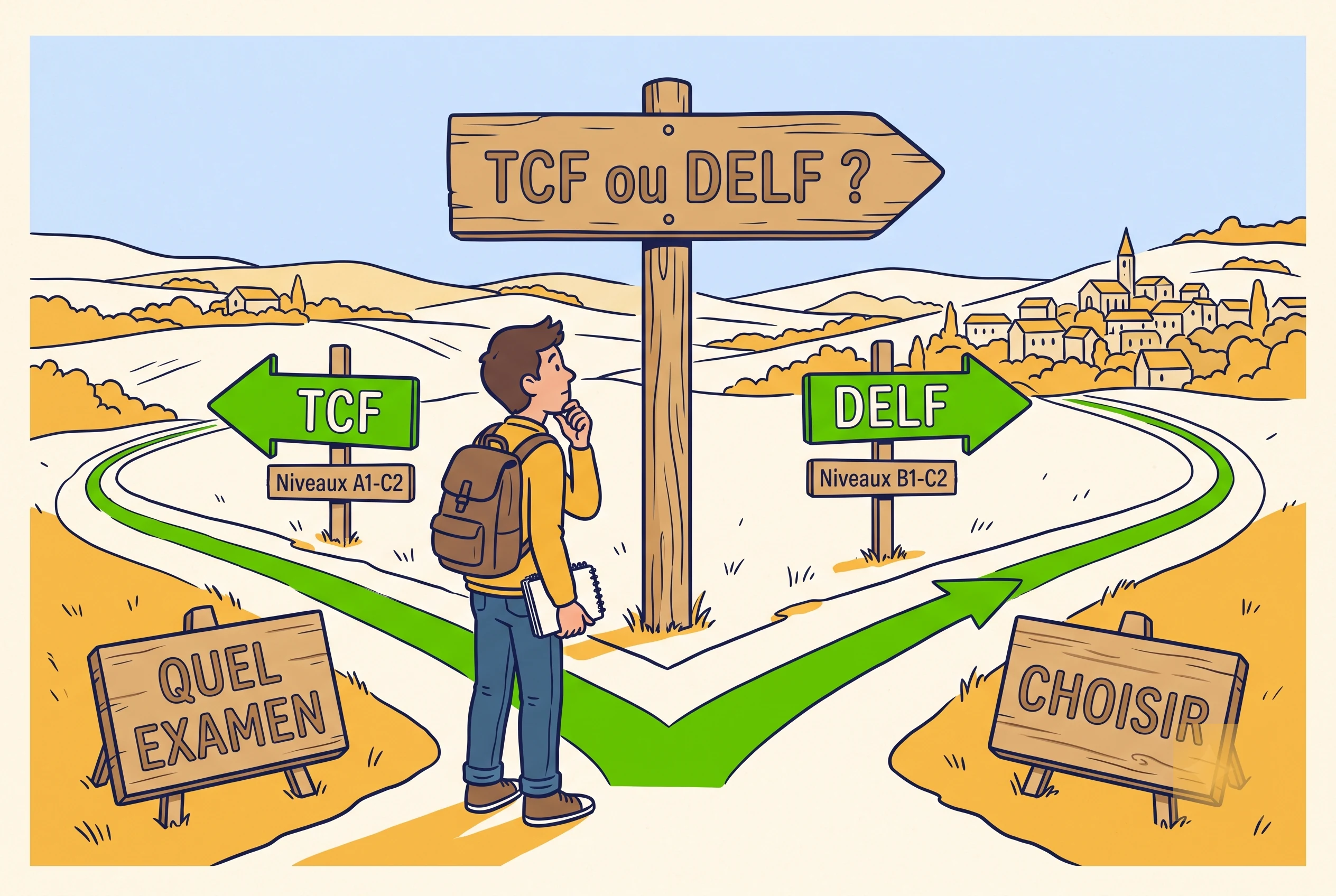
The purpose of your application comes before the choice of exam. Check the accepted test and version, then compare format and validity. Similar language levels do not make every certificate interchangeable.
The fundamental difference: diploma vs assessment
DELF is a diploma. You register for a specific level (A1, A2, B1, B2), you sit the exam, and you either pass or fail. If you pass, that diploma is yours permanently. It never expires. It is issued by the French Ministry of Education through France Éducation International and recognised worldwide. Once you have it, it works the same way ten years later as it did on the day you passed. The catch sits at registration: you name your level before anyone has tested it, and the fee is gone if you aim one step too high. Beginners should read the section-by-section breakdown of A1, pass thresholds included, before ticking that box.
TCF is a test. You take one standardised exam, receive a numeric score between 0 and 699, and that score places you somewhere on the CEFR scale. The resulting certificate expires after exactly two years from the date of results. It is also administered by France Éducation International. If you need recertification after the expiry window, you pay the full fee again, prepare again, and sit the exam again.
That distinction drives everything else. DELF gives you a diplôme. TCF gives you an attestation. The words themselves tell you which one lasts.
| Criteria | DELF | TCF |
|---|---|---|
| Type | Diploma (pass/fail per level) | Assessment (numeric score) |
| Validity | Lifetime | 2 years from results date |
| Levels tested | A1, A2, B1, B2 (one exam per level) | One test, score determines level |
| Skills tested | 4 (listening, reading, writing, speaking) | Varies by version (see below) |
| Pass threshold | 50/100 overall + minimum 5/25 per skill | No pass/fail. You get a score. |
| Format | Paper-based (most centres) | Computer-based or paper (varies) |
| Sessions | 2-6 per year (set by FEI national calendar) | Multiple per month (centre-dependent) |
| Results delay | 4-8 weeks after exam | 15 business days after FEI receives materials |
| Cost (France) | ~100-160€ depending on level and centre | ~160-250€ depending on version |
| Retake rule | No waiting period between attempts | 30-day mandatory wait between sittings |
Costs are not standardised nationally. Each centre sets its own tariff within a range. University centres in France tend to be cheaper (DELF B2 around 120-150€ for students). Alliance Française centres abroad are more expensive. In Canada, TCF Canada runs 340-450 CAD depending on province. Always check your specific centre. The only reliable way to find the exact price is the official FEI centre directory.
Which exam for which purpose: the decision tree
- 1Canadian immigration (federal or citizenship)?TCF Canada. Mandatory. 4 skills obligatory and inseparable. DELF not accepted by IRCC. Official TCF Canada page.
- 2Quebec immigration (CSQ)?TCF Québec. Modular: you can pass 1, 2, 3, or 4 skills separately. Different from TCF Canada. Recognised by MIFI.
- 3French naturalisation, carte de résident, or carte de séjour pluriannuelle?TCF IRN or DELF both accepted. But since January 2026: naturalisation = B2, carte de résident = B1, carte de séjour pluriannuelle = A2. Plus an examen civique is now mandatory. DELF never expires. TCF IRN expires in 2 years. If your application takes 12-18 months, TCF may expire before review. DELF is safer. The administrative French involved in these procedures overlaps with the broader bureaucracy vocabulary guide. Service-Public.fr (verified February 2026).
- 4French university admission?DELF B2 or TCF TP with B2 score. Both accepted. DELF B2 holders are permanently exempt from language testing for any future French university application. FEI confirms: DALF holders are dispensed from language tests for French university registration.
- 5Need certification in under 8 weeks?Check TCF availability first. Sessions run multiple times monthly. DELF sessions are set by a national calendar with 2-6 dates per year depending on the centre.
- 6Not sure of your level?TCF first as a diagnostic (your score tells you where you are). Then register for DELF at the confirmed level. Two exams, zero risk of choosing wrong. You can also start with the realistic French timeline to understand how long each CEFR level typically takes.
- 7None of the above, just want proof of French on your CV?DELF. Permanent. Clean. No expiry date to explain. “DELF B2” on a CV reads like a credential. “TCF B2 (2024)” reads like an expired test.
TCF versions: five exams that are NOT interchangeable
This is where real money gets wasted. The name “TCF” appears on five different exams that serve five different purposes. Test centres don’t always explain which version you’re registering for. Submitting TCF Tout Public for a process that requires TCF Canada gets your file returned without review. No refund on the exam fee. You start over.
| Version | Purpose | Skills tested | Key detail |
|---|---|---|---|
| TCF Tout Public (TP) | General proficiency, French university admission | 3 mandatory (listening, reading, language structures) + 2 optional (writing, speaking) | NOT accepted for Canadian immigration |
| TCF Canada | Canadian federal immigration (IRCC) + citizenship | 4 mandatory and inseparable | 30-day wait between sittings. Results in 15 business days. |
| TCF Québec | Quebec immigration (MIFI/CSQ) | 4 modular (can take 1-4 separately) | Different from TCF Canada. Quebec has its own immigration system. |
| TCF IRN | French naturalisation, carte de résident, carte de séjour pluriannuelle, CIR | 4 mandatory (listening, reading, writing, speaking) | Replaced TCF ANF + TCF CRF since January 2022. Evaluates up to B2 since May 2025. Duration: 1h35. |
| TCF DAP | Pre-admission to French universities (L1/architecture) | 3 mandatory + mandatory writing | Specific to first-year undergraduate admission. Administered by universities. |
The 200€+ mistake that happens every week. Someone preparing for Canadian immigration registers for TCF Tout Public instead of TCF Canada. The score is rejected by IRCC. The fee is lost. The preparation weeks are lost. The only way to prevent this: verify with the receiving institution (not the test centre) which exact version they require, then double-check the version name on your registration confirmation before paying.
January 2026 changes: the new French law that rewrites the rules
The loi n°2024-42 du 26 janvier 2024 (loi immigration) raised the required French levels for residency and citizenship in France. These new thresholds are applied by préfectures since January 2026:
| Procedure | Required level (since Jan 2026) | Previous requirement | Accepted certifications |
|---|---|---|---|
| Naturalisation | B2 | B1 | DELF B2, DALF, TCF IRN with B2, TEF |
| Carte de résident (10 ans) | B1 | A2 | DELF B1+, TCF IRN with B1, TEF |
| Carte de séjour pluriannuelle (first) | A2 | Not required | DELF A2+, TCF IRN with A2, TEF |
In addition, an examen civique is now mandatory alongside the language certification. It consists of 40 QCM questions on French values, institutions, rights and duties, history and culture, and life in society. It is a separate exam from the TCF IRN and must be passed for the file to be accepted by the préfecture.
Sources: Service-Public.fr (verified 10 February 2026) and France Éducation International (TCF IRN evolution announcement).
What this means concretely for certification choice
If you are pursuing naturalisation, the target is now B2. That is a significant jump from the old B1 requirement. A DELF B2 diploma is valid forever and eliminates the risk of your TCF expiring during the 12-18 month processing period. If you are pursuing a carte de résident, B1 is the new floor. If you are arriving in France and applying for your first carte de séjour pluriannuelle, A2 is now mandatory where it was not before. The examen civique adds a second exam to the process. Plan for both.
Transition rule. TCF IRN attestations issued before May 2025 evaluated up to B1 only. Since May 2025, the TCF IRN evaluates up to B2 to match the new naturalisation requirement. If you hold an older TCF IRN attestation showing B1, it remains valid for carte de résident (if still within its 2-year validity) but does NOT satisfy the new B2 naturalisation threshold. You would need to retake the updated version.
Format comparison: how each exam works on test day
DELF is paper-based in most centres. You can annotate, skip questions, and return to them. You get preparation time before the oral. The examiner adapts to your level within the section. You know exactly which level you are being tested on because you registered for it.
TCF is typically computer-based. Linear format: you cannot go back to a previous question once you move on. Listening recordings play once (DELF plays audio 1-2 times). TCF TP uses adaptive difficulty where correct answers trigger harder questions. TCF oral runs 3 tasks in about 12 minutes with minimal preparation time. DELF oral gives 10-20 minutes preparation depending on the level.
For people who manage time strategically and like reviewing their answers, DELF’s paper format is a genuine advantage. One difference outranks format anyway: TCF plays each recording once, DELF once or twice. Closing that gap means daily audio pitched at your real level, which is the sorting job done in our ranking of Spotify shows by level. For people who prefer steady-pace progression without time allocation decisions, TCF’s linear format removes that burden.
Long-term cost: the calculation nobody runs
Someone who needs French certification once pays roughly the same for either exam. Someone who needs it three times over a career pays ~480-750€ for TCF versus ~120-160€ for DELF. The gap widens with every retake because each TCF sitting requires full payment and fresh preparation. DELF is a one-time investment. Over a decade, the cost difference can exceed 500€ for the same level of proof.
The hidden cost of DELF: choosing the wrong level. If you register for B2 and fail, you lose ~150€ and must retake. TCF eliminates this risk because your score lands wherever your ability is. The dual strategy (TCF first as diagnostic, then DELF at the confirmed level) costs ~350€ total but provides both certainty and permanence. If you want to start building exam-ready French right now, the 15-minute daily routine is designed for people who need structure without spare time.
Common scenarios in one sentence
A student with a plan, an admissions page bookmarked, and two years between now and the first day of term.
Nobody enjoys admitting this, and it is the one answer here that sends you to a diagnostic before a diploma:
Study glossary: certification vocabulary
| 🇫🇷 French | 🇺🇸 English | 🎯 Why it matters |
|---|---|---|
| Le diplôme | Diploma (permanent) | DELF/DALF issue a diplôme. Valid for life. |
| L’attestation | Certificate (temporary) | TCF issues an attestation. Expires in 2 years. |
| La validité | Validity period | DELF = lifetime. TCF = 2 years from results date. |
| Le niveau CECRL | CEFR level | A1-C2 scale. The common reference for both exams. |
| S’inscrire | To register | Register via the centre, not via FEI directly. |
| La naturalisation | Naturalisation/citizenship | Now requires B2 (since January 2026). |
| La carte de résident | 10-year residency card | Now requires B1 (since January 2026). |
| L’examen civique | Civic knowledge exam | 40 QCM. Mandatory alongside TCF IRN since 2026. |
| Le centre d’examen agréé | Accredited exam centre | Only place to sit the exam. Find yours via FEI directory. |
| IRCC | Immigration, Refugees and Citizenship Canada | The Canadian authority that requires TCF Canada specifically. |
Prefer to keep it free today? Read the French Briefing →
The French Gamebook
Check the small slips in otherwise good French.
For English speakers practising French
Use the Gamebook to revisit common mistakes, spot a gap and practise the point again. A review of the fundamentals to sit alongside your advanced reading and conversation.
- 21 lessons with explanations
- 40 practice rounds · 2,000 questions
300 pages · Play on your computer or print
Get the Gamebook · $9 Read a preview before you buyOne payment · Instant PDF download
Try the French with someone who can reply.
Bring a sentence you found difficult. Ask a tutor to help you say it naturally, then try it in a short conversation.
Find a French tutor →Paid lessons. Compare tutors and prices before booking.
Affiliate link: we may earn a commission when you book.
📚 Keep building in the Learning Center
DELF B1 Exam Preparation: A 26-Session Framework You Can Adapt
A DELF B1 preparation plan should connect your available time with the four exam skills. Use a flexible…
Read →DELF B1 Practice Test: Find the Next Task Behind the Score
A DELF B1 practice test is most useful when you know what it measures and how to review…
Read →DELF B1: Understand the Exam and Choose Your Next Practice Task
DELF B1 preparation needs practice across listening, reading, writing and speaking. Understand the official task format and scoring,…
Read →