French Property Taxes for English Speakers: Taxe Foncière Explained (2026)
🌿 B1-B2
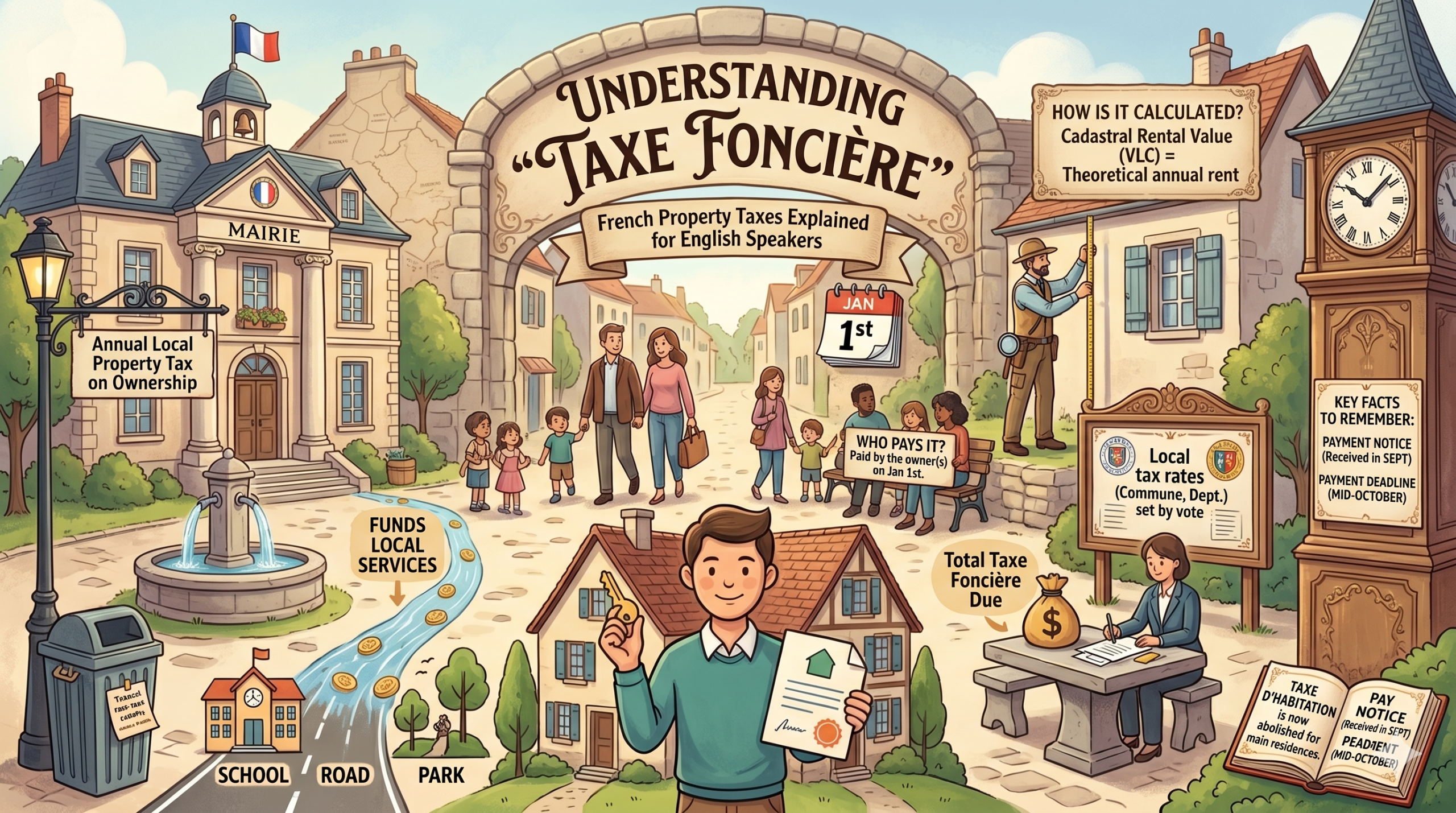
Most anglophone owners discover French property taxes the hard way: a notice arrives in late August, in administrative French, and the rules already moved while they were skim-reading. Here is how the taxe foncière actually works in 2026, what you will pay, and how it compares with the US, UK, and Canada.
Most anglophone owners who get burned by the French property tax system don’t get burned because the rates are high. They get burned because the bill follows ownership on 1 January, full stop, no proration. If you sell on 14 March, you still owe the entire 2026 taxe foncière. Buyer and seller usually split it privately in the deed, but the tax office only chases the registered owner. That detail breaks the mental model an American or British buyer arrives with.
Je suis propriétaire au 1ᵉʳ janvier 2026.I am the owner on January 1st, 2026.
That sentence, on the deed and in the tax office’s database, is the only legal trigger. Not your address. Not how many months you lived there. Not whether the property was rented, empty, or being gutted. The official source for everything that follows is impots.gouv.fr, available in English under the International tab. Bookmark it now, before the August notice arrives.
If the broader administrative landscape is still hazy, our guide to moving to France from the USA walks through visa, registration, and tax-residence basics in order. Property tax is one piece of a larger machinery, and it pays to see the machine.
Taxe foncière vs taxe d’habitation: stop confusing the two
France used to have two property-related taxes hitting nearly every home. Since 2023, the taxe d’habitation has been abolished on primary residences. It still exists on second homes (résidences secondaires), where about 3.7 million owners receive a bill each November, with an average around 1,125 €.
So in 2026, an English-speaking owner sits in one of three boxes: paying only taxe foncière (primary residence in France), paying both taxes (second home), or paying both plus a hefty surcharge (second home in a so-called zone tendue). Around 5,000 communes can now add a surtaxe of 5% to 60% on the taxe d’habitation for second homes. Coastal towns, ski resorts, Paris, and most of Brittany apply the maximum 60%.
Vous êtes redevable de la taxe d’habitation sur résidence secondaire.You are liable for the second-home occupancy tax.
Votre commune applique une majoration de 60%.Your commune applies a 60% surcharge.
Résidence principale, résidence secondaire, ou logement vacant ?Primary residence, second home, or vacant property?
Owner declaration trap. Every owner (resident or not) must declare the occupancy status of each property on impots.gouv.fr under Gérer mes biens immobiliers. Failing to update it triggers a 150 € fine per property, and any later tax adjustment falls on you.
Three pieces matter. The valeur locative cadastrale (VLC) is a theoretical annual rent that the tax office estimates your property could fetch. Most VLCs were set in the 1970s and have only been indexed since, which is why they often look bizarrely low compared with real market rents. A 50% standard abatement is then applied to cover assumed maintenance. The result is multiplied by the taux global, voted yearly by the commune, the intercommunalité, and (sometimes) the département.
Valeur locative cadastrale revalorisée pour 2026.Cadastral rental value revalued for 2026.
Coefficient de revalorisation : +0,8% en 2026.Indexation coefficient: +0.8% in 2026.
Base d’imposition après abattement de 50%.Taxable base after the 50% abatement.
Calcul automatique sur la valeur locative cadastrale.Automatic calculation on the cadastral rental value.
For 2026, the VLC is uplifted automatically by +0.8%, indexed on inflation (down from +3.9% in 2024 and +7.1% in 2023). The full general revaluation has been pushed to 2031; a separate update of éléments de confort across 7.4 million homes was suspended on 26 November 2025. If you bought thinking the cadastral system was about to be modernised, plan for the old logic to hold for years.
The structural anomaly. France charges expensive homes surprisingly little because the VLC has not tracked the housing market in five decades. A renovated Marais apartment worth 1.5 million € can carry a smaller taxe foncière than a 300,000 € house in a small town with an aggressive taux global. This is one reason why a Paris flat looks tax-friendly on paper compared with a New Jersey suburb.
The taux global is where bills diverge wildly. Most towns sit between 25% and 45%. Paris voted a 52% rate hike in 2023 and now applies 13.8%, still unusually low for political reasons. Identical apartments in Paris and a small town nearby can produce taxe foncière bills differing by a factor of three. If the term commune itself is unfamiliar, our guide to the Fifth Republic’s political layers explains why so many local bodies share the tax pie.
How much you will actually pay
The order of magnitude matters more than the formula. Here is a worked example for a typical owner-occupied home in 2026:
Worked example. A 70 m² Paris apartment with a VLC of 7,700 €/year. Taxable base = 7,700 × 50% = 3,850 €. Paris taux global = 13.8%. Annual taxe foncière ≈ 531 €. The same apartment in a commune with a 35% taux global would pay around 1,348 €. Same building, same square meters, same income for the State, very different bill.
Across France, the average taxe foncière sits between 800 € and 1,200 € per year for an apartment, and 1,200 € to 2,500 € for a house, with strong regional variation. The Union Nationale des Propriétaires Immobiliers tracks an average increase of +37.3% over the past decade. Building the French to read your own notice without translation tools is the single highest-leverage skill here, and that is exactly what a structured habit like the French Progress Pass targets — institutional French, daily, no scattered apps. From there the rest of the bureaucracy stops being a foreign language.
Montant à payer avant le 20 octobre 2026.Amount due before October 20, 2026.
Vous bénéficiez de la mensualisation.You are on the monthly direct-debit plan.
Réception de l’avis dans votre espace particulier.Notice received in your personal account.
Reste à payer après prélèvements mensuels.Balance remaining after monthly direct debits.
Calendar, démarches, and the official links you need
French property tax follows a strict autumn rhythm. For 2026, the schedule mirrors 2025, with dates confirmed by the DGFiP each summer. Missing the online deadline by a day triggers a 10% penalty automatically.
Late August 2026. Taxe foncière notice (avis) appears in your impots.gouv.fr account. Mid-September if you are on monthly direct debit.
15 October 2026. Payment deadline by cheque, bank transfer, or cash at a partner counter.
20 October 2026. Online payment deadline (impots.gouv.fr or the mobile app).
Early November 2026. Taxe d’habitation notice for second-home owners.
15 December 2026. Taxe d’habitation deadline (cheque, transfer).
20 December 2026. Online deadline for taxe d’habitation.
L’avis arrive fin août, le paiement est dû mi-octobre.The notice arrives in late August, payment is due in mid-October.
Date limite de paiement en ligne.Online payment deadline.
Adhérez au prélèvement à l’échéance pour éviter la pénalité de 10%.Sign up for direct debit at maturity to avoid the 10% penalty.
Avis disponible dans votre espace particulier.Notice available in your personal account.
Three official links to bookmark: impots.gouv.fr (account, payment, biens immobiliers declaration), service-public.fr (plain-language fact sheets), and economie.gouv.fr (Ministry of Finance explainers). Setting up a French bank account is non-negotiable for SEPA direct debit, the smoothest way to pay.
Exemptions, reductions, and how to challenge a bill
The system has built-in reliefs that English speakers rarely know about. New constructions are exempt for the first two years after completion (article 1383 of the General Tax Code). Owners over 75 with a revenu fiscal de référence below 11,885 € for one tax-share are fully exempt; between 65 and 75 with the same income limit, a 100 € automatic reduction applies. Energy-efficient renovations and BBC-labelled buildings can win 50% to 100% local exemptions.
Exonération temporaire de deux ans pour construction neuve.Two-year temporary exemption for new construction.
Dégrèvement applicable aux personnes âgées.Tax relief for elderly residents.
Revenu fiscal de référence inférieur au plafond.Reference taxable income below the threshold.
How to challenge an error. If your VLC looks wrong (wrong surface, missing exemption, wrong category), file a réclamation with the local tax office. Deadline: 31 December of the year following the bill. Submit through your impots.gouv.fr messaging interface and keep proof. Expect a written response within six months.
Énergies renouvelables. Solar panels, heat pumps, and approved insulation work qualify for partial exemptions in many communes. The decision is voted locally, so check your commune‘s deliberations on legifrance.gouv.fr or ask the mairie directly before banking on the relief.
“La taxe foncière fait partie des impôts les plus importants pour les collectivités locales.”
Direction générale des Finances publiques (DGFiP)
French property tax vs USA, UK, and Canada
The question most English-speaking owners ask is “is France more or less expensive?” The honest answer: France is middle of the pack, but the structure differs sharply from what you know.
Country
Average annual amount (2026)
Effective rate
Paid by
Reassessment
🇫🇷 France
800–2,500 € depending on type and commune
~0.3% of market value (highly variable)
Owner only
Cadastral, frozen since 1970s; revaluation pushed to 2031
🇺🇸 USA
$2,040 (SC) to $8,920 (NJ) on a $400k home
1.01% national average; 0.28% (HI) to 2.14% (NJ)
Owner (often via mortgage escrow)
Frequent, state-dependent
🇬🇧 UK
£2,392 Band D England 2026-27
Flat banded system based on 1991 values
Occupier (owner or tenant)
1991 (England) / 2003 (Wales)
🇨🇦 Canada
~$2,800 (Vancouver) to ~$8,000 (Winnipeg) on $1m home
0.28% (Vancouver) to 2%+ (some Atlantic cities)
Owner
Every 4 years (Ontario, MPAC)
Two things stand out. First, France has the lowest effective rate in this group, but that is an artifact of frozen VLCs, not a deliberate tax-friendly policy. Second, France is the only one where the tax follows the owner, not the occupier. UK landlords renting their property are rarely on the hook for Council Tax; French landlords are always on the hook for taxe foncière.
The compounding effect. American owners often face higher headline rates but enjoy regular reassessments that smooth out the relationship between bill and market. French owners enjoy lower headline bills but live under a 50-year-old cadastral grid that distorts who pays what. Neither system is fairer in the abstract; they fail and succeed in different places.
If you are a non-resident owner
Non-residents pay the same taxe foncière as residents, but several extra rules apply. Rental income is taxed in France at a 20% minimum, plus social charges that rose to 18.6% on 1 January 2026 (up from 17.2% under the LFSS 2026). EEA, Swiss, and UK nationals affiliated to home social security pay only the 7.5% solidarity levy. The Impôt sur la Fortune Immobilière (IFI) wealth tax kicks in on net French real estate above 1.3 million €.
Vous êtes non-résident fiscal en France.You are a non-resident for French tax purposes.
Prélèvements sociaux applicables aux revenus fonciers.Social charges applicable to property income.
Convention fiscale franco-américaine signée à Paris.France-USA tax treaty signed in Paris.
Plus-value immobilière sur la cession du bien.Capital gain on the sale of the property.
Représentant fiscal accrédité obligatoire.Accredited tax representative is mandatory.
Impôt sur la fortune immobilière sur le patrimoine net.Real estate wealth tax on net assets.
Capital gains on a sale are taxed at 19% plus social charges, with a new accelerated taper from the Loi de Finances pour 2026: full income tax exemption now after 17 years (down from 22), social charges still tapered out over 30 years. The US-France tax treaty and Foreign Tax Credit usually prevent double taxation for Americans, but you must still file in France. Above 150,000 € sale price and outside the EEA, an accredited représentant fiscal is mandatory.
Where Americans get caught. The Foreign Tax Credit prevents double taxation on income, but it does not apply to French wealth tax (IFI). A US owner with two French properties worth 1.5 million € net pays IFI on the slice above 1.3 million €, with no offset on the US side. Plan for it.
Verify everything against the official non-residents portal on impots.gouv.fr, not blog summaries. Treaty interpretations and rates change with each Loi de Finances.
The French you need to read your tax notice
A glossary of the terms that appear on every official document. Memorising these turns the August notice into a 10-minute task.
🇫🇷 French term
🇺🇸 English translation
📋 Usage Context
Avis d’imposition
Tax notice
Document received late August, payment due mid-October
Valeur locative cadastrale (VLC)
Cadastral rental value
Theoretical rent set by tax office, foundation of every calculation
Base d’imposition
Taxable base
VLC × 50% abatement, before applying the taux global
Taux global
Combined tax rate
Voted yearly by commune + intercommunalité, varies wildly
Date limite de paiement
Payment deadline
15 October by cheque, 20 October online
Mensualisation
Monthly direct debit
Spreads the bill over 10 monthly payments, opt-in
Prélèvement à l’échéance
Direct debit at due date
Single auto-payment on the deadline, avoids the 10% penalty
Dégrèvement
Tax relief or reduction
Applies to seniors, low income, energy-efficient renovations
Réclamation
Formal challenge or appeal
Filed before 31 December of the year following the bill
Résidence principale
Primary residence
Taxe d’habitation abolished since 2023 on this category
Résidence secondaire
Second home
Still taxed via taxe d’habitation, potential 60% surcharge
Threshold used to qualify for relief, capped per tax-share
Espace particulier
Personal taxpayer account
Where notices, payment, and biens immobiliers declaration happen
Représentant fiscal
Accredited tax representative
Mandatory for non-EEA owners selling above 150,000 €
Reading your first taxe foncière notice in French is one of those moments when admin vocabulary stops being abstract. If you want to build that habit beyond tax season, our Learning Center has the full ladder of expat-facing topics, and the political vocabulary guide is the natural next step for understanding why your commune voted a particular taux.
You just decoded a full taxe foncière notice in French. We turn this into a weekly habit.
Tax letters, prefecture forms, contracts: every piece of institutional French costs real money when misunderstood. The Pass turns scattered admin reading into a system with native audio, CEFR tracking, full archives.
✓ Weekly native audio✓ CEFR tracking✓ Full archives✓ Structured practice
Real French news. Real vocabulary. Every paragraph translated at your level.
EU-Mercosur Deal & French Agriculture: The Vocabulary Behind the Protests
The EU signed its trade deal with Mercosur in Paraguay on January 17, 2026. French farmers blocked Strasbourg. The vocabulary they brought with them tells the story English coverage skipped.
The EU-Mercosur agreement covers 700+ million consumers and enters provisional application on May 1, 2026.
The EU-Mercosur trade agreement was signed in Asunción on January 17, 2026, after twenty-five years of on-and-off negotiation. Mercosur (Mercado Común del Sur) groups Argentina, Brazil, Paraguay and Uruguay into South America’s largest economic bloc. Bolivia joined in 2024 but is not part of the deal.
🇫🇷 Read in French · choose your level
A1-A2
L’UE et le Mercosur ont signé un accord le 17 janvier 2026. Le Mercosur regroupe quatre pays d’Amérique du Sud. La Bolivie n’en fait pas partie.
B1-B2
L’UE et le Mercosur ont signé leur accord commercial à Asunción le 17 janvier 2026, après vingt-cinq ans de négociations. Le Mercosur réunit l’Argentine, le Brésil, le Paraguay et l’Uruguay. La Bolivie, qui a rejoint le bloc en 2024, n’est pas signataire.
C1-C2
L’accord commercial UE-Mercosur fut paraphé à Asunción le 17 janvier 2026, au terme de vingt-cinq années de négociations intermittentes. Le Mercosur fédère l’Argentine, le Brésil, le Paraguay et l’Uruguay au sein du plus vaste bloc économique d’Amérique latine. La Bolivie, intégrée en 2024, demeure hors du périmètre du texte.
What was actually signed is two documents, not one. The accord de libre-échange — free trade agreement exists in two parallel layers. The EMPA (Partnership Agreement) covers political cooperation and trade. The iTA (interim Trade Agreement) covers trade alone. The split matters. The iTA falls under exclusive EU competence, so it does not need ratification by all 27 member states. The EMPA does. That is how Brussels gets the deal moving while ratification drags on.
🇫🇷 Read in French · choose your level
A1-A2
Il y a deux textes, pas un. L’iTA concerne seulement le commerce. Il n’a pas besoin du vote des 27 pays. L’EMPA, oui.
B1-B2
Ce qui a été signé, ce sont deux textes parallèles. L’EMPA couvre la coopération politique et le commerce. L’iTA, lui, ne porte que sur le commerce. L’iTA relève de la compétence exclusive de l’UE et n’exige pas la ratification des 27 États membres. L’EMPA, oui.
C1-C2
Deux instruments juridiquement distincts ont été paraphés. L’EMPA articule un volet politique et un volet commercial ; l’iTA, en revanche, se cantonne au pilier commercial. L’iTA relevant de la compétence exclusive de l’Union, il échappe à l’obligation de ratification par les vingt-sept États membres. Tel n’est pas le cas de l’EMPA.
Provisional application of the iTA begins on May 1, 2026. That is the date most English coverage missed. The Commission notified Mercosur countries on March 23, 2026 that all four had completed their domestic procedures. From May 1 onwards, tariffs start dropping, even though the European Parliament has not given final consent and not a single national parliament has ratified anything. The deal is live, in pieces.
🇫🇷 Read in French · choose your level
A1-A2
L’accord commence le 1er mai 2026, par étapes. Les taxes baissent dès ce jour. Le Parlement n’a pas encore voté.
B1-B2
L’application provisoire de l’iTA débute le 1er mai 2026. La Commission a notifié le Mercosur le 23 mars, après que les quatre pays ont achevé leurs procédures internes. Dès cette date, les droits de douane commencent à tomber, alors même que le Parlement européen n’a pas donné son feu vert et qu’aucun parlement national n’a ratifié. L’accord vit déjà, par fragments.
C1-C2
L’application provisoire de l’iTA s’ouvre le 1er mai 2026. La Commission, par notification du 23 mars, a constaté l’achèvement des procédures internes des quatre signataires sud-américains. Dès cette échéance, les droits de douane entrent en phase de démantèlement, quand bien même le Parlement européen n’a pas rendu son avis conforme et qu’aucune ratification nationale n’est intervenue. Le texte s’applique déjà, par fragments.
🇫🇷 L’application provisoire de l’iTA débute le 1er mai 2026.
🇺🇸 The provisional application of the iTA begins on May 1, 2026.
That word, application provisoire — provisional application, keeps coming back in EU trade law commentary. It carries weight that “interim” doesn’t. It means the parts under exclusive EU competence apply now, while the rest waits for the slow grind of national ratifications. In France, where every farm union sees Brussels as moving the goalposts, the word sounds like a polite way of saying “before you finish complaining.”
🇫🇷 Read in French · choose your level
A1-A2
Ce mot, « application provisoire », revient souvent. Il veut dire : ça commence maintenant, sans attendre. En France, c’est mal vu.
B1-B2
Ce mot — application provisoire — revient sans cesse dans le commentaire juridique européen. Il porte un poids que « interim » n’a pas. Il signifie que les parties relevant de la compétence exclusive de l’UE entrent en vigueur maintenant, sans attendre les ratifications nationales. En France, où les syndicats agricoles voient Bruxelles déplacer les poteaux, le terme sonne comme une manière polie de dire « avant que vous ayez fini de râler ».
C1-C2
Ce terme — application provisoire — irrigue le commentaire juridique européen avec une charge sémantique que « interim » ne saurait porter. Il signifie l’entrée en vigueur immédiate des dispositions relevant de la compétence exclusive de l’Union, sans attendre l’aboutissement des procédures nationales de ratification. Dans l’imaginaire syndical agricole français, où la Commission est réputée déplacer les bornes, l’expression résonne comme un euphémisme institutionnel : commencer avant que les contestations soient closes.
The 8% Trigger and Why French Farmers Blocked Strasbourg
On January 20, 2026, more than 5,000 farmers and 700 tractors converged on the European Parliament in Strasbourg. The mobilization was called by the FNSEA, France’s largest agricultural union. Concurrence déloyale — unfair competition was the phrase repeated everywhere on signs and in radio interviews. Not “competition.” The qualifier matters. Déloyale carries a moral charge that “unfair” does not quite reproduce: it implies bad faith, not just imbalance.
🇫🇷 Read in French · choose your level
A1-A2
Le 20 janvier, 5 000 agriculteurs et 700 tracteurs sont venus à Strasbourg. La FNSEA a organisé la manifestation. Le mot clé était « concurrence déloyale ».
B1-B2
Le 20 janvier 2026, plus de 5 000 agriculteurs et 700 tracteurs ont convergé vers le Parlement européen à Strasbourg, à l’appel de la FNSEA. Sur les pancartes, dans les interviews radio, une expression revenait partout : « concurrence déloyale ». Pas « concurrence ». Le qualificatif compte : déloyale porte une charge morale que « unfair » ne rend pas exactement.
C1-C2
Le 20 janvier 2026, plus de cinq mille agriculteurs et sept cents tracteurs convergèrent vers le Parlement européen de Strasbourg, à l’initiative de la FNSEA. Sur les banderoles comme à l’antenne, une formule s’imposa : « concurrence déloyale ». Non pas « concurrence » seulement. L’épithète importe : déloyale charge le mot d’une connotation morale que l’anglais « unfair » peine à rendre.
French opposition is not abstract. The Institut de l’élevage estimated in November 2024 that beef production costs in Mercosur countries are 40% lower than in Europe on average, and nearly 60% lower on Brazilian farms specifically. That is the gap. EU farms operate under rules on antibiotics, pesticide residues, and animal welfare that South American competitors do not face at the same level. Whether that gap reflects « déloyauté » or simply different jurisdictions is exactly what the word fights about.
🇫🇷 Read in French · choose your level
A1-A2
Les coûts de production sont 40% plus bas au Mercosur, et 60% plus bas au Brésil. Les règles européennes sont plus strictes.
B1-B2
L’opposition française n’a rien d’abstrait. L’Institut de l’élevage a estimé en novembre 2024 que les coûts de production en bovins viande sont en moyenne 40% inférieurs au Mercosur, et près de 60% inférieurs dans les fermes brésiliennes. Voilà l’écart. Les exploitations européennes appliquent des règles sur les antibiotiques, les résidus de pesticides et le bien-être animal que les concurrents sud-américains ne suivent pas au même niveau.
C1-C2
L’opposition française ne relève pas de l’abstraction. L’Institut de l’élevage estimait en novembre 2024 que les coûts de production en bovins viande étaient en moyenne inférieurs de 40% au Mercosur, et de près de 60% dans les seules fermes brésiliennes. Tel est l’écart. Les exploitations européennes sont assujetties à un corpus normatif sur les antibiotiques, les résidus phytosanitaires et le bien-être animal que leurs concurrents sud-américains n’observent pas au même degré.
🇫🇷 « L’argent, ça ne suffit pas. » Arnaud Rousseau, président de la FNSEA, devant le Parlement européen, 20 janvier 2026.
🇺🇸 “Money is not enough.” Arnaud Rousseau, FNSEA president, in front of the European Parliament, January 20, 2026.
The compromise Brussels offered is a clause de sauvegarde — safeguard clause with an automatic 8% trigger. If domestic prices drop by 8%, or if Mercosur exports rise by 8% in volume, an investigation launches automatically and tariffs can be reimposed. That was the price Italy demanded in December 2025 before voting yes. France voted no anyway, with Austria, Hungary, Ireland and Poland. Belgium abstained. The vote was 21 to 5, qualified majority. France lost.
🇫🇷 Read in French · choose your level
A1-A2
Bruxelles propose une clause de sauvegarde avec un seuil de 8%. Si les prix baissent de 8%, on enquête. La France a voté contre. La France a perdu.
B1-B2
Bruxelles a proposé une clause de sauvegarde avec un seuil automatique de 8%. Si les prix domestiques chutent de 8%, ou si les exportations du Mercosur augmentent de 8% en volume, une enquête se déclenche et les droits de douane peuvent être rétablis. C’est le prix que l’Italie a exigé en décembre 2025 avant de voter oui. La France a voté non, avec l’Autriche, la Hongrie, l’Irlande et la Pologne. La Belgique s’est abstenue. Vote : 21 contre 5, majorité qualifiée. La France a perdu.
C1-C2
Bruxelles a concédé une clause de sauvegarde dotée d’un seuil de déclenchement automatique fixé à 8%. Une chute des prix domestiques de 8% ou une hausse symétrique des exportations mercosuriennes ouvrent ipso facto une enquête, susceptible de réinstaurer les droits de douane. Tel fut le prix exigé par Rome en décembre 2025. La France n’en vota pas moins contre, aux côtés de l’Autriche, de la Hongrie, de l’Irlande et de la Pologne. La Belgique s’abstint. Le scrutin se solda par 21 voix contre 5 : la majorité qualifiée. Paris fut défait.
The quotas themselves look small on paper. 99,000 tonnes of beef at a 7.5% reduced tariff. 180,000 tonnes of poultry duty-free. 180,000 tonnes of sugar. 450,000 tonnes of industrial ethanol. 60,000 tonnes of rice. That is 1.5% of EU beef production and 1.4% of poultry. The Commission insists the volumes are marginal. French producers point out that marginal volumes can wreck a filière — vertical value chain, no clean English equivalent if they hit the most price-sensitive cuts. A filière is not a “sector.” It is a coordinated chain from breeder to slaughterhouse to retailer, and breaking one link breaks the rest.
🇫🇷 Read in French · choose your level
A1-A2
Les quotas sont petits : 99 000 tonnes de viande, 180 000 tonnes de poulet. Mais une petite quantité peut casser une filière entière.
B1-B2
Sur le papier, les quotas semblent modestes : 99 000 tonnes de viande bovine à un droit réduit de 7,5%, 180 000 tonnes de volaille en franchise de droits, 180 000 tonnes de sucre, 450 000 tonnes d’éthanol industriel, 60 000 tonnes de riz. Soit 1,5% de la production européenne de bœuf et 1,4% de la volaille. La Commission jure que c’est marginal. Les producteurs répondent qu’un volume marginal peut détruire une filière s’il frappe les morceaux les plus sensibles aux prix.
C1-C2
Sur le papier, les contingents paraissent modestes : 99 000 tonnes de viande bovine soumises à un droit résiduel de 7,5%, 180 000 tonnes de volaille en franchise, 180 000 tonnes de sucre, 450 000 tonnes d’éthanol industriel, 60 000 tonnes de riz. Soit 1,5% de la production européenne de bœuf et 1,4% de la volaille. La Commission y voit une part marginale. Les producteurs rétorquent qu’un volume marginal peut suffire à dévaster une filière dès lors qu’il cible les morceaux les plus exposés aux prix.
Pisani’s Bargain: How French Agriculture Was Built in 1962
To understand why the Mercosur deal lands so hard in France, the relevant year is not 2026. It is 1962. That summer, two things happened in parallel. The Common Agricultural Policy (PAC, Politique Agricole Commune) entered into force on July 30. And French Agriculture Minister Edgard Pisani pushed through a second loi d’orientation agricole — framework agricultural law, building on Michel Debré’s 1960 framework. France traded peasants for productivity, and the deal was explicit.
🇫🇷 Read in French · choose your level
A1-A2
L’année clé n’est pas 2026, c’est 1962. La PAC commence le 30 juillet 1962. Le ministre Pisani fait voter une grande loi.
B1-B2
Pour comprendre pourquoi l’accord Mercosur fait si mal en France, l’année à retenir n’est pas 2026, c’est 1962. Cet été-là, deux choses se passent en parallèle. La Politique Agricole Commune (PAC) entre en vigueur le 30 juillet. Le ministre de l’Agriculture Edgard Pisani fait adopter une seconde loi d’orientation agricole, dans le prolongement du cadre Debré de 1960. La France a troqué ses paysans contre de la productivité, et le marché était assumé.
C1-C2
Pour saisir la résonance particulière de l’accord Mercosur en France, l’année déterminante n’est pas 2026 mais 1962. Cet été-là se déroulèrent deux séquences parallèles. La Politique Agricole Commune entra en vigueur le 30 juillet. Le ministre de l’Agriculture Edgard Pisani fit adopter une seconde loi d’orientation agricole, prolongeant le dispositif Debré de 1960. La France échangea sa paysannerie contre de la productivité, et l’arbitrage fut explicitement assumé.
The instruments were administrative, not lyrical. The Pisani law created the SAFER, regional bodies with right of first refusal on farmland sales, designed to consolidate small plots into competitive farms of 30 to 50 hectares. An indemnité viagère de départ — life annuity for departure paid older farmers to retire and free up land. Between 1964 and 1984, 659,000 farmers took it. The state subsidized mechanization through Crédit Agricole loans and tax breaks on tractors and combines.
🇫🇷 Read in French · choose your level
A1-A2
La loi Pisani crée la SAFER. Une indemnité paie les vieux agriculteurs pour partir. 659 000 agriculteurs sont partis entre 1964 et 1984.
B1-B2
Les outils étaient administratifs, pas lyriques. La loi Pisani crée les SAFER, organismes régionaux disposant d’un droit de préemption sur le foncier agricole, conçus pour regrouper les petites parcelles en exploitations compétitives de 30 à 50 hectares. Une indemnité viagère de départ rémunère les agriculteurs âgés pour qu’ils libèrent leurs terres. Entre 1964 et 1984, 659 000 d’entre eux la touchent. L’État subventionne la mécanisation via les prêts du Crédit Agricole et des détaxes sur tracteurs et moissonneuses.
C1-C2
Les leviers étaient administratifs, sans lyrisme aucun. La loi Pisani institua les SAFER, organismes régionaux dotés d’un droit de préemption sur les transactions foncières agricoles, destinés à recomposer un parcellaire morcelé en exploitations compétitives de 30 à 50 hectares. Une indemnité viagère de départ rétribuait les agriculteurs âgés en contrepartie de la cession de leurs terres : entre 1964 et 1984, 659 000 d’entre eux y eurent recours. L’État subventionna la mécanisation via les prêts bonifiés du Crédit Agricole et un régime de détaxes sur les engins.
Then came remembrement — literally “re-membering,” consolidation of fragmented plots. Twelve million hectares were reorganized between 1945 and 1984. Hedges were uprooted to let machinery through. Stone walls came down. Pisani himself, decades later, said the scale of the operation was something he came to regret. The countryside Americans imagine when they think of France, the bocage with its hedges and small fields, was largely engineered out of existence in twenty years.
🇫🇷 Read in French · choose your level
A1-A2
Le remembrement a changé 12 millions d’hectares. Les haies ont été arrachées. Pisani lui-même a dit qu’il regrettait.
B1-B2
Puis vint le remembrement. Douze millions d’hectares réorganisés entre 1945 et 1984. Les haies ont été arrachées pour laisser passer les machines. Les murets de pierre sont tombés. Pisani lui-même, des décennies plus tard, a dit qu’il regrettait l’ampleur de l’opération. Le bocage que les Américains imaginent quand ils pensent à la France a largement été démantelé en vingt ans.
C1-C2
Vint ensuite le remembrement. Douze millions d’hectares furent réorganisés entre 1945 et 1984. Les haies furent arrachées pour livrer passage aux engins. Les murets de pierre s’effondrèrent. Pisani lui-même, des décennies plus tard, confia qu’il en était venu à regretter l’ampleur de l’entreprise. Le bocage que les Américains se figurent en pensant à la France a été, pour l’essentiel, démantelé en vingt ans.
The bargain held one promise in exchange. French farmers would be shielded from world prices through préférence communautaire — community preference, intervention prices, and import tariffs. Sixty-four years later, Mercosur tests whether that promise survives.
1.5% of the Population, 17% of EU Output: The Paradox Today
French agriculture in 2026 is statistically a small sector. Farmers represent 1.5% of total employment, down from 31% in 1955 and 7% in the early 1980s. The country counted 2.3 million farms in 1955; 389,000 in mainland France in 2020, with average size up from 10 hectares to 69. Two-thirds of farms have disappeared in two generations.
🇫🇷 Read in French · choose your level
A1-A2
Aujourd’hui, l’agriculture représente 1,5% de l’emploi. En 1955, c’était 31%. Le nombre de fermes est passé de 2,3 millions à 389 000.
B1-B2
L’agriculture française en 2026 est statistiquement un petit secteur. Les agriculteurs représentent 1,5% de l’emploi total, contre 31% en 1955 et 7% au début des années 1980. Le pays comptait 2,3 millions d’exploitations en 1955 ; il en restait 389 000 en France métropolitaine en 2020, avec une taille moyenne passée de 10 à 69 hectares. Deux tiers des fermes ont disparu en deux générations.
C1-C2
L’agriculture française de 2026 demeure, statistiquement, un secteur restreint. Les exploitants représentent 1,5% de l’emploi total, contre 31% en 1955 et 7% au début de la décennie 1980. Le pays comptait 2,3 millions d’exploitations en 1955 ; il n’en subsistait plus que 389 000 en métropole en 2020, leur surface moyenne ayant cru de 10 à 69 hectares. Deux tiers du parc d’exploitations se sont évaporés en l’espace de deux générations.
And yet France remains the EU’s largest agricultural producer. €89.3 billion in production value in 2024, around 17% of total EU output. Wine, cereals, dairy, beef, sugar beet. The country still feeds itself and exports the surplus. The paradox is structural: fewer producers, larger units, higher productivity, with PAC subsidies underwriting the model. An exploitation agricole — farm operation today is closer to a small business than to anything Pisani would recognize.
🇫🇷 Read in French · choose your level
A1-A2
Et pourtant, la France est le premier producteur agricole de l’UE. 89,3 milliards d’euros en 2024. Une exploitation, c’est une petite entreprise.
B1-B2
Et pourtant, la France reste le premier producteur agricole de l’UE. 89,3 milliards d’euros de valeur de production en 2024, soit environ 17% du total européen. Vin, céréales, lait, viande bovine, betterave sucrière. Le pays continue à se nourrir et à exporter ses excédents. Le paradoxe est structurel : moins de producteurs, des unités plus grandes, une productivité plus élevée, avec les subventions PAC qui soutiennent le modèle. Une exploitation agricole aujourd’hui ressemble plus à une petite entreprise qu’à ce que Pisani aurait reconnu.
C1-C2
Et pourtant la France conserve le rang de premier producteur agricole de l’Union. La valeur de la production agricole française s’élevait en 2024 à 89,3 milliards d’euros, soit environ 17% du total européen. Vin, céréales, lait, viande bovine, betterave sucrière. Le pays continue d’assurer son autosuffisance et d’exporter ses excédents. Le paradoxe est structurel : moins de producteurs, des unités élargies, une productivité accrue, le tout adossé aux concours de la PAC. L’exploitation agricole contemporaine s’apparente davantage à une PME qu’à la ferme que Pisani aurait reconnue.
So why does Mercosur feel like an existential threat to a sector that has survived sixty years of consolidation? Because the safety net was built on the assumption that European prices would stay above world prices. The 8% trigger does not erase that assumption. It bets that the Commission will act fast enough when prices drop. French farmers do not trust that bet. The vocabulary they are using on the streets and in the press, déloyale, sauvegarde, filière, is not improvised. It is the language of a sixty-year compact with the state, and they are saying out loud what they think Brussels just broke.
🇫🇷 Read in French · choose your level
A1-A2
Le filet de sécurité reposait sur une idée : les prix européens restent au-dessus des prix mondiaux. Le seuil de 8% ne change rien à cette idée. Les agriculteurs n’y croient pas.
B1-B2
Alors pourquoi le Mercosur ressemble-t-il à une menace existentielle pour un secteur qui a survécu à soixante ans de concentration ? Parce que le filet de sécurité reposait sur l’idée que les prix européens resteraient au-dessus des cours mondiaux. Le seuil de 8% n’efface pas cette idée : il parie sur la rapidité de réaction de la Commission. Les agriculteurs ne font pas ce pari. Le vocabulaire qu’ils utilisent dans la rue et dans la presse — déloyale, sauvegarde, filière — n’a rien d’improvisé. C’est la langue d’un pacte de soixante ans avec l’État, et ils disent à voix haute ce qu’ils pensent que Bruxelles vient de rompre.
C1-C2
Pourquoi, dès lors, l’accord Mercosur prend-il les contours d’une menace existentielle pour un secteur ayant pourtant survécu à six décennies de concentration ? Parce que le dispositif de protection reposait sur le postulat que les prix européens demeureraient supérieurs aux cours mondiaux. Le seuil de 8% ne récuse pas ce postulat : il parie sur la célérité de la Commission en cas de chute des cours. Les exploitants se refusent à un tel pari. Le lexique mobilisé sur les pavés comme dans la presse — déloyale, sauvegarde, filière — ne procède d’aucune improvisation. Il est la langue d’un pacte sexagénaire avec l’État, et ce qu’ils profèrent à voix haute, c’est ce qu’ils tiennent pour la rupture consommée par Bruxelles.
📰 Vocabulaire clé
accord de libre-échange
free trade agreement — standard French in trade-policy coverage. « Libre-échange » is one hyphenated noun, not two adjectives
application provisoire
provisional application — EU mechanism letting parts of a treaty enter into force before full ratification, used here from May 1, 2026
clause de sauvegarde
safeguard clause — treaty mechanism allowing tariffs to be reimposed under defined triggers; here 8% on prices or volumes
concurrence déloyale
unfair competition — déloyale (disloyal, treacherous) is heavier than « unfair » and carries explicit moral weight in agricultural debate
filière
vertical value chain in a single product (filière bovine, filière laitière). No clean English equivalent. « Sector » loses the chain logic; « industry » is too broad
FNSEA
Fédération nationale des syndicats d’exploitants agricoles — France’s largest agricultural union, founded 1946. Currently led by Arnaud Rousseau
loi d’orientation
framework law setting long-term policy direction in a domain. The 1960 and 1962 lois d’orientation agricoles defined sixty years of French farm policy
PAC
Politique Agricole Commune — Common Agricultural Policy, in force since July 30, 1962. The institutional spine of European farming
préférence communautaire
community preference — PAC principle giving European farm products priority on the EU market. The pillar Mercosur visibly weakens
remembrement
land consolidation, the post-1945 reorganization of fragmented plots into larger fields. Often translated « land reform », which misses the engineering scale
🌍 How France compares
Swipe → to see all countries
Concept
🇫🇷 France
🇩🇪 Germany
🇺🇸 US
🇧🇷 Brazil
Farms (2020)
389,000 avg. 69 ha
262,000 avg. 63 ha
~1.9 million avg. 178 ha
~5 million avg. 64 ha
Share of employment
1.5% 31% in 1955
1.2% heavy industrial
~1.4% large-scale
~9% major sector
Production value (2024)
€89.3 bn 17% of EU total
€58 bn 14% of EU
$520 bn USDA, agricultural cash receipts
~$170 bn Embrapa, GVA
Beef cost gap vs Brazil
+40% EU average (Idele 2024)
+40% same EU baseline
+25% closer to Brazil
n/a global benchmark
Subsidy framework
PAC ~€9 bn/yr direct payments
PAC ~€6 bn/yr
Farm Bill ~$25 bn/yr
Plano Safra credit-based, no PAC
Mercosur deal vote (Jan 2026)
Against With AT, HU, IE, PL
For Industrial export priority
n/a Outside the bloc
For (Mercosur side) Major beneficiary
Symbolic role of agriculture
Constitutional bargain Pisani-PAC compact since 1962
Industrial complement Subordinate to manufacturing
Strategic export Cargill, ADM, Tyson
National export engine Soja, beef, sugar
📈 French Progress Pass
You just decoded filière, sauvegarde, préférence communautaire. We turn this into a weekly habit.
Reading Le Monde or Les Échos on French agriculture means parsing institutional vocabulary without subtitles. The Pass tracks the words you keep meeting in French news, level by level, until they stop slowing you down.
✓ Weekly native audio✓ CEFR tracking✓ Full archives✓ Structured practice
Real French news. Real vocabulary. Every paragraph translated at your level.
How France Turned New York Gold into €12.8 Billion
The Banque de France sold 129 tonnes of old gold in New York and bought new bars in Paris. The profit was enormous. The strategy behind it is pure French institutional logic.
France’s gold reserves are now entirely stored in Paris.
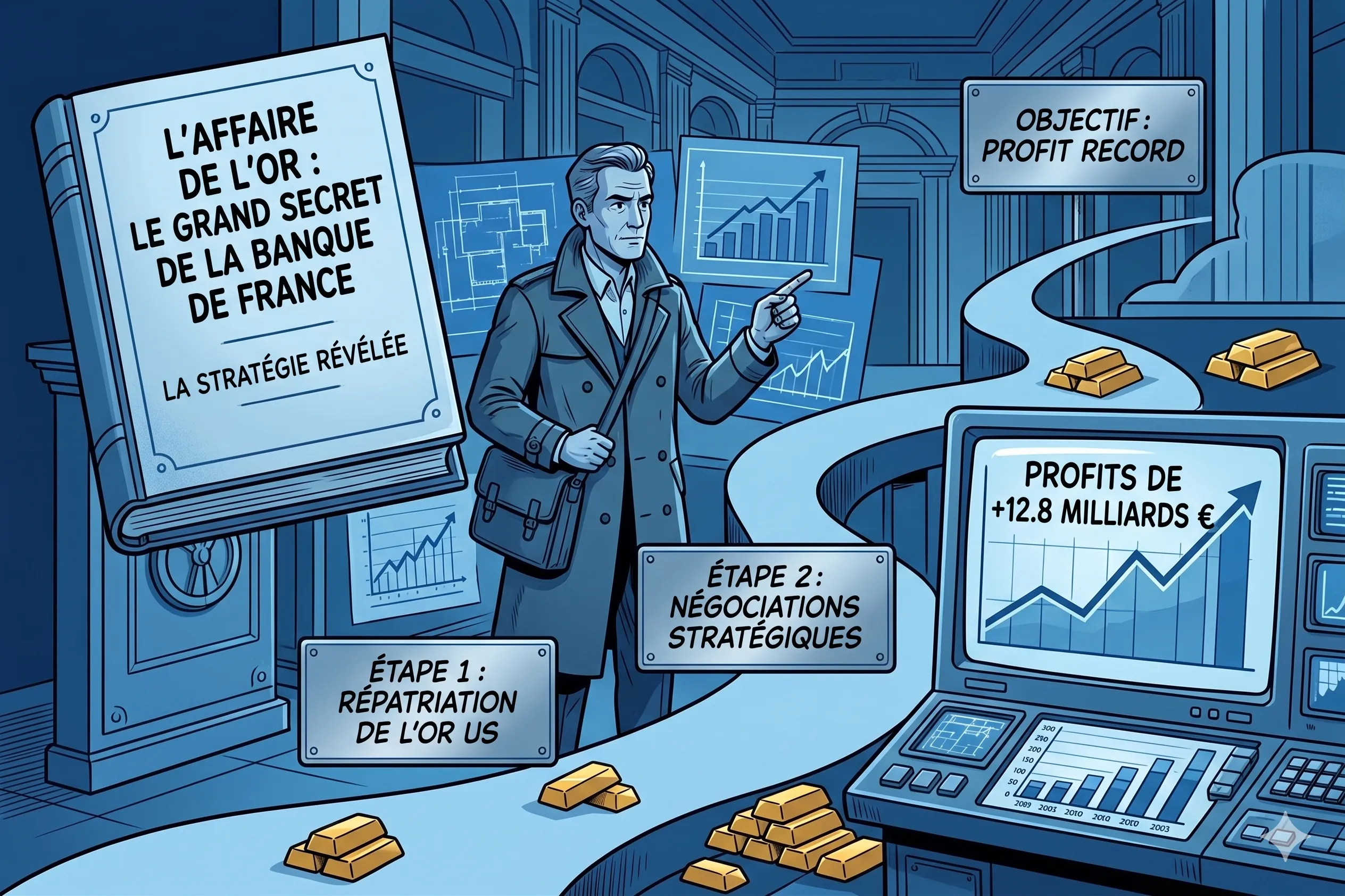
The Banque de France sold 129 tonnes of gold stored at the Federal Reserve Bank of New York between July 2025 and January 2026. Then it bought an identical volume of new bars in Europe. The total réserves d’or — gold reserves stayed the same: roughly 2,437 tonnes. But the operation generated a profit of €12.8 billion. Same gold. Different paperwork. Thirteen billion euros richer.
🇫🇷 Read in French · choose your level
A1-A2
La Banque de France a vendu de l’or à New York. Elle a acheté le même poids en or neuf à Paris. Le total n’a pas changé : 2 437 tonnes. Mais elle a gagné 12,8 milliards d’euros. Même or. Juste des papiers différents.
B1-B2
La Banque de France a vendu 129 tonnes d’or stockées à New York entre juillet 2025 et janvier 2026, puis racheté un volume identique de lingots neufs en Europe. Le total des réserves est resté le même : 2 437 tonnes. Mais l’opération a dégagé un bénéfice de 12,8 milliards d’euros. Même or. Paperasse différente. Treize milliards de plus.
C1-C2
La Banque de France a procédé à la cession de 129 tonnes d’or entreposées auprès de la Federal Reserve Bank de New York entre juillet 2025 et janvier 2026, avant d’acquérir un volume identique de lingots conformes aux normes LBMA sur le marché européen. L’encours total des réserves est demeuré inchangé — environ 2 437 tonnes — mais l’opération a engendré une plus-value comptable de 12,8 milliards d’euros.
How do you make money selling something and buying the same thing back? The bars in New York were old. Some dated to the late 1920s. They didn’t meet modern purity and weight standards used on the international gold market, standards set by the London Bullion Market Association. The Banque de France sold non-compliant bars at current market prices, then purchased LBMA-standard bars in Europe. Gold prices have been exceptionally high (above $4,000 per ounce), so the accounting gain on the old stock, originally booked at historical cost, was massive.
🇫🇷 Read in French · choose your level
A1-A2
Comment gagner de l’argent en vendant et en rachetant la même chose ? Les lingots de New York étaient vieux. Ils ne suivaient plus les règles du marché. La Banque les a vendus au prix actuel, puis a acheté des lingots neufs. L’or coûte très cher en ce moment, donc le gain a été énorme.
B1-B2
Comment gagner de l’argent en vendant quelque chose pour le racheter ? Les lingots de New York étaient anciens, certains dataient des années 1920. Ils ne répondaient plus aux normes de pureté du marché international. La Banque les a vendus au prix courant, puis a racheté des lingots conformes en Europe. Avec l’or au-dessus de 4 000 dollars l’once, la plus-value comptable sur l’ancien stock a été massive.
C1-C2
Comment réaliser un bénéfice en cédant un actif pour en acquérir l’équivalent ? Les lingots détenus à New York, dont certains remontaient aux années 1920, ne satisfaisaient plus aux critères de pureté et de poids édictés par la London Bullion Market Association. La Banque de France a liquidé ce stock non conforme aux cours en vigueur, puis s’est procuré des lingots aux normes LBMA sur le marché européen. Le cours de l’or étant exceptionnellement élevé, la plus-value comptable sur le stock historique, inscrit au coût d’acquisition d’origine, s’est révélée considérable.
The result: a net profit of €8.1 billion for 2025, reversing a €7.7 billion loss from 2024. Governor François Villeroy de Galhau insisted the move was pas politiquement motivé — not politically motivated. An internal 2024 audit had recommended completing the upgrade for this residual 5% of reserves still held abroad.
🇫🇷 Read in French · choose your level
A1-A2
Résultat : un gain de 8,1 milliards en 2025. L’année d’avant, c’était une perte de 7,7 milliards. Le chef de la Banque a dit que ce n’était pas une décision politique. Un rapport interne avait recommandé de le faire.
B1-B2
Résultat : un bénéfice net de 8,1 milliards d’euros pour 2025, effaçant une perte de 7,7 milliards en 2024. Le gouverneur Villeroy de Galhau a insisté : la décision n’était pas politiquement motivée. Un audit interne de 2024 avait recommandé de finaliser la mise aux normes des 5 % de réserves encore détenues à l’étranger.
C1-C2
Le solde net s’établit à 8,1 milliards d’euros de bénéfice pour l’exercice 2025, compensant intégralement le déficit de 7,7 milliards enregistré en 2024. Le gouverneur François Villeroy de Galhau a tenu à souligner le caractère apolitique de l’opération. Un audit interne conduit en 2024 avait préconisé l’achèvement de la mise en conformité de ce reliquat de 5 % des réserves encore entreposées hors du territoire national.
🇫🇷 La Banque de France a procédé au rapatriement de ses réserves d’or détenues à New York.
🇺🇸 The Banque de France carried out the repatriation of its gold reserves held in New York.
That word, rapatriement — repatriation, keeps coming back in French financial commentary. It carries weight that “transfer” doesn’t. It implies bringing something home. Something that shouldn’t have been abroad in the first place. And in France, the history of gold being abroad is a long, complicated, very political story.
🇫🇷 Read in French · choose your level
A1-A2
Ce mot, « rapatriement », revient souvent. Il veut dire « ramener chez soi ». Ce n’est pas un simple transfert. En France, l’histoire de l’or à l’étranger est longue et très politique.
B1-B2
Ce mot — rapatriement — revient sans cesse dans les commentaires financiers français. Il porte un poids que « transfert » n’a pas. Il implique un retour au pays. Quelque chose qui n’aurait jamais dû être à l’étranger. Et en France, l’histoire de l’or à l’étranger est longue, compliquée, et très politique.
C1-C2
Ce terme — rapatriement — irrigue le commentaire financier hexagonal avec une charge sémantique que « transfert » ne saurait porter. Il sous-entend une restitution, un retour à l’ordre naturel des choses. Et dans l’imaginaire institutionnel français, la présence d’or national sur un sol étranger constitue une anomalie historique dont les racines plongent dans un demi-siècle de politique monétaire conflictuelle.
De Gaulle, Bretton Woods, and Why France Trusts Gold More than Dollars
France’s obsession with physical gold isn’t new. It’s institutional, almost constitutional. And it starts with Charles de Gaulle.
🇫🇷 Read in French · choose your level
A1-A2
La France aime l’or depuis longtemps. Ce n’est pas nouveau. Tout a commencé avec le général de Gaulle.
B1-B2
L’obsession de la France pour l’or physique n’est pas nouvelle. Elle est institutionnelle, presque constitutionnelle. Et elle commence avec Charles de Gaulle.
C1-C2
L’attachement de la France à l’or physique n’est pas conjoncturel mais structurel, quasi constitutionnel dans sa permanence. Sa genèse remonte à la politique monétaire gaullienne.
In 1963, de Gaulle initiated a secret operation codenamed Vide-Gousset — literally “empty the pocket” to repatriate French gold from the vaults of the Federal Reserve in New York and the Bank of England in London. Over three years, 3,313 tonnes crossed the Atlantic on 44 boat trips and 129 flights. Air France planes carried gold bars. Ocean liners of the Compagnie Générale Transatlantique shipped 25 tonnes per voyage, twice a month.
🇫🇷 Read in French · choose your level
A1-A2
En 1963, de Gaulle a lancé une opération secrète pour ramener l’or français de New York et Londres à Paris. Pendant trois ans, des avions et des bateaux ont transporté plus de 3 000 tonnes d’or.
B1-B2
En 1963, de Gaulle a lancé une opération secrète baptisée Vide-Gousset pour rapatrier l’or français des coffres de la Federal Reserve à New York et de la Banque d’Angleterre à Londres. En trois ans, 3 313 tonnes ont traversé l’Atlantique en 44 voyages maritimes et 129 vols. Des avions Air France transportaient des lingots. Les paquebots de la Compagnie Générale Transatlantique acheminaient 25 tonnes par voyage, deux fois par mois.
C1-C2
En 1963, de Gaulle a initié une opération clandestine baptisée Vide-Gousset visant au rapatriement intégral de l’or français entreposé dans les coffres de la Federal Reserve Bank de New York et de la Bank of England. Sur trois années, 3 313 tonnes ont franchi l’Atlantique au fil de 44 traversées maritimes et 129 rotations aériennes. La Compagnie Générale Transatlantique acheminait 25 tonnes par rotation bimensuelle ; Air France affectait des appareils au transport de lingots.
Why? De Gaulle and his economic advisor Jacques Rueff believed the Bretton Woods system gave America an privilège exorbitant — exorbitant privilege: the ability to print dollars that other countries had to accept as equivalent to gold. France saw this as a structural subsidy to the American economy. De Gaulle said publicly, in a 1965 press conference, that the dollar’s special status let America buy French assets with money it created from thin air.
🇫🇷 Read in French · choose your level
A1-A2
Pourquoi ? De Gaulle pensait que le système donnait trop de pouvoir à l’Amérique. Les États-Unis pouvaient créer des dollars que tout le monde devait accepter comme de l’or. En 1965, il l’a dit publiquement.
B1-B2
Pourquoi ? De Gaulle et son conseiller Jacques Rueff estimaient que le système de Bretton Woods accordait à l’Amérique un privilège exorbitant : imprimer des dollars que les autres pays devaient accepter comme équivalent à l’or. La France y voyait une subvention structurelle à l’économie américaine. De Gaulle l’a dit publiquement en 1965.
C1-C2
La motivation ? De Gaulle et son conseiller économique Jacques Rueff percevaient dans le système de Bretton Woods l’incarnation d’un privilège exorbitant concédé aux États-Unis : la faculté d’émettre une monnaie que le reste du monde était contraint d’accepter comme substitut à l’or. La France dénonçait ce qu’elle analysait comme une subvention structurelle à l’économie américaine. De Gaulle a rendu publique cette position lors de sa conférence de presse de février 1965.
🇫🇷 L’or ne connaît pas de nationalité. Il est tenu, de par sa nature, comme la valeur immuable et fiduciaire par excellence.
🇺🇸 Gold knows no nationality. It is held, by its very nature, as the immutable and fiduciary value par excellence.
He was right. In 1971, Nixon closed the gold window, ending Bretton Woods. The dollar lost 96% of its value against gold between 1968 and 1980. France, with its gold safely in Paris, was positioned correctly. Germany, which had American troops on its soil and couldn’t afford to antagonize Washington, kept more of its reserves in New York. It didn’t start repatriating until 2013, fifty years later.
🇫🇷 Read in French · choose your level
A1-A2
Il avait raison. En 1971, les États-Unis ont arrêté de convertir le dollar en or. Le dollar a perdu beaucoup de valeur. La France, avec son or à Paris, était bien placée. L’Allemagne a attendu 2013 pour ramener le sien.
B1-B2
Il avait raison. En 1971, Nixon a fermé le guichet de l’or, mettant fin à Bretton Woods. Le dollar a perdu 96 % de sa valeur par rapport à l’or entre 1968 et 1980. La France, avec son or à Paris, était bien positionnée. L’Allemagne, qui ne pouvait pas se permettre de froisser Washington, a gardé ses réserves à New York. Elle n’a commencé à rapatrier qu’en 2013, cinquante ans plus tard.
C1-C2
L’histoire lui a donné raison. La suspension de la convertibilité or du dollar décrétée par Nixon en 1971 a mis fin au régime de Bretton Woods. Entre 1968 et 1980, le dollar a perdu 96 % de sa valeur face à l’or. La France, ayant consolidé l’intégralité de ses réserves à Paris, se trouvait en position favorable. L’Allemagne fédérale, contrainte par la présence militaire américaine sur son sol, a maintenu une part substantielle de ses avoirs à New York et n’a engagé son propre rapatriement qu’en 2013 — un demi-siècle de décalage.
This matters today because the instinct is still alive. When the Banque de France explains the 2025 operation, it uses the language of technical compliance: mise aux normes — bringing up to standard. But every French financial journalist understands the subtext. All 2,437 tonnes are now in Paris. In a vault called La Souterraine — literally “the underground”, 27 metres below the Banque de France headquarters, near the Louvre. Built between 1924 and 1927. Ten thousand square metres. Over 700 pillars holding the ceiling. The Austrian novelist Stefan Zweig visited it in 1932 and wrote that it had “more circles than Dante’s Hell.”
🇫🇷 Read in French · choose your level
A1-A2
C’est important aujourd’hui parce que la France pense toujours pareil. La Banque parle de « mise aux normes », mais tout le monde comprend : tout l’or est maintenant à Paris. Il est dans un coffre souterrain de 10 000 mètres carrés, près du Louvre.
B1-B2
Cela compte aujourd’hui parce que l’instinct est toujours vivant. Quand la Banque de France explique l’opération de 2025, elle utilise le langage de la conformité technique : mise aux normes. Mais chaque journaliste financier français comprend le sous-texte. Les 2 437 tonnes sont désormais à Paris, dans La Souterraine, 27 mètres sous le siège de la Banque, près du Louvre. Dix mille mètres carrés. Plus de 700 piliers. Stefan Zweig l’a visité en 1932 et a écrit que le lieu avait « plus de cercles que l’Enfer de Dante ».
C1-C2
Cette donnée conserve toute sa pertinence contemporaine car l’instinct gaullien demeure opérant. Lorsque la Banque de France justifie l’opération de 2025, elle recourt au registre de la conformité technique — mise aux normes. Mais la communauté financière hexagonale en décode le sous-texte sans difficulté. La totalité des 2 437 tonnes se trouve désormais dans La Souterraine, à 27 mètres sous la surface, à proximité du Louvre. Dix mille mètres carrés. Plus de 700 piliers porteurs. Stefan Zweig, visitant les lieux en 1932, écrivait que l’endroit comptait « plus de cercles que l’Enfer de Dante ».
The Sarkozy Chapter: 590 Tonnes Sold for a Fraction of Today’s Price
Not every French leader shared de Gaulle’s gold instinct.
🇫🇷 Read in French · choose your level
A1-A2
Tous les présidents français n’ont pas aimé l’or autant que de Gaulle.
B1-B2
Tous les dirigeants français n’ont pas partagé l’instinct de de Gaulle pour l’or.
C1-C2
L’attachement gaullien à l’or ne constitue pas un invariant du pouvoir exécutif français.
In May 2004, Nicolas Sarkozy, then Finance Minister, announced the sale of 500 to 600 tonnes of gold from the Banque de France’s reserves. The logic was straightforward: gold sits in a vault and produces zero revenue. Sell it, invest the proceeds in bonds and currencies, and use the interest to reduce France’s debt. At the time, gold traded near $400 per ounce. The consensus among central bankers across Europe was that gold was a relique barbare — barbarous relic, a phrase originally from Keynes that French policymakers borrowed with enthusiasm.
🇫🇷 Read in French · choose your level
A1-A2
En mai 2004, Sarkozy, alors ministre des Finances, a décidé de vendre 500 à 600 tonnes d’or. Son idée : l’or ne rapporte rien, autant le vendre et investir l’argent. À l’époque, l’or valait 400 dollars l’once. Beaucoup pensaient que l’or ne servait plus à rien.
B1-B2
En mai 2004, Nicolas Sarkozy, alors ministre des Finances, a annoncé la vente de 500 à 600 tonnes d’or. La logique était simple : l’or dans un coffre ne produit aucun revenu. Le vendre, investir en obligations et devises, utiliser les intérêts pour réduire la dette. L’or s’échangeait autour de 400 dollars l’once. Le consensus européen était que l’or était une relique barbare — une expression empruntée à Keynes que les décideurs français ont reprise avec enthousiasme.
C1-C2
En mai 2004, Nicolas Sarkozy, alors locataire de Bercy, a annoncé la cession de 500 à 600 tonnes d’or des réserves de la Banque de France. Le raisonnement relevait de l’orthodoxie financière de l’époque : un actif dormant à rendement nul devait être arbitré au profit d’instruments productifs — obligations souveraines et devises — dont les intérêts contribueraient au désendettement. Le métal jaune s’échangeait alors aux alentours de 400 dollars l’once. Le consensus prévalant parmi les banquiers centraux européens qualifiait l’or de relique barbare — emprunt keynésien que les décideurs français ont fait leur avec un enthousiasme non dissimulé.
Between 2004 and 2009, the Banque de France sold 589 tonnes. That’s nearly 20% of the national stock. France went from just over 3,000 tonnes to roughly 2,437. The sales generated approximately €4.67 billion. The reinvestments in bonds and currencies reached about €9.2 billion by 2010.
🇫🇷 Read in French · choose your level
A1-A2
Entre 2004 et 2009, la France a vendu 589 tonnes d’or. C’est presque 20 % du stock. Les ventes ont rapporté environ 4,67 milliards d’euros.
B1-B2
Entre 2004 et 2009, la Banque de France a vendu 589 tonnes. Près de 20 % du stock national. La France est passée de 3 000 tonnes à 2 437. Les ventes ont rapporté environ 4,67 milliards d’euros. Les réinvestissements ont atteint environ 9,2 milliards en 2010.
C1-C2
Entre 2004 et 2009, la Banque de France a cédé 589 tonnes, soit près de 20 % de l’encours national. Les réserves sont passées de quelque 3 000 tonnes à environ 2 437. Le produit des cessions s’est élevé à approximativement 4,67 milliards d’euros. Les réinvestissements en titres obligataires et en devises ont atteint quelque 9,2 milliards d’euros à l’horizon 2010.
The problem? Gold’s price exploded after the 2008 financial crisis. By late 2010, those same 589 tonnes would have been worth over €19 billion. The net loss from the timing: over €10 billion. French newspapers called it a bradage — a fire sale, a selloff. Some called it worse.
🇫🇷 Read in French · choose your level
A1-A2
Le problème ? Après la crise de 2008, le prix de l’or a beaucoup monté. Les 589 tonnes vendues vaudraient plus de 19 milliards en 2010. La perte : plus de 10 milliards d’euros. Les journaux ont parlé de bradage.
B1-B2
Le problème ? Le cours de l’or a explosé après la crise de 2008. Fin 2010, ces 589 tonnes auraient valu plus de 19 milliards d’euros. La perte nette due au timing : plus de 10 milliards. Les journaux français ont parlé de bradage. Certains ont employé des termes plus durs.
C1-C2
L’écueil ? La flambée du cours de l’or consécutive à la crise financière de 2008 a rendu la cession rétrospectivement désastreuse. Fin 2010, les 589 tonnes cédées représentaient une valeur de marché supérieure à 19 milliards d’euros. Le manque à gagner imputable au timing s’élève à plus de 10 milliards. La presse hexagonale a qualifié l’opération de bradage. D’autres ont usé de termes plus acerbes.
🇫🇷 L’or de la France vendu pour une bouchée de pain.
🇺🇸 France’s gold sold for a pittance.
A technical detail that most English-language coverage misses: Sarkozy didn’t directly order the Banque de France to sell. Since the Maastricht Treaty, the central bank operates independently on monetary policy and reserves. But the Banque de France acted, as one former director put it, “in a direction that was politically expected.” It wanted to please the government. The legal responsibility sits with the Banque, not the minister. The political responsibility? That’s a conversation the French are still having.
🇫🇷 Read in French · choose your level
A1-A2
Un détail important : Sarkozy n’a pas donné l’ordre directement. Depuis le traité de Maastricht, la Banque est indépendante. Mais elle a fait ce que le gouvernement voulait.
B1-B2
Un détail que la plupart des médias anglophones ratent : Sarkozy n’a pas directement ordonné la vente. Depuis Maastricht, la banque centrale est indépendante. Mais elle a agi « dans une direction politiquement attendue », selon un ancien directeur. La responsabilité juridique incombe à la Banque. La responsabilité politique ? Débat toujours ouvert.
C1-C2
Une nuance que la couverture anglophone occulte quasi systématiquement : Sarkozy n’a pas formellement enjoint à la Banque de France de procéder à ces cessions. Depuis le traité de Maastricht, l’institut d’émission jouit d’une indépendance statutaire en matière de politique monétaire et de gestion des réserves. Toutefois, la Banque a agi, selon les termes d’un ancien membre de la direction, « dans une direction politiquement attendue ». L’imputabilité juridique incombe à l’institution. L’imputabilité politique ? Ce débat n’a toujours pas trouvé son épilogue.
For context: Gordon Brown did the same thing in Britain between 1999 and 2002, selling 400 tonnes at the absolute bottom of the gold market. The British call it “Brown’s Bottom.” The French don’t have as catchy a name for Sarkozy’s version, but the sting is identical.
Where France Stands: Fourth Largest Gold Reserve on Earth
Even after Sarkozy’s sales, France holds 2,437 tonnes of gold. That’s the fourth largest réserve d’or in the world, behind the United States (8,133 tonnes), Germany (3,350 tonnes), and Italy (2,452 tonnes). Gold represents roughly 66% of France’s total foreign reserves. That’s an enormous concentration.
🇫🇷 Read in French · choose your level
A1-A2
Même après les ventes de Sarkozy, la France a 2 437 tonnes d’or. C’est la 4e réserve du monde. L’or représente 66 % de toutes les réserves de la France. C’est beaucoup.
B1-B2
Même après les ventes de Sarkozy, la France détient 2 437 tonnes d’or. Quatrième réserve mondiale, derrière les États-Unis (8 133 t), l’Allemagne (3 350 t) et l’Italie (2 452 t). L’or représente environ 66 % des réserves de change totales. C’est une concentration énorme.
C1-C2
En dépit des cessions opérées sous l’ère Sarkozy, la France conserve un stock de 2 437 tonnes, ce qui la place au quatrième rang mondial derrière les États-Unis (8 133 tonnes), l’Allemagne (3 350 tonnes) et l’Italie (2 452 tonnes). L’or représente environ 66 % de l’encours total des réserves de change, une concentration d’une ampleur considérable.
The European picture is striking. Germany, Italy, and France together hold over 8,200 tonnes, a legacy of the Bretton Woods era that serves as the backbone of the euro’s credibility. No Eurozone country has sold significant gold since 2009. The era of cession d’actifs — asset disposal is over.
Meanwhile, the buyers are elsewhere. Poland added 102 tonnes in 2025 alone. China has been a net buyer for over 30 consecutive months. India treats gold as a dynamic reserve tool. The trend is clear: central banks worldwide are accumulating gold, not selling it. France, which started this game in the 1960s, now looks prescient rather than paranoid.
The 2025 operation also signals something else. The Banque de France has been upgrading its gold since 2005, refining old bars to meet LBMA standards. There are still 134 tonnes in Paris that need to be brought up to standard by 2028. Once that’s done, every single bar in La Souterraine will be tradeable on the international market within hours. That’s not a museum. That’s a weapon you keep loaded.
📰 Vocabulaire clé
réserves d’or
gold reserves — the gold held by a country’s central bank as a strategic financial asset
rapatriement
repatriation — bringing gold back to national soil; carries political weight that “transfer” doesn’t
Banque de France
France’s central bank, founded in 1800 by Napoleon. Manages monetary policy within the Eurosystem
mise aux normes
bringing up to standard — the official justification for the 2025 gold operation
La Souterraine
literally “the underground” — the vault 27m below the Banque de France, near the Louvre. 10,000 m²
privilège exorbitant
exorbitant privilege — phrase coined by Valéry Giscard d’Estaing to describe the dollar’s reserve-currency advantage
bradage
fire sale — what French media called the Sarkozy-era gold sales. Implies selling national assets below their worth
cession d’actifs
asset disposal, divestiture — the formal term for selling reserves
relique barbare
barbarous relic — Keynes’ phrase for gold, adopted by French policymakers to justify selling
Vide-Gousset
literally “empty the pocket” — codename for de Gaulle’s secret gold repatriation operation (1963–1966)
🌍 How France compares
Swipe → to see all countries
Concept
🇫🇷 France
🇬🇧 UK
🇺🇸 US
🇨🇳 China
Central bank
Banque de France Est. 1800, Eurosystem member
Bank of England Est. 1694
Federal Reserve Est. 1913
People’s Bank of China Est. 1948
Gold reserves
2,437 t (4th) 66% of total reserves
310 t (18th) After Brown’s sales
8,133 t (1st) Fort Knox + NY Fed
2,279 t (6th) Buying since 2022
Storage
La Souterraine 100% in Paris since 2026
BoE vault, London Also stores for 30+ countries
Fort Knox + NY Fed NY Fed holds foreign gold too
PBOC vaults, Beijing Locations classified
Major sale
589 t (2004–09) Under Sarkozy. Called « bradage »
400 t (1999–02) “Brown’s Bottom”
None since 1971 Untouched since Nixon
None Net buyer since 2009
Political role of gold
Sovereignty symbol Constitutional instinct since de Gaulle
Pragmatic asset Sold when deemed unproductive
Strategic reserve Untouchable but passive
Strategic accumulation De-dollarization tool
📈 French Progress Pass
You just decoded rapatriement, bradage, privilège exorbitant. We turn this into a weekly habit.
Reading Le Monde or Les Échos on French monetary policy means parsing institutional vocabulary without subtitles. The Pass tracks the words you keep meeting in French news, level by level, until they stop slowing you down.
✓ Weekly native audio✓ CEFR tracking✓ Full archives✓ Structured practice
Imparfait vs Passé Composé Explained: Timeline Method
Imparfait vs passé composé trips up every English speaker because English never forces the same choice. You say “I lived there,” and French needs to know if you mean background or event, habit or one-time action, and it will not let you skip the decision.
⏰ A clear timeline for choosing between background and event in French past tenses.
Why English does not prepare you for this distinction
For English speakers, the biggest problem is not memorizing forms like j’étais or j’ai été. The real problem is that English usually does not force you to choose between background and event in the same precise way. In everyday English, you can often say “I lived there,” “I was living there,” or “I used to live there” with only a small difference in tone. In French, that difference is not optional. You have to decide whether the past action is being presented as an ongoing state, a repeated habit, a description, or a completed event. French grammar forces that decision every time.
That is why so many learners feel fine with present tense and future tense, then suddenly hit a wall with French storytelling. The moment you start talking about childhood, vacations, memories, stories, old jobs, relationships, routines, or interruptions, you need both imparfait and passé composé. If you use only one tense, your French sounds unnatural very quickly.
🇫🇷 Quand j’étais enfant, je lisais beaucoup.🇺🇸 When I was a child, I read a lot / I used to read a lot.
🇫🇷 Hier, j’ai lu un roman en deux heures.🇺🇸 Yesterday, I read a novel in two hours.
English uses “read” in both. French does not. The first sentence describes a repeated habit over a period of time, so French uses imparfait. The second describes one finished action with a clear endpoint, so French uses passé composé. Most textbooks explain that mechanically. The actual issue is viewpoint. That is where the timeline method starts to matter.
The easiest mental model: background versus event
The most effective way to understand these two tenses is to stop thinking in terms of “past tense one” and “past tense two.” Instead, think in terms of background and event.
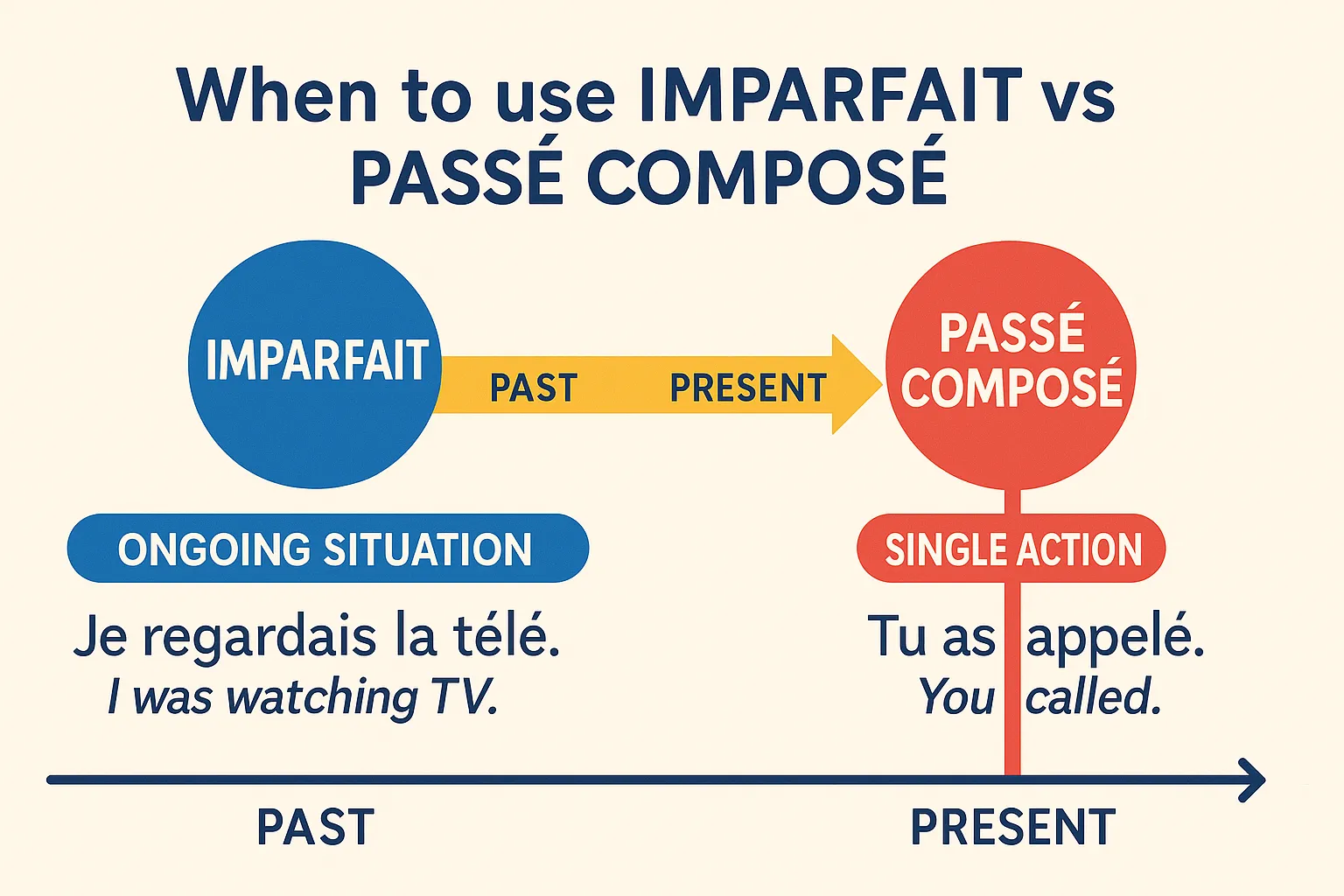
Imparfait gives background. It describes what things were like, what was happening, what people used to do, what the situation looked like, what the mood was, what time it was, what the weather was like, what somebody felt, knew, wanted, or thought.
Passé composé gives events. It tells you what happened, what occurred, what changed the situation, what moved the story forward, what started, what ended, what happened once, or what happened at a specific moment.
Passé composé = completed event, one-time action, narrative step, change.
That sounds almost too simple. Good. It should. Most B1 students do not need a philosophical explanation here. They need a fast decision model they can use under pressure. The nuance comes next.
The timeline method: think like a film director
The timeline method works because it gives you a visual system. Imagine a film scene. Some things form the backdrop: the weather, the setting, the emotional state, the actions already in progress. That is imparfait. Then something happens: the phone rings, someone enters, a glass falls, the train arrives, a decision is made. That is passé composé.
🇫🇷 Il faisait froid. La rue était vide. Je marchais tranquillement. Soudain, une voiture a freiné devant moi.🇺🇸 It was cold. The street was empty. I was walking calmly. Suddenly, a car braked in front of me.
Everything before soudain is background. The cold, the empty street, the walking in progress: all of that is the scene. Then the car braking is the event that interrupts and changes the situation. French marks that change clearly.
If you are not sure which tense to use, ask yourself one question: am I painting the scene, or am I advancing the story?
Use imparfait for description in the past
Descriptions almost always take imparfait. This includes physical descriptions, emotional states, weather, time, age, and general conditions. These things do not usually appear as isolated completed events. They exist as the background frame around other actions.
🇫🇷 Il faisait beau.🇺🇸 The weather was nice.
🇫🇷 La maison était très grande.🇺🇸 The house was very big.
🇫🇷 J’avais dix ans.🇺🇸 I was ten years old.
🇫🇷 Il était minuit.🇺🇸 It was midnight.
🇫🇷 Nous étions fatigués.🇺🇸 We were tired.
These are not events on a timeline. They are conditions. That is why imparfait is natural here. Same logic for mental states. If you are describing what somebody felt, knew, wanted, or believed over a stretch of time, imparfait is usually doing the heavy lifting. The same mismatch between what feels logical in English and what French actually demands shows up in words that look English but carry completely different weight in French.
Use imparfait for habits and repeated actions
If something happened regularly in the past, French usually uses imparfait. This is one of the clearest uses. When you say what you used to do, where you used to go, what your family did every summer, how your teacher behaved, what happened every Sunday, you are in habitual past territory.
🇫🇷 Quand j’étais petit, je jouais dans le jardin tous les jours.🇺🇸 When I was little, I used to play in the garden every day.
🇫🇷 Le dimanche, nous allions chez mes grands-parents.🇺🇸 On Sundays, we used to go to my grandparents’ house.
🇫🇷 À l’école, mon professeur parlait très vite.🇺🇸 At school, my teacher used to speak very fast.
Markers like toujours, souvent, d’habitude, chaque jour, autrefois, or quand j’étais jeune often push you toward imparfait because they frame the action as repeated or ongoing rather than punctual. Learners who still repeat the same structural errors English speakers default to often confuse these habitual markers with punctual ones.
Use imparfait for ongoing actions in progress
If an action was already in progress in the past, especially when another event happened, French uses imparfait. This is where English often uses “was doing.”
🇫🇷 Je dormais quand le téléphone a sonné.🇺🇸 I was sleeping when the phone rang.
🇫🇷 Nous regardions un film quand il est arrivé.🇺🇸 We were watching a film when he arrived.
🇫🇷 Elle lisait pendant que je cuisinais.🇺🇸 She was reading while I was cooking.
🇫🇷 Je travaillais quand tu m’as appelé.🇺🇸 I was working when you called me.
🇫🇷 Il pleuvait quand nous sommes sortis.🇺🇸 It was raining when we went out.
This is one of the most useful patterns in all French grammar. Learn it hard enough and the rest starts to look less random.
🇫🇷 Action en cours = imparfait🇺🇸 Ongoing background action = imparfait
🇫🇷 Événement qui interrompt = passé composé🇺🇸 Interrupting event = passé composé
You’re learning when French switches tenses mid-sentence.
The Briefing uses both every day. See the pattern in real stories?
Passé composé is the tense of completed actions. Something happened, finished, and became a clear point in the story. If you can put the action on a timeline as one narrative step, passé composé is often the right choice.
🇫🇷 J’ai ouvert la fenêtre.🇺🇸 I opened the window.
🇫🇷 Elle est arrivée à huit heures.🇺🇸 She arrived at eight o’clock.
🇫🇷 Nous avons mangé dans un petit restaurant.🇺🇸 We ate in a small restaurant.
🇫🇷 Il a perdu ses clés.🇺🇸 He lost his keys.
These actions happened as distinct units. They are not just background conditions. They are the plot points. If you tell a sequence of actions in order, you are usually in passé composé territory.
🇫🇷 Je me suis levé, j’ai pris une douche, j’ai bu un café, puis je suis parti au travail.🇺🇸 I got up, took a shower, drank a coffee, then left for work.
That is pure narrative. One thing happened, then the next, then the next. French wants those steps marked clearly. This same tension between what English flattens and what French insists on distinguishing shows up across the language, including in structural calques like “I am agree” that reveal deeper interference patterns.
When mental state verbs stay in the background
Verbs like être, avoir, savoir, penser, vouloir, aimer, croire, and espérer are very often used in imparfait when they describe an ongoing state of mind or feeling in the past.
🇫🇷 Je pensais que c’était une bonne idée.🇺🇸 I thought it was a good idea.
🇫🇷 Nous voulions partir plus tôt.🇺🇸 We wanted to leave earlier.
🇫🇷 Elle savait la vérité.🇺🇸 She knew the truth.
🇫🇷 J’aimais ce quartier.🇺🇸 I liked that neighborhood / I used to like that neighborhood.
This is because these verbs often describe an internal state rather than a single event. They help build the psychological background of the story. But this is exactly where learners overgeneralize, and then French pushes back.
But sometimes those same verbs become events
A verb like savoir or vouloir is often in imparfait, but not always. If the meaning becomes a specific event, a sudden realization, or a completed decision, French can switch to passé composé.
🇫🇷 Je savais la réponse.🇺🇸 I knew the answer.
🇫🇷 J’ai su la vérité hier soir.🇺🇸 I found out the truth last night.
🇫🇷 Je voulais partir.🇺🇸 I wanted to leave.
🇫🇷 J’ai voulu partir, mais c’était impossible.🇺🇸 I tried / decided to leave, but it was impossible.
Same verb. Different viewpoint. That is the whole game. If the verb expresses a state, imparfait often works. If it becomes a punctual event, French flips to passé composé. Most learners do not miss this because the rule is hard. They miss it because English does not force them to notice the meaning shift in the first place. The same blind spot shows up with French words that simply have no English equivalent. The problem is not vocabulary, it is that English never carved out that conceptual space. “For sure.”
Time markers that push the choice
Some expressions strongly suggest habitual or ongoing past. Others point to a specific event or one-time occurrence. They do not mechanically decide the tense alone, but they are strong signals.
Markers that often point to imparfait
tous les jours
chaque semaine
souvent
d’habitude
en général
quand j’étais jeune
à cette époque
autrefois
pendant que
Markers that often point to passé composé
hier
ce matin
la semaine dernière
en 2022
à huit heures
soudain
tout à coup
une fois
puis
ensuite
finalement
🇫🇷 Tous les étés, nous partions en Bretagne.🇺🇸 Every summer, we used to go to Brittany.
🇫🇷 À cette époque, il travaillait beaucoup.🇺🇸 At that time, he was working a lot.
🇫🇷 Hier, j’ai rencontré un ancien ami.🇺🇸 Yesterday, I met an old friend.
🇫🇷 Tout à coup, la lumière s’est éteinte.🇺🇸 Suddenly, the light went out.
The “pendant” trap
This is one of the most confusing points for English speakers. The word pendant can appear with both tenses depending on the meaning.
⚠️ Do not treat “pendant” as a fixed tense marker
With a finished duration, French often uses passé composé. With pendant que introducing simultaneous ongoing actions, imparfait is often the natural choice.
🇫🇷 J’ai vécu à Lyon pendant deux ans.🇺🇸 I lived in Lyon for two years.
🇫🇷 Je lisais pendant qu’il travaillait.🇺🇸 I was reading while he was working.
The first is a completed period with a beginning and an end. The second is a simultaneous background action. Same surface word. Different temporal logic. If these viewpoint shifts still feel random, The French Briefing puts them in front of you daily: real French stories where the tense choice is visible and natural, not drilled in isolation.
The two most common mistakes English speakers make
The first mistake is using passé composé for everything. The second is overcorrecting and using imparfait for specific events. Both errors come from the same source: treating French past tenses as form first, meaning second.
🇫🇷 Quand j’étais petit, j’habitais à la campagne et je jouais dehors tous les jours.🇺🇸 When I was little, I lived in the countryside and used to play outside every day.
🇫🇷 Hier, j’ai regardé ce film et ensuite je suis rentré chez moi.🇺🇸 Yesterday, I watched that film and then went home.
The first presents childhood as a period of life. The second presents specific actions as narrative steps. If you swap the tenses, French starts sounding either fragmented or vague.
💡 Fast decision rule
Ask what the sentence is doing. If it sets the scene, use imparfait. If it tells what happened, use passé composé. Under pressure, that rule beats abstract grammar labels every time.
How to practise this without getting lost
The best method is not to memorize huge tables first. The best method is to train yourself to tell short stories and label each sentence as background or event. Start with very simple narratives: your last vacation, a childhood memory, an embarrassing moment, a school memory, or a rainy day when something happened.
1
Set the scene in imparfaitDescribe the weather, time, place, mood, or routine before anything happens.
2
Introduce the event in passé composéAdd the action that changes the situation or moves the story forward.
3
Return to background if neededFeelings, reactions, and ongoing actions often switch back to imparfait.
4
Continue the sequence with passé composéOnce the story is moving, completed actions usually stay in passé composé.
🇫🇷 Il faisait très chaud et j’étais fatigué. Je marchais dans la rue quand j’ai vu un café. Je voulais boire quelque chose de frais, alors je suis entré et j’ai commandé une limonade.🇺🇸 It was very hot and I was tired. I was walking in the street when I saw a café. I wanted to drink something cold, so I went in and ordered a lemonade.
The imparfait versus passé composé problem feels brutal because it combines form, meaning, and storytelling logic. But once you stop asking which past tense is correct and start asking whether you are describing the background or narrating the event, the system becomes much easier. French is not asking you to guess randomly. It is asking you to choose a viewpoint.
Use imparfait for the scene, the atmosphere, the repeated habits, the ongoing states, and the actions already in progress. Use passé composé for the actions that happen, finish, and move the story forward. That contrast comes back everywhere in real French. And once you see it, you stop translating tense names and start reading the scene itself. “For sure.” 🕶️
You just decoded imparfait, passé, composé. We turn this into a weekly habit.
You just learned the imparfait/passé composé split. The Pass turns that into weekly audio where the same contrast shows up in real stories, not drills. CEFR tracking so you see the shift.
✓ Weekly native audio✓ CEFR tracking✓ Full archives✓ Structured practice
🎯 French Subjunctive Made Simple for English Speakers
The French subjunctive has one job: it marks that something is filtered through a mind, not stated as fact. Once you see that, the trigger list collapses into one question.
📖 The French subjunctive: trigger phrases, essential conjugations, and when to use it.
The first obstacle to understanding the French subjunctive is that English speakers don’t have the conceptual framework for it. In English, you express these concepts through separate words (might, want, necessary) while keeping the main verb unchanged. In French, you express these concepts by changing the verb itself into subjunctive form. That is the entire gap. Not complexity. Visibility.
🇫🇷 Je sais qu’il vient demain.🇺🇸 I know he’s coming tomorrow. (Indicative: stated as fact)
🇫🇷 Je doute qu’il vienne demain.🇺🇸 I doubt he’s coming tomorrow. (Subjunctive: filtered through doubt)
Is the speaker stating a fact about reality, or filtering information through desire, doubt, emotion, necessity, or judgment? If filtered: subjunctive. If stated: indicative. That single filter covers 90% of daily usage.
The magic word “que” and the two-subject rule
The subjunctive almost always appears after “que” when two different subjects are involved. One person wants, doubts, or feels something. Another person does the action. The moment those two subjects split across “que,” the second verb shifts to subjunctive.
One Subject → Infinitive
Je veux partir (I want to leave)
Two Subjects → Subjunctive
Je veux que tu partes (I want you to leave)
🇫🇷 Je suis content de partir.🇺🇸 I’m happy to leave. (One subject: infinitive)
🇫🇷 Je suis content que tu partes.🇺🇸 I’m happy that you’re leaving. (Two subjects: subjunctive)
You’re reading about “que” and two subjects.
Tomorrow’s Briefing has a Macron quote with both patterns in the same sentence. Can you tell which is which?
Regular conjugation: the pattern most learners never see
Take the third person plural present indicative (ils form), drop the -ent, add subjunctive endings. Done.
🇫🇷 Parler: ils parlent → que je parle, que tu parles, qu’il parle, que nous parlions, que vous parliez, qu’ils parlent🇺🇸 The “nous” and “vous” forms are the only ones that sound different.
💡 The hidden shortcut
For most regular verbs, you already know the subjunctive. The je/tu/il/ils forms sound exactly like the present indicative. In spoken French, you are already using the subjunctive correctly without knowing it.
The Big Four Irregular Verbs
These four account for roughly 60% of daily subjunctive usage.
🇫🇷 être → que je sois, que tu sois, qu’il soit, que nous soyons, que vous soyez, qu’ils soient🇺🇸 The most common subjunctive verb in French.
🇫🇷 avoir → que j’aie, que tu aies, qu’il ait, que nous ayons, que vous ayez, qu’ils aient🇺🇸 Second most common.
🇫🇷 faire → que je fasse, que tu fasses, qu’il fasse🇺🇸 “Il faut que je fasse attention” = half of real-life usage.
🇫🇷 aller → que j’aille, que tu ailles, qu’il aille🇺🇸 “Il faut que j’aille” = the other half.
⚠️ Espérer que takes the indicative
J’espère qu’il viendra. Hope is emotional. Should trigger subjunctive. Doesn’t. French just said no.
🇫🇷 J’espère qu’il viendra. (indicative: expectation)🇺🇸 I hope he will come.
🇫🇷 Je souhaite qu’il vienne. (subjunctive: desire)🇺🇸 I wish he would come.
When NOT to use the subjunctive
🇫🇷 Je sais que tu as raison. (indicative)🇺🇸 Stated fact: no filter.
Negate a certainty verb and the mood flips. “Je pense qu’il vient” → indicative. “Je ne pense pas qu’il vienne” → subjunctive. The negation introduces doubt.
Beginner-Friendly French News Sources: Ranked by Difficulty
Most French learners open Le Monde at A2 and conclude French news is impossible until C1. The real problem is source selection: beginner-friendly French news exists, but it is rarely where learners first look.
French news gets much easier once you stop asking “Can I read native media yet?” and start asking: “Which source matches my level right now?”
Why normal French newspapers feel impossibly hard at first
French learners often underestimate how difficult mainstream written news is because they compare it to everyday conversation. That comparison is misleading. News French is not café French. It is not textbook French. It is not even the same kind of French you hear in slow pedagogical podcasts. Journalistic French, especially in national newspapers and serious public-affairs media, assumes literate native readers who already understand the political system, the social context, and the historical background. Even when the grammar itself is not exotic, the density of meaning is much higher than in beginner-friendly language content.
There are four main reasons mainstream French news feels brutal. First, sentence length. Serious French journalism accepts long sentences with multiple clauses, parenthetical details, and compressed logic. Second, register. The vocabulary is often abstract, institutional, or political rather than concrete and daily. Third, assumed knowledge. An article can mention the Assemblée nationale, laïcité, les retraites, le pouvoir d’achat, the name of a minister, and a past reform without stopping to define anything. Fourth, style. French writing often feels more compact, less explicitly signposted, and more syntactically demanding than the English-language journalism many learners are used to.
🇫🇷 Le gouvernement a présenté son projet de réforme, vivement contesté par l’opposition et les syndicats.🇺🇸 The government presented its reform proposal, strongly contested by the opposition and the unions.
A sentence like that is easy for an advanced learner, but for a beginner it is full of landmines: présenté, projet, réforme, vivement contesté, l’opposition, les syndicats. None of those words are especially rare in the news. They are normal. That is the point. Beginner frustration does not come from unusual French. It comes from normal native French encountered too early.
The ranking system: how these French news sources are classified
The ranking below is not based on prestige. It is based on usability for learners. A source can be excellent journalism and still be a terrible starting point for an A2 learner. A source can be designed for children or learners and still be one of the smartest tools for building real news vocabulary. Each recommendation is ranked by practical difficulty, not by status.
Level
What you can usually handle
What will still feel hard
A1
Very short sentences, visual support, slow audio, high-frequency vocabulary
Abstract politics, dense opinion writing, long articles
A2
Simplified news, children’s current-events media, slow native audio with transcripts
Mainstream newspapers, heavy commentary
B1
Short authentic articles, teen-oriented news, easier current-affairs sources
Most news summaries, many standard newspaper reports, some radio and TV summaries
Dense op-eds, culture writing, intellectual debate language
C1-C2
Serious newspapers, long analysis, opinion sections, complex public-affairs media
Mainly speed, style, or specialist topic familiarity rather than basic language
A1 level: true beginner French news sources that do not crush motivation
At A1, most learners should stop pretending they are ready for mainstream native news. The best beginner news sources are not “lesser” resources. They are the correct resources. At this stage, the goal is not to become a political analyst in French. The goal is to connect current events with core vocabulary, basic sentence patterns, and understandable audio or text. You want repetition, clarity, and concrete framing. If a source gives you that, it is good. If it gives you prestige and misery, it is bad.
1. 1jour1actu
A1-A2Children’s newsVisual supportFree + premium elements
Why it works so well: Adult learners often resist children’s news because they think it will feel childish. That is the wrong way to see it. 1jour1actu is useful because it explains the world assuming limited prior knowledge. That is exactly what a learner needs. The language is clearer, the framing is more explicit, and the visual context supports comprehension. You get real topics without being punished by opaque style.
Best use: Read a short article, then watch one of the explanatory videos. Use it to build a base in politics, science, environment, technology, and social issues without needing advanced French right away.
What makes it special: It also has theme pages and short explainer formats, which are perfect when you want one idea explained clearly instead of one endless article.
A1-A27-10 years old targetShort daily formatSubscription
Why it deserves a place here: This is one of the most practical French news products for very early learners because it is short, consistent, and written with an educational logic. That matters. The more predictable the format, the faster your reading becomes. Short daily pieces help you create a routine without the psychological burden of “reading the news” as a giant intellectual task.
Best use: Ten minutes a day. Read one item, underline recurring words, move on. Do not over-analyze. The value is consistency.
💡 A1 rule: if you need a dictionary every single sentence, the source is wrong for your current stage. Beginner news should feel accessible, not humiliating.
A2 level: the first truly useful bridge into real current events
A2 is where French news becomes genuinely productive. You are still not ready for dense newspaper editorials, but you are ready to start building broad current-events vocabulary with well-chosen sources. At this stage, slow news, children’s and teen news, and carefully simplified audio become the best zone. The objective is to make current events part of your weekly French life without turning every session into a fight against syntax.
Why this is the classic choice: If you ask for one French news source that serious learners use again and again, this is the answer. It gives you genuine current events in simpler, clearer French, and the transcript support makes it enormously efficient. It is one of the best tools for learners who want to improve both listening and reading together.
Best use: Listen first. Then read the transcript. Then shadow one short paragraph out loud. That single sequence gives you news vocabulary, listening training, pronunciation, and rhythm in one exercise.
Why it is better than random YouTube “French news” content: The format is stable, the editorial quality is serious, and the learner support is built into the product.
A2-B110-13 years old targetDaily/regular youth newsSubscription or digital access
Why it matters: Mon Quotidien sits in an excellent middle zone. It is more advanced than the youngest children’s formats, but still far less punishing than adult news. That makes it one of the best stepping stones for learners who want to leave pure beginner material without jumping into the deep end.
Best use: Read 3 to 4 pieces on the same theme across a week. Youth news is especially helpful because topics recur with clearer explanatory framing than adult media.
Why it belongs in a news list: It is not a newspaper, but it is one of the best ways to hear ordinary people react to public topics in understandable formats. For many learners, this is the missing link between simplified news and real social French. You hear what current-affairs French sounds like outside formal journalism.
Best use: Use it when you want to hear news-adjacent vocabulary in real mouths, with subtitle support. It pairs very well with easier reading sources.
At A2, your best strategy is to stop chasing prestige and start chasing sustainable exposure. Read what you can actually finish. Use audio when possible. Stay on one topic long enough that vocabulary begins repeating. That repetition is how “news French” starts to feel less alien. “For sure.” This also pairs well with phone-call French survival work, because both require you to recover meaning under pressure without understanding every word.
You’re ranking French news sources by difficulty.
The Briefing is built for exactly this: real French news at your level. Quiz included.
B1 level: where you can finally begin touching authentic native news
B1 is the level where many learners get impatient. They are tired of simplified sources and want “the real thing.” That instinct is understandable, but the correct move is not to leap into the hardest papers. The correct move is to begin with native sources that are shorter, clearer, more direct, and less stylistically dense than elite editorial journalism. If you pick well, B1 is where authentic French news starts becoming realistic.
6. 20 Minutes
B1-B2FreeAuthentic native newsShorter articles
Why it is one of the best first native choices: 20 Minutes is much easier to enter than heavyweight quality newspapers because articles are often shorter, more direct, and less stylistically dense. It is still native French. It still exposes you to real news language. But it does not punish you quite as hard as Le Monde opinion pages or dense political analysis.
Best use: Choose short national, society, science, lifestyle, or sports articles before touching deeper politics. At B1, article selection matters as much as source selection.
Why it is underrated: L’ACTU is one of the strongest bridge products between learner-friendly current affairs and adult media. It is aimed at teenagers, which means the topics are real, the tone is current, and the explanatory burden is still much higher than in elite newspapers. That combination is exactly what many B1 learners need.
Best use: If you feel children’s news is now too easy but 20 Minutes still burns you out, this is often the perfect middle path.
Why it helps: France 24 is useful because you can often combine written articles with video and because many learners already know the international stories being discussed. That lowers context difficulty. It is not “easy French,” but it becomes much easier if you choose short reports, headline summaries, and major global stories you already followed in English.
Best use: Start with international topics you already know. Avoid long analysis pieces first. Use headline, intro paragraph, and video summary together.
Why it matters: Franceinfo is one of the best places to see how mainstream public-service news French works in shorter formats. It is often more accessible than long newspaper features because many items are brief, event-focused, and structurally simple. The topic range is also wide enough that you can choose what suits your current level.
Best use: Prioritize short explainers, headlines, quick summaries, and news updates rather than opinion-heavy sections.
⚠️ Common B1 mistake: reading only one impossible article for 40 minutes with a dictionary open. Better method: read three shorter pieces at 70 to 80% comprehension and keep the reading flow alive.
B2 level: the level where mainstream news becomes genuinely useful
At B2, you can stop thinking in terms of “Can I read French news at all?” and start thinking in terms of “Which kinds of French news are most useful for my goals?” This is a major shift. You are no longer only trying to survive. You are now building range: politics, society, economics, science, culture, media criticism, interviews, and long-form features. But even at B2, source selection still matters a lot, because editorial voice and article type can radically change difficulty.
10. Le Monde
B2-C2 depending on sectionHigh prestigeHarder analysisMixed free/paywalled
Where learners go wrong: They treat “Le Monde” as one thing. It is not. A short news brief, a straight report, a decoder piece, and an opinion column can sit worlds apart in difficulty. At B2, you can begin using Le Monde very profitably if you avoid the densest sections at first.
Best starting sections: short reporting, explanatory pieces, and some public-affairs summaries. Do not begin with long opinion columns if your reading stamina is still fragile.
B2-C2Mainstream major paperOpinion-richMixed free/paywalled
Why it is useful: Le Figaro exposes you to a different editorial culture and often to more conservative framing than some other major outlets. That matters for language learning because it teaches vocabulary through contrasting perspectives, not just through one ideological register.
What feels hard: Some pieces are very writerly, culturally dense, or opinion-heavy. Start with straight reporting before attempting the more argumentative material.
Why it helps advanced learners: Libération is useful because it exposes you to a sharper, more opinionated, often more socially and culturally engaged journalistic voice. This is valuable once you are ready for stronger tone, denser implication, and more ideological language.
What makes it harder: Tone, irony, and cultural references can raise the difficulty quickly.
B2 is also when “news” can become a serious engine for your speaking. Read an article, then summarize it aloud in French in three minutes. That exercise brutally exposes your gaps, but it also accelerates progress faster than passive reading alone. It pairs very well with common French mistakes English speakers make, because summarizing current events tends to reveal structural habits you did not notice before.
C1-C2: when serious French news becomes a normal daily ecosystem
At advanced levels, the problem is no longer “Can I read it?” but “How deep do I want to go?” You can begin using newspapers, magazines, newsletters, long-form investigations, public radio articles, and opinion sections as part of normal life. This is also the stage where source identity starts mattering more than raw language difficulty. You choose media not just because you can understand them, but because of editorial line, thematic coverage, speed, and intellectual quality.
At this stage, Le Monde, Le Figaro, Libération, Franceinfo, France 24, public radio sites, and specialized outlets can all become normal. The remaining barriers are usually one of three things: specialist topic knowledge, culture references, or stylistic density. That is a much more interesting problem to have than “I do not know what this paragraph means.”
The single best progression strategy: parallel reading
If you want the fastest path from beginner-friendly news to real French media, use parallel reading. This means reading or understanding the story first in English, then consuming the French version immediately after. This is not cheating. It is efficient cognitive design. It removes the burden of discovering the news event and lets you focus on the French used to express it.
Suppose a major international event happens. You already know the names, the stakes, and the timeline from English coverage. When you open the French article, your brain is not dealing with both new information and new language at once. It is mostly mapping French phrasing onto known content. That makes the article feel much easier and gives you a huge vocabulary return.
Read the event first in English from a reliable source.
Open one French source at your level on the same event.
Highlight repeated words and headline formulas.
Read a second French source on the same story only if the first one felt manageable.
This method is especially powerful when combined with Google News France, because you can quickly compare multiple French sources on the same topic. The French Briefing does exactly this: real French stories, explained, with comprehension quizzes built in.
Do not select articles randomly. Difficulty is not only about source. It is also about article type. One publication can contain pieces at wildly different levels. If you want steady progress, start by choosing easier article genres before harder ones.
Easier article types
Harder article types
headline summaries
editorials
breaking news briefs
op-eds
service journalism
high-culture criticism
science explainers
philosophical or literary essays
sports reports
deep institutional political analysis
photo-led current events coverage
ironic commentary pieces
Science and practical explainers are often easier than politics because the structure is clearer and the writer spends more time defining concepts. Sports can also be easier if you already know the sport. Opinion writing is often disproportionately hard because irony, implication, tone, and rhetorical economy raise the difficulty sharply.
The 30-day method to turn French news into a real habit
1
Week 1: pick one source onlyChoose one source that is clearly below your frustration threshold. Read or listen for 10 minutes every day. No jumping between six websites.
2
Week 2: build a recurring vocabulary notebookWrite down only repeated words and headline formulas. News language repeats a lot more than learners think.
3
Week 3: add one slightly harder sourceKeep your easier source as the base. Add one tougher article two or three times a week.
4
Week 4: summarize aloudPick one article a day and explain it in French in 60 to 90 seconds. This turns passive reading into active language growth.
💡 The right difficulty rule: if you understand 95% of everything, it is probably too easy to drive growth. If you understand under 50%, it is probably too hard. The sweet spot is usually around 70 to 85% functional comprehension.
The most useful French news expressions to recognize early
The news becomes easier very quickly once you stop treating every article like thousands of unique words and start noticing the formulas that repeat constantly. Journalistic French loves recurring structures. Learn those and the page stops looking random.
🇫🇷 selon…🇺🇸 according to…
🇫🇷 a annoncé…🇺🇸 announced…
🇫🇷 a indiqué…🇺🇸 indicated / stated…
🇫🇷 d’après les derniers chiffres…🇺🇸 according to the latest figures…
🇫🇷 il s’agit de…🇺🇸 it is about / it concerns…
🇫🇷 a été condamné / a été adopté / a été rejeté…🇺🇸 was convicted / was adopted / was rejected…
🇫🇷 au cœur du débat…🇺🇸 at the heart of the debate…
🇫🇷 une enquête🇺🇸 an investigation
🇫🇷 une mesure🇺🇸 a measure / policy step
🇫🇷 les autorités🇺🇸 the authorities
🇫🇷 le gouvernement🇺🇸 the government
🇫🇷 l’opposition🇺🇸 the opposition
🇫🇷 la réforme🇺🇸 reform
🇫🇷 le pouvoir d’achat🇺🇸 purchasing power
🇫🇷 l’actualité🇺🇸 current affairs / the news
Once you can recognize these instantly, news reading becomes much less exhausting. Instead of decoding from zero every time, you begin to move through familiar architecture. “For sure.” 🕶️
The real ranking: best French news sources by learner profile
If you are a complete beginner and mainly want confidence
The hidden advantage of reading French news: it improves everything else
French news reading is not only about reading. It improves almost every other domain of your French if you use it well. First, vocabulary. News gives you high-frequency adult words that textbooks often delay too long. Second, listening. If you read a topic first, then hear it in a radio segment, the audio becomes far easier. Third, speaking. Summarizing current events is one of the best ways to move from passive knowledge into active production. Fourth, cultural literacy. You stop being the learner who can order coffee but cannot follow what French people are discussing at lunch, online, or in public life.
This is also where internal progression matters. If your grammar still collapses under pressure, connect your news work to the most common French mistakes English speakers make. If you want to strengthen listening on the same themes, connect it to French podcasts for learners and eventually French radio debates. If your goal is long-term fluency instead of random exposure, build these systems together.
Study glossary: essential French news vocabulary for learners
French term
English meaning
Why you need it
l’actualité
current affairs / the news
Core word for all news consumption
les nouvelles
the news
Common general news term
un article
an article
Basic reading vocabulary
selon
according to
Constantly repeated in reporting
a annoncé
announced
Classic headline/reporting verb
une réforme
a reform
One of the most common French news words
le gouvernement
the government
Essential politics vocabulary
les autorités
the authorities
High-frequency reporting term
les derniers chiffres
the latest figures
Very common in economics and public-policy reporting
une enquête
an investigation
Useful in crime, politics, and society coverage
une mesure
a measure / policy action
Appears in politics, health, and economy news
il s’agit de
it concerns / it is about
Key explanatory phrase
le pouvoir d’achat
purchasing power
Essential French economic vocabulary
l’opposition
the opposition
Necessary for political articles
en revanche
by contrast
Frequent contrast marker in more advanced news writing
cependant
however
High-frequency formal connector
Final ranking: what you should actually start with today
If you are below B1, the smartest move is usually not a prestigious newspaper. It is Journal en français facile, 1jour1actu, Le Petit Quotidien, or Mon Quotidien. If you are around B1, 20 Minutes, Franceinfo, and France 24 often become your first realistic native sources. If you are B2 or stronger, the doors open much wider, but even then, choosing the right section matters more than pretending every article in every major newspaper is equally readable.
The learners who improve fastest are not the ones who keep attacking impossible articles to prove something. They are the ones who read at the right level every day, increase difficulty gradually, build repeated news vocabulary, and treat French current affairs as a long-term habit rather than a test of ego. Once that habit is in place, the progression is real and very visible. What felt impossible six months earlier starts looking normal. Headline formulas become automatic. Political vocabulary starts recurring. One article becomes three. Then the news stops being “study material” and becomes part of your life in French.
You just decoded beginner-friendly, french, news. We turn this into a weekly habit.
You just ranked every French news source by level. The Pass turns that into a system: weekly audio on real stories, CEFR tracking, and progress you can measure.
✓ Weekly native audio✓ CEFR tracking✓ Full archives✓ Structured practice
How to Understand French Radio Debates: Listening Guide
French radio debates combine everything hard at once: native speed, overlapping voices, political jargon, cultural references, and a debate style that sounds like controlled chaos. This guide breaks down exactly how to stop drowning in the noise and start hearing the structure underneath.
French radio debates feel brutal at first because they are brutal. The trick is not trying to understand everything at once, but learning how debate French is built.
Why French radio debates feel so much harder than podcasts, films, or normal conversation
Most learners underestimate the specific difficulty of French radio debates because they imagine the problem is simply “French is fast.” That is only part of it. Debate audio is hard because the speakers are not trying to help you. In a learner podcast, the host usually articulates clearly, repeats key ideas, and keeps sentence structure reasonably linear. In a film, the visual context helps you recover lost meaning. In face-to-face conversation, you get facial expression, gesture, rhythm, and the ability to ask for clarification. In a French radio debate, all those supports disappear at once. You are left with compressed audio, zero visual anchors, rapid shifts between speakers, interrupted syntax, and background assumptions that the audience already knows the topic, the political context, and often the people involved.
That is why even a solid B2 learner can suddenly feel like a lost beginner again after turning on France Inter, France Culture, Europe 1, RFI, or a strong opinion-driven panel show. A host introduces the topic. A guest begins answering. Another person jumps in before the sentence ends. Someone says “mais justement” in a sharp tone, which means disagreement is coming. The host reframes. A third speaker throws in an ironic aside. Two names of politicians go by. A policy acronym appears. A cultural reference lands and vanishes. If you do not know how debate French works structurally, your brain starts trying to decode every word and dies in under ninety seconds.
What overwhelms learners first
Not vocabulary. Not even speed. It is the combination of speed, interruptions, missing cultural context, and the false belief that you are supposed to understand every sentence in real time.
This article exists to break that false belief. You do not need full word-by-word comprehension to understand a French radio debate. You need layered comprehension: topic, position, tone, structure, recurring vocabulary, and only then details. Once you start listening that way, debates become much more manageable, and your listening level rises faster than with almost any passive resource. If you already use podcasts, this article works especially well alongside the best French podcasts on Spotify for language learners, because radio debates are the logical next step after learner-friendly audio.
The five specific things that make French radio debate French different
1. Native-speed speech is not the same as debate-speed speech
Plenty of learners can understand interviews or documentaries and still crash in debates. That is because debate speech often accelerates under pressure. People talk faster when defending a point, interrupting, pushing back, summarizing quickly, or trying to seize airtime before the host cuts them off. French radio is full of those moments. The result is not just “normal fast French.” It is compressed argumentative French with little mercy for the listener.
2. Turn-taking is rougher than in many English-language formats
Many English-speaking learners are trained by calmer formats: NPR-style pacing, BBC moderation, one speaker finishing before another starts. French radio can be more combative. Interrupting is not always perceived as catastrophic rudeness. It can signal engagement, urgency, disagreement, or rhetorical force. If you interpret every interruption emotionally instead of structurally, the whole exchange feels chaotic. If you learn to hear interruptions as argument markers, the chaos becomes readable.
3. The discourse markers matter more than the nouns at first
Beginners and intermediates often obsess over every unknown noun or policy term. In debates, the words that save you first are not the specialized terms. They are the small connective phrases: mais justement, au contraire, cela dit, en revanche, si je peux me permettre, permettez-moi de vous interrompre, sur ce point, en réalité, autrement dit. These tell you whether the speaker is attacking, agreeing, reframing, clarifying, or moving to a new angle.
4. French public debate assumes cultural memory
French radio does not stop to explain every historical, intellectual, or political reference. It assumes the audience has at least rough familiarity with the Republic, social movements, laïcité, labor law, pension reform, the structure of the French state, and major political personalities. That means a learner is not just listening to French. A learner is often listening through missing context. This is one reason debates on public radio can feel much harder than entertainment podcasts.
5. Multiple registers can appear in a single debate
A host may speak polished journalistic French, a politician may produce well-trained rhetorical French, a caller may speak more spontaneous everyday French, and an intellectual guest may drift into dense abstract phrasing. That means you are not training one kind of listening. You are training register-switching. That is demanding, but it is also why this practice is so powerful.
The biggest mental mistake: trying to understand every sentence
The fastest way to fail with French radio debates is to listen like you are taking an exam where every word matters equally. Real listening does not work like that, and debate listening especially does not. If you try to decode everything at once, you burn working memory on the first unknown cluster and miss the entire next thirty seconds. Then you panic, and once panic enters, the audio starts sounding even faster. The better method is to decide what layer of meaning you are hunting at each pass.
First pass: what is this debate about? Second pass: who agrees with what? Third pass: which arguments repeat? Fourth pass: which phrases and vocabulary do I want to keep?
This is why radio debate training belongs in a serious listening progression, not in random heroic attempts. If your listening still collapses easily in one-on-one phone French, do not jump directly into hard political panels without a system. Work first through easier but still authentic formats like French phone-call survival phrases, slower podcasts, and structured listening content. Then step upward. Debate comprehension is not magic. It is accumulated resistance to overload.
The debate markers you must learn before anything else
If you only memorize one category of language for French radio debates, make it discourse markers. These are the little phrases that show the skeleton of the argument. Once your ear recognizes them automatically, you stop drowning in undifferentiated sound and begin hearing structure. That changes everything.
🇫🇷 Mais justement…🇺🇸 But precisely… / That’s exactly the point…
🇫🇷 Au contraire…🇺🇸 On the contrary…
🇫🇷 Certes, mais…🇺🇸 Granted, but…
🇫🇷 En réalité…🇺🇸 In reality…
🇫🇷 Cela dit…🇺🇸 That said…
🇫🇷 En revanche…🇺🇸 On the other hand / By contrast…
🇫🇷 Si je peux me permettre…🇺🇸 If I may…
🇫🇷 Permettez-moi de vous interrompre…🇺🇸 Allow me to interrupt you…
🇫🇷 Laissez-moi terminer…🇺🇸 Let me finish…
🇫🇷 En d’autres termes…🇺🇸 In other words…
🇫🇷 Autrement dit…🇺🇸 Put differently / In other words…
🇫🇷 Sur ce point…🇺🇸 On that point…
🇫🇷 Je ne suis pas d’accord.🇺🇸 I don’t agree.
🇫🇷 Je vous rejoins sur ce point.🇺🇸 I agree with you on that point.
🇫🇷 Le problème, c’est que…🇺🇸 The problem is that…
These phrases do more than help you understand French radio. They help you predict what is about to happen. If someone says certes, mais, you know agreement is only provisional and contradiction is coming. If the host says si on revient à or pour revenir à la question de, the discussion is being pulled back to the main topic. If someone says autrement dit, you are about to get a rephrase that may be easier than the original sentence. That is usable listening power.
The three levels of comprehension you should track in every debate
Level 1: Topic comprehension
This is the most basic layer. What is the debate about? Retirement reform? Immigration? Public schools? Inflation? A film release? A literary prize? The European Union? A football scandal? If you cannot name the topic clearly after five minutes, the debate is probably too hard for your current level or you started with a topic where your background knowledge is too weak.
Level 2: Position comprehension
Once you know the topic, your next goal is not details but alignment. Who supports what? Who is criticizing what? Who sounds cautious? Who sounds ideologically committed? Who is reframing the discussion? This is where discourse markers help enormously. Debate comprehension becomes much less painful once you stop hearing “French sound” and start hearing “position A vs position B.”
Level 3: Argument comprehension
Only after the first two levels should you start caring about the exact arguments. Why does one speaker oppose the reform? What evidence do they use? Which numbers or examples recur? Which metaphors appear? If you try to begin here, you often lose the whole thing. If you build upward, details start sticking naturally.
💡 Best listening question while the audio runs: not “What did I miss?” but “What are they trying to prove?” That question forces your ear toward argument, not panic.
You’re training your ear for real French debate speed.
The Briefing puts that same pressure in daily news format. Quiz included.
How to choose the right French radio debate show for your level
Not all French debate audio is equally brutal. This matters because many learners sabotage themselves by starting with shows that are objectively too dense. You need a progression. A B1-B2 learner should not jump first into the most confrontational political programming and conclude that French radio is impossible. That is like trying to read a philosophical essay before you can comfortably read a good newspaper feature.
Best starting point: debates with social topics and clearer moderation
8 milliards de voisins (RFI) is one of the best bridges into debate listening because the topics are broad, human, and often internationally accessible: work, family, education, social change, digital life, health, urban life, and shared global concerns. The debate structure is often clearer, the register is less densely elite than some Parisian intellectual radio, and RFI is generally more accessible to learners than the fastest domestic formats.
Le téléphone sonne on France Inter is also valuable because it often mixes experts, journalists, and ordinary callers. That gives you a wider acoustic and social range. Callers are not always easier, but they often speak with less polished rhetorical compression than media professionals, which can actually make parts of the show more accessible than elite panel debate.
Intermediate step: analytic debates with stronger structure
L’Esprit public on France Culture is excellent when you want more depth but still need a relatively intelligible structure. The pace is not always easy, but the show is designed around analysis rather than pure verbal combat. If you are already reading French current affairs and can follow a solid B2 discussion, this show is one of the best places to build argument-listening ability.
Répliques is excellent for advanced learners because it forces you into dense ideas, philosophical framing, and high-register argumentative French. It is not where most learners should begin, but once you are strong, it becomes gold. You are not just learning listening there. You are learning how educated French intellectual disagreement sounds when compressed into radio form.
Le Nouvel Esprit public is also worth following if you want high-level current-affairs discussion in a podcast-first environment with a more reflective tone than some harder news-radio clashes.
The best way to train: one topic, many episodes, not random sampling
The worst learning strategy is jumping randomly from pensions to cinema to artificial intelligence to football to agricultural protests to constitutional law in a single week. It feels dynamic, but it destroys your chance to build repeated vocabulary. French radio becomes dramatically easier when you stay on one topic for several episodes because debate language is repetitive. The same nouns, acronyms, verbs, and arguments come back again and again. Repetition is not boring here. It is how your ear starts locking onto meaning.
Pick one topic you already understand in English. For example: inflation, education reform, immigration, climate policy, artificial intelligence, or football. Read two or three good English summaries first. Then listen to three or four French episodes on that same issue across different programs. Suddenly the debate becomes less about decoding unknown reality and more about matching French forms to ideas you already know. That is also why The French Briefing works as a daily stepping stone. Real French news explained at a pace that builds toward debate-level listening.
1
Choose one topic you already understandExisting background knowledge lowers the listening burden immediately.
2
Follow that topic for a week in FrenchOne theme repeated beats seven unrelated debates.
3
Write down repeated phrases, not every unknown wordDebate fluency grows through recurrence, not dictionary obsession.
4
Replay short segments ruthlesslyTen difficult minutes studied well beat one hour endured passively.
5
Switch topics only after the first one starts feeling predictablePredictability is progress, not boredom.
The listening method that actually works for debate audio
First listen: no stopping, no dictionary, no transcript
Your first listen should be about surviving the whole thing while tracking the topic and the main positions. Do not pause every twenty seconds. Do not look up words mid-stream. Do not turn the session into a vocabulary excavation site. That interrupts the skill you are actually trying to build, which is live comprehension under pressure.
Second listen: short replay segments
Take a difficult two-minute section and replay it. Now try to identify who is speaking and what their position is. Then replay again and catch the discourse markers. Only then look at vocabulary. This order matters because it trains your ear to hear structure first. If transcripts exist, use them after at least one full audio-first pass, not before.
Third listen: transcript or notes
If the show has a transcript, summary, title, guest list, or written episode description, use it now. The goal is not to “cheat.” It is to confirm what you actually heard and correct what your brain guessed wrongly. French radio becomes much less mysterious once you realize how often the same arguments and formulae return. “For sure.”
Fourth step: active extraction
Write down ten high-value items from the episode: three discourse markers, three topic words, two argument phrases, and two expressions you could reuse in speaking or writing. This is where raw listening turns into durable French.
This same principle of repeated passes is exactly why listening improvement often accelerates when paired with more structured oral work. If you want the speaking side to keep up with the listening side, it pairs well with common French mistakes English speakers make, because debates expose weak grammar habits brutally once you start trying to summarize them aloud.
The vocabulary fields that dominate French radio debates
French radio debates repeat certain lexical ecosystems constantly. If you learn these well, your comprehension jumps. The biggest ones are politics, economics, education, society, institutional life, and culture-war vocabulary. You do not need every term. You need the high-frequency ones that keep coming back across shows.
Politics and state vocabulary
🇫🇷 la réforme🇺🇸 reform
🇫🇷 le gouvernement🇺🇸 government
🇫🇷 l’opposition🇺🇸 opposition
🇫🇷 la majorité🇺🇸 governing majority
🇫🇷 l’Assemblée nationale🇺🇸 National Assembly
🇫🇷 le Sénat🇺🇸 Senate
🇫🇷 le député / la députée🇺🇸 MP / member of parliament
🇫🇷 le ministre / la ministre🇺🇸 minister
🇫🇷 le projet de loi🇺🇸 bill / draft law
Economics and everyday pressure vocabulary
🇫🇷 le pouvoir d’achat🇺🇸 purchasing power
🇫🇷 l’inflation🇺🇸 inflation
🇫🇷 le coût de la vie🇺🇸 cost of living
🇫🇷 la croissance🇺🇸 growth
🇫🇷 l’austérité budgétaire🇺🇸 budgetary austerity
🇫🇷 les impôts🇺🇸 taxes
🇫🇷 les inégalités🇺🇸 inequalities
Society and public life vocabulary
🇫🇷 la laïcité🇺🇸 French secularism
🇫🇷 le débat de société🇺🇸 societal debate
🇫🇷 les services publics🇺🇸 public services
🇫🇷 les acquis sociaux🇺🇸 hard-won social protections / social gains
🇫🇷 la fracture sociale🇺🇸 social divide
🇫🇷 le terrain🇺🇸 the reality on the ground
These expressions matter because they do not just carry meaning. They carry ideology. When a speaker says les acquis sociaux, they are not using neutral technocratic language. They are activating a political world. When someone says le pouvoir d’achat, they are signaling everyday economic pressure in a very French media frame. Learning the vocabulary means learning the worldview embedded inside it. If you want the full political context behind these terms, the political vocabulary guide breaks down the system they all refer to.
The cultural references that silently wreck comprehension
One brutal truth about French radio debates is that sometimes your French is not the real problem. Your missing cultural background is. If speakers reference Mai 68, the Fifth Republic, laïcité, the pension age, a famous journalist, a past labor movement, a literary figure, or a constitutional procedure without explanation, your brain may hear the French clearly and still understand very little. That is not a listening failure. That is a context failure.
This is why smart learners do not only train the ear. They also build French background knowledge. Read French news summaries. Follow a few recurring public figures. Learn the basic shape of French institutions. Know the names of the major public radio stations and what they sound like. Learn the recurring national obsessions. Once the background becomes less alien, the audio becomes dramatically easier.
⚠️ Big hidden trap: trying to learn advanced French debate listening without any French political or cultural background. You end up decoding the language while still not understanding the world being discussed.
The best show-by-show progression if you want real long-term results
Stage 1: RFI and accessible social debate
Start with 8 milliards de voisins on RFI. The topics are broad, human, and often internationally framed. That matters because it reduces the France-only context burden. Use the episode descriptions. Pick themes you already care about. Listen first without notes, then return with notes. Spend a full week on one theme if needed.
Stage 2: Mixed-expertise call-in and current affairs radio
Move to Le téléphone sonne once you can hold a topic across multiple speakers. This show trains you to hear different social voices, not just one polished media register. It is excellent for coping with real unpredictability. Use titles and episode blurbs before listening so you are not entering blind.
Then move into L’Esprit public. By this stage, your goal is not survival but analysis. Try summarizing each speaker’s position in two sentences. If you cannot do that, replay the segment until you can. This is one of the best bridges from upper-intermediate listening into high-register comprehension.
Once you can survive long-form current-affairs discussion, go to Répliques. This is where you start dealing with more compressed abstraction, stronger references, and much more “French intellectual radio” energy. Do not use this as your first battlefield unless you enjoy self-inflicted discouragement.
After that, specialize. If you like politics, stay in politics. If you like football, train on sports radio. If you like economics, follow business radio. Topic specialization is underrated because it massively increases repeated vocabulary exposure.
Independent podcast. Geopolitics, Europe, French institutions. Calm pace, long episodes. Perfect for re-listening.
B2-C1
How to take notes without destroying your listening
Bad note-taking kills listening because it pulls the eyes into writing and the brain into transcription. You are not a court reporter. You are a listener building auditory argument recognition. Good notes should be light, structural, and fast. Write topic headings, speaker positions, repeated words, and only a few key expressions. Do not try to write whole sentences while the audio runs unless the show is far below your level.
A good note page for one episode might contain four things: the topic, the names or labels of the speakers, one line for each person’s main stance, and a short vocabulary box. That is enough. After the replay, expand if needed. During the first listen, less is almost always more.
The transcript question: use them, but use them late
Many learners either avoid transcripts completely or depend on them too early. Both extremes are bad. If you use transcripts before your ear has done any work, you turn listening into reading support. If you never use them at all, you may fossilize wrong guesses and waste time. The right moment is after at least one strong audio-first pass. First you struggle productively. Then you verify. Then you listen again with corrected expectations.
This also makes transcripts emotionally useful. They stop being a crutch and become proof of progress. You discover that you caught more than you thought. Or you discover that your ear kept failing on the same sound pattern, which is actionable information. If pronunciation is a recurring weakness, it also helps to reinforce the listening work with high-frequency French mistakes English speakers make and related pronunciation work from the pronunciation and listening guide.
The anti-burnout rule: debate listening should be hard, not humiliating
There is a difference between useful strain and pointless punishment. French radio debates should challenge you. They should not destroy your morale every single day. If you are understanding below roughly 20 to 25 percent across multiple listens and cannot even identify the topic, the format may be too difficult right now. That is not shameful. It just means you need a more intelligent stepping stone. A good progression might be learner podcasts, then clear native podcasts, then interviews, then moderated discussions, then real debates. There is no prize for skipping developmental steps.
💡 A very good target: aim for 60 to 70 percent functional understanding on familiar topics. That is already strong listening. Debate French does not require perfection to be valuable.
And remember the real payoff. When debate listening starts improving, everything else gets easier: interviews, documentaries, podcasts, live conversation, audio books, even noisy real-life discussion. Debate radio is not just one skill. It is a listening stress test that upgrades the whole system.
Study glossary: essential French radio debate vocabulary
French term
English translation
Why it matters
mais justement
but precisely / that’s exactly the point
High-frequency disagreement marker
au contraire
on the contrary
Direct contradiction signal
certes, mais
granted, but
Partial concession before objection
tout à fait
absolutely / exactly
Common agreement marker
permettez-moi de vous interrompre
allow me to interrupt you
Classic debate interruption phrase
laissez-moi terminer
let me finish
Common turn-holding phrase
en d’autres termes
in other words
Rephrasing marker, often very useful
autrement dit
put differently
Another rephrasing marker
le pouvoir d’achat
purchasing power
Extremely common in French media debates
les acquis sociaux
social gains / protections
Heavy ideological and historical term
la réforme
reform
Appears constantly in politics and society debates
le débat de société
societal debate
Very common media framing phrase
le terrain
the reality on the ground
Used to oppose theory and lived reality
la laïcité
French secularism
Culturally central, often hard for outsiders
en revanche
by contrast
Important nuance marker
cela dit
that said
Common soft pivot phrase
French radio debates are one of the fastest ways to sound less like a learner
The reason this kind of listening matters so much is not just that it improves comprehension. It changes your relationship to French. Once you can survive and then enjoy French radio debates, you stop depending entirely on learner content and start living inside real French thought, real French disagreement, real French media rhythm, and real French public language. Your vocabulary gets sharper. Your ear becomes tougher. Your sense of register improves. You stop needing perfectly clean audio and perfectly polite one-at-a-time speech to function.
And perhaps most importantly, you stop panicking when French gets messy. That alone is a massive threshold in language learning. Debate audio teaches you to keep listening under pressure, keep tracking structure when details escape you, and recover meaning without total control. That is not just radio skill. That is mature listening skill. “For sure.” 🕶️
You just decoded understand, french, radio. We turn this into a weekly habit.
You just spent twenty minutes learning how French debate works. The Pass puts that same listening pressure into structured weekly audio. Transcripts, CEFR tracking, and no guesswork about what to listen to next.
✓ Weekly native audio✓ CEFR tracking✓ Full archives✓ Structured practice
American smiles and French smiles do not mean the same thing
The biggest source of confusion is that both cultures use the same facial expression but assign very different meanings to it. In the United States, especially in customer-facing or public environments, smiling often functions as a social lubricant. It says: I am safe, I am not hostile, I am open to a light human exchange, and I know how to behave in public. It does not always mean happiness. It often means social management. Americans are trained into this very early, sometimes without noticing it.
French culture often sees that very differently. In France, a smile is expected to correspond more closely to an actual emotional state or a real social relationship. If you are not amused, pleased, touched, or genuinely glad to see someone, why would you smile broadly at them? If you do, the French person may read the gesture as artificial, overly familiar, or strategic. The unspoken question becomes: what do you want from me?
🇫🇷 Pourquoi tu souris ?🇺🇸 Why are you smiling?
🇫🇷 Je souris parce que je suis content.🇺🇸 I’m smiling because I’m happy.
That exchange reveals the underlying logic. In French culture, a smile often wants a reason. In American culture, the smile can be the reason. That difference alone explains a huge number of painful little misunderstandings on the metro, in shops, in cafes, and on the street.
What Americans often expect
Smile = friendliness.
What many French people may hear instead: Smile = fake friendliness, low-grade sales energy, forced intimacy, or strange emotional overexposure.
The neutral face is normal in France
One of the hardest adjustments for Americans in France is learning that the neutral face is not a problem to solve. In many American environments, the neutral face gets treated almost like a minor social failure. If you look neutral, people may assume you are irritated, depressed, antisocial, or unhappy. In France, that assumption is much weaker. A neutral face is just a face when nothing in particular needs to be signaled.
This matters especially in Paris, where public transport, sidewalks, queues, and cafes are full of people existing without performing accessible cheerfulness. They are not on stage. They are not trying to reassure the room. They are simply moving through ordinary life. For Americans, this can feel cold at first. For many French people, it feels more honest and less exhausting than the pressure to display friendliness continuously for strangers.
In France, the neutral face is not the absence of kindness. It is the absence of performance.
This is why so many Americans misread Parisian public life. They think the city is full of angry people. Very often, it is full of neutral people. The difference matters. Once you stop assigning emotional hostility to every unsmiling face, France becomes much less personally stressful. “For sure.”
You’re decoding why French public behavior feels different.
The Briefing covers cultural patterns like this daily. Real context, not stereotypes.
Why smiling at strangers can make French people uncomfortable
When an American smiles warmly at a stranger on the Paris metro, the American often believes they are doing something generous and socially stabilizing. They are trying to make the moment lighter. But the French stranger may experience the same gesture as intrusive. Public space in France often works on a principle of respectful distance. You acknowledge others through appropriate behavior, not by trying to create instant emotional contact.
A smile from a stranger can therefore create a small burden. It implies an opening. It suggests the other person may want something: a conversation, confirmation, reassurance, flirtation, or attention. That is why the reaction is often not hostile but evasive. The French person looks away because they want to close the opening you just created.
⚠️ Common American mistake: reading avoidance as rejection. In France, looking away from a smiling stranger often means “I do not want to turn this into an interaction,” not “I hate you.”
This is particularly important in a city like Paris, where people spend a lot of time among strangers in dense environments. Public coexistence depends partly on not demanding emotional engagement from everyone around you. The French public face is often a boundary-maintaining face. That same logic of social calibration shapes how French politeness actually works, where greeting rituals matter more than emotional warmth at the start.
Why French service workers do not smile the American way
Another major source of confusion is service culture. Americans are used to service workers smiling constantly, asking upbeat questions, performing friendliness, and maintaining a visible customer-first emotional style. In France, service workers are usually expected to be correct, efficient, and professionally polite. That does not automatically include smiling. French service culture is less about emotional performance and more about competent execution within a respectful verbal frame.
This is why a French waiter, cashier, receptionist, or shop assistant may look neutral while still being entirely polite by French standards. If they greet you properly, take your order correctly, answer your question, and close the interaction correctly, they have done the job well. Their face is not the main measure of courtesy.
🇫🇷 Le serveur était très professionnel.🇺🇸 The waiter was very professional.
Notice what that sentence praises. Professionalism. Not emotional display. If you skip the greeting and then expect smiling service, the interaction often gets worse fast.
💡 Better expectation in France: do not ask whether the person seemed warm. Ask whether they were correct, respectful, and effective. That is often the more French measure of good service.
French people do smile, just not on demand and not for everyone
One of the worst misunderstandings foreigners can develop is the idea that French people never smile. They do. A lot. Just not in the same places, for the same reasons, or with the same automaticity as Americans. French people smile with friends, family, lovers, trusted colleagues, regular acquaintances, and in genuinely funny or pleasing moments. A French smile often carries more emotional weight precisely because it is not distributed as a default background setting.
Once you enter a real French social environment rather than observing public strangers, the emotional picture changes dramatically. At dinner tables, with friends at a cafe, in animated conversations, with children, during jokes, after wine, during shared complaining, during teasing, and inside actual relationships, the French can be very expressive and very warm. But that expression is usually tied to a context that justifies it.
🇫🇷 Ah bonjour, comme d’habitude ?🇺🇸 Ah hello, the usual?
A regular customer at a bakery may eventually get a soft smile and a warmer tone because a real micro-relationship has formed. That smile means more than a random public smile because it is grounded in recognition rather than social reflex. In other words, French warmth often grows through repetition and recognition, not through instant surface friendliness. The French Briefing covers these cultural patterns daily, with the kind of context that makes the rules stick.
French people often value authenticity more than easy warmth
Underneath the smile difference lies a bigger cultural principle: French culture often places a high value on emotional authenticity. That does not mean every French person is always sincere, obviously. But culturally, the ideal of not performing what you do not feel remains stronger than in the United States. If you smile all day regardless of your actual mood, many French people will not interpret that as admirable positivity. They may interpret it as emotional falseness.
This is why the American habit of smiling through stress, uncertainty, and discomfort can be hard for French observers to trust. They may assume you are smoothing reality too much, hiding what you really think, or behaving in a scripted way. In the US, that same behavior might be called professionalism, resilience, or positivity. In France, it can drift toward the suspicious category of being faux: not fully real.
🇫🇷 Ce sourire est faux.🇺🇸 That smile is fake.
🇫🇷 Elle est vraie.🇺🇸 She’s genuine.
That contrast is powerful. If you want to understand French public reserve, stop thinking only about introversion and start thinking about authenticity. A neutral expression can be morally cleaner, in French eyes, than a friendly expression that is not backed by real feeling. The same instinct for genuine signal over polished performance drives how the tu/vous distinction really works.
Public space in Paris is not built for emotional openness
Paris in particular intensifies the cultural logic. It is dense, fast, often tiring, and full of strangers. If everyone behaved with American public openness, the city would feel socially chaotic by French standards. Parisian public reserve is partly cultural and partly adaptive. People on the metro, in queues, on sidewalks, and in cafes protect themselves with controlled facial expression, selective eye contact, and limited unsolicited interaction.
This is also why the article title matters. The issue is not that French people cannot smile. It is that daily life in Paris and other French cities does not reward smiling at strangers as a standard civic behavior. It rewards correct distance, situational awareness, and lower emotional volume in public. If you want a related example of how French public norms differ from American expectations, this also connects well with French public holidays, where everyday life can also feel unexpectedly structured by collective norms that outsiders do not anticipate.
American public code
Smile to show harmlessness, reduce awkwardness, and create low-level friendliness fast.
French public code
Maintain neutral distance, respect boundaries, and save visible warmth for real context.
How to stop misreading French faces
The most useful adjustment is not “never smile again.” It is learning to stop interpreting every neutral French face through American emotional assumptions. Most of the time, the person is not upset with you, not judging you, not angry, and not communicating anything about you at all. They are simply not broadcasting accessible positivity into public space.
1
Assume neutral means neutralNot hostile, not sad, not anti-American. Just neutral.
2
Do not force emotional contact in publicOn transport and in queues, less can be more.
3
Use verbal politeness instead of facial optimismBonjour, s’il vous plait, merci, and au revoir matter more than smiling constantly.
4
Notice when French warmth becomes realWith repetition, recognition, shared context, and genuine interaction.
5
Let public anonymity be normalYou do not need every shared space to become a micro-community.
What to do instead of smiling at strangers in France
If smiling less in public feels awkward, replace the instinct with more locally meaningful signals. In shops and cafes, use proper greetings. In public spaces, respect shared silence. In service interactions, choose polite wording and good timing. With neighbors or regular contacts, let familiarity grow gradually. These behaviors are often more effective than facial friendliness in France because they align with the local code of respect.
🇫🇷 Bonjour madame.🇺🇸 Hello ma’am.
🇫🇷 Merci beaucoup, au revoir.🇺🇸 Thank you very much, goodbye.
That is why this article also overlaps with French politeness rules. In France, words and sequence often do more politeness work than facial brightness. If you get the structure right, you do not need to overcompensate with visible friendliness. “For sure.” 🕶️
Study glossary: French vocabulary for smiles, expressions, and public reserve
French term
English translation
Usage context
sourire
to smile / a smile
The core verb and noun for smiling
le visage neutre
the neutral face
Useful for describing normal unsmiling public expression
faire semblant
to pretend / fake it
Important for the idea of performative friendliness
être vrai / vraie
to be genuine
Linked to authenticity in French culture
être faux / fausse
to be fake
Often used critically about forced emotional display
l’expression du visage
facial expression
Useful for talking about public demeanor
avoir l’air
to look / seem
Used constantly in describing how someone appears
rester sérieux / sérieuse
to remain serious
Helpful for understanding public reserve
l’émotion authentique
genuine emotion
Captures the cultural preference for real feeling
la politesse
politeness
French politeness is not always smile-based
le contact visuel
eye contact
Central to understanding public interaction
être réservé / réservée
to be reserved
Useful for describing French public behavior accurately
France gets easier when you stop asking strangers to reassure you
The real lesson is not that France is cold. It is that France does not ask strangers to constantly reassure each other with visible positivity. Public life is often calmer, more reserved, and less emotionally demonstrative. For Americans, that can feel harsh at first because so much US public behavior depends on micro-signals of friendliness. But once you understand the French code, the silence and neutral faces lose their sting. They are not attacks. They are simply part of a different way of sharing space.
And once you stop demanding American-style friendliness from French strangers, you start noticing something better: French warmth, when it arrives, often feels more grounded. Less automatic. Less performed. More tied to real connection, real amusement, real recognition, and real human presence. That is not less social life. It is a different social contract.
You just decoded french, people, smile. We turn this into a weekly habit.
You just learned why French faces work differently. The Pass puts that cultural knowledge into weekly audio with real French stories, CEFR tracking, and progress you can measure.
✓ Weekly native audio✓ CEFR tracking✓ Full archives✓ Structured practice
French Politeness Rules Americans Misunderstand: Guide
Americans arrive in France convinced they are being polite. Then every interaction goes wrong. The problem is not rudeness: American and French politeness run on completely different social logic.
French politeness is not colder than American politeness. It is more ritualized, more formal at the start, and much less dependent on performative friendliness.
The most important French politeness rule is also the one Americans violate most often: you must say bonjour before doing almost anything in a shared service or social space. Not eventually. Not after your question. Not as background noise while already making a request. First. In France, bonjour is not decorative friendliness. It is the entry ticket into civil interaction. Skip it, and the rest of the conversation starts damaged.
This is where Americans often misread the situation completely. They enter a bakery or cafe, smile warmly, ask politely for what they want, and think the interaction should go well because by American standards they have already been nice. From the French perspective, they began by ignoring the human being in front of them and moving straight to the transaction. The warmth does not cancel that mistake. The smile does not cancel it. The “please” does not cancel it.
🇫🇷 Bonjour madame.🇺🇸 Hello ma’am.
🇫🇷 Bonjour monsieur, je voudrais une baguette, s’il vous plaît.🇺🇸 Hello sir, I would like a baguette, please.
The structure matters. First greeting. Then request. When leaving, the same logic applies in reverse: thank, close, exit.
🇫🇷 Merci, au revoir.🇺🇸 Thank you, goodbye.
💡 Safe rule: if you enter a shop, waiting room, office, elevator, reception area, or other enclosed shared space, lead with bonjour. In the evening, switch to bonsoir.
⚠️ Very common American error: starting with “Excuse me” or the request itself. In French politeness order, bonjour comes before the transaction.
This same social principle appears in many other French interactions. Ritual acknowledgment comes before efficiency. That is why people who struggle with French live interactions often also struggle on the phone, in shops, and in administration. If that feels familiar, this pairs very naturally with how to survive your first French phone call, where the opening ritual matters just as much.
French politeness is based more on respect than friendliness
One of the deepest differences between American and French politeness is what each culture is trying to signal first. American politeness often tries to show friendliness, openness, and good intentions fast. French politeness often tries to show respect, self-control, and correct distance first. This is why Americans often interpret French behavior as cold while French people often interpret American behavior as overfamiliar, noisy, or socially unstructured.
In French culture, you do not need to look delighted by everyone around you to be polite. You do not need to perform warmth at full volume. You do not need to ask strangers casual personal questions to seem human. In fact, doing too much too fast can make the interaction feel less respectful, not more. French politeness often begins with boundaries. Warmth comes later, once the relationship or context justifies it. “For sure.”
What Americans often see
No smile, short answer, neutral face, no “How are you today?”
What French people often mean: normal, professional, respectful interaction with no fake intimacy.
You’re learning why French politeness runs on different logic.
The Briefing puts these register decisions in real news context daily. Quiz included.
Vous and tu: the social distance Americans underestimate
English has one “you.” French has two. That alone creates a whole layer of politeness Americans are not trained to handle. Vous is the formal or respectful form. Tu is informal, intimate, familiar, or socially closer. Americans, used to first-name informality with almost everyone, often underestimate how much social meaning this choice carries in French. Choosing tu too early can sound childish, intrusive, or disrespectful.
🇫🇷 Excusez-moi, vous avez l’heure ?🇺🇸 Excuse me, do you have the time?
🇫🇷 Pourriez-vous m’aider, s’il vous plaît ?🇺🇸 Could you help me, please?
That is the safe default with strangers, shopkeepers, waiters, receptionists, doctors, teachers, neighbors you do not know well, new colleagues, and adults in almost any formal or semi-formal context.
🇫🇷 On peut se tutoyer, si tu veux.🇺🇸 We can use “tu” with each other, if you want.
That sentence matters because it shows something crucial: the shift to tu is often proposed, not assumed. And until it is clearly socially available, vous remains the intelligent default. The full tu/vous guide covers this in depth with more examples and edge cases.
Use vous with
Use tu with
Strangers, professionals, older adults, service staff, new colleagues, formal contacts
Close friends, children, family, peers once mutual informality is established
This is one reason French social life can feel slower to Americans. The boundaries are not necessarily higher forever, but they are usually clearer at the beginning. If you want a broader practical example of how these politeness layers affect real life, you can also see them inside opening a French bank account, where formal register matters far more than many English speakers expect. The French Briefing puts these register decisions in real news context daily.
The conditional tense is not optional politeness fluff
Another major misunderstanding comes from how Americans ask for things. In English, “I want a coffee” can sound normal in casual speech. In French, je veux un café is much more direct and can sound rude depending on context. French politeness strongly favors softened request forms, especially the conditional.
🇫🇷 Je voudrais un café, s’il vous plaît.🇺🇸 I would like a coffee, please.
🇫🇷 Pourriez-vous m’aider ?🇺🇸 Could you help me?
🇫🇷 Est-ce que je pourrais avoir l’addition ?🇺🇸 Could I have the check?
The more formal or socially distant the context, the more these softened structures matter. French politeness is not only about tone. It is built into grammar.
Small talk is not the same social ritual in France
Americans often use small talk as social lubrication. It proves goodwill, fills silence, and creates instant low-level friendliness. French people do small talk too, but not in all the same places and not with the same automaticity. A cashier does not need to ask how your day is going. A person in an elevator does not need to chat to prove they are nice. A stranger on public transport does not need to smile at you as a sign of harmlessness.
The difference is that American politeness often tries to reduce distance quickly. French politeness often preserves it until there is a reason to reduce it. That means strangers can be perfectly polite without becoming conversationally available.
French politeness often says: “I respect your space.” American politeness often says: “I want you to feel comfortable with me immediately.” Both aim at civility. They just travel by different roads.
Directness is not automatically rudeness in French culture
Another area of constant misreading is direct feedback. American communication often cushions criticism with positivity. French communication is often more willing to say what is wrong, what does not work, or what is not good, without wrapping it in a layer of emotional padding first. To an American ear, this can sound harsh. To many French speakers, it sounds clear and adult.
🇫🇷 Franchement, ce n’est pas très bon.🇺🇸 Frankly, it’s not very good.
🇫🇷 Non, je ne suis pas d’accord.🇺🇸 No, I don’t agree.
Neither sentence is automatically aggressive in French. Context matters, of course, but bluntness itself is not always impolite. Americans often confuse “less softened” with “more hostile.” That is not always true.
💡 Better reaction to French bluntness: listen for the content before judging the tone by American standards. Sometimes the message is direct because that is how the speaker thinks useful clarity works.
Table manners: where Americans accidentally signal bad upbringing
French table manners are one of the most efficient ways to reveal that you do not know the local code. Americans often think table manners are mostly about saying thank you, complimenting the food, and not being gross. In France, the rules go further and remain more visible, especially in formal meals or family dinners.
One classic rule Americans miss is hand visibility. In French table culture, both hands are generally kept visible above the table rather than hidden in the lap. Another difference concerns bread. Bread is not treated exactly the way Americans treat a side roll. It is usually placed directly on the tablecloth or beside the plate depending on context, torn rather than cut casually with a knife.
🇫🇷 On pose le pain directement sur la table.🇺🇸 We place the bread directly on the table.
🇫🇷 On rompt le pain, on ne le coupe pas au couteau.🇺🇸 We tear bread, we don’t cut it with a knife.
If you want to understand this layer more deeply, it connects very closely with French cheese culture, where the rules around serving, cutting, and sequencing reveal the same broader logic: pleasure has form.
⚠️ Especially visible mistake: treating the French table like an American casual dining environment where efficiency and comfort override ritual. In France, ritual is part of the comfort.
Smiling, volume, and public space: why Americans feel France is cold
American public behavior often includes smiling at strangers, speaking at a relatively high volume, and using visible friendliness as reassurance. French public behavior usually asks for less emotional display and less noise in shared space. Many Americans interpret that as unfriendliness. The tension is not about morality. It is about calibration. This dynamic is explored in depth in why French people don’t smile at strangers.
Why Paris feels “rude” to Americans
Americans often judge Paris by American friendliness signals. Paris judges Americans by French civility signals. Both sides often think the other failed first.
How to adapt without feeling fake
Many Americans resist French politeness because they think it requires becoming a different kind of person: colder, more formal, less expressive. That is the wrong frame. Adapting to French politeness does not require changing your personality. It requires learning the French code for respect. You can still be warm, funny, curious, and generous. You just do not begin by performing intimacy where the local system expects structure first.
1
Start every service interaction with bonjourGreeting is not optional, and it comes before the request.
2
Default to vousLet informality arrive later, not immediately.
3
Use the conditional for requestsJe voudrais and pourriez-vous make a huge difference.
4
Do not mistake neutrality for hostilityFrench politeness often looks less cheerful but remains fully polite.
5
Respect ritual before seeking warmthStructure first, closeness later.
Study glossary: essential French politeness vocabulary
French term
English translation
Usage context
bonjour
hello / good day
Mandatory opening in most daytime interactions
bonsoir
good evening
Used later in the day instead of bonjour
vous
you (formal)
Default with strangers and formal contacts
tu
you (informal)
Used with close friends, children, and familiar contacts
vouvoyer
to use “vous”
Describes formal address
tutoyer
to use “tu”
Describes informal address
je voudrais
I would like
Core polite request structure
pourriez-vous
could you
Polite conditional for requests
s’il vous plaît
please
Formal politeness marker
merci beaucoup
thank you very much
Strong closing courtesy marker
excusez-moi
excuse me
Formal attention-getter or apology opener
pardon
sorry / pardon me
Useful in minor interruptions and apologies
French politeness is a code. Learn the code and the country feels much warmer.
French politeness becomes much less mysterious once you stop judging it by American friendliness standards. It is not built to make strangers feel instantly at ease through enthusiasm. It is built to show respect through form, language, sequence, and social distance. Once you know the rules, interactions become more predictable, service often improves, and social life feels less hostile because you are no longer accidentally signaling the wrong things. “For sure.” 🕶️
You just decoded french, politeness, rules. We turn this into a weekly habit.
You just decoded the French politeness system. The Pass puts these cultural rules in weekly audio with real stories, CEFR tracking, and structured progress.
✓ Weekly native audio✓ CEFR tracking✓ Full archives✓ Structured practice
French Holidays Explained for English Speakers: Complete Guide
French public holidays do not just mark dates. They close banks, empty offices, break work weeks, and create bridge weekends that confuse every English speaker who tries to schedule anything in May.
French holidays are not minor calendar notes. They shape work, travel, family time, and the entire national rhythm more than many English speakers expect.
Why French public holidays feel more disruptive than UK or US holidays
For many English speakers, the first real shock of French public holidays is not the holiday itself but the level of closure around it. In the UK and especially in the US, a holiday often means reduced hours, some offices closed, and plenty of normal commercial life continuing. In France, a jour férié often means something much stronger: a collective pause. Banks close. Government offices close. Many shops close. Transport runs differently. Some towns feel deserted.
That difference matters because many newcomers keep treating French public holidays as if they were only symbolic. They are not. They have real scheduling power. They can make a work week collapse, shift meeting culture, distort business response times, and create whole mini-vacation periods when combined with weekends.
🇫🇷 Aujourd’hui c’est un jour férié.🇺🇸 Today is a public holiday.
🇫🇷 Les magasins sont fermés pour le jour férié.🇺🇸 The shops are closed for the public holiday.
Once you understand that jour férié implies real operational consequences, the culture starts making more sense. And this is part of a larger French pattern: systems are expected to rest. Constant availability is not the ideal. That same cultural logic appears in work-life boundaries, long lunches, vacation culture, and the relative seriousness of time off.
The real outsider mistake
Treating a French public holiday like a mild inconvenience instead of a real planning factor. In France, holidays often affect the whole ecosystem around the day, not just the day itself.
This is why French holiday awareness is not just trivia for tourists. It matters for business travel, remote collaboration, apartment logistics, appointments, school schedules, and daily life in France. The same practical adaptation mindset also shows up in surviving a first French phone call and handling administrative situations like opening a bank account, because the real challenge is often not language alone but understanding the rhythm of the system you are dealing with.
The 11 official French public holidays
France has 11 official nationwide public holidays. Some are fixed dates. Others move because they are tied to Easter. Several are religious in origin, which surprises many English speakers because France is officially secular. But French secularism does not erase historical Catholic structure from the calendar. It simply coexists with it.
1. Jour de l’An: January 1
New Year’s Day is quiet, family-oriented, and logistically dead for most normal errands. The real social event is often the réveillon on the night of December 31, but January 1 itself is still a formal holiday and not a good day for expecting services to operate normally.
2. Lundi de Pâques: Easter Monday
Easter Monday extends Easter weekend rather than concentrating everything into Easter Sunday. This makes sense inside French labor logic because Sunday is already socially special. The Monday creates a more visible holiday effect in work and school calendars.
You’re learning why French holidays break entire work weeks.
The Briefing covers these calendar disruptions in real time. Quiz included.
Labor Day is one of the most powerful closure days in France. It is associated with workers’ rights, union tradition, and the lily of the valley flower, muguet, which people give for luck. It is also one of the worst possible days to assume normal commerce will continue.
4. Victoire 1945: May 8
This holiday marks the end of World War II in Europe. For many English speakers, May 8 does not carry the same reflexive recognition as it does in France. But in French historical memory it matters deeply, and it has practical calendar effects beyond its symbolic role.
5. Ascension: moving Thursday
Ascension is one of the most operationally important French holidays because it always falls on a Thursday. That almost automatically creates the possibility of a bridge to the weekend. This is one reason Ascension is not just a religious holiday on the calendar but a structural event in French scheduling culture.
6. Lundi de Pentecôte: Whit Monday
Pentecost Monday is slightly complicated in practice because of labor arrangements around the “solidarity day” concept, but it still matters culturally and logistically enough that it should always be treated as a serious calendar marker.
7. Fête Nationale: July 14
Bastille Day is France’s national holiday and one of the most publicly visible holidays of the year. Parades, fireworks, dances, and civic ceremony make it feel more collectively performed than many other French holidays.
8. Assomption: August 15
Assumption sits in the middle of the French summer holiday period, which means that even beyond the holiday itself, you are operating inside the broader August vacation culture that already affects work and city life.
9. Toussaint: November 1
All Saints’ Day is quieter and more reflective. It is associated with family cemetery visits and chrysanthemums. It is not a playful autumn holiday in the American Halloween sense.
10. Armistice 1918: November 11
This marks the end of World War I and remains solemn in tone. It is part of France’s public relationship with remembrance and war memory, which has different historical depth than in countries where the wars were not lived on national soil in the same way.
11. Noël: December 25
Christmas is major, but with an important cultural nuance: Christmas Eve often carries more ritual meal importance than English speakers expect, while December 26 is not a national French holiday the way Boxing Day matters in the UK.
🇫🇷 Joyeuses Pâques !🇺🇸 Happy Easter!
🇫🇷 Joyeux Noël !🇺🇸 Merry Christmas!
🇫🇷 Bonne année !🇺🇸 Happy New Year!
These greeting phrases matter because French holiday wishes are often reciprocated rather than merely acknowledged. A bare “merci” can feel a little thin if someone offers a festive greeting warmly. Mirroring the greeting is usually safer. “For sure.”
Why May is a scheduling disaster in France
If one month teaches foreigners to respect the French holiday calendar, it is May. May is where several public holidays cluster, often creating broken weeks, long weekends, and a national atmosphere of partial disappearance. Trying to schedule anything important in France in May without checking the calendar is one of the most common avoidable mistakes made by English speakers, especially in business.
May 1 and May 8 are fixed. Ascension usually lands in May. Pentecost often lands close enough to continue the feeling of fragmentation. Add weekends, school breaks in some contexts, and the French instinct to maximize holiday continuity when possible, and May stops behaving like a normal work month.
⚠️ Practical rule: if something is important, avoid scheduling it in France in May unless you have already checked the holiday layout and confirmed the availability of the people involved.
What “faire le pont” means and why it matters so much
The concept that confuses English speakers most is probably faire le pont, literally “to make the bridge.” This means taking an extra day off between a public holiday and the weekend, usually when the holiday falls on a Thursday or Tuesday, in order to create a longer continuous break.
🇫🇷 On fait le pont pour l’Ascension.🇺🇸 We’re making the bridge for Ascension.
🇫🇷 Le bureau est fermé pour le pont.🇺🇸 The office is closed for the bridge.
For English speakers, this can sound like an improvised trick. In France, it is much more normalized than that, especially around certain holidays. Entire teams or businesses may effectively assume the bridge. Schools may be affected. Small companies may close. The French Briefing covers these calendar disruptions in real time when they hit.
💡 Best question before scheduling:Y a-t-il un pont ce jour-là ?: “Is there a bridge that day?” This instantly shows you understand how French holiday rhythm really works.
What actually closes on French public holidays
One of the most useful things to know is not just which days are holidays, but what those days do to everyday services. The answer is not identical for every holiday, but there are strong patterns.
Usually closed
Banks
Post offices
Government offices and administrative services
Most schools
Many non-touristic shops
A large number of restaurants outside major tourist zones
May remain open, but not normally
Hospitals and emergency services
Pharmacies on rotating duty schedules
Some bakeries, often with reduced hours
Some supermarkets in tourist or high-density areas
Transport, but often on Sunday/holiday schedules
Restaurants in major tourist cities, but with reduced options
🇫🇷 Horaires dimanche et jours fériés.🇺🇸 Sunday and public holiday schedules.
The day-before habit
French people often stock up before a public holiday not because they are dramatic, but because they know that a holiday really can mean fewer options tomorrow.
The Alsace-Moselle exception: when France is not uniform
France often presents itself as administratively centralized and nationally consistent, but there are exceptions. One of the most important holiday exceptions is Alsace-Moselle, where two extra public holidays exist because of historical legal inheritance from the period when those territories were under German control.
🇫🇷 En Alsace-Moselle, il y a deux jours fériés supplémentaires.🇺🇸 In Alsace-Moselle, there are two additional public holidays.
How to navigate French holiday culture intelligently as an outsider
1
Check the holiday calendar before schedulingEspecially for May, summer, and year-end periods.
2
Assume a holiday affects the day around itBridges, reduced staffing, slower responses, and altered schedules are common.
3
Prepare the day beforeCash, groceries, medicine, and transport checks become more important than usual.
4
Respect the tone of the holidayDo not treat a solemn remembrance day like a festive social occasion.
5
Use the rhythm instead of fighting itFrench holiday culture makes more sense once you stop expecting constant availability.
💡 Best survival habit: twenty-four hours before any French public holiday, ask yourself what you might need tomorrow that will be harder to access. That one habit prevents a surprising amount of frustration.
Study glossary: French holiday vocabulary
French term
English translation
Usage context
un jour férié
a public holiday
The standard term for an official holiday
faire le pont
to make the bridge
Taking an extra day off to extend a holiday
un pont
a bridge / long weekend extension
The extended break created around a holiday
fermé pour jour férié
closed for public holiday
Common sign on shops and services
horaires dimanche et fêtes
Sunday and holiday schedules
Used especially for transport
le réveillon
New Year’s Eve or Christmas Eve celebration
Important for year-end festivities
Bonne année !
Happy New Year!
Standard seasonal greeting
Joyeuses Pâques !
Happy Easter!
Easter greeting
Bonne fête nationale !
Happy National Day!
Greeting for July 14
Joyeux Noël !
Merry Christmas!
Christmas greeting
les congés
time off / vacation days
Used for leave and days off
un jour chômé
a non-working day
Used in work and labor contexts
French holidays make more sense once you stop expecting constant availability
French public holidays frustrate English speakers mostly when they are treated as inconveniences imposed on a system that should obviously stay open. But that assumption is exactly what French holiday culture does not share. In France, public holidays are part of a social rhythm that protects pauses, honors memory, preserves tradition, and legitimizes collective time off in ways many English-speaking countries have weakened. Once you understand that, the closures and long weekends stop looking random. “For sure.” 🕶️
The practical outcome is simple. Learn the dates. Check the bridges. Respect May. Prepare the day before. Do not schedule important things blindly. And understand that the holiday is never just the day itself. In France, the holiday often radiates outward into the days around it, the travel patterns around it, and the collective energy around it. That is the real calendar you need to read.
You just decoded french, holidays, explained. We turn this into a weekly habit.
You just learned why French holidays break schedules. The Pass puts that practical knowledge into weekly audio with real stories, CEFR tracking, and structured progress.
✓ Weekly native audio✓ CEFR tracking✓ Full archives✓ Structured practice