
Updated on September 15, 2026
French Smiling Etiquette: Reading Social Cues
Understand how smiles and greetings can differ across French social settings. Avoid assumptions and learn practical ways to start an interaction.
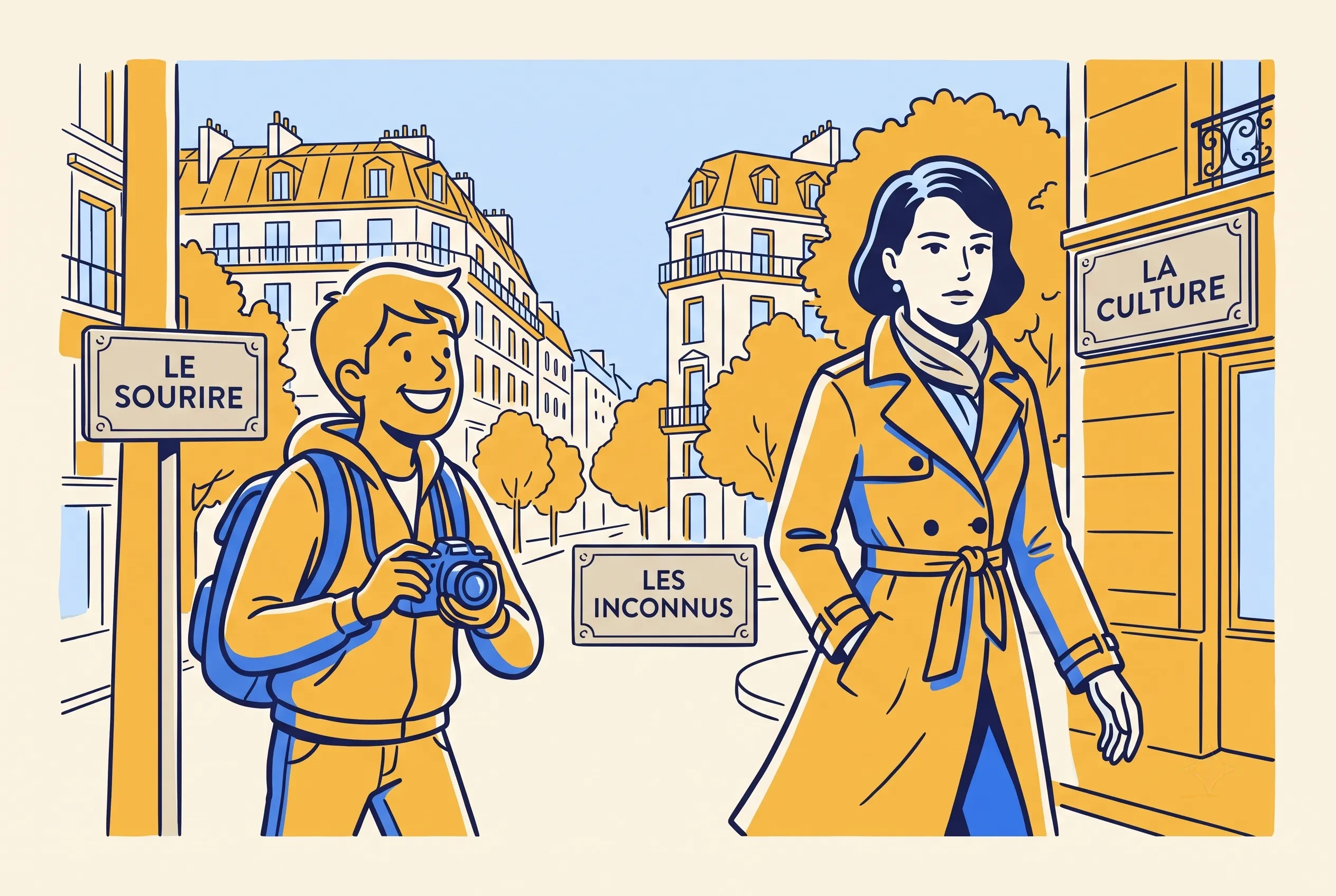
A smile is only one social cue, and its meaning depends on the setting and the person. Use these situations to consider possible interpretations rather than treating one interaction as a rule about everyone in France.
How the setting changes a smile's meaning
The biggest source of confusion is that both cultures use the same facial expression but assign very different meanings to it. In the United States, especially in customer-facing or public environments, smiling often functions as a social lubricant. It says: I am safe, I am not hostile, I am open to a light human exchange, and I know how to behave in public. It does not always mean happiness. It often means social management. Americans are trained into this very early, sometimes without noticing it.
French culture often sees that very differently. In France, a smile is expected to correspond more closely to an actual emotional state or a real social relationship. If you are not amused, pleased, touched, or genuinely glad to see someone, why would you smile broadly at them? If you do, the French person may read the gesture as artificial, overly familiar, or strategic. The unspoken question becomes: what do you want from me?
That exchange reveals the underlying logic. In French culture, a smile often wants a reason. In American culture, the smile can be the reason. That difference alone explains a huge number of painful little misunderstandings on the metro, in shops, in cafes, and on the street.
What many French people may hear instead: Smile = fake friendliness, low-grade sales energy, forced intimacy, or strange emotional overexposure.
Interpreting a neutral expression
One of the hardest adjustments for Americans in France is learning that the neutral face is not a problem to solve. In many American environments, the neutral face gets treated almost like a minor social failure. If you look neutral, people may assume you are irritated, depressed, antisocial, or unhappy. In France, that assumption is much weaker. A neutral face is just a face when nothing in particular needs to be signaled.
This matters especially in Paris, where public transport, sidewalks, queues, and cafes are full of people existing without performing accessible cheerfulness. They are not on stage. They are not trying to reassure the room. They are simply moving through ordinary life. For Americans, this can feel cold at first. For many French people, it feels more honest and less exhausting than the pressure to display friendliness continuously for strangers.
In France, the neutral face is not the absence of kindness. It is the absence of performance.
This is why so many Americans misread Parisian public life. They think the city is full of angry people. Very often, it is full of neutral people. The difference matters. Once you stop assigning emotional hostility to every unsmiling face, France becomes much less personally stressful.
Smiling at someone you do not know
When an American smiles warmly at a stranger on the Paris metro, the American often believes they are doing something generous and socially stabilizing. They are trying to make the moment lighter. But the French stranger may experience the same gesture as intrusive. Public space in France often works on a principle of respectful distance. You acknowledge others through appropriate behavior, not by trying to create instant emotional contact.
A smile from a stranger can therefore create a small burden. It implies an opening. It suggests the other person may want something: a conversation, confirmation, reassurance, flirtation, or attention. That is why the reaction is often not hostile but evasive. The French person looks away because they want to close the opening you just created.
⚠️ Common American mistake: reading avoidance as rejection. In France, looking away from a smiling stranger often means “I do not want to turn this into an interaction,” not “I hate you.”
This is particularly important in a city like Paris, where people spend a lot of time among strangers in dense environments. Public coexistence depends partly on not demanding emotional engagement from everyone around you. The French public face is often a boundary-maintaining face. That same logic of social calibration shapes how French politeness actually works, where greeting rituals matter more than emotional warmth at the start.
Greetings and expectations in service settings
Another major source of confusion is service culture. Americans are used to service workers smiling constantly, asking upbeat questions, performing friendliness, and maintaining a visible customer-first emotional style. In France, service workers are usually expected to be correct, efficient, and professionally polite. That does not automatically include smiling. French service culture is less about emotional performance and more about competent execution within a respectful verbal frame.
This is why a French waiter, cashier, receptionist, or shop assistant may look neutral while still being entirely polite by French standards. If they greet you properly, take your order correctly, answer your question, and close the interaction correctly, they have done the job well. Their face is not the main measure of courtesy.
Notice what that sentence praises. Professionalism. Not emotional display. If you skip the greeting and then expect smiling service, the interaction often gets worse fast.
💡 Better expectation in France: do not ask whether the person seemed warm. Ask whether they were correct, respectful, and effective. That is often the more French measure of good service.
How familiarity changes an interaction
One of the worst misunderstandings foreigners can develop is the idea that French people never smile. They do. A lot. Just not in the same places, for the same reasons, or with the same automaticity as Americans. French people smile with friends, family, lovers, trusted colleagues, regular acquaintances, and in genuinely funny or pleasing moments. A French smile often carries more emotional weight precisely because it is not distributed as a default background setting.
Once you enter a real French social environment rather than observing public strangers, the emotional picture changes dramatically. At dinner tables, with friends at a cafe, in animated conversations, with children, during jokes, after wine, during shared complaining, during teasing, and inside actual relationships, the French can be very expressive and very warm. But that expression is usually tied to a context that justifies it.
A regular customer at a bakery may eventually get a soft smile and a warmer tone because a real micro-relationship has formed. That smile means more than a random public smile because it is grounded in recognition rather than social reflex. In other words, French warmth often grows through repetition and recognition, not through instant surface friendliness. The French Briefing covers these cultural patterns daily, with the kind of context that makes the rules stick.
Avoid judging sincerity from a facial expression
People differ in how comfortable they feel showing emotion to someone they do not know. A neutral expression may reflect concentration, privacy or simply a personal habit. It is not reliable evidence of hostility, sincerity or a national preference for one emotion over another.
This is why the American habit of smiling through stress, uncertainty, and discomfort can be hard for French observers to trust. They may assume you are smoothing reality too much, hiding what you really think, or behaving in a scripted way. In the US, that same behavior might be called professionalism, resilience, or positivity. In France, it can drift toward the suspicious category of being faux: not fully real.
Use more than a facial expression to interpret an interaction: consider the greeting, tone, setting and response to your words. The tu/vous distinction is another contextual cue, but it also varies with the relationship.
Personal space in busy public settings
Paris in particular intensifies the cultural logic. It is dense, fast, often tiring, and full of strangers. If everyone behaved with American public openness, the city would feel socially chaotic by French standards. Parisian public reserve is partly cultural and partly adaptive. People on the metro, in queues, on sidewalks, and in cafes protect themselves with controlled facial expression, selective eye contact, and limited unsolicited interaction.
This is also why the article title matters. The issue is not that French people cannot smile. It is that daily life in Paris and other French cities does not reward smiling at strangers as a standard civic behavior. It rewards correct distance, situational awareness, and lower emotional volume in public. If you want a related example of how French public norms differ from American expectations, this also connects well with French public holidays, where everyday life can also feel unexpectedly structured by collective norms that outsiders do not anticipate.
American public code
Smile to show harmlessness, reduce awkwardness, and create low-level friendliness fast.
French public code
Maintain neutral distance, respect boundaries, and save visible warmth for real context.
How to stop misreading French faces
The most useful adjustment is not “never smile again.” It is learning to stop interpreting every neutral French face through American emotional assumptions. Most of the time, the person is not upset with you, not judging you, not angry, and not communicating anything about you at all. They are simply not broadcasting accessible positivity into public space.
- 1Assume neutral means neutralNot hostile, not sad, not anti-American. Just neutral.
- 2Do not force emotional contact in publicOn transport and in queues, less can be more.
- 3Use verbal politeness instead of facial optimismBonjour, s’il vous plait, merci, and au revoir matter more than smiling constantly.
- 4Notice when French warmth becomes realWith repetition, recognition, shared context, and genuine interaction.
- 5Let public anonymity be normalYou do not need every shared space to become a micro-community.
What to do instead of smiling at strangers in France
If smiling less in public feels awkward, replace the instinct with more locally meaningful signals. In shops and cafes, use proper greetings. In public spaces, respect shared silence. In service interactions, choose polite wording and good timing. With neighbors or regular contacts, let familiarity grow gradually. These behaviors are often more effective than facial friendliness in France because they align with the local code of respect.
That is why this article also overlaps with French politeness rules. In France, words and sequence often do more politeness work than facial brightness. If you get the structure right, you do not need to overcompensate with visible friendliness.
Study glossary: French vocabulary for smiles, expressions, and public reserve
| 🇫🇷 French term | 🇺🇸 English translation | 💡 Usage context |
|---|---|---|
| sourire | to smile / a smile | The core verb and noun for smiling |
| le visage neutre | the neutral face | Useful for describing normal unsmiling public expression |
| faire semblant | to pretend / fake it | Important for the idea of performative friendliness |
| être vrai / vraie | to be genuine | Linked to authenticity in French culture |
| être faux / fausse | to be fake | Often used critically about forced emotional display |
| l’expression du visage | facial expression | Useful for talking about public demeanor |
| avoir l’air | to look / seem | Used constantly in describing how someone appears |
| rester sérieux / sérieuse | to remain serious | Helpful for understanding public reserve |
| l’émotion authentique | genuine emotion | Captures the cultural preference for real feeling |
| la politesse | politeness | French politeness is not always smile-based |
| le contact visuel | eye contact | Central to understanding public interaction |
| être réservé / réservée | to be reserved | Useful for describing French public behavior accurately |
Practise reading the whole interaction
The real lesson is not that France is cold. It is that France does not ask strangers to constantly reassure each other with visible positivity. Public life is often calmer, more reserved, and less emotionally demonstrative. For Americans, that can feel harsh at first because so much US public behavior depends on micro-signals of friendliness. But once you understand the French code, the silence and neutral faces lose their sting. They are not attacks. They are simply part of a different way of sharing space.
And once you stop demanding American-style friendliness from French strangers, you start noticing something better: French warmth, when it arrives, often feels more grounded. Less automatic. Less performed. More tied to real connection, real amusement, real recognition, and real human presence. That is not less social life. It is a different social contract.
Prefer to keep it free today? Read the French Briefing →
The French Gamebook
Enjoy the French. Practise the tricky bits.
For English speakers practising French
After a film, a book or a cultural detour, spend a session on the mistakes you keep noticing. Choose a Gamebook lesson and check your answers as you go.
- 21 lessons with explanations
- 40 practice rounds · 2,000 questions
300 pages · Play on your computer or print
Get the Gamebook · $9 Read a preview before you buyOne payment · Instant PDF download
Try the French with someone who can reply.
Bring a sentence you found difficult. Ask a tutor to help you say it naturally, then try it in a short conversation.
Find a French tutor →Paid lessons. Compare tutors and prices before booking.
Affiliate link: we may earn a commission when you book.
📚 Keep building in the Learning Center
French Instagram Captions: Meanings and Pronunciation
Find French Instagram captions for travel, food, love and everyday moments. Check their meaning, tone and pronunciation before…
Read →French News for Beginners: Sources by Difficulty
Find French news sources suited to your reading and listening skills. Compare learner resources, authentic news and a…
Read →French Cinema Classics: Films and a Listening Method
Explore French cinema classics across different periods. Compare styles and listening demands, then practise with a short scene…
Read →