
Updated on September 15, 2026
French SIM Cards and eSIMs: How to Choose and Buy
Compare prepaid SIMs, eSIMs and French mobile plans. Check phone compatibility, activation and plan terms, with phrases for asking for help.
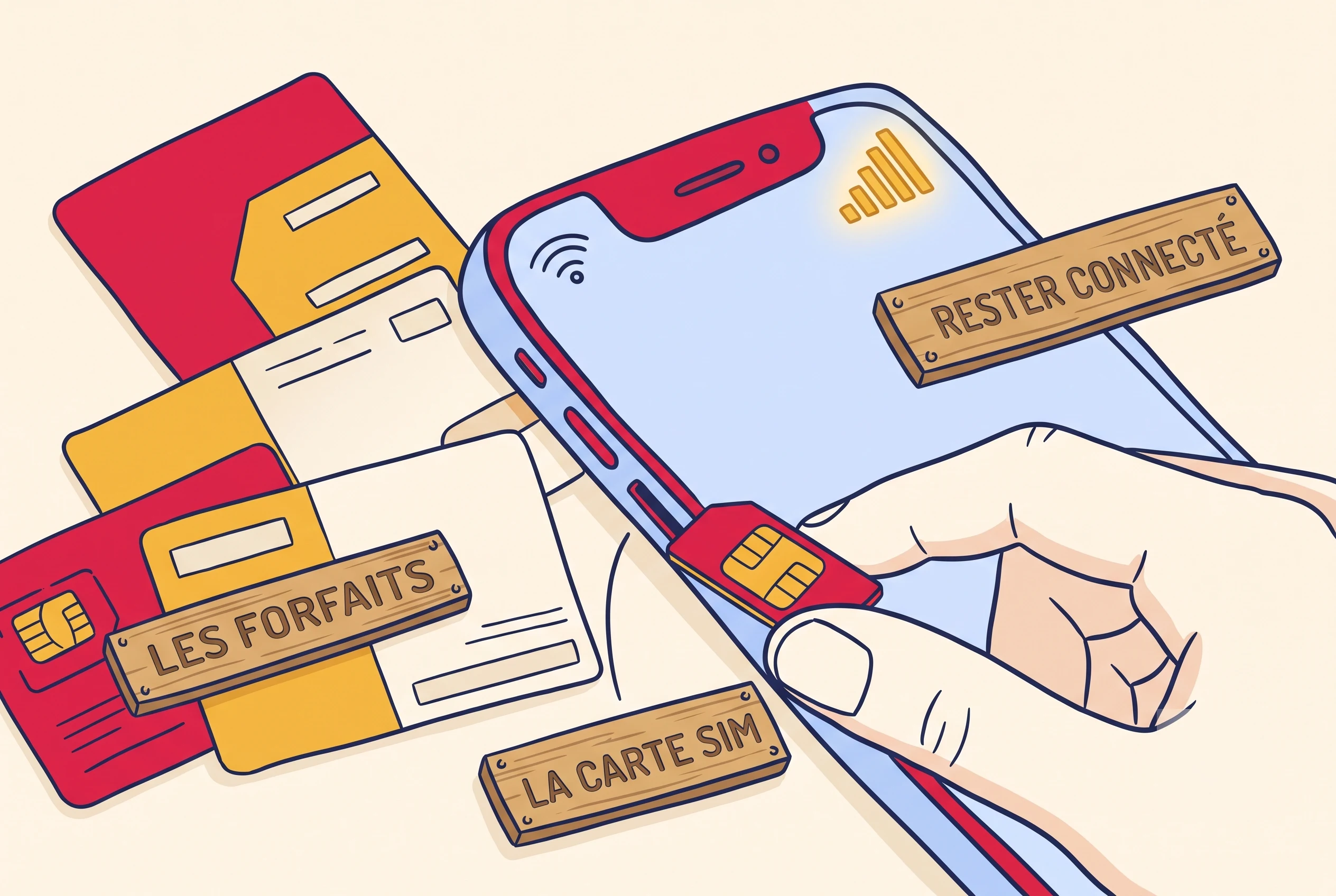
The right option depends on your phone, length of stay and data needs. Check compatibility and the full plan terms before paying, then use the shop phrases to clarify activation, renewal and cancellation.
For a short stay, buy a prepaid SIM or an eSIM before you worry about operators. Any of the four networks covers cities well, so the real decisions are whether your phone is unlocked, whether you need a French address, and whether the plan is genuinely sans engagement.
Airport counters cost the most. A phone shop or a tabac in town costs less for the same network, and an eSIM skips the queue entirely if your handset supports one.
The first decision is not “which operator”
Before comparing Orange, Free, SFR, or Bouygues, answer one question: what kind of stay is this. Two weeks, two months, one semester, a full relocation. Your answer changes almost everything. A two-week tourist and a relocating professional do not need the same thing, and the same logic applies to how long French itself takes to learn: the timeline shapes the strategy.
If you are coming from the US, the UK, or Canada: what will shock you
The French mobile market does not work like the American one. At all. If you arrive expecting Verizon/AT&T/T-Mobile logic, almost everything will feel disorienting, and most of it will feel disorienting in your favor.
Price: France is 3-5x cheaper than the US for comparable plans
An unlimited plan with a major US carrier costs $65-90/month before taxes. In France, Free’s 350 Go 5G plan with unlimited calls (including to the US) costs 19,99€/month. Taxes included. No hidden fees. No activation charge beyond the 10€ SIM. A comparable plan on RED or B&You with 150 Go 5G costs 9,99-10,99€. Americans routinely cannot believe these numbers are real. They are real. The reason is structural: Free Mobile entered the market in 2012, undercut everyone by 70%, and the other three operators had to follow. The price war never ended.
Contracts: France killed the 2-year lock-in
In the US, subsidized phone + 2-year contract is still the dominant model. In France, over 80% of mobile plans sold are now sans engagement (no commitment). You can cancel with a click, anytime, no penalty (except B&You’s 5€ fee since April 2025). There is no “early termination fee” of $350. There is no contract to terminate. The plan is month-to-month by default. Plans avec engagement (with commitment) still exist, usually bundled with a subsidized phone, but they are the minority and clearly labeled.
Taxes: the price you see IS the price you pay
In the US, a $50 plan becomes $58-65 after state taxes, federal fees, regulatory surcharges, and whatever else the carrier invents. In France, all advertised prices are TTC (toutes taxes comprises). The 19,99€ you see on the website is 19,99€ on your bill. No surprises. No line-item archaeology. This is not a telecom-specific thing. It is French consumer law. All prices displayed to consumers in France must include all taxes. This consumer protection logic extends to every service interaction you will have in France, from your rental contract to your bank account fees.
Coverage: smaller country, denser networks, but rural gaps exist
Metropolitan France is roughly the size of Texas. Four operators cover it. The result: urban coverage is excellent on all four networks. Rural coverage varies. Orange has the best rural reach. Free has historically been weaker in remote areas but compensates with an Orange roaming agreement. If your stay includes rural France, the nature vocabulary might matter as much as your signal bars. Before choosing an operator for a stay that includes the countryside, check the official Arcep coverage map: monreseaumobile.arcep.fr.
EU roaming: your French SIM works across Europe
This is the part that blows Americans’ minds. Since 2017, EU regulations mean your French SIM works at no extra charge across all 27 EU countries plus Iceland, Liechtenstein, and Norway. Calls, texts, and data (within a “reasonable use” allowance, typically 20-40 Go/month depending on the plan) are included. You buy a SIM in Paris and it works in Rome, Berlin, Amsterdam, Barcelona, and Dublin without touching your settings. That also means the Paris survival phrases you learn for France keep working across Europe. There is no equivalent of this in North America. Canadian and UK travelers benefit from similar treatment since most French operators still include the UK post-Brexit.
SIM purchase: no credit check, no SSN, less paperwork
In the US, getting a phone plan involves a credit check, a Social Security number, and sometimes a deposit. In France, you need a valid ID (passport works) and a payment method. For prepaid, you often do not even need an address. For sans engagement monthly plans, you typically need a French address and a bank account (or at least a European payment card). No credit score. No deposit. No 45-minute store interaction where someone tries to sell you insurance, a case, and a tablet. If the transaction French at the counter still feels intimidating, the politeness rules guide covers the exact register that makes French service interactions less stressful. And if the phone call to activate your line is the scary part, the first French phone call guide exists for exactly that.
For UK arrivals: the structure is more familiar. The UK has a similar prepaid/PAYG + SIM-only monthly market. The main difference: France is even cheaper (UK SIM-only plans at £10-15 give you what France gives for 7-10€), and the Orange network advantage in rural France has no real UK equivalent since UK coverage is more uniform across operators.
For Canadian arrivals: Canadian mobile prices are among the highest in the developed world. A basic plan with 20 Go costs $55-75 CAD. In France, 150 Go costs 9,99€. The shock is real. Also: if you need TCF Canada for immigration purposes, your French SIM is a separate issue from your exam certification path.
Prepaid, sans engagement, eSIM: what you actually need
| Option | Best for | Main advantage | Main risk |
|---|---|---|---|
| Tourist prepaid SIM | Trips of a few days to weeks | Fast setup, easy to abandon | Convenience markup, limited validity |
| Standard prepaid card | Flexible short stays, backup line | No bank account needed, buy at tabac | Top-ups and expiration annoying |
| Sans engagement plan | Students, interns, stays of months+ | Better ongoing value, cancel anytime | Usually needs French address |
| eSIM | Unlocked compatible phones | No physical chip swap, instant setup | Compatibility issues, fewer options |
One of the most useful questions in the whole process — are you locked in?:
The French mobile landscape: who owns what and why it matters for your wallet
France has exactly four companies that own actual cell towers: Orange, SFR, Bouygues Telecom, and Free Mobile. Every other brand you see (Sosh, RED, B&You, Lebara, Syma, Prixtel, the SIM card at the tabac) is renting space on one of those four networks. That means the signal quality you get depends on which network sits underneath, not on the brand name printed on the box. Arcep, the French telecom regulator, lists over 30 active operators, but they all flow back to those same four pipes.
Orange has the largest coverage footprint in France, especially in rural areas and smaller towns. If you are heading anywhere outside Paris, Lyon, or Marseille, Orange’s network is the safest bet for reliable 4G. That includes the French countryside and smaller towns where the train system vocabulary also becomes essential. They also run the most visible tourist product (Orange Holiday) and have about 1,000 physical stores across France. The trade-off: Orange-branded plans are the most expensive. Their budget arm Sosh uses the exact same network at lower prices, online only.
Free Mobile is the disruptor that crashed into the market in 2012 and permanently broke French telecom pricing. Their headline plan (350 Go 5G, 19,99€/month, sans engagement, prix gelé jusqu’en 2027) is still the most data for the least money from any network operator in France. They also have a 2€/month plan with 50 Mo and 2 hours of calls that is genuinely useful as a backup line or an ultra-cheap tourist option. Free does not have traditional stores. Instead, they use self-service kiosks (bornes) inside Fnac stores and Maison de la Presse locations. No human interaction needed. ID, plan choice, SIM in minutes. Once activated, the French texting abbreviations guide will decode the SMS you start receiving. French people abbreviate everything.
SFR and Bouygues Telecom sit in the middle. Both have strong urban networks and roughly 500 stores each. SFR’s budget brand RED by SFR is known for aggressive promotions and “prix fixe” positioning (the price does not increase after year 1). Bouygues’ budget brand B&You plays the same game but note: since April 2025, Bouygues charges 5€ résiliation fees even on sans engagement plans, which no other operator does.
What things actually cost right now (March 2026)
The French mobile market is, by European standards, absurdly cheap. You can get 150 Go of 5G data with unlimited calls for under 11€/month, sans engagement. That is not a promotional accident. That is the structural result of Free Mobile entering the market in 2012 and permanently breaking the pricing ceiling. Every other operator had to follow or die. They followed.
At the bottom of the market, both Sosh and RED by SFR offer a 2-hour calls + 1 Go plan at 1,99€/month. Free’s legendary 2€ plan gives you 50 Mo and 2 hours of calls (and is literally free if you have a Freebox at home). These ultra-cheap plans are not tourist gimmicks. They are permanent offers that millions of French people use as second lines, kid lines, or backup connections. Couples learning French together sometimes get two separate cheap lines to practice calling each other in French. Sounds silly. Works.
The sweet spot for most visitors and short-stay residents is the 8-11€/month range. That is where the real competition happens. RED currently offers 80 Go 5G at 7,99€ and 150 Go 5G at 9,99€. B&You has 150 Go 5G at 10,99€. Sosh offers 100 Go on the Orange network at 9,99€ (4G only at this tier, but the coverage advantage in rural France is real). All sans engagement. All include unlimited calls and SMS. All cancel with a click.
At the top, Free’s 5G+ plan at 19,99€/month gives you 350 Go in France and 35 Go across 117 international destinations with calls to US, Canada, and China included. That price is frozen until 2027. If you have a Freebox Pop, it drops to 9,99€ with unlimited data. Nobody else in France matches that combination of volume, international coverage, and price stability.
Watch for the year-1 trap. Free’s Série Free (150 Go, 10,99€) looks identical to RED and B&You on paper, but it automatically becomes the 19,99€ plan after 12 months. RED and B&You advertise “prix fixe” meaning the price stays the same after year 1. Sosh prices are generally stable too. Always check whether you are looking at a permanent price or a first-year promo. Also: Bouygues charges 5€ résiliation fees even on sans engagement plans since April 2025. No other operator does this.
So what should you actually get?
The smaller players worth knowing about
Beyond the big four and their budget brands, France has a layer of MVNOs (virtual operators) that rent network capacity and sell it cheaper, sometimes with a specific angle: international calls, eco-pricing, or distribution through supermarkets and post offices. You do not need to study all of them. But a few are genuinely useful depending on your situation.
| MVNO | Uses network | Best for | Website |
|---|---|---|---|
| La Poste Mobile | SFR | Available in every post office in France, good for in-person setup | lapostemobile.fr |
| Syma Mobile | Orange | Cheap international calls, popular with expats, prepaid available | symamobile.com |
| Lebara | SFR | International calls, prepaid-friendly, available at tabacs | lebara.com/fr |
| Prixtel | SFR | Flexible pricing (pay per GB used), from 6,99€/month for 120 Go 5G | prixtel.com |
| NRJ Mobile | Bouygues Telecom | Budget plans, owned by Bouygues group | nrjmobile.fr |
| Réglo Mobile (E.Leclerc) | SFR | Available in E.Leclerc supermarkets, ultra-budget | reglomobile.fr |
| Cdiscount Mobile | Bouygues Telecom | Online-only promo deals, sans engagement | cdiscount.com/telephonie |
| Coriolis | SFR | Mid-range MVNO, SIM at 1€, prepaid and monthly available | coriolis.com |
| YouPrice | Orange, SFR, or Bouygues (you choose) | Choose your network at signup. Budget plans from ~5€. | youprice.com |
eSIM: the option that did not exist five years ago
If your phone supports eSIM (most iPhones since XS, most Samsung Galaxy since S20, most Pixels), you can skip the physical SIM entirely. Buy online, scan a QR code, activate. No store visit. No queue. No waiting for delivery. This is the cleanest option for organized travelers who set things up before departure. The trade-off: fewer options, data-only on some providers (no French phone number), and compatibility is still not universal.
| Provider | Coverage | Best for | Website |
|---|---|---|---|
| Ubigi (Transatel) | Global (France included) | eSIM for short stays, instant activation, multi-country | ubigi.com |
| Airalo | 200+ countries | Budget eSIM, data-only, no French number | airalo.com |
| Holafly | Europe / global | Unlimited data eSIM for travelers, flat rate | holafly.com |
| Orange Holiday eSIM | Europe (30 countries) | Official Orange tourist eSIM, includes French number | orange.fr/holiday |
Check coverage before you buy. Arcep publishes an official interactive coverage map showing 2G/3G/4G/5G coverage by operator and by department: monreseaumobile.arcep.fr. If you are heading to rural France, this map matters more than any marketing claim.
Where to buy: every channel, compared
1. At the airport
Fastest path to immediate connection. Rarely the best value. Airport counters exist for urgency. If you can survive the first few hours on airport/accommodation Wi-Fi, you gain flexibility by waiting. The Paris survival phrases work even without data if you memorize the top ten before landing.
2. In an operator store (boutique)
Best route if you want someone to explain options, check compatibility, and help with activation. Slower than a tabac but safer if your situation is not simple. Knowing how to introduce yourself at a counter (Bonjour + situation + question) makes the whole interaction faster. Orange, SFR, Bouygues all have stores in every major city. Free uses bornes (self-service kiosks) inside Fnac stores and dedicated Free locations.
3. At a tabac or bureau de presse
The speed-value compromise. Less support than an operator store, much less markup than the airport. Most tabacs carry Lebara, Syma, and sometimes SFR/Orange prepaid. The French texting abbreviations guide will make more sense once you actually have a French number and start receiving SMS. Ask: “Vous vendez des cartes SIM ?” then “Comment je l’active ?” before you leave the counter.
4. At a supermarket (E.Leclerc, Auchan, Carrefour)
Réglo Mobile (E.Leclerc) SIMs are sold at checkout or dedicated kiosks. Auchan Telecom SIMs at Auchan stores. Carrefour sometimes carries its own or third-party prepaid. Very cheap but minimal support. The same supermarkets where you buy your SIM are where you discover French cheese culture and realize you need data for Google Translate at the fromagerie counter.
5. At a La Poste office
La Poste Mobile SIMs are available in every post office in France. Useful because post offices are everywhere, including small towns where operator stores do not exist. Staff can help with setup. Post offices are also where you handle other admin tasks covered in the French admin vocabulary guide.
6. Online (delivered or eSIM)
Best value for stays long enough to justify waiting for delivery (1-3 days). All budget brands (Sosh, RED, B&You, Free) are online-first. If you are a busy professional with no time for store visits, this is your channel. eSIM providers (Ubigi, Airalo, Holafly) activate instantly without delivery. Order before you travel if possible.
7. At a Free borne (self-service kiosk)
Free operates self-service terminals in Fnac stores and some Free shops. Insert your ID, pick a plan, get a SIM in minutes. No human interaction needed. Available in most cities.
Quick decision rule
Need connection NOW: airport or tabac. Need advice: operator store or La Poste. Need best value: online or supermarket. Need zero physical SIM: eSIM provider. Need zero human interaction: Free borne.
Activation: what to do when data does not work immediately
- 1Insert SIM or install eSIM correctly. Wrong slot, old SIM still active, or partial eSIM setup causes fake confusion.
- 2Wait a few minutes. Some activations are not instant. Give the network time to settle.
- 3Test calls and data separately. Calls can work before data. That distinction matters for troubleshooting.
- 4Check mobile data settings. Enable “données mobiles” / “data cellulaire” in phone settings. Check APN if needed.
- 5Ask before leaving the store. “Il faut faire quelque chose pour l’activer ?” prevents hotel-room frustration later. If activation requires a phone call to customer service, the first French phone call guide is built for exactly that scenario.
If something’s wrong, describe it precisely to narrow the problem fast:
The locked-phone disaster. A perfect French SIM is useless if your home carrier still controls the device. Check your phone is unlocked (débloqué) before departure, not at a counter in France while the queue grows behind you.
The smart choice by stay length
| Stay | Best option | Why |
|---|---|---|
| <1 week | Home roaming or tourist prepaid / eSIM | Speed matters more than value. Airalo or Orange Holiday eSIM work instantly. |
| 1-4 weeks | Tourist SIM (Orange Holiday) or tabac prepaid (Lebara, Syma) | Classic tourist zone. City purchase beats airport markup. |
| 1-6 months | Sans engagement monthly (Free, Sosh, RED, B&You) | Too long for tourist pricing. Monthly plans win on value. Cancel anytime. |
| 6+ months / relocation | Sans engagement monthly + portabilité if switching | Phone plan becomes part of your admin ecosystem (bank, address, contracts). |
French phrases that make buying a SIM card easier
Open by placing yourself — tourist or medium-term resident changes what they’ll offer:
Steer them to what you actually use — for most travellers that’s data:
A foreign phone must be unlocked to take a French SIM — confirm it up front:
Two practical follow-ups — easy top-ups, and keeping your number (la portabilité):
Study glossary: French mobile vocabulary
| 🇫🇷 French | 🇺🇸 English | 🎯 Why it matters |
|---|---|---|
| La carte SIM / l’eSIM | SIM card / eSIM | Core product |
| Le forfait mobile | Mobile plan | Monthly or prepaid |
| Prépayé | Prepaid | Pay in advance, top-up based |
| Sans engagement | No commitment | Cancel anytime. Key phrase. |
| Avec engagement | With commitment | Locked-in contract. Avoid unless you know why. |
| Recharger | To top up | Add credit to prepaid |
| La data / les données mobiles | Mobile data | Internet on your phone |
| Le réseau / la couverture | Network / coverage | Check on monreseaumobile.arcep.fr |
| Débloqué | Unlocked | Phone can accept any SIM |
| Le solde | Balance | Remaining prepaid credit |
| La portabilité / le RIO | Number portability / operator ID code | Keep your French number when switching carriers |
| Activer | To activate | Make the line usable |
| La borne | Self-service kiosk | Free uses these in Fnac stores |
Prefer to keep it free today? Read the French Briefing →

Your First 90 Days in France
Ask about the phone plan before you sign.
For English speakers getting settled in France
Practise asking about the monthly price, the contract length and what happens after a promotion ends. Adapt the phone-plan message to the offer you are considering.
- 30 everyday situations to rehearse
- 90 practice questions with explanations
About 180 pages per edition · Interactive + Print A4 included
Get the 90-day guide · $9 Decode the phone-plan offerOne payment · Instant PDF download
Practise choosing a phone plan in French.
Bring an offer you are considering. Rehearse asking about the monthly price, coverage and contract length with a tutor.
Find a French tutor →Paid lessons. Compare tutors and prices before booking.
Affiliate link: we may earn a commission when you book.
📚 Keep building in the Learning Center
Moving to France from the US: A Practical First-90-Days Plan
Your first 90 days in France involve overlapping tasks, from housing and banking to everyday conversations. Use this…
Read →French Health Insurance for Expats: The Vocabulary Behind the Paperwork
French health insurance arrangements for expats depend on status and circumstances. Distinguish eligibility, registration, evidence of cover and…
Read →France Long-Stay Visa Requirements: A Document Checklist You Can Actually Use
France long-stay visa requirements depend on your route and circumstances. Build your file from the official checklist, then…
Read →