
Updated on September 15, 2026
French Phone Call Phrases: Answer, Ask and Clarify
Prepare for French phone calls with phrases for answering, asking for repetition, leaving voicemail and ending a call, with translations and audio.
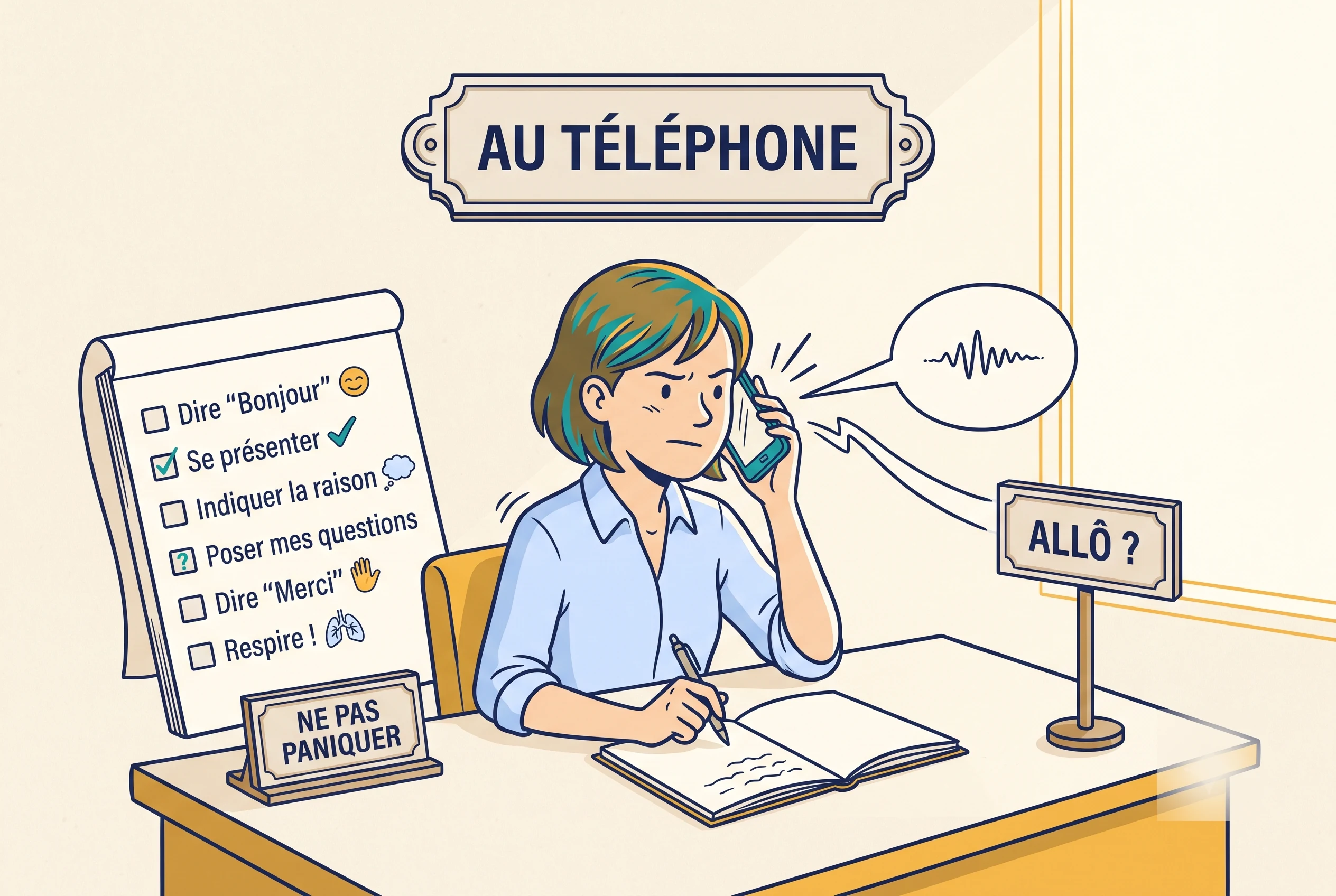
Phone calls remove the gestures and visual clues that help face-to-face conversation. Prepare an opening and a clarification phrase, then practise the sequence from identifying yourself to confirming the next step.
Answer with “Allô, oui ?” or your name, then use one repair phrase and stop apologising. “Pardon, pouvez-vous répéter plus lentement, s’il vous plaît ?” buys you the whole call, and French callers slow down when asked directly.
The difficulty is not your French. It is that a phone strips out lips, gestures and faces, which is where a large part of your comprehension was quietly coming from.
Why French phone calls feel worse than normal French conversations
A French phone call feels disproportionately hard because it removes the supports you normally do not notice you are using. In person, you read faces, watch lips, track body language, and often infer meaning even when the French itself is partly blurry. On the phone, all of that disappears. Your brain has to do the entire job from audio alone. For English speakers, that is especially difficult because French already compresses words together in ways that make speech boundaries feel less obvious than in English. Once phone audio quality reduces the sound even further, what was already hard can suddenly feel impossible.
The psychological part matters too. A phone call creates urgency. Silence feels longer. Misunderstandings feel riskier. You cannot rely on a smile, a raised eyebrow, or a hand gesture to soften the moment where you did not understand. That is why even learners who are decent in person often panic on the phone. The problem is not that their French vanished. The problem is that the format became harsher.
Your first French phone call does not feel hard because you are weak. It feels hard because phone conversations are a stripped-down version of language where every missing support suddenly matters.
The reassuring part is that phone calls are also more repetitive than they seem. Most French phone interactions are not open-ended philosophical debates. They are reservations, appointments, confirmations, missed-call follow-ups, information requests, schedule changes, business hours, directions, or simple personal logistics. Once you learn the scripts, the experience changes fast. If listening under pressure is one of your broader weak spots, that often connects directly to the same underlying issue explored in French pronunciation and listening at A1-B1, where the ear needs better contact with real spoken French, not just grammar knowledge.
How to answer the phone in French without sounding lost
The opening matters because it sets the tone of the call immediately. English speakers often answer with a hesitant “Hello?” and wait to see who is there. French phone etiquette is usually more direct and slightly more formal, especially when the number is unknown or the context is practical rather than intimate.
This sounds natural, clear, and serious without sounding stiff. It also gives the other person useful information immediately. If you are calling someone else rather than receiving a call, the opening changes slightly:
That question is standard. It is not rude. It is just part of the phone ritual. The faster you stop treating these formulas as personal and start treating them as routine, the easier French phone calls become. The same tension shows up in French politeness rules English speakers misread, where “cold” is often just structured politeness rather than actual distance.
The essential repair phrases when you do not understand
The single most important shift in French phone confidence is this: stop thinking of not understanding as the crisis. The crisis is pretending to understand when you do not. Once you accept that repetition and clarification are normal tools, the phone becomes less threatening.
This is the lifeline phrase. Use it immediately, calmly, and without apology theatre. Sometimes the other person simply repeats the same sentence at the same speed. Then you need a slower or different version:
💡 Best survival principle: if the information matters, ask again. Times, dates, prices, addresses, names, conditions, and meeting points are never the place to fake understanding.
Sometimes you understood almost everything except one detail. That is when targeted confirmation becomes better than full repetition:
⚠️ Dangerous reflex: saying “oui, oui, d’accord” when you are actually lost. This feels like escape in the moment and often creates a bigger problem ten minutes or ten hours later.
Common French phone situations and the scripts behind them
The reason French phone calls become manageable surprisingly fast is that the range of common real-life situations is narrow. The same structures come back constantly. A restaurant reservation. A doctor’s appointment. A hairdresser. A landlord. A late arrival. A cancellation. A callback request. A shop inquiry. A confirmation. Once you know the standard language for those situations, most calls stop feeling like improvisation.
Making a reservation
Making an appointment
Calling because you are late
Calling to cancel or reschedule
Asking for opening hours
When the person is unavailable
Learning these as reusable chunks helps much more than trying to build every phone call from scratch. This is exactly the kind of pattern-based survival language that also makes thinking in French instead of translating much easier, because chunks reduce the amount of live sentence construction your brain has to do under pressure.
How to control the pace instead of being dragged by it
One of the most important phone skills in French is not vocabulary. It is pace management. Many English speakers feel trapped by the momentum of the call. That is usually false. You have more control than you think. You can pause, ask for repetition, ask for slower speech, confirm details, say you are checking something, and take notes.
That kind of bridge phrase is excellent because it buys you a few seconds without sounding panicked. Taking notes is another massive advantage:
💡 Pre-call system: before any important call, write one sentence explaining why you are calling, list the information you need, keep a pen ready, and decide your opening phrase in advance. Five minutes of prep changes the whole call.
How French phone calls end and why English speakers cut them off too fast
Phone closings are another place where English-speaking instincts can create awkwardness. In English, many calls end quite abruptly once the practical purpose is done. In French, the closing often has a more visible sequence. First, the essential information is summarised or confirmed. Then gratitude appears. Then a final courtesy phrase. Then au revoir.
⚠️ Common awkward ending: solving the practical issue, saying one quick “merci” and hanging up before the other person has actually entered the closing ritual.
How to leave a voicemail in French without collapsing
Voicemail sounds safer because the other person is not there live. In reality, many learners panic harder because they hear the beep and suddenly feel they must produce a complete coherent mini-speech alone. The good news: French voicemail messages are extremely formulaic.
Phone numbers matter because French speakers usually say them in pairs. Slow down and group it the French way:
⚠️ Voicemail trap: hanging up midway because you made one mistake. Finish the message. One imperfect complete voicemail is more useful than three abandoned fragments.
What to practice before your first real French phone call
The best preparation is not abstract fluency work alone. It is targeted rehearsal. Practice saying your opening phrase out loud until it sounds automatic. Practice asking for repetition. Practice confirming times, dates, and addresses. Practice leaving a voicemail. You do not need a giant library of phone dialogues. You need a compact set of high-value phrases you can deploy without freezing.
It also helps to lower the emotional stakes of the first calls. Do not begin with the most important administrative conversation of your month if you can avoid it. Start with low-risk real calls. Ask a shop about opening hours. Call a restaurant to ask whether they are open on Sunday. Each successful call teaches your nervous system that a French phone call is survivable. The French Briefing trains the same ear for real spoken French daily.
- 1Prepare your openingKnow exactly how you will answer or start the call.
- 2Prepare your purpose in one sentenceIf you cannot state the reason for the call simply, the call will feel more chaotic.
- 3Keep repair phrases visibleRepetition, slower speech, rephrasing, confirmation.
- 4Take notes during the callDo not trust stressed memory with important details.
- 5End properlyConfirm, thank, close, and let the final goodbye happen fully.
If your general spoken French still feels fragile, it also helps to reinforce the broader everyday interaction layer around phone calls. That is why articles like opening a French bank account in French or reducing the translation reflex tend to help with phone calls too.
Study glossary: French phone call vocabulary
| 🇫🇷 French term | 🇺🇸 English translation | 💡 Usage context |
|---|---|---|
| allo | hello on the phone | Phone-specific greeting used when answering |
| a l’appareil | speaking | Used after your name when identifying yourself |
| c’est de la part de qui ? | who is calling? | Standard question when screening a call |
| ne quittez pas | hold on / don’t hang up | Used when the person is putting you through |
| je vous le passe | I’m putting you through | Used when connecting you to someone else |
| laisser un message | to leave a message | Useful when the person is unavailable |
| rappeler | to call back | Used for return calls or callback requests |
| la messagerie | voicemail | Used in automated or personal answering systems |
| prendre rendez-vous | to make an appointment | One of the most common phone call purposes |
| réserver | to reserve / book | Restaurants, hotels, tickets, appointments |
| pouvez-vous répéter ? | can you repeat? | Core repair phrase when comprehension breaks down |
Your first French phone call does not need to be pretty to be successful
The most important truth about your first French phone call is that success and elegance are not the same thing. A successful first call may include several repetitions, one or two awkward pauses, slow note-taking, a request for clarification, and a slightly clumsy ending. That still counts as success if you achieved the practical goal of the conversation.
That is how phone confidence is built. Not by waiting until you feel fearless, but by making a series of slightly uncomfortable calls until the structure becomes familiar and the discomfort stops feeling exceptional. The first call is the hardest because it is unknown. The fifth is easier because you start hearing the patterns. The twentieth feels ordinary because the phone has stopped being a special French battlefield and become just another place where French happens. That is the real shift you are aiming for.
Prefer to keep it free today? Read the French Briefing →
Your First 90 Days in France
Make the call with a few useful replies ready.
For English speakers getting settled in France
Practise introducing yourself, asking someone to repeat and reading a date back aloud. Use the phone situation to prepare for the moment you miss a word.
- Phone situations and useful replies
- Everyday practice with answer explanations
About 180 pages per edition · Interactive + Print A4 included
Get the 90-day guide · $9 Rehearse the phone callOne payment · Instant PDF download
Try the phone call with a tutor first.
Practise without looking at each other. Give your name, confirm a time and ask your tutor to repeat a detail at normal speed.
Find a French tutor →Paid lessons. Compare tutors and prices before booking.
Affiliate link: we may earn a commission when you book.
📚 Keep building in the Learning Center
French Travel Phrases for Hotels, Shops and Cafés
Practise French travel phrases for hotels, cafés, shops and transport. Learn follow-up replies and polite ways to ask…
Read →Introduce Yourself in French: Phrases for Real Situations
Learn French introductions for social and professional situations. Compare formal and informal wording, follow-up questions and example templates.…
Read →Order at a French Bakery: Bread, Pastries and Phrases
Order bread and pastries in French, ask about types and slicing, and handle payment. Listen to practical bakery…
Read →