
Updated on September 15, 2026
Book a Restaurant in French: Phrases and Replies
Book a restaurant table in French, understand common replies and change a reservation. Practise phone, arrival and ordering phrases.
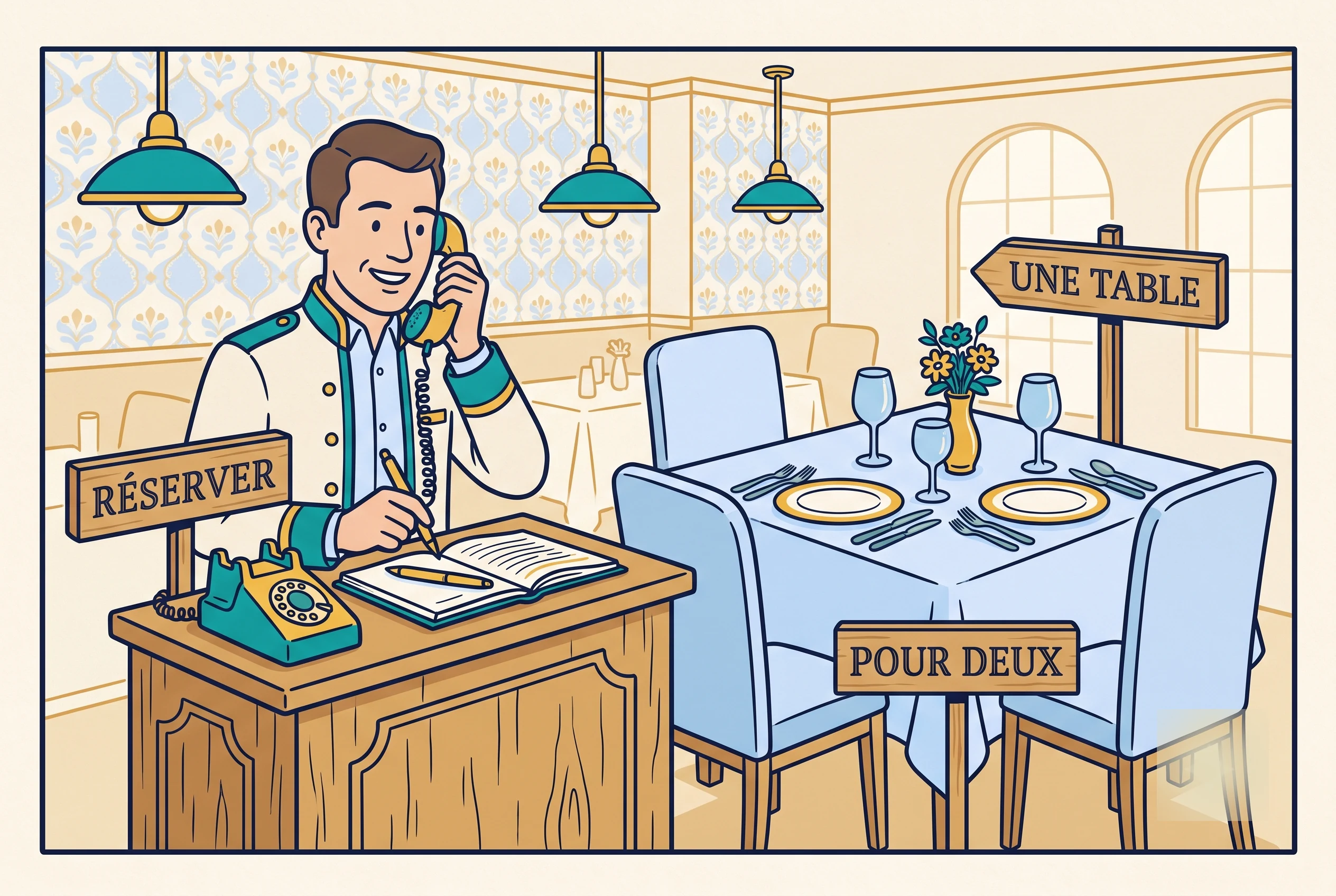
A reservation involves details such as the date, time and number of people. Practise giving them clearly, then use the reply examples to confirm the arrangement or ask for an alternative.
Booking by phone: one sentence, four pieces of information
The phone rings twice. Someone picks up: “Bonsoir, Le Comptoir.” Full speed. You have four seconds before silence becomes awkward. Cram everything into one sentence: party size, date, time, name. No small talk. French restaurant staff parse efficiency, not politeness padding. The restaurant call is below. If it is French phone calls in general that empty your head, the phone call guide starts further back.
Leave out any of the four and the host stops you to ask. Party size, day, time, name, in one go.
Want the terrace? Ask rather than assume; the host needs a yes/no question:
“On” is informal but completely standard on the phone; “nous” would sound stiff here:
What the host says back
Most guides only teach what you say. The host’s reply is what derails you. Expect: “Pour quelle heure ?” (what time?), “Quel nom ?” (what name?), or “On est complet.” (we are full). French erases the boundary between words on purpose, which is why putting the gaps back where they belong is trainable rather than innate. If you hear “complet,” move on to the next restaurant.
If your slot is taken, “vers” (around) gives the host room to offer an alternative:
Timing rule. French dinner service starts at 19h30. Booking for 18h gets a confused silence, because nobody serves dinner at 6 PM. Before that hour the country is drinking coffee, and the café runs on its own rules about price, seat, and when the bill arrives.
Arriving: the first thirty seconds
You walk in. The host does not smile. Not hostility, just neutral service protocol. Say “Bonjour” first. Always. Then state your reservation in one line. Greeting a stranger who has not greeted you feels excessive, until the evening you skip it and feel the chill; the logic underneath that reflex takes ten minutes.
On arrival, say bonjour first, then state the reservation in one line, name last:
What do you say when you want the window table and the host is the one who assigns seats?
Numbers changed? “Finalement” flags it politely; without it the sentence sounds like a correction:
That seating rule catches every American and British diner off guard. In France the table belongs to the house. The host decides. You suggest. Sitting wherever you want reads as rude in any establishment with table service.
Friday and Saturday. Walking in without a reservation on a weekend evening means no table. Smaller bistros might squeeze you in. Anything with a reputation will not. Pick the fallback before you are hungry: the forty phrases that get you fed anywhere in Paris work at any counter.
Allergies, water, and the bread question
Say it while the waiter still has the pad open, before the plate lands. Swap “noix” for whichever allergy is yours:
Tap water is free by law; ask for a carafe so they don’t bring a paid bottle:
The bread question nobody asks
Bread appears without ordering. It is included. Asking “is the bread free?” marks you as a tourist faster than any accent. Take it. Use it to push food onto your fork. That is what it is for in France.
Ordering: entrée, plat, dessert
French ordering follows courses. Entrée (starter), plat (main), dessert. Jump straight to the main and you will hear “pas d’entrée ?” from the server. In French, “entrée” is the starter, never the main course. How many other French words are lying to you in English clothing? We counted the twenty worst offenders, and this is not the costliest.
In English the same word covers the printed list of dishes and the fixed-price set. French keeps two words: only the list is the “carte”.
Order by course and the server immediately knows you understand the system:
Ordering the steak well done earns a look from the server, who will still bring it exactly as you asked.
“Si possible” softens a special request; without it, it lands like a command:
Servers take this seriously and will give you an honest opinion:
Quick win. Point to the menu if pronunciation fails. “Celui-ci” (this one) plus a gesture works perfectly at A0. If pointing feels like defeat, the shy beginners guide takes that apart.
Changing or cancelling your booking
You need to move the reservation earlier, postpone it, or cancel. Lead with the change and the call is over in under a minute. The tu/vous guide applies: always vous with restaurant staff.
Two verbs, one call. “Reporter” pushes the booking later; this one pulls it earlier:
Some restaurants expect a same-day confirmation; skipping it can cost you the table:
Cancelling is always better than a no-show; keep it short and direct:
Adding a guest reshuffles the seating plan, so call early:
No-show culture is different
Paris restaurants with Michelin stars or long waitlists now take card details at booking. Cancelling is always better than ghosting. One phone call, ten seconds of French. The drinking half of the evening is outside this page: ordering the apéro without sounding like a phrasebook has its own guide.
Study glossary: French restaurant vocabulary
| 🇫🇷 French | 🇺🇸 English | 💡 Context |
|---|---|---|
| Réserver / réservation | To book / reservation | Phone or online, with party size and time |
| En terrasse / en salle | Terrace / inside | Ask; terrace fills fast in summer |
| Près de la fenêtre | Near the window | Request only; host assigns seating |
| Allergique aux… | Allergic to… | + noix, gluten, fruits de mer, produits laitiers |
| Carafe d’eau | Tap water jug | Free by law. Say it to avoid bottled. |
| Menu du jour | Daily set menu | Fixed price. NOT the menu card. |
| La carte | The menu card | Not “le menu” which means set meal |
| Entrée / plat / dessert | Starter / main / dessert | Course order. Entrée ≠ main course. |
| Bien cuit / saignant | Well-done / rare | State after dish name |
| Avancer / reporter | Move earlier / postpone | Do not mix these up |
| Annuler | Cancel | Always better than a no-show |
| Complet | Full / booked out | If you hear this, try next restaurant |
| Au nom de | Under the name | Last piece of the booking sentence |
The restaurant gives you the most time. The same sentence, faster, gets you through the train ticket window; the bakery queue is shorter still; and the drinks guide picks up where the plates leave off.
The shortest call in the whole booking is the one that cancels it. Bonjour, the name on the reservation, the date, and the fact that you are not coming. Ten seconds. The table goes to whoever rings next and would otherwise have heard “On est complet”, and the card details you left at booking exist for the people who never make that call.
Prefer to keep it free today? Read the French Briefing →
The French Gamebook
Practise the French behind everyday exchanges.
For English speakers practising French
Work on common mistakes before your next conversation. Play a Gamebook round, check the answers and try saying a few corrected sentences aloud.
- 21 lessons with explanations
- 40 practice rounds · 2,000 questions
300 pages · Play on your computer or print
Get the Gamebook · $9 Read a preview before you buyOne payment · Instant PDF download
Try the French with someone who can reply.
Bring a sentence you found difficult. Ask a tutor to help you say it naturally, then try it in a short conversation.
Find a French tutor →Paid lessons. Compare tutors and prices before booking.
Affiliate link: we may earn a commission when you book.
📚 Keep building in the Learning Center
French Travel Phrases for Hotels, Shops and Cafés
Practise French travel phrases for hotels, cafés, shops and transport. Learn follow-up replies and polite ways to ask…
Read →French Phone Call Phrases: Answer, Ask and Clarify
Prepare for French phone calls with phrases for answering, asking for repetition, leaving voicemail and ending a call,…
Read →French Phrases for Paris: Métro, Cafés and Directions
Prepare French phrases for Paris cafés, shops, the métro and directions. Listen to examples and learn how to…
Read →