
Updated on September 15, 2026
Belgian French vs France French: Words and Numbers
Compare Belgian and France French numbers, meal names, vocabulary and expressions. Learn the differences through examples and context.
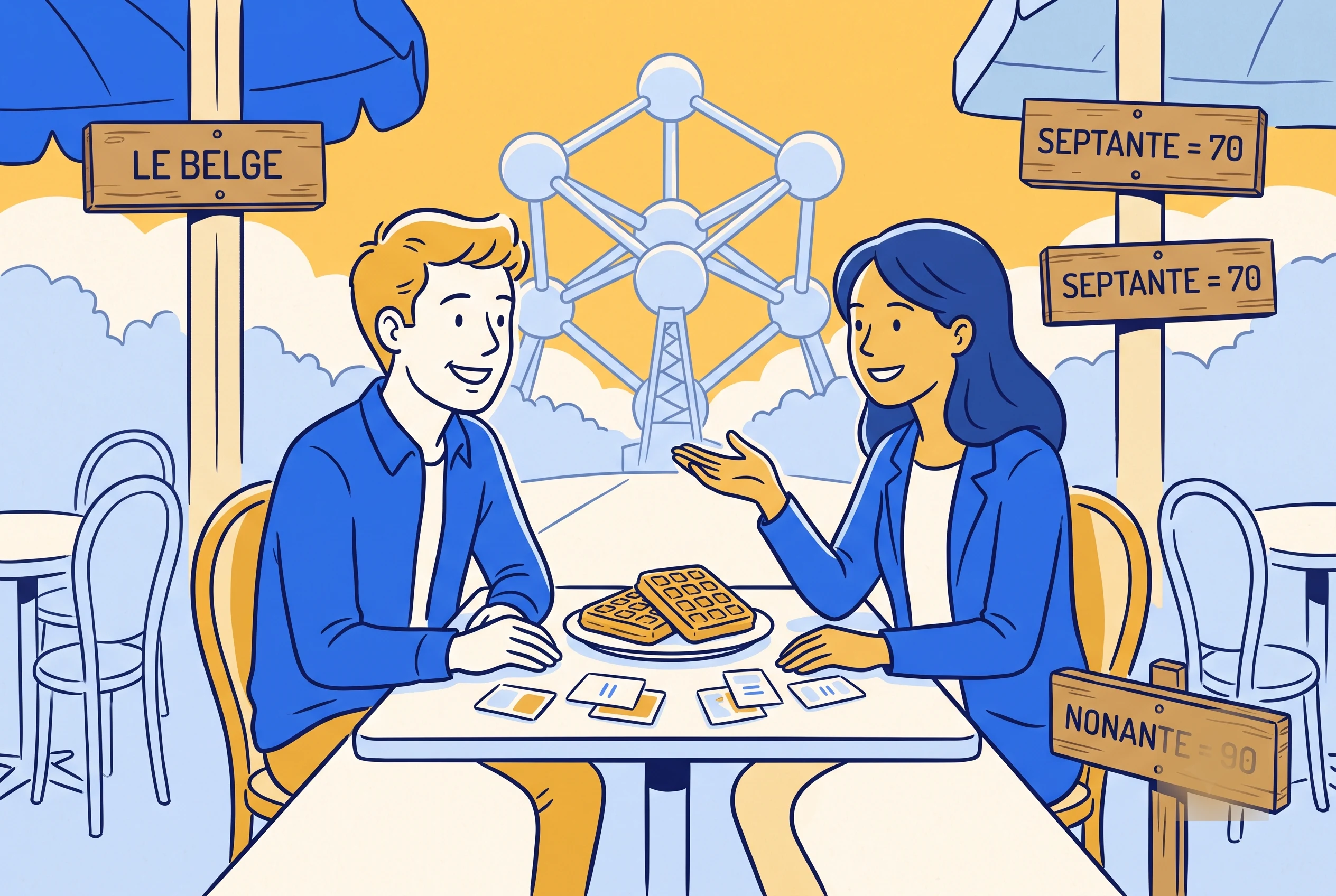
Belgian French and France French share a language, with some differences in everyday usage. Compare the examples as regional tendencies; individual speakers and contexts vary, and neither variety is a correction of the other.
Why Belgian French feels familiar, then suddenly strange
Belgian French is not a separate language, and it is not France French with mistakes in it. It is French with its own habits: a cleaner counting system, a set of everyday words you will not have met in a Paris-oriented course, and a few turns of phrase borrowed from centuries of living next to Dutch. A speaker from France almost never fails to understand a Belgian. They just hesitate for half a second, reach for the France French meaning, and have to correct course.
That half-second is the whole story at A2 and B1. You hear recognisable French, so you trust it, and then septante, drache or tantôt lands and the sentence you thought you had slips. The fix is not more grammar. It is knowing exactly where the ground moves, so you stop being surprised by the same five or six things. Think British versus American English: close enough to talk, different enough to catch you out.
The numbers are simpler in Belgium, and that surprises everyone
This is the first thing people notice, and the one everyone secretly wishes France had kept. For 70 and 90, France French builds on twenty and ten: soixante-dix (sixty-ten) and quatre-vingt-dix (four-twenties-ten). Belgium keeps the older, tidier decimal forms instead.
One detail catches learners who over-generalise: Belgium keeps quatre-vingts for 80. It does not say huitante. That form belongs to parts of Switzerland, not Belgium. So the Belgian system is regular at 70 and 90, and then quietly agrees with France at 80.
| Number | 🇧🇪 Belgian French | 🇫🇷 France French |
|---|---|---|
| 70 | septante | soixante-dix |
| 80 | quatre-vingts | quatre-vingts |
| 90 | nonante | quatre-vingt-dix |
| 92 | nonante-deux | quatre-vingt-douze |
What to actually do: train your ear to recognise septante and nonante instantly, because they turn up in prices, phone numbers, addresses and times. For your own speaking and for exams, France French numbers stay the safe default unless Belgium is your real target.
The meal names slide by one
Belgium, like Quebec and much of Switzerland, kept the older meal names. Each label points one meal earlier than a Paris-trained learner expects. Get this wrong and you can agree to a meeting over lunch while your Belgian colleague means breakfast.
Watch the clock, not the word. If a Belgian suggests on dîne ensemble ?, they usually mean lunch. Answer on the France French meaning and you show up for the wrong meal. When it matters, name the time instead of the meal.
Tantôt is the word that breaks appointments
Of all the shifts, this is the one that costs people real time, because tantôt looks completely ordinary. No slang marker, no odd spelling. And yet it points to different parts of the day on either side of the border.
In Belgium
Tantôt usually means this afternoon, a specific stretch of today.
In France
Tantôt is vaguer: a bit later, or sometimes earlier today, from context.
Small on paper, large in a calendar. A Belgian hears “this afternoon”; a speaker from France hears “at some point.” The same trap runs through French words that look familiar but point somewhere else: the recognition is high, so the tiny gap in meaning slips past you.
Safe move: when precision counts, drop tantôt and say cet après-midi for this afternoon, or tout à l’heure for later today. Clear beats regional when a plan is on the line.
The everyday words change first
Regional French shows up in ordinary nouns long before it touches grammar. You can hold a whole standard conversation and still get stuck buying bread, naming the weather, or asking where the towels are. These are the Belgian words worth recognising on sight.
At the bakery
Yes, pistolet also means a handgun, which is exactly why the word delights visitors. Order two at a Brussels bakery and no one blinks. Next to it you will see une couque, the Belgian word for a sweet pastry: une couque au chocolat is what France calls un pain au chocolat.
In the kitchen and at the market
Mess, rain, and daily life
None of these is rare or literary. They are the words people reach for without thinking, which is precisely why they catch a learner off guard. The problem is rarely learning the word once. It is catching it at speed, in the middle of a sentence. That is where listening under real-time pressure matters more than another vocabulary list.
The une fois question, honestly
Every stereotype of Belgian French includes une fois dropped into the middle of a sentence, as in the cartoon line “Viens une fois ici, une fois.” Here is the honest version. As a filler that softens a request or adds a nudge, une fois is real, but it is mostly a Brussels feature, tied to the old Brusseleer speech and to contact with Dutch, where a similar little word does the same job. Most educated Belgians today use it lightly, if at all, and they are very aware it is the thing outsiders imitate.
A cleaner Belgian habit to actually copy is s’il vous plaît used when handing something over, the way English uses “here you go.” A shopkeeper passes you your change with a voilà, s’il vous plaît. It comes straight from the Dutch alstublieft, which covers both “please” and “here you are.”
Don’t perform it. Learners love une fois because it sounds memorable, then overuse it and end up sounding like a costume. Recognise it, understand it, and let it stay in the background. The s’il vous plaît = here you go habit is the safer one to adopt.
The accent is often easier, not harder
Accent talk is messy and no two Belgian speakers sound alike, but one thing comes up again and again: many learners find Belgian French easier to follow than fast Parisian speech. The rhythm tends to be a little more open and a little less clipped, so the cues you were trained on survive longer.
- The intonation can feel more even and melodic to an ear tuned to Paris media French.
- The French r is still there, but in some Belgian accents it lands more softly.
- Vowel contrasts often stay clearer in relaxed, everyday speech.
This matters because comprehension is as much nerve as technique. When the rhythm feels less aggressive, you panic less, and when you panic less, you catch more. For a lot of B1 learners the real bottleneck is running every sentence through English before the meaning lands, and a friendlier accent gives you the breathing room to stop doing that.
Belgian French or France French first?
If your aim is general travel, exams, and broad comprehension, build the foundation in standard France French. It is what fills courses, apps and exam prep, and that is a matter of efficiency, not of one variety being better. Belgian French becomes worth adding the moment your real life touches it: a job in Brussels, colleagues in Wallonia, Belgian media in your feed, a partner from Liège.
Stay with France French first if
You want one stable model, you are still below B1, or your main goal is exam readiness and broad recognition.
Add Belgian French now if
You work, study, live or date in Belgium, especially in Brussels or Wallonia, and the gap already shows up in real conversations.
The reassuring part: Belgian and France French stay mutually intelligible. Nothing collapses. It just gets sticky in a few predictable spots, the numbers, the clock, the meals, a handful of household words, and once you know where those are, the whole variety turns readable.
Study glossary: Belgium versus France
| 🇧🇪 Belgian French | 🇫🇷 France French | 🇺🇸 English |
|---|---|---|
| septante | soixante-dix | seventy |
| nonante | quatre-vingt-dix | ninety |
| déjeuner | petit-déjeuner | breakfast |
| dîner | déjeuner | lunch |
| souper | dîner | dinner |
| tantôt | cet après-midi | this afternoon |
| un pistolet | un petit pain rond | a round bread roll |
| une couque | une viennoiserie | a sweet pastry |
| un chicon | une endive | Belgian endive |
| un essuie | une serviette | a towel |
| une wassingue | une serpillière | a floor cloth |
| du brol | du bazar | junk, clutter |
| drache | pluie battante | heavy rain |
| un kot | une chambre d’étudiant | a student flat |
| un GSM | un portable | a mobile phone |
| faire la file | faire la queue | to queue |
| s’il vous plaît | tenez / voilà | here you go |
That is the useful core: not every Belgicism, just the ones most likely to catch a learner who started with France French. Once these feel familiar, the rest stops sounding chaotic.
Belgian French: quick questions
Is Belgian French hard to understand for France French speakers?
No. The two are mutually intelligible, so understanding rarely breaks down completely. It gets sticky in a few predictable places: the numbers (septante, nonante), the meal names, timing words like tantôt, and a set of everyday nouns. Once you know those, the friction mostly disappears.
Why does Belgium say septante and nonante?
Both are older, regular decimal forms that once existed across French. France standardised on the base-twenty soixante-dix and quatre-vingt-dix, while Belgium kept the simpler septante (70) and nonante (90). Belgium still uses quatre-vingts for 80, unlike parts of Switzerland, which say huitante.
Do Belgians really say “une fois” all the time?
Not the way the cliché suggests. As a softening filler it is real but mostly a Brussels feature, linked to older Brusseleer speech and to Dutch. Most Belgians today use it sparingly, and they know it is the thing outsiders imitate. Recognise it; don’t perform it.
What does “tantôt” mean in Belgium?
Usually “this afternoon”, a specific part of today. In France the same word is vaguer and tends to mean “a bit later” or “earlier”. If a plan depends on it, say cet après-midi or tout à l’heure to avoid the mix-up.
Should I learn Belgian French for the DELF or TCF?
No. For DELF, DALF, TCF and general coursework, standard France-oriented French is the safe production target. Belgian comprehension is a useful bonus for real life in Belgium, not something the exams ask you to produce.
Prefer to keep it free today? Read the French Briefing →
The French Gamebook
Catch the French mistakes you keep making.
For English speakers practising French
Work through a short lesson, choose your answers and check the explanations. Use a practice round to see which basics need another try.
- 21 lessons with explanations
- 40 practice rounds · 2,000 questions
300 pages · Play on your computer or print
Get the Gamebook · $9 Read a preview before you buyOne payment · Instant PDF download
Try the French with someone who can reply.
Bring a sentence you found difficult. Ask a tutor to help you say it naturally, then try it in a short conversation.
Find a French tutor →Paid lessons. Compare tutors and prices before booking.
Affiliate link: we may earn a commission when you book.
📚 Keep building in the Learning Center
French Reflexive Verbs: Daily Routine and Word Order
Build a daily routine in French with reflexive pronouns, negatives and infinitives. Compare translated examples, listen and practise.
Read →Futur Proche vs Futur Simple: Examples and Practice
Compare futur proche and futur simple in French plans, promises and announcements. Learn the forms and practise choosing…
Read →French Emphasis: C’est, Ce Qui and Ce Que
Use French emphasis to highlight the right information. Compare c’est, ce qui and ce que, detached topics and…
Read →