
Updated on September 15, 2026
French Phrases for Paris: Métro, Cafés and Directions
Prepare French phrases for Paris cafés, shops, the métro and directions. Listen to examples and learn how to ask for help or clarification.
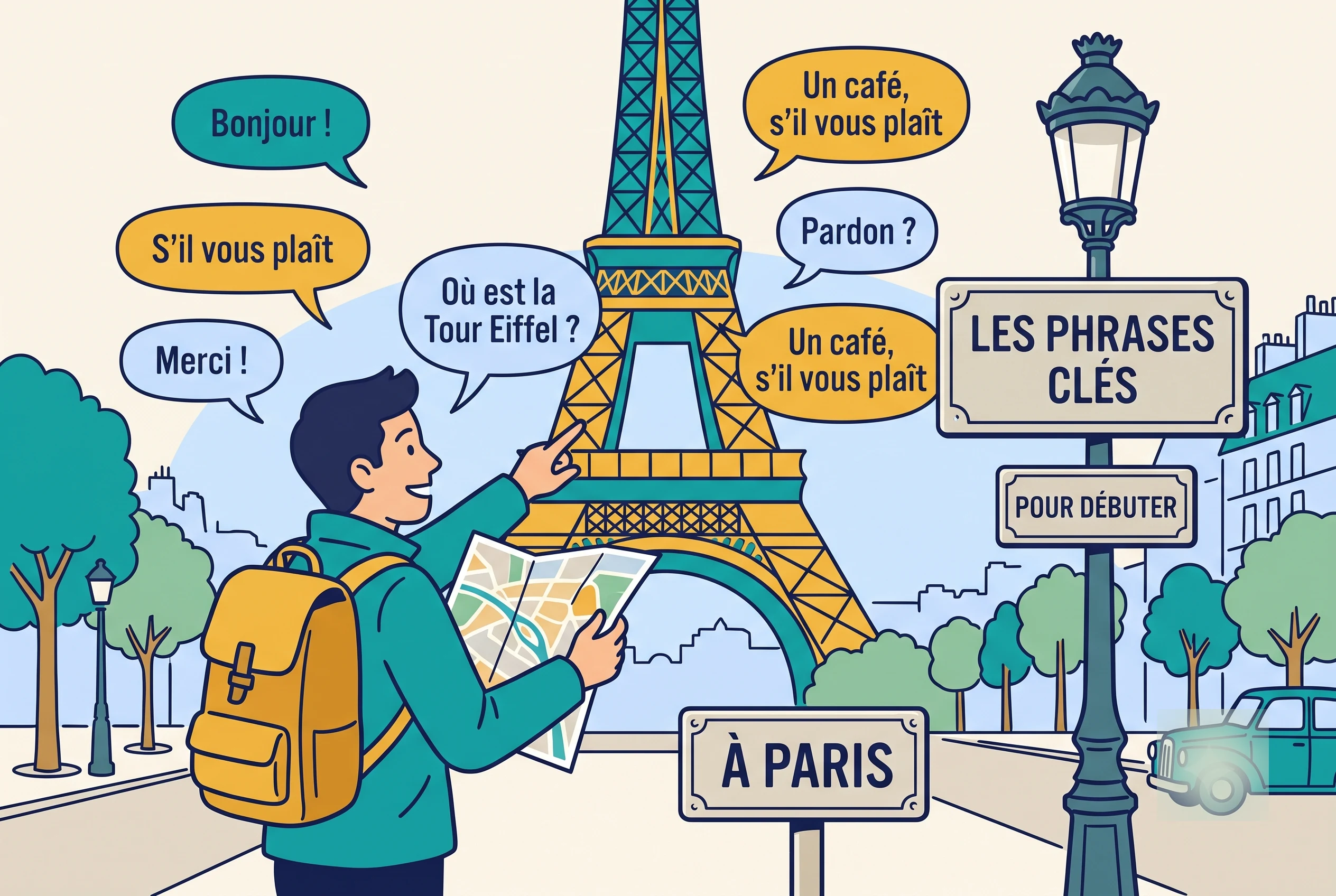
These phrases cover common exchanges rather than a script that guarantees a particular reply. Choose the situations you need, listen to the wording and practise a clarification question before using them in Paris.
The golden rule that changes everything in Paris
Every interaction in Paris starts with the same word. Not merci. Not parlez-vous anglais. Bonjour. That single word determines whether the next 30 seconds of your life in Paris will be pleasant or frosty. Walk into a shop without saying it and the staff becomes cold. Say it first, even with a terrible accent, and something shifts. The door opens. The person behind the counter becomes a human being who wants to help you instead of a wall.
The bonjour rule is the foundation of the entire French politeness system. Americans especially underestimate it because in the US, walking into a store and immediately asking a question is normal. In France, it is mildly rude, just enough to make the interaction start wrong and never fully recover.
First word out of your mouth in every shop, café, museum, bakery and taxi, every single time:
Walk out without it and the exchange stays open, whether or not you bought anything.
Attach it to every request; it turns broken French into polite broken French, a completely different experience:
You genuinely cannot overuse this in Paris:
English lets you open with the question itself. French wants this in front of it, on the street, in the metro, at a counter:
The real reason Parisians seem cold to tourists
It is almost never about your French level. It is almost always about skipping bonjour. A tourist who says “Bonjour, excusez-moi, est-ce que vous parlez anglais ?” with a terrible accent will receive warmer treatment than a tourist who walks up and says “Do you speak English?” in perfect pronunciation. The guide to why French people don’t smile at strangers explains the deeper cultural logic.
The Paris metro: getting around without panic
The Paris metro is one of the densest urban transit systems in the world. 16 lines, 300+ stations, trains every 2-4 minutes. It is also, once you understand the logic, one of the easiest ways to move around any major city. The system is designed for volume, not for hand-holding. Announcements are fast. Signs are in French. Ticket machines have an English option but the staff at the guichet may not. Here is what you actually need.
The carnet saves money once you’ll ride more than three or four times:
Two questions in one, and the answer to the second is never left or right but the name of the last station on the line:
Useful at a counter, on a platform, or to any passerby, with whatever destination you need dropped into the middle.
Not asking is how people end up riding a line to its final stop, luggage in hand, still nowhere near the address they wanted.
Line 13 at rush hour, doors closing, a wall of shoulders between you and the platform, and no time for a polite murmur:
Trips that run past the périphérique end at a different counter. Read the one sentence that holds destination, date, class and seat the night before, with no departure board in sight and nobody in the queue behind you. The transaction logic is the metro’s: bonjour, destination, s’il vous plaît, pay, merci, leave.
Download offline maps before you go. Google Maps and Citymapper both work offline for Paris metro routing. Your French SIM card will handle data, but offline maps work even in tunnels where signal drops.
Cafés, bakeries, and restaurants: the phrases that feed you
This is where Paris happens. Not at the Eiffel Tower. At the café terrace where you sit with a coffee and watch the street go by. At the bakery where the smell of butter hits you at 7am. At the restaurant where the waiter leaves you alone with the empty plates for as long as you want them. And the French you need for all three is surprisingly small.
☕ At the café
Sit down, wait to be served (no frantic waving at the waiter), order with s’il vous plaît, and never rush. That is the survival version. The full code, starting with why the same espresso carries three prices depending on where you drink it, runs considerably longer.
A plain coffee arrives small, black and gone in a moment; “allongé” is the word that buys you something longer.
Two easy non-coffee orders:
In the States the check lands while you are still chewing. In Paris it waits, and that is respect for your table, not neglect:
Most places take cards now, but some small cafés keep a minimum (often €10–15):
🥐 At the bakery
French bakeries are the single best place to practice French as a nervous beginner. The interaction lasts 30 seconds. The script is almost always the same. And the reward is warm bread. Four sentences get you through the door. The bakery’s own etiquette has one rule this script leaves out: you never reach into the display yourself.
The gentlest place in Paris to try a first sentence out loud, and the whole thing is over in thirty seconds.
Add items naturally; no need for a full sentence:
If you didn’t catch the price, this saves you:
A clean closing that works everywhere:
🍷 At the restaurant
Restaurant French is slightly more complex but still manageable. The harder half is booking the table by phone, where nobody slows down for you. Here is what keeps you alive on your first Parisian dinner.
The standard opener at a restaurant that’s expecting you:
And if you’re walking in without a booking:
You give up control of your dinner with the second half, and that is exactly why the waiter warms to it.
Often the best value and the freshest thing on the menu:
Into the bracket goes whatever you cannot eat, with a word like “lait” for dairy needing no change at all:
Plates cleared, coats going on, the waiter passing your table one last time, and nothing to lose by speaking:
Tipping in Paris. Service is included in the price by law (service compris). You do not need to tip. Leaving 1-2€ in coins on the table for good service is a nice gesture but never obligatory. Do not tip 20% like in the US. It would be bizarre. One more American reflex to drop before the bill arrives: the cheese board is not dessert and does not replace it. It arrives first, and choosing from it out loud, then cutting it without insulting the table takes ten minutes to learn.
Shopping, markets, and getting what you need
🏪 In shops
This one is meant to trail off, and a finger, a gesture or the name of the thing finishes it for you.
Handy in clothing shops:
The two you’ll need before buying clothes:
Where English hunts for a face-saving excuse, French lets the price be the whole reason, said plainly and without drama:
The exit line, good in any shop in France, and no one will ask you for a reason.
🍅 At a market
Paris markets (Marché d’Aligre, Marché des Enfants Rouges, Rue Mouffetard) are some of the best experiences in the city. The vendors are fast, the displays are beautiful, and the French is surprisingly simple because the interaction follows a tight script.
Quantity leads at every stall, so the useful unit beyond the kilo is “une barquette”, the little punnet for berries:
Ask this and the vendor stops grabbing whatever is nearest and starts choosing for the day you named:
Markets are one of the rare places where asking to taste is normal and welcome:
Asking for directions and finding things
Any landmark slots in at the end. Which words go in front of it when the name is all you have?
The two natural follow-ups once you’ve asked for a place:
If someone gives you directions, these three words cover 90% of what you need to catch:
Paris keeps its public toilets well hidden, so this usually gets asked in a café, and it costs you a coffee.
🆘 When things go wrong: the phrases that save you
Most Paris trips go perfectly. But sometimes your wallet disappears, your phone dies, you get lost at 11pm, you need a pharmacy, or you genuinely do not understand what is happening. These phrases exist for those moments. A pharmacy visit has its own script, and describing a symptom to a pharmacist is worth rehearsing before you need it at ten at night.
The plain, direct ask when something’s wrong:
The bracketed e is there for women, and out loud nobody hears the difference anyway.
Lost is one thing. Not following the answer is the next, and neither one needs an apology.
You have said “bonjour”, you have said “excusez-moi”, and now you are out of French. What comes third?
French pharmacies (the green cross) handle many minor issues without a doctor:
Somewhere between the metro and the hotel, something has gone missing, and the nearest “commissariat” is the next stop:
Emergency numbers in France: 112 (European), 15 (SAMU medical) or 17 (police):
Emergency numbers in France. 112 works from any phone including locked phones. 15 = SAMU (medical emergency). 17 = police. 18 = fire brigade (pompiers, who also handle medical emergencies). Operators on 112 often speak English.
The phrases that turn a trip into something better than tourism
These are not survival phrases. These are the phrases that make Parisians smile, that open conversations, and that turn a visit into a story instead of a checklist. You do not need them. But if you use them, Paris feels different.
Both lines make people want to help you:
Simple, genuine and effective small talk:
Small talk has warmed them up, which is exactly the moment to ask a total stranger for the thing every visitor eventually wants.
Which of the two you owe depends on the hour. Still the afternoon out there, or already the evening?
One line further, and this is the one a waiter, a shopkeeper or a baker will remember, provided you mean it.
If you want your introduction to sound less like a textbook and more like a real person arriving in a real city, the register for Paris is simple: Moi, c’est [name]. Je suis américain(e). C’est ma première fois. J’adore Paris. That is enough to start a conversation that neither of you expected.
What to know before you go: practical Paris intel
Things Americans do not expect
Check what the city is celebrating. Paris reshapes itself around anniversaries, and 2026 is a heavy year for them. Our briefing on 250 years of Franco-American friendship explains why American flags are hanging on French public buildings this summer, and where the July fireworks actually went.
Shops close on Sunday. Most of them, so plan around it. Bakeries usually open Sunday morning and close Monday instead.
Lunch is 12h-14h. Many restaurants stop serving at 14h sharp. If you arrive at 14h05, the kitchen is closed.
Water is free. Ask for une carafe d’eau (a jug of tap water). It is free and perfectly drinkable. Do not order Evian unless you want to pay 5-7€ for the same water in a different bottle.
Waiters are not ignoring you. They are giving you space. In France, a waiter who hovers is annoying. A waiter who waits for your signal is professional. To get attention: make eye contact and raise a finger slightly. Do not wave, snap, or call out.
The French holiday calendar will affect your trip. May is particularly dense with public holidays. Some businesses close for an entire bridge weekend (le pont).
Your Paris French cheat sheet
| 🇫🇷 French | 🇺🇸 English | 💡 When you’ll need it |
|---|---|---|
| Bonjour / Bonsoir | Hello / Good evening | FIRST word. Every interaction. Non-negotiable. |
| Au revoir / Bonne journée | Goodbye / Have a nice day | LAST word. Every interaction. Closes the loop. |
| S’il vous plaît / Merci | Please / Thank you | Attach to everything. Free politeness upgrade. |
| Excusez-moi | Excuse me | Before any question to a stranger. |
| Parlez-vous anglais ? | Do you speak English? | After bonjour. Never as opener. |
| Un café / un café crème | Espresso / coffee with milk | Café = espresso by default in France. |
| Une baguette, s’il vous plaît | A baguette, please | Bakery. Your easiest French win. |
| L’addition, s’il vous plaît | The bill, please | Waiter won’t bring it until you ask. |
| Une carafe d’eau | A jug of tap water (free) | Restaurant. Free. Always available. |
| C’est combien ? | How much is it? | Shops, markets, anywhere. |
| Où est / Où sont ? | Where is / Where are? | Metro, toilettes, pharmacie, anything. |
| À gauche / à droite / tout droit | Left / right / straight ahead | Understanding directions. |
| Je ne comprends pas | I don’t understand | Rescue phrase. Use without shame. |
| J’ai besoin d’aide | I need help | Emergencies and genuine confusion. |
| C’était très bon, merci | That was very good, thanks | End of meal. Costs nothing. Means everything. |
The only rule that matters. Bad French with bonjour beats perfect English without it. If you take one thing from this guide, take that. Paris opens for people who try. It closes for people who assume.
Prefer to keep it free today? Read the French Briefing →
The French Gamebook
Practise the French behind everyday exchanges.
For English speakers practising French
Work on common mistakes before your next conversation. Play a Gamebook round, check the answers and try saying a few corrected sentences aloud.
- 21 lessons with explanations
- 40 practice rounds · 2,000 questions
300 pages · Play on your computer or print
Get the Gamebook · $9 Read a preview before you buyOne payment · Instant PDF download
Try the French with someone who can reply.
Bring a sentence you found difficult. Ask a tutor to help you say it naturally, then try it in a short conversation.
Find a French tutor →Paid lessons. Compare tutors and prices before booking.
Affiliate link: we may earn a commission when you book.
📚 Keep building in the Learning Center
French Travel Phrases for Hotels, Shops and Cafés
Practise French travel phrases for hotels, cafés, shops and transport. Learn follow-up replies and polite ways to ask…
Read →French Phone Call Phrases: Answer, Ask and Clarify
Prepare for French phone calls with phrases for answering, asking for repetition, leaving voicemail and ending a call,…
Read →Order Drinks in French: Bar Phrases and Apéro Vocabulary
Order drinks in French, ask about sizes and ingredients, and request the bill. Learn bar vocabulary and regional…
Read →