
Updated on September 15, 2026
French Shows on Netflix: Listening Practice and Subtitles
Choose French shows for listening practice and learn how to use audio and subtitles. Check your local Netflix catalogue before starting a series.
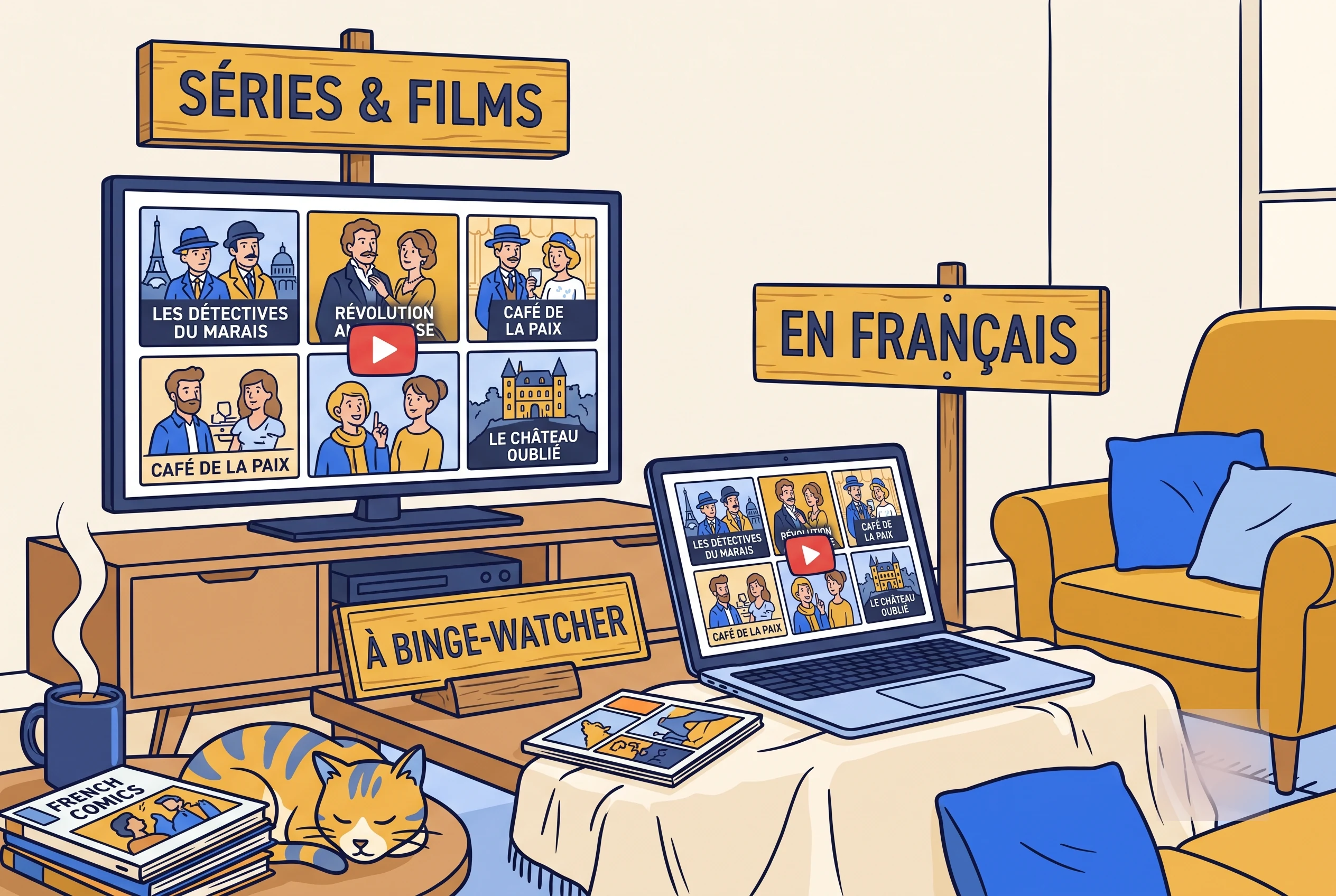
Subtitles can serve different purposes at different stages. Choose a manageable scene, listen for the main idea and use text to check gaps. The suggested shows are starting points, subject to your local catalogue.
Pick a French original, not a French dub, then set audio to French and subtitles to French. Netflix labels the original language in the audio menu, and that label is the only thing separating a genuine French show from an American one with a French voice track recorded in a studio.
Start with Lupin or Call My Agent at A2 to B1, and expect the French subtitles not to match the French audio word for word. That mismatch is normal, and there is a way to use it.
- Netflix — series and films on Netflix US, ranked by level (you’re reading this)
- Canal+ prestige series — the demanding B2+ dramas
- Live TV & channels — how to watch French networks, including from abroad
- Amazon Prime films — French films to own and study
- Cinema classics — the historical canon every learner should know
Affiliate disclosure: As an Amazon Associate, FrenchToEnglish earns from qualifying purchases and Prime sign-ups. The Amazon and Prime Video links here are affiliate links — using them costs you nothing extra and helps keep these guides free.
Build a second French library on Prime Video
Netflix rotates titles out without warning. A Prime Video trial adds a deep catalogue of French films and series you can start tonight — free for 30 days, new members only.
The subtitle rule that changes everything
English subtitles teach you zero French. Your brain reads the translation and ignores the audio entirely. French subtitles train the eye-ear connection: you see the word while hearing it. That single switch is the difference between entertainment and learning. The Amazon Prime guide uses the same four-stage subtitle progression. Netflix has the advantage of more French original content, which means better subtitle accuracy than dubbed imports.
| Level | Audio | Subtitles | Goal |
|---|---|---|---|
| A1-A2 | French | English first, then French | Calibrate your ear. Get the plot, then the language. |
| A2-B1 | French | French | Read while listening. Pause on unknown words. Build vocabulary. |
| B1-B2 | French | French → then none | Test comprehension. The gap between viewings = your progress. |
| B2+ | French | None | Cold viewing. Accept gaps. Capture main ideas. |
The dubbing trap: not everything labelled French is French
Search “French” on Netflix US and the results mix two completely different things. Some are French productions, shot in France with French actors speaking their own lines. Others are American, Korean or Spanish shows carrying a French audio track added afterwards. Netflix presents them side by side, and for a learner the difference is enormous.
Dubbed audio is written to fit mouth movements filmed in another language. The result is French that is grammatically perfect and rhythmically wrong: sentences stretched or compressed to land on a foreign actor’s lips, vocabulary chosen for syllable count rather than for what a French person would say. You can learn words from it. You cannot learn how French sounds when nobody is fighting a timing constraint.
How to check in three seconds
Open the audio menu and look for the language marked as the original. Netflix flags it, usually as “Français [Original]” or by listing it first with an original tag. If French is not the original, you are watching a dub. This single check does more for your listening than any subtitle strategy, because it decides whether the audio you are training on was ever real speech.
The vocabulary for this lives in the interface itself, and it is worth knowing before you switch the whole account to French:
And its opposite, the abbreviation you will see on French cinema listings too:
VO and VF are the two abbreviations that matter. In France, VO means original language, VF means dubbed into French, and VOST means original with subtitles. A cinema listing marked VOST is showing the film in its own language. Netflix does not use these labels, but every French person you discuss films with will.
Why the French subtitles do not match the French audio
You turn on French audio and French subtitles, expecting to read exactly what you hear, and within two minutes the two have drifted apart. Words appear on screen that nobody said. Whole clauses vanish. This is not a bug on your account and it is worth understanding, because most learners quietly conclude their listening is worse than it is.
Subtitles and dialogue are produced by different people under different constraints. A subtitle track has to fit a reading speed, so it compresses: filler words go, repetitions go, and long sentences are rewritten shorter. On top of that, the French subtitle file for a French show is sometimes generated from the translation workflow rather than transcribed from the actual audio, which introduces its own small divergences.
| What you hear | What the subtitle shows | What was removed |
|---|---|---|
| Ben écoute, franchement, moi je sais pas trop | Franchement, je ne sais pas | The fillers and the doubled subject, which is exactly how people speak |
| T’as pas vu mon téléphone ? | Tu n’as pas vu mon téléphone ? | The spoken contraction, restored to written French |
| Il y a un truc qui va pas là | Quelque chose ne va pas | The casual register, flattened to neutral |
Turn the mismatch into the lesson
The gap between the two is a free register lesson, and it is the most valuable thing on the screen. The audio gives you spoken French with its ne dropped and its subjects doubled. The subtitle gives you the same idea in written French. Watching them diverge teaches you, line by line, which forms belong to speech and which belong to writing. That distinction is what makes learners sound stiff when they finally open their mouths, and no textbook demonstrates it as clearly as a paused Netflix frame.
A1 beginner: shows where visual context carries you
At A1, you need slow speech, visual context, and simple vocabulary. Cooking shows, documentaries, and animated content work better than dramas because the images explain the words. Not sure where you stand? The Level Quiz takes three minutes.
🎬 Chef’s Table: France — food vocabulary, measured speech
Interviews with French chefs provide visual context that anchors every new word. The narration is slow, deliberate, and built around concrete objects you can see on screen. “C’est une recette de famille” (it is a family recipe) is the kind of sentence that appears in A1 conversation but requires no explanation because the image carries it. The food vocabulary transfers directly to the café culture guide and the restaurant ordering guide.
▶ Watch the trailer
🎬 Le Petit Nicolas — children’s French, everyday school vocabulary
Based on the beloved French children’s books by René Goscinny and Jean-Jacques Sempé. The language is intentionally simple: present tense, basic sentence structures, school and family vocabulary. Perfect entry point if adult dramas feel overwhelming. The school setting produces everyday French that transfers immediately to real situations, and the humor works even at A1 comprehension levels.
▶ Watch on Prime Video▶ Watch the trailer
🎬 Amélie (film) — narrator-driven, descriptive, Parisian
The narrator speaks slowly, precisely, and descriptively. Audrey Tautou’s diction is unusually crisp. Paris neighbourhood vocabulary (Montmartre, Abbesses, Canal Saint-Martin) appears throughout. The Montmartre guide covers the same geography at street level. “Vous désirez ?” (what would you like?) appears in every service interaction in France, and hearing it in the film means recognizing it instantly at the counter.
A1 rule. If you understand less than 40% with French subtitles, the show is too hard. Drop to English subtitles or pick a simpler title. The sweet spot is 60-70% comprehension: enough to follow, enough gaps to learn from.
▶ Watch the trailer
A2: comedy series where conversation speed builds naturally
A2 is where Netflix becomes genuinely useful. Comedies with recurring characters repeat vocabulary naturally across episodes. The same phrases come back in different contexts, which is exactly how acquisition works. Three series do this reliably.
🎬 Plan Cœur (The Hook Up Plan) — casual Parisian, invitations, dating
3 seasons · Parisian rom-com with short dialogues, invitations, and casual reductions. “On se voit ce soir ?” (are we meeting tonight?) and “C’était sympa” (that was nice) appear every episode. The register is informal but not too slangy for A2 ears. The show teaches the casual French you need for social situations: making plans, cancelling plans, reacting to plans. If you are preparing for the Paris survival guide situations, this show is the audio version.
▶ Watch the trailer
🎬 Dix pour cent (Call My Agent!) — office French, phone calls, scheduling
4 seasons + film · The show that made French TV internationally prestigious before Lupin. Talent agents manage celebrity clients in a Paris agency. Office comedy that teaches phone calls, scheduling, and polite professional formulas. “Je vous rappelle” (I will call you back), “On fait le point à quinze heures” (let us review at 3 p.m.). Workplace French that transfers directly to the business expressions guide. The tu/vous dynamics between agents and celebrities demonstrate the tu/vous system in real professional situations.
▶ Watch the trailer
🎬 Family Business — family chaos, quick favours, money vocabulary
3 seasons · A family converts their failing kosher butcher shop into a cannabis café. The premise delivers family arguments, quick favours, money talk, and affectionate sarcasm in every episode. “Tu peux m’aider une minute ?” (can you help me a minute?) and “C’est risqué, non ?” (it is risky, right?) are everyday French you will use with friends. The tag question “non ?” turns any statement into a conversation, and French speakers do this constantly.
▶ Watch the trailer
B1: register shifts, planning, and professional vocabulary
B1 is where you stop needing simple and start needing varied. The shows below mix formal and informal French, which trains register awareness. That is the skill that separates “understood” from “sounds natural.” The think in French guide becomes relevant here: you need to stop translating every line.
🎬 Lupin — heist planning, conditional structures, Paris geography
3 parts · Omar Sy as a modern gentleman thief inspired by Arsène Lupin. The heist structure means planning language dominates: “On se retrouve à l’entrée” (let us meet at the entrance), “Tout est prêt ?” (everything ready?), conditional structures for hypotheticals. Short operational lines that map to real travel and meeting scenarios. Paris geography (Louvre, banlieue, gare) provides spatial vocabulary the Paris guide covers at street level. The show switches between Assane’s formal public persona and his informal private conversations, which is register training in action.
▶ Watch the trailer
🎬 Intouchables (film) — register contrast, class vocabulary, humor
The highest-grossing French-language film, and the best B1 film on any platform for register training. Philippe (François Cluzet) speaks formal bourgeois French. Driss (Omar Sy) speaks casual banlieue French. The two registers coexist in every scene. The friendship arc provides emotional context that carries you even when you miss slang. “Ça vous va ?” (does that work for you?) is polite confirmation that works in every service and social situation. The Amazon Prime guide covers this film in detail with purchase links for rewatching.
▶ Watch on Prime Video▶ Watch the trailer
🎬 Au service de la France (A Very Secret Service) — 1960s spy comedy, institutional French
2 seasons · A comedy set in France’s intelligence services in the 1960s. Institutional vocabulary, hierarchical language, formal address, and absurd bureaucracy. The humor comes from the gap between the seriousness of espionage and the pettiness of office politics. Teaches the same formal register as the work culture guide but through comedy, which makes the vocabulary stick faster.
▶ Watch the trailer
B2-C1: subtext, irony, and the full French register
At B2-C1, the dialogue stops explaining itself. Irony, social coding, class markers, and cultural references land without annotation. These shows assume you can keep up. The Canal+ series guide covers the premium tier that operates at this same density.
🎬 La Mante — crime thriller, interrogation register, psychological
A serial killer consultant helps police catch a copycat. The interrogation scenes deliver formal police French: question formation, legal vocabulary, conditional structures under pressure. Dense, psychological, and fast. If you follow the dialogue without subtitles, your comprehension is B2+.
▶ Watch the trailer
🎬 Marseille — political drama, power vocabulary, regional accent
Gérard Depardieu as the mayor of Marseille in a power struggle. Political vocabulary, negotiation language, and the Marseillais accent that sounds different from Parisian French. The Fifth Republic guide covers the institutional architecture this show dramatizes. The political vocabulary guide covers the specific terms.
▶ Watch the trailer
🎬 Osmosis — sci-fi, philosophical French, ethical debate
A dating app that reads brain data to find perfect matches. The dialogue mixes tech vocabulary with philosophical and ethical debate. Conditional, subjunctive, and abstract vocabulary in natural conversational context. C1 territory for learners who want to hear French people argue about ideas, not just events.
Titles rotate. Netflix cycles French content regularly. JustWatch shows current availability by country for every title. The subtitle method stays the same regardless of which show is available. The TV channels guide adds free live alternatives when Netflix rotates your show away.
▶ Watch the trailer
The 10-minute routine that turns Netflix into study
Watching a full episode is not studying. Watching a clip three times with a purpose is. The routine below takes ten minutes and produces more measurable improvement than a full evening of passive streaming.
- 1Pick one scene (2-4 min) — French audio + French subtitles First watch for gist. Who is talking? What do they want? Do not pause.
- 2Rewatch — note 3 words + 1 full sentence Pause allowed. Look up the 3 words. Write the sentence. This is the one you will shadow.
- 3Rewatch without subtitles You know the content. Now listen for the music: liaison, reductions, rhythm. The pronunciation guide gives you the phonetic framework.
- 4Shadow one sentence — use it within 24 hours Say it. Text it to a friend. “On se voit ce soir ?” Production completes the cycle.
Why 10 minutes beats 2 hours
A full episode gives 45 minutes of passive exposure. Three clips of 3 minutes each, watched three times with the routine above, give 27 minutes of active structured practice. The structured version produces measurable improvement. The full episode produces a nice evening. The 15-minute routine shows how this fits into a broader daily system.
After 30 days of this routine, you will have 15-30 natural French phrases you can produce without thinking. That is more active vocabulary than most A2 courses deliver in a semester. The podcast guide fills commute time. The music guide adds rhythm. Together with Netflix, they build a media diet that keeps French present every day.
What learners ask about Netflix and French
How do I change the audio to French on Netflix?
Start playing, open the audio and subtitles menu (the speech bubble icon on most devices), and pick French under audio. If French is not offered, the title has no French track in your region. Changing your whole profile language in account settings also surfaces more French titles in browsing, which is worth doing once and forgetting about.
Should I watch with English or French subtitles?
French, as soon as you can tolerate it. English subtitles route everything through reading and your ear switches off completely, which is why people finish a French series having learned nothing. If French subtitles are too fast at first, watch an episode with English subtitles for the plot, then rewatch the same episode in French. Familiar content is what makes the jump possible.
How do I know if a show is really French?
Check the audio menu for the language flagged as original. French productions list French as the original track. If French appears only as one option among many dubs, the show was made in another language. The catalogue mixes both freely and the artwork gives you no clue.
Is Netflix enough to learn French on its own?
No, and it is not designed to be. Netflix delivers a large amount of authentic listening input, which is one ingredient. It gives you no speaking practice, no correction, and no structure, and it will happily let you watch for a year at a level where you understand the plot and none of the language. Pair it with something that makes you produce French, or the hours do not convert.
Why do I understand the news but not a Netflix drama?
Because news French is the easiest French there is. It is scripted, articulated, and read at a controlled pace by professionals, with no overlapping speech and no slang. A drama gives you people interrupting each other in regional accents with the music up. Understanding a bulletin and not understanding a series is the normal order of things, not evidence that you have plateaued.
Start watching French cinema on Prime Video
New members stream the French catalogue free for 30 days — cancel anytime. The cheapest way to test everything above tonight.
Prefer to keep it free today? Read the French Briefing →
The French Gamebook
Enjoy the French. Practise the tricky bits.
For English speakers practising French
After a film, a book or a cultural detour, spend a session on the mistakes you keep noticing. Choose a Gamebook lesson and check your answers as you go.
- 21 lessons with explanations
- 40 practice rounds · 2,000 questions
300 pages · Play on your computer or print
Get the Gamebook · $9 Read a preview before you buyOne payment · Instant PDF download
Try the French with someone who can reply.
Bring a sentence you found difficult. Ask a tutor to help you say it naturally, then try it in a short conversation.
Find a French tutor →Paid lessons. Compare tutors and prices before booking.
Affiliate link: we may earn a commission when you book.
📚 Keep building in the Learning Center
French Instagram Captions: Meanings and Pronunciation
Find French Instagram captions for travel, food, love and everyday moments. Check their meaning, tone and pronunciation before…
Read →French News for Beginners: Sources by Difficulty
Find French news sources suited to your reading and listening skills. Compare learner resources, authentic news and a…
Read →French Politeness: Bonjour, Tu, Vous and Requests
Learn French politeness through greetings, tu and vous, requests and everyday etiquette. Compare situations and useful translated phrases.…
Read →