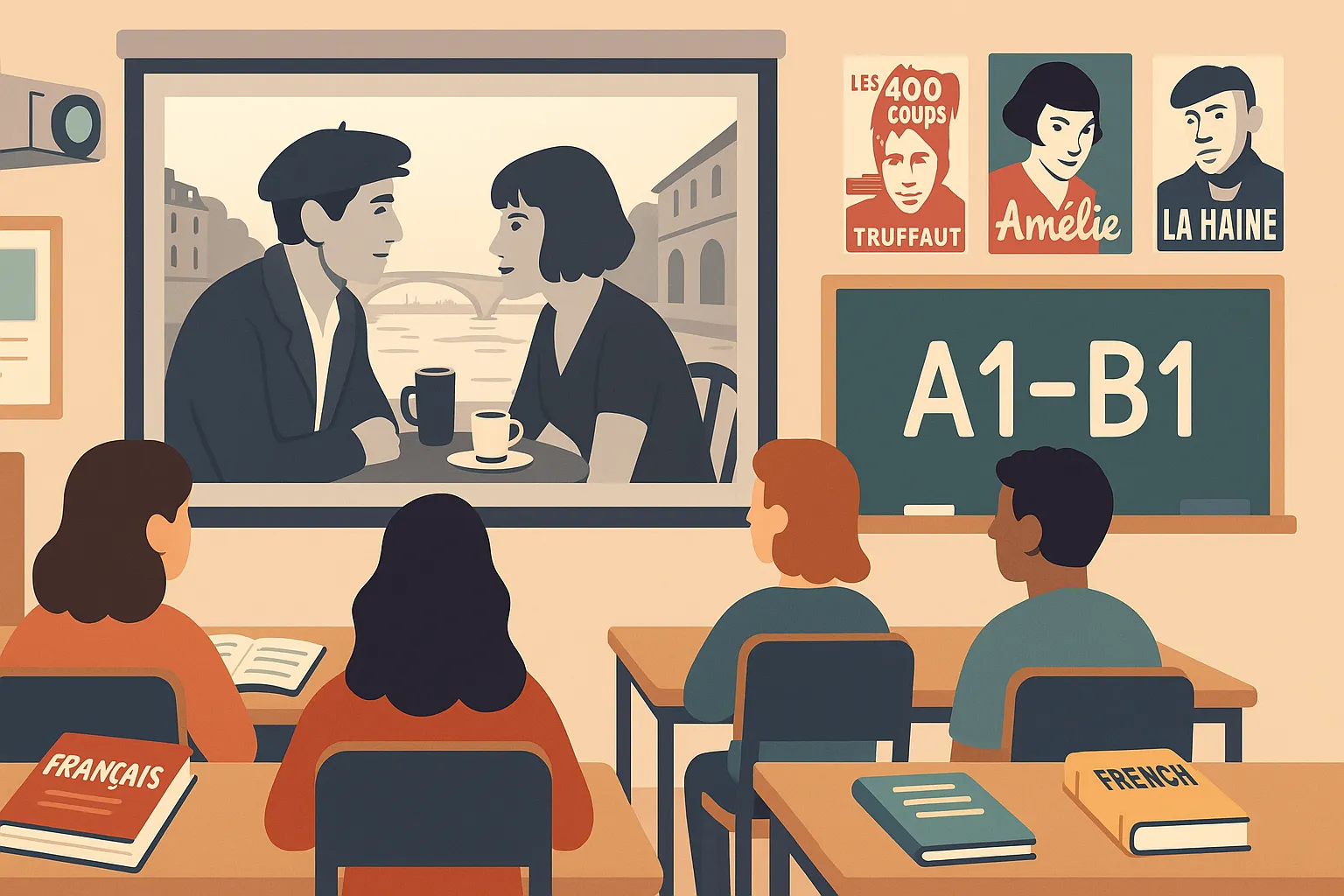
Can You Learn French in 3 Months? The Honest Math That Marketing Won’t Show You
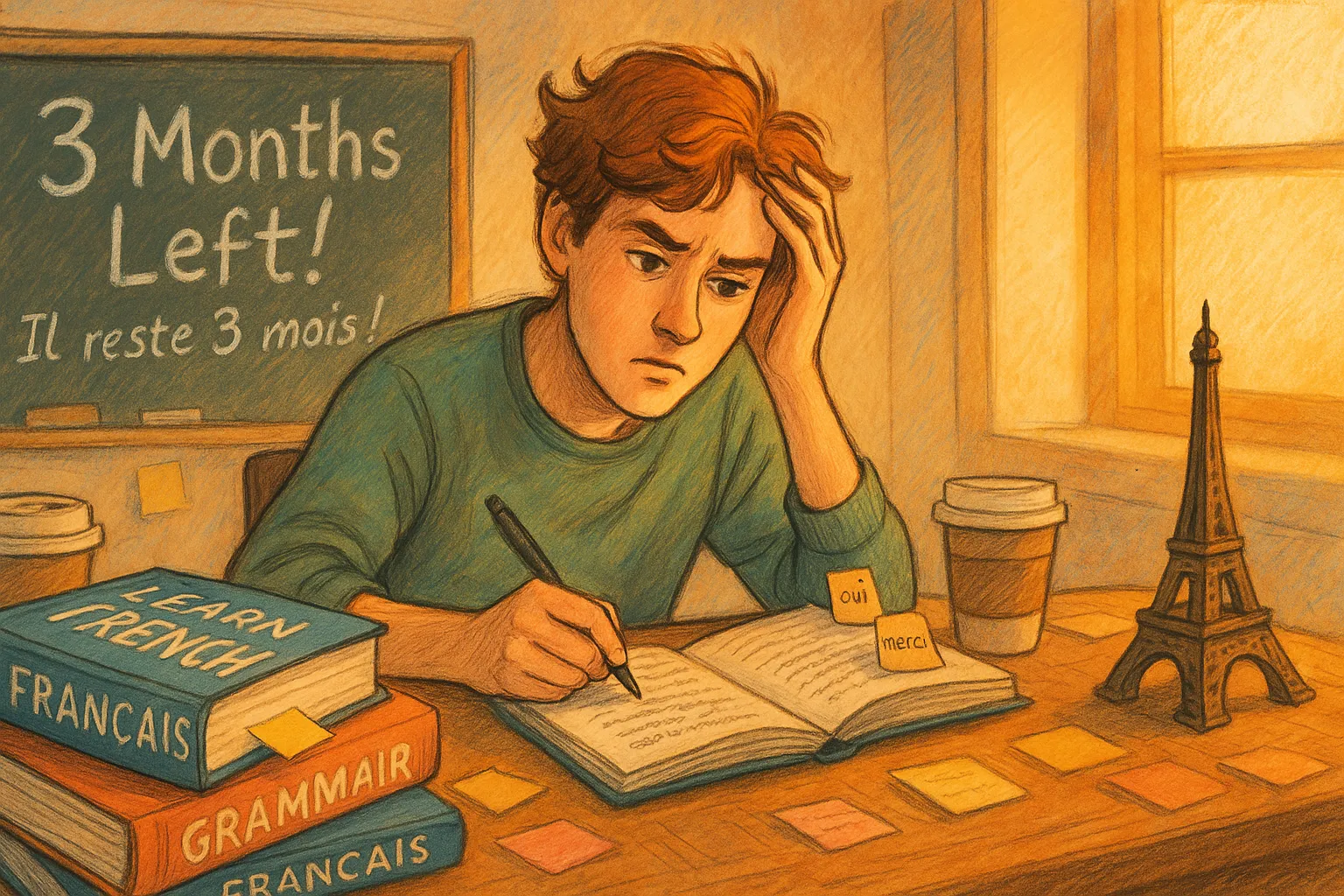
Yes, if “learn” means ordering coffee without panic; no, if “learn” means following a conversation between two French people at normal speed. This guide runs the actual numbers, shows what each study intensity produces in 90 days, and gives you the plan that works within honest limits.
90 days. The question is not whether you can learn French. It is how much.
The FSI classifies French as Category I for English speakers: 600-750 classroom hours for professional proficiency. Three months is 90 days. To hit 600 hours in 90 days, you would need 6.7 hours of focused study daily, seven days a week, zero days off. That is a full-time job plus overtime. For most people, that is not a study plan. It is a fantasy.
Total hours
Daily pace
Realistic level
What you can do
45h (30 min/day)
Minimum dose
Solid A1
You survive. You order. You do not converse.
90-180h (1-2h/day)
Serious commitment
Strong A2, early B1
Travel situations. Your life in simple terms. Slow clear speech understood.
270-360h (3-4h/day)
Intensive + immersion
Solid A2, emerging B1
Extended conversations on familiar topics. Simple series with French subtitles.
600-750h (7-8h/day)
FSI target
B2 (professional)
Unrealistic for anyone with a life. This is why B2 in 3 months does not exist.
The fluency redefinition trick
“Fluent in 3 months” programs redefine fluency to mean “can have a simple conversation.” By that definition, yes. By the definition most people have in their heads (effortless communication across all contexts), three months is not close. The programs are not lying. They are rebranding A2 as fluency. The full timeline guide shows what each CEFR level actually requires.
The English speaker advantage accelerates A1: about 30% of English vocabulary comes from French. “Restaurant,” “government,” “justice” require zero memorization. The false friends guide covers where that advantage turns into a trap. By A2, grammar complexity (gendered nouns, subjunctive, verb conjugations) takes over and shared vocabulary stops carrying you.
You have 90 days. Make each one count.
The Briefing gives you daily French on real topics. 5 minutes of structured input that compounds over 90 days. Quiz included.
With unlimited time, you study everything. With three months, you triage. The best way to learn French guide covers the full four-part system. This section covers the compressed version.
1
Top 1000 words first They cover ~85% of daily conversation. Être, avoir, faire, aller before literary vocabulary. Frequency beats breadth.
2
Pronunciation from day one Not week four. Day one. Nasal vowels, the French R, liaison patterns, silent letters. The pronunciation guide exists because bad habits at A1 become permanent at B1.
3
Speak before you are ready Which means now. The shy beginners guide gives you the techniques if speaking terrifies you.
4
Active production over passive consumption Watching French Netflix with English subtitles teaches zero French. The film guide explains the subtitle method that works.
5
One structured resource, not five random ones Switching apps every week = restarting every week. The books minimalist guide tells you exactly what you need.
6
Daily consistency over weekend marathons 30 min × 6 days beats 3 hours × 1 day. The 15-minute routine shows the absolute minimum viable daily practice.
The app trap. Duolingo-style apps create the feeling of progress without the substance. Apps are fine for vocabulary review (component 4 of the four-part system). They are not a method. If your three months is app-only, expect solid A1 and nothing more.
The 30-minute split that works. 10 minutes vocabulary (spaced repetition). 10 minutes listening (podcast clip from the podcast guide). 10 minutes production (record a sentence, write three lines, text someone in French). Balanced. Sustainable. Compounding.
Month-by-month milestones: how to know if you are on track
Vague goals produce vague results. These milestones are testable. If you can do the thing, you are on track. If you cannot, something in your method needs changing. Not sure where you stand right now? The Level Quiz takes three minutes.
Month 1: survival
Test: order a meal in French without switching to English.
“Bonjour ! Je voudrais un café crème et un croissant, s’il vous plaît.”
Pass/fail. No ambiguity. The café culture guide gives you every phrase you need for this milestone.
Month 2: description
Test: describe your job and daily routine for 2 minutes without stopping.
“Je travaille dans le marketing. Le matin, je prends le métro…”
Requires present tense, basic connectors, 800+ active words. Record yourself to test.
Month 3: narration
Test: tell a story about something that happened yesterday.
“Hier, je suis allée au marché et j’ai acheté des fruits. C’était intéressant parce que j’ai parlé avec le vendeur en français.”
Requires passé composé + imparfait, narrative connectors, 1000+ active words. The imparfait vs passé composé guide trains exactly this skill. Adding parce que + second clause = B1 territory: the threshold between describing events and explaining them.
The month 2 plateau. Month 1 everything is new and progress is visible daily. Month 2 you understand more than you can produce, conversations feel harder than they should, and the gap between what you want to say and what you can say becomes frustrating. This is normal. This is where most people quit. The ones who push through start accelerating in month 3.
After three months: the real decision
Three months of intensive study creates momentum, not completion. The students who progress are the ones who transition from sprint to sustainable pace: 30 minutes daily, weekly conversation practice, French media in the background. The ones who stop after three months lose most of what they built within six weeks.
The concrete goal that compresses time: register for DELF A2. Put a test date on the calendar. Deadlines compress timelines because you study for a specific, testable outcome instead of a vague feeling of improvement. The DELF A1 prep guide covers the exam format if you want a target before the three months even end.
🇫🇷 J’apprends le français depuis trois mois.🇺🇸 I have been learning French for three months. — The sentence you will say at the end. Present tense + “depuis” captures ongoing effort better than any past form.
🇫🇷 C’est difficile mais j’avance.🇺🇸 It is difficult but I am progressing. — Honest. Direct. Saying it in French proves you are further along than you think.
Study glossary
French
English
Context
Apprendre
To learn
“J’apprends le français”
Débutant
Beginner
A1 stage
Objectif / progrès
Goal / progress
“Je fais des progrès”
Pratiquer / réviser
To practice / to review
Daily habits
Immersion
Immersion
Active, not passive residence
Répétition espacée
Spaced repetition
Anki, vocabulary retention
Plateau / percée
Plateau / breakthrough
Month 2 wall → month 3 acceleration
Rythme durable
Sustainable pace
Post-sprint maintenance
Aisance
Fluency / ease
The real goal, not the marketing one
Étude intensive
Intensive study
2+ hours daily
Three months is a beginning, not a deadline. The full timeline guide shows what comes next. The method guide builds the system that survives beyond the sprint. “For sure.” 🕶️
French Tu vs Vous: Why English Lost This Distinction and Why It Changes Everything
English once had this: “thou” was intimate, “you” was formal, and the wrong choice defined your social standing. French kept both pronouns, and the choice between tu and vous still encodes intimacy, hierarchy, trust, and distance in a single word that English has to rebuild through three layers of grammar.
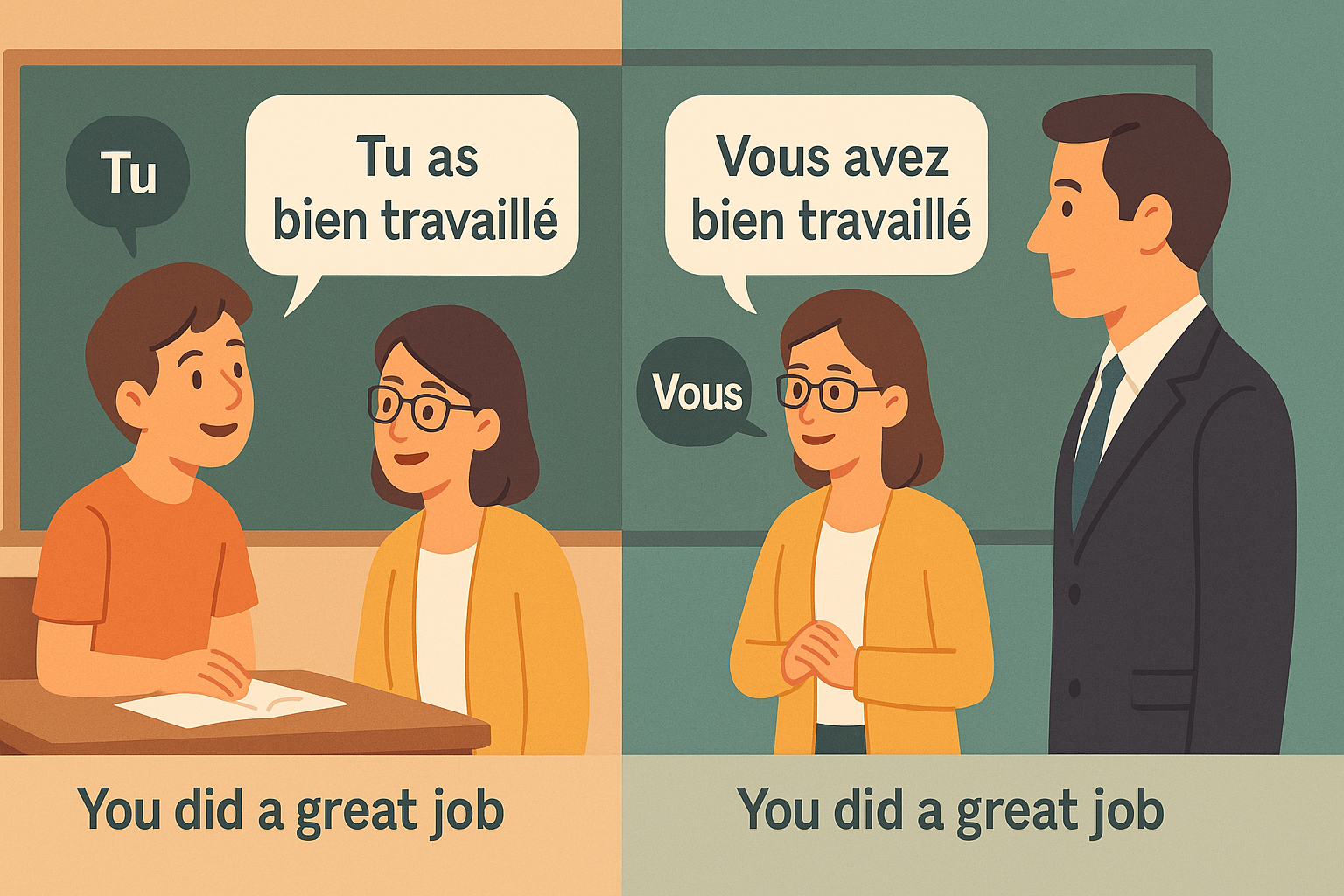
Tu or vous? The choice defines the relationship before the conversation starts.
From Diocletian to Barthes: why French has two words for “you”
The distinction probably originates with the Roman emperor Diocletian (245-313), who divided the Empire between two Augustes and two Caesars. When one emperor spoke, he spoke for all four: nos replaced ego, and subjects began addressing a single ruler as vos instead of tu. The plural became the power form. Latin carried it into every Romance language. French kept it. English had it (thou/you), used it for centuries, and then dropped it entirely by the 1700s.
The Académie française, in its 1718 Dictionnaire, noted that tutoiement was reserved for addressing servants and social inferiors. By 1740, the definition expanded to include people with whom one shared great familiarity. The French Revolution tried to abolish vous altogether: on October 31, 1793, the Comité de salut public decreed universal tutoiement as a republican principle. Voltaire had already argued that tu was the language of truth and vous the language of flattery. The decree failed. Vous survived. Roland Barthes, two centuries later, would call the post-1968 spread of tutoiement a cultural ruin.
L’hésitation, le choix, le balancement entre le “vous” et le “tu” offre quelque chose de délicieux et d’infiniment significatif dans la conversation, dans cette délicatesse des rapports humains, dans l’établissement de ces nuances entre la courtoisie et l’intimité, la déférence et l’amitié, le respect et la complicité.
Académie française, Éloge du vouvoiement
That passage from the Académie captures everything this article explains. The hesitation between vous and tu is not a grammar problem. It is the mechanism through which French speakers negotiate every human relationship. English speakers have no equivalent reflex because English eliminated the distinction three centuries ago.
What the pronoun actually encodes
Tu is not “informal.” Vous is not “formal.” That simplification misses the point. Tu signals that the relationship has been established. You are inside the circle: family, friends, peers, intimates. Vous signals that distance exists. The relationship is new, hierarchical, professional, or deliberately maintained at arm’s length. The wrong pronoun does not make you rude. It tells the other person what you think you are to them.
Tu/vous is one layer. The Briefing teaches the full protocol.
Daily French on real social situations where register choices matter. Same complexity as this article, at learner-friendly speed.
When French uses vous: the default English speakers reverse
The fundamental asymmetry: French defaults to vous and moves toward tu when invited. English defaults to casual and adds formality when required. Every English speaker in France makes the same mistake: they start too familiar because their language trains them to. The full politeness guide covers the broader system. This section covers the vous-specific rules.
🇫🇷 Bonjour Madame, comment allez-vous ?🇺🇸 Good morning, how are you? — Any stranger, any elder, any professional. Vous until told otherwise. No exceptions.
🇫🇷 Excusez-moi, pourriez-vous me dire où se trouve la gare ?🇺🇸 Excuse me, could you tell me where the station is? — Stranger on the street. Vous. Even if they are your age. Even if they are wearing jeans.
🇫🇷 Monsieur le directeur, je vous remercie de votre réponse.🇺🇸 Thank you for your response, sir. — Professional hierarchy. Vous stays in place for years in French offices. Americans switch to first names in a week. French keeps the distance deliberately.
Research on French workplace tutoiement shows dramatic variation by sector: 89% of interactions use tu in scientific and technical fields, but only 56% in real estate. A Paris tech startup uses tu from day one. A law firm on avenue Hoche uses vous for years. Industry decides, not personal preference. The work culture guide covers the email and office protocol where vous dominates.
The age rule is absolute. Vous with any elderly person, always, regardless of context. A French grandparent’s neighbour using tu after twenty years is one thing. You, as a foreigner, using tu with someone over seventy? That is disrespect. No nuance. No exceptions.
The asymmetric vous: when one person tutoie and the other vouvoie
This situation shocks English speakers but is perfectly normal in French. A professor tutoies students; students vouvoient the professor. A parent tutoies a child; the child vouvoies an elderly family friend. An adult tutoies a teenager; the teenager does not reciprocate. The asymmetry is the hierarchy made audible.
🇫🇷 Le professeur : “Tu as compris ?” — L’élève : “Oui, Monsieur.”🇺🇸 Teacher: “Did you understand?” — Student: “Yes, sir.” — The student does not say “tu” back. The hierarchy is one-directional.
When French uses tu: the permission you need to wait for
Tu is not a downgrade. It is an upgrade. It means someone has decided you belong in their inner circle. The shift from vous to tu is a social event. In English, there is no equivalent moment. The closest is switching from surnames to first names, but even that carries less weight.
🇫🇷 On se tutoie ? /ɔ̃ sə tytwaje/🇺🇸 Shall we use tu? — The sentence that changes the relationship. English has no equivalent. When a French colleague says this, they are offering trust, not simplifying grammar.
🇫🇷 Vous pouvez me tutoyer, vous savez.🇺🇸 You can use tu with me, you know. — Someone senior offering tu to someone junior. The junior does not initiate. That is the hierarchy.
🇫🇷 Tu viens ce soir ? — Passe-moi le sel. — Tu es où ?🇺🇸 Coming tonight? — Pass the salt. — Where are you? — Between friends, family, partners. Short, no hedging, no conditional. The directness IS the intimacy signal.
The café etiquette guide is a perfect test case: you use vous with the server, tu with the friend sitting across from you, and the register shifts audibly mid-sentence. The don’t-smile guide explains the same social distance mechanism in non-verbal form.
The irreversibility rule
Once tu is established, you do not go back to vous. The switch is permanent. Reverting to vous after using tu signals anger, irony, or a deliberate reintroduction of distance. In a couple’s argument, switching from tu to vous is the verbal equivalent of slamming a door. French fiction uses this device constantly: the pronoun shift carries the emotional weight that English has to express through tone and word choice.
The grey zones: where the rules blur
Real life is not a textbook. The rules have generational, regional, and professional variations that no guide covers perfectly.
Hierarchy is the product. Distance is professional identity.
Social media
Tu universally
Screen anonymity removes the social distance vous maintains
Québec
Tu much earlier than in France
North American informality norms influence francophone usage
Wallonia (Belgium)
Vous even with young children
Tu can be considered rude in some Walloon contexts
Old aristocratic families
Vous between spouses
A vanishing tradition where distance signals respect within intimacy
French military
Tu between soldiers of equal rank
Shared risk creates instant intimacy that bypasses normal protocol
🇫🇷 Je ne sais jamais si je dois dire tu ou vous avec elle.🇺🇸 I never know whether to use tu or vous with her. — Even French people have this confusion. It is not just a learner problem.
Safe default, always. When unsure, use vous. Nobody is offended by excessive formality. People are offended by excessive familiarity. Vous is always safe. Tu requires permission. The protocol-heavy contexts (first meetings, professional settings) recommend waiting until the fourth encounter before even considering the shift.
How English fakes the tu/vous distinction without pronouns
English lost its pronoun distinction but did not lose the need for register. It compensates through vocabulary, grammar, and sentence structure. French changes one pronoun. English rewrites the entire sentence.
Tu-register in English = removal
Commands: “Pass the salt.” Contractions: “Whatcha want?” Dropped subjects: “Coming tonight?” Slang greetings: “Hey! How’s it going?” English signals tu by stripping away politeness machinery until the sentence is bare.
Vous-register in English = addition
Modals: “Would you mind…” Hedging: “I was wondering if perhaps…” Latinate vocabulary: “assist” instead of “help.” Full structure: “Good morning, how are you?” English signals vous by adding layers of indirection until the sentence creates distance.
🇫🇷 Tu → Tu veux quoi ? — Vous → Que souhaiteriez-vous ?🇺🇸 Tu → What do you want? — Vous → What would you prefer? How may I assist you? — French changes one word. English changes everything.
The business expressions guide covers the professional register where this vous-equivalent English is mandatory. The restaurant guide shows it in action at the table. The phone call guide covers the voice-only version where register is the only social information available.
The Revolution tried to kill vous. It failed.
On October 31, 1793, the Comité de salut public decreed universal tutoiement as a revolutionary principle. If vous encoded feudal hierarchy, then tu would encode republican equality. Voltaire had already argued that tu was the language of truth. Montesquieu called vous a defect of modern languages. The Convention debated a decree making tutoiement mandatory. It was defeated. Vous survived the Revolution, the Empire, two World Wars, and May 1968.
The failure is instructive: vous carries social information that a democracy still needs. Distance is not always hierarchy. It is also respect, professionalism, and the right to privacy before intimacy is offered. The Fifth Republic guide covers the institutional architecture where this formality still operates daily. The political vocabulary guide covers the register in which French politicians vouvoient each other on camera and tutoient each other off.
Study glossary: tu/vous vocabulary
French
English
Context
Tutoyer / vouvoyer
To use tu / to use vous
“On se tutoie ?” changes everything
Le tutoiement / le vouvoiement
The practice of using tu / vous
Nouns for the social practice itself
Registre
Register (formality level)
Formal vs informal language
Politesse
Politeness
Social protocol, not just manners
Hiérarchie
Hierarchy
The power structure vous maintains
Distance sociale
Social distance
What vous creates and tu dissolves
Intimité
Intimacy
What tu signals
Le conditionnel
Conditional tense
“Pourriez-vous” = vous-register verb form
Formule de politesse
Polite formula
Email openings/closings use vous
Enchanté(e)
Pleased to meet you
Always with vous at first meeting
Monsieur / Madame
Sir / Madam
Title + vous = full formal address
Le passage au tu
The switch to tu
A relationship milestone, not a grammar update
The tu/vous distinction is not grammar. It is the French social contract made audible in every sentence. The full politeness guide covers the broader system. The shy beginners guide helps if the social pressure of choosing the wrong pronoun paralyzes you entirely. “For sure.” 🕶️
You just decoded translate, french, politeness. We turn this into a weekly habit.
Register is everything. The Pass builds it weekly: real audio situations where tu and vous choices play out so you hear the shift before you need to make it.
✓ Weekly native audio✓ CEFR tracking✓ Full archives✓ Structured practice
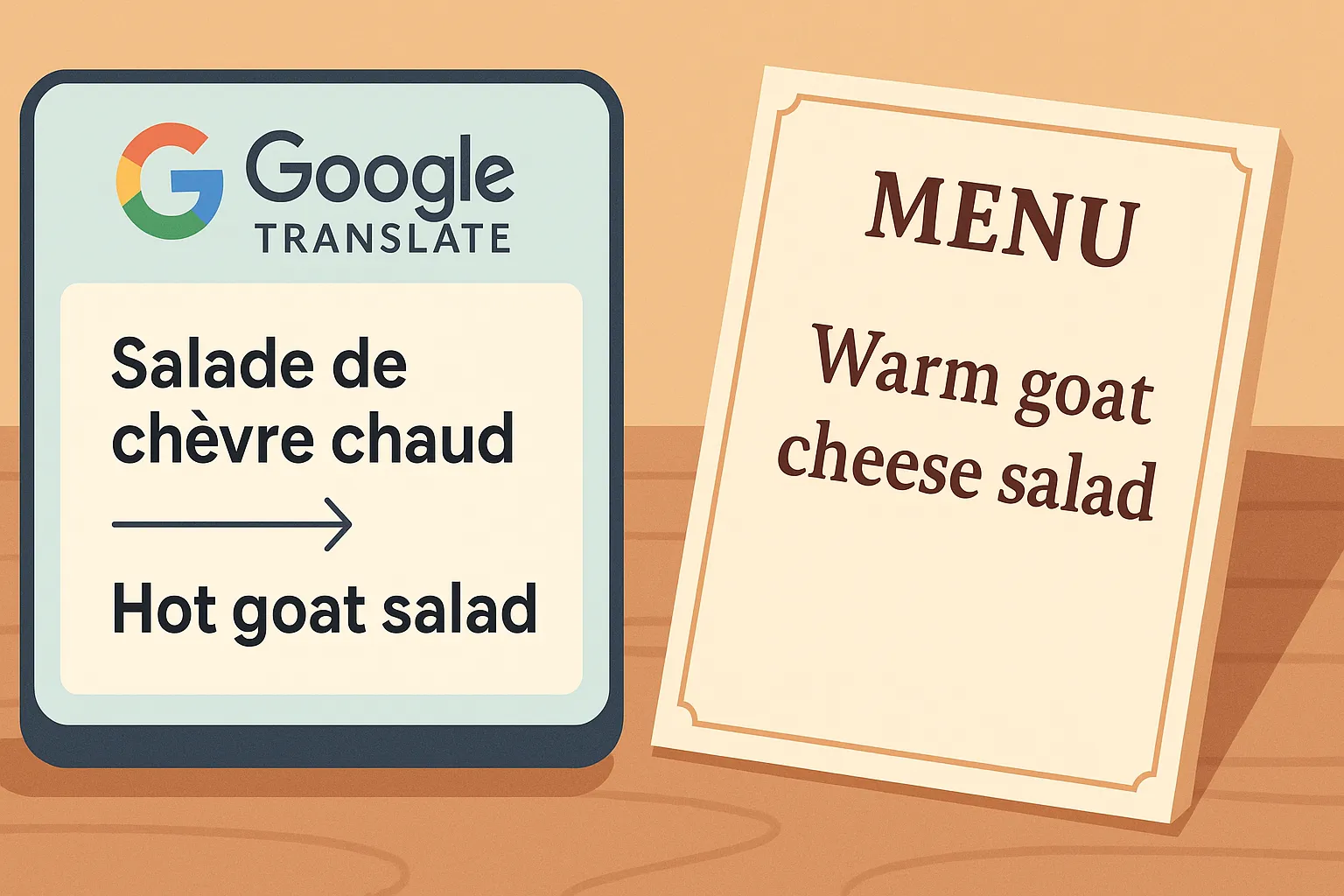
Google Translate French English Mistakes: The Fails That Prove You Still Need to Learn
Google Translate French English mistakes are not rare edge cases: they happen on every restaurant menu, every administrative form, and every professional email that matters. This guide shows real translation fails with the French originals, explains why the algorithm breaks, and tells you when to trust it and when to close the tab.
Google Translate works until it does not. These are the moments it does not.
False friend fails: when Google picks the wrong twin
False friends are words that look identical in French and English but mean different things. Google Translate usually gets them right. The failures happen when context is short or ambiguous. The full list of false friends that confuse English speakers covers about thirty common pairs. Here are the ones the algorithm breaks on most often.
🇫🇷 “Je travaille actuellement sur ce projet.”
Google: “I am actually working on this project.” ❌
Correct: “I am currently working on this project.” ✓
“Actuellement” = currently. The mistranslation inverts the emphasis entirely.
🇫🇷 “Il a été blessé dans l’accident.”
Google: “He was blessed in the accident.” ❌
Correct: “He was injured in the accident.” ✓
“Blessé” = injured. In a medical context, this error could cost someone appropriate care.
🇫🇷 “J’ai rendez-vous avec mon avocat.”
Google: “I have an appointment with my avocado.” ❌
Correct: “I have an appointment with my lawyer.” ✓
“Avocat” = both lawyer and avocado. Short sentences give insufficient context.
🇫🇷 “La location de cet appartement est chère.”
Google: “The location of this apartment is expensive.” ❌
Correct: “The rent for this apartment is expensive.” ✓
“Location” = rental. The moving to France guide covers the full administrative vocabulary.
Why the algorithm fails on false friends
Google Translate picks translations based on statistical probability from training data. It does not understand meaning. It calculates likelihood. In short phrases, probability tilts toward the more common English word, not the correct one. The grammar interference guide explains why humans make the same errors for different reasons.
Every sentence you run through Google is one your brain did not process.
The Briefing gives you real French daily. Same vocabulary Google breaks on, explained at learner speed.
French idioms use images that do not exist in English. Google sees the words, translates them individually, and produces sentences from another dimension.
🇫🇷 “J’ai le cafard.” → Google: “I have the cockroach.” ❌ → Correct: “I’m feeling down.” ✓
🇫🇷 “Coûter les yeux de la tête.” → Google: “Cost the eyes of the head.” ❌ → Correct: “Cost an arm and a leg.” ✓
Different body parts, same meaning. The leap is cultural, not linguistic.
🇫🇷 “Poser un lapin.” → Google: “Put a rabbit.” ❌ → Correct: “Stand someone up.” ✓
🇫🇷 “Avoir d’autres chats à fouetter.” → Google: “Have other cats to whip.” ❌ → Correct: “Have other fish to fry.” ✓
Same concepts. Different animals. The translation sounds like a threat instead of a polite exit.
🇫🇷 “Tomber dans les pommes.” → Google: “Fall in the apples.” ❌ → Correct: “Faint.” ✓
🇫🇷 “Ce n’est pas la mer à boire.” → Google: “It’s not the sea to drink.” ❌ → Correct: “It’s not that hard.” ✓
🇫🇷 “Mettre son grain de sel.” → Google: “Put his grain of salt.” ❌ → Correct: “Put in his two cents.” ✓
Never use Google Translate for: legal documents, medical information, professional emails to French clients, or anything where a wrong translation has real consequences. The cost of a professional translator is always less than the cost of a mistranslation.
Grammar and register fails: when structure breaks meaning
🇫🇷 “Je ne bois que de l’eau.” → Google: “I don’t drink only water.” ❌ → Correct: “I only drink water.” ✓
“Ne…que” = “only.” Google reads “ne” as negation and produces the opposite meaning.
🇫🇷 “Je vous prie d’agréer mes salutations distinguées.”
Google: “Please accept my distinguished greetings.” ❌ → Correct: “Yours sincerely.” ✓
The work culture guide covers the formulas machines cannot translate.
🇫🇷 “Il fait beau.” (isolated) → Google: “He is handsome.” ❌ → Correct: “The weather is nice.” ✓
🇫🇷 “On y va ?” → Google: “We go there?” ❌ → Correct: “Shall we go?” ✓
🇫🇷 “Je viens de manger.” → Google: “I come from eating.” ❌ → Correct: “I just ate.” ✓
🇫🇷 “Le médecin est arrivé. Elle a examiné le patient.”
Google: “The doctor arrived. He examined the patient.” ❌ → Correct: “She examined the patient.” ✓
“Elle” = feminine. Google defaults to “he” for doctor. Training data bias reflects corpus assumptions, not the French original.
The back-translation test
Translate French to English. Paste the English back into Google Translate French. If the retranslation does not match your original, the first translation was wrong. Five seconds. Catches major errors before they cause problems.
When Google Translate is good enough (and when it is not)
Context
Verdict
Why
Casual texts, social media
✅ Fine
You need the gist, not precision.
Restaurant menus
✅ Mostly fine
“Poulet rôti” works. “Crème anglaise” → “English cream” does not, but you survive.
Signs and instructions
✅ Fine
Concrete nouns, short commands, no ambiguity.
Professional emails
❌ Dangerous
Register and cultural conventions are invisible to the algorithm.
Humor, irony
❌ Impossible
French irony does not survive machine translation. The joke dies.
Legal or medical
❌ Never
One wrong word changes a diagnosis or a contract clause.
Better alternatives.Linguee shows real bilingual sentence pairs from professional translations. DeepL handles register and idioms better. Larousse gives authoritative definitions. Use Google for the gist. Use these to get it right.
The deeper problem is dependency itself. The think in French guide explains why every sentence you run through a translator is one your brain did not process. The method guide replaces translation dependency with the four-part system that builds actual comprehension. The pronunciation guide covers the audio side: if you can hear French, you stop needing to read it through a translator. “For sure.” 🕶️
Best Online Dictionaries for French to English: Why WordReference Is Your Starting Point, Not Your Finish Line
Professional translators use five or six resources for a single word, and you do not need that many, but you need more than one. This guide ranks the tools that matter, shows what each does that the others cannot, and gives you the lookup workflow that gets the right answer in under thirty seconds.
One dictionary gives you a translation. Three give you the right one.
Context-based tools: see how French words actually live in sentences
Traditional dictionaries give you a word and a definition. Context-based tools give you the word inside twenty real sentences from official documents, news articles, and published translations. That is the difference between knowing what a word means and knowing how to use it.
Better register handling than Google. Useful for paragraph drafts, not isolated words.
The single-source trap
Relying on one dictionary is like navigating with one landmark. Linguee shows context. A monolingual dictionary shows nuance. WordReference shows the quick answer. The quick answer is often right. When it is not, you need the other two. The Google Translate fails guide shows exactly where single-source lookups produce the worst errors.
Dictionaries give you words. The Briefing gives you context.
Daily French on real topics. The vocabulary you look up today appears in context tomorrow. Quiz included.
Monolingual French dictionaries: the switch that marks B1
At some point, looking up French words in English stops helping and starts hurting. Bilingual dictionaries give approximate equivalents. Monolingual dictionaries give actual meaning. “Flâner” translated as “to stroll” loses everything that makes the word interesting. “Flâner” defined in French reveals the cultural concept of aimless, deliberate observation that English has no word for.
Clear French definitions with examples, synonyms, antonyms. Less academic than CNRTL. The bridge between bilingual and monolingual.
Le Petit Robert
B2-C1
Contemporary usage, audio, usage notes. Worth it for professionals. Free alternatives cover the same ground for most learners.
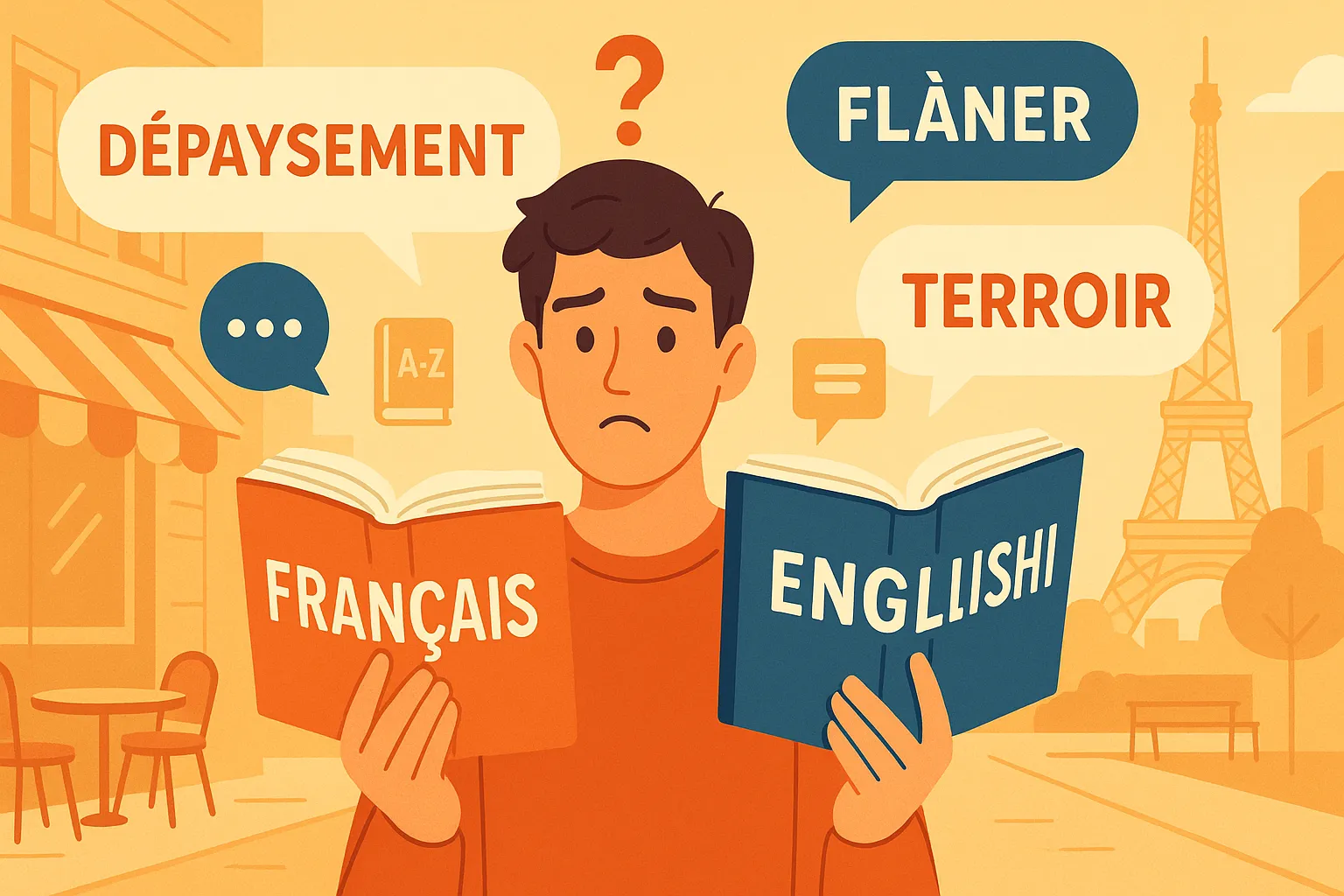
🇫🇷 “Dépaysement” défini en français : désorientation mêlée d’émerveillement face à un environnement nouveau🇺🇸 “Dépaysement” translated: “culture shock” — kills half the meaning The French definition reveals excitement alongside disorientation. The English translation erases it. Only the French definition captures both.
Students who work on thinking in French find that switching to monolingual dictionaries accelerates the shift. Every lookup in French is practice. Every lookup in English is a step backward. The books guide covers the same transition for reading material.
The transition method. Look up new words in Larousse French first. If you still do not understand after reading the French definition, check the bilingual entry. Over time, you need the bilingual check less and less.
Specialized dictionaries: when general tools fail
General dictionaries translate “formation” as “training” or “formation” without telling you which applies. Medical, legal, financial, and technical vocabulary requires tools that understand domain-specific meaning. The work culture guide covers the professional vocabulary where general dictionaries produce the worst approximations.
Real native speakers from multiple regions. Hear “croissant” from a Parisian and a Québécois. Knowing a word you cannot pronounce is knowing half a word.
Never use a general dictionary for legal or medical translation. “Ordonnance” means “prescription” in medical French but “ordinance/decree” in legal French. General dictionaries list both without telling you which applies. Termium Plus labels each by domain. The moving to France guide covers the administrative terms where this matters most.
The lookup workflow: right answer in thirty seconds
1
Linguee first: context before meaning See the word in real bilingual sentences before committing. “Assurer le suivi” shows “follow up” in business, “monitor” in medical.
2
Larousse or CNRTL: French definition Understand the word in French. At B1+ this builds the think-in-French habit. At A2, skip and return later.
3
Forvo: hear it Ten seconds. One click. Now you can say it. The pronunciation guide gives you the phonetic framework.
4
Termium Plus: verify specialized meaning Only for professional, legal, medical vocabulary. General words skip this step.
5
Note it: French word + IPA + definition + example sentence Five fields. Thirty seconds. Permanent vocabulary. The sentence from Linguee is the example you need.
Why WordReference is not step 1
WordReference gives you the answer before you have seen the context. That is fast but dangerous. You pick the first translation, use it, and it is wrong because the context required a different meaning. Starting with Linguee forces you to see usage before committing. The false friends guide shows exactly which words this prevents you from getting wrong.
Free vs paid. CNRTL, Larousse basic, Linguee, Reverso Context, Termium Plus, IATE, Forvo, and WordReference are all free. Le Petit Robert adds polish but not substance. Free tools match or exceed paid alternatives for most learners.
The best dictionary is the one that makes you need it less over time. The method guide builds the system where dictionary lookups become verification, not crutches. The podcast guide adds the audio input that turns looked-up words into recognized sounds. “For sure.” 🕶️
Study glossary: dictionary and translation vocabulary
French Business Expressions English Speakers Get Wrong: The Complete Professional Register Guide
Every anglophone executive working with French teams hits the same walls: “faire le point” is not “make a point,” “reporter” is not “to report,” and the email closing formula is a full sentence that sounds absurd in English but is mandatory in French. This guide covers every meeting, email, negotiation, and deadline expression that causes real professional damage, with the cultural logic behind each one.
French business French operates on different rules. The formality is not optional.
Why French business language works the way it does
American business culture rewards directness. Say what you mean, get to the point, waste nobody’s time. French business culture rewards precision, hierarchy awareness, and the demonstration that you understand the protocol. These are not preferences. They are operating systems. Running American software on a French machine produces errors that look like competence gaps even when the underlying skill is strong.
The formality is structural, not decorative. French corporate hierarchy is steeper than American hierarchy, and the language reflects it. You do not email the CEO the way you email a colleague. You do not address a client the way you address a teammate. English has these distinctions too, but they are optional norms that younger companies often ignore. In French business, they are load-bearing walls. Remove them and the structure reads as broken, not modern. The tu/vous guide covers the pronoun layer of this system. This article covers the vocabulary layer.
The conditional tense is the single most important grammatical structure in French business communication. “Pouvez-vous” (can you) is a question. “Pourriez-vous” (could you) is a professional request. The two-letter difference between present and conditional is the difference between a colleague and a subordinate issuing orders. Every request, every suggestion, every disagreement in professional French uses the conditional. Anglophones who skip it sound blunt in a culture that reads bluntness as aggression.
The register gap that damages careers
French professionals judge competence partly through language register. An executive who says “tu peux m’envoyer ça” in an email to a client has revealed more about their professional formation than any CV can hide. The correct version, “pourriez-vous me faire parvenir ce document,” signals mastery of the code. In French corporate culture, the code is the credibility. The work culture guide covers the broader office protocol.
Business French is real French under pressure. Train for it.
The Briefing covers professional-register topics daily. Politics, economics, culture. The vocabulary Les Echos uses, at learner-friendly speed.
Meeting expressions: where anglophones lose credibility fastest
Meeting vocabulary is the highest-stakes area because errors happen live, in front of colleagues, with no edit button. Using the wrong expression does not cause confusion. It causes the specific kind of silence where everyone in the room knows you got it wrong but nobody corrects you. That silence is the French professional equivalent of a red underline. The correction never comes verbally. It comes in how seriously your next proposal is taken.
Faire le point: the expression every anglophone mistranslates
“Faisons le point sur l’avancement du projet.” This means “let us review the status of the project.” It does not mean “let us make a point about the project.” The English cognate “point” pulls anglophones toward “make a point” (which is “souligner” or “insister sur” in French). “Faire le point” is a status review, a stock-taking, a moment to assess where things stand. It appears in every French meeting agenda. Getting it right signals that you have attended French meetings before. Getting it wrong signals that you have not.
Reporter: the false friend that creates scheduling chaos
“Nous devons reporter la réunion à jeudi.” This means “we need to postpone the meeting to Thursday.” Not “we need to report on the meeting.” The verb “reporter” in French means to postpone, to push back, to defer. “To report on” is “faire le compte rendu de.” Using “reporter” to mean “give a report” in a French meeting creates immediate scheduling confusion: you have just told the room the meeting is being moved, not that someone will summarize it. The compound error (wrong verb + wrong meaning) requires its own correction meeting to untangle.
Assurer le suivi: the professional alternative to Franglais
“Je vais assurer le suivi de ce dossier.” This means “I will follow up on this file.” Not “je vais faire un follow-up.” Franglais (French-English hybrid) is common in French tech companies but reads as amateur in traditional corporate, legal, financial, and government contexts. “Assurer le suivi” is the native French expression. Using it signals professional fluency. Using Franglais signals that you learned business French from English-language management books translated badly. In sectors where precision matters (law, finance, government), the distinction between native expression and Franglais calque is a credibility marker.
More meeting expressions that matter
🇫🇷 Prendre la parole = commencer à s’exprimer dans une réunion🇺🇸 Take the floor. “Puis-je prendre la parole ?” English speakers just start talking. French meetings have a protocol. Not observing it reads as interruption, not confidence.
🇫🇷 Donner son feu vert = approuver officiellement🇺🇸 Greenlight, approve. “La direction a donné son feu vert.” Using the idiomatic form signals fluency. The flat form (“donner l’accord”) signals textbook.
🇫🇷 Rendre compte = rapporter à quelqu’un, être responsable devant🇺🇸 Report to, be accountable to. NOT “reporter à” (which means postpone). “Je rends compte directement au directeur.” Hierarchy verb. Essential in French corporate structures.
🇫🇷 Être force de proposition = apporter activement des idées et solutions🇺🇸 Be proactive with ideas. No English equivalent as a set phrase. French CV gold. One of the most commonly requested qualities in French job descriptions.
🇫🇷 Monter en compétence = développer ses compétences, se perfectionner🇺🇸 Upskill, develop expertise. NOT “augmenter les compétences” (too literal). The phrase managers use in every performance review.
🇫🇷 Mettre en copie = ajouter quelqu’un en CC dans un email🇺🇸 CC someone. NOT “copier” (that means to copy/cheat). “Merci de me mettre en copie.”
🇫🇷 L’ordre du jour = le programme d’une réunion🇺🇸 The agenda (of a meeting). NOT “l’agenda” (that means a personal planner/diary). One of the most common false friends in business French.
🇫🇷 Un compte rendu = un rapport écrit après une réunion🇺🇸 Meeting minutes, a written report. What “reporter” does NOT mean. “Je vais rédiger le compte rendu de la réunion.”
Email formulas: the written record you cannot take back
French professional emails are longer, more formal, and more structured than English ones. The opening is ceremonial. The closing is a full sentence. Between them, every request is wrapped in conditional politeness. Anglophones who write short, direct emails in French sound rude without knowing it. The email is a written record of your register competence, and unlike a spoken slip in a meeting, it can be forwarded, printed, and referenced months later.
The opening hierarchy
The way you open a French professional email signals everything about how you perceive the relationship. Get it wrong and the recipient reads the rest of your email through a filter of “this person does not know the code.”
Context
French opening
English equivalent
Unknown recipient
Madame, Monsieur,
Dear Sir/Madam,
Known recipient, formal
Madame Dupont, / Monsieur Martin,
Dear Ms. Dupont, / Dear Mr. Martin,
Known colleague
Bonjour Madame Dupont,
Hello Ms. Dupont,
Close colleague
Bonjour Sophie,
Hi Sophie,
Never acceptable for first contact
Bonjour, / Salut,
Hey, / Hi there,
The closing hierarchy
French email closings are the single biggest culture shock for anglophones. They are full sentences. They sound absurd translated literally. They are mandatory. Skipping them or abbreviating them reads as either ignorance or deliberate rudeness.
Context
French closing
English equivalent
Maximum formality (unknown, senior)
Je vous prie d’agréer, Madame/Monsieur, l’expression de mes salutations distinguées.
Yours faithfully,
High formality (known, professional)
Veuillez agréer mes salutations distinguées.
Yours sincerely,
Standard professional
Cordialement,
Best regards,
Warm professional
Bien cordialement,
Kind regards,
Colleague you know well
Bonne journée, / Bien à vous,
Have a good day, / Best,
Key email expressions
🇫🇷 Suite à votre email du 15 novembre, je vous confirme…🇺🇸 Following your email of November 15, I confirm… — The standard reply opener. NOT “après votre email” (too casual).
🇫🇷 Dans l’attente de votre retour, je vous prie d’agréer…🇺🇸 Awaiting your reply… — Standard closing before the signature formula. NOT “j’attends votre réponse” (sounds like an ultimatum).
🇫🇷 Je me permets de vous contacter concernant…🇺🇸 I am taking the liberty of contacting you regarding… — Essential for cold outreach, job applications, first contact. Signals awareness of the imposition.
🇫🇷 Pourriez-vous me faire parvenir ce document ?🇺🇸 Could you send me this document? — “Faire parvenir” (formal send) + conditional + vous. Full professional register in one sentence.
🇫🇷 Accuser réception = confirmer qu’on a bien reçu quelque chose🇺🇸 Acknowledge receipt. “Je vous écris pour accuser réception de votre proposition.” The standard professional acknowledgment formula.
🇫🇷 Transmettre = faire parvenir à quelqu’un en contexte professionnel🇺🇸 Forward (professional). NOT “passer” (too casual for business). “Pourriez-vous transmettre ce document à l’équipe ?”
The “Bonjour” trap. “Bonjour” as an email opening is fine for colleagues you already know. It is never acceptable for first contact with unknown recipients. “Madame, Monsieur,” is the default. Getting this wrong on a job application email eliminates you before the CV is opened. The job interview guide covers the full application register.
Negotiation and deadline expressions: precision French for professionals
French negotiation language is built around indirect suggestion and diplomatic phrasing. Direct statements that work in English (“we need this by Friday”) sound aggressive in French business contexts. The conditional form does the heavy lifting. The politeness guide covers the broader cultural logic. This section covers the specific vocabulary.
Diplomatic disagreement
French professionals disagree by suggesting alternatives, not by saying “no.” Direct contradiction is reserved for crises. In normal business, indirection is the protocol. The standard disagreement opener is “Je comprends votre point de vue, cependant…” (I understand your view, however…). Disagree with the data, not the person. This formula is so standard that not using it reads as either aggression or ignorance of the code.
🇫🇷 Trouver un terrain d’entente = trouver une base commune d’accord🇺🇸 Find common ground. NOT just “compromis” (implies both sides lose). “Nous devons trouver un terrain d’entente.” Signals alignment, not concession.
🇫🇷 Serait-il possible de décaler notre rendez-vous ?🇺🇸 Would it be possible to reschedule? — NOT “pouvez-vous” (too direct for professional requests). The conditional adds the politeness French business expects.
🇫🇷 Dans les meilleurs délais = aussi rapidement que possible🇺🇸 As soon as possible. NOT “aussitôt que possible” (sounds panicked). Diplomatic urgency. The French way of saying “I need this now” without saying it.
🇫🇷 D’ici vendredi = avant vendredi, au plus tard vendredi🇺🇸 By Friday. The professional deadline preposition. “Je vous enverrai le rapport d’ici vendredi.”
🇫🇷 Revenir vers vous = vous recontacter sous peu🇺🇸 Get back to you. NOT “retourner vers vous” (means physically return). “Je reviens vers vous d’ici lundi.”
🇫🇷 Être en phase = être en accord, partager la même vision🇺🇸 Be aligned. NOT “être sur la même page” (Franglais calque). “Nous sommes en phase sur les objectifs.”
🇫🇷 Prendre en charge = assumer la responsabilité active🇺🇸 Take ownership of, handle. NOT “être responsable de” (correct but passive). “Je prends en charge ce dossier.” Action verb. Ownership verb.
🇫🇷 Mettre sur la table = soumettre à la discussion🇺🇸 Bring up for discussion. “Je voudrais mettre une nouvelle proposition sur la table.” “Mettre” not “poser.”
CV and job interview expressions: the French HR register
French CVs and cover letters use a register that does not exist in American English. The cover letter (lettre de motivation) is a formal exercise in structured argumentation, not a casual pitch. The vocabulary signals whether you have operated in French professional environments or are translating from English.
🇫🇷 Être force de proposition = apporter activement des idées🇺🇸 Be proactive with ideas. The most requested quality in French job descriptions. No English equivalent as a set phrase.
🇫🇷 Monter en compétence = développer ses compétences professionnelles🇺🇸 Upskill, develop expertise. The phrase every French manager uses in performance reviews.
🇫🇷 Polyvalent(e) = capable de remplir plusieurs fonctions🇺🇸 Versatile, multi-skilled. Appears on every French job posting for SMEs. Not “polyvalent” in English (which has a chemistry meaning).
🇫🇷 Lettre de motivation = lettre formelle d’argumentation pour une candidature🇺🇸 Cover letter. But structurally different: French lettres de motivation follow a three-part argument format (you/me/us) that American cover letters do not.
🇫🇷 Stage = période de formation en entreprise (PAS “scène”)🇺🇸 Internship. NOT “stage” (English: performance platform). One of the most common false friends in professional French. The false friends guide covers thirty more.
🇫🇷 Cadre = employé avec responsabilités de management et statut spécifique🇺🇸 Executive / manager (with specific French legal status). NOT “cadre” (English: framework). A “cadre” in France has a distinct legal employment category with different social charges, pension contributions, and working conditions than a non-cadre employee.
🇫🇷 Bilan de compétences = évaluation professionnelle structurée des compétences🇺🇸 Skills assessment. A formal, funded evaluation available to French employees. No American equivalent exists as an institutional right.
The three false friends that cost meetings
“Actuellement” means currently, not actually. “Nous travaillons actuellement sur ce projet” = “we are currently working on this project.” “Éventuellement” means possibly, not eventually. “On pourrait éventuellement décaler la date” = “we could possibly change the date.” “Demander” means to ask, not to demand. “Je vous demande de bien vouloir confirmer” = “I am asking you to kindly confirm.” These three appear in every business conversation. Getting one wrong changes your commitment, your timeline, or your tone. The Google Translate fails guide shows why machines get them wrong too.
Register shortcut. Convert any informal request to professional by adding “pourriez-vous” at the start and “s’il vous plaît” at the end. “Tu peux m’envoyer ça ?” becomes “Pourriez-vous me faire parvenir ce document, s’il vous plaît ?” Instant formality upgrade. The dictionary guide covers the tools that verify register when you are unsure.
The news websites guide adds the reading layer: Les Echos uses this exact vocabulary daily, and reading it builds passive recognition that transfers to meetings. The podcast guide adds the audio layer: France Culture and France Inter use the same register in interview format.
Complete glossary: French business expressions
French
English
Context
Faire le point
Review status
Meetings, project updates
Reporter
Postpone (NOT report)
“Reporter la réunion à jeudi”
Assurer le suivi
Follow up
Project management, emails
Prendre la parole
Take the floor
Formal meetings
Rendre compte
Report to, be accountable
Hierarchy verb
Être force de proposition
Be proactive with ideas
CVs, performance reviews
Monter en compétence
Upskill
Performance reviews
Suite à
Following (email opener)
Professional email replies
Dans l’attente de
Awaiting
Email closing formula
Je me permets de
I take the liberty of
Cold outreach, first contact
Transmettre / faire parvenir
Forward / send (formal)
Professional documents
Accuser réception
Acknowledge receipt
Professional confirmation
Cordialement
Best regards
Standard closing (colleagues)
Terrain d’entente
Common ground
Negotiation
Feu vert
Green light
Approvals
Dans les meilleurs délais
ASAP (diplomatic)
Deadline requests
D’ici (vendredi)
By (Friday)
Deadline preposition
Revenir vers vous
Get back to you
Professional follow-up
Être en phase
Be aligned
Agreement in meetings
Prendre en charge
Take ownership of
Action/responsibility
Compte rendu
Meeting minutes/report
Post-meeting documentation
Ordre du jour
Agenda (NOT “agenda”)
Meeting programme
Cadre
Executive/manager (legal status)
NOT “framework”
Stage
Internship (NOT “stage”)
Professional training period
Polyvalent(e)
Versatile, multi-skilled
Job descriptions
Bilan de compétences
Skills assessment
Institutional French right
Lettre de motivation
Cover letter (formal)
Three-part argument format
Business French is a register, not a dialect. The vocabulary is specific, the formality is structural, and the consequences of getting it wrong are professional, not just linguistic. The method guide builds the system that develops this register. The think in French guide helps you stop translating business English into French and start producing business French directly. “For sure.” 🕶️
You just decoded french, business, expressions. We turn this into a weekly habit.
Business French costs careers when it is wrong. The Pass builds the professional register weekly: real audio situations, the vocabulary Les Echos uses, at your level.
✓ Weekly native audio✓ CEFR tracking✓ Full archives✓ Structured practice
French Words That Don’t Translate to English: 20 Concepts Your Language Doesn’t Have
French words that do not translate to English show up in daily conversation, and when you do not know them, you spend thirty seconds explaining what a French speaker captures in one word. This guide covers twenty untranslatable words you will actually hear, with pronunciation, real sentences, and the cultural reason English has no equivalent for any of them.
Twenty words. Twenty cultural concepts. Zero English equivalents.
Feeling and experience: French words English cannot capture
These words describe internal states that English breaks into multiple phrases. French packs them into one. That is not efficiency. It is a different way of seeing the world. The think in French guide explains why accepting these concepts without translation is the cognitive shift that separates A2 from B1.
🇫🇷 Dépaysement /depɛizmɑ̃/ = désorientation mêlée d’émerveillement dans un lieu inconnu🇺🇸 The disorientation of being somewhere unfamiliar, including the excitement, not just the confusion. “Le dépaysement en arrivant au Japon était intense.” English needs a full sentence. French needs one word.
🇫🇷 Retrouvailles /ʁətʁuvɑj/ = la joie spécifique de retrouver quelqu’un après une longue séparation🇺🇸 The specific joy of reuniting after long separation. Not the event, the emotion. Always plural. “Reunion” captures only the occasion, not the rush of recognition when you see the face.
🇫🇷 L’esprit de l’escalier /lɛspʁi də lɛskalje/ = la répartie parfaite trouvée trop tard🇺🇸 The perfect comeback thought of after the conversation has ended. Literally “staircase wit.” Everyone has lived this. Only French named it.
🇫🇷 Spleen /splin/ = mélancolie profonde et vague, sans cause précise🇺🇸 A deep, vague melancholy without clear cause. Baudelaire made it a literary concept. Not sadness. Not depression. A romantic, almost pleasurable heaviness.
🇫🇷 Ras-le-bol /ʁa lə bɔl/ = exaspération totale, saturation absolue🇺🇸 Fed up to the absolute brim. Stronger than “j’en ai marre.” “I’ve had enough” is too calm. “I’m fed up” is too mild. Ras-le-bol is the sound of a limit being reached.
🇫🇷 Coup de foudre /ku də fudʁ/ = amour ou passion instantanée, comme un éclair🇺🇸 Love at first sight. Literally “lightning strike.” Can also apply to a place, a meal, or an apartment. The metaphor tells you everything: overwhelming, immediate, involuntary.
Why English does not have these words
Language reflects what a culture needs to name. French developed “flâner” because Paris built wide boulevards and café terrasses for aimless observation. English-speaking cities built for commerce, not contemplation. No practice, no word. The café culture guide covers the physical spaces where these words live.
These words only make sense in context. The Briefing provides context daily.
Real French on real topics. The vocabulary that lists can’t teach, explained at learner speed.
Lifestyle and social concepts: the words you will use most
🇫🇷 Flâner /flɑne/ = se promener sans destination, en observant, en refusant l’efficacité🇺🇸 To stroll without destination, observing everything, rejecting efficiency. Walking has a purpose. Flâner IS the purpose. The Montmartre guide is where you practice it.
🇫🇷 Joie de vivre /ʒwa də vivʁ/ = enthousiasme actif et vigoureux pour l’existence🇺🇸 An active, spirited enjoyment of living. Not passive happiness, chosen enthusiasm. English borrows this directly because “joy of living” sounds flat.
🇫🇷 Bon vivant /bɔ̃ vivɑ̃/ = quelqu’un qui profite des plaisirs de la vie🇺🇸 Someone who enjoys life’s pleasures. Not “foodie” (too narrow), not “hedonist” (too negative). A compliment in French. The drinks guide covers what a bon vivant orders.
🇫🇷 Profiter /pʁɔfite/ = jouir pleinement de quelque chose, saisir le moment🇺🇸 To fully enjoy something, seize the moment. “Profitez-en !” The imperative you hear at every dinner, every sunset. Active, not passive. It commands you to stop holding back.
🇫🇷 Douceur de vivre /dusœʁ də vivʁ/ = la douceur de l’existence bien vécue, sans hâte🇺🇸 The sweetness of living well. Not “quality of life” (too clinical). What expats are actually chasing when they say they want to “live in France.” The moving to France guide covers the practical steps to get there.
🇫🇷 Sortable /sɔʁtabl/ = acceptable à présenter en société🇺🇸 Someone presentable enough to bring out in public. “Il faut que tu sois sortable pour le dîner chez mes parents.” One word. English needs a full clause.
Food, place, and craft: the words English already stole
English speakers already use some of these without knowing they are untranslatable. “Terroir” appears on wine labels. “Savoir-faire” appears in business contexts. The words exist in English precisely because English could not create its own version.
🇫🇷 Terroir /tɛʁwaʁ/ = l’ensemble des facteurs naturels et humains qui donnent son caractère à un produit🇺🇸 The complete environment that gives wine and cheese their character. Not “location.” Soil + climate + tradition + accumulated knowledge. The cheese guide explains terroir through fromage.
🇫🇷 Savoir-faire /savwaʁ fɛʁ/ = compétence technique alliée à l’élégance dans l’exécution🇺🇸 Knowing how to do something with skill AND style. Not “know-how” (too mechanical). The business expressions guide covers where this matters professionally.
🇫🇷 Bricolage /bʁikɔlaʒ/ = fabrication ingénieuse à partir de ce qu’on a sous la main🇺🇸 Making something functional from whatever materials are available. DIY follows instructions. Bricolage improvises.
🇫🇷 Chez /ʃe/ = au domicile ou à l’établissement de quelqu’un🇺🇸 At someone’s home/place. One syllable where English needs a full phrase. “On se retrouve chez moi à vingt heures.” Location + possession + social relationship in two letters.
🇫🇷 Gourmand vs gourmet = deux attitudes distinctes face à la nourriture🇺🇸 Gourmand: loves eating (quantity + pleasure). Gourmet: appreciates fine food (quality + expertise). “Il est gourmand” is not an insult. English blurs these. French keeps them separate.
Communication and daily life: the gaps you discover in France
🇫🇷 Tutoyer / vouvoyer = utiliser “tu” ou “vous” avec quelqu’un🇺🇸 To use “tu” / to use “vous.” English has no verb for choosing a pronoun. “On se tutoie ?” is the moment a relationship shifts. The tu/vous guide covers the full system.
🇫🇷 Flemme /flɛm/ = paresse situationnelle, manque de motivation momentané🇺🇸 The specific laziness of not wanting to do something you should do. Temporary, not permanent. “J’ai la flemme.” Less moral weight than the English equivalent implies.
🇫🇷 Craquer /kʁake/ = céder à la tentation, s’effondrer, ou tomber sous le charme🇺🇸 Three meanings in one word: give in to temptation, break down emotionally, fall instantly for someone. “J’ai craqué pour ce sac.” Context decides which meaning.
🇫🇷 Empêchement /ɑ̃pɛʃmɑ̃/ = obstacle imprévu qui rend impossible d’honorer un engagement🇺🇸 An unforeseen obstacle preventing attendance. Not an “excuse.” “J’ai un empêchement.” The polite way to cancel without explaining. French respects the boundary.
🇫🇷 Yaourter /jauʁte/ = chanter des paroles qu’on ne connaît pas en imitant les sons🇺🇸 To fake-sing lyrics you do not know, producing yogurt-like sounds. Every human does this. Only French named it.
🇫🇷 Se retrouver /sə ʁətʁuve/ = se rejoindre / se retrouver soi-même🇺🇸 To meet up (practical) / to find oneself again (philosophical). “On se retrouve au café ?” Both meanings feel like the same emotional mechanism: finding what was missing.
Practice method. For each word, learn one sentence you would actually say. “J’ai la flemme.” “On se retrouve chez moi.” “Profitez-en !” Sentences beat definitions. The shy beginners guide helps if producing these out loud feels intimidating.
The real lesson behind untranslatable words
Every untranslatable word is a permission slip to stop translating. The moment you accept that “dépaysement” is dépaysement and not “culture shock,” you have made the cognitive shift that separates A2 from B1. The method guide builds this shift systematically. The false friends guide covers the words that look translatable but are not.
Complete list: French words that do not translate
French
Approximation
Why it fails
Dépaysement
Disorientation abroad
Includes excitement, not just confusion
Retrouvailles
Joyful reunion
The emotion, not the event
L’esprit de l’escalier
Staircase wit
Comeback after the conversation ends
Spleen
Vague melancholy
Romantic, almost pleasurable
Ras-le-bol
Fed up
Explosive, not mild
Coup de foudre
Love at first sight
Applies to places and objects too
Flâner
Aimless strolling
Walking with purpose defeats it
Joie de vivre
Zest for life
Active enthusiasm, not passive
Bon vivant
Epicurean
No negative connotation
Profiter
Enjoy fully
Active command, not passive state
Douceur de vivre
Sweetness of living
A feeling, not a metric
Sortable
Presentable
One adjective, one social judgment
Terroir
Sense of place
Soil + climate + tradition + taste
Savoir-faire
Know-how
Includes elegance, not just competence
Bricolage
DIY
DIY follows instructions, bricolage improvises
Chez
At someone’s place
Location + possession + relationship in 2 letters
Flemme
Can’t be bothered
Situational, not a character trait
Craquer
Give in / fall for
Three meanings, one word
Empêchement
Unforeseen obstacle
Legitimacy without justification
Yaourter
Fake-sing lyrics
Universal action, only French named it
Every gap between the two languages is a cultural story. The BD guide covers untranslatable visual culture. The music guide covers untranslatable lyrical culture. “For sure.” 🕶️
French False Friends That Confuse English Speakers: The Words Your Brain Gets Wrong Every Time
French false friends look like English words but mean something completely different, and they show up in every conversation, every shop, and every administrative form. This guide covers the pairs that cause real embarrassment, explains why your brain falls for each one, and gives you the sentences that fix the mistake permanently.
Same spelling, different meaning. These word pairs trip up every English speaker.
The critical four: the false friends that cause the most damage
These four false friends appear in daily French conversation more often than any others. They are not obscure vocabulary traps. They are words you will read on signs, hear in meetings, and need to use in your first week in France. Getting them wrong does not cause a minor misunderstanding. It causes the specific kind of confusion where the French speaker hears one meaning and you intended another, and neither of you realizes the disconnect until three sentences later when the conversation stops making sense.
Actuellement: currently, not actually
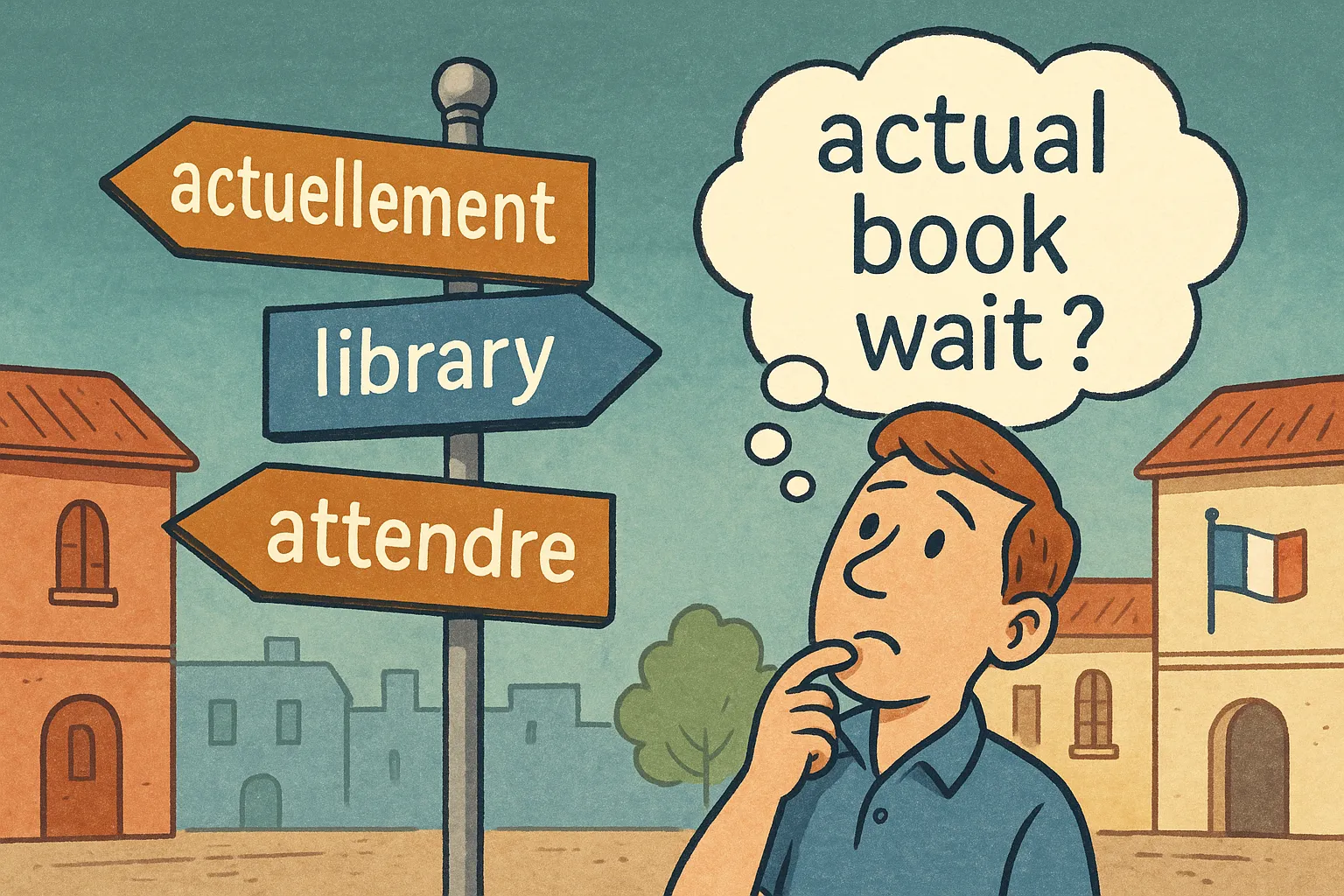
“Actuellement, j’habite à Paris” means “Currently, I live in Paris.” Not “Actually, I live in Paris.” The English brain sees “actuellement” and immediately fires “actually” because the shape is identical and the English word is used ten times a day. The French meaning is temporal (right now, at this moment), while the English meaning is corrective (in fact, in reality). Using “actuellement” to mean “actually” in a French sentence changes a simple statement of fact into a strange emphasis that confuses the listener. The correct French word for “actually” is “en fait.” The Google Translate guide shows that machines get this one wrong too, for the same statistical reasons your brain does.
Librairie: bookstore, not library
“Je vais à la librairie” means “I am going to the bookstore.” A librairie is a commercial shop where you buy books. A bibliothèque is a public institution where you borrow them. Walking into a bookshop and asking to borrow produces a blank stare and an immediate classification as someone who has not spent time in French-speaking environments. The words share a Latin root (liber, book) but diverged centuries ago: English kept “library” for the lending institution, while French kept “librairie” for the selling one. Knowing this distinction is one of the clearest A1 markers in French.
Préservatif: condom, not preservative
There is no polite way to describe the social aftermath of asking whether food contains “préservatifs” when you mean preservatives. The French word for food preservative is “conservateur.” The word “préservatif” means condom, exclusively and unambiguously. This is the single most embarrassing false friend in the entire French-English vocabulary overlap, and it catches anglophone tourists in restaurants, supermarkets, and bakeries with reliable regularity. The room goes silent. The correction comes later, from a friend, not from the server who heard it.
Assister à: to attend, not to assist
“J’ai assisté à la réunion” means “I attended the meeting.” Not “I helped with the meeting.” The verb “assister” followed by “à” means to be present at, to witness, to attend. The verb “aider” means to help or to assist. This false friend creates a circular confusion with “attendre” (to wait, not to attend), which means two verbs look like each other’s correct translation but both mean something else entirely. Sorting out the assister/attendre/aider triangle is one of the first vocabulary puzzles every English-speaking French learner has to solve. The grammar interference guide explains why these structural mismatches persist even at intermediate levels.
Why false friends persist at every level
Your brain processes familiar-looking words faster than unfamiliar ones. When you see “actuellement,” English fires before French has a chance. One correction rarely sticks. Ten corrections in ten different sentences does. The fix is not memorization. It is creating a corrective association strong enough to override the automatic English assumption.
False friends hide in every French sentence. The Briefing exposes them daily.
Real French on real topics. The vocabulary traps that lists cannot teach, in context.
Time and schedule false friends that break your plans
Mixing up time-related false friends does not just cause confusion. It changes your commitment. “Possibly” is not “eventually.” One is a maybe. The other is a certainty. Students preparing for a move to France consistently report that these cause the most practical problems: scheduling errors, missed commitments, confused invitations. The business expressions guide covers these in the professional context where the consequences multiply.
Éventuellement: possibly, not eventually
“Éventuellement, je pourrais venir” means “Possibly, I could come.” Not “Eventually, I will come.” The gap between these two meanings is the gap between a tentative maybe and a firm commitment. The French word for “eventually” is “finalement.” Using “éventuellement” when you mean “eventually” in a professional email tells your French colleague that your attendance is uncertain when you intended to confirm it. In business contexts, this single false friend has derailed project timelines because the anglophone thought they were confirming a deadline and the French counterpart heard a conditional maybe.
Agenda: personal planner, not meeting agenda
Asking for “l’agenda de la réunion” asks for someone’s personal diary instead of the meeting programme. The French word for a meeting agenda is “l’ordre du jour.” The French word “agenda” refers to a personal planner, a datebook, a calendar where you write appointments. The confusion is universal among anglophone professionals arriving in French offices, and it produces a moment of puzzled silence every time. “J’ai noté ça dans mon agenda” means “I wrote it in my planner.” Not “I put it on the agenda.”
More time and schedule false friends
🇫🇷 Journée = la durée du jour (PAS “journey”)🇺🇸 “Journey” = voyage / trajet. “Bonne journée” = “Have a good day.” Not “Have a good journey.”
🇫🇷 Entrée = premier plat d’un repas (PAS “main course”)🇺🇸 In American English, “entrée” = main course. In French, entrée = starter. Every American tourist hits this at every French restaurant. The restaurant guide covers the full ordering sequence.
🇫🇷 Monnaie = pièces de monnaie, rendu de caisse (PAS “money”)🇺🇸 “Money” = argent. “Vous avez la monnaie ?” = “Do you have change?” Not “Do you have money?”
The “demander” trap. “Demander” means “to ask,” not “to demand.” “Je vous demande” is polite. If you think it means “I demand,” you will avoid the word and sound stiff or overly formal. Use it freely. It is the standard polite request verb in French. The tu/vous guide covers the full register system where this verb operates.
Emotion and personality false friends: how to describe people without embarrassment
False friends that describe people carry higher social stakes than false friends that describe objects. Calling someone “sensible” when you mean “sensible” changes a compliment into an observation about emotional fragility. Saying “je suis excité” about a concert announces something entirely unrelated to enthusiasm. These errors produce immediate, visible reactions in the room because they concern the person you are talking to or about, not an abstract concept.
Sensible: sensitive, not sensible
“Elle est très sensible” means “She is very sensitive.” Not “She is very practical.” The French word for “sensible” (practical, reasonable) is “raisonnable.” The memory trick that makes this stick permanently: in French, “sensible” relates to the senses, to feeling. In English, “sensible” relates to sense, to logic. Same Latin root (sensibilis), different evolutionary branch. Once you see the split, the false friend loses its power. The French meaning stayed close to the physical (feeling, perceiving), while the English meaning drifted toward the cognitive (reasoning, being practical).
Excité: sexually aroused, not excited
Saying “je suis excité” about an upcoming concert or vacation gets a very different reaction than intended. In French, “excité” carries a primary sexual connotation that the English word “excited” does not. The correct French words for “excited” (enthusiastic) are “enthousiaste” or “j’ai hâte” (I cannot wait). This is the false friend with the highest social cost because the reaction in the room is immediate, unmistakable, and memorable. Every French language teacher has a story about a student who learned this one the hard way.
More personality false friends
🇫🇷 Sympathique = agréable (PAS “sympathetic”)🇺🇸 “Sympathetic” = compatissant. “Il est sympathique” = “He’s nice.” Often shortened to “sympa.” Nothing to do with empathy.
🇫🇷 Blessé = blessure physique (PAS “blessed”)🇺🇸 “Blessed” = béni. “Il est blessé” = “He is injured.” Not a spiritual statement. A medical one.
🇫🇷 Formidable = excellent, remarquable (PAS “formidable/fearsome”)🇺🇸 “C’est formidable !” = “That’s wonderful!” A compliment, not a warning. The untranslatable words guide covers concepts that go even further.
🇫🇷 Engagé = impliqué politiquement (PAS “engaged to marry”)🇺🇸 “Engaged” = fiancé(e). “Elle est très engagée” = “She’s politically committed.” Not getting married.
🇫🇷 Collège = enseignement secondaire 11-15 ans (PAS “college”)🇺🇸 “College” = université / fac. “Mon fils est au collège” = he is 11-15, not studying for a degree. Confuses every American parent.
Action verb false friends: when French verbs lie to your English brain
Action verb false friends are particularly damaging because they change what you are describing yourself doing. Saying you are resting when you mean you are staying, or saying you are waiting when you mean you are attending, produces narratives where your listener hears a different story from the one you are telling. The confusion compounds because correcting a verb retroactively requires rewinding the entire sentence in the listener’s mind.
Rester: to stay, not to rest
“Je reste à la maison” means “I am staying home.” Not “I am resting at home.” The French word for “to rest” is “se reposer.” The meanings are close enough that the error sometimes goes undetected in casual conversation, which makes it more dangerous than a false friend that produces obvious nonsense. The listener might not correct you because the sentence still makes approximate sense, and the error becomes a fossilized habit. “Je reste” means I am choosing not to leave. “Je me repose” means I am recovering. The difference between a decision and a physical state.
Attendre: to wait, not to attend
“J’attends le bus” means “I am waiting for the bus.” The verb “attendre” means to wait for, to expect, to anticipate. It does not mean to attend. To attend is “assister à.” This creates a triple confusion with “assister” (to attend, not to assist) and “aider” (to assist, to help). Three verbs, three false friend chains, all intersecting. The only way to sort it out is to learn each one as a complete sentence rather than a word pair: “J’attends le bus” (waiting), “J’ai assisté à la réunion” (attended), “Je peux vous aider” (help). Context locks the meaning where translation cannot.
More action verb false friends
🇫🇷 Regarder = observer (PAS “to regard/consider”)🇺🇸 “To regard” = considérer. “Regarde !” = “Look!” Not “Consider this!” A physical command, not an intellectual invitation.
🇫🇷 Large = wide (PAS “large/big”)🇺🇸 “Large” = grand / gros. “La rue est large” = “The street is wide.” Describing a person as “large” means they are wide, not big.
🇫🇷 Ancien = former (PAS “ancient”)🇺🇸 “Ancient” = antique. “Mon ancien professeur” = “My former teacher.” Not “My ancient teacher.” Recent past, not historical antiquity.
🇫🇷 Cave = cellier, espace souterrain (PAS “cave”)🇺🇸 “Cave” = grotte. “Le vin est dans la cave” = the cellar. The drinks guide covers what comes out of it.
🇫🇷 Figure = visage (PAS “figure/body shape”)🇺🇸 “Figure” = silhouette. “Il a bonne figure” = “He looks well” (face). The word belongs to the face, not the body.
🇫🇷 Bras = arm (PAS “bra”)🇺🇸 “Bra” = soutien-gorge. “J’ai mal au bras” = “My arm hurts.” Gets a laugh every time.
🇫🇷 Coin = angle, recoin (PAS “coin/money”)🇺🇸 “Coin” = pièce de monnaie. “Le café du coin” = the corner café. Not the coin-operated café.
The correction that sticks
One correction in isolation fades within a week. One correction embedded in a real situation sticks permanently. Do not memorize “rester = to stay.” Memorize “Je reste à la maison ce soir.” The context locks the meaning. The method guide builds this context-first approach into the full learning system. The common mistakes guide covers the grammar errors that compound with false friend vocabulary errors.
The complete sentence method. For each false friend, learn one correct sentence you would actually say. “Actuellement, j’habite à Paris.” “Je vais à la librairie.” “J’attends le bus.” “Je reste à la maison.” Sentences beat word lists. Every time. The dictionary guide gives you the tools to verify any suspicious word before it embarrasses you.
Complete reference: 20 French false friends
False friend
Correct FR meaning
What you meant → correct FR
Actuellement
Currently
Actually → en fait
Librairie
Bookstore
Library → bibliothèque
Préservatif
Condom
Preservative → conservateur
Assister à
To attend
To assist → aider
Éventuellement
Possibly
Eventually → finalement
Agenda
Personal planner
Agenda → ordre du jour
Sensible
Sensitive
Sensible → raisonnable
Sympathique
Nice / friendly
Sympathetic → compatissant
Excité
Sexually aroused
Excited → enthousiaste
Demander
To ask
To demand → exiger
Rester
To stay
To rest → se reposer
Attendre
To wait
To attend → assister à
Large
Wide
Large → grand / gros
Ancien
Former
Ancient → antique
Cave
Cellar
Cave → grotte
Blessé
Injured
Blessed → béni
Formidable
Wonderful
Formidable → redoutable
Engagé
Politically committed
Engaged → fiancé(e)
Collège
Middle school (11-15)
College → université / fac
Monnaie
Change (coins)
Money → argent
False friends are half the vocabulary problem. The untranslatable words guide covers the other half: concepts French has that English lacks entirely. Together, they map the full territory where English intuition fails and French thinking begins. “For sure.” 🕶️
You just decoded common, french, false. We turn this into a weekly habit.
False friends hide in every sentence. The Pass catches them weekly: real situations where these traps appear, with audio so you hear the difference before you make the mistake.
✓ Weekly native audio✓ CEFR tracking✓ Full archives✓ Structured practice
French Shows on Netflix US: Which Series and Films Actually Teach You French at Each Level
Most learners pick a French show on Netflix because it looks good, watch with English subtitles, understand the plot, and learn zero French. This guide ranks the best series and films by listening difficulty, explains what each one actually teaches, and gives you the active viewing routine that turns streaming into study.
French audio + French subtitles. That is the only setting that teaches you anything.
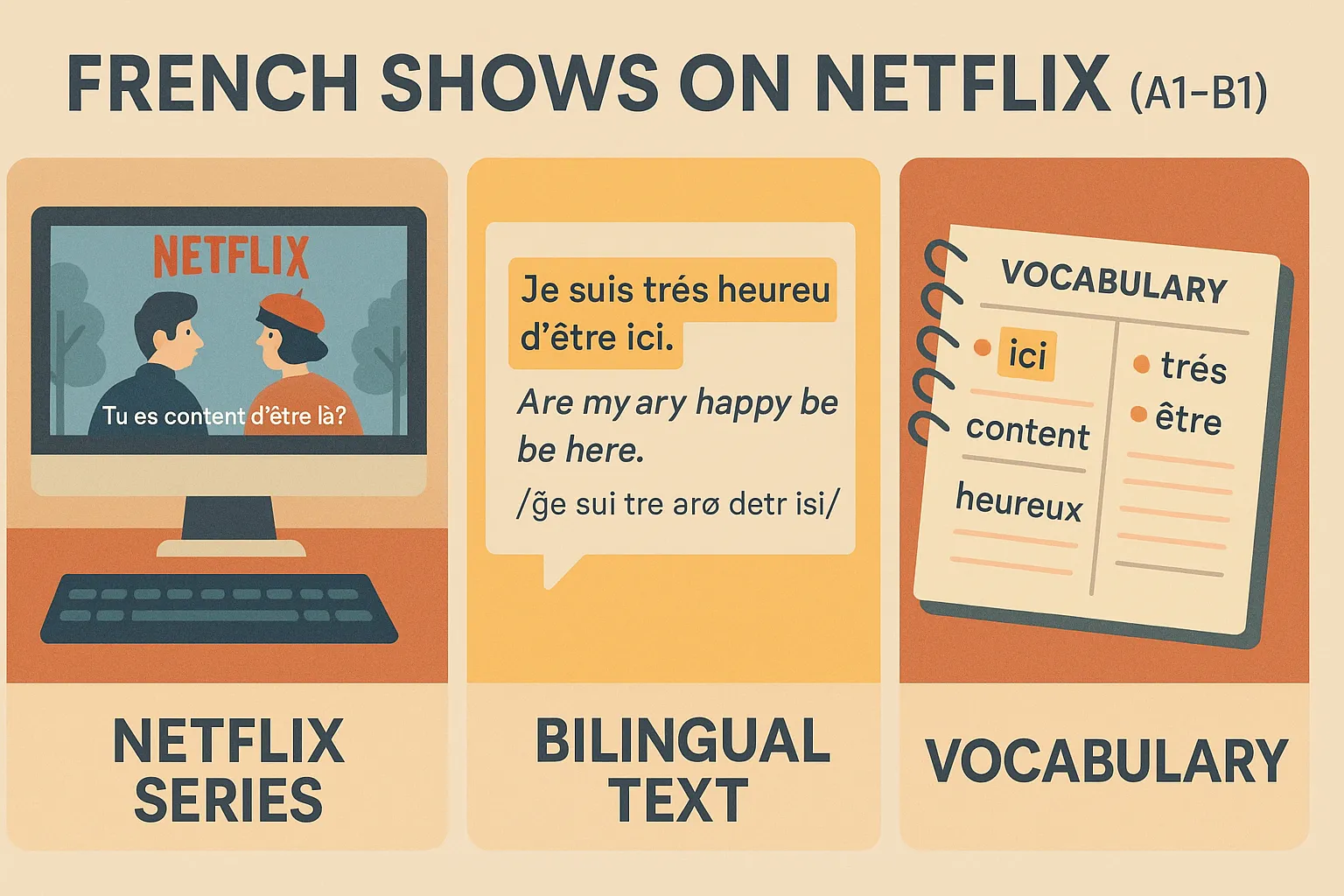
English subtitles teach you zero French. Your brain reads the translation and ignores the audio entirely. French subtitles train the eye-ear connection: you see the word while hearing it. That single switch is the difference between entertainment and learning. The Amazon Prime guide uses the same four-stage subtitle progression. Netflix has the advantage of more French original content, which means better subtitle accuracy than dubbed imports.
Level
Audio
Subtitles
Goal
A1-A2
French
English first, then French
Calibrate your ear. Get the plot, then the language.
A2-B1
French
French
Read while listening. Pause on unknown words. Build vocabulary.
B1-B2
French
French → then none
Test comprehension. The gap between viewings = your progress.
B2+
French
None
Cold viewing. Accept gaps. Capture main ideas.
Netflix trains your ear. The Briefing trains your reading.
Daily written French on real topics. Same register as adult conversation. Complements Netflix perfectly.
A1 beginner: shows where visual context carries you
At A1, you need slow speech, visual context, and simple vocabulary. Cooking shows, documentaries, and animated content work better than dramas because the images explain the words. Not sure where you stand? The Level Quiz takes three minutes.
🎬 Chef’s Table: France — food vocabulary, measured speech
Interviews with French chefs provide visual context that anchors every new word. The narration is slow, deliberate, and built around concrete objects you can see on screen. “C’est une recette de famille” (it is a family recipe) is the kind of sentence that appears in A1 conversation but requires no explanation because the image carries it. The food vocabulary transfers directly to the café culture guide and the restaurant ordering guide.
🎬 Le Petit Nicolas — children’s French, everyday school vocabulary
Based on the beloved French children’s books by René Goscinny and Jean-Jacques Sempé. The language is intentionally simple: present tense, basic sentence structures, school and family vocabulary. Perfect entry point if adult dramas feel overwhelming. The school setting produces everyday French that transfers immediately to real situations, and the humor works even at A1 comprehension levels.
The narrator speaks slowly, precisely, and descriptively. Audrey Tautou’s diction is unusually crisp. Paris neighbourhood vocabulary (Montmartre, Abbesses, Canal Saint-Martin) appears throughout. The Montmartre guide covers the same geography at street level. “Vous désirez ?” (what would you like?) appears in every service interaction in France, and hearing it in the film means recognizing it instantly at the counter.
A1 rule. If you understand less than 40% with French subtitles, the show is too hard. Drop to English subtitles or pick a simpler title. The sweet spot is 60-70% comprehension: enough to follow, enough gaps to learn from.
A2: comedy series where conversation speed builds naturally
A2 is where Netflix becomes genuinely useful. Comedies with recurring characters repeat vocabulary naturally across episodes. The same phrases come back in different contexts, which is exactly how acquisition works. Three series do this reliably.
🎬 Plan Cœur (The Hook Up Plan) — casual Parisian, invitations, dating
3 seasons · Parisian rom-com with short dialogues, invitations, and casual reductions. “On se voit ce soir ?” (are we meeting tonight?) and “C’était sympa” (that was nice) appear every episode. The register is informal but not too slangy for A2 ears. The show teaches the casual French you need for social situations: making plans, cancelling plans, reacting to plans. If you are preparing for the Paris survival guide situations, this show is the audio version.
🎬 Dix pour cent (Call My Agent!) — office French, phone calls, scheduling
4 seasons + film · The show that made French TV internationally prestigious before Lupin. Talent agents manage celebrity clients in a Paris agency. Office comedy that teaches phone calls, scheduling, and polite professional formulas. “Je vous rappelle” (I will call you back), “On fait le point à quinze heures” (let us review at 3 p.m.). Workplace French that transfers directly to the business expressions guide. The tu/vous dynamics between agents and celebrities demonstrate the tu/vous system in real professional situations.
🎬 Family Business — family chaos, quick favours, money vocabulary
3 seasons · A family converts their failing kosher butcher shop into a cannabis café. The premise delivers family arguments, quick favours, money talk, and affectionate sarcasm in every episode. “Tu peux m’aider une minute ?” (can you help me a minute?) and “C’est risqué, non ?” (it is risky, right?) are everyday French you will use with friends. The tag question “non ?” turns any statement into a conversation, and French speakers do this constantly.
B1: register shifts, planning, and professional vocabulary
B1 is where you stop needing simple and start needing varied. The shows below mix formal and informal French, which trains register awareness. That is the skill that separates “understood” from “sounds natural.” The think in French guide becomes relevant here: you need to stop translating every line.
🎬 Lupin — heist planning, conditional structures, Paris geography
3 parts · Omar Sy as a modern gentleman thief inspired by Arsène Lupin. The heist structure means planning language dominates: “On se retrouve à l’entrée” (let us meet at the entrance), “Tout est prêt ?” (everything ready?), conditional structures for hypotheticals. Short operational lines that map to real travel and meeting scenarios. Paris geography (Louvre, banlieue, gare) provides spatial vocabulary the Paris guide covers at street level. The show switches between Assane’s formal public persona and his informal private conversations, which is register training in action.
🎬 Intouchables (film) — register contrast, class vocabulary, humor
The highest-grossing French-language film, and the best B1 film on any platform for register training. Philippe (François Cluzet) speaks formal bourgeois French. Driss (Omar Sy) speaks casual banlieue French. The two registers coexist in every scene. The friendship arc provides emotional context that carries you even when you miss slang. “Ça vous va ?” (does that work for you?) is polite confirmation that works in every service and social situation. The Amazon Prime guide covers this film in detail with purchase links for rewatching.
🎬 Au service de la France (A Very Secret Service) — 1960s spy comedy, institutional French
2 seasons · A comedy set in France’s intelligence services in the 1960s. Institutional vocabulary, hierarchical language, formal address, and absurd bureaucracy. The humor comes from the gap between the seriousness of espionage and the pettiness of office politics. Teaches the same formal register as the work culture guide but through comedy, which makes the vocabulary stick faster.
B2-C1: subtext, irony, and the full French register
At B2-C1, the dialogue stops explaining itself. Irony, social coding, class markers, and cultural references land without annotation. These shows assume you can keep up. The Canal+ series guide covers the premium tier that operates at this same density.
🎬 La Mante — crime thriller, interrogation register, psychological
A serial killer consultant helps police catch a copycat. The interrogation scenes deliver formal police French: question formation, legal vocabulary, conditional structures under pressure. Dense, psychological, and fast. If you follow the dialogue without subtitles, your comprehension is B2+.
🎬 Marseille — political drama, power vocabulary, regional accent
Gérard Depardieu as the mayor of Marseille in a power struggle. Political vocabulary, negotiation language, and the Marseillais accent that sounds different from Parisian French. The Fifth Republic guide covers the institutional architecture this show dramatizes. The political vocabulary guide covers the specific terms.
A dating app that reads brain data to find perfect matches. The dialogue mixes tech vocabulary with philosophical and ethical debate. Conditional, subjunctive, and abstract vocabulary in natural conversational context. C1 territory for learners who want to hear French people argue about ideas, not just events.
Titles rotate. Netflix cycles French content regularly. JustWatch shows current availability by country for every title. The subtitle method stays the same regardless of which show is available. The TV channels guide adds free live alternatives when Netflix rotates your show away.
The 10-minute routine that turns Netflix into study
Watching a full episode is not studying. Watching a clip three times with a purpose is. The routine below takes ten minutes and produces more measurable improvement than a full evening of passive streaming.
1
Pick one scene (2-4 min) — French audio + French subtitles First watch for gist. Who is talking? What do they want? Do not pause.
2
Rewatch — note 3 words + 1 full sentence Pause allowed. Look up the 3 words. Write the sentence. This is the one you will shadow.
3
Rewatch without subtitles You know the content. Now listen for the music: liaison, reductions, rhythm. The pronunciation guide gives you the phonetic framework.
4
Shadow one sentence — use it within 24 hours Say it. Text it to a friend. “On se voit ce soir ?” Production completes the cycle.
Why 10 minutes beats 2 hours
A full episode gives 45 minutes of passive exposure. Three clips of 3 minutes each, watched three times with the routine above, give 27 minutes of active structured practice. The structured version produces measurable improvement. The full episode produces a nice evening. The 15-minute routine shows how this fits into a broader daily system.
After 30 days of this routine, you will have 15-30 natural French phrases you can produce without thinking. That is more active vocabulary than most A2 courses deliver in a semester. The podcast guide fills commute time. The music guide adds rhythm. Together with Netflix, they build a media diet that keeps French present every day. “For sure.” 🕶️
You just decoded french, shows, netflix. We turn this into a weekly habit.
Netflix gives you exposure. The Pass gives you structure: weekly audio situations, CEFR tracking, the system that turns passive watching into measurable progress.
✓ Weekly native audio✓ CEFR tracking✓ Full archives✓ Structured practice
French News Phrases and Headline Grammar: How to Read What 67 Million French People Read Every Morning
French news headlines use words you already know in combinations that make no sense at first because headline grammar is not standard French grammar. This guide teaches you the compression code that French journalists have used since 1631, with iconic historical examples, the vocabulary that repeats every week, and the 90-second method that decodes any article.
French headlines compress a full story into six words. The patterns have not changed in a century.
From La Gazette to Mediapart: why French headlines work the way they do
French press history explains why French headlines are compressed the way they are. The first French newspaper, La Gazette, was founded by Théophraste Renaudot in 1631 under royal privilege. It reported court news in dense, formal prose because its audience was the literate elite and its pages were expensive. That original compression, fitting maximum information into minimum space, became the DNA of French journalism. Four centuries later, the logic has not changed: space costs money, attention is finite, and the headline must deliver the story before the reader decides to read further.
The golden age of French press arrived between 1890 and 1914. Le Petit Parisien reached 1.3 million daily copies, making it the highest-circulation newspaper on the planet. Le Petit Journal, Le Matin, and Le Journal each exceeded 500,000 copies. The loi du 29 juillet 1881 had guaranteed press freedom, and the rotary press had dropped unit costs to one sou (five centimes). Headlines became weapons in a circulation war: short, punchy, designed to be shouted by street vendors. The compression grammar you see in modern French headlines, articles dropped, verbs in present tense for past events, subject first, was invented during this period to sell papers from a kiosk at walking speed.
Three headlines that changed French history
The most famous headline in French press history appeared on January 13, 1898: Émile Zola’s open letter to President Félix Faure on the front page of L’Aurore, defending Captain Alfred Dreyfus against a wrongful treason conviction. The newspaper sold over 200,000 copies in hours. The headline was two words. The letter below it was thousands. But the two words were enough to split France in half, trigger Zola’s own trial for defamation, and eventually lead to Dreyfus’s exoneration. Two words, one front page, and the entire trajectory of the Third Republic changed. That is what a French headline can do.
When Le Monde was founded on December 18, 1944, in the offices of the collaborationist newspaper Le Temps, its first front page carried no photographs, no illustrations, and no sensational headlines. The layout was deliberately austere: dense text, analytical tone, intellectual distance. Founder Hubert Beuve-Méry wanted a newspaper that refused the kiosk-shouting tradition. Le Monde’s headline style, longer, more analytical, closer to a thesis statement than a tabloid punch, became the model for what the French call the “presse de référence.” When you read a Le Monde headline today and it feels like a full sentence, you are reading the legacy of that 1944 founding decision.
Libération, founded in 1973 by Jean-Paul Sartre and Serge July, invented the opposite tradition: the provocative one-word or one-phrase headline designed to make you react before you read. When Bernard Arnault, the LVMH billionaire, was reported to be seeking Belgian citizenship in September 2012 to avoid French taxes, Libération’s front page read simply: the headline became a national talking point before most people read the article. Libération’s headline tradition treats the front page as a poster, not a summary. That is why Libé headlines are shorter, angrier, and more culturally loaded than Le Monde headlines, and why reading both on the same story teaches you more about French media than any textbook.
Why this history matters for learners
French headline grammar is not broken French. It is a 130-year-old compression system optimized for speed. Understanding that the rules are deliberate, not random, makes decoding them systematic instead of frustrating. The news websites guide maps every source by political orientation and reading level. This article teaches you how to read whatever source you choose.
You are learning to read French news. Start with one that explains itself.
The Briefing covers real French current affairs daily, at learner-friendly speed, with quiz. The bridge between this guide and Le Monde.
The compression code: how French headlines strip sentences to their skeleton
French journalists eliminate words in a specific order when compressing a full sentence into a headline. Articles go first (“le,” “la,” “un,” “une”), then auxiliary verbs (“a été,” “est,” “sont”), then prepositions if context survives without them. The resulting headline is not grammatically correct French. It is a telegram. Reconstructing the full sentence from the telegram is the reading exercise that builds comprehension fastest.
The article-drop rule
“Accident signalé autoroute A6” is the headline. The full sentence is “Un accident a été signalé sur l’autoroute A6.” The headline dropped the indefinite article “un,” the passive auxiliary “a été,” and the preposition “sur.” What remains is subject-verb-location in compressed form. This pattern covers roughly 60% of all French news headlines. Once you can reconstruct the full sentence from the compressed version, you are reading headlines at near-native speed.
🇫🇷 Paris : trafic perturbé lundi matin.🇺🇸 Full: Le trafic a été perturbé à Paris lundi matin. = Traffic was disrupted in Paris Monday morning. Place first, then event, then time. That is the headline template. Works for 80% of French news.
🇫🇷 Grève prévue jeudi dans les transports.🇺🇸 Full: Une grève est prévue jeudi dans les transports. = A strike is planned Thursday in transport. No article, past participle as adjective. Pure compression.
The present-tense-for-past-events rule
French headlines use the present tense to describe events that have already happened. “Le ministre annonce de nouvelles mesures” means the minister announced new measures, not that the announcement is happening right now. This is called the “présent de narration” or historical present, and it has been standard in French journalism since the 19th century. English newspapers sometimes do this too (“PM announces new policy”), but French does it systematically. The rule: when reading a French headline, check the timestamp of the article, not the verb tense of the headline.
🇫🇷 Le gouvernement confirme la réforme.🇺🇸 The government confirms (= confirmed) the reform. Present tense, past event. When articles appear in a headline, the story is major.
🇫🇷 Éducation : rentrée perturbée dans trois académies.🇺🇸 Education: disrupted school start in three districts. Colon after the topic word is a headline convention. Everything after the colon is the event.
The colon convention
A colon in a French headline separates topic from event. “Éducation : rentrée perturbée” means the topic is education and the event is a disrupted school year start. “Santé : nouvelle campagne de vaccination” means the topic is health and the event is a new vaccination campaign. The colon replaces an entire introductory clause. Recognizing it immediately tells you what domain the article covers before you read a single content word.
Numbers, dates, and the direction words that tell you the story in three seconds
Most French news updates revolve around a number: a percentage, a date, a price, a count. The fastest way to decode any headline is to find the number first, then read the direction word: hausse (up), baisse (down), confirme (confirmed), prévue (planned). Those two elements, number and direction, give you the story in under three seconds. Everything else is detail.
Hausse and baisse: the two words that dominate French news
“Hausse” means increase. “Baisse” means decrease. These two words appear in every financial headline, every weather forecast, every poll result, and every economic indicator. The structure is always “hausse/baisse de/des” + noun + number. “Hausse de 10 % en mars” = 10% increase in March. “Baisse des températures ce week-end” = temperature drop this weekend. Mastering hausse and baisse alone lets you decode roughly a quarter of all Franceinfo and Les Echos headlines without reading the full article. The political vocabulary guide covers the terms that appear around these numbers during election cycles.
🇫🇷 Budget voté : 2,5 milliards d’euros.🇺🇸 Budget approved: 2.5 billion euros. French uses comma for decimals (2,5 = two point five) and spaces for thousands (15 000). Not dots.
🇫🇷 Réunion à 18h30. Résultats attendus d’ici vendredi.🇺🇸 Meeting at 6:30 PM. Results expected by Friday. 24-hour clock, no AM/PM. “D’ici” = by/within. The business expressions guide uses “d’ici” in professional context.
Date trap. French dates are day/month/year. “13/11/2025” is November 13th, not January 13th. Getting this wrong flips the entire timeline of any article you are reading.
Quoted speech and source attribution: reading between the guillemets
French news articles use attribution verbs to signal who said what and how reliable the information is. These verbs are not interchangeable. “Selon” (according to) is neutral. “Affirme” (states) implies the speaker is confident. “Précise” (clarifies) adds detail to something already established. “Déclare” (declares) signals a formal, official statement. “Dément” (denies) signals that the speaker is contradicting a previous claim. Recognizing these verbs before you finish the sentence tells you how much weight the journalist places on the source.
Selon: the word you will read fifty times per news session
“Selon” is the most common attribution word in French journalism. It appears in every political article, every economic report, every poll result. “Selon un sondage IFOP” = according to an IFOP poll. “Selon Le Monde” = according to Le Monde. “Selon des sources proches du dossier” = according to sources close to the case. If you learn one word from this article, learn “selon.” It marks the difference between fact and source-attributed claim, which is the fundamental distinction in news literacy in any language.
🇫🇷 « Nous restons prudents », précise la mairie.🇺🇸 “We remain cautious,” the city hall clarifies. The quote inside « » is reusable French. “Nous restons prudents” works in any context where caution matters.
🇫🇷 D’après les témoins, l’incident était mineur.🇺🇸 According to witnesses, the incident was minor. “D’après” is the conversational version of “selon.” More common in spoken French.
🇫🇷 Le ministre affirme : « Aucun retard n’est prévu. »🇺🇸 The minister states: “No delay is expected.” Colon before « » signals a direct quote. These are the cleanest, most reusable sentences in any article.
Quotes are free vocabulary
Direct quotes in news articles are naturally occurring French sentences with verified grammar. Extract one quote per article. Practice it. Use it in conversation. “La situation s’améliore” works in any discussion about progress. The journalist did the quality control for you. The Netflix guide uses the same extraction technique for dialogue.
The 90-second method: decode any French article without a dictionary
Professional translators and journalists do not read articles word by word. They scan for structure. The method below turns any French news article into a comprehensible summary in under 90 seconds, regardless of your vocabulary level. It works because French news articles follow a rigid structure that has not changed since the professionalization of French journalism in the late 19th century.
1
First sentence: who + what (15 seconds) The first sentence of any French news article answers who did what. Read it. Skip everything after the first period. You now have the story.
2
Numbers: when, how much, how many (15 seconds) Scan for digits. Find the number, the date, the percentage. Numbers are language-neutral. They tell you the scale.
3
Quote: what did they actually say? (30 seconds) Find the « guillemets ». Read the quote inside them. This is the most natural, reusable French in the article.
4
“Why” word: car, en raison de, à cause de, grâce à (30 seconds) Find the cause. “En raison d’un mouvement social” = due to a strike. “Grâce à une hausse des exportations” = thanks to export growth. The why-word gives you the analysis.
Daily habit. Five French headlines. Two minutes. Read the subject, find the number, identify the direction word. That is enough to build news-reading fluency in weeks, not months. The beginner news sources guide tells you which outlets to start with at each level: RFI at A2, Franceinfo at B1, Le Monde at B2.
Discussing French news: the phrases that start real conversations
Reading news in French is step one. Discussing it is step two. These phrases bridge the gap between passive comprehension and active conversation. The café culture guide covers the setting where most of these conversations happen.
🇫🇷 J’ai lu que… / Avez-vous des nouvelles ? / C’est confirmé ?🇺🇸 I read that… / Do you have any updates? / Is that confirmed? — Three conversation openers that work in any news discussion.
🇫🇷 Qu’en pensez-vous ? / Quelle est la source ?🇺🇸 What do you think about it? / What is the source? — One invites opinion, the other shows critical reading. Both signal you are following French current affairs actively.
🇫🇷 En raison d’un mouvement social. / Mise à jour à 14h.🇺🇸 Due to industrial action. / Update at 2 PM. — “En raison de” = the polite French way of saying “because of a strike.” “Mise à jour” = the phrase on every developing story.
Students who understand the French political system find news articles easier because the institutional vocabulary (“l’Assemblée nationale,” “le Conseil constitutionnel,” “le remaniement”) stops being opaque. The radio debates guide adds the oral version: the same vocabulary spoken at full speed.
Complete glossary: French news vocabulary
French
English
Where it appears
Selon
According to
Every political article, every poll
Hausse / baisse
Increase / decrease
Financial, weather, statistics
Grève
Strike
Transport, public sector, recurring
Perturbation
Disruption
Transport news, weather alerts
Confirmer / préciser / déclarer
Confirm / clarify / declare
Attribution verbs, different weights
En raison de / à cause de
Due to / because of
Cause in formal/informal contexts
Grâce à
Thanks to
Positive cause attribution
Mise à jour
Update
Developing stories
D’ici (vendredi)
By (Friday)
Deadline in every developing story
Réforme
Reform (almost always controversial)
Political news, recurring
Scrutin
Ballot / election
Every election article
Remaniement
Cabinet reshuffle
Government changes
Pouvoir d’achat
Purchasing power
Dominates every French election
Sondage
Poll / survey
IFOP, IPSOS, BVA results
Laïcité
Secularism (French-specific)
Identity, education, religion debates
Communiqué
Press release
Official statements
La une
Front page
“Faire la une” = make the front page
Témoin
Witness
“D’après les témoins…”
Travaux
Works / construction
Transport delays
Mouvement social
Industrial action
Euphemism for strikes
French news is not advanced French. It is repetitive French with a compression grammar that becomes transparent once you see the patterns. The news websites guide maps every source. The TV channels guide adds live audio. The podcast guide adds commute-time listening. Together they build a French news diet that keeps you informed and keeps your French progressing daily. “For sure.” 🕶️
You just decoded french, news, phrases. We turn this into a weekly habit.
Headlines are the entry point. The Pass takes you inside: weekly audio on real French current affairs, explained at your level, so you follow the next news cycle without a dictionary.
✓ Weekly native audio✓ CEFR tracking✓ Full archives✓ Structured practice
French Cinema Classics: The Greatest Films of All Time and What Each One Teaches You
French cinema invented half the techniques every film uses today, and the dialogue in these films remains the best listening material for learners ever recorded. This guide covers the greatest French films from every era, explains what register and vocabulary each one trains, and tells you where to stream or buy every title on Netflix US, Amazon Prime, and Criterion.
From Renoir to Audiard. From 1937 to 2023. The greatest French films, ranked for learners.
The golden age: pre-Nouvelle Vague masterpieces (1937-1955)
Before the New Wave reinvented cinema, France had already produced some of the most important films in history. These films use literary French, measured dialogue, and theatrical precision that gives learners time to process every sentence. They are slower than modern films by design, which makes them paradoxically better for listening practice at B1-B2.
🎬 La Grande Illusion (1937) — Jean Renoir
Cast: Jean Gabin, Pierre Fresnoy, Erich von Stroheim · Level: B1-B2 · Stream:Criterion Blu-ray on Amazon · Criterion Channel
World War I. French officers in a German prisoner-of-war camp. Renoir’s film is about class, nationality, and the death of the old European aristocratic order, but for learners it is about register. Pierre Fresnoy speaks with the precise, elevated diction of the French officer class. Jean Gabin speaks with the naturalistic working-class French that would define French cinema for decades. The two registers coexist in every scene, and the contrast teaches you more about social French than any textbook chapter on formal versus informal. Renoir’s dialogue was written to be understood by international audiences in 1937, which means the pacing is generous by modern standards.
🎬 Les Enfants du paradis (1945) — Marcel Carné
Cast: Arletty, Jean-Louis Barrault, Pierre Brasseur · Level: B2-C1 · Stream:Criterion Blu-ray on Amazon · Criterion Channel
Often called the greatest French film ever made. Set in the theatrical world of 1840s Paris, it was filmed during the German Occupation with a script by the poet Jacques Prévert. The dialogue is literary, witty, and delivered with theatrical precision that makes every sentence quotable. Arletty’s famous line about her eyes (“C’est tellement simple, l’amour”) became part of the French language itself. At three hours, it is a marathon, but the theatrical delivery gives B2 learners time to process complex sentence structures that would disappear at conversational speed. The film teaches the elevated register that French people call “la belle langue” and that still defines prestige French.
A wife and her husband’s mistress conspire to murder him. The plot is Hitchcock-level suspense, but the dialogue is domestic French: arguments, plans, whispered conspiracies, and the polite surface hiding violent intentions. Clouzot’s dialogue is shorter and more naturalistic than Carné’s. If Les Enfants du paradis teaches you literary French, Les Diaboliques teaches you the French of people who are lying to each other, which is arguably more useful in daily life.
Films train your ear. The Briefing trains your reading.
Daily written French on real topics. Same register as adult conversation.
La Nouvelle Vague: the revolution that still sounds like Paris (1959-1967)
The New Wave directors filmed on real Paris streets with handheld cameras and natural sound. The dialogue sounds improvised because much of it was. Incomplete sentences, interruptions, overlapping speech. This is the most authentic French listening material ever recorded, and it sounds more like modern Paris conversation than anything filmed before or since. The Cahiers du Cinéma critics (Truffaut, Godard, Chabrol, Rohmer, Rivette) and the Left Bank group (Varda, Resnais, Demy, Marker) created films that feel like eavesdropping on real people. For learners, that is exactly the point.
🎬 Les Quatre Cents Coups (The 400 Blows) (1959) — François Truffaut
Cast: Jean-Pierre Léaud · Level: A2-B1 · Stream: Criterion Channel · Prime Video · Criterion Blu-ray on Amazon
The film that started the French New Wave and possibly the greatest French film ever made. Antoine Doinel, a twelve-year-old in 1950s Paris, rebels against school, parents, and a society that has no space for him. Jean-Pierre Léaud’s performance is so natural it barely looks like acting. The dialogue is schoolyard French, family arguments, street slang, and the stammering self-defense of a child who knows he is losing. Every sentence is short. Every emotion is visible. The final shot, Antoine running toward the sea, is one of the most famous images in cinema. For A2 learners, the film is accessible because the vocabulary is concrete and the situations are universal: school, punishment, escape. Truffaut would make four more films following Antoine Doinel into adulthood, creating the longest autobiographical series in cinema history.
🎬 À bout de souffle (Breathless) (1960) — Jean-Luc Godard
Cast: Jean-Paul Belmondo, Jean Seberg · Level: B1-B2 · Stream: Criterion Channel · Prime Video · Criterion Blu-ray on Amazon
A small-time criminal steals a car, shoots a policeman, and hides out with an American journalist in Paris. Godard filmed with a handheld camera by Raoul Coutard on real streets with natural sound, invented the jump cut, and broke every rule of film grammar in 90 minutes. Belmondo’s speech is pure informal Parisian: clipped, rhythmic, full of the philosophical throwaway lines that define French cool. Jean Seberg speaks French with an American accent, which gives learners a mirror. The film that proved cinema could be remade from scratch with a camera, a car, and two actors who looked like they were making it up as they went. Richard Linklater’s 2025 film “Nouvelle Vague” dramatizes the making of Breathless, bringing the story full circle.
🎬 Jules et Jim (1962) — François Truffaut
Cast: Jeanne Moreau, Oskar Werner, Henri Serre · Level: B1-B2 · Stream: Criterion Channel · Criterion Blu-ray on Amazon
Two friends, one French and one Austrian, fall in love with the same woman across decades. Jeanne Moreau’s Catherine is the most magnetic character in French cinema: unpredictable, joyful, destructive, free. The dialogue is literary but spoken naturally, and the narration by Michel Subor is some of the most beautiful French prose ever recorded on film. The film teaches the passé simple in natural context (the literary past tense that textbooks teach but no one speaks) and the vocabulary of love, friendship, and time passing. If you can follow the narration without subtitles, your French comprehension is at B2+.
A Parisian singer waits two hours for medical test results that will tell her if she has cancer. The film unfolds in near-real-time, following Cléo through the streets of Paris as she confronts mortality. Varda’s dialogue is sparse, intimate, and honest. The film teaches everyday Parisian French in real locations: cafés, taxis, parks, shops. The vocabulary is contemporary and practical. Varda was the grande dame of the New Wave, and this is her masterpiece: a stripped-down portrait of one woman thinking about her life in the most ordinary and extraordinary circumstances simultaneously.
Post-New Wave auteurs: the genre masters (1967-1999)
A hitman in a trench coat and fedora moves through Paris with glacial precision. Alain Delon speaks perhaps 50 words in the entire film. The silence is the point. What little dialogue exists is measured, compressed, and loaded with meaning. For learners, this is an exercise in understanding French through context, body language, and minimal verbal cues. Melville, considered the godfather of the New Wave, proved that French cinema could be as cool as American noir while remaining utterly French.
Occupied Paris, 1942. A Jewish theater director hides in the basement of his own theater while his wife runs the company above. Truffaut’s late masterpiece combines wartime tension with theatrical vocabulary and the formal French of the stage. Catherine Deneuve’s diction is pristine. The film teaches the register of performance, rehearsal, criticism, and the coded language people use when they cannot say what they mean because someone dangerous is listening. The Fifth Republic guide covers the institutional context that grew from this period.
🎬 Le Dîner de Cons (1998) — Francis Veber
Cast: Thierry Lhermitte, Jacques Villeret · Level: A2-B1 · Stream: check JustWatch · DVD on Amazon
A group of Parisian snobs invite “idiots” to dinner for entertainment. The chosen idiot turns out to be more resourceful than anyone expected. The entire film is rapid-fire dialogue: short sentences, quick comebacks, misunderstandings that compound into chaos. The humor depends on wordplay and social codes, which forces you to listen at vocabulary level rather than plot level. This is the French comedy that every French person over thirty has seen, and quoting it in conversation signals cultural literacy immediately. The café culture guide covers the same Parisian social dynamics.
Modern classics: contemporary French cinema (1995-2024)
🎬 La Haine (1995) — Mathieu Kassovitz
Cast: Vincent Cassel, Hubert Koundé, Saïd Taghmaoui · Level: B2-C1 · Stream: Criterion Channel · Criterion Blu-ray on Amazon
24 hours in a Paris banlieue after a police shooting. Three young men (Jewish, Black, North African) move between the cité and central Paris. In black and white. In verlan, slang, and compressed informal French at a speed that tests even strong B2 listeners. Vincent Cassel’s opening monologue is one of the most quoted passages in French cinema. The film teaches banlieue vocabulary, class markers in speech, and the register contrast between suburban and central Paris that defines modern French social dynamics. The Amazon Prime guide covers this film with purchase links.
🎬 Amélie (2001) — Jean-Pierre Jeunet
Cast: Audrey Tautou, Mathieu Kassovitz · Level: A2 · Stream: frequently on Prime Video · Blu-ray on Amazon
Amélie Poulain, a shy Parisian waitress, improves the lives of strangers through anonymous schemes. The narrator speaks slowly, precisely, and descriptively. Audrey Tautou’s diction is unusually crisp. Paris neighbourhood vocabulary (Montmartre, Abbesses, Canal Saint-Martin) saturates every scene. The Montmartre guide covers the same geography at street level. The first French film for millions of learners worldwide, and still arguably the best entry point for pure beginners.
🎬 Intouchables (2011) — Nakache & Toledano
Cast: François Cluzet, Omar Sy · Level: A2-B1 · Stream: frequently on Prime Video (free with ads) · Blu-ray on Amazon
The highest-grossing French-language film of all time. Two registers coexist in every scene: Philippe’s educated bourgeois French and Driss’s banlieue informal. That contrast is itself a French lesson. The Amazon Prime guide covers this film in full detail.
🎬 Anatomie d’une chute (2023) — Justine Triet
Cast: Sandra Hüller, Swann Arlaud · Level: B2 · Palme d’Or 2023 · Stream: check JustWatch · Blu-ray on Amazon
A woman is suspected of killing her husband. The trial dissects their marriage. The film switches between French and English, giving learners a bilingual anchor. Courtroom vocabulary, argument structure, code-switching under institutional pressure. The most important French film of the 2020s.
The study method: how to extract French from any film
The Amazon Prime guide covers the full four-stage subtitle method. The Netflix guide covers the 10-minute routine. This section covers the principle that applies to classics specifically: one film three times beats ten films once. Classics reward rewatching because the dialogue is denser, the register is more varied, and the cultural references compound with each viewing.
1
First viewing: English subtitles, full film Understand the plot. Get the emotional shape. Do not study.
2
Second viewing: French subtitles, selected scenes Pick 3-4 scenes. Extract 10 phrases. Write them down. The pronunciation guide gives you the phonetic framework for shadowing.
3
Third viewing: no subtitles, full film You know the plot. Now listen for the French. The gap between first and third viewing measures your actual progress.
Where to find classic French films
Criterion Channel has the deepest classic French catalogue: Truffaut, Godard, Varda, Melville, Renoir, Carné. Amazon Prime has Intouchables, Breathless, and rotating titles. Arte.tv streams classic French cinema free worldwide. JustWatch shows current availability for every title by country. Owning the Blu-ray via Amazon eliminates the rotation problem entirely.
French cinema is not a genre. It is a tradition that spans from Renoir’s pre-war humanism through the New Wave’s revolution to Triet’s courtroom dissection of modern marriage. The Canal+ series guide covers the television extension of this tradition. The podcast guide fills commute time. The music guide adds rhythm. Together they build the French media diet that keeps your ear calibrated daily. “For sure.” 🕶️
You just decoded french, cinema, classics. We turn this into a weekly habit.
Films give you exposure. The Pass gives you structure: weekly audio, real situations, CEFR tracking. The system that turns passive watching into measurable progress.
✓ Weekly native audio✓ CEFR tracking✓ Full archives✓ Structured practice