
Updated on September 15, 2026
French Cinema Classics: Films and a Listening Method
Explore French cinema classics across different periods. Compare styles and listening demands, then practise with a short scene and subtitles.
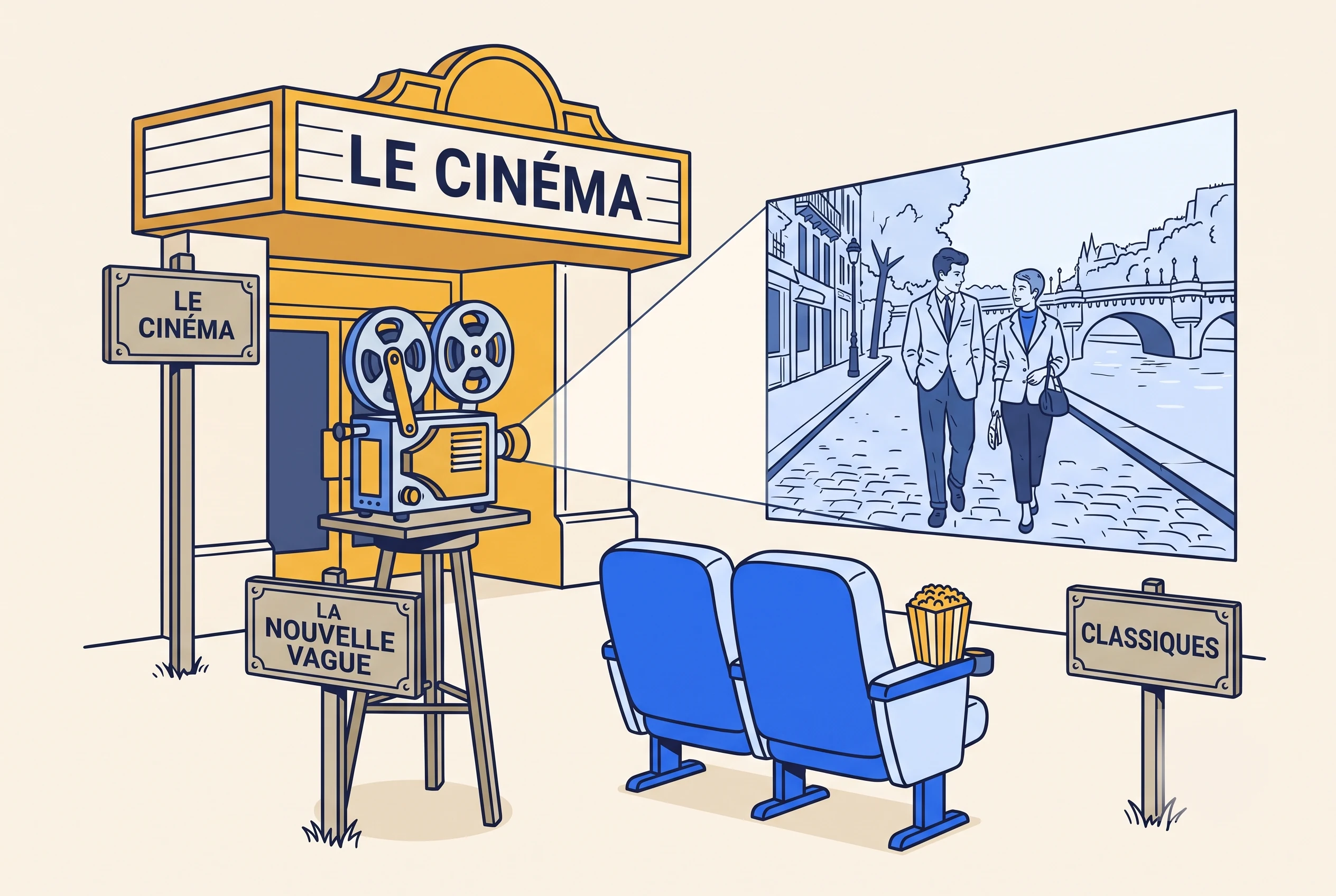
Older films expose you to different styles of dialogue and storytelling. Choose for interest as well as listening demands, then study a short scene rather than expecting to understand a whole film immediately.
- Netflix — series and films on Netflix US, ranked by level
- Canal+ prestige series — the demanding B2+ dramas
- Live TV & channels — how to watch French networks, including from abroad
- Amazon Prime films — French films to own and study
- Cinema classics — the historical canon every learner should know (you’re reading this)
Affiliate disclosure: As an Amazon Associate, FrenchToEnglish earns from qualifying purchases and Prime sign-ups. The Amazon and Prime Video links here are affiliate links — using them costs you nothing extra and helps keep these guides free.
Own these classics — or stream them free for 30 days
The films below reward rewatching. Own the ones you’ll study, and start a 30-day Prime Video trial to stream the rest tonight. New members only, cancel anytime.
The golden age: pre-Nouvelle Vague masterpieces (1937-1955)
Before the New Wave reinvented cinema, France had already produced some of the most important films in history. These films use literary French, measured dialogue, and theatrical precision that gives learners time to process every sentence. They are slower than modern films by design, which makes them paradoxically better for listening practice at B1-B2.
🎬 La Grande Illusion (1937) — Jean Renoir
Cast: Jean Gabin, Pierre Fresnay, Erich von Stroheim · Level: B1-B2 · Stream: Criterion Blu-ray on Amazon · Criterion Channel
World War I. French officers in a German prisoner-of-war camp. Renoir’s film is about class, nationality, and the death of the old European aristocratic order, but for learners it is about register. Pierre Fresnay speaks with the precise, elevated diction of the French officer class. Jean Gabin speaks with the naturalistic working-class French that would define French cinema for decades. The two registers coexist in every scene, and the contrast teaches you more about social French than any textbook chapter on formal versus informal. Renoir’s dialogue was written to be understood by international audiences in 1937, which means the pacing is generous by modern standards.
▶ Watch on Prime Video📀 Blu-ray▶ Watch the trailer
🎬 Les Enfants du paradis (1945) — Marcel Carné
Cast: Arletty, Jean-Louis Barrault, Pierre Brasseur · Level: B2-C1 · Stream: Criterion Blu-ray on Amazon · Criterion Channel
Often called the greatest French film ever made. Set in the theatrical world of 1840s Paris, it was filmed during the German Occupation with a script by the poet Jacques Prévert. The dialogue is literary, witty, and delivered with theatrical precision that makes every sentence quotable. Arletty’s famous line (“C’est tellement simple, l’amour”) became part of the French language itself. At three hours, it is a marathon, but the theatrical delivery gives B2 learners time to process complex sentence structures that would disappear at conversational speed. The film teaches the elevated register that French people call “la belle langue” and that still defines prestige French.
▶ Watch on Prime Video📀 Blu-ray▶ Watch the trailer
🎬 Les Diaboliques (1955) — Henri-Georges Clouzot
Cast: Simone Signoret, Véra Clouzot, Paul Meurisse · Level: B1 · Stream: Criterion Blu-ray on Amazon
A wife and her husband’s mistress conspire to murder him. The plot is Hitchcock-level suspense, but the dialogue is domestic French: arguments, plans, whispered conspiracies, and the polite surface hiding violent intentions. Clouzot’s dialogue is shorter and more naturalistic than Carné’s. If Les Enfants du paradis teaches you literary French, Les Diaboliques teaches you the French of people who are lying to each other, which is arguably more useful in daily life.
▶ Watch on Prime Video📀 Blu-ray▶ Watch the trailer
La Nouvelle Vague: the revolution that still sounds like Paris (1959-1967)
The New Wave directors filmed on real Paris streets with handheld cameras and natural sound. The dialogue sounds improvised because much of it was. Incomplete sentences, interruptions, overlapping speech. This is the most authentic French listening material ever recorded, and it sounds more like modern Paris conversation than anything filmed before or since. The Cahiers du Cinéma critics (Truffaut, Godard, Chabrol, Rohmer, Rivette) and the Left Bank group (Varda, Resnais, Demy, Marker) created films that feel like eavesdropping on real people. For learners, that is exactly the point.
🎬 Les Quatre Cents Coups (The 400 Blows) (1959) — François Truffaut
Cast: Jean-Pierre Léaud · Level: A2-B1 · Stream: Criterion Channel · Prime Video · Criterion Blu-ray on Amazon
The film that started the French New Wave and possibly the greatest French film ever made. Antoine Doinel, a twelve-year-old in 1950s Paris, rebels against school, parents, and a society that has no space for him. Jean-Pierre Léaud’s performance is so natural it barely looks like acting. The dialogue is schoolyard French, family arguments, street slang, and the stammering self-defense of a child who knows he is losing. Every sentence is short. Every emotion is visible. The final shot, Antoine running toward the sea, is one of the most famous images in cinema. For A2 learners, the film is accessible because the vocabulary is concrete and the situations are universal: school, punishment, escape. Truffaut would make four more films following Antoine Doinel into adulthood, creating the longest autobiographical series in cinema history.
▶ Watch on Prime Video📀 Blu-ray▶ Watch the trailer
🎬 À bout de souffle (Breathless) (1960) — Jean-Luc Godard
Cast: Jean-Paul Belmondo, Jean Seberg · Level: B1-B2 · Stream: Criterion Channel · Prime Video · Criterion Blu-ray on Amazon
A small-time criminal steals a car, shoots a policeman, and hides out with an American journalist in Paris. Godard filmed with a handheld camera by Raoul Coutard on real streets with natural sound, invented the jump cut, and broke every rule of film grammar in 90 minutes. Belmondo’s speech is pure informal Parisian: clipped, rhythmic, full of the philosophical throwaway lines that define French cool. Jean Seberg speaks French with an American accent, which gives learners a mirror. The film that proved cinema could be remade from scratch with a camera, a car, and two actors who looked like they were making it up as they went. Richard Linklater’s 2025 film “Nouvelle Vague” dramatizes the making of Breathless, bringing the story full circle.
▶ Watch on Prime Video📀 Blu-ray▶ Watch the trailer
🎬 Jules et Jim (1962) — François Truffaut
Cast: Jeanne Moreau, Oskar Werner, Henri Serre · Level: B1-B2 · Stream: Criterion Channel · Criterion Blu-ray on Amazon
Two friends, one French and one Austrian, fall in love with the same woman across decades. Jeanne Moreau’s Catherine is the most magnetic character in French cinema: unpredictable, joyful, destructive, free. The dialogue is literary but spoken naturally, and the narration by Michel Subor is some of the most beautiful French prose ever recorded on film. The film teaches the passé simple in natural context (the literary past tense that textbooks teach but no one speaks) and the vocabulary of love, friendship, and time passing. If you can follow the narration without subtitles, your French comprehension is at B2+.
▶ Watch on Prime Video📀 Blu-ray▶ Watch the trailer
🎬 Cléo de 5 à 7 (1962) — Agnès Varda
Cast: Corinne Marchand · Level: B1 · Stream: Criterion Channel · Criterion Blu-ray on Amazon
A Parisian singer waits two hours for medical test results that will tell her if she has cancer. The film unfolds in near-real-time, following Cléo through the streets of Paris as she confronts mortality. Varda’s dialogue is sparse, intimate, and honest. The film teaches everyday Parisian French in real locations: cafés, taxis, parks, shops. The vocabulary is contemporary and practical. Varda was the grande dame of the New Wave, and this is her masterpiece: a stripped-down portrait of one woman thinking about her life in the most ordinary and extraordinary circumstances simultaneously.
▶ Watch on Prime Video📀 Blu-ray▶ Watch the trailer
Post-New Wave auteurs: the genre masters (1967-1999)
🎬 Le Samouraï (1967) — Jean-Pierre Melville
Cast: Alain Delon · Level: B1 · Stream: Criterion Channel · Criterion Blu-ray on Amazon
A hitman in a trench coat and fedora moves through Paris with glacial precision. Alain Delon speaks perhaps 50 words in the entire film. The silence is the point. What little dialogue exists is measured, compressed, and loaded with meaning. For learners, this is an exercise in understanding French through context, body language, and minimal verbal cues. Melville, considered the godfather of the New Wave, proved that French cinema could be as cool as American noir while remaining utterly French.
▶ Watch on Prime Video📀 Blu-ray▶ Watch the trailer
🎬 Le Dernier Métro (1980) — François Truffaut
Cast: Catherine Deneuve, Gérard Depardieu · Level: B1-B2 · Stream: Criterion Blu-ray on Amazon
Occupied Paris, 1942. A Jewish theater director hides in the basement of his own theater while his wife runs the company above. Truffaut’s late masterpiece combines wartime tension with theatrical vocabulary and the formal French of the stage. Catherine Deneuve’s diction is pristine. The film teaches the register of performance, rehearsal, criticism, and the coded language people use when they cannot say what they mean because someone dangerous is listening. The Fifth Republic guide traces what happened to French politics after the parliament of this period folded under pressure.
▶ Watch on Prime Video📀 Blu-ray▶ Watch the trailer
🎬 Le Dîner de Cons (1998) — Francis Veber
Cast: Thierry Lhermitte, Jacques Villeret · Level: A2-B1 · Stream: check JustWatch · DVD on Amazon
A group of Parisian snobs invite “idiots” to dinner for entertainment. The chosen idiot turns out to be more resourceful than anyone expected. The entire film is rapid-fire dialogue: short sentences, quick comebacks, misunderstandings that compound into chaos. The humor depends on wordplay and social codes, which forces you to listen at vocabulary level rather than plot level. This is the French comedy that every French person over thirty has seen, and quoting it in conversation signals cultural literacy immediately. The film plays Parisian hierarchy as blood sport at a private dinner; a café runs the same hierarchy in daylight at the next table, and the rules there are written down: where to sit, what to order at which hour.
▶ Watch on Prime Video📀 Blu-ray▶ Watch the trailer
Modern classics: contemporary French cinema (1995-2024)
🎬 La Haine (1995) — Mathieu Kassovitz
Cast: Vincent Cassel, Hubert Koundé, Saïd Taghmaoui · Level: B2-C1 · Stream: Criterion Channel · Criterion Blu-ray on Amazon
24 hours in a Paris banlieue after a police shooting. Three young men (Jewish, Black, North African) move between the cité and central Paris. In black and white. In verlan, slang, and compressed informal French at a speed that tests even strong B2 listeners. Vincent Cassel’s opening monologue is one of the most quoted passages in French cinema. The film teaches banlieue vocabulary, class markers in speech, and the register contrast between suburban and central Paris that defines modern French social dynamics. Nobody follows this one at full speed on a first pass, which is an argument for owning it rather than renting a 48-hour window: the Prime write-up lists where to buy it alongside the rest of the French catalogue.
▶ Watch on Prime Video📀 Blu-ray▶ Watch the trailer
🎬 Amélie (2001) — Jean-Pierre Jeunet
Cast: Audrey Tautou, Mathieu Kassovitz · Level: A2 · Stream: frequently on Prime Video · Blu-ray on Amazon
Amélie Poulain, a shy Parisian waitress, improves the lives of strangers through anonymous schemes. The narrator speaks slowly, precisely, and descriptively. Audrey Tautou’s diction is unusually crisp. Paris neighbourhood vocabulary (Montmartre, Abbesses, Canal Saint-Martin) saturates every scene, and the hill under all of it is a walk we mapped stop by stop, with the words each stop asks for. The first French film for millions of learners worldwide, and still arguably the best entry point for pure beginners.
▶ Watch on Prime Video📀 Blu-ray▶ Watch the trailer
🎬 Intouchables (2011) — Nakache & Toledano
Cast: François Cluzet, Omar Sy · Level: A2-B1 · Stream: frequently on Prime Video (free with ads) · Blu-ray on Amazon
The highest-grossing French-language film of all time. Two registers coexist in every scene: Philippe’s educated bourgeois French and Driss’s banlieue informal. That contrast is itself a French lesson. Start with this one if La Haine defeated you; the Amazon Prime page takes it apart.
▶ Watch on Prime Video📀 Blu-ray▶ Watch the trailer
🎬 Anatomie d’une chute (2023) — Justine Triet
Cast: Sandra Hüller, Swann Arlaud · Level: B2 · Palme d’Or 2023 · Stream: check JustWatch · Blu-ray on Amazon
A woman is suspected of killing her husband. The trial dissects their marriage. The film switches between French and English, giving learners a bilingual anchor. Courtroom vocabulary, argument structure, code-switching under institutional pressure. The most important French film of the 2020s.
▶ Watch on Prime Video📀 Blu-ray▶ Watch the trailer
The study method: how to extract French from any film
Two methods already exist elsewhere on this site and they pull in opposite directions: the four-stage subtitle drill is slow, deliberate, one film at a time, while the ten-minute Netflix routine is built for daily volume. Classics want the slow one. One film three times beats ten films once, because the dialogue is denser, the register is more varied, and the cultural references compound with each viewing.
- 1First viewing: English subtitles, full film Understand the plot. Get the emotional shape. Do not study.
- 2Second viewing: French subtitles, selected scenes Pick 3-4 scenes. Extract 10 phrases. Write them down. The pronunciation guide gives you the phonetic framework for shadowing.
- 3Third viewing: no subtitles, full film You know the plot. Now listen for the French. The gap between first and third viewing measures your actual progress.
Where to find classic French films
Criterion Channel has the deepest classic French catalogue: Truffaut, Godard, Varda, Melville, Renoir, Carné. Amazon Prime has Intouchables, Breathless, and rotating titles. Arte.tv streams classic French cinema free worldwide. JustWatch shows current availability for every title by country. Owning the Blu-ray via Amazon eliminates the rotation problem entirely.
French cinema is not a genre. It is a tradition that spans from Renoir’s pre-war humanism through the New Wave’s revolution to Triet’s courtroom dissection of modern marriage. Readers tell us the same thing most weeks: the two-hour block is the first thing a busy week takes away. What survives it is time you already spend: Canal+ dramas tagged with the level each one demands, podcasts ranked by difficulty, twelve artists sorted from clear diction to full speed. The ear stays calibrated on ordinary days.
One film three times beats ten films once: the plot on the first pass, ten phrases pulled from three or four scenes on the second, no subtitles on the third. The distance between the first viewing and the third is the only measure of progress here that does not lie. Renoir in 1937, Triet in 2023: eighty-six years, and the method does not change.
Start watching French cinema on Prime Video
New members stream the French catalogue free for 30 days — cancel anytime. The cheapest way to test everything above tonight.
Prefer to keep it free today? Read the French Briefing →
The French Gamebook
Enjoy the French. Practise the tricky bits.
For English speakers practising French
After a film, a book or a cultural detour, spend a session on the mistakes you keep noticing. Choose a Gamebook lesson and check your answers as you go.
- 21 lessons with explanations
- 40 practice rounds · 2,000 questions
300 pages · Play on your computer or print
Get the Gamebook · $9 Read a preview before you buyOne payment · Instant PDF download
Try the French with someone who can reply.
Bring a sentence you found difficult. Ask a tutor to help you say it naturally, then try it in a short conversation.
Find a French tutor →Paid lessons. Compare tutors and prices before booking.
Affiliate link: we may earn a commission when you book.
📚 Keep building in the Learning Center
French Instagram Captions: Meanings and Pronunciation
Find French Instagram captions for travel, food, love and everyday moments. Check their meaning, tone and pronunciation before…
Read →French News for Beginners: Sources by Difficulty
Find French news sources suited to your reading and listening skills. Compare learner resources, authentic news and a…
Read →French Podcasts on Spotify: Choose by Topic and Level
Explore French podcasts on Spotify by topic and listening difficulty. Find a manageable starting point and practise with…
Read →