
Updated on September 15, 2026
Agree and Disagree in French: D’accord and Alternatives
Compare ways to agree and disagree in French, and understand why être d’accord differs from English agree. Read translated examples in context.
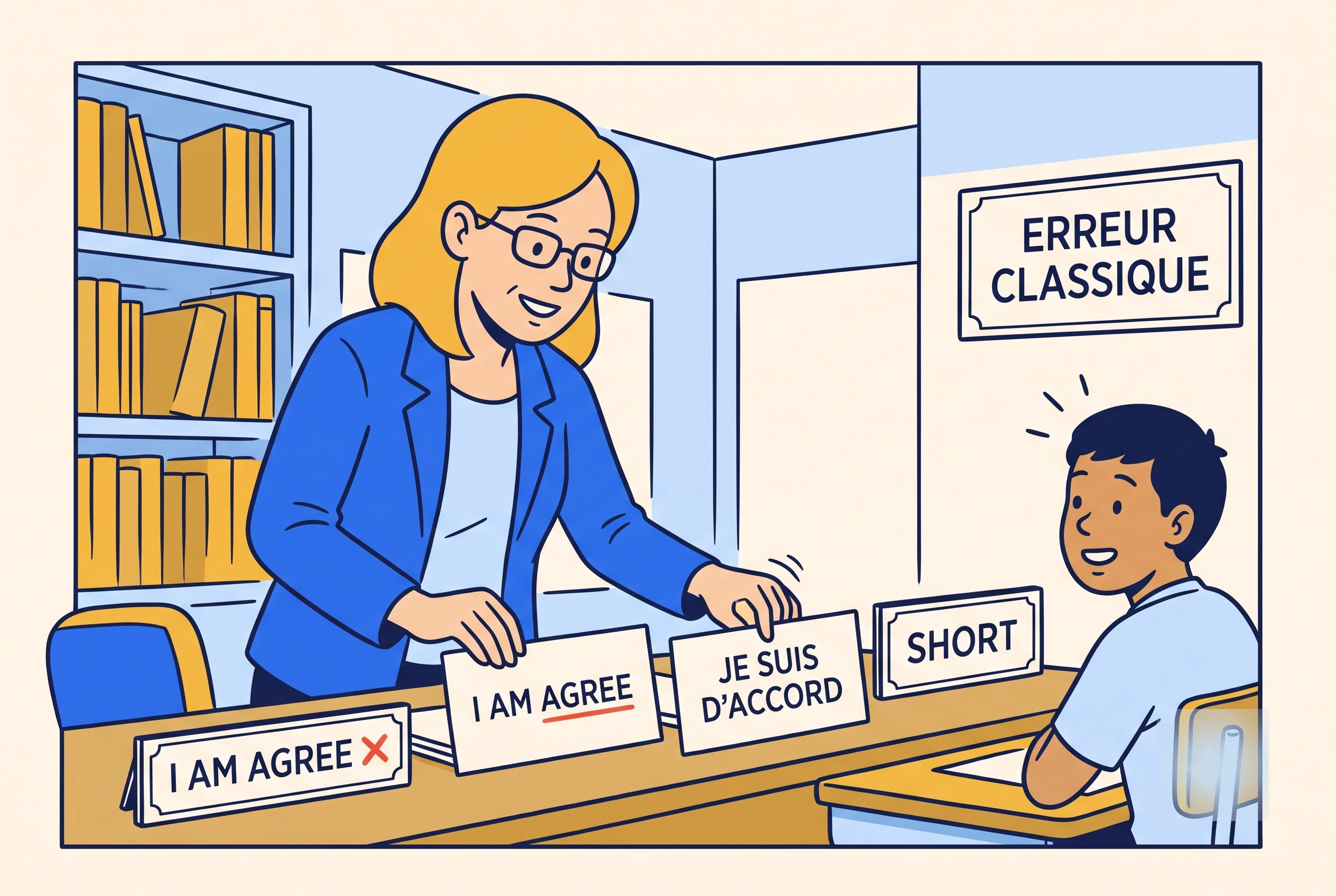
Agreement is not a word-for-word translation exercise. Start with the basic construction, then compare how to express partial agreement, a reservation or disagreement while making your position clear.
The root cause: French “être d’accord” vs English “agree”
French treats agreement as a state of being. English treats it as an action. That single structural difference explains the error and every error like it. In French, d’accord is not a verb. It is a prepositional phrase meaning “of accord.” It requires être (to be) the way “happy” requires “to be” in English. In English, “agree” is a standalone verb that needs no auxiliary. The collision between these two systems produces “I am agree” every time a French speaker’s first-language wiring fires before their English can override it.
The error persists even at advanced levels because it involves deep structural wiring, not surface vocabulary. French speakers know intellectually that “I agree” is correct. In spontaneous speech, the French pattern activates before conscious monitoring can intervene. Correcting someone does not fix it. Understanding the mechanism does. The same pattern shows up across dozens of other structures, which is why the common mistakes guide keeps coming back to this family of errors.
The “être” reflex: every place French speakers over-insert “to be”
French uses être far more broadly than English uses “to be.” The reflex to insert “am/is/are” transfers to English in predictable patterns. Once you see the list, you understand it is one error with many faces. Grammar is only half the collision; the other half is the word that exists in both languages and quietly means something else in each. What follows is the structural half.
The être/avoir swap on age and sensations
French uses avoir (to have) where English uses “to be” for age and physical sensations. The interference runs in both directions: French speakers say “I have 30 years” in English, English speakers say je suis 30 ans in French. Neither is a vocabulary mistake. Both are structural misfires.
The article reflex
French requires le/la/les before generic nouns. English drops the article. The reflex to include it is so deep that even C1 French speakers maintain it in English. This error is less dramatic than “I am agree” but more persistent and harder to eliminate because it does not sound obviously wrong to the speaker.
The false friend that causes real embarrassment
Reach for the obvious cognate here and the room hears something you never meant to say:
The continuous tense blind spot
French has no continuous form. Je mange does the work of both “I eat” (habitual) and “I am eating” (right now). French speakers skip the continuous in English because it does not exist in their system. It never fires automatically. It has to be consciously inserted every time, which is why it fails under pressure. So how does French mark an action still running when something interrupted it? Not with an auxiliary but with a tense choice, and the timeline method sorts that choice out.
The verb test. When tempted to say “I am [X],” ask: is X a verb or an adjective? “I am happy” (adjective → needs “to be”). “I agree” (verb → no “to be”). If X is a verb in English, drop the “am.” Always.
Get être, avoir, aller and faire right
Every mistake on this page traces back to how French leans on être and avoir. Get those two automatic in the present tense, along with aller and faire, and the interference stops firing before it reaches your mouth. Enter your email and the free Present Tense, Essential Verbs sheet, all four verbs conjugated on one page, downloads right away.
The reverse: errors English speakers make in French
English speakers learning French make the exact opposite mistakes. Where French speakers over-insert “to be” in English, English speakers under-use être and avoir in French. The interference runs both ways, and understanding one direction automatically explains the other. The think in French guide addresses the deeper habit: the reflex to translate through English instead of processing French directly.
The same English reflex is at work, except the slip here is a missing word rather than a wrong verb.
The symmetry that teaches both languages
Every interference error French speakers make in English reveals a structure English speakers get wrong in French. “I am agree” teaches you je suis d’accord. “I have 30 years” teaches you j’ai 30 ans. Understanding the interference in one direction automatically explains the other. One mechanism, two languages, mirror-image errors.
How to actually fix structural interference
Knowing the rule is not enough. The error persists because the wrong pattern is wired deeper than the correction. The fix requires building a competing reflex that fires faster than the interference. Three methods work. Everything else is just knowing the answer without being able to produce it under pressure.
- 1Paired sentence drilling For each interference pair, learn one correct sentence in each language. Je suis d’accord + “I agree.” J’ai 30 ans + “I am 30.” J’ai froid + “I am cold.” Paired sentences rewire the reflex faster than rules.
- 2Third-person testing “She is agree” sounds obviously wrong. “I am agree” sounds less wrong to the speaker because first person is automatic. Test every structure in third person first. If “she is agree” fails your ear test, “I am agree” should fail too.
- 3Context repetition, not isolated correction Hearing the correct pattern in real situations prevents fossilization better than memorizing rules. The 15-minute routine builds this kind of repetition into daily life without requiring a class.
The deeper lesson
Languages do not just label the same reality with different words. They structure reality differently. French treats agreement as a state (être d’accord). English treats it as an action (“agree”). French treats age as a possession (avoir 30 ans). English treats it as a state (“be 30”). Neither is more logical. They are different systems for organizing the same human experience. Once you see that, interference stops feeling like mistakes and starts feeling like evidence of how language actually works.
How to agree and disagree in real French: 12 expressions
The textbook teaches je suis d’accord. Real French uses shorter forms most of the time. The gap between knowing the full phrase and knowing when to shorten it is the gap between textbook French and the register you hear on a café terrace or in a work meeting.
Dinner, a political turn in the conversation, and everyone at the table waiting to hear where you stand.
Study glossary: grammar interference vocabulary
| 🇫🇷 French | 🇺🇸 English | 💡 Context |
|---|---|---|
| Être d’accord | To agree | State of being, not action |
| Avoir (âge, sensations) | To have (age, sensations) | J’ai 30 ans, j’ai froid, j’ai faim |
| Interférence linguistique | Language interference | L1 patterns affecting L2 production |
| Transfert négatif | Negative transfer | When L1 rules produce L2 errors |
| Erreur fossilisée | Fossilized error | Permanent, resistant to correction |
| Verbe auxiliaire / principal | Auxiliary / main verb | “Être” = auxiliary. “Agree” = main verb. |
| Aspect continu | Continuous aspect | “I am eating” — does not exist in French |
| Faux ami | False friend | Words that look similar but mean different things |
| Analyse contrastive | Contrastive analysis | Comparing two language structures systematically |
The lexical version of the collision is the faster one to fix: the list of words that look English and are not reads in one sitting, while what Google Translate does with the same collisions shows the reflex running at industrial scale. Read the list tonight. The machine can wait for the day you stop trusting it.
Test it in the third person. “She is agree” fails your ear immediately; “I am agree” does not, because first person runs on autopilot. That gap is the whole error, and it closes one paired sentence at a time: je suis d’accord next to I agree, j’ai 30 ans next to I am thirty, until the wrong one stops arriving first.
Prefer to keep it free today? Read the French Briefing →
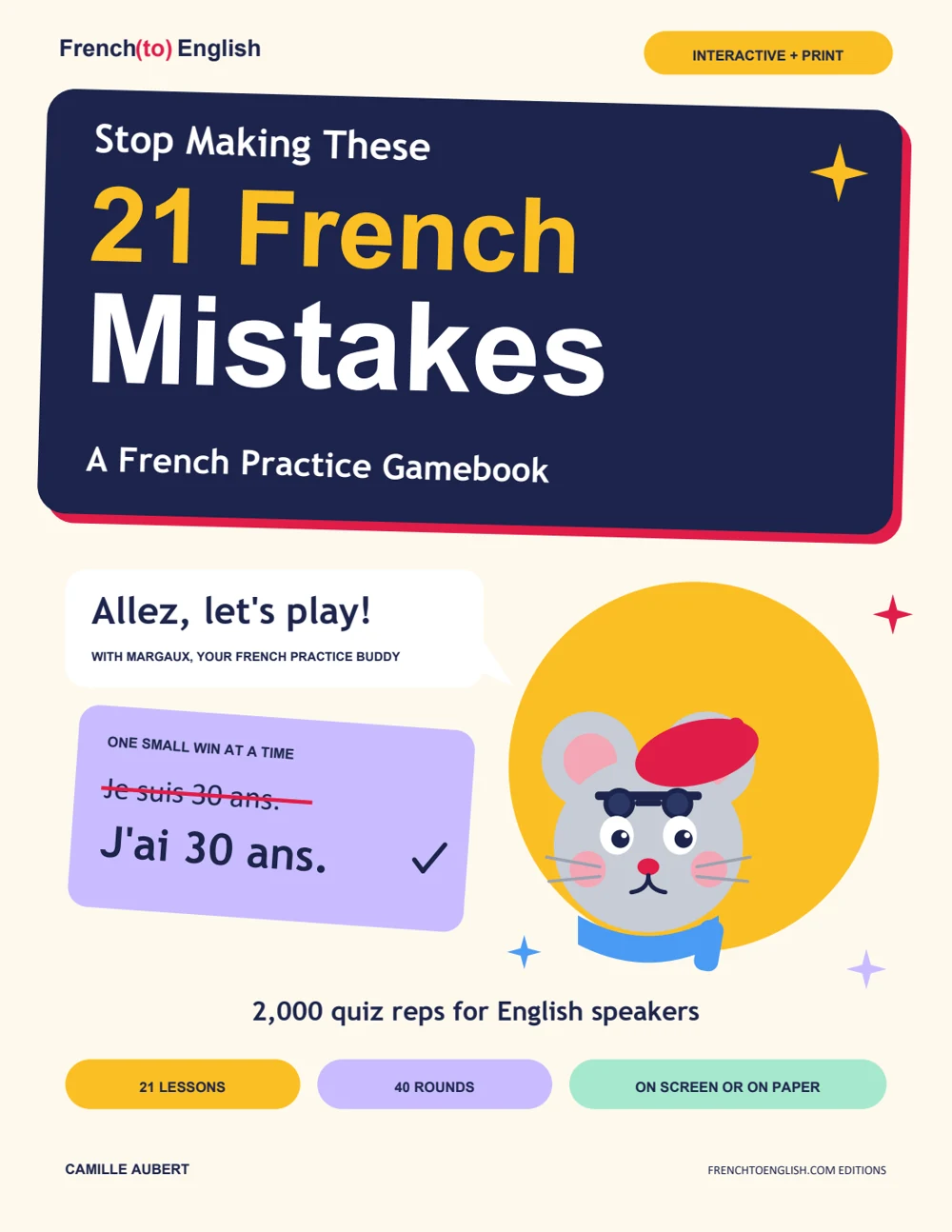
The French Gamebook
Catch the French mistakes you keep making.
For English speakers practising French
Work through a short lesson, choose your answers and check the explanations. Use a practice round to see which basics need another try.
- 21 lessons with explanations
- 40 practice rounds · 2,000 questions
300 pages · Play on your computer or print
Get the Gamebook · $9 Read a preview before you buyOne payment · Instant PDF download
Try the French with someone who can reply.
Bring a sentence you found difficult. Ask a tutor to help you say it naturally, then try it in a short conversation.
Find a French tutor →Paid lessons. Compare tutors and prices before booking.
Affiliate link: we may earn a commission when you book.
📚 Keep building in the Learning Center
French Reflexive Verbs: Daily Routine and Word Order
Build a daily routine in French with reflexive pronouns, negatives and infinitives. Compare translated examples, listen and practise.
Read →Futur Proche vs Futur Simple: Examples and Practice
Compare futur proche and futur simple in French plans, promises and announcements. Learn the forms and practise choosing…
Read →French Words with No Exact English Equivalent: 20 Examples
Explore 20 French words without a single exact English equivalent. Compare meanings, situations and translated examples to choose…
Read →