French Fifth Republic explained — how political power works in France

French Fifth Republic: How Political Power Works in France (and Why English Speakers Lose the Thread)

French political news stops making sense the moment you assign power to the wrong institution. This guide maps the Fifth Republic’s architecture, compares it to the US, UK, and previous French republics, and gives you the vocabulary to follow the 2027 election without mentally converting everything into a system that does not apply.

French Fifth Republic political power and government system
The Fifth Republic, clearer once you stop reading it like Washington or Westminster.

From the First Republic to the Fifth: why France kept rewriting the rules

France has had five republics, two empires, a restoration monarchy, and a wartime puppet state. No other major Western democracy rewrote its constitution this often. That is not chaos. It is a country that kept discovering that the previous system could not absorb the next crisis. Each republic died from a specific structural failure. Understanding those failures is the fastest way to understand why the Fifth Republic works the way it does.

First Republic (1792-1804): revolution without stability

Born from the Revolution, the First Republic never stabilized. It produced the Terror, the Directory, and eventually Napoleon’s coup. The lesson France took from it: revolutionary legitimacy alone cannot build durable institutions. The republic lasted twelve years and ended in an empire. The vocabulary of French civic life (citoyen, liberté, égalité, fraternité, la République) was forged here, but the institutional design was not durable enough to carry it.

Second Republic (1848-1852): a president who became emperor

The Second Republic introduced direct presidential election. Louis-Napoléon Bonaparte won, then used the presidency to destroy the republic and declare himself Emperor Napoleon III. The lesson: a directly elected president with insufficient institutional checks can use democratic legitimacy to dismantle democracy. This explains why the Third and Fourth Republics were so suspicious of executive power, and why the Fifth Republic designed elaborate constraints around the presidency even while making it powerful.

Third Republic (1870-1940): parliament as absolute sovereign

The Third Republic lasted 70 years, longer than any other French regime since the Revolution. It survived WWI. But its design was deeply parliamentary: the President was ceremonial, the Prime Minister (président du Conseil) governed only as long as shifting coalitions allowed, and cabinets fell constantly. Governments averaged about eight months. That instability was tolerable in peacetime. It was catastrophic in 1940. The Third Republic voted itself out of existence and handed power to Pétain. The lesson: pure parliamentary sovereignty without a strong executive is vulnerable to crisis paralysis.

Fourth Republic (1946-1958): the same problem, amplified

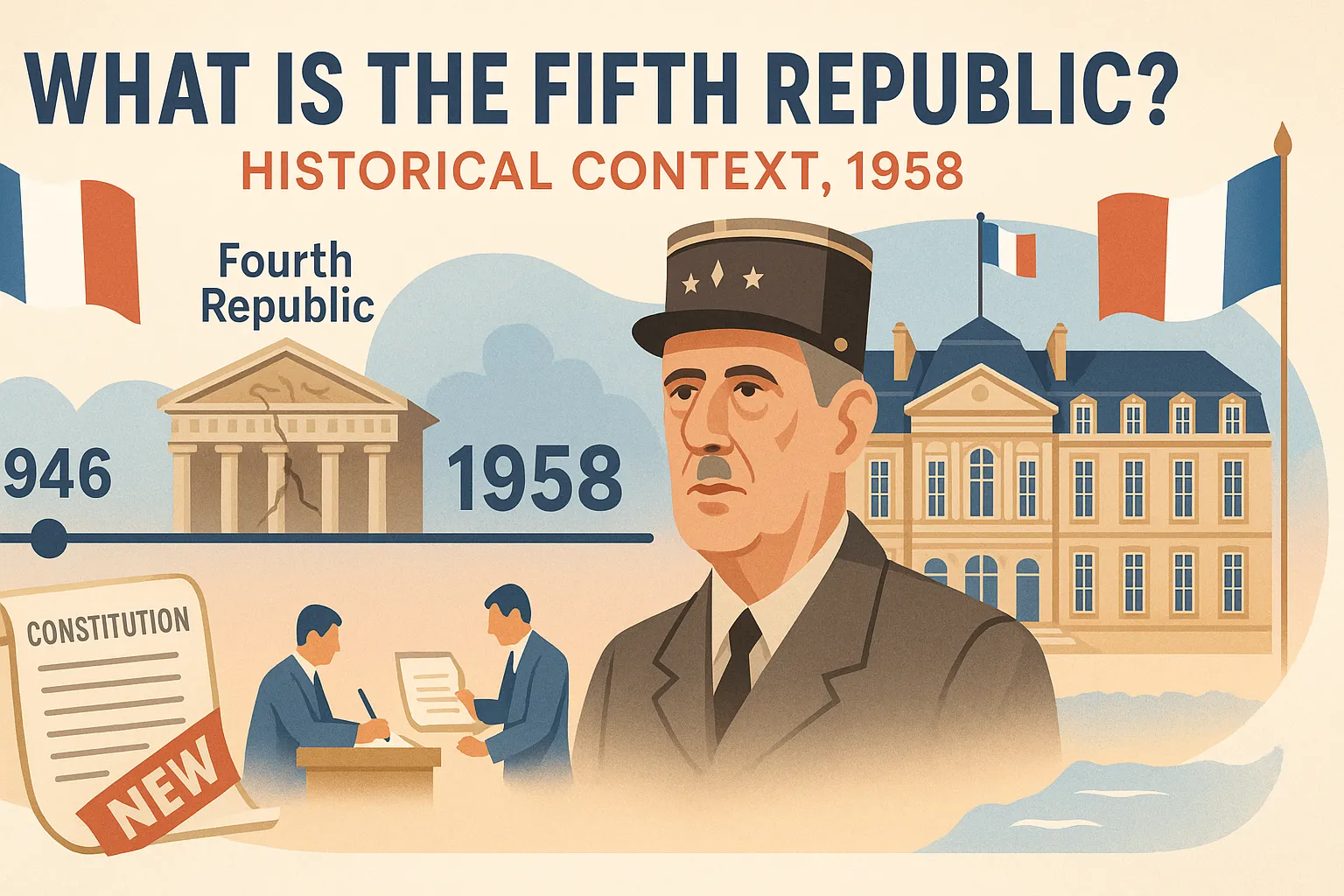
The Fourth Republic rebuilt after WWII with almost the same parliamentary design. Coalition governments fell even faster. The Algerian War broke the system. In 1958, France recalled de Gaulle, who demanded and received permission to write a new constitution. That constitution became the Fifth Republic. The lesson was finally absorbed: France needed a strong, directly elected president who could act during crisis, combined with a government still accountable to parliament. The hybrid design is the point.

🇫🇷 La Cinquième République a été conçue pour stabiliser l’exécutif. 🇺🇸 The Fifth Republic was designed to stabilize the executive. — Not democratic theatre. Stabilization. One sentence explains the entire architecture.

Why this history matters for reading French news

When a French article mentions dissolution, motion de censure, or article 49.3, it is referencing tools that exist precisely because previous republics did not have them and collapsed. The vocabulary is constitutional memory, not decoration.

You’re learning the system behind French news. Good timing.
The Briefing covers real French politics weekly. Same institutions, same vocabulary, same register. Quiz included.
📰 Read The French Briefing
Free. No account.

How political power really works in the Fifth Republic

The President is elected directly by voters for five years. The Prime Minister is appointed by the President but only governs if the government can survive in the National Assembly. Who runs France? The President sets direction: diplomacy, defense, arbitration, strategic timing. The Prime Minister handles machinery: parliamentary management, ministers, domestic execution. Same executive branch. Different pressure points.

When presidential and parliamentary majorities align, the system looks almost presidential. The President dominates, ministers follow line, the Prime Minister acts as chief operator. When they do not align, the same institutions produce cohabitation: slower, more negotiated, less photogenic. Much more French.

President

Elected directly. Strategic direction, foreign affairs, defense, appointments, dissolution power. Sets the frame and tempo of national politics.

Prime Minister

Appointed, survives via Assembly. Coordinates ministers, manages parliament, carries domestic policy. Turns constitutional authority into daily governing capacity.

🇫🇷 Le gouvernement est responsable devant l’Assemblée nationale. 🇺🇸 The government is accountable to the National Assembly. — The President appoints. The Assembly can still break the government. That is the dual key.

Where Parliament still matters

The National Assembly is the politically decisive chamber: it votes laws, questions ministers, and can topple the government through a motion de censure. The Senate revises, delays, and carries constitutional weight. If you remember one thing: the Assembly decides political survival.

InstitutionMain leverageWhat it changes
National AssemblyVotes, censure, final legitimacyWhether a government can continue governing
SenateRevision, delay, constitutional weightShape and pace of legislation
Constitutional CouncilReviews constitutionality post-voteCan strike down laws after parliament finishes

49.3 does not mean parliament disappeared. It means the government used a constitutional shortcut that still leaves room for a censure vote. If an article mentions 49.3, keep reading. The political story is not over.

France vs USA vs UK: why the mental translation always fails

This is where most English speakers go wrong. They read French politics through the lens of the system they already know, and every institution comes out slightly distorted. The Fifth Republic is neither presidential like the US nor parliamentary like the UK. It is a hybrid that borrows from both and obeys neither. Here is why each comparison breaks.

France vs USA: the president is not what you think

American readers assume the French President works like the US President. Similar title, completely different job. The US President is head of state and head of government: they run the cabinet, set the legislative agenda, and take personal responsibility for domestic policy. The French President is head of state but does not directly run the government. That is the Prime Minister’s job. The French President arbitrates, directs foreign policy, commands the military, and can dissolve the Assembly. But domestic governance passes through the Prime Minister and the cabinet, who must survive parliamentary confidence.

The biggest difference: the US President cannot dissolve Congress. The French President can dissolve the National Assembly and call new elections. The US President faces impeachment (political trial). The French President faces cohabitation (forced power-sharing). These are structurally different consequences of losing political support.

🇺🇸 US President

Head of state + head of government. Runs the cabinet directly. Cannot dissolve Congress. Fixed 4-year term. Congress cannot topple the executive (except impeachment). Separation of powers is absolute.

🇫🇷 French President

Head of state only. Appoints PM who runs the cabinet. Can dissolve the Assembly. 5-year term. Assembly can topple the government (censure). Separation of powers is flexible, depends on majority alignment.

France vs UK: the prime minister is not what you think either

British readers assume the French Prime Minister works like the UK PM. Also wrong. The UK Prime Minister is the dominant political figure: they lead the majority party, control the legislative agenda, and the monarch is ceremonial. In France, the Prime Minister is politically subordinate to the President when majorities align. The PM becomes powerful only when cohabitation forces a split. There is no French equivalent of the UK monarch: the French President is a politically active head of state, not a ceremonial one.

The UK has no written constitution. France has one of the most detailed constitutions in Europe. The UK has parliamentary sovereignty: Parliament can do almost anything. France has constitutional review: the Constitutional Council can strike down laws that violate the constitution. The UK has no second round of elections. France has two rounds for both presidential and legislative elections, which completely changes coalition dynamics.

🇬🇧 UK Prime Minister

Head of government, leader of majority party. Dominant political figure. Monarch is ceremonial. No written constitution. First-past-the-post elections. Parliament is sovereign.

🇫🇷 French Prime Minister

Head of government, appointed by President. Subordinate to President when majorities align. Powerful during cohabitation. Written constitution. Two-round elections. Constitutional Council can override parliament.

🇫🇷 Le système français n’est ni présidentiel ni parlementaire. Il est semi-présidentiel. 🇺🇸 The French system is neither presidential nor parliamentary. It is semi-presidential. — This one sentence prevents 80% of misreadings.

Why the comparison matters for reading French news

When a French article says the Prime Minister “directs government action,” an American reader thinks “so the PM is the real boss” (wrong: the President dominates when majorities align). When a British reader sees the President dissolving the Assembly, they think “constitutional crisis” (wrong: it is a normal constitutional tool used multiple times). The elections vocabulary guide gives you the terms. This section gives you the map that makes those terms click.

Why the two-round election changes everything

French presidential elections use two rounds. First round: preference. Second round: coalition. The first round lets voters signal identity, ideology, irritation. The second round forces aggregation: you vote for what you can live with. The language of campaigns changes with it. Hard lines in round one become strategic positioning in round two. The 2027 presidential election will put this system on full display, and the vocabulary guide covers every term you will need.

🇫🇷 Le premier tour exprime une préférence. Le second tour impose un choix. 🇺🇸 The first round expresses a preference. The second round forces a choice. — Two different reflexes. Two different results. Reading only first-round numbers is how foreign commentary gets French elections wrong.

Fast reading rule. If a French political article mentions alliances, withdrawals, or vote transfers (report de voix), you are already in second-round logic even before the ballot happens.

Cohabitation: when power splits

Cohabitation is the moment foreign readers finally see the architecture. The President stays President, but domestic authority shifts toward a Prime Minister backed by an opposing parliamentary majority. The President retains diplomacy and defense. The PM carries domestic policy. France designed a system that absorbs rivalry without rewriting the constitution. The US cannot produce cohabitation (President and Congress are separate branches). The UK cannot produce cohabitation (the PM is the majority leader). Only France’s hybrid model creates this specific dynamic.

🇫🇷 La cohabitation modifie l’équilibre sans changer la Constitution. 🇺🇸 Cohabitation changes the balance without changing the Constitution.

What this means for reading French politics

You do not need a political science degree. Start with four questions: Who has electoral legitimacy? Who has parliamentary backing? Which procedure is being used? Is the legal story finished? Once those become automatic, articles slow down. Source selection matters: the news websites with political leanings mapped helps you choose. For easier entry, the beginner news sources lets you build up gradually. And Baron Noir dramatizes everything this article explains in 24 episodes of prestige television. The radio debates guide trains you for the oral version.

Study glossary: French political institutions

FrenchEnglishContext
La Cinquième RépubliqueThe Fifth RepublicCurrent regime since 1958
Le Président de la RépubliqueThe PresidentHead of state, strategic and constitutional powers
Le Premier ministreThe Prime MinisterHead of government operations
L’Assemblée nationale / le SénatNational Assembly / SenateLower chamber (decisive) / upper chamber (revision)
La motion de censureNo confidence motionCan bring down the government
La dissolutionDissolutionPresident dissolves Assembly, calls elections
La cohabitationCohabitationPresident and majority from opposing camps
Le projet / la proposition de loiGovernment bill / private member billTwo origins of legislation
Le Conseil constitutionnelConstitutional CouncilReviews constitutionality of laws
Le Conseil d’ÉtatCouncil of StateSupreme administrative court
Le report de voixVote transfer (2nd round)How first-round votes shift in the runoff
Le scrutin uninominal à deux toursTwo-round majority votingThe election system for president and deputies

That is the map. The next level is speed: processing it live. “For sure.” 🕶️

$19/mo

Less than one coffee a week.

French politics makes sense weekly, not once. The Pass gives you weekly audio on real situations, institutions, and the register that makes news readable.

✓ WEEKLY AUDIO✓ CEFR TRACKING✓ FULL ARCHIVES
📈 GET THE PASS · $19/MO
Zero contract. Liquidate in 2 clicks.
100% Free. Zero friction.

French TV channels guide — main networks, TNT, and streaming access

French TV Channels, TNT, and Streaming: How to Watch From Anywhere in the World

France broadcasts about thirty free channels through TNT (digital terrestrial television) with no subscription required. This guide maps every major network with direct streaming links, explains what each one teaches a learner, and shows exactly how to watch from the US, UK, Canada, or anywhere else.

French TV channels TNT streaming guide with TF1 France 2 M6 Arte
Thirty free channels. Every one of them teaches French differently.

The TNT system: how French television works

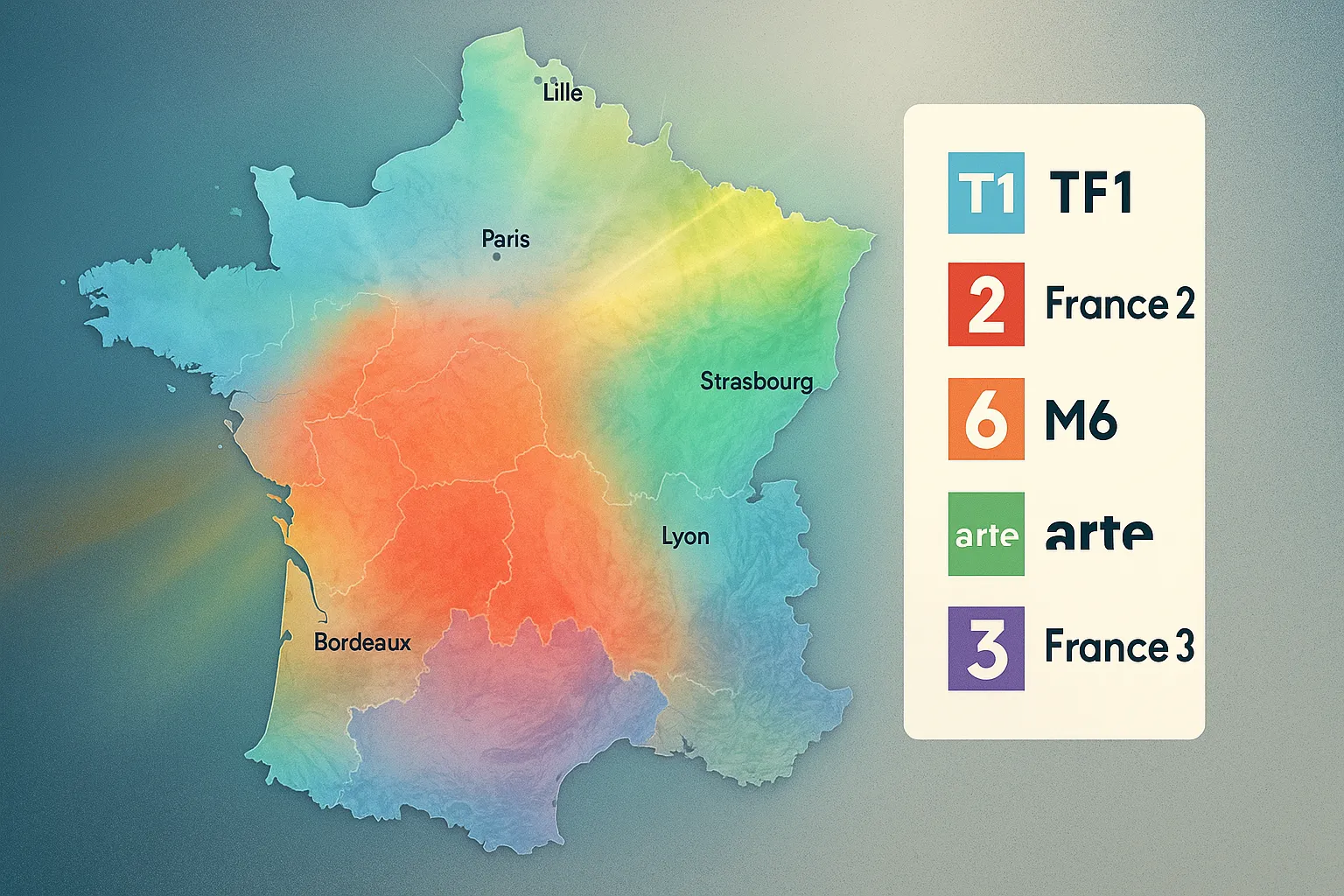
TNT replaced analog broadcasting in 2011. About thirty digital channels broadcast free-to-air through standard antennas. No subscription, no cable box. The system splits into public service broadcasters (government-funded + some advertising) and private commercial networks (advertising-only). Public channels emphasize culture, documentaries, and education alongside entertainment. Private channels chase mass-market audiences.

For learners, the value is different from streaming. Netflix lets you choose what to watch. French TV chooses for you. That randomness is pedagogically powerful: news you would not seek, game shows that teach numbers, documentaries on topics you would never pick. The variety forces your ear to handle registers, speeds, and vocabulary domains you would never encounter in a curated playlist. The Netflix guide covers curated viewing. This guide covers immersive exposure.

France Télévisions: public service channels

All France Télévisions channels stream free at france.tv with extensive replay libraries. VPN may be needed outside France (see the watching from anywhere section below).

France 2 — general entertainment and news

Stream: france.tv/france-2 · General audience, families. Evening news (Journal de 20h), political debates, French series, talk shows, major sports. Notable: Envoyé Spécial (investigative journalism), N’oubliez pas les paroles (music game). Best for mainstream contemporary French at B1+.

France 3 — regional focus

Stream: france.tv/france-3 · Regional news, local documentaries, detective series, classic films. Regional accents provide diversity. Slower pacing suits intermediate learners. Notable: regional 19/20 news, Des racines et des ailes (heritage documentary).

France 5 — education and knowledge

Stream: france.tv/france-5 · Documentaries, popular science, health, cultural debates. Clear explanatory French with specialized vocabulary. Notable: La Grande Librairie (literature), science documentaries. Best for learners wanting structured French on specific topics.

Arte — the cultural powerhouse (streams worldwide)

Stream: arte.tv/fr · No VPN needed. Worldwide. Free. Franco-German public channel. High-quality documentaries, European cinema, art programs, cultural magazines, international news. Sophisticated French, cultural vocabulary, European perspectives. Notable: Karambolage (Franco-German comparison), 28 Minutes (cultural news). Exceptional on-demand library. If you watch one French TV channel from abroad, make it Arte.

You’re building a French media diet. Add daily written French to it.
The Briefing covers the same topics as the evening news, in written French, with quiz. Complements TV perfectly.
📰 Read The French Briefing
Free. No account.

Private channels and 24-hour news

TF1 — market leader

Stream: TF1+ · Mass market, largest audience share. Evening news (Le 20h), reality TV, game shows, French and dubbed American series, blockbuster films, major sports. Notable: Koh-Lanta (Survivor-style), The Voice. Best for mainstream vocabulary and current cultural references.

M6 — younger demographic

Stream: 6play · Young adults, families. Reality shows, lifestyle, American series, documentaries. Informal French, youth vocabulary. Notable: Capital (economics magazine), cooking competitions.

C8 — debate and confrontation

Stream: c8.fr · Political talk shows, entertainment, controversial debates. Notable: Touche pas à mon poste. Controversial but teaches argumentative French. The register you need if you want to understand French opinion culture.

Three channels, three registers

TF1 = mainstream France. News vocabulary, 8 million viewers at 20h. M6 = younger France. Lifestyle vocabulary, informal register. C8 = argumentative France. Debate structures, political lexicon. Rotate between all three and you cover the full range of contemporary spoken French.

24-hour news channels (all free live streams)

ChannelLive streamOrientationBest for
BFM TVbfmtv.com/directBreaking news, business-friendlySpeed, news vocab, B1+
franceinfofrancetvinfo.fr/directPublic service, balancedClear French, deeper analysis
LCItf1info.fr/directTF1 group, mainstreamGeneral political coverage
CNewscnews.fr/directConservative, opinion-heavyRight-wing French discourse

Start with franceinfo (clear, balanced), move to BFM TV (speed), then compare with CNews (argument register). All four stream free. The news websites guide maps the same editorial spectrum for written sources, and the beginner news sources ranks everything by difficulty if B1 still feels fast.

Premium and children’s channels

Canal+ (canalplus.com, subscription): exclusive films, original series, sports, satirical shows. The Canal+ series guide covers the best titles with streaming links by country. Gulli (gulli.fr): children’s programming, animated series. Simple vocabulary, clear articulation, visual support. Excellent for A1-A2 learners. No shame in this recommendation. Children’s programming is real French at a speed learners can actually process.

How to watch French TV from anywhere in the world

This is the section that matters most for 80% of readers. Access splits into three categories: channels that stream worldwide by design, channels that need a workaround, and aggregator platforms that bundle everything. Here is the complete map.

Tier 1: Free worldwide, no VPN, no tricks

These channels are designed for international audiences. They work from the US, UK, Canada, Australia, Japan, Brazil, anywhere. No subscription. No VPN. Just open the link.

ChannelLinkWhat you get
Artearte.tv/frDocumentaries, cinema, cultural magazines. Full on-demand library. The single best free French TV resource for international learners.
France 24france24.com/fr/direct24h French news. French and English versions side by side for comprehension checking. B1 entry point.
TV5Mondetv5monde.com/tv/directInternational francophone channel. Programming from France, Belgium, Switzerland, Quebec, Africa. Accent diversity built in.
TV5Monde Learningapprendre.tv5monde.comFree exercises and videos organized by CEFR level. A1 to B2. Transcripts included. Designed specifically for learners.
YouTube live streamsSearch “France 24 direct” or “BFM TV direct”Several French news channels maintain official YouTube live streams that work worldwide. Quality varies but access is immediate.

Tier 2: Free in France, VPN needed abroad

Most French TNT channels geo-block their streams to French IP addresses. A VPN with French servers solves this. Connect to a French server, then stream through official broadcaster websites. The content is free. The VPN is the only cost.

PlatformWhat it unlocksLink
france.tvFrance 2, France 3, France 5, France 4. Full replay library. Live streams.france.tv
TF1+TF1 live, replay, original content. Koh-Lanta, The Voice, JT 20h.tf1plus.fr
6playM6 group: M6, W9, 6ter. Replay and live.6play.fr
BFM TV / franceinfo / LCI / CNewsLive news streams. Most work without VPN on YouTube. Official sites may geo-block.See links above

VPN selection tip. Any reputable VPN with French servers works. Look for speed (HD streaming), French server locations (Paris, Lyon, Marseille), and month-to-month plans if you only need it temporarily. Free VPNs exist but are usually too slow for live TV.

Tier 3: Aggregator platforms

These bundle multiple French channels into one interface. They are the closest thing to “turning on the TV” from abroad.

PlatformWhat it doesAccessLink
Molotov TVCombines 30+ French channels into one app. Live + replay. The best single app for French TV abroad.Free basic tier. Premium tiers for recording and extra channels. May need French payment method + VPN.molotov.tv
Pluto TV FranceFree ad-supported streaming with French channels and themed streams.Free. Works in many countries. French content selection varies by region.pluto.tv
Samsung TV Plus / Rakuten TVFree channels including some French content on smart TVs.Free. Check French channel availability in your region.Built into Samsung/Rakuten devices

By country: quick access summary

Your locationBest free optionBest with VPNBest for news
🇺🇸 USAArte + France 24 + TV5Mondefrance.tv + TF1+ + MolotovFrance 24 (no VPN) or BFM TV YouTube
🇬🇧 UKArte + France 24 + TV5Mondefrance.tv + MolotovFrance 24 (no VPN)
🇨🇦 CanadaArte + France 24 + TV5Monde (strong Québec presence)france.tv + TF1+France 24 + Radio-Canada (FR)
🇦🇺 AustraliaArte + France 24france.tv + MolotovFrance 24 (no VPN)
🇫🇷 FranceEverything. france.tv + TF1+ + 6play + Molotov. All free.Not neededAll 4 news channels free
🌍 ElsewhereArte + France 24 + TV5MondeVPN → france.tv + MolotovFrance 24 YouTube live

Legal note. Using a VPN to access free-to-air content for personal viewing is generally legal. Some premium services (Canal+, OCS) explicitly prohibit VPN use in their terms. Always check terms before subscribing to paid services.

Using French TV for language learning: strategies by level

The channel you choose matters less than the consistency of exposure. What matters is matching the register and speed to your current level. The Level Quiz takes three minutes and tells you which tier below is your starting point.

A1-A2: visual context carries you

Best channels: Gulli (children’s), France 5 (documentaries with visuals), weather forecasts on any channel.

What you’re training: your ear to accept French phonology. The spoken French is almost secondary. Visual context does most of the work. Des chiffres et des lettres teaches numbers and letters through play. Start there.

B1-B2: passive becomes active

Best channels: France 2 JT, reality shows (TF1/M6), talk shows, France 5 documentaries, podcasts as complement.

What you’re training: conversational speed, register variety, real-world topics. B1 is the threshold where French TV stops being punishment and starts being input.

C1-C2: argumentation at speed

Best channels: C8 political debates, Arte documentaries, Canal+ satire, films without subtitles. Canal+ series for prestige registers.

The benchmark: if you follow a heated debate on C8 without subtitles, you are C1. Not a grammar test. Not a vocabulary list. A debate at speed, unfiltered. The radio debates guide trains the same skill through audio.

Subtitle progression. Many French streaming platforms offer French subtitles for the deaf/hard-of-hearing (sous-titres SME). Enable them to connect spoken and written French simultaneously. Progress from French subtitles → no subtitles as comprehension develops. The think in French guide covers the same principle for reading.

The dubbing culture you need to understand

French TV dubs almost everything. VF (Version Française) = French dubbing. VO (Version Originale) = original language. VOST = original language with French subtitles. Arte frequently broadcasts in VO/VOST. Mainstream channels default to VF. For learners: VF gives French dialogue for international shows. VOST trains reading while you listen. Both are useful. Different skills. Choose deliberately, not randomly.

Study glossary: French television vocabulary

FrenchEnglishContext
La télé / une chaîneTV / a channel“Quelle chaîne ?” = Which channel?
La TNTDigital terrestrial TVFree-to-air system, ~30 channels
Une émissionA programmeGame show, talk show, documentary, any format
Le journal télévisé (JT)TV news broadcast“Le JT de 20h” = the 8pm news
En direct / le replayLive / catch-up“C’est en direct ou en replay ?”
Les sous-titres / la VOSTSubtitles / original + FR subs“Mets les sous-titres” = turn on subs
VF / VOFrench dubbed / original versionArte = VO. TF1 = VF. Know the difference.
La télécommandeRemote control“Passe-moi la télécommande” = most-used sentence in France
La pub / la publicitéAd / advertising“C’est la pub” = it’s the ad break
Un feuilletonA soap opera / serialFrom “feuille” (page). Serialized TV.
Un divertissementEntertainment programmeGame shows, variety, talent shows
Le présentateur / la présentatriceTV host / presenter“Le présentateur du JT”
Le zappingChannel surfing“J’ai passé la soirée à zapper”

French TV is the immersion channel that never runs out of content. Once it stops feeling like noise and starts feeling like input, your ear has crossed a threshold that no textbook reproduces. The Netflix guide covers curated series. The music guide adds rhythm. The podcast guide fills commute time. Together, they build a media diet that keeps French present every day. “For sure.” 🕶️

$19/mo

Less than one coffee a week.

TV gives you exposure. The Pass gives you structure: weekly audio, real situations, CEFR tracking. The system that turns background noise into measurable progress.

✓ WEEKLY AUDIO✓ CEFR TRACKING✓ FULL ARCHIVES
📈 GET THE PASS · $19/MO
Zero contract. Liquidate in 2 clicks.
100% Free. Zero friction.

Why French speakers say “I am agree” instead of “I agree” — common mistakes explained

Why French Speakers Say “I Am Agree” Instead of “I Agree”: The Grammar That Explains Everything

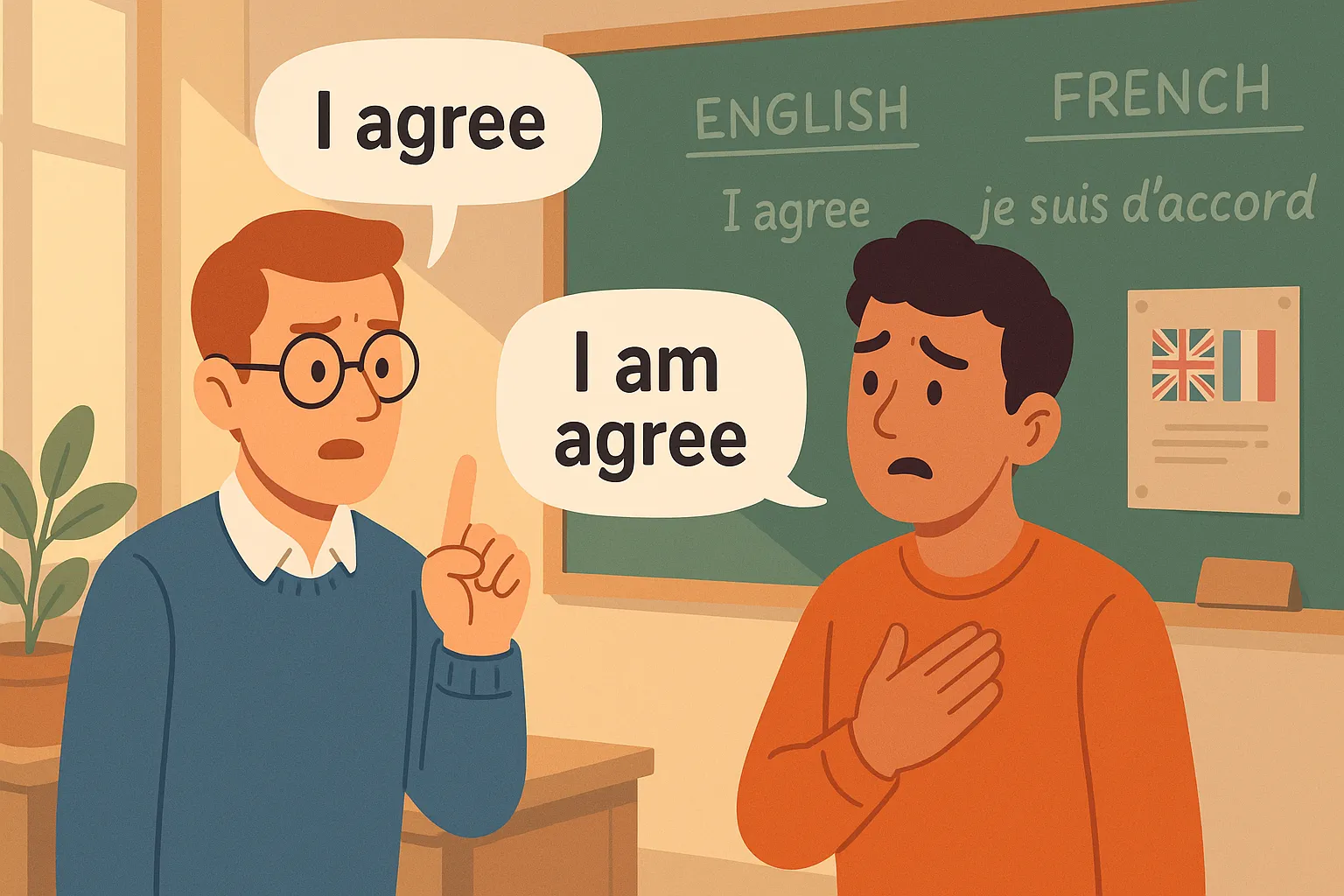
“I am agree” is structural interference from je suis d’accord, where French uses être + prepositional phrase and English uses “agree” as a standalone verb. This guide maps the root cause, every similar pattern between French and English, and why understanding the mechanism makes you better at both languages.

Why French speakers say I am agree grammar interference between French and English
“I am agree” → “I agree.” Same mistake, different root cause than you think.

The root cause: French “être d’accord” vs English “agree”

French treats agreement as a state of being. English treats it as an action. That single structural difference explains the error and every error like it. In French, d’accord is not a verb. It is a prepositional phrase meaning “of accord.” It requires être (to be) the way “happy” requires “to be” in English. In English, “agree” is a standalone verb that needs no auxiliary. The collision between these two systems produces “I am agree” every time a French speaker’s first-language wiring fires before their English can override it.

🇫🇷 Je suis d’accord avec toi. 🇺🇸 I agree with you. (NOT “I am agree with you.”) — French: être + prepositional phrase. English: verb. No auxiliary.
🇫🇷 Je ne suis pas d’accord. 🇺🇸 I disagree. (NOT “I am not agree.”) — “Disagree” is a verb. No “to be” in either direction.

The error persists even at advanced levels because it involves deep structural wiring, not surface vocabulary. French speakers know intellectually that “I agree” is correct. In spontaneous speech, the French pattern activates before conscious monitoring can intervene. Correcting someone does not fix it. Understanding the mechanism does. The same pattern shows up across dozens of other structures, which is why the common mistakes guide keeps coming back to this family of errors.

You’re learning where French and English collide structurally.
The Briefing uses these exact structures in real daily French. You hear the correct pattern before the wrong one calcifies. Quiz included.
📰 Read The French Briefing
Free. No account.

The “être” reflex: every place French speakers over-insert “to be”

French uses être far more broadly than English uses “to be.” The reflex to insert “am/is/are” transfers to English in predictable patterns. Once you see the list, you understand it is one error with many faces. The false friends guide covers the vocabulary version of this problem. This section covers the structural version.

The être/avoir swap on age and sensations

French uses avoir (to have) where English uses “to be” for age and physical sensations. The interference runs in both directions: French speakers say “I have 30 years” in English, English speakers say je suis 30 ans in French. Neither is a vocabulary mistake. Both are structural misfires.

🇫🇷 J’ai 30 ans. → ❌ “I have 30 years” → ✅ “I am 30 years old” 🇺🇸 French uses avoir for age. English uses to be. Each language catches the other off guard.
🇫🇷 J’ai froid. → ❌ “I have cold” → ✅ “I am cold” 🇺🇸 French treats physical sensations as possessions. English treats them as states.
🇫🇷 J’ai faim. → ❌ “I have hungry” → ✅ “I am hungry” 🇺🇸 French “has hunger.” English “is hungry.” Noun vs adjective adds a second layer.

The article reflex

French requires le/la/les before generic nouns. English drops the article. The reflex to include it is so deep that even C1 French speakers maintain it in English. This error is less dramatic than “I am agree” but more persistent and harder to eliminate because it does not sound obviously wrong to the speaker.

🇫🇷 J’aime le chocolat. → ❌ “I love the chocolate” → ✅ “I love chocolate” 🇺🇸 French: article obligatory before generics. English: article dropped. The reflex inserts it automatically.
🇫🇷 La vie est belle. → ❌ “The life is beautiful” → ✅ “Life is beautiful” 🇺🇸 Same pattern. French: “La vie.” English: “Life.” No article.

The false friend that causes real embarrassment

🇫🇷 ❌ “I am excited” said in French → ⚠️ “Je suis excité(e)” = sexually aroused 🇺🇸 Use “enthousiaste” or “j’ai hâte” instead. This is not subtle. Every French speaker in the room notices.

The continuous tense blind spot

French has no continuous form. Je mange covers both “I eat” (habitual) and “I am eating” (right now). French speakers skip the continuous in English because it does not exist in their system. It never fires automatically. It has to be consciously inserted every time, which is why it fails under pressure. The imparfait vs passé composé guide covers the closest French equivalent to this English distinction.

🇫🇷 Qu’est-ce que tu fais ? → ❌ “What you do?” → ✅ “What are you doing?” 🇺🇸 French uses simple present for current actions. The continuous auxiliary “are” is absent from French.
🇫🇷 Ça ne fait rien. → ❌ “It makes nothing” → ✅ “It doesn’t matter” 🇺🇸 Literal translation fails completely. The French phrase is correct and natural. The English translation of it is not.

The verb test. When tempted to say “I am [X],” ask: is X a verb or an adjective? “I am happy” (adjective → needs “to be”). “I agree” (verb → no “to be”). If X is a verb in English, drop the “am.” Always.

The reverse: errors English speakers make in French

English speakers learning French make the exact opposite mistakes. Where French speakers over-insert “to be” in English, English speakers under-use être and avoir in French. The interference runs both ways, and understanding one direction automatically explains the other. The think in French guide addresses the deeper habit: the reflex to translate through English instead of processing French directly.

🇫🇷 ❌ “J’agree” → ✅ Je suis d’accord. 🇺🇸 “Agree” does not exist as a French verb. The structure requires être + d’accord. No shortcut.
🇫🇷 ❌ “Je suis 30 ans” → ✅ J’ai 30 ans. 🇺🇸 English speakers use être for age because English uses “to be.” French uses avoir. This error marks an English speaker immediately.
🇫🇷 ❌ “Je suis froid” → ✅ J’ai froid. 🇺🇸 “Je suis froid” = I am a cold person (personality). “J’ai froid” = I feel cold. Different meaning entirely.
🇫🇷 ❌ “J’aime chocolat” → ✅ J’aime le chocolat. 🇺🇸 English drops the article for generics. French requires it. Missing “le” sounds broken to every French ear.
🇫🇷 ❌ “Je suis excité pour le concert” → ✅ J’ai hâte d’aller au concert. 🇺🇸 “Excité” in French has sexual connotation. Use “enthousiaste” or “j’ai hâte.” This error gets a visible reaction every time.

The symmetry that teaches both languages

Every interference error French speakers make in English reveals a structure English speakers get wrong in French. “I am agree” teaches you je suis d’accord. “I have 30 years” teaches you j’ai 30 ans. Understanding the interference in one direction automatically explains the other. One mechanism, two languages, mirror-image errors.

How to actually fix structural interference

Knowing the rule is not enough. The error persists because the wrong pattern is wired deeper than the correction. The fix requires building a competing reflex that fires faster than the interference. Three methods work. Everything else is just knowing the answer without being able to produce it under pressure.

  1. 1
    Paired sentence drilling For each interference pair, learn one correct sentence in each language. Je suis d’accord + “I agree.” J’ai 30 ans + “I am 30.” J’ai froid + “I am cold.” Paired sentences rewire the reflex faster than rules.
  2. 2
    Third-person testing “She is agree” sounds obviously wrong. “I am agree” sounds less wrong to the speaker because first person is automatic. Test every structure in third person first. If “she is agree” fails your ear test, “I am agree” should fail too.
  3. 3
    Context repetition, not isolated correction Hearing the correct pattern in real situations prevents fossilization better than memorizing rules. The 15-minute routine builds this kind of repetition into daily life without requiring a class.

The deeper lesson

Languages do not just label the same reality with different words. They structure reality differently. French treats agreement as a state (être d’accord). English treats it as an action (“agree”). French treats age as a possession (avoir 30 ans). English treats it as a state (“be 30”). Neither is more logical. They are different systems for organizing the same human experience. Once you see that, interference stops feeling like mistakes and starts feeling like evidence of how language actually works.

Useful expressions: agreement and disagreement in real French

The textbook teaches je suis d’accord. Real French uses shorter forms most of the time. The gap between knowing the full phrase and knowing when to shorten it is the gap between textbook French and the register you hear on a café terrace or in a work meeting.

🇫🇷 D’accord. / OK. 🇺🇸 Alright. / OK. — The single most common French response. Casual. Universal.
🇫🇷 Tout à fait d’accord. 🇺🇸 Absolutely agree. — Emphatic. “Tout à fait” intensifies without changing the structure.
🇫🇷 Pas du tout. 🇺🇸 Not at all. — Clean disagreement. No drama. Useful in debate.
🇫🇷 Ça dépend. 🇺🇸 It depends. — The French middle ground. More common than outright disagreement in polite conversation.
🇫🇷 Je comprends ton point de vue, mais… 🇺🇸 I understand your point of view, but… — The politeness system prefers this to direct contradiction.

Study glossary: grammar interference vocabulary

FrenchEnglishContext
Être d’accordTo agreeState of being, not action
Avoir (âge, sensations)To have (age, sensations)J’ai 30 ans, j’ai froid, j’ai faim
Interférence linguistiqueLanguage interferenceL1 patterns affecting L2 production
Transfert négatifNegative transferWhen L1 rules produce L2 errors
Erreur fossiliséeFossilized errorPermanent, resistant to correction
Verbe auxiliaire / principalAuxiliary / main verb“Être” = auxiliary. “Agree” = main verb.
Aspect continuContinuous aspect“I am eating” — does not exist in French
Faux amiFalse friendWords that look similar but mean different things
Analyse contrastiveContrastive analysisComparing two language structures systematically

If this article made the structural collision clear, the next step is spotting the vocabulary version of the same problem. The false friends guide covers words that look English but mean something completely different. And if the broader error pattern interests you, the Google Translate mistakes guide shows what happens when machines make the same structural errors humans do. “For sure.” 🕶️

$19/mo

Less than one coffee a week.

Structural errors fossilize without correction in context. The Pass gives you weekly audio on real situations where these patterns surface naturally.

✓ WEEKLY AUDIO✓ CEFR TRACKING✓ FULL ARCHIVES
📈 GET THE PASS · $19/MO
Zero contract. Liquidate in 2 clicks.
100% Free. Zero friction.

French news websites guide — political leanings and reading levels explained

French News Websites Political Leanings and Reading Levels: The Complete Map for Learners

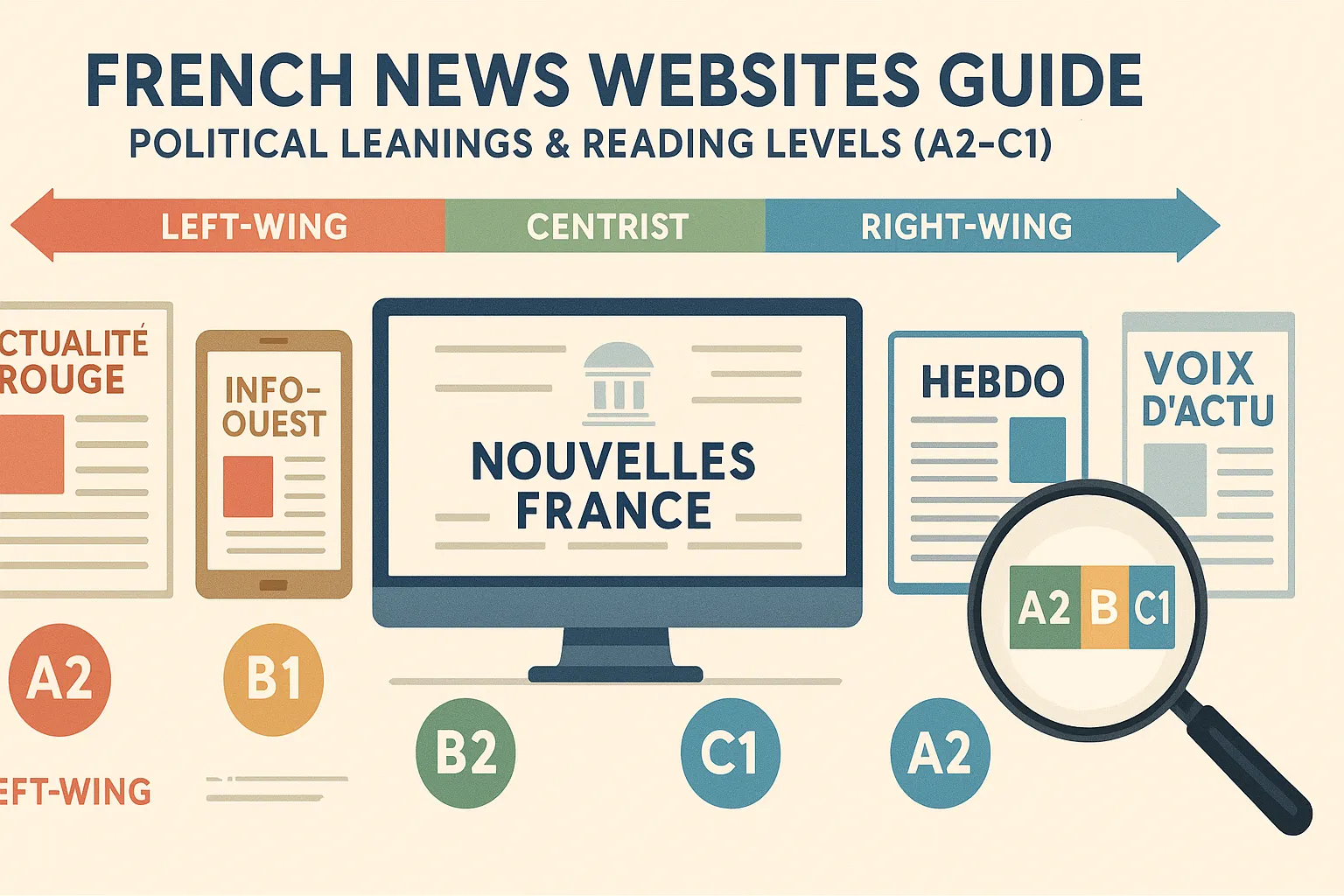
Every major French newspaper has an explicit political orientation that readers choose deliberately, not a pretence of neutrality. This guide maps every source by political leaning, reading difficulty, and access model so you can build a news diet that actually matches your level and teaches you French that matters.

French news websites political leanings and reading levels mapped
Every French news source mapped: political orientation, reading level, and access.

How the French media landscape differs from Anglo-American news

The Anglo-American ideal of strict journalistic objectivity barely exists in French media. French newspapers embrace clear political orientations, and readers select sources aligning with their perspectives rather than expecting one “neutral” outlet. This pluralism assumes informed citizens consume multiple sources. If you only read Le Monde, you get centre-left. If you only read Le Figaro, you get centre-right. Neither is wrong. Both are incomplete.

French journalism maintains stronger separation between reportage (news reporting), analysis (contextual interpretation), and éditorial (opinion) than American media where these boundaries increasingly blur. Understanding these distinctions prevents mistaking opinion for neutral reporting. Print media retains more prestige in France than in the US: major newspapers function as agenda-setters, and French intellectuals regularly publish in them. The Fifth Republic guide explains the institutional architecture that these newspapers cover daily.

Why reading French news accelerates learning

News vocabulary is the vocabulary of adult conversation in France. Political, economic, and social topics introduce terminology that textbooks never cover but that surfaces in every dinner party, every workplace discussion, every argument about the state of France. The elections vocabulary guide covers the terms. This article maps the sources.

You’re mapping French news sources. Start reading one today.
The Briefing covers real French current affairs daily, at learner-friendly speed, with quiz. The easiest entry point on this entire page.
📰 Read The French Briefing
Free. No account.

The full source map: every major French news outlet

Centre-left and progressive

SourceOrientationLevelAccessBest for
Le MondeCentre-left, progressiveB2-C1~5 free/month, €12.99/moAuthoritative French, politics, culture, international
LibérationLeft-wing, progressiveB1-B2Partial paywallCultural coverage, younger tone, accessible prose
MediapartLeft, investigativeB2-C1Full paywall €11/moInvestigative journalism, political scandals
L’ObsCentre-left, social-democraticB2Partial paywallWeekly digest, longer-form analysis

Centre-right and conservative

SourceOrientationLevelAccessBest for
Le FigaroCentre-right, conservativeB2-C1~limited free, €9.99/moTraditional journalism, literary sections, counterpoint to Le Monde
Les ÉchosCentre-right, businessB2-C1Partial paywallBusiness French, economics, finance
Le PointCentrist, centre-right tendencyB2Partial paywallWeekly format, balanced political analysis
Valeurs ActuellesRight-wing, nationalistB1-B2Partial paywallUnderstanding right-wing French discourse

Centrist and neutral

SourceOrientationLevelAccessBest for
AFPNeutral wire serviceB1-B2FreeFactual reporting, concise prose, vocabulary building
France 24Centrist, state-fundedB1Completely freeParallel FR/EN versions, international focus, video
franceinfoPublic service, balancedB1-B2FreeAudio + text + video, educational approach
20 MinutesMainstream, no strong leanB1FreeShort articles, accessible vocab, daily habit

Le Monde vs Le Figaro: same fact, two narratives

Read both on the same story and you see how identical facts become two distinct narratives depending on the editorial lens. Le Monde (centre-left, founded 1944, intellectual, dense) vs Le Figaro (centre-right, founded 1826, traditional, serious cultural sections). If reading Le Monde feels natural, you are B2+. Reading both on the same topic is the single best exercise for building political vocabulary and critical thinking simultaneously.

News sources ranked by reading level

A2-B1: start here

Journal en Français Facile (RFI) — ten minutes of daily audio news with full transcript. Simplified vocabulary, slow clear pronunciation. The single best entry point for French news as a learner. 1jour1actu — French children’s news, excellent for adult A2 learners. Complex topics explained without jargon. No shame in starting here: the French is real, and the vocabulary recurs in adult sources. France 24 — read in French, check in English. The lowest-pressure entry point for authentic adult French news.

B1-B2: expand here

20 Minutes and AFP for straightforward reporting. Libération for accessible left-wing prose. franceinfo for public service journalism that combines audio, text, and video. The beginner news sources guide ranks these by difficulty with specific entry strategies. At this level, the TV channels guide adds the audio version: BFM TV, franceinfo, and LCI all stream free.

B2-C1: full landscape

Le Monde, Le Figaro, Mediapart, L’Obs, Les Échos — the complete spectrum. Read opinion pieces alongside news. Compare coverage across political orientations. Advanced reading means engaging with complex sentences, subtle connotations, and implied meanings that do not survive translation. The radio debates guide trains the oral version of the same register. Baron Noir dramatizes it.

Intermediate strategy. Start with France 24 or AFP for straightforward reporting, then progress to 20 Minutes or Libération. Use browser dictionary extensions for quick lookups without breaking reading flow. The jump from B1 to B2 in reading happens fastest through daily news exposure because the same terms recur across articles, creating natural spaced repetition.

Strategic reading techniques

  1. 1
    Headline scanning — 10 minutes daily, 3 sources Rapid exposure builds vocabulary and current events awareness. Low pressure, high frequency. The daily habit that maintains French contact.
  2. 2
    Comparative reading — same subject, 3 orientations Le Monde + Le Figaro + AFP on the same story. See how framing changes meaning. Reinforces vocabulary through repetition while building media literacy.
  3. 3
    Vocabulary extraction by domain Maintain a notebook: politics, economics, society, culture, international. Le scrutin, l’Assemblée nationale, le remaniement, la grève, le pouvoir d’achat, la réforme, un sondage, la laïcité. Domain-organized vocabulary compounds faster than random word lists.
  4. 4
    Audio-text pairing France 24, franceinfo, and Le Monde all offer multimedia. Listen first, then read. Dual-mode exposure strengthens listening while text provides verification. The podcast guide adds more audio channels.

Paywall navigation. AFP, France 24, franceinfo, RFI, and 20 Minutes are completely free. Le Monde allows ~5 free articles/month. Many US public libraries provide free digital access to French newspapers through PressReader. Check your library’s digital resources before subscribing.

Fact-checking resources

Les Décodeurs (Le Monde) — political claims investigated. AFP Factuel — misinformation debunked. Both teach critical reading while building vocabulary through clear explanations.

Study glossary: French news and media vocabulary

FrenchEnglishContext
Un journal / un quotidienA newspaper / a dailyLe Monde, Le Figaro = quotidiens
Un hebdomadaireA weeklyL’Obs, Le Point = hebdomadaires
Les actualités / les infosThe news (formal / casual)“Tu as vu les infos ?”
Un éditorial / une tribuneAn editorial / an op-edNewspaper’s opinion vs external opinion
La uneThe front page“Faire la une” = make the front page
SelonAccording toThe attribution word. You will read it 50 times per news session.
Le scrutinBallot / electionEvery election article
Le remaniementCabinet reshuffleHappens frequently in French politics
La grèveStrike“Les cheminots sont en grève”
Le pouvoir d’achatPurchasing powerDominates every French election
La réformeReform (almost always controversial)“La réforme des retraites” = pension reform
Un sondageA pollIFOP, IPSOS, BVA = major polling firms
La laïcitéSecularism (French-specific, untranslatable)Governs debates on religion, education, identity
Un communiquéA press release / official statement“L’Élysée a publié un communiqué”
De gauche / de droiteLeft-wing / right-wingPolitical orientation
Une enquêteAn investigationMediapart specialty

If this map made the landscape clearer, the next step is building speed. The news vocabulary guide gives you the specific phrases that French news articles use every day. The TV channels guide adds the live audio version. And the think in French guide helps you stop translating news articles word by word and start processing them directly. “For sure.” 🕶️

$19/mo

Less than one coffee a week.

News vocabulary compounds weekly. The Pass covers real French current affairs with audio so you follow political and economic developments without reaching for a dictionary.

✓ WEEKLY AUDIO✓ CEFR TRACKING✓ FULL ARCHIVES
📈 GET THE PASS · $19/MO
Zero contract. Liquidate in 2 clicks.
100% Free. Zero friction.

French movies on Amazon Prime Video US — best films to learn French

French Movies on Amazon Prime Video US: The Films That Actually Teach You French at Every Level

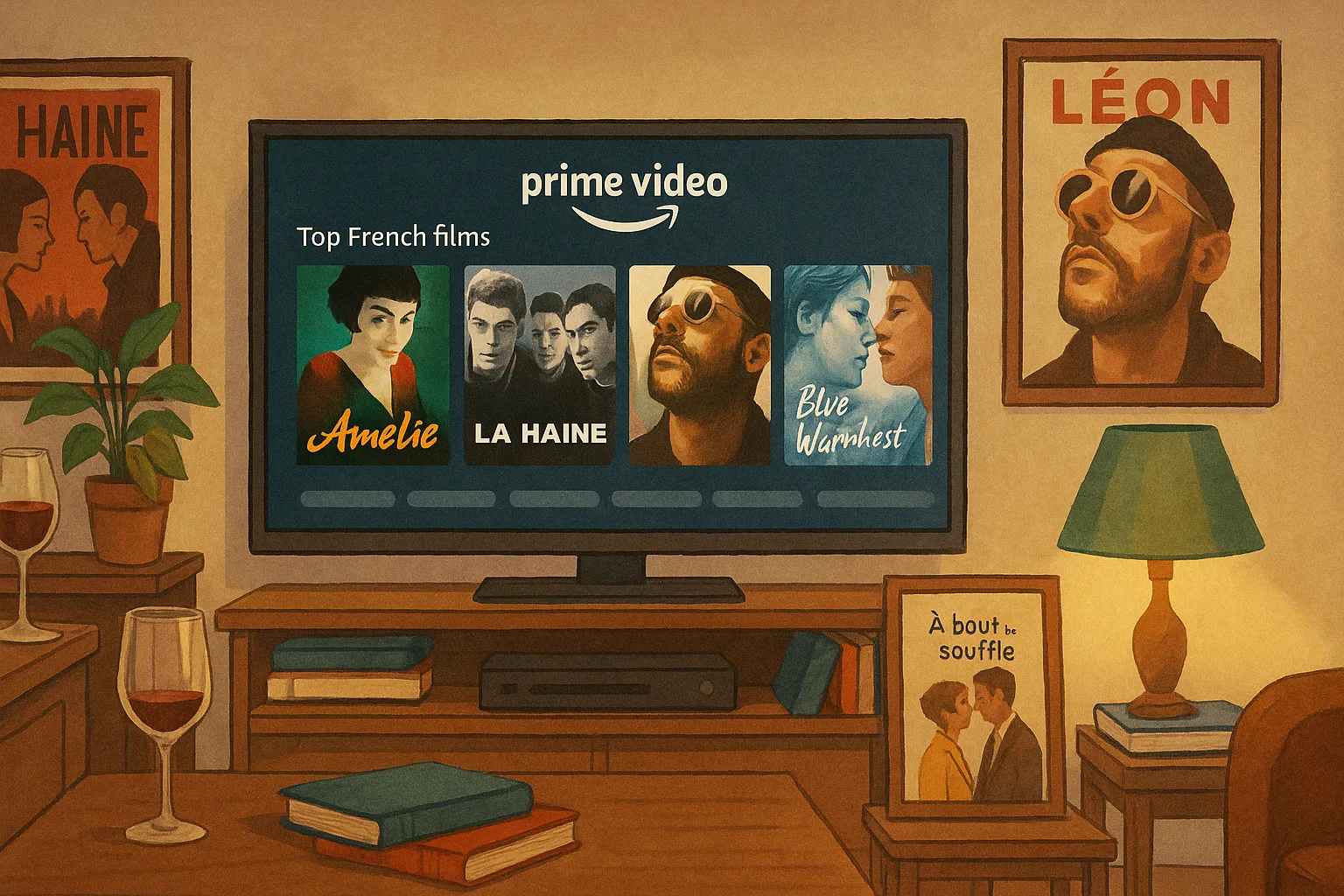
Streaming catalogues rotate, but the films that actually teach you French do not change. This guide ranks 12 essential French films by listening difficulty, explains what each one trains, and gives you Amazon links to own the ones worth rewatching.

Best French films for language learning ranked by difficulty
Same film, three viewings, three subtitle settings. That is the method. Everything else is decoration.
🍷 Society & Pop Culture 🌿 All Levels (A1-C1)

The subtitle method: the only technique that converts watching into learning

Watching French films with English subtitles teaches you zero French. Your brain reads the translation and ignores the audio. Watching without any subtitles at A1 also teaches you zero French because you cannot acquire language from input you do not understand. The method is a four-stage progression that matches your subtitle strategy to your level.

LevelAudioSubtitlesGoal
A1-A2FrenchEnglishUnderstand the story. Calibrate your ear to French sounds and rhythm.
A2-B1FrenchFrenchRead while listening. Build vocabulary. Pause on unknown words.
B1-B2FrenchFrench → then noneTest comprehension. The gap between the two viewings = your progress.
B2+FrenchNoneCold viewing. Accept gaps. Capture main ideas.

Why owning the film matters more than streaming it

The method requires three viewings of the same film with different subtitle settings. Streaming catalogues rotate titles without warning. If the film disappears after your first viewing, the method breaks. Owning the Blu-ray or digital copy means the film stays available for rewatching, shadowing, and vocabulary extraction whenever you need it. Every film below has an Amazon link for exactly this reason.

Films train your ear. The Briefing trains your reading.
Daily written French on real topics, same register as adult conversation. Complements film watching perfectly. Quiz included.
📰 Read The French Briefing
Free. No account.

A1-A2: films where visual context carries you

At A1-A2, you need slow speech, clear diction, visual storytelling, and simple vocabulary. Animated films and narrator-driven stories outperform rapid dialogue dramas because your ear is still calibrating to French phonology. The goal is not comprehension. It is tolerance: your brain accepting French sound patterns as normal input. Not sure where you stand? The Level Quiz takes three minutes.

🎬 Intouchables (2011) — the perfect first French film

Director: Olivier Nakache & Éric Toledano · Cast: François Cluzet, Omar Sy · Runtime: 112 min · Level: A2-B1

The highest-grossing French-language film of all time, and for good reason. Driss (Omar Sy), a young man from the banlieue, becomes the live-in caretaker for Philippe (François Cluzet), a quadriplegic millionaire. Their friendship is the film. The dialogue is contemporary, conversational, and split between two distinct registers: Philippe’s educated, measured French and Driss’s informal, fast, slang-heavy speech. That register contrast is itself a French lesson. You hear the class system in every exchange without anyone explaining it.

What it teaches: everyday vocabulary (ça va, c’est pas grave, laisse tomber, je m’en fiche), informal vs formal register, humor as social navigation, banlieue slang in context. The friendship arc provides emotional context that carries you even when you miss words.

Own it: Intouchables Blu-ray on Amazon (French audio, English + French subtitles) · DVD on Amazon · Stream: frequently on Prime Video (free with ads) · Check JustWatch

🎬 Le Fabuleux Destin d’Amélie Poulain (2001) — narrator-driven, descriptive

Director: Jean-Pierre Jeunet · Cast: Audrey Tautou, Mathieu Kassovitz · Runtime: 122 min · Level: A2

Amélie Poulain, a shy Parisian waitress, decides to improve the lives of strangers through elaborate, anonymous schemes. The film is famous for its narrator, who speaks slowly, precisely, and descriptively. That narration is the learning engine: adjectives, present tense, Paris geography, and emotional vocabulary delivered at a pace A2 ears can process. The visuals explain what the words do not.

What it teaches: descriptive vocabulary, present tense narration, Paris neighbourhood names (Montmartre, Abbesses, Canal Saint-Martin), adjective placement, emotional states. The Paris survival phrases cover the same geography at street level.

Own it: Amélie Blu-ray on Amazon · Stream: check JustWatch

🎬 Ernest et Célestine (2012) — animated, gentle, real French

Directors: Stéphane Aubier, Vincent Patar, Benjamin Renner · Runtime: 80 min · Level: A1-A2

A bear and a mouse become friends in a world that forbids it. The vocabulary is simple, the present tense dominates, the diction is crystal clear, and the emotional context provides meaning clues when words fail you. Animated films are underrated for learning: clear articulation, simplified vocabulary, visual support at every moment. No shame in starting here. The French is real.

What it teaches: basic sentence structures, present tense, food vocabulary, emotions, simple negation. Perfect for the first film in French ever.

Own it: Ernest et Célestine on Amazon · Stream: check JustWatch

🎬 Le Petit Prince (2015) — short sentences, repetitive structures

Director: Mark Osborne · Runtime: 108 min · Level: A1-A2

Saint-Exupéry’s story animated. Basic grammar structures, common verbs, gentle pacing. The philosophical simplicity of the source text means the French stays accessible even when the ideas are deep. “On ne voit bien qu’avec le cœur” is one of the most quoted French sentences in the world, and you hear it in context here.

Own it: Le Petit Prince on Amazon · Stream: check JustWatch

A1 rule. If you understand less than 40% with French subtitles, the film is too hard. Drop to English subtitles or pick a simpler film. The sweet spot is 60-70% comprehension: enough to follow, enough gaps to learn from.

B1-B2: films where variety replaces simplicity

At B1-B2, you stop needing simple and start needing varied. The films below mix formal and informal French, introduce debate vocabulary, and challenge your ear with natural-speed dialogue. This is the level where the think in French guide becomes relevant: you need to stop translating every line and start processing directly.

🎬 Entre les murs (2008) — the most authentic French in any film

Director: Laurent Cantet · Cast: François Bégaudeau (playing himself), real students · Runtime: 128 min · Level: B1-B2 · Palme d’Or, Cannes 2008

A year inside a Paris middle school classroom. The students are real. The teacher (Bégaudeau, who wrote the book) is real. The dialogue was improvised from outlines, not scripted. The result is the most authentic spoken French you will find in any film: classroom French, teenage slang, debate structures, the formal-informal shift happening in a single sentence. Argumentation vocabulary, vous/tu tension, and the sound of real French adolescents pushing back against authority. Nothing else sounds like this.

What it teaches: argumentation (mais monsieur, c’est pas juste), register switching (teacher vs student), imperfect/passé composé in natural use, banlieue youth vocabulary, French education system vocabulary. The politeness guide explains the vous/tu dynamics this film dramatizes.

Own it: Entre les murs on Amazon · Stream: check JustWatch

🎬 Portrait de la jeune fille en feu (2019) — elevated register, deliberate pacing

Director: Céline Sciamma · Cast: Noémie Merlant, Adèle Haenel · Runtime: 122 min · Level: B1-B2

18th-century Brittany. A painter is commissioned to paint the wedding portrait of a young woman who refuses to pose. The period setting means slower, more precise language. Conditional and subjunctive appear in natural context rather than textbook isolation. The dialogue is sparse, deliberate, and carries enormous emotional weight in few words. Every sentence matters because there are so few of them.

What it teaches: literary register, conditional in natural use, art and emotion vocabulary, formal politeness in historical context, the sound of careful French where every word is chosen.

Own it: Portrait de la jeune fille en feu on Amazon · Stream: check JustWatch

🎬 À bout de souffle (Breathless) (1960) — Godard, New Wave, Paris forever

Director: Jean-Luc Godard · Cast: Jean-Paul Belmondo, Jean Seberg · Runtime: 90 min · Level: B1-B2

The film that started the French New Wave. A small-time criminal and an American journalist in Paris. The dialogue is casual, fast, improvised-feeling, and full of the philosophical throwaway lines that define French cinema. Belmondo’s speech is pure Parisian informal: clipped, rhythmic, cool. Seberg speaks French with an American accent, which gives learners a mirror. The film is 90 minutes long and moves like a conversation.

What it teaches: informal Parisian register, 1960s slang (much of it still alive), question structures in real speech, the rhythm of French conversation at natural speed. The BD guide covers another pillar of French cultural literacy.

Own it: À bout de souffle Criterion Blu-ray on Amazon · Stream: check JustWatch

🎬 Ne le dis à personne (Tell No One) (2006) — thriller that teaches under pressure

Director: Guillaume Canet · Cast: François Cluzet, Marie-Josée Croze, Kristin Scott Thomas · Runtime: 131 min · Level: B1-B2

A pediatrician receives an email from his wife, who was murdered eight years ago. The plot drives you forward even when you miss dialogue. Investigation vocabulary, question formation, formal vs informal speech in police contexts, medical vocabulary. Thrillers are underrated for learning: narrative momentum compensates for comprehension gaps. François Cluzet (also in Intouchables) delivers dialogue that is fast but clear.

Own it: Ne le dis à personne on Amazon · Stream: check JustWatch

🎬 Anatomie d’une chute (Anatomy of a Fall) (2023) — courtroom French, current

Director: Justine Triet · Cast: Sandra Hüller, Swann Arlaud, Milo Machado Graner · Runtime: 152 min · Level: B2 · Palme d’Or, Cannes 2023

A woman is suspected of killing her husband. The trial becomes a trial of their marriage. The film switches between French and English (Sandra Hüller speaks both), which gives learners a bilingual anchor. The courtroom scenes are some of the best legal French in recent cinema: la partie civile, le procureur, l’audience, la plaidoirie. You hear how French argument works under institutional pressure.

What it teaches: legal vocabulary, courtroom register, argument structure, bilingual code-switching, formal question formation. The Fifth Republic guide covers the judicial system this film dramatizes.

Own it: Anatomie d’une chute on Amazon · Stream: check JustWatch

B2-C1: films where subtext replaces explanation

At B2-C1, the dialogue stops explaining itself. Irony, social coding, class markers, and cultural references land without annotation. These films assume you can keep up. If you cannot yet, that is what the Canal+ series guide trains you for: the same density in episodic form where repetition builds tolerance.

🎬 La Haine (1995) — banlieue, verlan, raw speed

Director: Mathieu Kassovitz · Cast: Vincent Cassel, Hubert Koundé, Saïd Taghmaoui · Runtime: 98 min · Level: B2-C1

24 hours in a Paris banlieue after a police shooting. Three young men (Jewish, Black, North African) move between the cité and central Paris. The film is in black and white. The dialogue is in verlan, slang, and compressed informal French at a speed that tests even strong B2 listeners. Vincent Cassel’s performance is volcanic. The famous opening monologue (“C’est l’histoire d’un homme qui tombe d’un immeuble de 50 étages…”) is one of the most quoted passages in French cinema.

What it teaches: verlan (meuf, keuf, relou, chelou), banlieue vocabulary, class markers in French speech, register contrast between cité and central Paris, police/justice vocabulary. Watch with French subtitles first. The cultural depth is worth the difficulty.

Own it: La Haine Criterion Blu-ray on Amazon · Stream: check JustWatch

🎬 Un prophète (2009) — prison, power, dense institutional French

Director: Jacques Audiard · Cast: Tahar Rahim, Niels Arestrup · Runtime: 155 min · Level: B2-C1

A young Arab man enters prison illiterate and exits running a criminal empire. The film moves between French, Arabic, and Corsican. The French is institutional (prison hierarchy, judicial vocabulary, social worker language) and street (slang, threats, deals). Tahar Rahim’s performance is a masterclass in code-switching between registers. The film won the Grand Prix at Cannes 2009.

Own it: Un prophète Criterion Blu-ray on Amazon · Stream: check JustWatch

🎬 Caché (Hidden) (2005) — Haneke, subtext as the entire film

Director: Michael Haneke · Cast: Daniel Auteuil, Juliette Binoche · Runtime: 117 min · Level: C1

A Parisian intellectual receives anonymous surveillance tapes of his own home. The dialogue is measured, bourgeois, and full of what is not said. The film never explains itself. It assumes you understand French colonial history, Parisian class anxiety, and the guilt structures of the educated left. If you follow the dinner party scenes without subtitles, your French comprehension is at native-adjacent level.

Own it: Caché on Amazon · Stream: check JustWatch

Availability rotates. Prime Video, Netflix, and other platforms cycle French films regularly. JustWatch shows current streaming availability by country for every title. Check before subscribing to any platform for one specific film. Owning the Blu-ray or DVD via Amazon eliminates this problem entirely.

The active viewing technique: one film, maximum extraction

Watching a film is not studying. Watching a film with a notebook, pausing for unknown words, shadowing one scene, and rewatching without subtitles is studying. One film used actively teaches more than ten films watched passively.

  1. 1
    First viewing: comprehension Watch with your current subtitle setting. Enjoy the film. Note timestamps of 2-3 dense scenes. Do not pause. Get the shape of the story.
  2. 2
    Scene replay: vocabulary extraction Return to your noted scenes. Replay with French subtitles. Write down 5-10 useful phrases you will actually reuse: je m’en fiche, c’est n’importe quoi, on y va, ça ne me dit rien, laisse tomber.
  3. 3
    Shadowing: pronunciation in context Replay 2-3 minutes of one scene. Pause after each sentence. Repeat out loud. Copy the rhythm, the melody, the mouth movements. The pronunciation guide gives you the phonetic framework.
  4. 4
    Second full viewing: comprehension test Rewatch without subtitles within a week. You know the plot. Now listen for the French. The gap between first and second viewing measures your actual progress.

Why one film three times beats ten films once

First viewing: you get the plot. Second viewing: you notice vocabulary. Third viewing: you hear patterns. The brain needs repeated exposure to convert recognition into production. Ten different films give you ten half-understood plots. One film watched three times gives you fifty phrases you can actually use. That is the same principle behind the 15-minute daily routine: consistency over volume.

Where to find French films beyond Prime Video

PlatformWhat it offersAccess
Amazon Prime VideoRotating French catalogue. Some free with Prime, others to rent/buy.🌍 Subscription + rentals
NetflixStrong French original content + licensed films. The Netflix guide ranks everything.🌍 Subscription
Arte.tvFree. Worldwide. European cinema, documentaries. The best free source.🌍 Free, no VPN
MUBICurated art-house cinema. Strong French selection. Hand-picked, not algorithm-driven.🌍 Subscription
Criterion ChannelClassic and art cinema. Best for New Wave, Godard, Truffaut, Audiard.🇺🇸🇨🇦 Subscription
JustWatchSearch any title → see every legal streaming option by country.🌍 Free

Films train your ear. The podcast guide fills commute time. The music guide adds rhythm. The TV channels guide gives you live immersion. Together, they build a media diet that keeps French present every day. “For sure.” 🕶️

$19/mo

Less than one coffee a week.

Films give you exposure. The Pass gives you structure: weekly audio, real situations, CEFR tracking. The system that turns passive watching into measurable progress.

✓ WEEKLY AUDIO✓ CEFR TRACKING✓ FULL ARCHIVES
📈 GET THE PASS · $19/MO
Zero contract. Liquidate in 2 clicks.
100% Free. Zero friction.

French café culture — unwritten rules every tourist should know

French Café Culture Rules and Etiquette: The Unwritten Code Nobody Explains to Tourists

The same espresso costs three different prices depending on where you drink it, the server is not rude, and the bill will not arrive until you ask. This guide covers the pricing system, the ordering protocol, the things you must never do, and the vocabulary that turns you from obvious tourist into someone the waiter nods at instead of ignores.

French café culture rules and etiquette guide
Three prices. One coffee. Zero explanations on the menu.

The three-price system: comptoir, salle, terrasse

The same espresso costs ~1.50€ standing at the bar, ~2.50€ sitting inside, and ~4.50€ on the terrace. You are not paying for better coffee. You are paying for space, service, and the right to sit for as long as you want. This is not tourist exploitation. It is how French cafés have worked for over a century. The café sells time, not just drinks.

🇫🇷 Au comptoir = debout au bar, le moins cher 🇺🇸 At the counter = standing at the bar, cheapest tier. How Parisians actually drink their morning coffee. Fast, two minutes, social only with the barista.
🇫🇷 En salle = assis à l’intérieur, prix moyen 🇺🇸 Inside seating = middle price. Order one coffee, read for three hours. Completely acceptable. The café sells time.
🇫🇷 En terrasse = dehors, vue sur la rue, le plus cher 🇺🇸 Outdoor seating = most expensive. The chairs face the street, not each other. Watching the city is the point.

Look for the price board labeled Tarifs or Nos Prix with three columns. Tourist-area cafés charge double. Neighbourhood cafés charge half. The coffee is identical. The Paris survival guide covers the same pricing logic for restaurants and bakeries.

Why the café is not a coffee shop

American coffee culture optimizes for speed and turnover. French café culture optimizes for staying. You are not buying fuel. You are renting territory. The café is an extension of the living room, the office, the meeting point, and the social club. Sartre wrote Being and Nothingness at Café de Flore. Nobody asked him to order a second coffee.

You’re learning the unwritten rules. The Briefing teaches the written ones.
Daily French on real culture and real situations. Same register as a café conversation. Quiz included.
📰 Read The French Briefing
Free. No account.

Ordering etiquette: the greet-before-you-speak rule

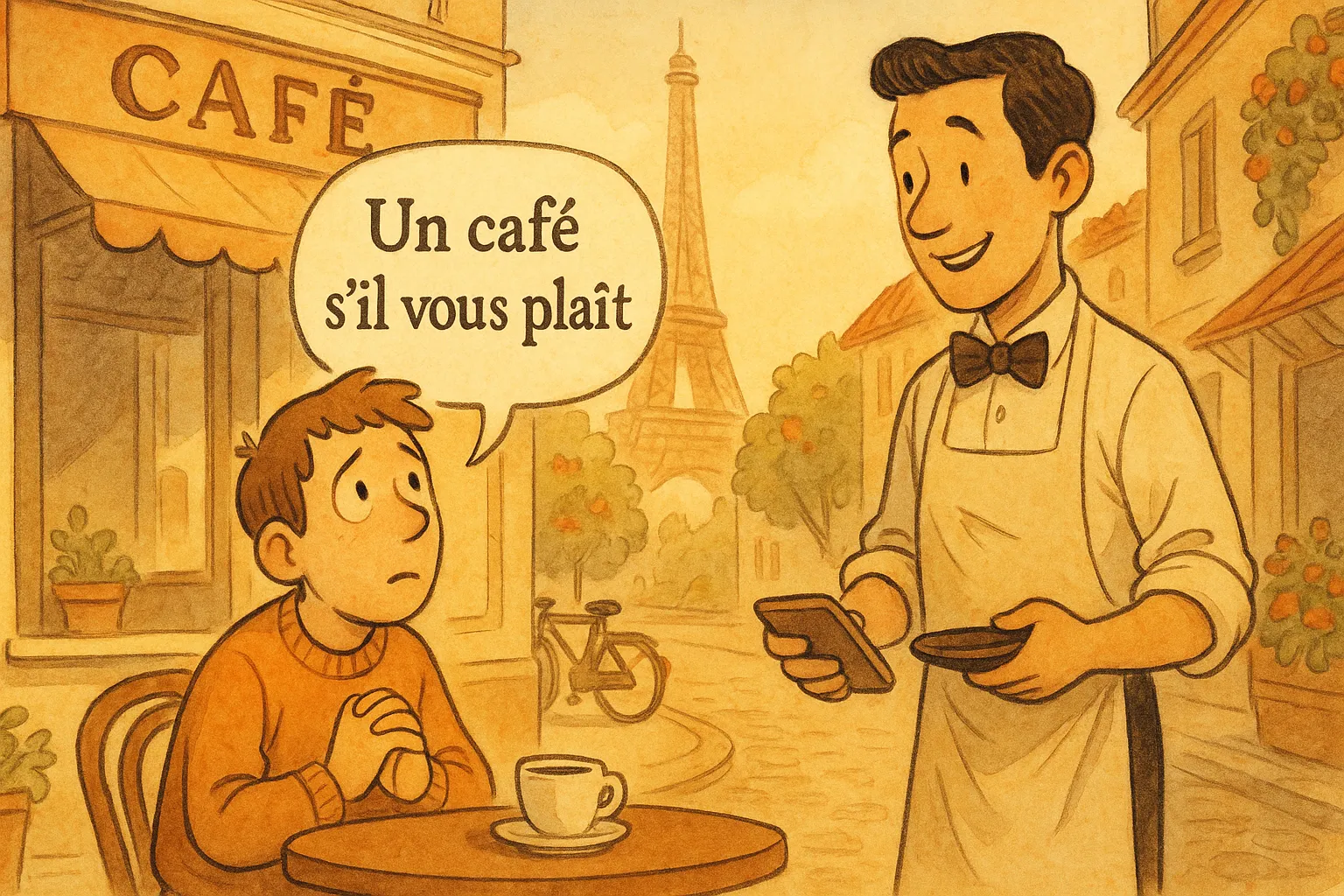
The single biggest mistake anglophone tourists make is not pronunciation. It is walking up to the counter and saying “un café” without greeting the person first. In French culture, every interaction begins with “Bonjour.” Skipping it marks you as rude faster than any accent. The politeness guide explains the full system. This section covers the café-specific version.

🇫🇷 ❌ “Un café.” (sans salutation) 🇺🇸 Too abrupt. The server has already decided you are rude before making your drink.
🇫🇷 ✅ “Bonjour ! Un café, s’il vous plaît.” 🇺🇸 Greeting + order + please. Three elements. Non-negotiable. The server relaxes. Everything goes smoother.
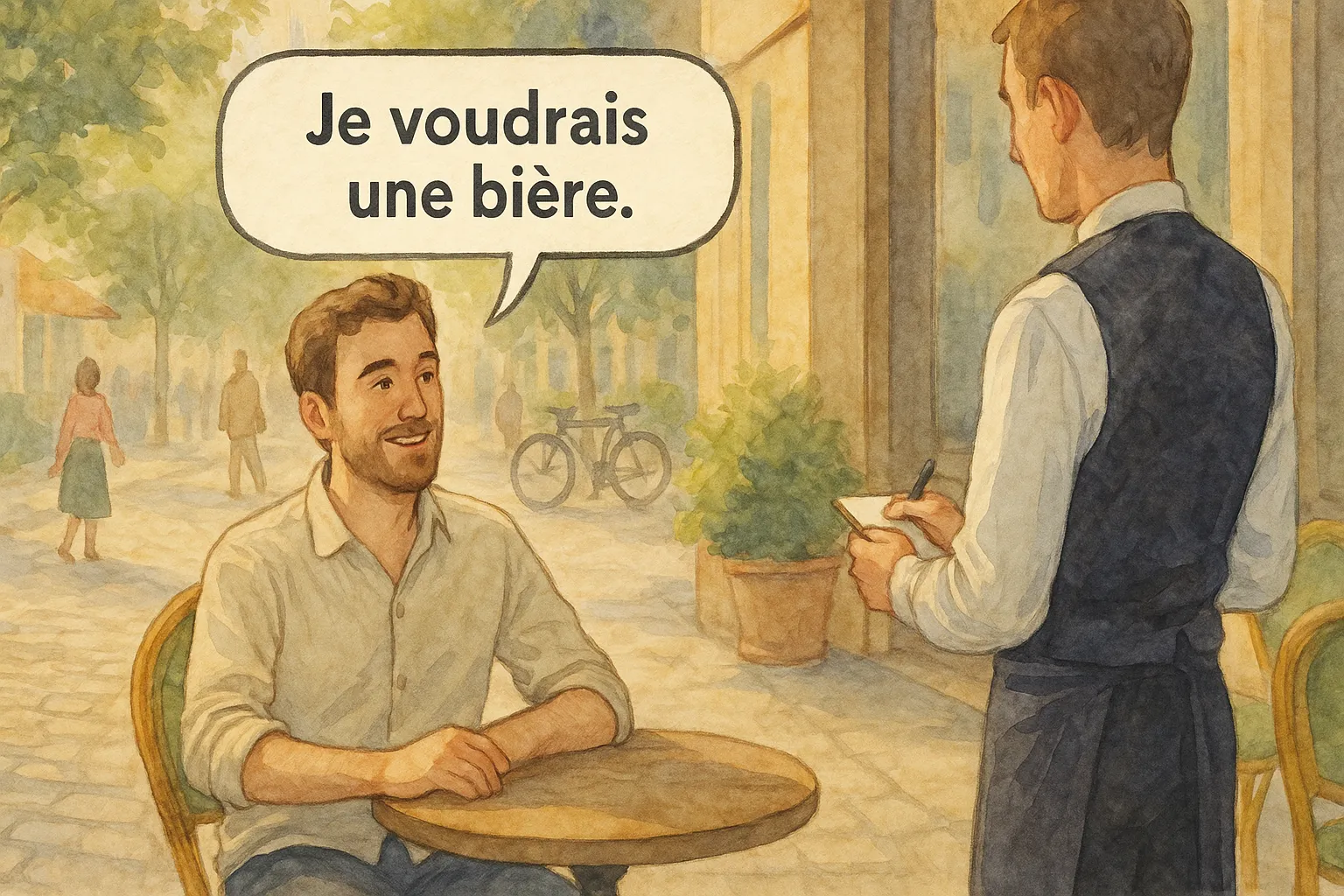
🇫🇷 “Bonjour ! Je voudrais un café crème, s’il vous plaît.” 🇺🇸 “I would like a coffee with cream, please.” — Je voudrais (conditional) = the magic phrase. More polite than je veux. Use it everywhere.

“Un café” = espresso. Not drip coffee. Not Americano. If you want larger coffee, order un café allongé (espresso + hot water) or un café crème (with steamed milk). Asking for “a regular coffee” produces confusion. The drinks guide covers everything beyond coffee.

If the ordering moment makes you freeze, that is the same response described in the shy beginners guide. Pre-decide your phrase before you walk in. The 3-second rule: inhale, say bonjour, deliver the order. Done.

What you must never do in a French café

These are not preferences. They are rules nobody writes down but everyone enforces through silent judgment. Break one and the server remembers. Break two and you become the anecdote they tell other servers.

  1. 1
    Never skip the greeting No bonjour, no respect. The interaction starts wrong and never recovers.
  2. 2
    Never snap fingers or wave aggressively Make eye contact, raise a hand slightly, or say “Excusez-moi” at moderate volume. That is it.
  3. 3
    Never ask for the bill prematurely Request “L’addition, s’il vous plaît” only when you are ready to leave. The bill is a signal that you are going, not a request to hurry.
  4. 4
    Never sit at an uncleared table A dirty table means unavailable. Wait for it to be cleared.
  5. 5
    Never bring outside food or drinks This causes genuine offense, even with water. Applies at every French establishment.
🇫🇷 L’addition, s’il vous plaît. 🇺🇸 The check, please. — You say this when YOU decide to leave. Until you say it, the table is yours.

The server is not rude. You did not say bonjour.

French service culture is reserved, not hostile. The server will not check on you five times, will not suggest dessert, will not bring the bill uninvited. This is not indifference. It is respect for your autonomy. Americans read it as cold. The French read American service as intrusive. The don’t-smile guide explains the same cultural distance in every other French context.

The laptop question. Parisian cafés tolerate laptop workers less than American coffee shops. It is not forbidden, but it violates the spirit of the café as social space. If you must work: order regularly, avoid peak hours, choose larger cafés, and read the room.

The terrasse: why chairs face the street and not each other

The café terrasse is the most iconic image of Parisian life: wicker chairs, small round tables, people watching the city pass. The chairs face outward. That arrangement enables the essential Parisian activity: watching street life as entertainment. Sitting side by side observing the theatre of the city is a perfectly acceptable alternative to conversation.

🇫🇷 C’est pour emporter ou sur place ? 🇺🇸 To go or for here? — “Sur place” triggers the salle/terrasse price. “Emporter” = takeaway at comptoir price.
🇫🇷 Une carafe d’eau, s’il vous plaît. 🇺🇸 A jug of tap water, please. Free. Your legal right in any French establishment. Every French person at the next table already has one.
🇫🇷 On est bien ici. 🇺🇸 It’s nice here. — The sentence that captures why French cafés exist. Not rushing. Not producing. Just being.

Tipping in French cafés

Service is included in every price by law (service compris). The server earns a full wage regardless. Tipping is optional: round up to the nearest euro, or leave small change (0.50-2€ for coffee). Large percentage-based tips are neither expected nor appropriate. Overtipping can be read as condescension rather than generosity. The restaurant guide covers the same logic for meals.

Budget hack. Drink your morning espresso au comptoir like locals do. ~1.50€, two minutes, real French coffee ritual. Save the terrasse for the afternoon when you want to sit and watch the city. The bakery guide covers the same logic for breakfast: croissant at the boulangerie is 1.20€. Croissant at the café terrasse is 3.50€.

Study glossary: French café vocabulary

FrenchEnglishContext
Un caféEspressoDefault. Not drip coffee.
Un café crèmeCoffee with steamed milkThe “latte” equivalent
Un café allongéAmericanoEspresso + hot water
Un noisetteEspresso + drop of milkBetween espresso and crème
La terrasse / en salle / au comptoirTerrace / inside / at the barThree price tiers
L’additionThe billOnly comes when you ask
Le pourboireTipOptional. Small coins on the saucer.
Service comprisService includedBy law in all French prices
Le serveur / la serveuseWaiter / waitressNot rude. Reserved.
Sur place / emporterFor here / takeawayDetermines which price column applies
Une carafe d’eauJug of tap water (free)Your legal right. Ask without hesitation.
L’apéroPre-dinner drinksThe sacred 6-7pm ritual on the terrasse

If the café code now makes sense but the broader social rhythm still feels opaque, the next step is usually the restaurant ordering guide (the full meal version of the same protocol), the bakery guide (the morning version), and the drinks guide for everything stronger than coffee. “For sure.” 🕶️

$19/mo

Less than one coffee a week.

Café French is social French. The Pass builds it weekly: real audio, real situations, the register that makes you sound like you have been here before.

✓ WEEKLY AUDIO✓ CEFR TRACKING✓ FULL ARCHIVES
📈 GET THE PASS · $19/MO
Zero contract. Liquidate in 2 clicks.
100% Free. Zero friction.

Best way to learn French for English speakers — what actually works

Best Way to Learn French for English Speakers: Why the Method Debate Misses the Point

The best way to learn French is not one method but the right four-part system applied daily. This guide builds that system with schedules, level-specific strategies, and the resources that actually work from A1 to C1.

Best way to learn French for English speakers combined methods
No single method works. The right combination does.
🧱 Language Foundations 🌿 All Levels (A1-C1)

The English speaker advantage: what it buys you and where it stops

About thirty percent of English vocabulary comes from French through the Norman conquest. “Restaurant,” “government,” “justice” require zero memorization. The suffix patterns alone give you hundreds of free words: English “-tion” → French “-tion” (information, nation, education), English “-ity” → French “-ité” (university → université, quality → qualité), English “-ous” → French “-eux” (dangerous → dangereux, curious → curieux). No Japanese or Arabic speaker has this head start.

That advantage accelerates A1 and fades by A2. After the shared vocabulary runs out, you hit gendered nouns, verb conjugations that change by person, tense, and mood, the subjunctive, and pronunciation patterns that bear no resemblance to English. Worse, the shared vocabulary creates false friends: “actuellement” means currently (not actually), “demander” means to ask (not to demand), “librairie” means bookstore (not library). The grammar interference guide explains why these errors persist even at advanced levels.

You’re building a system. Add daily French contact to it.
The Briefing gives you real French every day. Culture, politics, society. Same register as adult conversation. Quiz included.
📰 Read The French Briefing
Free. No account.

The four-part system: what actually works at every level

Every successful French learner we observe uses the same four components. The ratio shifts by level, but the components stay constant. Drop any one and the system breaks.

  1. 1
    Structured grammar (30-40% of study time) Textbook, course, or teacher. Systematic progression through core competencies. Without structure, you learn random fragments. The books minimalist guide tells you exactly how many resources you need at each level.
  2. 2
    Authentic input (30-40% of study time) French shows, podcasts, news, books at your level. Real French, not textbook French. Without input, your ear never calibrates.
  3. 3
    Active production (20-30% of study time) Speaking, writing, recording yourself. Without production, you understand but cannot respond. The shy beginners guide helps if speaking terrifies you.
  4. 4
    Spaced repetition (10-20% of study time) Reviewing vocabulary at increasing intervals. Anki, Memrise, or a notebook. Without review, you learn and forget. With review, vocabulary transfers to permanent memory.

The Duolingo trap. Apps are component 4 (review) pretending to be component 1 (structure). Gamification rewards exercise completion, not communication. Apps are fine for daily vocabulary maintenance. They are not a method. Students who use apps as their only tool reach A1 and stall.

The balance test. Did you speak, listen, read, AND write this week? If any skill was missing, your system has a gap. Gaps compound into plateaus. Most self-learners over-read and under-speak. Schedule speaking first, not last.

The daily schedule: 30 minutes, 60 minutes, or 2 hours

Consistency beats intensity. Thirty minutes daily outperforms three hours on Sunday. The 15-minute routine shows the absolute minimum viable system for people who think they have no time.

TimeBreakdownExpected result
30 min/day10 min grammar · 10 min listening · 10 min vocab reviewMinimum effective dose. Add 2-3 speaking sessions per week separately.
60 min/day20 min course · 15 min reading/listening · 15 min speaking · 10 min reviewAll 4 components daily. The schedule that reaches B2 in 18-24 months.
2h+/day30 min course · 30 min conversation · 30 min immersive content · 15 min writing · 15 min reviewFull coverage. B2 in 12-15 months. Requires treating French as a daily non-negotiable.

The realistic timeline guide maps these schedules to specific CEFR milestones. Students who understand the full timeline find that the schedule matters more than the method: a mediocre method applied daily beats a perfect method applied sporadically.

The five mistakes that waste months

1. Waiting until “ready” to speak. You are never ready. Start at A1. 2. Deferring pronunciation. Bad habits at A1 become permanent at B1. The pronunciation guide exists for this reason. 3. Translating everything mentally. The think in French guide breaks this habit. 4. App-only study. Gamification is not acquisition. 5. Passive consumption. Watching French shows with English subtitles teaches zero French. The film guide explains the subtitle method that actually works.

How the system shifts by level

The four components stay constant. The ratio changes. A1 is grammar-heavy. B2 is input-heavy. Not sure where you stand? The Level Quiz takes three minutes.

A1-A2: Foundation

40% grammar, 25% input, 20% production, 15% review. Structure dominates. Present tense, basic questions, top 1000 words, pronunciation habits. This is where apps actually help. The common mistakes guide prevents the errors that calcify at this stage.

B1: Expansion

25% grammar, 35% input, 25% production, 15% review. Input takes more weight. Past tenses, conditional, conversational fluency on familiar topics. French media becomes useful instead of frustrating. The Netflix guide and TV channels guide open up here.

B2-C1: Refinement

15% grammar, 40% input, 30% production, 15% review. Grammar is maintenance. Input and production drive progression. Subjunctive, register awareness, specialized vocabulary. You read newspapers, debate opinions, and follow Canal+ series without subtitles. The political vocabulary and work culture vocabulary become relevant.

The B1 plateau: why month 6-12 feels impossible

Between months 6 and 12, progress feels invisible. You understand more than you can produce. Conversations feel harder than they should because your expectations outpace your output. Every learner hits it. The ones who push through by maintaining daily practice start accelerating around month 12-14. The ones who quit at month 8 restart at A2 six months later. The DELF B1 exam is the best antidote: put a test date on the calendar and the plateau has an expiration date.

Study glossary: French learning method vocabulary

FrenchEnglishContext
Programme structuréStructured curriculumComponent 1: systematic study
Input compréhensibleComprehensible inputContent slightly above your level
Production activeActive productionSpeaking + writing, not just absorbing
Répétition espacéeSpaced repetitionComponent 4: vocabulary retention (Anki)
ImmersionImmersionActive exposure, not passive residence
Échange linguistiqueLanguage exchangeFree conversation with French learners
Mot apparenté / faux amiCognate / false friendSimilar word (help vs trap)
Erreur fossiliséeFossilized errorPermanent mistake from bad early habits
Lecture graduéeGraded readerBook simplified for your CEFR level
PlateauPlateauThe B1 wall. Normal. Temporary.
Technique du shadowingShadowing techniqueRepeating after native speakers in real time
La régularitéConsistencyThe only principle that beats every method debate

The system is simple. Grammar, input, production, review. Every day. The method debate is noise. Consistency is signal. “For sure.” 🕶️

$19/mo

Less than one coffee a week.

Stop debating methods. The Pass is the system: weekly audio, real situations, CEFR tracking. All four components in one place.

✓ WEEKLY AUDIO✓ CEFR TRACKING✓ FULL ARCHIVES
📈 GET THE PASS · $19/MO
Zero contract. Liquidate in 2 clicks.
100% Free. Zero friction.

Can you learn French in 3 months? — honest answer for English speakers

Can You Learn French in 3 Months? The Honest Math That Marketing Won’t Show You

Yes, if “learn” means ordering coffee without panic; no, if “learn” means following a conversation between two French people at normal speed. This guide runs the actual numbers, shows what each study intensity produces in 90 days, and gives you the plan that works within honest limits.

Can you learn French in 3 months realistic timeline
90 days. The question is not whether you can learn French. It is how much.

The math: what three months actually contains

The FSI classifies French as Category I for English speakers: 600-750 classroom hours for professional proficiency. Three months is 90 days. To hit 600 hours in 90 days, you would need 6.7 hours of focused study daily, seven days a week, zero days off. That is a full-time job plus overtime. For most people, that is not a study plan. It is a fantasy.

Total hoursDaily paceRealistic levelWhat you can do
45h (30 min/day)Minimum doseSolid A1You survive. You order. You do not converse.
90-180h (1-2h/day)Serious commitmentStrong A2, early B1Travel situations. Your life in simple terms. Slow clear speech understood.
270-360h (3-4h/day)Intensive + immersionSolid A2, emerging B1Extended conversations on familiar topics. Simple series with French subtitles.
600-750h (7-8h/day)FSI targetB2 (professional)Unrealistic for anyone with a life. This is why B2 in 3 months does not exist.

The fluency redefinition trick

“Fluent in 3 months” programs redefine fluency to mean “can have a simple conversation.” By that definition, yes. By the definition most people have in their heads (effortless communication across all contexts), three months is not close. The programs are not lying. They are rebranding A2 as fluency. The full timeline guide shows what each CEFR level actually requires.

The English speaker advantage accelerates A1: about 30% of English vocabulary comes from French. “Restaurant,” “government,” “justice” require zero memorization. The false friends guide covers where that advantage turns into a trap. By A2, grammar complexity (gendered nouns, subjunctive, verb conjugations) takes over and shared vocabulary stops carrying you.

You have 90 days. Make each one count.
The Briefing gives you daily French on real topics. 5 minutes of structured input that compounds over 90 days. Quiz included.
📰 Read The French Briefing
Free. No account.

What to prioritize when time is the constraint

With unlimited time, you study everything. With three months, you triage. The best way to learn French guide covers the full four-part system. This section covers the compressed version.

  1. 1
    Top 1000 words first They cover ~85% of daily conversation. Être, avoir, faire, aller before literary vocabulary. Frequency beats breadth.
  2. 2
    Pronunciation from day one Not week four. Day one. Nasal vowels, the French R, liaison patterns, silent letters. The pronunciation guide exists because bad habits at A1 become permanent at B1.
  3. 3
    Speak before you are ready Which means now. The shy beginners guide gives you the techniques if speaking terrifies you.
  4. 4
    Active production over passive consumption Watching French Netflix with English subtitles teaches zero French. The film guide explains the subtitle method that works.
  5. 5
    One structured resource, not five random ones Switching apps every week = restarting every week. The books minimalist guide tells you exactly what you need.
  6. 6
    Daily consistency over weekend marathons 30 min × 6 days beats 3 hours × 1 day. The 15-minute routine shows the absolute minimum viable daily practice.

The app trap. Duolingo-style apps create the feeling of progress without the substance. Apps are fine for vocabulary review (component 4 of the four-part system). They are not a method. If your three months is app-only, expect solid A1 and nothing more.

The 30-minute split that works. 10 minutes vocabulary (spaced repetition). 10 minutes listening (podcast clip from the podcast guide). 10 minutes production (record a sentence, write three lines, text someone in French). Balanced. Sustainable. Compounding.

Month-by-month milestones: how to know if you are on track

Vague goals produce vague results. These milestones are testable. If you can do the thing, you are on track. If you cannot, something in your method needs changing. Not sure where you stand right now? The Level Quiz takes three minutes.

Month 1: survival

Test: order a meal in French without switching to English.

“Bonjour ! Je voudrais un café crème et un croissant, s’il vous plaît.”

Pass/fail. No ambiguity. The café culture guide gives you every phrase you need for this milestone.

Month 2: description

Test: describe your job and daily routine for 2 minutes without stopping.

“Je travaille dans le marketing. Le matin, je prends le métro…”

Requires present tense, basic connectors, 800+ active words. Record yourself to test.

Month 3: narration

Test: tell a story about something that happened yesterday.

“Hier, je suis allée au marché et j’ai acheté des fruits. C’était intéressant parce que j’ai parlé avec le vendeur en français.”

Requires passé composé + imparfait, narrative connectors, 1000+ active words. The imparfait vs passé composé guide trains exactly this skill. Adding parce que + second clause = B1 territory: the threshold between describing events and explaining them.

The month 2 plateau. Month 1 everything is new and progress is visible daily. Month 2 you understand more than you can produce, conversations feel harder than they should, and the gap between what you want to say and what you can say becomes frustrating. This is normal. This is where most people quit. The ones who push through start accelerating in month 3.

After three months: the real decision

Three months of intensive study creates momentum, not completion. The students who progress are the ones who transition from sprint to sustainable pace: 30 minutes daily, weekly conversation practice, French media in the background. The ones who stop after three months lose most of what they built within six weeks.

The concrete goal that compresses time: register for DELF A2. Put a test date on the calendar. Deadlines compress timelines because you study for a specific, testable outcome instead of a vague feeling of improvement. The DELF A1 prep guide covers the exam format if you want a target before the three months even end.

🇫🇷 J’apprends le français depuis trois mois. 🇺🇸 I have been learning French for three months. — The sentence you will say at the end. Present tense + “depuis” captures ongoing effort better than any past form.
🇫🇷 C’est difficile mais j’avance. 🇺🇸 It is difficult but I am progressing. — Honest. Direct. Saying it in French proves you are further along than you think.

Study glossary

FrenchEnglishContext
ApprendreTo learn“J’apprends le français”
DébutantBeginnerA1 stage
Objectif / progrèsGoal / progress“Je fais des progrès”
Pratiquer / réviserTo practice / to reviewDaily habits
ImmersionImmersionActive, not passive residence
Répétition espacéeSpaced repetitionAnki, vocabulary retention
Plateau / percéePlateau / breakthroughMonth 2 wall → month 3 acceleration
Rythme durableSustainable pacePost-sprint maintenance
AisanceFluency / easeThe real goal, not the marketing one
Étude intensiveIntensive study2+ hours daily

Three months is a beginning, not a deadline. The full timeline guide shows what comes next. The method guide builds the system that survives beyond the sprint. “For sure.” 🕶️

$19/mo

Less than one coffee a week.

Make every study hour count. The Pass gives you weekly structured situations with audio so your 90 days produce real results, not app streaks.

✓ WEEKLY AUDIO✓ CEFR TRACKING✓ FULL ARCHIVES
📈 GET THE PASS · $19/MO
Zero contract. Liquidate in 2 clicks.
100% Free. Zero friction.

How to translate French politeness (tu vs vous) into English contexts — complete guide

French Tu vs Vous: Why English Lost This Distinction and Why It Changes Everything

English once had this: “thou” was intimate, “you” was formal, and the wrong choice defined your social standing. French kept both pronouns, and the choice between tu and vous still encodes intimacy, hierarchy, trust, and distance in a single word that English has to rebuild through three layers of grammar.

French tu vs vous politeness distinction explained for English speakers
Tu or vous? The choice defines the relationship before the conversation starts.

From Diocletian to Barthes: why French has two words for “you”

The distinction probably originates with the Roman emperor Diocletian (245-313), who divided the Empire between two Augustes and two Caesars. When one emperor spoke, he spoke for all four: nos replaced ego, and subjects began addressing a single ruler as vos instead of tu. The plural became the power form. Latin carried it into every Romance language. French kept it. English had it (thou/you), used it for centuries, and then dropped it entirely by the 1700s.

The Académie française, in its 1718 Dictionnaire, noted that tutoiement was reserved for addressing servants and social inferiors. By 1740, the definition expanded to include people with whom one shared great familiarity. The French Revolution tried to abolish vous altogether: on October 31, 1793, the Comité de salut public decreed universal tutoiement as a republican principle. Voltaire had already argued that tu was the language of truth and vous the language of flattery. The decree failed. Vous survived. Roland Barthes, two centuries later, would call the post-1968 spread of tutoiement a cultural ruin.

L’hésitation, le choix, le balancement entre le “vous” et le “tu” offre quelque chose de délicieux et d’infiniment significatif dans la conversation, dans cette délicatesse des rapports humains, dans l’établissement de ces nuances entre la courtoisie et l’intimité, la déférence et l’amitié, le respect et la complicité.

Académie française, Éloge du vouvoiement

That passage from the Académie captures everything this article explains. The hesitation between vous and tu is not a grammar problem. It is the mechanism through which French speakers negotiate every human relationship. English speakers have no equivalent reflex because English eliminated the distinction three centuries ago.

What the pronoun actually encodes

Tu is not “informal.” Vous is not “formal.” That simplification misses the point. Tu signals that the relationship has been established. You are inside the circle: family, friends, peers, intimates. Vous signals that distance exists. The relationship is new, hierarchical, professional, or deliberately maintained at arm’s length. The wrong pronoun does not make you rude. It tells the other person what you think you are to them.

Tu/vous is one layer. The Briefing teaches the full protocol.
Daily French on real social situations where register choices matter. Same complexity as this article, at learner-friendly speed.
📰 Read The French Briefing
Free. No account.

When French uses vous: the default English speakers reverse

The fundamental asymmetry: French defaults to vous and moves toward tu when invited. English defaults to casual and adds formality when required. Every English speaker in France makes the same mistake: they start too familiar because their language trains them to. The full politeness guide covers the broader system. This section covers the vous-specific rules.

🇫🇷 Bonjour Madame, comment allez-vous ? 🇺🇸 Good morning, how are you? — Any stranger, any elder, any professional. Vous until told otherwise. No exceptions.
🇫🇷 Excusez-moi, pourriez-vous me dire où se trouve la gare ? 🇺🇸 Excuse me, could you tell me where the station is? — Stranger on the street. Vous. Even if they are your age. Even if they are wearing jeans.
🇫🇷 Monsieur le directeur, je vous remercie de votre réponse. 🇺🇸 Thank you for your response, sir. — Professional hierarchy. Vous stays in place for years in French offices. Americans switch to first names in a week. French keeps the distance deliberately.

Research on French workplace tutoiement shows dramatic variation by sector: 89% of interactions use tu in scientific and technical fields, but only 56% in real estate. A Paris tech startup uses tu from day one. A law firm on avenue Hoche uses vous for years. Industry decides, not personal preference. The work culture guide covers the email and office protocol where vous dominates.

The age rule is absolute. Vous with any elderly person, always, regardless of context. A French grandparent’s neighbour using tu after twenty years is one thing. You, as a foreigner, using tu with someone over seventy? That is disrespect. No nuance. No exceptions.

The asymmetric vous: when one person tutoie and the other vouvoie

This situation shocks English speakers but is perfectly normal in French. A professor tutoies students; students vouvoient the professor. A parent tutoies a child; the child vouvoies an elderly family friend. An adult tutoies a teenager; the teenager does not reciprocate. The asymmetry is the hierarchy made audible.

🇫🇷 Le professeur : “Tu as compris ?” — L’élève : “Oui, Monsieur.” 🇺🇸 Teacher: “Did you understand?” — Student: “Yes, sir.” — The student does not say “tu” back. The hierarchy is one-directional.

When French uses tu: the permission you need to wait for

Tu is not a downgrade. It is an upgrade. It means someone has decided you belong in their inner circle. The shift from vous to tu is a social event. In English, there is no equivalent moment. The closest is switching from surnames to first names, but even that carries less weight.

🇫🇷 On se tutoie ? /ɔ̃ sə tytwaje/ 🇺🇸 Shall we use tu? — The sentence that changes the relationship. English has no equivalent. When a French colleague says this, they are offering trust, not simplifying grammar.
🇫🇷 Vous pouvez me tutoyer, vous savez. 🇺🇸 You can use tu with me, you know. — Someone senior offering tu to someone junior. The junior does not initiate. That is the hierarchy.
🇫🇷 Tu viens ce soir ? — Passe-moi le sel. — Tu es où ? 🇺🇸 Coming tonight? — Pass the salt. — Where are you? — Between friends, family, partners. Short, no hedging, no conditional. The directness IS the intimacy signal.

The café etiquette guide is a perfect test case: you use vous with the server, tu with the friend sitting across from you, and the register shifts audibly mid-sentence. The don’t-smile guide explains the same social distance mechanism in non-verbal form.

The irreversibility rule

Once tu is established, you do not go back to vous. The switch is permanent. Reverting to vous after using tu signals anger, irony, or a deliberate reintroduction of distance. In a couple’s argument, switching from tu to vous is the verbal equivalent of slamming a door. French fiction uses this device constantly: the pronoun shift carries the emotional weight that English has to express through tone and word choice.

The grey zones: where the rules blur

Real life is not a textbook. The rules have generational, regional, and professional variations that no guide covers perfectly.

ContextUsual practiceWhy it breaks the “rule”
Tech startupsTu from day oneFlat hierarchy culture imports Anglo-American informality
Law firmsVous for yearsHierarchy is the product. Distance is professional identity.
Social mediaTu universallyScreen anonymity removes the social distance vous maintains
QuébecTu much earlier than in FranceNorth American informality norms influence francophone usage
Wallonia (Belgium)Vous even with young childrenTu can be considered rude in some Walloon contexts
Old aristocratic familiesVous between spousesA vanishing tradition where distance signals respect within intimacy
French militaryTu between soldiers of equal rankShared risk creates instant intimacy that bypasses normal protocol
🇫🇷 Je ne sais jamais si je dois dire tu ou vous avec elle. 🇺🇸 I never know whether to use tu or vous with her. — Even French people have this confusion. It is not just a learner problem.

Safe default, always. When unsure, use vous. Nobody is offended by excessive formality. People are offended by excessive familiarity. Vous is always safe. Tu requires permission. The protocol-heavy contexts (first meetings, professional settings) recommend waiting until the fourth encounter before even considering the shift.

How English fakes the tu/vous distinction without pronouns

English lost its pronoun distinction but did not lose the need for register. It compensates through vocabulary, grammar, and sentence structure. French changes one pronoun. English rewrites the entire sentence.

Tu-register in English = removal

Commands: “Pass the salt.” Contractions: “Whatcha want?” Dropped subjects: “Coming tonight?” Slang greetings: “Hey! How’s it going?” English signals tu by stripping away politeness machinery until the sentence is bare.

Vous-register in English = addition

Modals: “Would you mind…” Hedging: “I was wondering if perhaps…” Latinate vocabulary: “assist” instead of “help.” Full structure: “Good morning, how are you?” English signals vous by adding layers of indirection until the sentence creates distance.

🇫🇷 Tu → Tu veux quoi ? — Vous → Que souhaiteriez-vous ? 🇺🇸 Tu → What do you want? — Vous → What would you prefer? How may I assist you? — French changes one word. English changes everything.

The business expressions guide covers the professional register where this vous-equivalent English is mandatory. The restaurant guide shows it in action at the table. The phone call guide covers the voice-only version where register is the only social information available.

The Revolution tried to kill vous. It failed.

On October 31, 1793, the Comité de salut public decreed universal tutoiement as a revolutionary principle. If vous encoded feudal hierarchy, then tu would encode republican equality. Voltaire had already argued that tu was the language of truth. Montesquieu called vous a defect of modern languages. The Convention debated a decree making tutoiement mandatory. It was defeated. Vous survived the Revolution, the Empire, two World Wars, and May 1968.

The failure is instructive: vous carries social information that a democracy still needs. Distance is not always hierarchy. It is also respect, professionalism, and the right to privacy before intimacy is offered. The Fifth Republic guide covers the institutional architecture where this formality still operates daily. The political vocabulary guide covers the register in which French politicians vouvoient each other on camera and tutoient each other off.

Study glossary: tu/vous vocabulary

FrenchEnglishContext
Tutoyer / vouvoyerTo use tu / to use vous“On se tutoie ?” changes everything
Le tutoiement / le vouvoiementThe practice of using tu / vousNouns for the social practice itself
RegistreRegister (formality level)Formal vs informal language
PolitessePolitenessSocial protocol, not just manners
HiérarchieHierarchyThe power structure vous maintains
Distance socialeSocial distanceWhat vous creates and tu dissolves
IntimitéIntimacyWhat tu signals
Le conditionnelConditional tense“Pourriez-vous” = vous-register verb form
Formule de politessePolite formulaEmail openings/closings use vous
Enchanté(e)Pleased to meet youAlways with vous at first meeting
Monsieur / MadameSir / MadamTitle + vous = full formal address
Le passage au tuThe switch to tuA relationship milestone, not a grammar update

The tu/vous distinction is not grammar. It is the French social contract made audible in every sentence. The full politeness guide covers the broader system. The shy beginners guide helps if the social pressure of choosing the wrong pronoun paralyzes you entirely. “For sure.” 🕶️

$19/mo

Less than one coffee a week.

Register is everything. The Pass builds it weekly: real audio situations where tu and vous choices play out so you hear the shift before you need to make it.

✓ WEEKLY AUDIO✓ CEFR TRACKING✓ FULL ARCHIVES
📈 GET THE PASS · $19/MO
Zero contract. Liquidate in 2 clicks.
100% Free. Zero friction.

Google Translate vs professional translation — real French to English fails

Google Translate French English Mistakes: The Fails That Prove You Still Need to Learn

Google Translate French English mistakes are not rare edge cases: they happen on every restaurant menu, every administrative form, and every professional email that matters. This guide shows real translation fails with the French originals, explains why the algorithm breaks, and tells you when to trust it and when to close the tab.

Google Translate French English mistakes real fails
Google Translate works until it does not. These are the moments it does not.

False friend fails: when Google picks the wrong twin

False friends are words that look identical in French and English but mean different things. Google Translate usually gets them right. The failures happen when context is short or ambiguous. The full list of false friends that confuse English speakers covers about thirty common pairs. Here are the ones the algorithm breaks on most often.

🇫🇷 “Je travaille actuellement sur ce projet.” Google: “I am actually working on this project.” ❌ Correct: “I am currently working on this project.” ✓ “Actuellement” = currently. The mistranslation inverts the emphasis entirely.
🇫🇷 “Il a été blessé dans l’accident.” Google: “He was blessed in the accident.” ❌ Correct: “He was injured in the accident.” ✓ “Blessé” = injured. In a medical context, this error could cost someone appropriate care.
🇫🇷 “J’ai rendez-vous avec mon avocat.” Google: “I have an appointment with my avocado.” ❌ Correct: “I have an appointment with my lawyer.” ✓ “Avocat” = both lawyer and avocado. Short sentences give insufficient context.
🇫🇷 “La location de cet appartement est chère.” Google: “The location of this apartment is expensive.” ❌ Correct: “The rent for this apartment is expensive.” ✓ “Location” = rental. The moving to France guide covers the full administrative vocabulary.

Why the algorithm fails on false friends

Google Translate picks translations based on statistical probability from training data. It does not understand meaning. It calculates likelihood. In short phrases, probability tilts toward the more common English word, not the correct one. The grammar interference guide explains why humans make the same errors for different reasons.

Every sentence you run through Google is one your brain did not process.
The Briefing gives you real French daily. Same vocabulary Google breaks on, explained at learner speed.
📰 Read The French Briefing
Free. No account.

Idiom disasters: when Google goes literal

French idioms use images that do not exist in English. Google sees the words, translates them individually, and produces sentences from another dimension.

🇫🇷 “J’ai le cafard.” → Google: “I have the cockroach.” ❌ → Correct: “I’m feeling down.” ✓ 🇫🇷 “Coûter les yeux de la tête.” → Google: “Cost the eyes of the head.” ❌ → Correct: “Cost an arm and a leg.” ✓ Different body parts, same meaning. The leap is cultural, not linguistic.
🇫🇷 “Poser un lapin.” → Google: “Put a rabbit.” ❌ → Correct: “Stand someone up.” ✓ 🇫🇷 “Avoir d’autres chats à fouetter.” → Google: “Have other cats to whip.” ❌ → Correct: “Have other fish to fry.” ✓ Same concepts. Different animals. The translation sounds like a threat instead of a polite exit.
🇫🇷 “Tomber dans les pommes.” → Google: “Fall in the apples.” ❌ → Correct: “Faint.” ✓ 🇫🇷 “Ce n’est pas la mer à boire.” → Google: “It’s not the sea to drink.” ❌ → Correct: “It’s not that hard.” ✓ 🇫🇷 “Mettre son grain de sel.” → Google: “Put his grain of salt.” ❌ → Correct: “Put in his two cents.” ✓

Never use Google Translate for: legal documents, medical information, professional emails to French clients, or anything where a wrong translation has real consequences. The cost of a professional translator is always less than the cost of a mistranslation.

Grammar and register fails: when structure breaks meaning

🇫🇷 “Je ne bois que de l’eau.” → Google: “I don’t drink only water.” ❌ → Correct: “I only drink water.” ✓ “Ne…que” = “only.” Google reads “ne” as negation and produces the opposite meaning.
🇫🇷 “Je vous prie d’agréer mes salutations distinguées.” Google: “Please accept my distinguished greetings.” ❌ → Correct: “Yours sincerely.” ✓ The work culture guide covers the formulas machines cannot translate.
🇫🇷 “Il fait beau.” (isolated) → Google: “He is handsome.” ❌ → Correct: “The weather is nice.” ✓ 🇫🇷 “On y va ?” → Google: “We go there?” ❌ → Correct: “Shall we go?” ✓ 🇫🇷 “Je viens de manger.” → Google: “I come from eating.” ❌ → Correct: “I just ate.” ✓
🇫🇷 “Le médecin est arrivé. Elle a examiné le patient.” Google: “The doctor arrived. He examined the patient.” ❌ → Correct: “She examined the patient.” ✓ “Elle” = feminine. Google defaults to “he” for doctor. Training data bias reflects corpus assumptions, not the French original.

The back-translation test

Translate French to English. Paste the English back into Google Translate French. If the retranslation does not match your original, the first translation was wrong. Five seconds. Catches major errors before they cause problems.

When Google Translate is good enough (and when it is not)

ContextVerdictWhy
Casual texts, social media✅ FineYou need the gist, not precision.
Restaurant menus✅ Mostly fine“Poulet rôti” works. “Crème anglaise” → “English cream” does not, but you survive.
Signs and instructions✅ FineConcrete nouns, short commands, no ambiguity.
Professional emails❌ DangerousRegister and cultural conventions are invisible to the algorithm.
Humor, irony❌ ImpossibleFrench irony does not survive machine translation. The joke dies.
Legal or medical❌ NeverOne wrong word changes a diagnosis or a contract clause.

Better alternatives. Linguee shows real bilingual sentence pairs from professional translations. DeepL handles register and idioms better. Larousse gives authoritative definitions. Use Google for the gist. Use these to get it right.

The deeper problem is dependency itself. The think in French guide explains why every sentence you run through a translator is one your brain did not process. The method guide replaces translation dependency with the four-part system that builds actual comprehension. The pronunciation guide covers the audio side: if you can hear French, you stop needing to read it through a translator. “For sure.” 🕶️

Study glossary: translation vocabulary

FrenchEnglishContext
Traduction automatiqueMachine translationGoogle Translate, DeepL
Faux amiFalse friendWords that look alike but differ
Expression idiomatiqueIdiomFigurative phrase, not literal
RegistreRegisterFormal vs informal language level
Traduction littéraleLiteral translationWord-for-word, usually wrong
Rétro-traductionBack-translationTranslate back to verify accuracy
NuanceNuanceSubtle meaning machines miss
Langue source / cibleSource / target languageOriginal vs translation language
ContexteContextWhat determines correct meaning
AmbiguïtéAmbiguityMultiple meanings (avocat = lawyer/avocado)
$19/mo

Less than one coffee a week.

Stop relying on Google. The Pass gives you weekly French situations with audio so you build comprehension that makes translators unnecessary.

✓ WEEKLY AUDIO✓ CEFR TRACKING✓ FULL ARCHIVES
📈 GET THE PASS · $19/MO
Zero contract. Liquidate in 2 clicks.
100% Free. Zero friction.