
French Pronunciation and Listening: Why You Understand Every Word on Paper but Nothing Out Loud
Your ear hunts for stressed syllables that French does not provide, and that single mismatch explains why normal-speed speech sounds like one blurred stream. This guide covers the linguistic reasons behind the gap, liaison mechanics, everyday reductions, chunking for comprehension, repair strategies, and the mouth mechanics that make you understood.
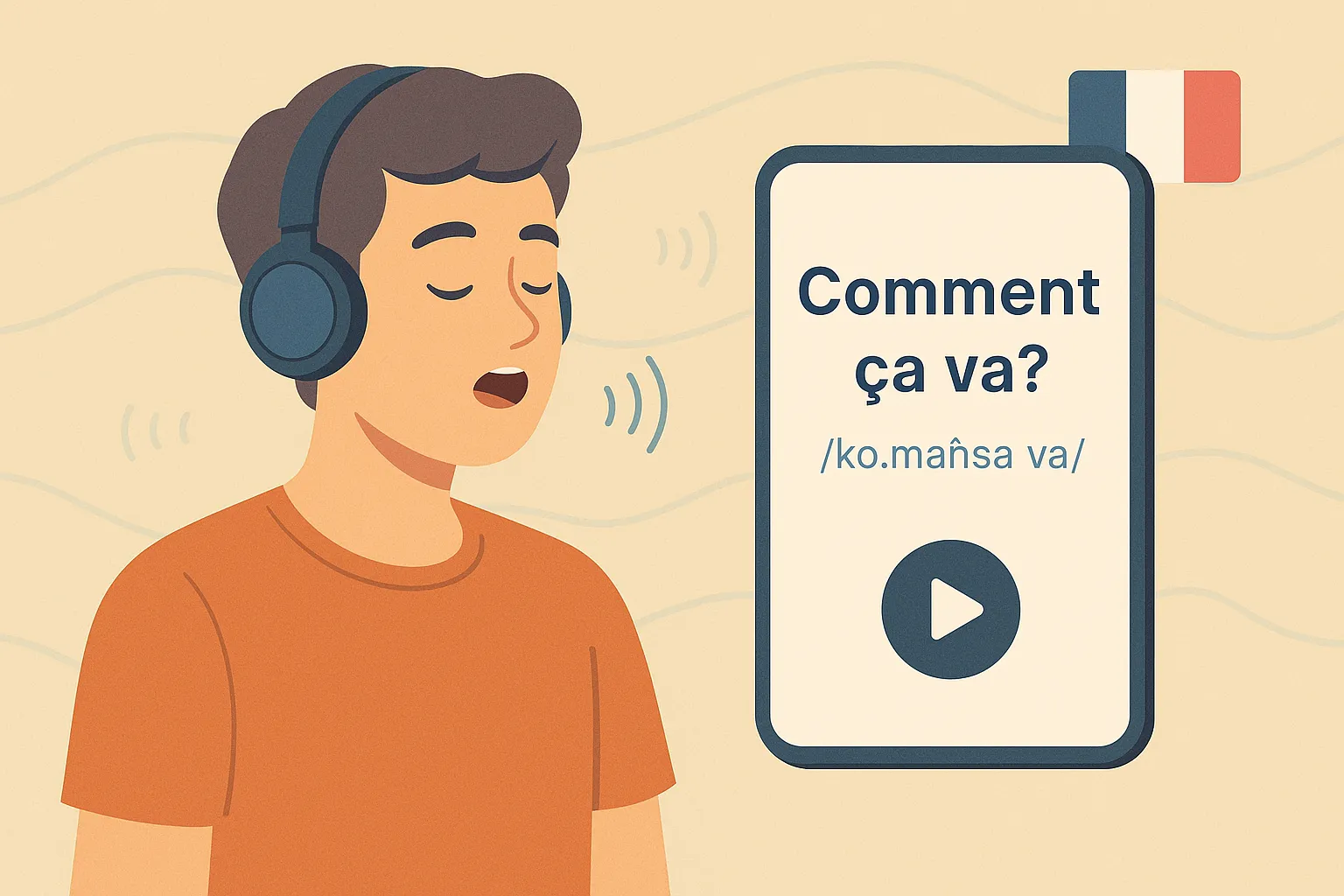
Why French sounds fast when it is not: the rhythm problem your English brain cannot solve alone
French is not faster than English. Research from the Université de Lyon measured speech rates across seven languages and found that French delivers roughly 7.18 syllables per second compared to English at 6.19. French has slightly more syllables per second but carries less information per syllable, which means the two languages transmit roughly the same amount of information in the same time. The difference is not speed. It is distribution. English concentrates meaning on stressed syllables and reduces unstressed ones to near-silence. French distributes syllable weight almost evenly, which means your English-trained brain is scanning for stress peaks that never arrive.
That scanning failure is what produces the “wall of sound” experience. Your brain expects a rhythm like “I WANT to GO to the SHOP” where capitalized syllables carry the meaning and the rest fades. French gives you “je-vou-drais-al-ler-au-ma-ga-sin” where every syllable gets roughly equal time and weight. No peaks. No valleys. Your English ear has nothing to grab onto, so it perceives the entire stream as fast, even when the speaker is talking at moderate speed. The think in French guide covers what happens after your ear adjusts: the next bottleneck is processing without translating.
Syllable-timed versus stress-timed: the fundamental difference
Linguists classify English as stress-timed and French as syllable-timed. In stress-timed languages, the intervals between stressed syllables stay roughly constant, which means unstressed syllables get compressed (the “schwa” reduction that makes “comfortable” sound like “comf-ter-ble”). In syllable-timed languages, each syllable gets roughly equal duration. The consequence for English-speaking learners: the rhythm template your brain has used since birth does not work for French. You are not learning new words. You are learning a new way of distributing sound through time. That is a deeper recalibration than vocabulary, and it explains why pronunciation progress often feels slow even when grammar and vocabulary are advancing.
The speed illusion
French feels 40% faster than it is because your brain is wasting processing cycles looking for stress patterns that do not exist. The moment you stop scanning for stressed syllables and start listening for connected phrases, the language slows down without anyone speaking slower. That shift usually happens around the third week of daily exposure to natural-speed audio.
Liaison: the 800-year-old system that erases word boundaries
Liaison is not a quirk of modern French. It is a relic of Old French pronunciation where final consonants were still pronounced. As spoken French evolved, those final consonants went silent in isolation but survived when followed by a vowel. “Vous” ended with a pronounced /s/ in the 12th century. Today that /s/ is silent when “vous” stands alone but reappears as /z/ before a vowel: “vous avez” becomes /vu.zave/. Liaison is not French adding a sound. It is French preserving a sound that used to always be there.
The three liaisons that cover 90% of spoken French
Grammar books list over forty liaison rules with obligatory, optional, and forbidden categories. At A1-B1, three patterns cover the vast majority of what you will hear in shops, cafés, and transport announcements. The /z/ liaison after plural markers and “vous.” The /n/ liaison after “un” and “on.” The /t/ liaison after “est,” “sont,” “quand,” and inverted verbs. Every other liaison rule is refinement for B2+ that you will absorb naturally through exposure once these three are automatic.
The /z/ links “vous” to “avez.” Without it, the sentence sounds choppy and unnatural to French ears.
Your ear hears “lezami” as one word. That is correct. French intended it that way. Plural /z/ liaison.
The /n/ connects “un” to “ancien.” Miss this and you hear two separate words where French hears one.
The /n/ after “on” connects to “a.” Without liaison this sounds like two separate statements.
The /t/ links across the word boundary. This is the liaison that catches A1 learners most often.
Why English speakers miss liaison
English separates words with micro-pauses. French does not. Your brain is trained to hear silence between words. French fills that silence with consonants. The fix is not listening harder. It is retraining your ear to expect connections instead of gaps. The Netflix guide trains this: French subtitles show you where the connections happen while the audio plays them.
Reductions: the gap between textbook French and the French people actually speak
Native speakers drop sounds constantly, and these drops follow predictable patterns. The “ne” in negation vanishes in roughly 95% of informal speech, which means that the full negation form your textbook taught (“je ne sais pas”) is the exception, not the rule, in any conversation between friends, colleagues, or family members. “Tu es” compresses to “t’es.” “Il y a” becomes “y’a.” These are not sloppy speech. They are standard spoken French. The false friends guide covers a parallel problem: words that look familiar but mean something different. Reductions are the phonetic version: sounds that should be there but are not.
The “ne” drop: the reduction that breaks every beginner
If you learned negation as “ne…pas” and you listen to natural French expecting to hear both elements, you will miss the negation entirely, because the “ne” disappears. “Je sais pas” sounds like a statement to an English ear that was trained to listen for “ne” as the negation marker. The fix: retrain yourself to listen for “pas,” “plus,” “rien,” and “jamais” as the primary negation signals. “Ne” is the written form. “Pas” is the spoken one.
The “ne” disappears. “Pas” carries all the negation. If you only learned the full form, you will not recognise the natural one.
“Tu es” compresses to one syllable. This happens in every informal conversation in France.
Three reductions in one sentence. “Il” drops, “y a” fuses, “de” shrinks to “d’.” Standard spoken French.
“Je ne” compresses to “j'” and the “ne” vanishes. The sentence loses two syllables.
The formal question structure collapses entirely. Informal French just inverts the word order instead.
Register matters. Use full forms with strangers, officials, and in formal settings. Use reductions with friends and in casual contexts. Speaking reduced French to a notaire sounds wrong. Speaking full-form French to a friend sounds robotic. The tu/vous guide covers the same register logic at the pronoun level. The business expressions guide covers the professional register where full forms survive.
Chunking: the technique that makes French speech slow down without anyone speaking slower
French prosody builds meaning in groups, not words. A train announcement does not say seven separate things. It says three blocks: [time] [action + destination] [detail]. Once you listen for blocks instead of individual words, you stop panicking about the sounds inside them. The technique is called chunking, and it is how native speakers of every language process speech. Your English brain already chunks English automatically. The goal is to build the same automatic chunking for French phrase patterns. The news phrases guide uses the same chunking logic for headlines: [topic] : [event] [number].
Transport announcements: the chunking training ground
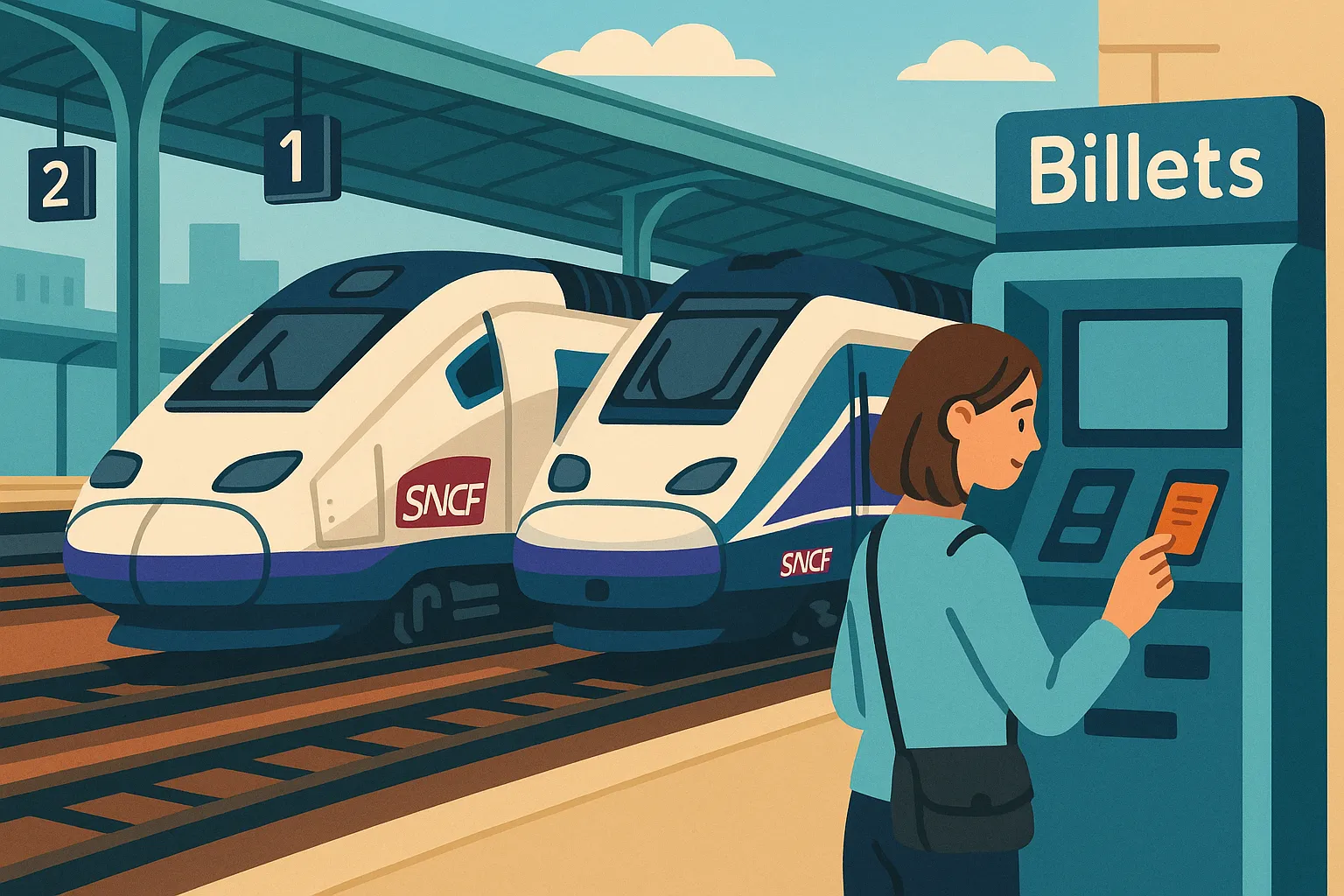
French transport announcements follow rigid templates. Once you know the template, you only need to catch the variable (the line number, the destination, the delay duration). Everything else is filler you already know. SNCF and RATP have not changed their announcement templates in decades, which means every train station and metro platform in France is a free listening exercise that repeats the same structures hundreds of times per day. The train tickets guide covers the vocabulary that fills these templates.
Three chunks: [time] ce soir à 18h → [action] le train pour Lyon part → [detail] voie cinq. Full story.
Template: [line] la ligne 4 → [direction] en direction de Bagneux → [problem] ralentie en raison d’un incident. Hear “en raison de” and expect a noun.
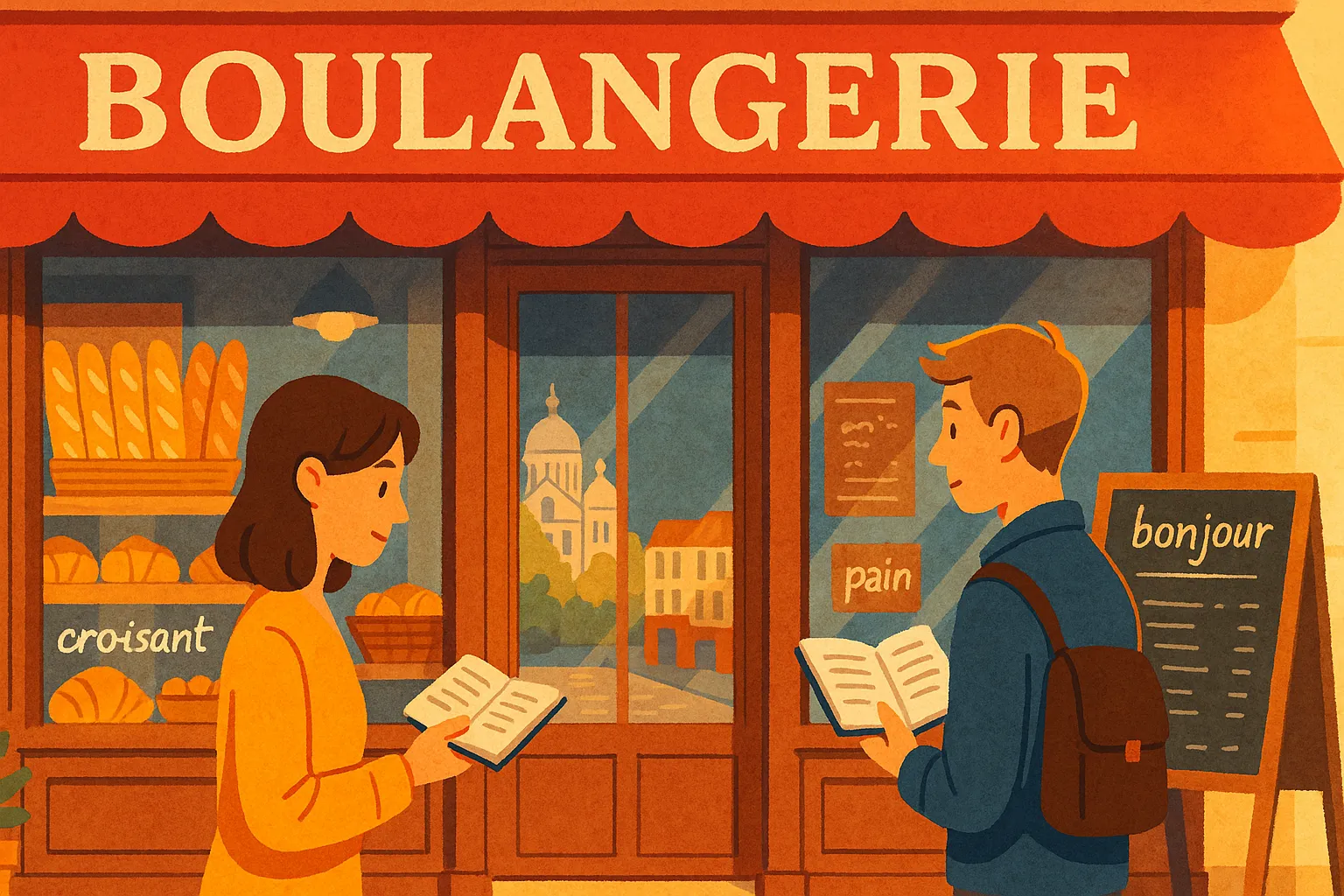
Market vendor hears three chunks: [greeting] bonjour → [items] deux pommes, un kilo d’tomates → [extra] un p’tit peu de basilic.
The market as pronunciation gym
Short sentences, clear numbers, immediate feedback. The vendor either gives you what you asked for or asks you to repeat. No stakes. Maximum repetition. Five stalls in a row and your ear has adjusted more than in a month of textbook audio. The café guide covers the ordering version. The restaurant guide covers the seated version.
Repair strategies: stay in the conversation instead of freezing
Freezing and asking “can you repeat everything?” is the beginner reflex. The better approach: confirm what you did hear and narrow the gap. It is faster, more polite, and the other person knows exactly what to clarify. The shy beginners guide covers the psychological side of the freeze response. This section covers the linguistic tools that keep you moving.
Partial repetition: the strategy that works better than “repeat please”
When you repeat the part you understood and mark the part you missed, the speaker fills only the gap instead of restarting from zero. “J’ai entendu voie… c’est bien voie cinq ?” gives the speaker a precise target. “Repeat please” gives them nothing, so they repeat everything at the same speed and you miss the same word again. Partial repetition is the single most effective repair strategy for A1-B1 learners in live French interactions.
The baseline repair. Works everywhere. Add “s’il vous plaît” in formal settings.
Partial repetition. Shows you are listening actively. The person only needs to confirm or correct one word.
Targets the specific section you missed instead of asking for the full sentence again.
For addresses, prices, and appointment times. Visual confirmation eliminates listening guesswork entirely.
When two words sound similar (/vwa/ vs /tʁwa/), narrow it down with a direct choice. Faster than a full repetition.
Confidence trick. Saying “j’ai entendu X, c’est correct ?” proves engagement, not confusion. French speakers respond better to partial understanding than to blank stares. The politeness guide covers why effort signals respect.
Mouth mechanics: the sounds that make or break comprehension
Three physical adjustments cover most of what English speakers get wrong in French production. The rounded vowels /u/, /y/, and /ø/ that English does not have. The nasal vowels /ɑ̃/, /ɔ̃/, /ɛ̃/ that English speakers tend to close with a hard consonant. And the French R, which is uvular (back of the throat) rather than alveolar (tongue tip) or retroflex (American R). Every other sound in French has a close enough English equivalent that approximation works. These three categories do not. Getting them wrong does not produce an accent. It produces incomprehension.
Rounded vowels: the muscle your mouth has never used
The French /y/ sound (as in “tu,” “rue,” “vu”) does not exist in any variety of English. It requires lip rounding combined with a tongue position that English speakers associate with the unrounded /i/ sound. The result is that English speakers hear “tu” and produce something between “too” and “tee” when the French sound is neither. The physical instruction: round your lips like you are saying “oo” but position your tongue like you are saying “ee.” The combination produces /y/. It feels strange. It looks strange. It sounds exactly right.
Keep lips rounded for all three. “Tu” and “tout” use different vowels but both need the same lip shape. English speakers relax too early.
/y/ vs /u/. Same word shape, different vowel. Mixing them up gives someone the opposite direction. Practise both back to back.
Nasal vowels: air through the nose, no consonant at the end
English speakers hear “bon” and produce “bonn” with a hard /n/ at the end. French nasal vowels route air through the nose but never close with a consonant. The /n/ or /m/ that appears in the spelling is a signal to nasalise the vowel, not a consonant to pronounce. “Pain” is /pɛ̃/, not “pan.” “Bon” is /bɔ̃/, not “bonn.” The difference is immediately audible to French speakers, and getting it wrong changes the word. The cinema guide gives you shadowing material where nasal vowels appear in every sentence of dialogue.
Air through the nose. No “n” at the end. The spelling has an N but the sound does not. English speakers add a hard consonant that French does not want.
The /ø/ sound does not exist in English. Round your lips like “o” but say “ay.” Strange at first. Essential for being understood.
The French R: short, light, and in the throat
The French R is produced by vibrating the uvula (the small piece of tissue at the back of the soft palate) against the back of the tongue. It is not rolled (that is Spanish or Italian). It is not the American R (which curls the tongue tip back). Think of a very gentle gargle that barely happens. The most common English-speaker error is making it too long and too loud. A French R in the middle of a word like “Paris” /paʁi/ should be almost imperceptible. If your R is the loudest sound in the word, it is too strong.
The R is shorter than you think. Barely there. A soft gargle that lasts less than the vowel on either side of it.
Smile vowels. Tongue forward, lips slightly spread. The opposite muscle set from the rounded vowels above.
The 2-minute commute routine
Pick one sentence. Whisper the slow version to place the sounds. Say the natural version twice at normal speed. Imagine the scene: a platform, a café, a pharmacy. When reality arrives, your brain recognises the melody before it processes the words. That recognition gap is where listening fluency lives. The 15-minute routine builds this into a complete daily system. The podcast guide gives you the audio material. The film guide gives you the shadowing scenes.
Pronunciation is the foundation every other skill depends on. The method guide makes it component one for a reason: bad habits at A1 become permanent at B1. The 3-month plan puts pronunciation on day one, not week four. The common mistakes guide covers the grammar errors that compound with pronunciation errors. “For sure.” 🕶️
You just decoded french, pronunciation, listening. We turn this into a weekly habit.
You know the words. The Pass connects them: weekly audio situations where liaison, reductions, and real-speed French become familiar instead of frightening.
Or start free with The Briefing.
One French news story every morning, picked at your level. Tax letters, prefecture vocabulary, political quotes: the institutional French decoded in three minutes, glossary built in.
- Process what you hear without translating it
- Netflix with French subtitles: see the connections while hearing them
- Film shadowing: copy the rhythm, not just the words
- Podcasts for pure audio training without visual cues
- The ordering scenarios where you test your ear live
- If the freeze response stops you from speaking
- Where pronunciation fits in the four-part system
- Why day one pronunciation matters for three-month plans