
Updated on September 16, 2026
French News for Beginners: Sources by Difficulty
Find French news sources suited to your reading and listening skills. Compare learner resources, authentic news and a practical reading routine.
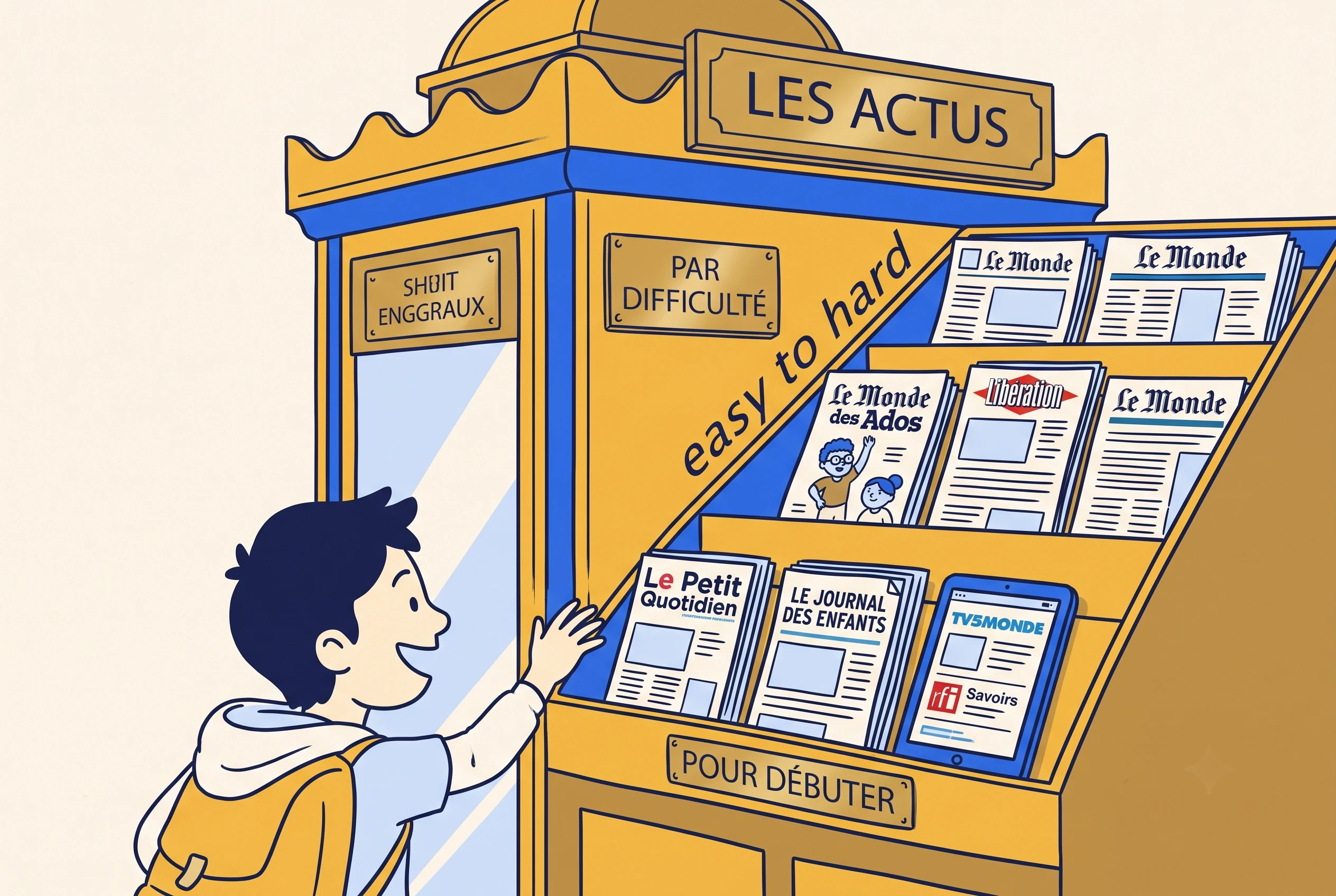
The subject, speed and amount of background knowledge all affect difficulty. Start with a source you can partly understand, then use the reading routine to work on a short item before moving to longer coverage.
Four reasons normal French newspapers feel impossibly hard at first
French learners often underestimate how difficult mainstream written news is because they compare it to everyday conversation. That comparison is misleading. News French is not café French. It is not textbook French. It is not even the same kind of French you hear in slow pedagogical podcasts. Journalistic French, especially in national newspapers and serious public-affairs media, assumes literate native readers who already understand the political system, the social context, and the historical background. Even when the grammar itself is not exotic, the density of meaning is much higher than in beginner-friendly language content.
There are four main reasons mainstream French news feels brutal. First, sentence length. Serious French journalism accepts long sentences with multiple clauses, parenthetical details, and compressed logic. Second, register. The vocabulary is often abstract, institutional, or political rather than concrete and daily. Third, assumed knowledge. An article can mention the Assemblée nationale, laïcité, les retraites, le pouvoir d’achat, the name of a minister, and a past reform without stopping to define anything. Fourth, style. French writing often feels more compact, less explicitly signposted, and more syntactically demanding than the English-language journalism many learners are used to.
A sentence like that is easy for an advanced learner, but for a beginner it is full of landmines: présenté, projet, réforme, vivement contesté, l’opposition, les syndicats. None of those words are especially rare in the news. They are normal. That is the point. Beginner frustration does not come from unusual French. It comes from normal native French encountered too early.
If you also want to make the transition from easier listening into harder reading more intelligently, this article works extremely well alongside the best French podcasts on Spotify for language learners and how to understand French radio debates, because news reading and news listening reinforce each other fast when the source difficulty is chosen properly.
The ranking system: how these French news sources are classified
The ranking below is not based on prestige. It is based on usability for learners. A source can be excellent journalism and still be a terrible starting point for an A2 learner. A source can be designed for children or learners and still be one of the smartest tools for building real news vocabulary. Each recommendation is ranked by practical difficulty, not by status.
| Level | What you can usually handle | What will still feel hard |
|---|---|---|
| A1 | Very short sentences, visual support, slow audio, high-frequency vocabulary | Abstract politics, dense opinion writing, long articles |
| A2 | Simplified news, children’s current-events media, slow native audio with transcripts | Mainstream newspapers, heavy commentary |
| B1 | Short authentic articles, teen-oriented news, easier current-affairs sources | Editorials, institutional French, multi-layered analysis |
| B2 | Most news summaries, many standard newspaper reports, some radio and TV summaries | Dense op-eds, culture writing, intellectual debate language |
| C1-C2 | Serious newspapers, long analysis, opinion sections, complex public-affairs media | Mainly speed, style, or specialist topic familiarity rather than basic language |
A1 level: true beginner French news sources that do not crush motivation
At A1, most learners should stop pretending they are ready for mainstream native news. The best beginner news sources are not “lesser” resources. They are the correct resources. At this stage, the goal is not to become a political analyst in French. The goal is to connect current events with core vocabulary, basic sentence patterns, and understandable audio or text. You want repetition, clarity, and concrete framing. If a source gives you that, it is good. If it gives you prestige and misery, it is bad.
1. 1jour1actu
Why it works so well: Adult learners often resist children’s news because they think it will feel childish. That is the wrong way to see it. 1jour1actu is useful because it explains the world assuming limited prior knowledge. That is exactly what a learner needs. The language is clearer, the framing is more explicit, and the visual context supports comprehension. You get real topics without being punished by opaque style.
Best use: Read a short article, then watch one of the explanatory videos. Use it to build a base in politics, science, environment, technology, and social issues without needing advanced French right away.
What makes it special: It also has theme pages and short explainer formats, which are perfect when you want one idea explained clearly instead of one endless article.
Access: Current news page | Videos | Children’s area
2. Le Petit Quotidien
Why it deserves a place here: This is one of the most practical French news products for very early learners because it is short, consistent, and written with an educational logic. That matters. The more predictable the format, the faster your reading becomes. Short daily pieces help you create a routine without the psychological burden of “reading the news” as a giant intellectual task.
Best use: Ten minutes a day. Read one item, underline recurring words, move on. Do not over-analyze. The value is consistency.
Access: Subscription page | Digital platform
💡 A1 rule: if you need a dictionary every single sentence, the source is wrong for your current stage. Beginner news should feel accessible, not humiliating.
A2 level: the first truly useful bridge into real current events
A2 is where French news becomes genuinely productive. You are still not ready for dense newspaper editorials, but you are ready to start building broad current-events vocabulary with well-chosen sources. At this stage, slow news, children’s and teen news, and carefully simplified audio become the best zone. The objective is to make current events part of your weekly French life without turning every session into a fight against syntax.
3. Journal en français facile (RFI Savoirs)
Why this is the classic choice: If you ask for one French news source that serious learners use again and again, this is the answer. It gives you genuine current events in simpler, clearer French, and the transcript support makes it enormously efficient. It is one of the best tools for learners who want to improve both listening and reading together.
Best use: Listen first. Then read the transcript. Then shadow one short paragraph out loud. That single sequence gives you news vocabulary, listening training, pronunciation, and rhythm in one exercise.
Why it is better than random YouTube “French news” content: The format is stable, the editorial quality is serious, and the learner support is built into the product.
Access: Journal en français facile | RFI Savoirs home
4. Mon Quotidien
Why it matters: Mon Quotidien sits in an excellent middle zone. It is more advanced than the youngest children’s formats, but still far less punishing than adult news. That makes it one of the best stepping stones for learners who want to leave pure beginner material without jumping into the deep end.
Best use: Read 3 to 4 pieces on the same theme across a week. Youth news is especially helpful because topics recur with clearer explanatory framing than adult media.
Access: PlayBac guide | Mon Quotidien access page | Digital platform
5. Easy French current-affairs street content
Why it belongs in a news list: It is not a newspaper, but it is one of the best ways to hear ordinary people react to public topics in understandable formats. For many learners, this is the missing link between simplified news and real social French. You hear what current-affairs French sounds like outside formal journalism.
Best use: Use it when you want to hear news-adjacent vocabulary in real mouths, with subtitle support. It pairs very well with easier reading sources.
Access: Easy French YouTube channel
At A2, your best strategy is to stop chasing prestige and start chasing sustainable exposure. Read what you can actually finish. Use audio when possible. Stay on one topic long enough that vocabulary begins repeating. That repetition is how “news French” starts to feel less alien. This also pairs well with phone-call French survival work, because both require you to recover meaning under pressure without understanding every word.
B1 level: where you can finally begin touching authentic native news
B1 is the level where many learners get impatient. They are tired of simplified sources and want “the real thing.” That instinct is understandable, but the correct move is not to leap into the hardest papers. The correct move is to begin with native sources that are shorter, clearer, more direct, and less stylistically dense than elite editorial journalism. If you pick well, B1 is where authentic French news starts becoming realistic.
6. 20 Minutes
Why it is one of the best first native choices: 20 Minutes is much easier to enter than heavyweight quality newspapers because articles are often shorter, more direct, and less stylistically dense. It is still native French. It still exposes you to real news language. But it does not punish you quite as hard as Le Monde opinion pages or dense political analysis.
Best use: Choose short national, society, science, lifestyle, or sports articles before touching deeper politics. At B1, article selection matters as much as source selection.
Access: 20 Minutes
7. L’ACTU
Why it is underrated: L’ACTU is one of the strongest bridge products between learner-friendly current affairs and adult media. It is aimed at teenagers, which means the topics are real, the tone is current, and the explanatory burden is still much higher than in elite newspapers. That combination is exactly what many B1 learners need.
Best use: If you feel children’s news is now too easy but 20 Minutes still burns you out, this is often the perfect middle path.
Access: L’ACTU subscription page | Digital platform
8. France 24 Français
Why it helps: France 24 is useful because you can often combine written articles with video and because many learners already know the international stories being discussed. That lowers context difficulty. It is not “easy French,” but it becomes much easier if you choose short reports, headline summaries, and major global stories you already followed in English.
Best use: Start with international topics you already know. Avoid long analysis pieces first. Use headline, intro paragraph, and video summary together.
Access: France 24 Français
9. Franceinfo
Why it matters: Franceinfo is one of the best places to see how mainstream public-service news French works in shorter formats. It is often more accessible than long newspaper features because many items are brief, event-focused, and structurally simple. The topic range is also wide enough that you can choose what suits your current level.
Best use: Prioritize short explainers, headlines, quick summaries, and news updates rather than opinion-heavy sections.
Access: Franceinfo
⚠️ Common B1 mistake: reading only one impossible article for 40 minutes with a dictionary open. Better method: read three shorter pieces at 70 to 80% comprehension and keep the reading flow alive.
B2 level: the level where mainstream news becomes genuinely useful
At B2, you can stop thinking in terms of “Can I read French news at all?” and start thinking in terms of “Which kinds of French news are most useful for my goals?” This is a major shift. You are no longer only trying to survive. You are now building range: politics, society, economics, science, culture, media criticism, interviews, and long-form features. But even at B2, source selection still matters a lot, because editorial voice and article type can radically change difficulty.
10. Le Monde
Where learners go wrong: They treat “Le Monde” as one thing. It is not. A short news brief, a straight report, a decoder piece, and an opinion column can sit worlds apart in difficulty. At B2, you can begin using Le Monde very profitably if you avoid the densest sections at first.
Best starting sections: short reporting, explanatory pieces, and some public-affairs summaries. Do not begin with long opinion columns if your reading stamina is still fragile.
Access: Le Monde | Les Décodeurs
11. Le Figaro
Why it is useful: Le Figaro exposes you to a different editorial culture and often to more conservative framing than some other major outlets. That matters for language learning because it teaches vocabulary through contrasting perspectives, not just through one ideological register.
What feels hard: Some pieces are very writerly, culturally dense, or opinion-heavy. Start with straight reporting before attempting the more argumentative material.
Access: Le Figaro
12. Libération
Why it helps advanced learners: Libération is useful because it exposes you to a sharper, more opinionated, often more socially and culturally engaged journalistic voice. This is valuable once you are ready for stronger tone, denser implication, and more ideological language.
What makes it harder: Tone, irony, and cultural references can raise the difficulty quickly.
Access: Libération
B2 is also when “news” can become a serious engine for your speaking. Read an article, then summarize it aloud in French in three minutes. That exercise brutally exposes your gaps, but it also accelerates progress faster than passive reading alone. It pairs very well with common French mistakes English speakers make, because summarizing current events tends to reveal structural habits you did not notice before.
C1-C2: when serious French news becomes a normal daily ecosystem
At advanced levels, the problem is no longer “Can I read it?” but “How deep do I want to go?” You can begin using newspapers, magazines, newsletters, long-form investigations, public radio articles, and opinion sections as part of normal life. This is also the stage where source identity starts mattering more than raw language difficulty. You choose media not just because you can understand them, but because of editorial line, thematic coverage, speed, and intellectual quality.
At this stage, Le Monde, Le Figaro, Libération, Franceinfo, France 24, public radio sites, and specialized outlets can all become normal. The remaining barriers are usually one of three things: specialist topic knowledge, culture references, or stylistic density. That is a much more interesting problem to have than “I do not know what this paragraph means.”
The single best progression strategy: parallel reading
If you want the fastest path from beginner-friendly news to real French media, use parallel reading. This means reading or understanding the story first in English, then consuming the French version immediately after. This is not cheating. It is efficient cognitive design. It removes the burden of discovering the news event and lets you focus on the French used to express it.
Suppose a major international event happens. You already know the names, the stakes, and the timeline from English coverage. When you open the French article, your brain is not dealing with both new information and new language at once. It is mostly mapping French phrasing onto known content. That makes the article feel much easier and gives you a huge vocabulary return.
- Read the event first in English from a reliable source.
- Open one French source at your level on the same event.
- Highlight repeated words and headline formulas.
- Read a second French source on the same story only if the first one felt manageable.
This method is especially powerful when combined with Google News France, because you can quickly compare multiple French sources on the same topic. The French Briefing does exactly this: real French stories, explained, with comprehension quizzes built in.
The smartest way to choose articles at your level
Do not select articles randomly. Difficulty is not only about source. It is also about article type. One publication can contain pieces at wildly different levels. If you want steady progress, start by choosing easier article genres before harder ones.
| Easier article types | Harder article types |
|---|---|
| headline summaries | editorials |
| breaking news briefs | op-eds |
| service journalism | high-culture criticism |
| science explainers | philosophical or literary essays |
| sports reports | deep institutional political analysis |
| photo-led current events coverage | ironic commentary pieces |
Science and practical explainers are often easier than politics because the structure is clearer and the writer spends more time defining concepts. Sports can also be easier if you already know the sport. Opinion writing is often disproportionately hard because irony, implication, tone, and rhetorical economy raise the difficulty sharply.
Try 3 real Gamebook questions — answers included
From the book · no email needed
Three small choices. How would you answer?
Choose an answer in your head, then open the correction. These are questions 2, 3 and 10 from Round 1, “Arrival in Nice”, page 52. The explanations below are added for this preview.
1. Translate: “a suitcase”
- un valise
- le valise
- une valise
- la valise
Show answer & explanation
Valise is feminine. Une means “a”; la means “the”. Learn the noun with its article.
2. Translate: “She is 29 years old.”
- Elle est 29 années.
- Elle est 29 ans.
- Elle a 29 ans.
- Elle a 29 année.
Show answer & explanation
French uses avoir for age: elle a + a number + ans. English uses “is”, which makes this an easy habit to carry over.
3. Server: Bonjour. Vous désirez ? You want one coffee politely.
- Donne-moi un café.
- Je voudrais un café, s’il vous plaît.
- Je veux un café maintenant.
- Je voudrais une café, s’il vous plaît.
Show answer & explanation
Je voudrais makes a polite request, and café is masculine: un café. The other choices are too direct here or use the wrong article.
2,000 questions. 40 rounds. Click your answers in the PDF or print a round and grab a pen.
Play on your computer or print a round. Full refund within 30 days.
The 30-day method to turn French news into a real habit
Try the routine with one story: open the latest French Briefing articles, choose a topic you recognise and read for the main idea. Listen to a few French sentences, check the explanations and save three expressions. Return to the same story before moving on to another.
- 1Week 1: pick one source onlyChoose one source that is clearly below your frustration threshold. Read or listen for 10 minutes every day. No jumping between six websites.
- 2Week 2: build a recurring vocabulary notebookWrite down only repeated words and headline formulas. News language repeats a lot more than learners think.
- 3Week 3: add one slightly harder sourceKeep your easier source as the base. Add one tougher article two or three times a week.
- 4Week 4: summarize aloudPick one article a day and explain it in French in 60 to 90 seconds. This turns passive reading into active language growth.
💡 The right difficulty rule: if you understand 95% of everything, it is probably too easy to drive growth. If you understand under 50%, it is probably too hard. The sweet spot is usually around 70 to 85% functional comprehension.
The grammar sheets behind the news
You have picked the sources that match your level. What decides whether you actually read them is a handful of grammar patterns: the articles and gender headlines drop, the past tenses, the present that stands in for narration, and the way French writes its numbers, dates and times. The free cheat sheet pack lays each one out on its own page, so the grammar stops being the reason you close the tab. Enter your email and the free cheat sheet pack downloads right away.
The most useful French news expressions to recognize early
The news becomes easier very quickly once you stop treating every article like thousands of unique words and start noticing the formulas that repeat constantly. Journalistic French loves recurring structures. Learn those and the page stops looking random.
Attribution again, except the source here is a set of numbers rather than a person with a name:
How does a newspaper tell you in four words which fight the article is really about?
Whoever acted, this noun will not say whether it was the police, a prefecture or a ministry:
Read past this one and a whole article about pensions goes by without telling you what is at stake.
Once you can recognize these instantly, news reading becomes much less exhausting. Instead of decoding from zero every time, you begin to move through familiar architecture.
The real ranking: best French news sources by learner profile
If you are a complete beginner and mainly want confidence
If you are around A2 and want real current affairs without drowning
If you are B1 and want the first authentic native sources
If you are B2+ and want serious newspaper reading
The hidden advantage of reading French news: it improves everything else
French news reading is not only about reading. It improves almost every other domain of your French if you use it well. First, vocabulary. News gives you high-frequency adult words that textbooks often delay too long. Second, listening. If you read a topic first, then hear it in a radio segment, the audio becomes far easier. Third, speaking. Summarizing current events is one of the best ways to move from passive knowledge into active production. Fourth, cultural literacy. You stop being the learner who can order coffee but cannot follow what French people are discussing at lunch, online, or in public life.
This is also where internal progression matters. If your grammar still collapses under pressure, connect your news work to the most common French mistakes English speakers make. If you want to strengthen listening on the same themes, connect it to French podcasts for learners and eventually French radio debates. If your goal is long-term fluency instead of random exposure, build these systems together.
Study glossary: essential French news vocabulary for learners
| 🇫🇷 French term | 🇺🇸 English meaning | 🎯 Why you need it |
|---|---|---|
| l’actualité | current affairs / the news | Core word for all news consumption |
| les nouvelles | the news | Common general news term |
| un article | an article | Basic reading vocabulary |
| selon | according to | Constantly repeated in reporting |
| a annoncé | announced | Classic headline/reporting verb |
| une réforme | a reform | One of the most common French news words |
| le gouvernement | the government | Essential politics vocabulary |
| les autorités | the authorities | High-frequency reporting term |
| les derniers chiffres | the latest figures | Very common in economics and public-policy reporting |
| une enquête | an investigation | Useful in crime, politics, and society coverage |
| une mesure | a measure / policy action | Appears in politics, health, and economy news |
| il s’agit de | it concerns / it is about | Key explanatory phrase |
| le pouvoir d’achat | purchasing power | Essential French economic vocabulary |
| l’opposition | the opposition | Necessary for political articles |
| en revanche | by contrast | Frequent contrast marker in more advanced news writing |
| cependant | however | High-frequency formal connector |
Final ranking: what you should actually start with today
If you are below B1, the smartest move is usually not a prestigious newspaper. It is Journal en français facile, 1jour1actu, Le Petit Quotidien, or Mon Quotidien. If you are around B1, 20 Minutes, Franceinfo, and France 24 often become your first realistic native sources. If you are B2 or stronger, the doors open much wider, but even then, choosing the right section matters more than pretending every article in every major newspaper is equally readable.
The learners who improve fastest are not the ones who keep attacking impossible articles to prove something. They are the ones who read at the right level every day, increase difficulty gradually, build repeated news vocabulary, and treat French current affairs as a long-term habit rather than a test of ego. Once that habit is in place, the progression is real and very visible. What felt impossible six months earlier starts looking normal. Headline formulas become automatic. Political vocabulary starts recurring. One article becomes three. Then the news stops being “study material” and becomes part of your life in French.
Want the version with training wheels first? Our French reading practice page sorts real news excerpts by CEFR level, with side-by-side translations.
Tomorrow morning, open Journal en francais facile before you open Le Monde. Ten minutes, one bulletin, then the transcript. Four weeks of that and the same words keep surfacing: selon, a annonce, une reforme, le pouvoir d’achat. The vocabulary of French news is small and stubborn, and the stubbornness is what teaches.
Prefer to keep it free today? Read the French Briefing →
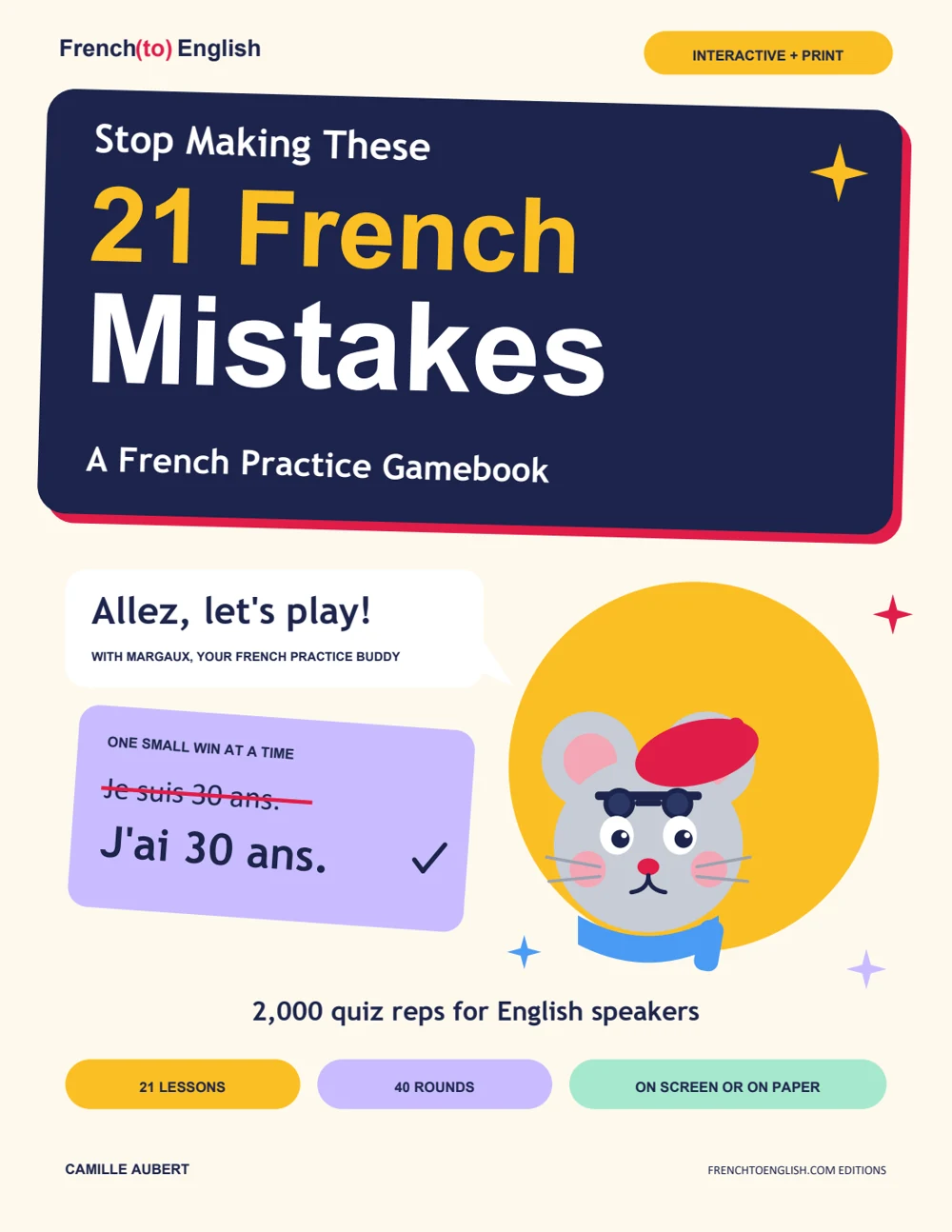
The French Gamebook
Check the small slips in otherwise good French.
For English speakers practising French
Use the Gamebook to revisit common mistakes, spot a gap and practise the point again. A review of the fundamentals to sit alongside your advanced reading and conversation.
- 21 lessons with explanations
- 40 practice rounds · 2,000 questions
300 pages · Play on your computer or print
Get the Gamebook · $9 Read a preview before you buyOne payment · Instant PDF download
Try the French with someone who can reply.
Bring a sentence you found difficult. Ask a tutor to help you say it naturally, then try it in a short conversation.
Find a French tutor →Paid lessons. Compare tutors and prices before booking.
Affiliate link: we may earn a commission when you book.
📚 Keep building in the Learning Center
French Instagram Captions: Meanings and Pronunciation
Find French Instagram captions for travel, food, love and everyday moments. Check their meaning, tone and pronunciation before…
Read →Understand French Radio Debates: A Listening Method
Follow French radio debates using discourse markers, topic vocabulary and structured listening. Learn to track arguments without catching…
Read →French News Websites: Editorial Lines and Reading Level
Compare French news websites by editorial focus, access and reading demands. Choose an outlet and build a routine…
Read →