
Updated on September 15, 2026
How to Learn French: A Practical Plan for English Speakers
Build a French study plan combining listening, reading, recall and speaking. Adapt the routine to your level, available time and practical goals.
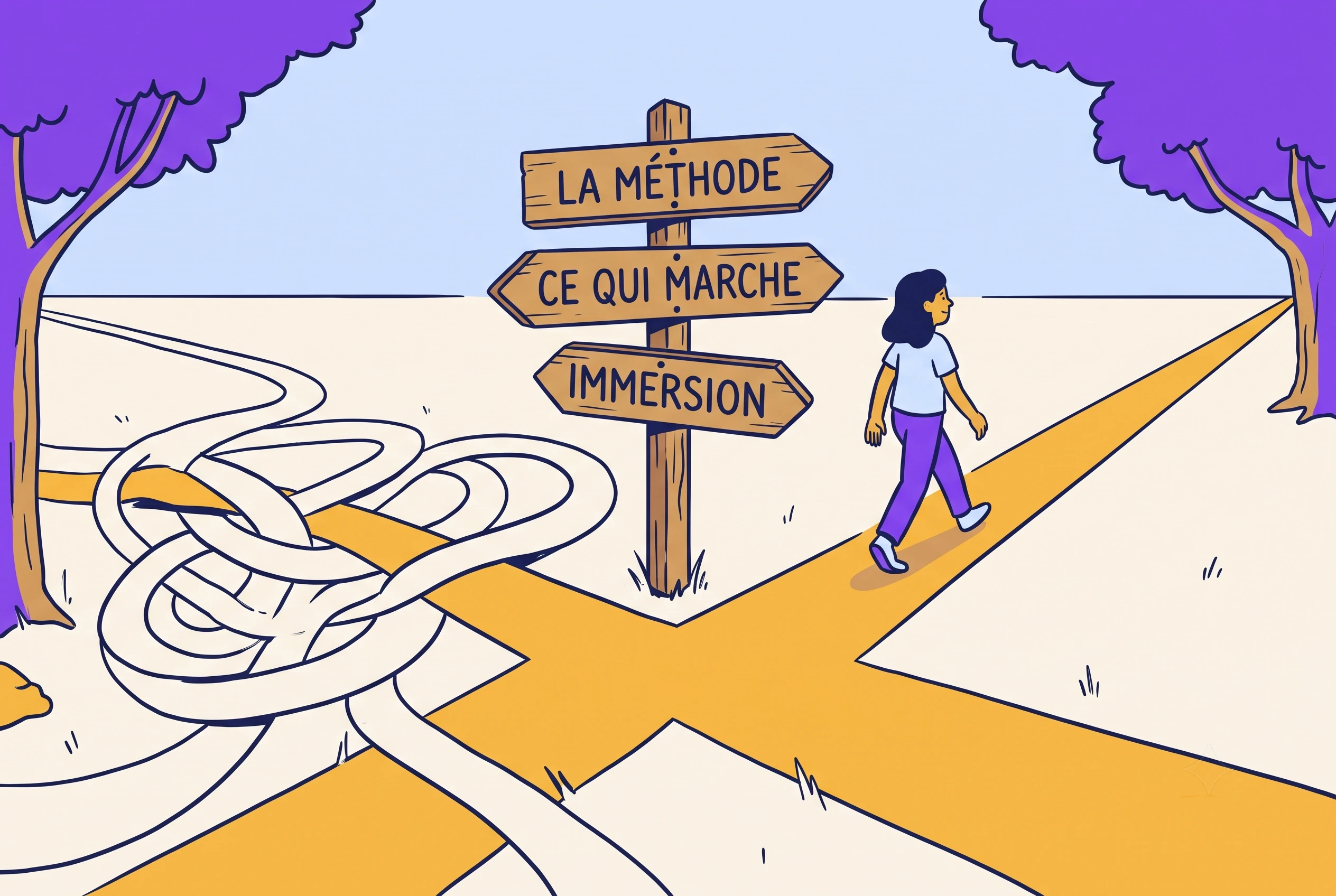
A useful plan connects the language you study to something you want to do. Set a manageable goal, combine input with recall and speaking, and adjust the routine when you see which tasks need more practice.
- The method — the four-part system that works at every level (you’re reading this)
- The 3-month sprint — what an intensive quarter can realistically reach
- The hour-by-hour timeline — CEFR levels and the study hours each one takes
The English speaker advantage: what it buys you and where it stops
About thirty percent of English vocabulary comes from French through the Norman conquest. “Restaurant,” “government,” “justice” require zero memorization. The suffix patterns alone give you hundreds of free words: English “-tion” → French “-tion” (information, nation, education), English “-ity” → French “-ité” (university → université, quality → qualité), English “-ous” → French “-eux” (dangerous → dangereux, curious → curieux). No Japanese or Arabic speaker has this head start.
That advantage accelerates A1 and fades by A2. After the shared vocabulary runs out, you hit gendered nouns, verb conjugations that change by person, tense, and mood, the subjunctive, and pronunciation patterns that bear no resemblance to English. Worse, the shared vocabulary creates false friends: “actuellement” means currently (not actually), “demander” means to ask (not to demand), “librairie” means bookstore (not library). Interference runs both ways, and it outlives fluency: the French speaker who still says “I am agree” in English.
Your foundation on nine cheat sheets
You just saw how the beginner’s head start fades and the four-part system takes over: grammar, input, production, and review. Our nine free cheat sheets put the core of that foundation on hand, from noun genders and present-tense verbs to key sounds and survival phrases, so the essentials sit next to you while you study. Enter your email and the free cheat sheet pack downloads right away.
The four-part system: what actually works at every level
Every successful French learner we observe uses the same four components. The ratio shifts by level, but the components stay constant. Drop any one and the system breaks.
- 1Structured grammar (30-40% of study time) Textbook, course, or teacher. Systematic progression through core competencies. Without structure, you learn random fragments. The books minimalist guide tells you exactly how many resources you need at each level.
- 2
- 3Active production (20-30% of study time) Speaking, writing, recording yourself. Without production, you understand but cannot respond. The shy beginners guide helps if speaking terrifies you.
- 4Spaced repetition (10-20% of study time) Reviewing vocabulary at increasing intervals. Anki, Memrise, or a notebook. Without review, you learn and forget. With review, vocabulary transfers to permanent memory.
The Duolingo trap. Apps are component 4 (review) pretending to be component 1 (structure). Gamification rewards exercise completion, not communication. Apps are fine for daily vocabulary maintenance. They are not a method. Students who use apps as their only tool reach A1 and stall.
The balance test. Did you speak, listen, read, AND write this week? If any skill was missing, your system has a gap. Gaps compound into plateaus. Most self-learners over-read and under-speak. Schedule speaking first; whatever sits last is what gets cancelled.
The daily schedule: 30 minutes, 60 minutes, or 2 hours
Consistency beats intensity. Thirty minutes daily outperforms three hours on Sunday. The 15-minute routine shows the absolute minimum viable system for people who think they have no time.
| Time | Breakdown | Expected result |
|---|---|---|
| 30 min/day | 10 min grammar · 10 min listening · 10 min vocab review | Minimum effective dose. Add 2-3 speaking sessions per week separately. |
| 60 min/day | 20 min course · 15 min reading/listening · 15 min speaking · 10 min review | All 4 components daily. The schedule that reaches B2 in 18-24 months. |
| 2h+/day | 30 min course · 30 min conversation · 30 min immersive content · 15 min writing · 15 min review | Full coverage. B2 in 12-15 months. Requires treating French as a daily non-negotiable. |
So how many months does this take? The honest answer depends on what you want to do in French, which is why we counted the hours level by level. The short version: schedule beats method, and a mediocre method run daily beats a perfect one run occasionally.
The five mistakes that waste months
1. Waiting until “ready” to speak. You are never ready, so start at A1 anyway and let readiness catch up with the speaking. 2. Deferring pronunciation. Bad habits at A1 harden by B1, and the ear problem is the same problem: chunking is what makes normal-speed French slow down. 3. Translating everything mentally. The round trip through English is a habit, and internal narration is how people break it. 4. App-only study. Gamification rewards the streak, not the sentence. 5. Passive consumption. French audio with English subtitles teaches nothing, so use the subtitle sequence that does. All five feel productive. That is what makes them expensive.
How the system shifts by level
The four components stay constant while the ratio shifts under them: A1 is grammar-heavy, B2 input-heavy. Not sure where you stand? The Level Quiz takes three minutes.
A1-A2: Foundation
40% grammar, 25% input, 20% production, 15% review. Structure dominates. Present tense, basic questions, top 1000 words, pronunciation habits. This is where apps actually help. The common mistakes guide prevents the errors that calcify at this stage.
B1: Expansion
25% grammar, 35% input, 25% production, 15% review. Input takes more weight. Past tenses, conditional, conversational fluency on familiar topics. French media becomes useful instead of frustrating. The Netflix guide and TV channels guide open up here.
B2-C1: Refinement
15% grammar, 40% input, 30% production, 15% review. Grammar drops to maintenance while input and production drive the progression, and the remaining work is the subjunctive, register awareness, specialized vocabulary. You read newspapers, debate opinions, and follow Canal+ series without subtitles. The political vocabulary and work culture vocabulary become relevant.
The B1 plateau: why month 6-12 feels impossible
Between months 6 and 12, progress feels invisible. You understand more than you can produce. Conversations feel harder than they should because your expectations outpace your output. Every learner hits it. The ones who push through by maintaining daily practice start accelerating around month 12-14. The ones who quit at month 8 restart at A2 six months later. The DELF B1 exam is the best antidote: put a test date on the calendar and the plateau has an expiration date.
The mistakes that quietly cost you months
Most English speakers who stall are not lazy or ungifted. They are doing something that feels productive but isn’t. These are the five patterns that waste the most time, and the fix for each.
1. Collecting resources instead of finishing one. Three apps, two textbooks and a YouTube playlist feel like progress, but switching between them resets your momentum. Pick one core resource per skill and finish it before adding another.
2. Studying grammar you can’t yet use. Learning the subjunctive at A1 is a comfort activity: it feels like “real French” without the risk of speaking. Learn structures roughly in the order you will actually need them — present, near future, passé composé, then the rest.
3. Waiting to feel ready before speaking. You never feel ready. The learners who progress fastest speak badly on purpose, early, and let corrections do the teaching.
4. Passive input with no output. Hours of listening with zero speaking or writing build recognition but not production. For every session of input, do a little output — a spoken summary, three sentences in a journal, a message to a tutor.
5. Measuring streaks instead of skills. A 300-day app streak can coexist with being unable to hold a two-minute conversation. Track what you can do (order a coffee, describe your weekend, argue a point), not how many days you logged in.
Study glossary: French learning method vocabulary
| 🇫🇷 French | 🇺🇸 English | 💡 Context |
|---|---|---|
| Programme structuré | Structured curriculum | Component 1: systematic study |
| Input compréhensible | Comprehensible input | Content slightly above your level |
| Production active | Active production | Speaking + writing, not just absorbing |
| Répétition espacée | Spaced repetition | Component 4: vocabulary retention (Anki) |
| Immersion | Immersion | Active exposure, not passive residence |
| Échange linguistique | Language exchange | Free conversation with French learners |
| Mot apparenté / faux ami | Cognate / false friend | Similar word (help vs trap) |
| Erreur fossilisée | Fossilized error | Permanent mistake from bad early habits |
| Lecture graduée | Graded reader | Book simplified for your CEFR level |
| Plateau | Plateau | The B1 wall. Normal. Temporary. |
| Technique du shadowing | Shadowing technique | Repeating after native speakers in real time |
| La régularité | Consistency | The only principle that beats every method debate |
The system is simple. Grammar, input, production, review. Every day. The method debate is noise. Consistency is signal.
Choosing tools? We compared every format, apps, tutors, software and immersion, in our 2026 guide to French courses, and settled the eternal app debate in Babbel vs Duolingo.
Month 8 is where most of the damage happens: progress has gone invisible, the plateau still has months to run, and the ones who stop there come back six months later and start again at A2. The acceleration is real and it arrives somewhere around month 12 to 14, which means the month you are most likely to quit and the month before it lifts feel identical from the inside.
Prefer to keep it free today? Read the French Briefing →
The French Gamebook
Check the small slips in otherwise good French.
For English speakers practising French
Use the Gamebook to revisit common mistakes, spot a gap and practise the point again. A review of the fundamentals to sit alongside your advanced reading and conversation.
- 21 lessons with explanations
- 40 practice rounds · 2,000 questions
300 pages · Play on your computer or print
Get the Gamebook · $9 Read a preview before you buyOne payment · Instant PDF download
Try the French with someone who can reply.
Bring a sentence you found difficult. Ask a tutor to help you say it naturally, then try it in a short conversation.
Find a French tutor →Paid lessons. Compare tutors and prices before booking.
Affiliate link: we may earn a commission when you book.
📚 Keep building in the Learning Center
French Learning Games for Adults: Pick a Format That Fits Your Life
French games for adults work best when the task feels useful and everyone can participate. Plan cooperative or…
Read →Learn French with a Game: Turn One Round into a Useful Study Session
To learn French with a game, choose one small language goal and make the rules serve it. Build…
Read →French Word Games: Five Ways to Practise More Than Spelling
French word games can help you notice spelling, word relationships and sentence choices. Explore activities for solo and…
Read →