
Updated on September 15, 2026
Montmartre in French: Walks, Cafés and Useful Phrases
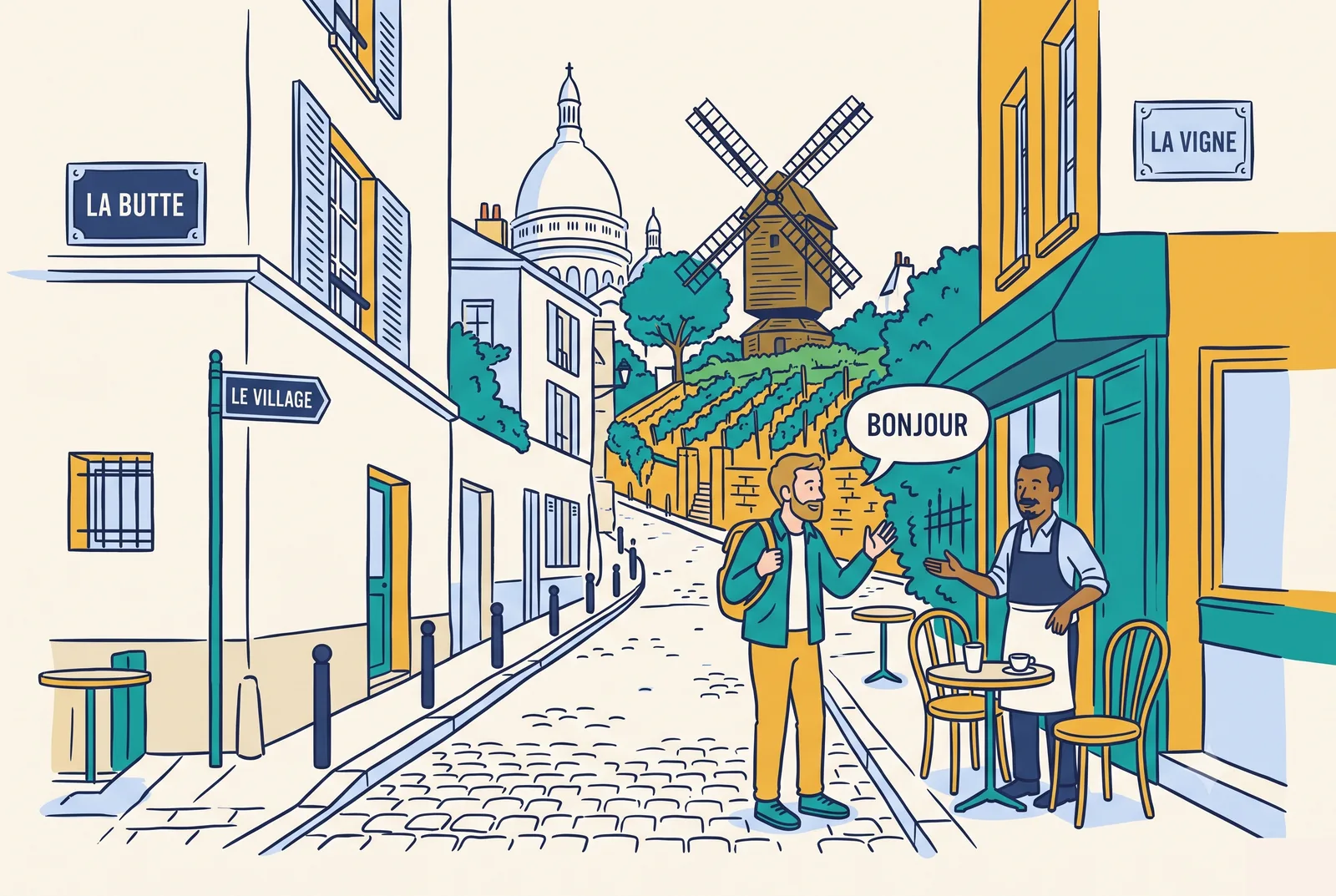
Explore Montmartre with French phrases for directions, cafés and art. Follow a walking outline and learn vocabulary for the neighbourhood.
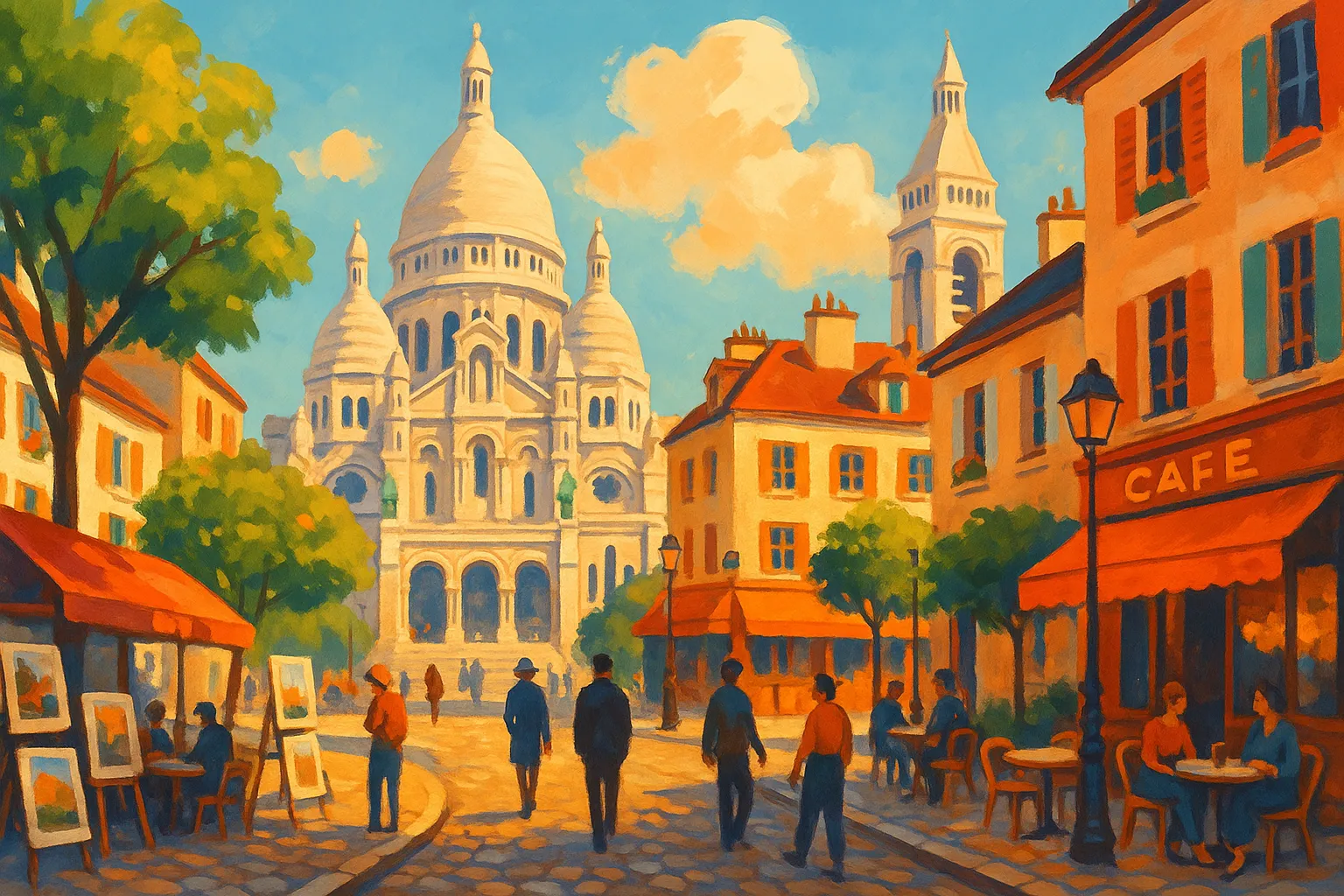
Use the neighbourhood as a setting for practical French: asking the way, reading a menu and discussing art. The walking outline provides context for the phrases; check local access and opening times when planning a visit.
Your first words: openers that actually work here
Montmartre rewards effort more than almost anywhere else in Paris. The side streets are quiet, the pace is slower, and the people you meet often live here rather than pass through. That changes the maths of a first interaction. In a packed brasserie near the Champs-Élysées, a waiter switches to English to move the queue. On the rue des Abbesses, admitting you only speak a little French usually makes the other person slow down and stay with you. The one rule that unlocks all of it is the one every guidebook mentions and most visitors still skip: you open with “bonjour”, every time, before anything else. Nobody fails that rule on vocabulary. They fail in the half second between knowing the word and getting it out, and the three-second rule, the pre-decided sentence and the rest of the anti-freeze kit were written for that half second. Walking up and starting in English, or worse, starting straight with your question, reads as rude in a way that quietly closes the door.
Notice what those lines do. None of them is a question yet. They are small signals that you know the code: greet first, apologise for the intrusion, admit your level. Once those three seconds are done, you can ask almost anything and the tone stays warm. Get the order wrong and the same words land badly: greeting before request is the first of the politeness rules Americans break without noticing, and not the only one.
The English trap
Everything within sight of the Place du Tertre runs on English menus and English-speaking staff, priced for people who will never come back. Step one street back and the language flips to French, and the prices drop with it. The rue des Trois Frères, the rue des Abbesses, the rue Lepic below the windmills: that is where the practice, and the real neighbourhood, actually are.
The real Montmartre: a village Paris swallowed
Montmartre does not feel like the rest of Paris because, for most of its history, it was not part of it. It was a separate village on a hill, “la Butte”, annexed by the city only in 1860. That late arrival is why the streets still curl like a village instead of running in Haussmann’s straight lines, and why locals talk about “le village” without irony. Knowing this one fact changes how you see everything around you, and gives you something real to say when a conversation opens up.
By 1900 the cheap rents had pulled in the painters. Renoir, Toulouse-Lautrec, then a young Picasso who shared a crumbling wooden studio building called the Bateau-Lavoir, where Cubism was more or less invented. The cabarets came with them: the Moulin Rouge at the foot of the hill, the Lapin Agile still standing near the top. Two of the old windmills survive too, the Moulin de la Galette and the Moulin Radet, from the days when the Butte was covered in them and milled the neighbourhood’s flour.
And the vineyard is real. The Clos Montmartre, planted on the north slope, still produces a few hundred bottles a year, celebrated every October at the Fête des Vendanges, the harvest festival. Drop any one of these into a conversation and you stop being a tourist reciting the Sacré-Cœur and become someone who actually knows where they are standing.
Any of these opens a warm conversation. The first is a line locals agree with instantly; the other two show you know the history, which turns a passer-by into a guide.
“People think Montmartre is the Sacré-Cœur and the Place du Tertre. But us, we live in the village. The real Butte is the little streets, the vineyard, the stairs. The rest is for postcards.”
Getting around the hill without the wrong words
Standard direction vocabulary quietly fails in Montmartre. “Tout droit”, straight ahead, means little when the street tilts almost vertically or turns into a staircase. Here the two words that actually navigate are “monter”, to go up, and “descendre”, to go down. Ask for a place and the answer will almost always be framed that way: you go up these stairs, you go down that lane. Build your questions around the climb and the replies suddenly make sense. The Paris survival guide handles flat-ground navigation; this is the hill version.
This one is worth asking someone who lives on the hill, not the staff at the funicular counter.
Notice they are all built around the climb. Yes, there are steps, around 300 from the bottom, and yes, the funicular near Anvers takes a normal metro ticket and saves your knees. But that last question is the one worth memorising on its own. The main staircase below the basilica is packed shoulder to shoulder in summer. Ask for the calmer route and you trade the crowd for the rue Saint-Rustique, one of the oldest streets in Paris, or the lanes around the vineyard, where the only sound is your own footsteps.
Save your legs. If the climb feels like too much, the funicular runs from the bottom of the hill up to the basilica in under a minute and takes a standard t+ metro ticket. Say “un ticket, s’il vous plaît” at the machine or the counter. Coming down on foot is the easy direction, and the views are better anyway.
Sitting down: ordering at a Montmartre café
Café time on the Butte is slower than downtown, and that is the point. At old rooms like Le Consulat, or the pink corner of La Maison Rose that every visitor photographs, nobody will hurry you. Nursing one coffee for an hour while you read or sketch is not tolerated, it is expected. Two rules save every first-timer money and embarrassment: the terrace always costs more than the counter or the room inside, and the waiter will never bring the bill until you ask. Read the tariff by the door before you sit down, because the three prices printed on it, comptoir, salle, terrasse, are the whole game, and if the coffee turns into dinner, booking by phone and surviving the host’s two questions is a separate set of reflexes you want before 19h30.
It reads as a decision to leave, never as a complaint about slow service:
Two small traps hide in there. Say “un crème” and never “latte”, or you get a glass of warm milk. And “une carafe d’eau” is the free tap water; skip it and you are handed a paid bottle. The host seats you, so wait rather than grabbing a table, and the bill only ever comes when you ask.
Place du Tertre prices. The cafés ringing the painters’ square charge two to three times the normal Paris rate for the same cup. Walk one block down the rue du Mont-Cenis or the rue des Trois Frères and the price halves. Always read the tariff posted by the door before you sit.
Art beyond the postcard painters
The artists crowding the Place du Tertre with easels are the visible, packaged layer. The living art scene is quieter and one street over: small galleries, print workshops, and studios wedged into residential buildings. Speaking even a little French to a gallerist changes the encounter from “tourist with a wallet” to “someone who is actually curious”, and the conversation you get back is completely different. Two vocabulary points do most of the work. When you mean a specific piece on the wall, say “un tableau”, not “une peinture”, which is the art form in general. And referencing the Butte’s own history, Toulouse-Lautrec, Renoir, the Bateau-Lavoir, shows you know whose streets these are. Why does the staircase look familiar before you have ever climbed it? Because most of these corners were filmed first, and we went through those films title by title, with the register each one trains, from Amélie’s café downhill to the steps everyone recognises.
Use “tableau” for a specific piece on the wall. The second question is the one that turns a transaction into a real conversation with the artist, and for the third, ask in any café: the regulars know which galleries are open that day.
The portrait trap
On and around the Place du Tertre, some sketchers start drawing you without asking, then hand over the paper and demand twenty or thirty euros. A firm “non merci” and keep walking is all it takes. A real artist shows you finished work and waits for you to come to them.
A one-hour walk, in the order that makes sense
If you only have an hour and you want the village rather than the crowd, this is the route locals would quietly recommend. It climbs gently, saves the famous view for last, and puts every word above into a real situation.
- 1Start at Abbesses. Come out of the metro (line 12, one of the deepest and prettiest stations in Paris) onto the Place des Abbesses. Around the corner is le mur des « je t’aime », the I-love-you wall, where the phrase is written around 300 times in 250 languages. A soft opening, and flat.
- 2Climb the rue des Trois Frères. This is the “step one street back” rule in action: real shops, real bakeries, real prices. Buy something and practise your bonjour. This is where the French actually happens.
- 3Cut to the vineyard. Follow the quiet lanes to the Clos Montmartre and the Lapin Agile cabaret. Ask a passer-by “il y a une vraie vigne ici ?” and watch the neighbourhood pride switch on.
- 4Coffee on a real terrace. Sit somewhere off the Place du Tertre, order “un crème, s’il vous plaît”, and do nothing for twenty minutes. That is flâner, and it is the whole point of the hill.
- 5Finish at the Sacré-Cœur, from the side. Approach from the rue Saint-Rustique rather than the main stairs. The same view, a fraction of the crowd, and you have earned it on foot.
Safety, scams, and the practical bits
The Butte is a calm, residential place, but the tourist magnets draw the usual crowd. Pickpockets work the packed steps below the Sacré-Cœur and the Place du Tertre, exactly where everyone stops to look up. The side streets are quiet and safe. The one scam worth naming is the bracelet sellers at the foot of the basilica stairs: they try to knot a string bracelet onto your wrist “as a gift”, then demand cash and block your way. The defence is simple and not rude. Keep your hands in your pockets, say “non” once, and keep moving. Do not stop, do not let them touch your wrist, do not argue. Warmth is the right instinct everywhere else on this hill; at the foot of those stairs it is the opening they are waiting for. If a flat refusal still feels brutal to an American ear, the section on why directness reads as clarity rather than rudeness is worth reading before you decide the country is cold.
The first line, said once and calmly as you keep walking, ends any bracelet-seller approach. The other two are the ones you hope not to need: say either in any shop or café and the staff will check lost-and-found or point you to the police.
Which metro. Anvers (line 2) drops you closest to the funicular and the busy climb. Abbesses (line 12) is deeper underground but opens onto the quieter, residential side of the Butte, which is the better place to start the walk above. Both take a standard ticket.
Study glossary: Montmartre vocabulary
| 🇫🇷 French | 🇺🇸 English | 💡 Context |
|---|---|---|
| la Butte | The hill/mound | What locals call Montmartre |
| le village | The village | Locals use it for the Butte, no irony |
| le quartier | The neighbourhood | “Ce quartier est magnifique” |
| monter / descendre | Go up / go down | The primary direction words here |
| les escaliers | The stairs | Montmartre has hundreds |
| les marches | The steps | Around 300 up to the basilica |
| le funiculaire | The funicular | A metro ticket works; saves your knees |
| le point de vue | The viewpoint | Several beyond the basilica steps |
| un café crème | Coffee with milk | “Un crème” for short; never “latte” |
| une carafe d’eau | A jug of tap water | Free, but you must ask by name |
| la terrasse | The terrace | Costs more than sitting inside |
| l’addition | The bill | Never arrives until you ask |
| un tableau | A painting (a piece) | Not “une peinture” when buying one |
| la vigne | The vineyard | Clos Montmartre, on the north slope |
| les vendanges | The grape harvest | Celebrated every October |
| le moulin | The windmill | Two survive: Galette and Radet |
| l’ambiance | The atmosphere | A compliment word for neighbourhoods |
| le commissariat | The police station | Hopefully never needed |
Montmartre is one hill in one city. The same bonjour opens a ticket window, a bar and a bakery counter: the phrasebook for the flat city below, what to order when the coffee turns into an apéro, and the two seconds you get to choose your bread.
Montmartre in French: quick questions
Do people in Montmartre speak English?
Around the Sacré-Cœur and the Place du Tertre, yes, everything runs on English. One street back into the residential lanes, far less. That is exactly why it is such good practice: open with “bonjour” and a little French and most locals will happily meet you halfway.
What does “la Butte” mean?
It is what locals call Montmartre. “Butte” means a hill or mound, and Montmartre sits on the highest natural point in Paris. Saying “la Butte” instead of “Montmartre” instantly sounds more like a resident than a visitor.
Is there really a vineyard in Montmartre?
Yes. The Clos Montmartre on the north slope still produces a few hundred bottles a year, and the harvest is celebrated every October at the Fête des Vendanges. It is one of the last working vineyards inside Paris.
How do I get up to the Sacré-Cœur without the stairs?
Take the funicular from the bottom of the hill near Anvers metro. It runs in under a minute and accepts a standard t+ metro ticket. Ask for “un ticket, s’il vous plaît” if you need to buy one.
How do I avoid the tourist prices?
Never sit at a café directly on the Place du Tertre, and check the posted tariff before you sit anywhere. Walk one block down streets like the rue des Trois Frères or the rue du Mont-Cenis and the same coffee costs roughly half.
What level of French do I need for Montmartre?
A1 to B1 is plenty. You need greetings, a handful of café and direction phrases, and the confidence to open with “bonjour”. Every phrase in this guide is written at that level, with its English translation.
Prefer to keep it free today? Read the French Briefing →
The French Gamebook
Practise the French behind everyday exchanges.
For English speakers practising French
Work on common mistakes before your next conversation. Play a Gamebook round, check the answers and try saying a few corrected sentences aloud.
- 21 lessons with explanations
- 40 practice rounds · 2,000 questions
300 pages · Play on your computer or print
Get the Gamebook · $9 Read a preview before you buyOne payment · Instant PDF download
Try the French with someone who can reply.
Bring a sentence you found difficult. Ask a tutor to help you say it naturally, then try it in a short conversation.
Find a French tutor →Paid lessons. Compare tutors and prices before booking.
Affiliate link: we may earn a commission when you book.
📚 Keep building in the Learning Center
French Travel Phrases for Hotels, Shops and Cafés
Practise French travel phrases for hotels, cafés, shops and transport. Learn follow-up replies and polite ways to ask…
Read →French Phone Call Phrases: Answer, Ask and Clarify
Prepare for French phone calls with phrases for answering, asking for repetition, leaving voicemail and ending a call,…
Read →Buy Train Tickets in French: Phrases and Station Words
Buy train tickets in French, use a ticket machine and ask about seats or platforms. Practise common questions…
Read →