
Updated on September 15, 2026
French–English Dictionaries: Which Tool to Use
Compare French–English dictionaries and context tools. Learn to check meaning, gender, register and conjugation with a practical lookup method.
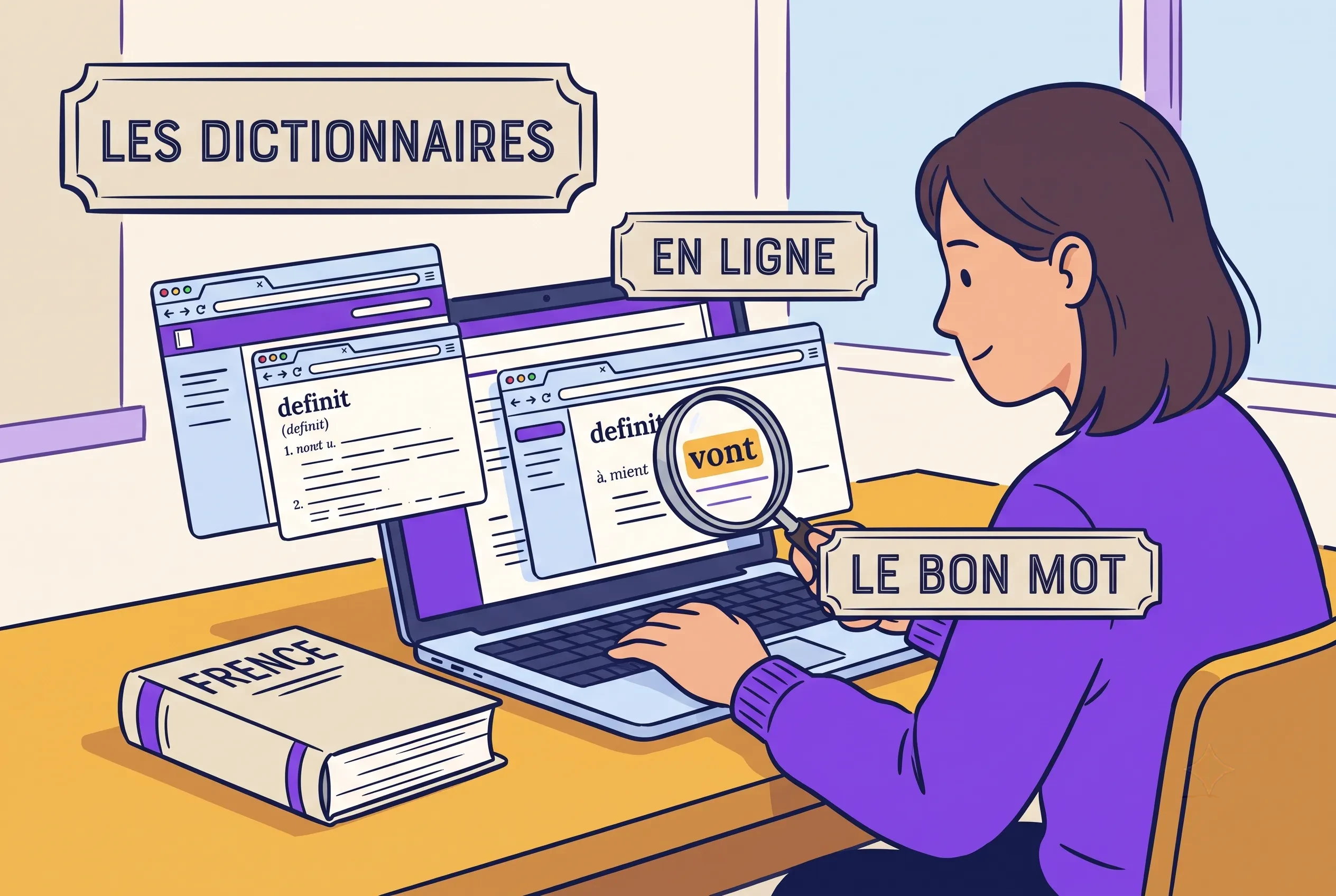
Different tools answer different questions: a definition, a grammatical form or usage in context. Start with the word's role in your sentence, then use the lookup method to avoid choosing the first translation automatically.
No single dictionary is the best one, and that is the actual answer. Use Linguee to see a word inside real sentences, Larousse or CNRTL to read its definition in French, and Forvo to hear it. WordReference is fine for a fast check and dangerous as your only source, because it hands you a translation before you have seen any context.
All of them are free. The paid options buy polish, not accuracy.
Context-based tools: see how French words actually live in sentences
Traditional dictionaries give you a word and a definition. Context-based tools give you the word inside twenty real sentences from official documents, news articles, and published translations. That is the difference between knowing what a word means and knowing how to use it.
| Tool | Type | Best level | Strength |
|---|---|---|---|
| Linguee | Professional bilingual corpus | A2-C1 | Millions of real sentence pairs (EU docs, corporate, press). The reference for professional translators. |
| Reverso Context | Conversational corpus | A2-B2 | Film subtitles, TV dialogues, informal texts. Complements Linguee on oral and casual register. |
| WordReference | Bilingual dictionary + forums | A1-B1 | Fast, familiar, with forum discussion. Good for quick lookups. Insufficient for natural usage. |
| DeepL | Advanced machine translation | B1-C1 | Better register handling than Google. Useful for paragraph drafts, not isolated words. |
The single-source trap
Relying on one dictionary is like navigating with one landmark. Linguee shows context. A monolingual dictionary shows nuance. WordReference shows the quick answer. The quick answer is often right. When it is not, you need the other two. The Google Translate fails guide shows exactly where single-source lookups produce the worst errors.
Monolingual French dictionaries: the switch that marks B1
At some point, looking up French words in English stops helping and starts hurting. Bilingual dictionaries give approximate equivalents. Monolingual dictionaries give actual meaning. “Flâner” translated as “to stroll” loses everything that makes the word interesting. “Flâner” defined in French reveals the cultural concept of aimless, deliberate observation that English has no word for.
| Tool | Best level | What it gives you |
|---|---|---|
| CNRTL | B2-C1 | The deepest French dictionary online. Free. Etymology, historical usage, literary citations, full semantic range. Search “flâner” and get Baudelaire. |
| Larousse en ligne | A2-B1 | Clear French definitions with examples, synonyms, antonyms. Less academic than CNRTL. The bridge between bilingual and monolingual. |
| Le Petit Robert | B2-C1 | Contemporary usage, audio, usage notes. Worth it for professionals. Free alternatives cover the same ground for most learners. |
The bilingual entry offers “culture shock” and kills half the word. The French definition keeps the excitement sitting next to the disorientation, which is the part that makes the word worth learning. That gap is the whole argument for going monolingual.
Students who work on thinking in French find that switching to monolingual dictionaries accelerates the shift. Every lookup in French is practice. Every lookup in English is a step backward. The books guide covers the same transition for reading material.
The transition method. Look up new words in Larousse French first. If you still do not understand after reading the French definition, check the bilingual entry. Over time, you need the bilingual check less and less.
How to read a French dictionary entry without missing half of it
Most people look at an entry, take the first bold word they recognise, and leave. The abbreviations around that word carry as much information as the translation itself, and they are the same in every French dictionary you will open.
| What you see | What it means | Why it changes your sentence |
|---|---|---|
| n.m. / n.f. | Masculine or feminine noun | Decides le or la, and every adjective that follows. Learn it with the word, never after. |
| v.t. / v.i. | Transitive or intransitive verb | Transitive takes a direct object, intransitive does not. This is why “répondre” needs à and “regarder” does not. |
| fam. | Familiar register | Fine with friends, wrong in an email to an administration. Half of learner embarrassment lives in this label. |
| littér. / soutenu | Literary or elevated | You will read it. Saying it out loud makes you sound like a nineteenth-century novel. |
| vieilli | Dated | The word is real and nobody under seventy uses it. Textbooks are full of these. |
| péj. | Pejorative | The translation looks neutral. The French word is not. |
The label that saves you the most trouble
Register labels matter more than definitions. A learner who picks a fam. word for a formal email has not made a vocabulary error, they have made a social one, and French readers notice it faster than a grammar slip. When two translations look equally good, the register label is the tiebreaker. The tu and vous guide covers the same instinct at sentence level.
Conjugation and gender: the two lookups you will do most
Vocabulary lookups feel like the main event. In practice, most of the time you spend in a dictionary goes on two much smaller questions: how does this verb behave, and is this noun masculine or feminine. Both have better tools than a general dictionary.
For verbs, a dedicated conjugator beats scrolling a dictionary entry. Type the infinitive and you get every tense laid out, including the ones you are avoiding. What matters is not memorising the table but noticing the pattern: French has far fewer irregular families than the endings suggest, and seeing prendre, comprendre and apprendre behave identically saves you three separate memorisation efforts.
For gender, the rule is simpler than it looks and nobody tells beginners: learn the article, not the noun. Storing “table” in your head is useless. Storing “une table” is permanent. Every dictionary gives you the gender in two characters and most learners skip past it, then spend a year guessing.
This is the question a dictionary answers instantly and a translator answers badly:
The two-second habit. When you note a new noun, write the indefinite article in front of it and never write the bare noun again. When you note a verb, write it with the preposition it takes: not “penser” but “penser à”. Those two characters carry most of the grammar you would otherwise learn twice.
Specialized dictionaries: when general tools fail
General dictionaries translate “formation” as “training” or “formation” without telling you which applies. Medical, legal, financial, and technical vocabulary requires tools that understand domain-specific meaning. The work culture guide covers the professional vocabulary where general dictionaries produce the worst approximations.
| Tool | Domain | Why it matters |
|---|---|---|
| Termium Plus | All professional fields | Government of Canada. Authoritative. Domain-labelled translations prevent “formation” = training OR geological formation ambiguity. |
| IATE | Legal, administrative, diplomatic | EU terminology database. 24 languages. The terms that general dictionaries approximate badly. |
| Forvo | Pronunciation | Real native speakers from multiple regions. Hear “croissant” from a Parisian and a Québécois. Knowing a word you cannot pronounce is knowing half a word. |
Never use a general dictionary for legal or medical translation. “Ordonnance” means “prescription” in medical French but “ordinance/decree” in legal French. General dictionaries list both without telling you which applies. Termium Plus labels each by domain. The moving to France guide covers the administrative terms where this matters most.
The lookup workflow: right answer in thirty seconds
- 1Linguee first: context before meaning See the word in real bilingual sentences before committing. “Assurer le suivi” shows “follow up” in business, “monitor” in medical.
- 2Larousse or CNRTL: French definition Understand the word in French. At B1+ this builds the think-in-French habit. At A2, skip and return later.
- 3Forvo: hear it Ten seconds. One click. Now you can say it. The pronunciation guide gives you the phonetic framework.
- 4Termium Plus: verify specialized meaning Only for professional, legal, medical vocabulary. General words skip this step.
- 5Note it: French word + IPA + definition + example sentence Five fields. Thirty seconds. Permanent vocabulary. The sentence from Linguee is the example you need.
Why WordReference is not step 1
WordReference gives you the answer before you have seen the context. That is fast but dangerous. You pick the first translation, use it, and it is wrong because the context required a different meaning. Starting with Linguee forces you to see usage before committing. The false friends guide shows exactly which words this prevents you from getting wrong.
Free vs paid. CNRTL, Larousse basic, Linguee, Reverso Context, Termium Plus, IATE, Forvo, and WordReference are all free. Le Petit Robert adds polish but not substance. Free tools match or exceed paid alternatives for most learners. One thing no dictionary fixes for you is typing the accents in the first place, which is a keyboard problem long before it is a vocabulary one.
The best dictionary is the one that makes you need it less over time. The method guide builds the system where dictionary lookups become verification, not crutches. The podcast guide adds the audio input that turns looked-up words into recognized sounds.
Where AI translators fit now, and where they still lie to you
DeepL and the general-purpose chat models have genuinely changed this. Ten years ago machine translation was a punchline. Today it produces paragraphs that read naturally, handles idioms it has seen before, and will explain its own choice if you ask. Pretending otherwise is not useful advice.
What has not changed is where it fails, and it fails in a specific and predictable place: the shorter the input, the worse the output. Give a model a full paragraph and the surrounding words disambiguate everything. Give it one word with no context and it picks the statistically common meaning, which is precisely the lookup you were doing.
| Use it for | Do not use it for |
|---|---|
| Getting the gist of a long French text quickly | Choosing between two candidate words for your own sentence |
| Checking whether your draft sounds natural | Confirming a word exists, because it will confidently produce one that does not |
| Asking why a native phrasing differs from yours | Register decisions, since it does not know who you are writing to |
The confident invention problem. Ask a model for a French idiom matching an English one and it will supply a fluent, well-formed, grammatically perfect expression that no French speaker has ever said. A corpus tool cannot do this, because it only shows you sentences somebody actually wrote. When the answer matters, verify in Linguee or Reverso Context before you use it. The machine translation failures guide shows what this looks like in the wild.
The honest position: AI translators are now an excellent reading aid and a mediocre writing aid, and they are worst at exactly the job a dictionary exists for. Use both, and let the corpus have the last word.
Which dictionary for your level (a quick decision guide)
The right dictionary is the one that matches where you are. Using a monolingual French dictionary at A1 is discouraging; leaning on a bilingual one at B2 keeps you translating instead of thinking in French.
A1–A2 — bilingual, with examples. Stick to a good French–English dictionary that shows full example sentences (WordReference, Larousse bilingual). You need to see the word used, not just its gloss.
B1 — start switching to monolingual. This is the level where a French-only dictionary (Larousse, Le Robert) stops being intimidating and starts building intuition. Look up new words in French first, and fall back to bilingual only when you’re stuck.
B2–C1 — monolingual by default, plus nuance tools. Use the CNRTL/TLFi for depth and register, and a context corpus like Linguee to see how a word behaves in real sentences.
Study glossary: dictionary and translation vocabulary
| 🇫🇷 French | 🇺🇸 English | 💡 Context |
|---|---|---|
| Dictionnaire / définition | Dictionary / definition | “Quel dictionnaire tu utilises ?” |
| Traduction | Translation | Converting between languages |
| Contexte | Context | What determines correct meaning |
| Registre | Register | Formal vs informal level |
| Synonyme / antonyme | Synonym / antonym | Similar or opposite meaning |
| Étymologie | Etymology | Word origin and history (CNRTL) |
| Prononciation | Pronunciation | How to say the word (Forvo) |
| Faux ami | False friend | Words that look alike but differ |
| Locution | Expression/phrase | Multi-word fixed meaning |
| Monolingue / bilingue | Monolingual / bilingual | FR-FR vs FR-EN dictionary |
The dictionary questions we get asked most
What is the best free French to English dictionary?
For a single recommendation, Linguee, because it shows the word inside real bilingual sentences rather than as an isolated gloss. If you want a classic dictionary layout, WordReference is the fastest. Both are free, and so are CNRTL, Larousse, Reverso Context, Termium Plus, IATE and Forvo. There is no paid tool that meaningfully outperforms that set for a learner.
Is WordReference reliable?
Yes, and that is not the problem. The entries are accurate. The risk is structural: WordReference hands you a list of translations before you have seen how the word behaves, so you pick the first plausible one and use it in a context that needed a different one. Used as a second opinion after a corpus check, it is excellent. Used alone, it produces confident errors.
DeepL or Google Translate for French?
DeepL, comfortably, on register and on anything longer than a sentence. Its French output reads far more naturally and it handles formal and informal tone better. Neither is the right tool for a single word, where both will simply give you the most common meaning regardless of your context.
When should I switch to a French only dictionary?
Around B1, and the test is behavioural rather than about your level on paper. Look a word up in Larousse in French. If you understand the definition without silently translating it, you are ready for that word. Most learners can do this for common vocabulary well before they feel ready, and the shift is the single biggest accelerator toward thinking in French.
Why does the same word have five different translations?
Because the French word covers a range that English splits across several words, or the reverse. Formation is training, education, a geological formation, or the act of forming, and only the sentence around it decides. This is exactly why context tools come first in the workflow: you are not choosing a translation, you are identifying which sense you are looking at.
Do I need a paper dictionary?
No. Paper dictionaries lose on lookup speed, on audio, and on the corpus examples that do the real teaching. The one argument for a physical dictionary is that flipping pages exposes you to neighbouring words, which is a genuine if small benefit. It does not outweigh hearing the word pronounced by a native speaker one click after you find it.
Prefer to keep it free today? Read the French Briefing →
The French Gamebook
Check the small slips in otherwise good French.
For English speakers practising French
Use the Gamebook to revisit common mistakes, spot a gap and practise the point again. A review of the fundamentals to sit alongside your advanced reading and conversation.
- 21 lessons with explanations
- 40 practice rounds · 2,000 questions
300 pages · Play on your computer or print
Get the Gamebook · $9 Read a preview before you buyOne payment · Instant PDF download
Try the French with someone who can reply.
Bring a sentence you found difficult. Ask a tutor to help you say it naturally, then try it in a short conversation.
Find a French tutor →Paid lessons. Compare tutors and prices before booking.
Affiliate link: we may earn a commission when you book.
📚 Keep building in the Learning Center
French Learning Games for Adults: Pick a Format That Fits Your Life
French games for adults work best when the task feels useful and everyone can participate. Plan cooperative or…
Read →Learn French with a Game: Turn One Round into a Useful Study Session
To learn French with a game, choose one small language goal and make the rules serve it. Build…
Read →Speaking French as a Shy Beginner: Practical Steps
Practise speaking French through small, manageable exchanges. Find starter phrases, rehearsal methods and a gradual plan for shy…
Read →