
Updated on September 15, 2026
The French Fifth Republic: President and Parliament
Understand the French Fifth Republic through the president, prime minister, parliament and elections, with explanations and political vocabulary.
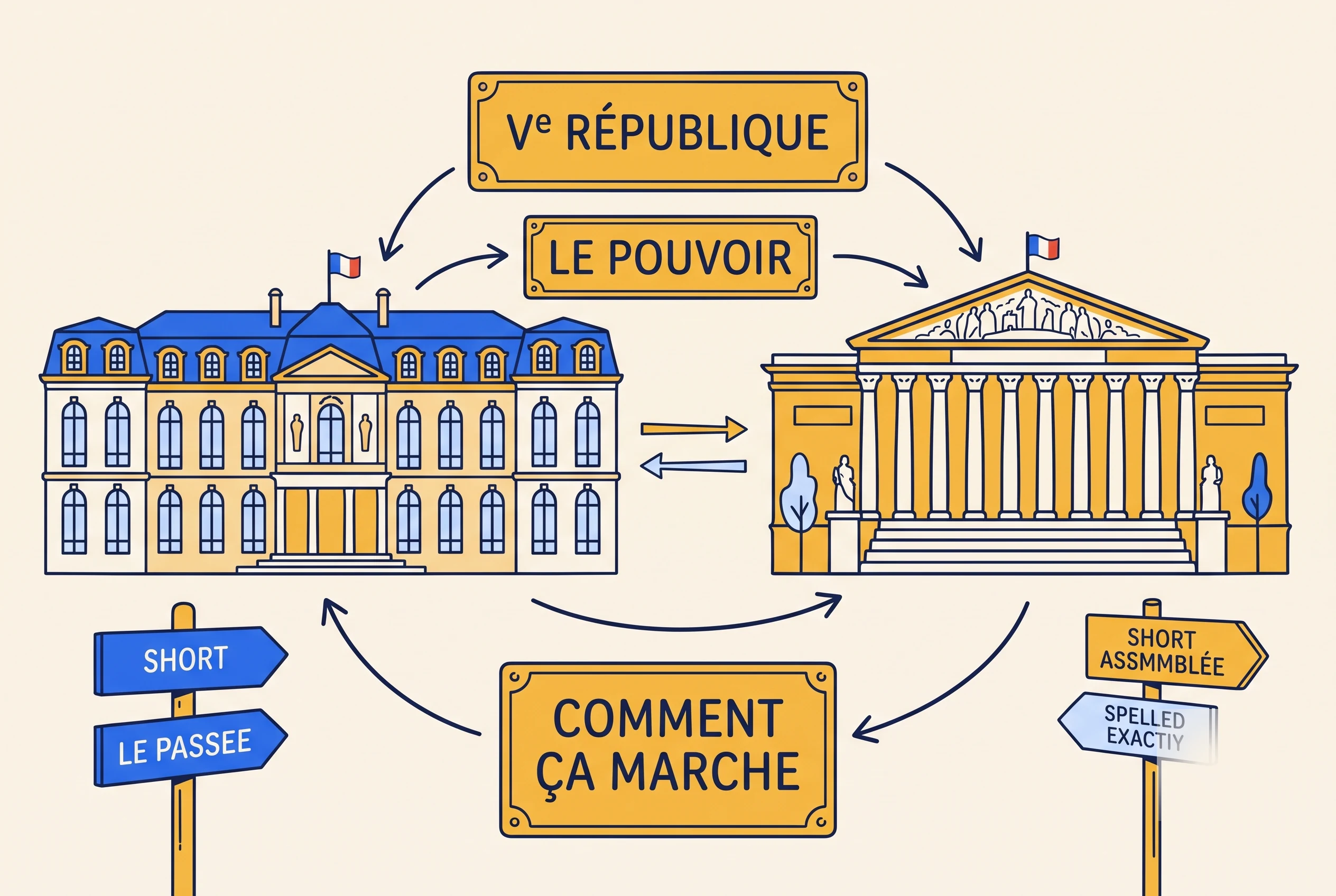
Start with the roles of the main institutions, then follow how they relate to elections and law-making. The vocabulary helps you read political coverage without confusing the president, government and parliament.
From the First Republic to the Fifth: why France kept rewriting the rules
France has had five republics, two empires, a restoration monarchy, and a wartime puppet state. No other major Western democracy rewrote its constitution this often. That is not chaos. It is a country that kept discovering that the previous system could not absorb the next crisis. Each republic died from a specific structural failure. Understanding those failures is the fastest way to understand why the Fifth Republic works the way it does.
First Republic (1792-1804): revolution without stability
Born from the Revolution, the First Republic never stabilized. It produced the Terror, the Directory, and eventually Napoleon’s coup. The lesson France took from it: revolutionary legitimacy alone cannot build durable institutions. The republic lasted twelve years and ended in an empire. The vocabulary of French civic life (citoyen, liberté, égalité, fraternité, la République) was forged here, but the institutional design was not durable enough to carry it.
Second Republic (1848-1852): a president who became emperor
The Second Republic introduced direct presidential election. Louis-Napoléon Bonaparte won, then used the presidency to destroy the republic and declare himself Emperor Napoleon III. The lesson: a directly elected president with insufficient institutional checks can use democratic legitimacy to dismantle democracy. This explains why the Third and Fourth Republics were so suspicious of executive power, and why the Fifth Republic designed elaborate constraints around the presidency even while making it powerful.
Third Republic (1870-1940): parliament as absolute sovereign
The Third Republic lasted 70 years, longer than any other French regime since the Revolution. It survived WWI. But its design was deeply parliamentary: the President was ceremonial, the Prime Minister (président du Conseil) governed only as long as shifting coalitions allowed, and cabinets fell constantly. Governments averaged about eight months. That instability was tolerable in peacetime. It was catastrophic in 1940. The Third Republic voted itself out of existence and handed power to Pétain. The lesson: pure parliamentary sovereignty without a strong executive is vulnerable to crisis paralysis.
Fourth Republic (1946-1958): the same problem, amplified
The Fourth Republic rebuilt after WWII with almost the same parliamentary design. Coalition governments fell even faster. The Algerian War broke the system. In 1958, France recalled de Gaulle, who demanded and received permission to write a new constitution. That constitution became the Fifth Republic. The lesson was finally absorbed: France needed a strong, directly elected president who could act during crisis, combined with a government still accountable to parliament. The hybrid design is the point.
Why this history matters for reading French news
When a French article mentions dissolution, motion de censure, or article 49.3, it is referencing tools that exist precisely because previous republics did not have them and collapsed. The vocabulary is constitutional memory, not decoration.
How political power really works in the Fifth Republic
The President is elected directly by voters for five years. The Prime Minister is appointed by the President but only governs if the government can survive in the National Assembly. Who runs France? The President sets direction: diplomacy, defense, arbitration, strategic timing. The Prime Minister handles machinery: parliamentary management, ministers, domestic execution. Same executive branch. Different pressure points.
When presidential and parliamentary majorities align, the system looks almost presidential. The President dominates, ministers follow line, the Prime Minister acts as chief operator. When they do not align, the same institutions produce cohabitation: slower, more negotiated, less photogenic. Much more French.
President
Elected directly. Strategic direction, foreign affairs, defense, appointments, dissolution power. Sets the frame and tempo of national politics.
Prime Minister
Appointed, survives via Assembly. Coordinates ministers, manages parliament, carries domestic policy. Turns constitutional authority into daily governing capacity.
Where Parliament still matters
The National Assembly is the politically decisive chamber: it votes laws, questions ministers, and can topple the government through a motion de censure. The Senate revises, delays, and carries constitutional weight. If you remember one thing: the Assembly decides political survival.
| Institution | Main leverage | What it changes |
|---|---|---|
| National Assembly | Votes, censure, final legitimacy | Whether a government can continue governing |
| Senate | Revision, delay, constitutional weight | Shape and pace of legislation |
| Constitutional Council | Reviews constitutionality post-vote | Can strike down laws after parliament finishes |
49.3 does not mean parliament disappeared. It means the government used a constitutional shortcut that still leaves room for a censure vote. If an article mentions 49.3, keep reading. The political story is not over.
France vs USA vs UK: why the mental translation always fails
This is where most English speakers go wrong. They read French politics through the lens of the system they already know, and every institution comes out slightly distorted. The Fifth Republic is neither presidential like the US nor parliamentary like the UK. It is a hybrid that borrows from both and obeys neither. Here is why each comparison breaks.
France vs USA: the president is not what you think
American readers assume the French President works like the US President. Similar title, completely different job. The US President is head of state and head of government: they run the cabinet, set the legislative agenda, and take personal responsibility for domestic policy. The French President is head of state but does not directly run the government. That is the Prime Minister’s job. The French President arbitrates, directs foreign policy, commands the military, and can dissolve the Assembly. But domestic governance passes through the Prime Minister and the cabinet, who must survive parliamentary confidence.
The biggest difference: the US President cannot dissolve Congress. The French President can dissolve the National Assembly and call new elections. The US President faces impeachment (political trial). The French President faces cohabitation (forced power-sharing). These are structurally different consequences of losing political support.
🇺🇸 US President
Head of state + head of government. Runs the cabinet directly. Cannot dissolve Congress. Fixed 4-year term. Congress cannot topple the executive (except impeachment). Separation of powers is absolute.
🇫🇷 French President
Head of state only. Appoints PM who runs the cabinet. Can dissolve the Assembly. 5-year term. Assembly can topple the government (censure). Separation of powers is flexible, depends on majority alignment.
France vs UK: the prime minister is not what you think either
British readers assume the French Prime Minister works like the UK PM. Also wrong. The UK Prime Minister is the dominant political figure: they lead the majority party, control the legislative agenda, and the monarch is ceremonial. In France, the Prime Minister is politically subordinate to the President when majorities align. The PM becomes powerful only when cohabitation forces a split. There is no French equivalent of the UK monarch: the French President is a politically active head of state, not a ceremonial one.
The UK has no written constitution. France has one of the most detailed constitutions in Europe. The UK has parliamentary sovereignty: Parliament can do almost anything. France has constitutional review: the Constitutional Council can strike down laws that violate the constitution. The UK has no second round of elections. France has two rounds for both presidential and legislative elections, which completely changes coalition dynamics.
🇬🇧 UK Prime Minister
Head of government and leader of the majority party, dominant in a system with a ceremonial monarch, no written constitution, first-past-the-post elections, and a sovereign Parliament.
🇫🇷 French Prime Minister
Head of government, appointed by President, subordinate to him when majorities align and powerful only during cohabitation: written constitution, two-round elections, a Constitutional Council that can override parliament.
Why the comparison matters for reading French news
When a French article says the Prime Minister “directs government action,” an American reader thinks “so the PM is the real boss” (wrong: the President dominates when majorities align). When a British reader sees the President dissolving the Assembly, they think “constitutional crisis” (wrong: it is a normal constitutional tool used multiple times). The elections vocabulary guide gives you the terms. This section gives you the map that makes those terms click.
Keep the fundamentals within reach
You just worked out how the Fifth Republic actually runs, from the President down to a motion de censure. Reading French politics at this level goes faster when the basics stay sharp underneath, so we bundled nine one-page cheat sheets on the essentials: key verbs, tenses, gender, numbers, and more. Enter your email and the free cheat sheet pack downloads right away.
Why the two-round election changes everything
French presidential elections use two rounds. First round: preference. Second round: coalition. The first round lets voters signal identity, ideology, irritation. The second forces aggregation: you vote for what you can live with. Between the two Sundays the words change, and front républicain, la majorité and every other campaign term, set out in plain English, are how you tell which round a commentator has already moved to. Hard lines in round one become strategic positioning in round two, and 2027 will run the whole mechanism past you.
Fast reading rule. If a French political article mentions alliances, withdrawals, or vote transfers (report de voix), you are already in second-round logic even before the ballot happens.
Cohabitation: when power splits
Cohabitation is the moment foreign readers finally see the architecture. The President stays President, but domestic authority shifts toward a Prime Minister backed by an opposing parliamentary majority. The President retains diplomacy and defense. The PM carries domestic policy. France designed a system that absorbs rivalry without rewriting the constitution. The US cannot produce cohabitation (President and Congress are separate branches). The UK cannot produce cohabitation (the PM is the majority leader). Only France’s hybrid model creates this specific dynamic.
What this means for reading French politics
You do not need a political science degree, only four questions asked in order: who has electoral legitimacy, who has parliamentary backing, which procedure is being used, and whether the legal story is finished. Once those become automatic, articles slow down. Where you read matters as much as what you know: where each paper stands politically tells you what you are reading before you open it, and the beginner sources, ranked by difficulty, give you the plainest ones first. Baron Noir dramatizes the whole machine across 24 episodes. The radio debates are the same vocabulary at speaking speed.
Study glossary: French political institutions
| 🇫🇷 French | 🇺🇸 English | 💡 Context |
|---|---|---|
| La Cinquième République | The Fifth Republic | Current regime since 1958 |
| Le Président de la République | The President | Head of state, strategic and constitutional powers |
| Le Premier ministre | The Prime Minister | Head of government operations |
| L’Assemblée nationale / le Sénat | National Assembly / Senate | Lower chamber (decisive) / upper chamber (revision) |
| La motion de censure | No confidence motion | Can bring down the government |
| La dissolution | Dissolution | President dissolves Assembly, calls elections |
| La cohabitation | Cohabitation | President and majority from opposing camps |
| Le projet / la proposition de loi | Government bill / private member bill | Two origins of legislation |
| Le Conseil constitutionnel | Constitutional Council | Reviews constitutionality of laws |
| Le Conseil d’État | Council of State | Supreme administrative court |
| Le report de voix | Vote transfer (2nd round) | How first-round votes shift in the runoff |
| Le scrutin uninominal à deux tours | Two-round majority voting | The election system for president and deputies |
An English-speaking reader watches a censure motion pass and waits for the President to go. He does not go. The government falls, the President appoints another Prime Minister, and the office at the top is the one thing the Assembly cannot vote out. Four earlier republics collapsed before France settled on that arrangement.
Prefer to keep it free today? Read the French Briefing →
The French Gamebook
Check the small slips in otherwise good French.
For English speakers practising French
Use the Gamebook to revisit common mistakes, spot a gap and practise the point again. A review of the fundamentals to sit alongside your advanced reading and conversation.
- 21 lessons with explanations
- 40 practice rounds · 2,000 questions
300 pages · Play on your computer or print
Get the Gamebook · $9 Read a preview before you buyOne payment · Instant PDF download
Try the French with someone who can reply.
Bring a sentence you found difficult. Ask a tutor to help you say it naturally, then try it in a short conversation.
Find a French tutor →Paid lessons. Compare tutors and prices before booking.
Affiliate link: we may earn a commission when you book.
📚 Keep building in the Learning Center
French Instagram Captions: Meanings and Pronunciation
Find French Instagram captions for travel, food, love and everyday moments. Check their meaning, tone and pronunciation before…
Read →French News for Beginners: Sources by Difficulty
Find French news sources suited to your reading and listening skills. Compare learner resources, authentic news and a…
Read →French News Websites: Editorial Lines and Reading Level
Compare French news websites by editorial focus, access and reading demands. Choose an outlet and build a routine…
Read →