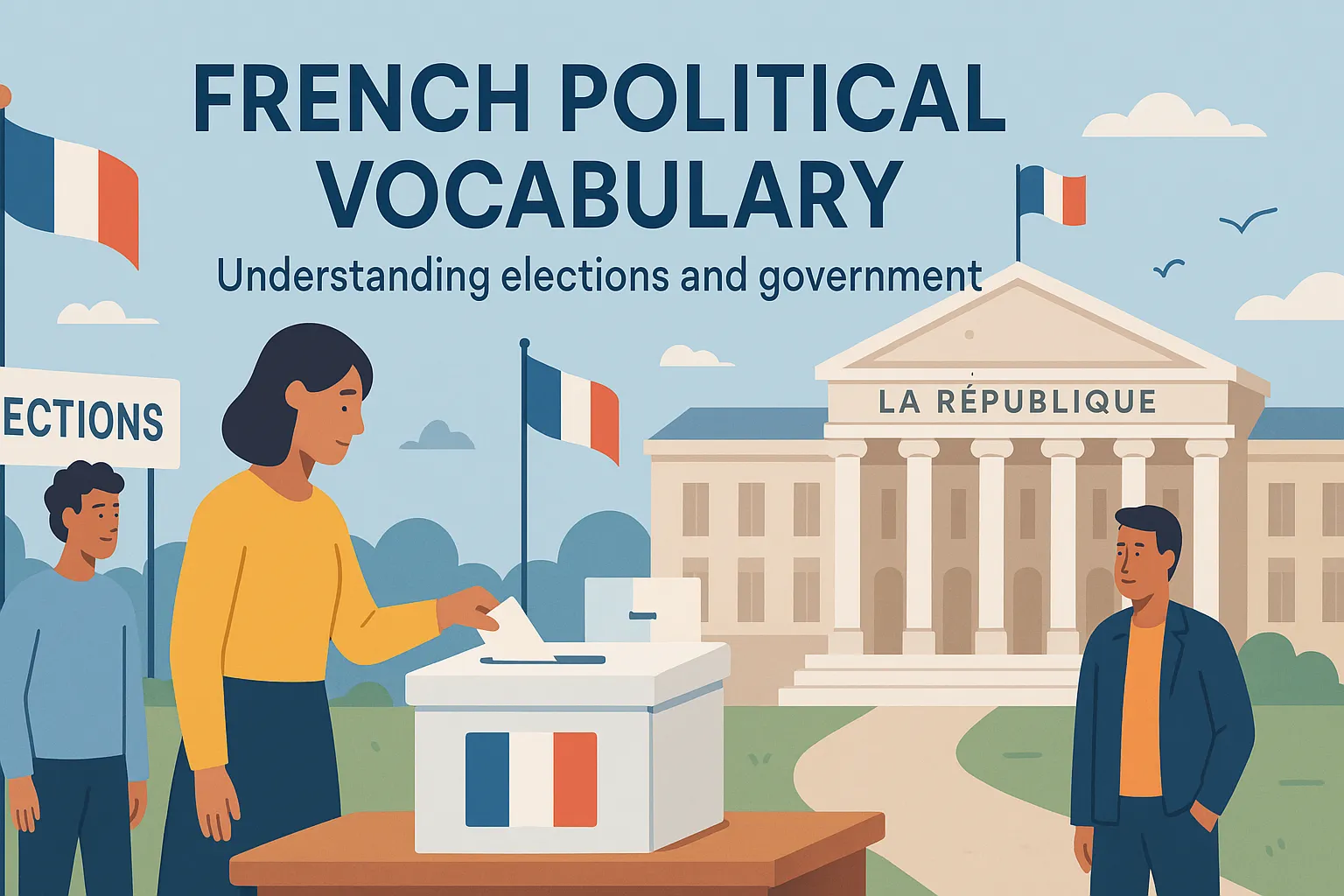
French Political Vocabulary – Understanding Elections and Government

French Political Vocabulary for Elections and Government: The System That Doesn’t Map Onto Anything You Know

France has both a president and a prime minister, and the president is more powerful. “Libéral” means free-market, not progressive. “La cohabitation” has no English equivalent. Every institution, election, and party term you need to follow French news without nodding blankly.

French political vocabulary for elections government institutions and parties
The French political system has its own logic. The vocabulary follows the system, not the other way around.
🍷 Society & Pop Culture 🌳 Intermediate to Upper-Intermediate (B1-B2)

The executive branch: why France has both a president and a prime minister

Most anglophone professionals assume “le président” works like the American president or “le premier ministre” works like the British PM. Neither assumption holds. France runs a hybrid system called a semi-presidential republic, where the president holds supreme executive authority on foreign policy, defence, and institutional direction, while the prime minister handles day-to-day governance, parliamentary relations, and domestic policy implementation. The president is elected directly by citizens for a five-year term called “un quinquennat.” The prime minister is appointed by the president but must maintain the confidence of the National Assembly, meaning the PM can be removed by parliament even though the president chose them. This dual executive creates power dynamics that have no equivalent in purely presidential (US) or purely parliamentary (UK) systems.

🇫🇷 Le président de la République 🇺🇸 The President of the Republic (head of state, supreme executive)
🇫🇷 Le Premier ministre 🇺🇸 The Prime Minister (head of government, appointed by president)

The PM is NOT elected by citizens. The president appoints them. This confuses Americans who expect direct election for all top positions and confuses Brits who expect the PM to be the dominant figure.

🇫🇷 Le quinquennat 🇺🇸 The five-year presidential term (since 2000, formerly seven years)
🇫🇷 Le gouvernement 🇺🇸 The government / the cabinet (all ministers collectively)
🇫🇷 Un(e) ministre 🇺🇸 A minister (equivalent to a secretary in the US cabinet)

Key ministerial positions include “le ministre de l’Intérieur” (Interior Minister, closest to Home Secretary), “le ministre des Affaires étrangères” (Foreign Affairs, equivalent to Secretary of State), and “le ministre de l’Économie” (Economy Minister, closest to Treasury Secretary). French media refers to these by their abbreviated names constantly.

🇫🇷 Un remaniement ministériel 🇺🇸 A cabinet reshuffle (can change the entire government composition overnight)
🇫🇷 L’Élysée 🇺🇸 The Elysee Palace (presidential residence and office, like the White House)
🇫🇷 Matignon 🇺🇸 Matignon (PM’s residence and office, like 10 Downing Street)

French media uses “l’Élysée” and “Matignon” as metonyms for the president and PM respectively. “L’Élysée a déclaré…” means the president’s office said. “Matignon a répondu…” means the PM’s office responded. Knowing these shortcuts is essential for reading headlines in The French Briefing or any French newspaper.

La cohabitation: the concept with no English equivalent

Cohabitation occurs when the president and the prime minister come from opposing political parties. It happened three times in modern French history: 1986-88, 1993-95, and 1997-2002. During cohabitation, the president focuses on foreign policy and defence while the PM controls domestic affairs, creating institutionalised tension at the top of the executive. The 2000 constitutional reform that aligned presidential and legislative election calendars was specifically designed to make cohabitation less likely, but it remains theoretically possible and is a concept every French political commentator references when discussing power dynamics. If you read a French headline mentioning “cohabitation,” now you know why no translator can hand you a one-word equivalent.

You’re learning the system behind the headlines.
The Briefing covers real French political news daily. Same vocabulary, real context. Quiz included.
📰 Read The French Briefing
Free. No account.

The legislative branch: Assemblée nationale, Sénat, and how laws actually pass

France has a bicameral parliament, but the power balance between the two chambers is nothing like the US Senate-House relationship. The Assemblée nationale (National Assembly) holds primary legislative power: 577 députés elected directly by citizens for five-year terms in single-member constituencies using a two-round voting system. The Sénat (Senate) reviews and amends legislation but is subordinate: 348 sénateurs elected indirectly by local officials for six-year terms. When the two chambers disagree, the Assemblée nationale has the final say on most legislation. This asymmetry means that following French political news requires tracking the Assemblée far more closely than the Sénat.

🇫🇷 Le Parlement 🇺🇸 Parliament (both chambers together)
🇫🇷 L’Assemblée nationale 🇺🇸 The National Assembly (lower house, 577 députés, directly elected)
🇫🇷 Un député / une députée 🇺🇸 A member of parliament / an MP (elected to the Assemblée)
🇫🇷 Le Sénat 🇺🇸 The Senate (upper house, 348 sénateurs, indirectly elected)
🇫🇷 Un sénateur / une sénatrice 🇺🇸 A senator
🇫🇷 Le Palais Bourbon 🇺🇸 The Bourbon Palace (where the Assemblée nationale meets, used as metonym)
🇫🇷 Le Palais du Luxembourg 🇺🇸 The Luxembourg Palace (where the Sénat meets)

“Le Palais Bourbon a voté…” means the National Assembly voted. Recognising palace names as institutional shorthand is essential for reading headlines.

How laws pass: the vocabulary of the legislative process

The legislative process has vocabulary that appears in every political news article. “Un projet de loi” is a bill proposed by the government. “Une proposition de loi” is a bill proposed by a member of parliament. The distinction matters because government bills receive priority scheduling and carry the executive’s political weight. Confusing the two reveals unfamiliarity with how the system works.

🇫🇷 Un projet de loi (gouvernement) 🇺🇸 A government bill (proposed by the cabinet, priority scheduling)
🇫🇷 Une proposition de loi (parlementaire) 🇺🇸 A parliamentary bill (proposed by an MP or senator)
🇫🇷 Adopter / voter une loi 🇺🇸 To pass / to vote on a law
🇫🇷 Un amendement / amender 🇺🇸 An amendment / to amend
🇫🇷 Promulguer une loi 🇺🇸 To promulgate a law (presidential signature making it effective)
🇫🇷 Abroger une loi 🇺🇸 To repeal a law
🇫🇷 Un décret / une ordonnance 🇺🇸 A decree / an ordinance (executive orders with varying legal force)

L’article 49.3: the nuclear option. This constitutional provision allows the prime minister to pass legislation without a parliamentary vote. The bill is considered adopted unless the Assemblée passes a motion de censure (no-confidence motion) within 24 hours. It is controversial, frequently used, and guaranteed to appear in every French political discussion. Elisabeth Borne used it eleven times during the pension reform debate alone. When someone mentions “le 49.3,” they are talking about executive overreach vs parliamentary gridlock, and everyone in the room has an opinion.

🇫🇷 La motion de censure 🇺🇸 The motion of no confidence (can topple the government)
🇫🇷 La dissolution de l’Assemblée 🇺🇸 The dissolution of the National Assembly (president’s power to call snap elections)

The president can dissolve the Assemblée and force new legislative elections. Macron did this in June 2024 after the European election results. The decision shocked France and reshaped the parliamentary balance entirely. This vocabulary was on every French screen for weeks.

🇫🇷 Les questions au gouvernement 🇺🇸 Question Time (MPs question ministers, broadcast live on TV every Tuesday and Wednesday)

The entire institutional architecture described above rests on the Constitution of the Fifth Republic, established in 1958 specifically to give the president enough power to govern without parliamentary paralysis. Professionals who understand why the Fifth Republic was designed this way grasp the logic behind 49.3, cohabitation, and the presidential dominance that puzzles anglophones accustomed to separated powers.

Elections and the voting system: how the two-round system changes everything

The French electoral system uses a two-round format for both presidential and legislative elections. In the first round, all candidates compete. If no candidate wins more than 50% of the vote (which almost never happens in presidential elections), the top two candidates face each other in a second round two weeks later. This system fundamentally changes political strategy compared to American winner-take-all: French voters can vote their conscience in the first round (supporting a minor party or protest candidate) and vote strategically in the second round (choosing the “lesser evil” between two frontrunners). The common French expression “au premier tour on choisit, au second tour on élimine” (in the first round you choose, in the second round you eliminate) captures this logic perfectly.

🇫🇷 L’élection présidentielle 🇺🇸 The presidential election (every 5 years, two rounds)
🇫🇷 Les élections législatives 🇺🇸 The legislative elections (for Assemblée nationale, also two rounds)
🇫🇷 Les élections européennes / municipales / régionales 🇺🇸 European / municipal / regional elections
🇫🇷 Le premier tour / le second tour 🇺🇸 The first round / the second round (runoff)
🇫🇷 Le scrutin 🇺🇸 The ballot / the vote (the act of voting or the election itself)

The physical voting process

French voting is physical in a way that surprises anglophones used to electronic systems. You enter the polling station, pick up printed ballot papers for each candidate from a table, enter the voting booth (l’isoloir), place your chosen ballot in an envelope, then deposit the envelope in a transparent ballot box (l’urne) while the official announces “a voté” (has voted). The transparency of the box, the physical act of choosing paper ballots, and the public announcement are deliberate design choices meant to reinforce democratic participation as a visible civic act.

🇫🇷 Le bureau de vote 🇺🇸 The polling station
🇫🇷 L’isoloir 🇺🇸 The voting booth (where you place your ballot in the envelope)
🇫🇷 L’urne (transparente) 🇺🇸 The (transparent) ballot box
🇫🇷 “A voté !” 🇺🇸 “Has voted!” (announced by the official as you deposit your envelope)
🇫🇷 Le taux de participation / le taux d’abstention 🇺🇸 The voter turnout rate / the abstention rate
🇫🇷 Voter blanc / s’abstenir 🇺🇸 To cast a blank ballot / to abstain

“Voter blanc” is a deliberate political statement in France: showing up, taking a ballot, putting it in the box empty. It says “I participated but rejected all candidates.” French media reports blank vote percentages separately from abstention rates, and high blank vote numbers generate their own political commentary. This distinction matters for reading election night coverage.

🇫🇷 Se qualifier pour le second tour 🇺🇸 To qualify for the second round (runoff)
🇫🇷 La majorité absolue / la majorité relative 🇺🇸 The absolute majority (50%+) / the relative majority (most votes, under 50%)
Election night at the office It’s Sunday evening. Your French colleagues are watching results on BFM TV. At 20h sharp, the estimated results flash on screen. “Il passe au second tour” (he qualifies for the runoff). “Le taux de participation est en hausse” (turnout is up). “Le front républicain va jouer” (the republican front will come into play). You understand every sentence. Or you don’t. This section is the difference.

Anglophone professionals consistently ask the same question during election season: why does the outcome of the first round matter if a second round always follows? Because the first round reveals the real political landscape. Who is rising, who is collapsing, which alliances form between rounds. The second round is binary. The first round is the diagnostic.

🇫🇷 Le front républicain 🇺🇸 The republican front (tactical alliance to block an extreme candidate in the second round)

This concept became central in 2002 when Chirac faced Le Pen, and again in 2017 and 2022 when Macron faced Marine Le Pen. The phrase appears in every election cycle and is essential for understanding second-round dynamics.

Political parties and the French spectrum: why “libéral” doesn’t mean what you think

The French political spectrum runs from extreme left to extreme right with more distinct positions than the American two-party system allows. Centre-left, centre-right, far-left, far-right, ecologist, centrist: each occupies a recognisable position with specific vocabulary, historical references, and cultural associations. French parties also change names, merge, split, and rebrand with a frequency that confuses even French voters. The spectrum vocabulary is permanent even as party names shift.

🇫🇷 La gauche / la droite 🇺🇸 The left / the right (political orientation)
🇫🇷 Le centre / la majorité présidentielle 🇺🇸 The centre / the presidential majority (coalition supporting the sitting president)
🇫🇷 L’extrême gauche / l’extrême droite 🇺🇸 The far left / the far right
🇫🇷 Un parti politique / une coalition / l’opposition 🇺🇸 A political party / a coalition / the opposition

Current major formations from left to right: La France Insoumise (far-left populist, Mélenchon), le Parti Socialiste (centre-left), Europe Écologie Les Verts (green/left), Renaissance (centrist, presidential party, Macron), Les Républicains (centre-right conservative, historically Gaullist), Rassemblement National (far-right, Marine Le Pen, formerly Front National). These names change frequently: the Rassemblement National was called Front National until 2018, the presidential party has been renamed three times since 2016. Learning the position vocabulary (gauche, droite, centre, extrême) is more durable than memorising current party names.

The “libéral” false friend. In French politics, “libéral” means economically liberal: supporting free markets, privatisation, reduced government intervention. This is closer to American “libertarian” or British “classical liberal,” NOT American “liberal” (which translates as “de gauche” or “progressiste” in French). Saying “je suis libéral” in France means “I support free-market capitalism.” This confusion derails cross-cultural political conversations constantly and produces genuine misunderstandings in professional settings.

The vocabulary that reveals your political awareness

Using the right party names signals that you follow French politics actively. Calling the Rassemblement National “le Front National” (its former name) reveals you have not updated your political knowledge since 2018. Using “la majorité” correctly (meaning the coalition supporting the president, not 50%+1) shows you understand parliamentary dynamics. Distinguishing “projet de loi” from “proposition de loi” tells French colleagues you understand how the system works, not just the words. These vocabulary choices function as competence signals in every professional conversation about French politics.

Campaigns, protests, and political discourse: the vocabulary of French public life

French political culture includes strikes, protests, and demonstrations as normal democratic expression, not exceptional events. “Une manifestation” (a demonstration) is a standard political tool that French unions, students, and citizens deploy regularly. “Une grève” (a strike) is constitutionally protected and culturally accepted in ways that surprise anglophones. Understanding this vocabulary means understanding that when your train is cancelled because of “un mouvement social” (industrial action), you are witnessing French democracy functioning as designed, not malfunctioning.

🇫🇷 La campagne électorale 🇺🇸 The electoral campaign
🇫🇷 Un(e) candidat(e) / se présenter 🇺🇸 A candidate / to run for office
🇫🇷 Un sondage 🇺🇸 A poll / a survey
🇫🇷 Le programme électoral 🇺🇸 The electoral platform / manifesto
🇫🇷 Un débat télévisé 🇺🇸 A televised debate
🇫🇷 Une manifestation 🇺🇸 A demonstration / protest (standard political tool in France)
🇫🇷 Une grève / un mouvement social 🇺🇸 A strike / industrial action
🇫🇷 Les syndicats 🇺🇸 The unions (CGT, CFDT, FO are the main ones)
🇫🇷 Les réformes 🇺🇸 Reforms (in French politics, almost always contested)

“La réforme des retraites” (pension reform) is the phrase that has launched more protests than any other in modern French history. When French news says “réforme,” expect controversy. The word is never neutral in political context.

🇫🇷 Une polémique / un scandale politique 🇺🇸 A controversy / a political scandal
🇫🇷 La laïcité 🇺🇸 Secularism (French-specific: strict separation of church and state, no English equivalent captures the full weight)

Laïcité is not just “secularism.” It is a foundational principle of the French Republic that affects school policy, public employment, political debate, and cultural identity. It appears in news headlines constantly and is the subject of ongoing national controversy. Understanding this word is understanding a fault line in French public life.

Discussion vocabulary for political conversations

French professional culture expects political awareness. Dinner conversations with clients, networking events, even office small talk routinely include political topics. Avoiding politics signals disengagement, not neutrality. The framing phrases below are what French speakers use to express, qualify, and challenge political positions in conversation. Using them correctly signals that you understand the register of intellectual exchange, not just the vocabulary of political institutions.

🇫🇷 À mon avis / selon moi 🇺🇸 In my opinion / as I see it
🇫🇷 Je pense que / j’estime que 🇺🇸 I think that / I believe that (j’estime is stronger)
🇫🇷 C’est discutable / c’est contestable 🇺🇸 That’s debatable / that’s questionable
🇫🇷 D’un côté… d’un autre côté / en revanche 🇺🇸 On one hand… on the other hand / however
🇫🇷 Quoi qu’il en soit / toujours est-il que 🇺🇸 Be that as it may / the fact remains that
🇫🇷 Il faut nuancer / ce n’est pas si simple 🇺🇸 We need to qualify that / it’s not that simple

The weekly news habit that compounds. Follow one French political story per week through The French Briefing: same story, increasing vocabulary each week. Political vocabulary compounds faster than any other domain because the same terms recur across stories, creating natural spaced repetition that textbooks cannot replicate. With the 2027 presidential election approaching, every week of practice now pays double later.

Why political vocabulary is professional vocabulary in France

The executive who can discuss “la réforme des retraites” at a client dinner earns trust in ways that no amount of technical competence replaces. Political vocabulary is not optional for professional integration in France. It is the baseline of what educated adults are expected to know, and the absence of it creates a social gap that no business card compensates for. You do not need strong opinions. You need enough vocabulary to follow the conversation, ask informed questions, and demonstrate the cultural competence that French professionals associate with credibility.

Study glossary: essential French political vocabulary

FrenchEnglishUsage context
Le présidentThe PresidentHead of state, supreme executive
Le Premier ministreThe Prime MinisterHead of government, appointed
Le quinquennatThe five-year termPresidential mandate since 2000
L’Assemblée nationaleNational AssemblyLower house, 577 députés
Le SénatThe SenateUpper house, 348 sénateurs
Un(e) député(e)An MPDirectly elected representative
Le scrutinThe ballot / election“Le scrutin présidentiel”
Le premier / second tourFirst / second roundTwo-round voting system
La gauche / la droiteLeft / rightPolitical orientation
L’extrême droiteThe far rightRassemblement National
Une loi / un projet de loiA law / a government billLegislative vocabulary
Une proposition de loiA parliamentary billProposed by an MP
La motion de censureNo-confidence motionCan topple the government
La dissolutionDissolutionPresident dissolves Assemblée
L’article 49.3Article 49.3Pass law without vote
Le front républicainRepublican frontTactical anti-extreme alliance
Une manifestationA demonstrationStandard democratic tool
Une grèveA strikeConstitutionally protected
La cohabitationCohabitationPresident/PM from opposing parties
La laïcitéSecularism (French-specific)Foundational Republic principle
Un sondageA poll“Les sondages donnent…”
Voter blancTo cast a blank ballotDeliberate rejection of all candidates

That is the complete map. Not every French political word, just the ones that appear in headlines, debates, office conversations, and every election cycle from municipal to presidential. The 2027 presidential election will test every term in this article in real time. “For sure.” 🕶️

$19/mo

Less than one coffee a week.

You just mapped the French political system. The Pass delivers real political French weekly: audio briefing, CEFR tracking, structured progress toward 2027.

✓ WEEKLY AUDIO✓ CEFR TRACKING✓ FULL ARCHIVES
📈 GET THE PASS · $19/MO
Zero contract. Liquidate in 2 clicks.
100% Free. Zero friction.

How to Describe Nature in French – Trees, Rivers, Mountains

Describe Nature in French: Trees, Rivers, Mountains and the Vocabulary Textbooks Skip

You know “arbre” and “montagne” but your neighbour in Dordogne is talking about “le chêne centenaire” and “le sous-bois” and “la crue du fleuve.” French has distinctions English doesn’t make: “fleuve” vs “rivière” depends on where the water ends up. Every tree, river, mountain, and weather term you need to stop saying “c’est joli” and start actually describing what you see.

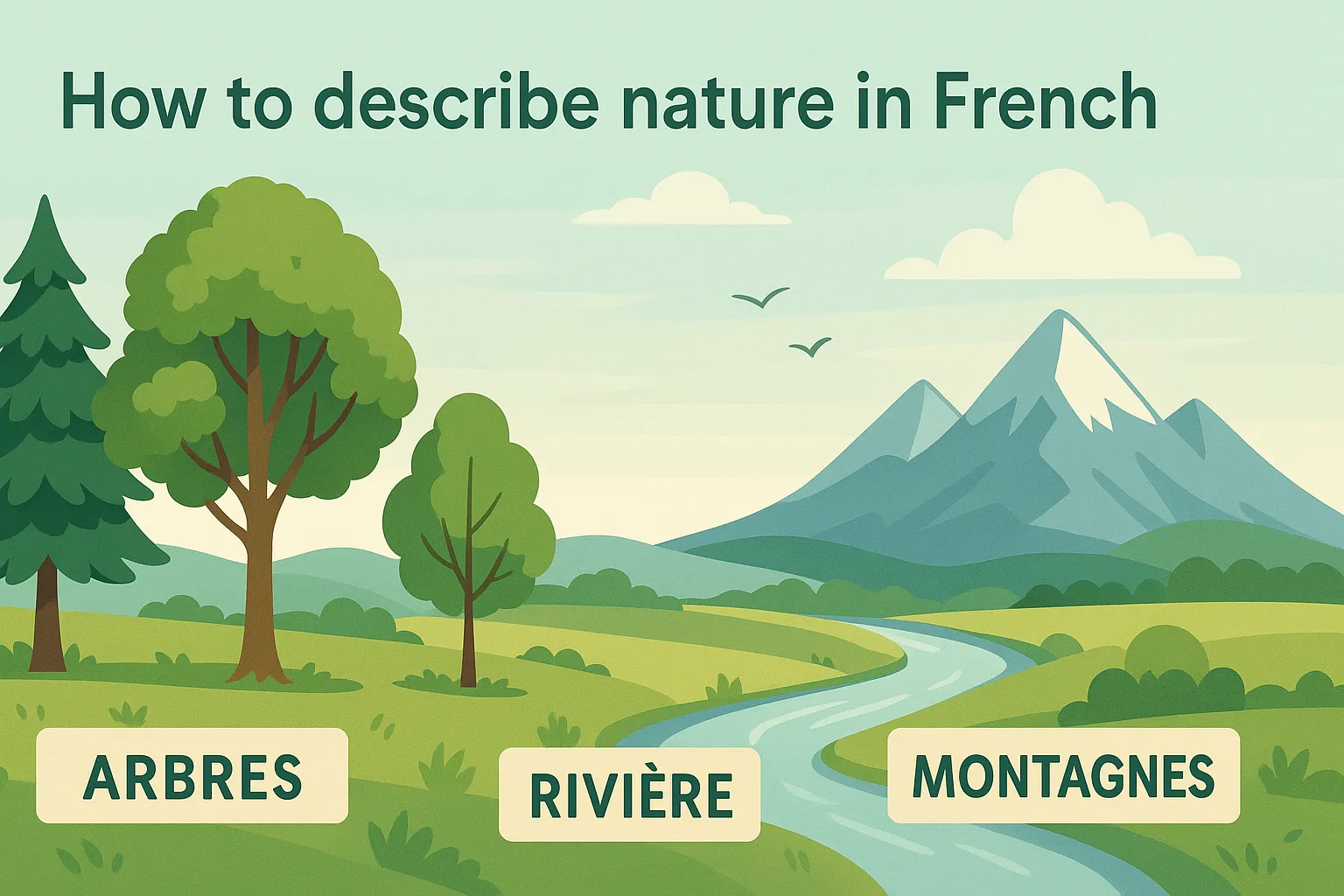
Describe nature in French with vocabulary for trees rivers mountains and landscapes
French nature vocabulary goes far beyond “arbre” and “montagne.” The specifics are where conversation lives.
☕ Travel & Everyday 🌿 Elementary to Intermediate (A2-B1)

Trees and forests: the vocabulary French people actually use outdoors

French has specific names for trees that English speakers lump together as “that tree over there.” Knowing the difference between a chêne and a hêtre matters because French people reference specific species in conversation the way Americans reference car brands.

🇫🇷 Le chêne 🇺🇸 The oak tree

France’s symbolic tree. “Solide comme un chêne” (solid as an oak) = strong and reliable.

🇫🇷 Le hêtre 🇺🇸 The beech tree
🇫🇷 Le pin / le sapin / l’épicéa 🇺🇸 The pine / the fir / the spruce

English speakers call all of these “pine trees.” French distinguishes them. Le sapin is the Christmas tree. Le pin is Mediterranean. L’épicéa grows at altitude.

🇫🇷 Le châtaignier 🇺🇸 The chestnut tree
🇫🇷 L’olivier (m.) 🇺🇸 The olive tree

Provence vocabulary. “L’oliveraie” is the olive grove. Property listings in the south mention olive trees the way Manhattan listings mention square footage.

🇫🇷 Le platane 🇺🇸 The plane tree

Lines every road in southern France. “L’allée de platanes” is the iconic Provençal road image.

Forest types and features

French distinguishes between “le bois” (a small wooded area) and “la forêt” (a proper forest). French speakers are more precise about it and will correct you if you call a small copse “une forêt.”

🇫🇷 La forêt de feuillus / la forêt de conifères 🇺🇸 The deciduous forest / the coniferous forest
🇫🇷 La clairière 🇺🇸 The clearing (open area inside a forest)
🇫🇷 Le sous-bois 🇺🇸 The undergrowth / the forest floor

The word hikers and mushroom pickers use constantly. “On a trouvé des cèpes dans le sous-bois” is autumn conversation in rural France.

🇫🇷 Le sentier forestier 🇺🇸 The forest path

Famous forests French people reference

La forêt de Fontainebleau: near Paris, popular for hiking and rock climbing. La forêt de Brocéliande: Brittany, legendary Arthurian forest. La forêt des Landes: southwest France, largest pine forest in western Europe.

You’re building the French that works outside the classroom.
The Briefing uses real French daily. Same structures, real context. Quiz included.
📰 Read The French Briefing
Free. No account.

Rivers and water: the fleuve vs rivière distinction that catches everyone

English has one word: “river.” French has two, and the difference matters. A “fleuve” flows into the sea or the ocean. A “rivière” flows into another river. La Seine is “un fleuve” because it reaches the English Channel. Le Cher is “une rivière” because it flows into la Loire. Using “rivière” for the Seine is like calling the Atlantic a lake.

🇫🇷 Le fleuve 🇺🇸 River (flowing to the sea)
🇫🇷 La rivière 🇺🇸 River (tributary, flowing into another river)
🇫🇷 Le ruisseau 🇺🇸 The stream / brook
🇫🇷 Le torrent 🇺🇸 The torrent (fast mountain stream)
🇫🇷 La cascade / la chute d’eau 🇺🇸 The waterfall
🇫🇷 Le lac / l’étang (m.) 🇺🇸 The lake / the pond

“Étang” is smaller and shallower than a lake. Many French properties advertise “avec étang” as a selling point.

🇫🇷 La source 🇺🇸 The spring / source (where water emerges)

Describing water movement and quality

🇫🇷 L’eau cristalline / l’eau trouble 🇺🇸 Crystal-clear water / murky water
🇫🇷 Le courant 🇺🇸 The current
🇫🇷 La crue 🇺🇸 The flood / high water

“La crue de la Seine” = the Seine flooding. Parisians track this annually.

🇫🇷 L’embouchure (f.) 🇺🇸 The river mouth (where a fleuve meets the sea)

See the distinction in real places:

The “rivière” trap: Calling la Loire “une rivière” is factually wrong. La Loire is le plus long fleuve de France (1,012 km). When unsure, say “le cours d’eau” (the waterway). It’s neutral.

Mountains and elevated terrain: Alps, Pyrenees, and hiking vocabulary

Mountain vocabulary is unavoidable in France. The Alps, the Pyrenees, the Massif Central, the Vosges, the Jura: every winter the entire country tracks snow levels, avalanche warnings, and ski conditions.

🇫🇷 Le sommet / le pic 🇺🇸 The summit / the peak
🇫🇷 Le col 🇺🇸 The mountain pass

Tour de France vocabulary. “Le col du Galibier” is a reference every French person knows.

🇫🇷 Le versant / la pente 🇺🇸 The slope / mountainside
🇫🇷 La crête 🇺🇸 The ridge
🇫🇷 Le glacier 🇺🇸 The glacier
🇫🇷 La falaise 🇺🇸 The cliff
🇫🇷 Le refuge 🇺🇸 The mountain hut / refuge

Hikers book “un refuge” the way city people book hotels. Essential for multi-day hikes in the Alps or Pyrenees.

Iconic mountain spots to know by name:

  • Le Mont Blanc (4,808 m) — highest peak in western Europe, Chamonix. chamonix.com
  • Le Col du Galibier (2,642 m) — legendary Tour de France climb, Savoie. Savoie Mont Blanc
  • Le Cirque de Gavarnie — UNESCO amphitheatre in the Pyrenees, 1,500 m waterfall. UNESCO listing
  • Les Calanques de Marseille — limestone cliffs plunging into the Mediterranean. Parc National des Calanques
  • Le Parc National des Écrins — glaciers, 3,000+ m peaks, Alpine wilderness. ecrins-parcnational.fr
On a hiking trail in the Alps You reach the col after three hours of climbing. The view opens on both sides. Someone says “la vue est à couper le souffle.” You understand: the view is breathtaking. But when they start describing the versant nord vs the versant sud, the neige éternelle on the crête, and the torrent in the vallée below, the vocabulary gap hits. That’s the gap this section fills.
🇫🇷 Faire de la randonnée / randonner 🇺🇸 To hike / to go hiking
🇫🇷 Le sentier de randonnée 🇺🇸 The hiking trail
🇫🇷 La neige éternelle 🇺🇸 The permanent snow (above a certain altitude year-round)

Hiking map vocabulary: French IGN maps use abbreviations: “Col” (pass), “Pic” (peak), “Rge” (refuge), “Cne” (commune). Learn these before your first hike.

Weather phenomena and sky descriptions

French nature descriptions are incomplete without weather vocabulary because the French relationship with landscape is inseparable from atmospheric conditions.

🇫🇷 Le brouillard / la brume 🇺🇸 The fog / the mist

“Brouillard” is thick, visibility-reducing. “Brume” is lighter, atmospheric, almost poetic.

🇫🇷 La rosée 🇺🇸 The dew
🇫🇷 Le givre 🇺🇸 The frost (on surfaces)
🇫🇷 L’orage (m.) / la tempête 🇺🇸 The thunderstorm / the storm
🇫🇷 L’arc-en-ciel (m.) 🇺🇸 The rainbow
🇫🇷 Le coucher de soleil / le lever de soleil 🇺🇸 The sunset / the sunrise
🇫🇷 Le crépuscule 🇺🇸 The twilight / dusk

Literary vocabulary that French speakers use in casual conversation more than English speakers use “twilight.”

🇫🇷 Le ciel étoilé 🇺🇸 The starry sky

Descriptive adjectives for landscapes

🇫🇷 Une vue à couper le souffle 🇺🇸 A breathtaking view (literally: a view to cut your breath)
🇫🇷 Un paysage pittoresque / un endroit paisible 🇺🇸 A picturesque landscape / a peaceful place
🇫🇷 Une nature sauvage / préservée 🇺🇸 Wild nature / pristine nature
🇫🇷 Des montagnes imposantes / une forêt majestueuse 🇺🇸 Imposing mountains / a majestic forest

Coastal vocabulary for completeness

La côte / le littoral (the coast/coastline), la plage (the beach), la baie (the bay), la crique (the cove), le cap (the cape/headland). France has three coastlines: Atlantic, Mediterranean, and Channel.

Study glossary: essential nature vocabulary

FrenchEnglishUsage context
Le chêneThe oak treeSymbolic: strength, French identity
Le sapinThe fir treeChristmas tree, mountain forests
La forêt / le boisForest / woodsSize distinction: forêt > bois
Le sous-boisUndergrowthMushroom picking, hiking
Le fleuveRiver (to sea)La Seine est un fleuve
La rivièreRiver (tributary)Le Cher est une rivière
La cascadeThe waterfall“Une belle cascade”
Le sommet / le colSummit / mountain passHiking and Tour de France
Le versantThe slope“Le versant nord”
Le refugeMountain hutMulti-day hiking accommodation
Le brouillard / la brumeFog / mistDensity distinction matters
Le coucher de soleilThe sunsetDaily conversation topic
Le paysageThe landscape“Un paysage magnifique”
RandonnerTo hike“J’adore randonner”
$19/mo

Less than one coffee a week.

You just mapped the French nature vocabulary textbooks skip. The Pass builds this kind of situational confidence weekly: real audio, real descriptions, CEFR tracking.

✓ WEEKLY AUDIO✓ CEFR TRACKING✓ FULL ARCHIVES
📈 GET THE PASS · $19/MO
Zero contract. Liquidate in 2 clicks.
100% Free. Zero friction.

French Countryside Vocabulary – Rural Life and Landscapes

French Countryside Vocabulary: The Words You Need When Paris Isn’t the Plan

Textbooks teach Parisian French. Your notaire in Dordogne speaks farmhouse French. Your neighbours discuss “les vendanges” and “le terroir” and “la fête du village” and you nod without understanding. Landscape, farms, animals, crops, village life, seasons, and the expressions that make rural French conversation possible.

French countryside vocabulary for rural life landscapes farms and village structures
Most of France isn’t Paris. This is the vocabulary for the rest of it.
☕ Travel & Everyday 🌿 Elementary to Intermediate (A2-B1)

Landscape and terrain: the countryside French you see from the car

Most French textbooks skip countryside vocabulary entirely because they assume you are in a city. But France is rural. Roughly 80% of the land surface sits outside urban areas, and the people living there do not talk about their environment the way Parisians talk about theirs. The landscape vocabulary below appears in every property listing, every weather report, every conversation with a neighbour about what is growing where, and every Sunday drive where someone in the back seat points at the view and says something you cannot quite follow.

🇫🇷 La campagne 🇺🇸 The countryside

Not just “rural area.” In French culture, “la campagne” carries romantic weight that the English word does not. It is the soul of French identity, the counterpart to Paris, the place where food has a postcode and silence has a reputation. When a French person says “j’habite à la campagne,” they are making a lifestyle statement. When a Parisian says “on part à la campagne ce weekend,” they mean something closer to a pilgrimage than a road trip.

🇫🇷 Le champ / les champs 🇺🇸 The field / the fields
🇫🇷 Le pré 🇺🇸 The meadow / pasture

The difference matters. “Champ” is cultivated: wheat, corn, sunflowers. “Pré” is grass for animals. Mixing them up in conversation is like calling a parking lot a garden. Both are flat, but only one has a purpose your neighbour respects.

🇫🇷 Le vignoble 🇺🇸 The vineyard

“Vignoble” is the entire vineyard estate. “La vigne” is the individual grapevine or the vine row. The distinction matters in wine conversations, and wine conversations are where half of rural social life happens. If you are in Bordeaux, Burgundy, the Loire, Alsace, the Rhône Valley, or Languedoc, vineyard vocabulary is not optional. It is the local language of economy, pride, and weather anxiety.

🇫🇷 Le verger 🇺🇸 The orchard
🇫🇷 La colline 🇺🇸 The hill
🇫🇷 Le vallon / la vallée 🇺🇸 The small valley / the valley
🇫🇷 Le sentier / le chemin 🇺🇸 The path / the country road

“Sentier” is a walking path. “Chemin” is a rural road, often unpaved. Your GPS says “chemin.” Your hiking guide says “sentier.” Property listings assume you know the difference: “accès par chemin” means unpaved access road, which in winter means mud, and in August means dust. “Accès par route” means tarmac. That single word changes what your car needs and what your insurance covers.

🇫🇷 La haie 🇺🇸 The hedge

Hedges define the Norman bocage landscape the way stone walls define the English Cotswolds. A property described as “entouré de haies” is enclosed by hedgerows, which means privacy, windbreak, and a particular kind of rural aesthetic that photographs well and costs money to maintain.

Why this vocabulary matters for expats

Property listings in rural France use these words constantly. “Terrain avec vue sur les collines, entouré de vignobles, accès par chemin privé.” If you cannot read that sentence fluently, you cannot evaluate the property. Students moving to Provence, Dordogne, or Normandy hit this wall in week one. The vocabulary is not advanced. It is just absent from every course that assumes your life will happen inside a city.

Regions where this vocabulary matters most:

You’re building the French that works outside the city.
The Briefing builds real French structures daily. Same register, real context. Quiz included.
📰 Read The French Briefing
Free. No account.

Farm structures, buildings, and animals

Rural France is not a museum. People still work the land, raise animals, and maintain buildings whose names have not changed in centuries. The farm vocabulary below is what you hear when your neighbours are the ones producing the food you buy at the market on Saturday morning, and when the estate agent walks you through a property that used to be a working farm and still smells like it remembers.

🇫🇷 La ferme 🇺🇸 The farm
🇫🇷 La grange 🇺🇸 The barn

“Grange rénovée” is one of the most searched terms in French rural property. Anglophone buyers love barn conversions: the stone walls, the exposed beams, the volume. Estate agents know this. The word alone adds thousands to the listing price.

🇫🇷 L’étable (f.) 🇺🇸 The cowshed / stable
🇫🇷 Le poulailler 🇺🇸 The chicken coop
🇫🇷 La cour de ferme 🇺🇸 The farmyard
🇫🇷 Le potager 🇺🇸 The vegetable garden

“Cultiver son potager” (to tend your vegetable garden) is the rural French hobby that crosses every social class. The retired doctor does it. The farmer’s wife does it. The British couple who moved to the Lot does it. Your potager is your credibility. It proves you actually live here, not just visit.

🇫🇷 Le puits 🇺🇸 The well
At the farmer’s market Your neighbour introduces you to the vendeur. “C’est un Américain qui vient de s’installer dans le coin.” You catch “installé” and “coin.” That is enough. You are not a tourist. You are “du coin” now. The vocabulary of belonging starts with knowing what grows in the fields around your house and what the buildings on your property used to do.

Farm animals and countryside wildlife

The animals below are what you hear at dawn and discuss over apéro. They are also menu vocabulary, which is the part that makes visiting carnivores uncomfortable and vegetarians relieved.

🇫🇷 Le coq (qui fait cocorico) 🇺🇸 The rooster (cock-a-doodle-doo in English, cocorico in French)

Animal sounds differ between languages. French roosters say “cocorico.” The sound is also a nationalist exclamation, a sporting chant, and a cultural cliché. The rooster is the unofficial symbol of France, and hearing one at 5am is the unofficial alarm clock of rural France. Nobody warned you. Now you know.

🇫🇷 La vache (qui fait meuh) 🇺🇸 The cow (goes moo)
🇫🇷 Le mouton (qui fait bêê) 🇺🇸 The sheep (goes baa)
🇫🇷 La chèvre 🇺🇸 The goat

“Fromage de chèvre” (goat cheese) is the countryside cheese. Every market has it. Every neighbour either makes it or knows someone who does. The quality difference between industrial chèvre and the one your neighbour wraps in a vine leaf is the difference between knowing a word and understanding a culture.

🇫🇷 Le troupeau 🇺🇸 The herd / flock
🇫🇷 Le veau / l’agneau 🇺🇸 The calf / the lamb

These are also menu vocabulary. “Veau” on a restaurant menu means veal. “Agneau” means lamb. Farm to table, one word. Rural France does not sentimentalise this transition the way anglophone culture sometimes does. The animal has a name in the field and a name on the plate, and both appear in the same conversation without cognitive dissonance.

The hunting season warning: “La chasse” (hunting) runs from September to February. Wear bright colours when walking in rural areas during this period. “Attention, chasse en cours” signs mean active hunting. This is not a vocabulary note. It is a safety one. Every year, accidents involve people who did not take the signs seriously.

Seasons and agricultural activities: the rural calendar

Rural France runs on an agricultural calendar that textbooks never mention because textbooks assume you care about verb conjugation more than what your neighbours are doing in September. They are wrong. The agricultural calendar is the social calendar. “Les vendanges” in September structures the entire south. “Les moissons” in July structures the north. Knowing which season brings which activity is knowing how your neighbours think about time, plan their weeks, and decide whether this is a good year or a bad one.

🇫🇷 Les vendanges 🇺🇸 The grape harvest (September-October)

The defining event of wine regions. Entire communities mobilise. Students, seasonal workers, and neighbours show up to pick grapes. “C’est les vendanges” explains everything from traffic delays to cancelled appointments to why the entire village smells like fermenting fruit for three weeks. In Burgundy and Bordeaux, the quality of the vendanges determines the economic mood of the region for the next twelve months.

Major vendanges regions:

🇫🇷 Les moissons / moissonner 🇺🇸 The grain harvest / to harvest grain (July-August)
🇫🇷 Semer / les semailles 🇺🇸 To sow / the sowing (spring)
🇫🇷 Récolter / la récolte 🇺🇸 To harvest / the harvest (general)
🇫🇷 Labourer / le labour 🇺🇸 To plow / plowing (autumn-spring)

The smell of freshly plowed earth in October is the countryside equivalent of the first coffee smell in a city kitchen. It means the season turned. If you live in rural France long enough, you start tracking the year by what the fields look like, not by what month the calendar says.

🇫🇷 La canicule 🇺🇸 The heatwave (summer)

A word you will hear every July on every news channel. France has taken heatwaves seriously since 2003, when a canicule killed roughly 15,000 people, most of them elderly and isolated in rural areas. The word carries weight. “Vigilance canicule” is not a weather forecast. It is a public health alert.

🇫🇷 Le gel / la gelée 🇺🇸 The frost (devastating for vineyards and orchards)

Late frost in April can destroy an entire wine or fruit harvest. When your neighbour checks the weather obsessively in spring, this is why. “Les gelées tardives” (late frosts) is the phrase that makes winemakers lose sleep and insurance companies adjust premiums.

🇫🇷 Les champignons 🇺🇸 Mushrooms (autumn activity: foraging)

“Ramasser des champignons” (picking mushrooms) is the autumn obsession of rural France. It starts in September, peaks in October, and involves family outings, secret spots that nobody shares, baskets lined with newspaper, and a trip to the pharmacist who identifies your species for free. That last part is not a joke. French pharmacists are trained in mushroom identification, and every autumn people walk in with baskets full of things they found under an oak tree and need someone to confirm will not kill them.

Americans moving to rural Provence consistently ask the same question in month two. Not about language. About the market. Where is it, which day, and what is the vocabulary for the produce they do not recognise. The answer is always the same: go, point, ask “c’est quoi ?” and listen. The market teaches faster than any app because the feedback is immediate and the stakes are dinner.

Terroir in practice: “Ce fromage a un goût de terroir” means this cheese tastes of its place. Not a compliment about flavour. A statement about origin. The word “terroir” connects land, climate, tradition, and identity into a single concept that English does not have. Understanding terroir is understanding how rural France thinks about food, wine, and the relationship between a product and the ground it comes from. It is not a wine word. It is a worldview.

Village life: the structures and traditions that organise rural France

French villages are not quaint decorations. They are administrative units, social ecosystems, and the places where most of non-urban France actually happens. Every village has a mayor, a town hall, a church (used or not), and some version of a public square where life concentrates. Understanding village vocabulary is understanding the smallest functional unit of French society, which is also the unit where integration happens or does not happen, depending on whether you show up.

🇫🇷 Le village 🇺🇸 The village
🇫🇷 Le hameau 🇺🇸 The hamlet (tiny village, sometimes just 3-4 houses)

A hameau is too small for a mairie. It is administratively attached to a commune but socially it is its own world. Living in a hameau means your nearest neighbour might be 200 metres away and your nearest boulangerie might be 8 kilometres away. That is not isolation. That is the point.

🇫🇷 La place du village 🇺🇸 The village square

The centre of rural French life. Market day, pétanque, apéro, gossip. If the village has a heart, it is the place. The same square hosts the 14 juillet fireworks, the autumn brocante, the Sunday boules tournament, and the awkward silence when two neighbours who are not speaking to each other end up at the same café table.

🇫🇷 La mairie 🇺🇸 The town hall

Where you register, vote, complain, and meet the mayor. In small villages, the maire (mayor) knows everyone. Including you, even before you introduce yourself. Especially if you are the anglophone who just bought the old house on the chemin above the vignoble. The mairie is also where you get married in France, because civil ceremonies happen at the town hall, not the church. The church is optional. The mairie is not.

🇫🇷 Le clocher 🇺🇸 The bell tower
🇫🇷 Le marché / le marché fermier 🇺🇸 The market / the farmers’ market

The weekly market is not a shopping trip. It is a social event that happens to involve food. You go to be seen, to catch up, to judge the quality of this year’s tomatoes compared to last year’s, and to have the same conversation about weather that your neighbour will have with six other people before lunch. Skipping market day when you are new is a missed integration opportunity that takes weeks to recover from.

Famous rural markets:

  • Marché de Sarlat (Dordogne, Saturday) — foie gras, truffles, noix du Périgord. Sarlat markets
  • Marché de L’Isle-sur-la-Sorgue (Provence, Sunday) — antiques + food, largest brocante after Paris. Isle-sur-la-Sorgue Tourisme
  • Marché de Saint-Jean-de-Luz (Pays Basque, Tuesday/Saturday) — piment d’Espelette, fromage de brebis. Saint-Jean-de-Luz Tourisme
🇫🇷 La fête du village 🇺🇸 The village festival

Annual event. Music, food, fireworks, dancing, and a level of community warmth that makes the rest of the year’s social distance feel temporary. Miss it and you miss the village. Attend it and you are invited to things for the next twelve months. The fête du village is the single best return-on-investment social event in rural France.

🇫🇷 Le vide-grenier 🇺🇸 The garage sale (literally “empty-attic”)
🇫🇷 La brocante 🇺🇸 The antiques/secondhand market

Regional vocabulary: Provence vs Normandy

Provence: “le mas” (Provençal farmhouse), “la garrigue” (Mediterranean scrubland), “les cigales” (cicadas), “les oliviers” (olive trees), “les champs de lavande” (lavender fields). Normandy: “le bocage” (hedged farmland), “les pommiers” (apple trees), “le cidre” (cider), “le calvados” (apple brandy), “la chaumière” (thatched cottage). Different regions, different vocabulary, different landscapes. Saying “le mas” in Normandy or “le bocage” in Provence is geographically illiterate in a way French people notice and find funny.

Villages to know by name:

  • Gordes (Luberon) — stone village perched on a cliff, lavender panorama. gordes-village.com
  • Saint-Cirq-Lapopie (Lot) — medieval village above the Lot river. saint-cirqlapopie.com
  • Beuvron-en-Auge (Calvados) — half-timbered Norman village on the cidre route. Calvados Tourisme
  • Eguisheim (Alsace) — circular medieval village, vineyards, Christmas markets. eguisheim.fr
  • Collonges-la-Rouge (Corrèze) — red sandstone, “Plus Beau Village de France.” Les Plus Beaux Villages

Students who understand French bakery culture already know “la boulangerie.” In villages, it is the last shop standing. When the boulangerie closes, the village dies. That is not metaphor. That is demography. The boulangerie is simultaneously a business, a social institution, and a vital sign.

Countryside expressions: the phrases that make you sound local

The expressions below are not vocabulary drills. They are identity markers. Using them correctly tells your neighbours that you pay attention, that you are settling in, and that you understand the rhythm of the place, not just the words.

🇫🇷 Se mettre au vert 🇺🇸 To get away to nature (literally “put yourself in the green”)
🇫🇷 La France profonde 🇺🇸 Deep France (rural, traditional, away from cities)

Not pejorative. Descriptive. “La France profonde” is the France that votes differently, eats differently, speaks differently, and lives at a pace that Paris forgot decades ago. It is also where most of the food Paris eats comes from, which creates an economic dependency that neither side likes to discuss at dinner.

🇫🇷 Retour à la terre 🇺🇸 Back to the land (movement toward rural living)
🇫🇷 La vie au grand air 🇺🇸 Outdoor life / life in the open air
🇫🇷 En avril, ne te découvre pas d’un fil 🇺🇸 In April, don’t remove a thread (don’t dress lightly, weather is unpredictable)
🇫🇷 Après la pluie, le beau temps 🇺🇸 After rain comes good weather (things get better)

These two proverbs are among the most commonly quoted in rural France. The first one, people actually follow. The second one, people say while staring at a flooded field and wondering whether optimism is a strategy or a coping mechanism. “For sure.” 🕶️

The cultural weight of “la campagne”

French people romanticise rural life in ways Americans do not. Weekend houses in the countryside, farmers’ markets as social events, terroir as identity. Even urban French maintain connections to rural origins through family, vacation homes, or regional foods they insist taste better than anything a supermarket sells. Understanding countryside vocabulary means participating in conversations that define French identity at a level deeper than politics or fashion. When a French colleague says “mes grands-parents avaient une ferme en Corrèze,” they are not sharing a fact. They are sharing a credential.

Study glossary: essential countryside vocabulary

FrenchEnglishUsage context
La campagneThe countryside“J’habite à la campagne”
Le champ / le préThe field / the meadowCultivated vs pasture
La fermeThe farm“Visiter une ferme”
La grangeThe barn“Grange rénovée” in listings
Le fermier / l’agriculteurThe farmer“Le fermier cultive la terre”
Le potagerThe vegetable garden“Cultiver son potager”
Le troupeauThe herd/flock“Un troupeau de vaches”
La récolteThe harvest“C’est la saison de la récolte”
Les vendangesThe grape harvestSeptember event, wine regions
Les moissonsThe grain harvestJuly-August, northern France
Le village / le hameauThe village / the hamletSize distinction
La mairieThe town hallAdmin centre, weddings, voting
Le marchéThe marketWeekly social and food event
La fête du villageThe village festivalAnnual social highlight
Le terroirTerroir / regional character“Les produits du terroir”
Le vignoble / la vigneThe vineyard / the vineEstate vs individual plant
Le paysageThe landscape“Un beau paysage rural”
La France profondeDeep FranceRural, traditional France
$19/mo

Less than one coffee a week.

You just mapped the countryside French textbooks ignore. The Pass builds this kind of situational vocabulary weekly: real audio, real rural situations, CEFR tracking.

✓ WEEKLY AUDIO✓ CEFR TRACKING✓ FULL ARCHIVES
📈 GET THE PASS · $19/MO
Zero contract. Liquidate in 2 clicks.
100% Free. Zero friction.

TCF vs DELF: Which French Exam Should You Take?

TCF vs DELF: Which French Exam Costs You Less Money, Less Time, and Actually Gets Accepted

One is a diploma forever. The other expires in two years. One requires you to choose your level before the exam. The other tells you where you land. The decision takes two minutes if you know which question to ask first. And once the exam question is settled, the real work begins: building French that holds up under formal pressure, which is a different problem covered across the Learning Center.

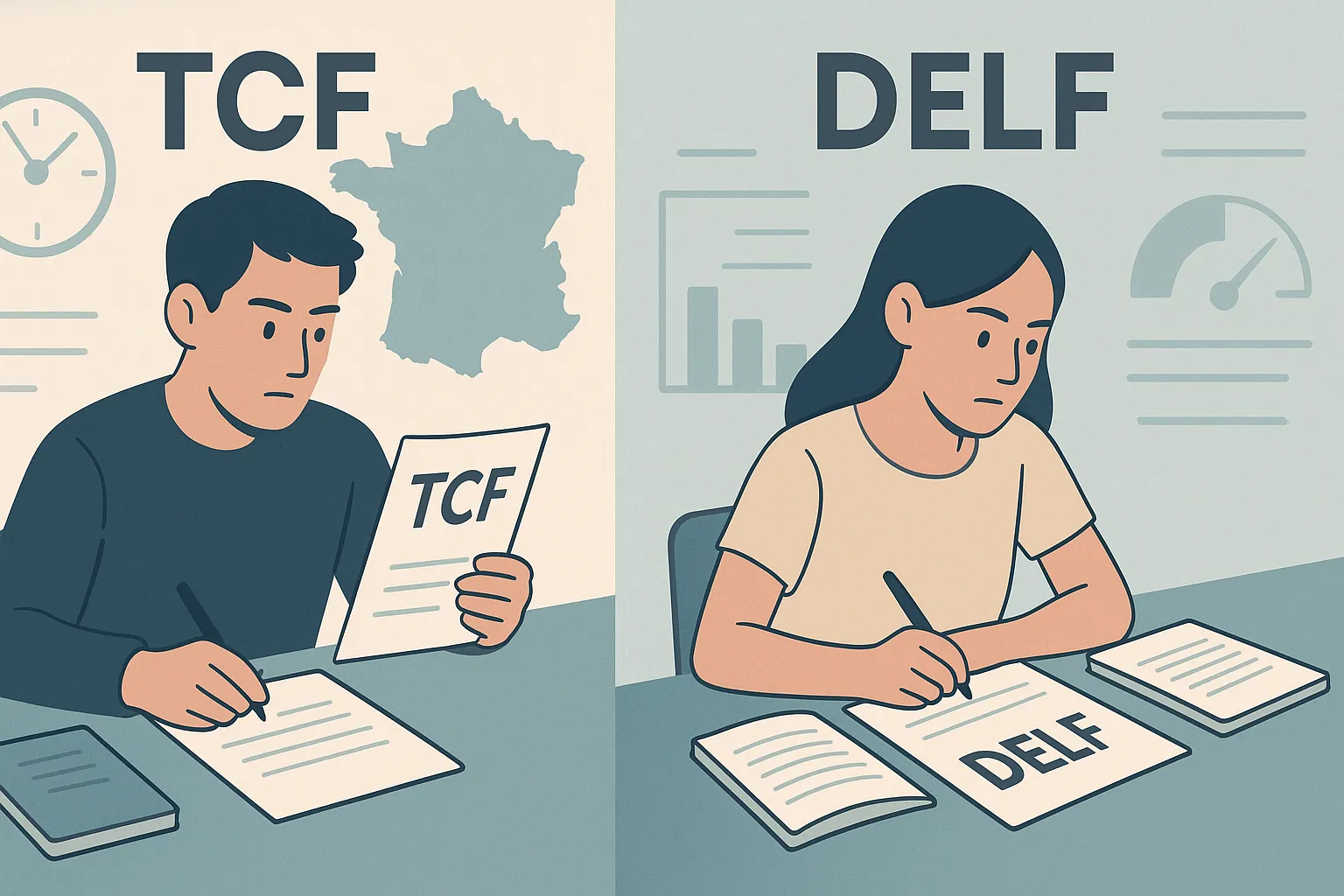
TCF vs DELF comparison showing which French exam to choose for visa university or immigration
One is a diploma forever. The other expires in two years. That’s where the decision starts.
🧱 Language Foundations 🌿 All Levels (A1-C2)

The fundamental difference: diploma vs assessment

DELF is a diploma. You register for a specific level (A1, A2, B1, B2), you sit the exam, and you either pass or fail. If you pass, that diploma is yours permanently. It never expires. It is issued by the French Ministry of Education through France Éducation International and recognised worldwide. Once you have it, it works the same way ten years later as it did on the day you passed. If you are starting at beginner level, the DELF A1 exam guide breaks down exactly what that first level requires.

TCF is a test. You take one standardised exam, receive a numeric score between 0 and 699, and that score places you somewhere on the CEFR scale. The resulting certificate expires after exactly two years from the date of results. It is also administered by France Éducation International. If you need recertification after the expiry window, you pay the full fee again, prepare again, and sit the exam again.

That distinction drives everything else. DELF gives you a diplôme. TCF gives you an attestation. The words themselves tell you which one lasts.

CriteriaDELFTCF
TypeDiploma (pass/fail per level)Assessment (numeric score)
ValidityLifetime2 years from results date
Levels testedA1, A2, B1, B2 (one exam per level)One test, score determines level
Skills tested4 (listening, reading, writing, speaking)Varies by version (see below)
Pass threshold50/100 overall + minimum 5/25 per skillNo pass/fail. You get a score.
FormatPaper-based (most centres)Computer-based or paper (varies)
Sessions2-6 per year (set by FEI national calendar)Multiple per month (centre-dependent)
Results delay4-8 weeks after exam15 business days after FEI receives materials
Cost (France)~100-160€ depending on level and centre~160-250€ depending on version
Retake ruleNo waiting period between attempts30-day mandatory wait between sittings

Costs are not standardised nationally. Each centre sets its own tariff within a range. University centres in France tend to be cheaper (DELF B2 around 120-150€ for students). Alliance Française centres abroad are more expensive. In Canada, TCF Canada runs 340-450 CAD depending on province. Always check your specific centre. The only reliable way to find the exact price is the official FEI centre directory.

You’re choosing the right French certification path.
The Briefing builds exam-ready French daily. Real structures, real register. Quiz included.
📰 Read The French Briefing
Free. No account.

Which exam for which purpose: the decision tree

  1. 1
    Canadian immigration (federal or citizenship)?TCF Canada. Mandatory. 4 skills obligatory and inseparable. DELF not accepted by IRCC. Official TCF Canada page.
  2. 2
    Quebec immigration (CSQ)?TCF Québec. Modular: you can pass 1, 2, 3, or 4 skills separately. Different from TCF Canada. Recognised by MIFI.
  3. 3
    French naturalisation, carte de résident, or carte de séjour pluriannuelle?TCF IRN or DELF both accepted. But since January 2026: naturalisation = B2, carte de résident = B1, carte de séjour pluriannuelle = A2. Plus an examen civique is now mandatory. DELF never expires. TCF IRN expires in 2 years. If your application takes 12-18 months, TCF may expire before review. DELF is safer. The administrative French involved in these procedures overlaps with the broader bureaucracy vocabulary guide. Service-Public.fr (verified February 2026).
  4. 4
    French university admission?DELF B2 or TCF TP with B2 score. Both accepted. DELF B2 holders are permanently exempt from language testing for any future French university application. FEI confirms: DALF holders are dispensed from language tests for French university registration.
  5. 5
    Need certification in under 8 weeks?Check TCF availability first. Sessions run multiple times monthly. DELF sessions are set by a national calendar with 2-6 dates per year depending on the centre.
  6. 6
    Not sure of your level?TCF first as a diagnostic (your score tells you where you are). Then register for DELF at the confirmed level. Two exams, zero risk of choosing wrong. You can also start with the realistic French timeline to understand how long each CEFR level typically takes.
  7. 7
    None of the above, just want proof of French on your CV?DELF. Permanent. Clean. No expiry date to explain. “DELF B2” on a CV reads like a credential. “TCF B2 (2024)” reads like an expired test.

TCF versions: five exams that are NOT interchangeable

This is where real money gets wasted. The name “TCF” appears on five different exams that serve five different purposes. Test centres don’t always explain which version you’re registering for. Submitting TCF Tout Public for a process that requires TCF Canada gets your file returned without review. No refund on the exam fee. You start over.

VersionPurposeSkills testedKey detail
TCF Tout Public (TP)General proficiency, French university admission3 mandatory (listening, reading, language structures) + 2 optional (writing, speaking)NOT accepted for Canadian immigration
TCF CanadaCanadian federal immigration (IRCC) + citizenship4 mandatory and inseparable30-day wait between sittings. Results in 15 business days.
TCF QuébecQuebec immigration (MIFI/CSQ)4 modular (can take 1-4 separately)Different from TCF Canada. Quebec has its own immigration system.
TCF IRNFrench naturalisation, carte de résident, carte de séjour pluriannuelle, CIR4 mandatory (listening, reading, writing, speaking)Replaced TCF ANF + TCF CRF since January 2022. Evaluates up to B2 since May 2025. Duration: 1h35.
TCF DAPPre-admission to French universities (L1/architecture)3 mandatory + mandatory writingSpecific to first-year undergraduate admission. Administered by universities.

The 200€+ mistake that happens every week. Someone preparing for Canadian immigration registers for TCF Tout Public instead of TCF Canada. The score is rejected by IRCC. The fee is lost. The preparation weeks are lost. The only way to prevent this: verify with the receiving institution (not the test centre) which exact version they require, then double-check the version name on your registration confirmation before paying.

January 2026 changes: the new French law that rewrites the rules

The loi n°2024-42 du 26 janvier 2024 (loi immigration) raised the required French levels for residency and citizenship in France. These new thresholds are applied by préfectures since January 2026:

ProcedureRequired level (since Jan 2026)Previous requirementAccepted certifications
NaturalisationB2B1DELF B2, DALF, TCF IRN with B2, TEF
Carte de résident (10 ans)B1A2DELF B1+, TCF IRN with B1, TEF
Carte de séjour pluriannuelle (first)A2Not requiredDELF A2+, TCF IRN with A2, TEF

In addition, an examen civique is now mandatory alongside the language certification. It consists of 40 QCM questions on French values, institutions, rights and duties, history and culture, and life in society. It is a separate exam from the TCF IRN and must be passed for the file to be accepted by the préfecture.

Sources: Service-Public.fr (verified 10 February 2026) and France Éducation International (TCF IRN evolution announcement).

What this means concretely for certification choice

If you are pursuing naturalisation, the target is now B2. That is a significant jump from the old B1 requirement. A DELF B2 diploma is valid forever and eliminates the risk of your TCF expiring during the 12-18 month processing period. If you are pursuing a carte de résident, B1 is the new floor. If you are arriving in France and applying for your first carte de séjour pluriannuelle, A2 is now mandatory where it was not before. The examen civique adds a second exam to the process. Plan for both.

Transition rule. TCF IRN attestations issued before May 2025 evaluated up to B1 only. Since May 2025, the TCF IRN evaluates up to B2 to match the new naturalisation requirement. If you hold an older TCF IRN attestation showing B1, it remains valid for carte de résident (if still within its 2-year validity) but does NOT satisfy the new B2 naturalisation threshold. You would need to retake the updated version.

Format comparison: how each exam works on test day

DELF is paper-based in most centres. You can annotate, skip questions, and return to them. You get preparation time before the oral. The examiner adapts to your level within the section. You know exactly which level you are being tested on because you registered for it.

TCF is typically computer-based. Linear format: you cannot go back to a previous question once you move on. Listening recordings play once (DELF plays audio 1-2 times). TCF TP uses adaptive difficulty where correct answers trigger harder questions. TCF oral runs 3 tasks in about 12 minutes with minimal preparation time. DELF oral gives 10-20 minutes preparation depending on the level.

For people who manage time strategically and like reviewing their answers: DELF’s paper format is a genuine advantage. Listening practice specifically matters more than most candidates expect, and the French podcast guide covers the audio sources that build real comprehension. For people who prefer steady-pace progression without time allocation decisions: TCF’s linear format removes that burden.

Long-term cost: the calculation nobody runs

Someone who needs French certification once pays roughly the same for either exam. Someone who needs it three times over a career pays ~480-750€ for TCF versus ~120-160€ for DELF. The gap widens with every retake because each TCF sitting requires full payment and fresh preparation. DELF is a one-time investment. Over a decade, the cost difference can exceed 500€ for the same level of proof.

The hidden cost of DELF: choosing the wrong level. If you register for B2 and fail, you lose ~150€ and must retake. TCF eliminates this risk because your score lands wherever your ability is. The dual strategy (TCF first as diagnostic, then DELF at the confirmed level) costs ~350€ total but provides both certainty and permanence. If you want to start building exam-ready French right now, the 15-minute daily routine is designed for people who need structure without spare time.

Common scenarios in one sentence

🇫🇷 “Je veux étudier à la Sorbonne dans deux ans” 🇺🇸 DELF B2. You have time, the diploma stays valid, and DALF holders skip language testing entirely.
🇫🇷 “J’ai besoin d’un certificat pour l’immigration canadienne” 🇺🇸 TCF Canada. Mandatory. No alternative. Not TCF TP. Not DELF. TCF Canada specifically.
🇫🇷 “Je prépare la naturalisation française” 🇺🇸 Since January 2026: B2 required. DELF B2 never expires. TCF IRN also works but expires in 2 years.
🇫🇷 “Je ne suis pas sûr(e) de mon niveau” 🇺🇸 TCF first as diagnostic. Then DELF at the confirmed level. Two exams, zero risk.
🇫🇷 “J’ai besoin du certificat dans six semaines” 🇺🇸 TCF. Sessions run monthly. DELF may not have a session in your window.

Study glossary: certification vocabulary

FrenchEnglishWhy it matters
Le diplômeDiploma (permanent)DELF/DALF issue a diplôme. Valid for life.
L’attestationCertificate (temporary)TCF issues an attestation. Expires in 2 years.
La validitéValidity periodDELF = lifetime. TCF = 2 years from results date.
Le niveau CECRLCEFR levelA1-C2 scale. The common reference for both exams.
S’inscrireTo registerRegister via the centre, not via FEI directly.
La naturalisationNaturalisation/citizenshipNow requires B2 (since January 2026).
La carte de résident10-year residency cardNow requires B1 (since January 2026).
L’examen civiqueCivic knowledge exam40 QCM. Mandatory alongside TCF IRN since 2026.
Le centre d’examen agrééAccredited exam centreOnly place to sit the exam. Find yours via FEI directory.
IRCCImmigration, Refugees and Citizenship CanadaThe Canadian authority that requires TCF Canada specifically.
$19/mo

Less than one coffee a week.

You just mapped which French exam fits your situation. The Pass builds exam-ready French weekly: real audio, real structures, CEFR tracking.

✓ WEEKLY AUDIO✓ CEFR TRACKING✓ FULL ARCHIVES
📈 GET THE PASS · $19/MO
Zero contract. Liquidate in 2 clicks.
100% Free. Zero friction.

DELF A1 Exam Guide – Complete Preparation for Beginners

DELF A1 Exam Guide: The Complete Beginner Preparation Plan to Pass Without Guessing What the Exam Really Wants

DELF A1 is a beginner exam, but it still punishes scattered preparation and weak control in one section. Official structure, real durations, pass thresholds, section-by-section strategy, and the concrete mistakes that waste the most points.

DELF A1 beginner exam preparation guide with strategy for all four sections
DELF A1 is a beginner exam, but it still punishes scattered preparation and weak control in one section.
🧱 Language Foundations 🌱 Beginner (A1)

What DELF A1 officially proves and why it matters

DELF A1 is the first level of the DELF “tout public” diploma series. It is an official diploma issued by the French Ministry of Education through France Éducation International. It is recognised worldwide. Once you pass, the diploma is valid for life. No renewal. No expiry. No recertification. That alone separates it from TCF certificates, app badges, and informal placement tests. If you are not sure whether DELF or TCF is the right choice for your situation, the TCF vs DELF comparison covers every scenario with official 2026 data.

According to FEI’s official A1 page, the candidate who chooses DELF A1 can: answer simple questions about themselves (name, nationality, activities), understand very short and simple texts phrase by phrase, recognise familiar words accompanied by images, write simple isolated expressions and phrases, give simple personal information in writing (name, address, family), and ask and transmit basic personal details.

That is the scale. Not fluency. Not conversation. Basic functional communication across four skills simultaneously. The confusion begins because many learners study “French in general” while DELF A1 tests “basic communication in exam format.” Those are related, but not identical.

What DELF A1 does NOT prove

It does not prove you can follow a real conversation between French people. It does not prove you can read a newspaper. It does not prove you can make a phone call without support. It does not satisfy any visa, residency, or citizenship requirement (those start at A2). It proves you can function at the most basic everyday level across four skills. That is genuinely useful, and it is also genuinely limited.

Practical facts: cost, sessions, registration, CPF

Costs vary by centre. In France, DELF A1 typically costs 100-130€ for external candidates. University centres often offer reduced rates for enrolled students (Sorbonne Nouvelle 2026: ~134€ for students, ~194€+ for external candidates at B1 level; A1 is cheaper). Abroad, costs range from 100€ to 250€ depending on country. The only reliable source for your exact price is the FEI worldwide exam centre directory.

In France, the 2026 national calendar shows DELF/DALF tout public sessions in January, February, May, and June. Dates for collective exams are fixed nationally by FEI. Individual oral exams are scheduled by each centre. Registration deadlines typically fall 1-2 months before the session. Abroad, calendars differ by country.

In France, DELF is eligible for CPF (Compte Personnel de Formation) funding. If you are employed or have been employed, you may be able to use your CPF credits to cover exam fees and preparation courses. FEI confirms CPF eligibility on their practical information page.

FEI also offers épreuves d’entraînement (practice exams) in accredited centres: real exam papers, real conditions, listening and reading only, with rapid results. These exist specifically so candidates can test their level before committing to the real exam. If you are unsure whether you are ready, this is the official low-risk option.

You’re preparing for a real French exam.
The Briefing builds daily French contact that compounds into exam readiness. Real structures, quiz included.
📰 Read The French Briefing
Free. No account.

The official exam structure: what you actually face

DELF A1 has three collective papers (taken in a room with other candidates) and one individual oral exam (alone with two examiners). Each section is scored out of 25. Total: 100. To pass: minimum 50/100 overall AND minimum 5/25 in every section. A score below 5 in any single section is eliminatory even if your total exceeds 50. Source: FEI official DELF A1 page.

SectionTypeDurationPointsWhat it tests
Compréhension de l’oralCollective~20 min/25Understand short announcements, instructions, conversations about everyday situations
Compréhension des écritsCollective~30 min/25Read short practical documents: signs, notices, messages, forms, simple ads
Production écriteCollective~30 min/25Fill in a form + write a very short message (postcard, email, note)
Production oraleIndividual (2 examiners)~5-7 min + 10 min prep/25Guided interview + information exchange + role-play

Total collective exam duration: approximately 1h20. The oral exam is scheduled separately, sometimes on a different day. You get 10 minutes preparation time before the oral.

The eliminatory threshold that catches people. You can score 20/25 in reading, 18/25 in writing, 16/25 in speaking, and 4/25 in listening — total 58/100, which looks like a pass. It is not. The 4/25 in listening is below the 5/25 minimum. You fail. This scoring rule means DELF A1 preparation must be balanced. You cannot compensate a collapsed section with strong performance elsewhere.

Official sample papers exist. France Éducation International publishes free example subjects for every DELF level: DELF A1 sample papers (FEI). These are real past exam papers. If you have not done at least two of these under timed conditions before exam day, you are underprepared.

Section by section: what each one really wants and where points get lost

Listening (compréhension de l’oral) — 20 minutes, /25

You hear short recordings about everyday situations. Questions ask for specific practical information: time, place, person, number, day, price, activity. Audio plays twice for most exercises. You are not expected to understand every word. You are expected to extract the key detail the question asks for.

The biggest beginner mistake: panicking after one missed word and mentally shutting down for the next 30 seconds of audio. One missed detail does not ruin the exercise. Stopping active listening does. Strategy: read the questions before each recording starts. If your listening base is weak, daily podcast exposure at A1-A2 level helps more than grammar drills. The French podcast guide ranks sources by difficulty. The French Briefing also works as a daily listening micro-session. Know what type of information you need (a time? a place? a name?) before you hear anything. First listen = understand the situation. Second listen = lock the specific detail.

Reading (compréhension des écrits) — 30 minutes, /25

Short practical documents: opening hours, notices, simple messages, tiny classified ads, signs, menus. The real skill is not “knowing lots of French.” It is identifying what the document is, what it says about the specific question, and answering from the text rather than from your assumptions.

The most common reading mistake at A1: reading too fast, assuming meaning from one familiar word, and answering from expectation instead of from what the text actually says. French signs and notices are precise. “Ouvert du mardi au samedi” means closed on Sunday and Monday. Candidates who skim and guess lose points on details they could have caught with slower, deliberate reading.

Writing (production écrite) — 30 minutes, /25

Typically two tasks. One is a form to fill in (name, address, nationality, date of birth, phone number, email). The other is a short message: a postcard, a note, a very short email. The form task is free points if you have practiced writing your own details in French-format labels. The short message task is where most beginners lose points by writing too much, forgetting part of the prompt, or trying to sound more advanced than they are.

🇫🇷 Salut Emma, Je suis en vacances à Marseille. Il fait beau. Hier, j’ai visité le port. Je rentre dimanche. À bientôt, Noah 🇺🇸 This is correct A1 exam writing. Short. Relevant. Clean. Answers the prompt.

The 10 most common mistakes English speakers make shows up heavily in A1 writing: gender errors, missing articles, literal translations. Fixing those before exam day is free points. FEI’s official descriptors for A1 writing say it plainly: “Can write simple isolated expressions and phrases. Can give simple personal information.” The exam does not reward elegance. It rewards clarity, relevance, and task completion.

Speaking (production orale) — 5-7 minutes + 10 min preparation, /25

Three parts. The guided interview starts with the same self-introduction you use in every other French social situation, except here the register must stay formal. Part 1: guided interview (the examiner asks simple questions about you — name, nationality, work/studies, hobbies, family). Part 2: information exchange (you draw cards with words/themes and ask simple questions to the examiner). Part 3: role-play (a short everyday scenario — buying something, making a reservation, asking for directions).

You are alone with two examiners. One asks questions. The other takes notes. You get 10 minutes preparation time before entering the room. The examiners are trained to be encouraging and to adapt to your level. They are not trying to trick you. They are trying to evaluate whether you can keep basic interaction alive.

The worst thing you can do in the oral is go silent. A weak answer is recoverable. Silence scores zero. If you do not understand, say: “Pardon, vous pouvez répéter ?” or “Je ne comprends pas bien.” Those sentences are themselves proof of A1 interaction competence. If fear is the bigger problem, the speaking anxiety guide for shy beginners addresses the same freeze mechanism.

Oral preparation checklist. Before exam day, you should be able to do all of these without hesitation: state your name, nationality, city, job or studies. Describe 2-3 hobbies. Describe your family briefly. Ask the price of something. Ask what time something opens/closes. Order food or drink. Ask the examiner to repeat. Say you don’t understand. These cover 80% of what A1 oral actually requires.

Why people fail DELF A1 when they “know some French”

Most failures do not happen because the candidate knows no French. They happen because the candidate is unstable across the four skills. They can recognise vocabulary in an app but cannot produce it under timed pressure. They can read slowly but panic in listening. They can write simple things but freeze in the oral. DELF A1 does not check whether you have touched beginner French. It checks whether all four skills are minimally functional at the same time.

Weak exam profile

Can do app exercises and controlled reading. Loses control when the exam requires speed, precision, or spontaneous output. Has never done a timed A1 paper under real conditions.

Stronger exam profile

Not advanced, but stable across all four skills. Has done at least 2 timed practice papers. Can handle the oral without freezing. Knows what the form task looks like. Has practiced writing a short message under time pressure.

The 8-week DELF A1 preparation plan

  1. 1
    Weeks 1-2: diagnose your weak sectionDownload the official FEI sample papers. Do one full paper under timed conditions. Score it honestly. If your self-introduction still feels shaky, the introduction guide covers exactly the register DELF A1 oral expects. Identify which section is your danger zone. Do not guess.
  2. 2
    Weeks 3-4: build high-frequency exam basicsNumbers 1-100, dates, times, days of the week, months. Personal information vocabulary. Daily-life nouns (food, transport, housing, family, hobbies). Short audio practice (5-10 min daily). Short practical reading (signs, menus, notices).
  3. 3
    Weeks 5-6: train output every dayWrite one short message per day (postcard, note, email — 30-50 words). Practice the oral: record yourself answering personal questions. Do role-play scenarios out loud (café, bakery, train station). Practice asking questions, not just answering them.
  4. 4
    Weeks 7-8: exam simulation modeDo 2-3 full timed practice papers. Correct them ruthlessly. No new resources. More repetition. Sleep properly. If your centre offers épreuves d’entraînement, sign up.

What to remember on exam day

Bring a valid ID (passport, titre de séjour, or national ID card) and a recent photo. FEI requires it. Arrive early. You cannot enter the collective exam more than 10 minutes late in most centres. You cannot contest your grades: jury decisions are final. If you fail, you receive a relevé de notes (score report) but no diploma, and you must pay the full fee again to retake.

You do not need to impress the examiner. You need to show stable beginner communication. If one listening item goes badly, keep going. If one reading question feels strange, move on. If one oral answer sounds ugly, continue speaking. DELF A1 is often passed by candidates who stay functional after small mistakes, not by candidates who feel perfect from start to finish. “For sure.” 🕶️

Study glossary: DELF A1 exam vocabulary

FrenchEnglishWhy it matters
L’examen / les épreuvesThe exam / the papers3 collective + 1 individual oral
Réussir / échouerTo pass / to fail50/100 minimum + 5/25 per section
La compréhension de l’oralListening comprehension~20 min, short practical recordings
La compréhension des écritsReading comprehension~30 min, short documents
La production écriteWritten production~30 min, form + short message
La production oraleOral production5-7 min + 10 min prep, 2 examiners
Remplir un formulaireTo fill in a formFree points if practiced
Un jeu de rôleA role-playPart 3 of oral: everyday scenario
L’examinateur / l’examinatriceThe examinerTrained, encouraging, adapts to your level
Le diplômeThe diplomaValid for life. Issued by Ministry of Education.
Le relevé de notesScore reportGiven if you fail. No diploma.
S’inscrireTo registerVia the centre, not FEI directly. 1-2 months before session.
Les épreuves d’entraînementPractice examsOfficial option offered by some centres. Real conditions.
Le CPFPersonal Training AccountDELF is CPF-eligible in France. Check with your centre.
$19/mo

Less than one coffee a week.

You just mapped the DELF A1 exam with official data. The Pass builds exam-ready French weekly: real audio, real structures, CEFR tracking from day one.

✓ WEEKLY AUDIO✓ CEFR TRACKING✓ FULL ARCHIVES
📈 GET THE PASS · $19/MO
Zero contract. Liquidate in 2 clicks.
100% Free. Zero friction.

French Job Interview Guide: Questions & Answers

French Job Interview Vocabulary: The Complete Career Guide to Answering Well, Sounding Professional, and Handling the French Specifics That Many Candidates Miss

Your French grammar may be fine. Your professional register is probably wrong. This guide covers the real interview vocabulary, the contract framework, the salary discussion (always in brut annuel), and the cross-cultural traps that catch anglophone candidates before they even reach the hard questions.

French job interview vocabulary and work phrases for career success
In a French interview, small signals matter: tone, structure, proof, and whether you sound like someone who can already operate in a French-speaking workplace.
💼 Professional & Expat Life 🌳 Intermediate to Upper-Intermediate (B1-B2)

Why French interviews feel different even when the role is familiar

Many candidates prepare as if a French interview were an English interview translated into French. That approach creates two problems at once. The language sounds literal and over-explained. And the candidate misses the deeper expectations of the French format.

France Travail’s interview guidance shows what recruiters actually evaluate: your understanding of the role, your interest in it, your relevant skills, your motivation, and your medium-term projection. That list explains why vague answers, generic enthusiasm, or overfriendly improvisation land badly. The recruiter is looking for structured evidence that you understand the job and can position yourself clearly inside it. That kind of register does not build itself overnight. Daily contact with real professional French, like the French Briefing, trains the exact structures and formality level that interviews reward.

What French recruiters are testing underneath the question

Main layer: your fit for the role. Second layer: your ability to explain yourself with structure and precision. Third layer: your professional judgment, including how you ask questions, discuss money, and understand contract realities.

What is structurally different from the US, the UK, and most anglophone countries

This section exists because the differences are not cosmetic. They are structural. Getting them wrong does not just sound awkward. It signals that you have not done the work of understanding how the French labour market operates.

Salary is discussed in brut annuel. Always.

In the US, salary is typically discussed as annual gross or sometimes monthly gross. In the UK, annual gross is standard. In France, the default unit is brut annuel (gross annual). When a recruiter asks “Quelles sont vos prétentions salariales ?”, they expect a number like “45 000 euros bruts annuels.” Not monthly. Not net. Not “around 3,500 a month.” Giving a monthly figure or a net figure marks you instantly as someone who does not know how French compensation works. The gap between brut and net in France is roughly 22-25% for cadres (managers/professionals) and 20-23% for non-cadres, depending on the company’s charges sociales. A 45K brut annuel translates to roughly 2,800-2,900€ net mensuel. Know this before the conversation starts. The same numerical precision matters in French admin and bureaucracy situations where getting a figure wrong has consequences.

The “package” includes things that don’t exist in the US

French compensation goes beyond salary. The standard package for a CDI position typically includes: mutuelle d’entreprise (mandatory employer-provided health insurance top-up), tickets restaurant (meal vouchers, ~8-10€/day, employer covers 50-60%), participation and intéressement (mandatory or optional profit-sharing), RTT days (additional paid leave on top of the legal 5 weeks, for people working more than 35h/week), comité social et économique (CSE) benefits (culture vouchers, discounts, holiday subsidies), and sometimes a prime de transport (commuting subsidy). When a recruiter says “le package global,” they mean all of this. Asking only about salary and ignoring the rest makes your negotiation incomplete.

CDI is not “at-will” employment

Americans expect employment to be at-will: either side can end it at any time, for any legal reason. France is the opposite. A CDI (contrat à durée indéterminée) is an open-ended contract with strong legal protections. Dismissal requires justification (cause réelle et sérieuse), follows a formal procedure, and often involves severance (indemnités de licenciement). The employee also has a legally defined notice period (préavis), typically 1-3 months depending on seniority and convention collective. This means “I can start in two weeks” is almost never true for someone currently in a CDI. The recruiter knows this. If you claim immediate availability while holding a CDI, it raises questions. The broader contract and admin vocabulary also shows up when renting an apartment or opening a bank account in France.

The période d’essai is mutual, not one-sided

In the US, probation periods (when they exist) mainly protect the employer. In France, the période d’essai protects both sides. Either the employer or the employee can end the contract during this period with minimal notice (24h to 48h in the first month, scaling up after). For cadres in CDI, the initial legal maximum is 4 months, renewable once under conditions set by the convention collective. For CDD, it scales differently: one day per week of contract up to a cap of 2 weeks (for CDDs ≤6 months) or 1 month (for CDDs >6 months). Service-Public.fr covers the full framework.

35 hours is the legal standard, not 40

The French standard work week is 35 hours. Cadres often work more in practice (39h is common, with RTT days to compensate), but the legal reference is 35h. When a French colleague leaves at 18h, they are not leaving early. They are leaving on time. Interpreting French work rhythms through an American lens of constant availability creates friction in both the interview and the job itself. If the role involves forfait jours (annual day-count contract for cadres), the concept of weekly hours disappears entirely and is replaced by a maximum of 218 working days per year.

Vacation is 5 weeks minimum by law

Not a perk. Not negotiable downward. Five weeks of paid vacation (25 jours ouvrés) is the legal minimum for all employees in France. Many cadres get additional RTT days on top (typically 8-12 per year). Asking “how many vacation days do I get?” in a French interview is legitimate, but the answer will never be less than 25 unless you are on a very short CDD. Americans who treat French vacation policy as a generous benefit misread the situation. It is a legal right, and French employees exercise it fully.

The cadre / non-cadre distinction that doesn’t exist in the US or UK

In France, every salaried employee falls into one of two broad categories: cadre or non-cadre (sometimes called ETAM: employé, technicien, agent de maîtrise). This is not a job title. It is a legal and social classification that changes your pension contributions, your unemployment insurance rates, your probation period length, your notice period, your salary structure, and even the retirement fund you contribute to. Cadres contribute to Agirc-Arrco (the unified complementary pension fund since 2019), but historically the cadre system carried different contribution rates and ceiling levels. The gap between brut and net is higher for cadres (~25%) than for non-cadres (~22%) because of these additional contributions.

For anglophone professionals, the closest analogy is “exempt vs non-exempt” in the US, but the French version goes further. Cadre status appears on your payslip, on your contract, in your convention collective classification, and on your Pôle Emploi file if you lose your job. It affects how much unemployment insurance you receive and for how long. It affects your période d’essai (4 months for cadres vs 2 months for most non-cadres in CDI). It affects your préavis de démission (typically 3 months for cadres vs 1-2 months for non-cadres, but this depends on the convention collective). When a recruiter asks about your current status, they need to know whether you are cadre or non-cadre because it changes the entire administrative setup of your contract.

If the recruiter says “c’est un poste cadre”, they are telling you: the salary will be discussed in brut annuel, the période d’essai is 4 months (renewable once = 8 months max), the préavis is likely 3 months, you will probably be on a forfait jours (218 days/year, no weekly hour count), and your social charges will be higher. This is not a promotion. It is a classification. Many anglophone professionals assume “cadre” means “executive.” It does not. It means “professional/managerial staff” and includes engineers, project managers, department heads, and many mid-level roles.

The convention collective: the industry-level rulebook nobody tells you about

Every French company is covered by a convention collective (collective bargaining agreement) tied to its industry sector. This is not optional. It is legally binding. The convention collective sets minimum salaries by job classification, notice periods, probation period durations and renewal rules, overtime compensation, holiday bonuses (13ème mois), seniority premiums, and many other conditions that override or supplement the Code du Travail (national labour law). Your individual contract cannot offer less than what the convention collective guarantees.

This matters in interviews because the same job title can have different salary floors, different préavis lengths, and different probation rules depending on the convention collective. A marketing manager in the convention collective Syntec (IT/consulting) has different rules than a marketing manager in the convention collective de la métallurgie (manufacturing) or the convention collective des bureaux d’études (engineering consultancies). When the recruiter mentions “notre convention collective,” they are telling you which rulebook governs your contract.

Major conventions collectives you’ll encounter

Syntec (IT, consulting, engineering firms) — one of the most common for anglophone professionals. Cadre préavis: 3 months. Période d’essai: 4 months renewable. Classification system: from position 1.1 to 3.3. Minimum salaries indexed on coefficient.

Métallurgie (manufacturing, automotive, aerospace, defense) — recently overhauled in 2024. New classification grid. Covers ~1.5 million workers.

Commerce de détail et de gros (retail and wholesale) — different rules for cadres vs employés, specific holiday bonus structures.

Banque (banking) — 13ème mois standard, specific paid leave days, generous mutuelle.

Hôtels, cafés, restaurants (HCR) — different overtime rules, specific meal benefit (avantage en nature repas), seasonal contract provisions.

The convention collective applicable to your role is legally required to appear on your payslip and in your contract. If you want to check the rules before the interview, search your industry on Légifrance (IDCC directory).

Why this matters in the salary conversation. If the convention collective Syntec sets a minimum brut annuel of 30K for your classification level, and the recruiter offers 28K, that offer is illegal regardless of what you “agreed” to. Knowing your convention collective means knowing the floor. It also means you can ask informed questions: “Quelle est la convention collective applicable ?” and “À quel coefficient correspond ce poste ?” Those two questions signal that you understand the system.

You’re learning the professional French that shapes how employers see you.
The Briefing builds that same register daily. Real French, real structures. Quiz included.
📰 Read The French Briefing
Free. No account.

The opening and “Tell me about yourself”

The safest opening is controlled formality. Bonjour Madame / Monsieur, merci de me recevoir. Je suis ravi(e) d’être ici aujourd’hui. Do not rush into enthusiasm. Do not try to create immediate casual closeness. French interview tone rewards control more than charisma.

“Parlez-moi de vous” needs a structure, not a script. Four beats: what you do now, the experience that matters for this role, one or two strengths with evidence, and why this move makes sense now.

🇫🇷 Je travaille actuellement comme responsable marketing dans le secteur du logiciel B2B. Au cours des dernières années, j’ai développé une expérience en pilotage de campagnes et en coordination d’équipes transverses. Ce qui m’amène aujourd’hui, c’est la volonté de rejoindre une structure où je pourrai prendre un périmètre plus stratégique. 🇺🇸 Current role → relevant trajectory → reason for being here. Modular. Works in a 90-second screening call or a 20-minute deep interview. The register here is distinctly more professional than casual French introductions, where moi c’est replaces je m’appelle.

The questions you will almost certainly get

The problem is not understanding the question. The problem is sounding convincing in French while staying concise. Here are the recurring ones with the answer logic that works.

Pourquoi souhaitez-vous rejoindre notre entreprise ?

Weak answer: admiration with no evidence. Better answer: company + role + your trajectory connected logically. “Ce poste m’intéresse parce qu’il correspond à une étape logique de mon parcours. J’ai été sensible à votre positionnement sur le marché. Je pense que mon expérience sur des projets comparables me permettrait d’être rapidement utile.”

Quels sont vos points forts ?

Do not list qualities. Build one strength into an example. “L’une de mes principales forces est ma capacité à structurer les priorités dans des contextes complexes. Par exemple, sur mon dernier projet, j’ai repris un sujet en retard et réorganisé le pilotage avec les parties prenantes clés.”

Quels sont vos axes d’amélioration ?

French recruiters use axes d’amélioration rather than “weaknesses.” Name a real limitation, show awareness, show what you are doing with it. “J’ai parfois tendance à vouloir aller vite dans l’exécution. Avec l’expérience, j’ai appris à consacrer plus de temps au cadrage initial.”

Pourquoi souhaitez-vous quitter votre poste actuel ?

Never attack your employer. Focus on forward movement. “Je cherche un cadre qui me permettra d’élargir mon champ d’action. J’ai beaucoup appris dans mon poste actuel, mais je sens que c’est le bon moment pour franchir une nouvelle étape.”

Où vous voyez-vous dans trois à cinq ans ?

Answer with progression, not fantasy. “À moyen terme, j’aimerais consolider mon expertise sur ce type de périmètre et prendre davantage de responsabilités.”

Behavioral questions: claim, then proof

France Travail explicitly recommends supporting every claim with concrete examples. If you say you are rigorous, resilient, or collaborative, prove it with an actual situation. The strongest pattern: situation → challenge → action → result.

🇫🇷 Dans mon précédent poste, nous avions un retard important sur un projet prioritaire. L’enjeu principal était de réaligner rapidement les équipes. J’ai organisé un point de recadrage, clarifié les priorités et mis en place un suivi plus serré. Nous avons sécurisé la livraison dans le calendrier révisé. 🇺🇸 Situation → challenge → action → result. Observable. Credible. No slogans.

Stronger verbs that change how professional you sound

Strong interview verbs

J’ai piloté, j’ai coordonné, j’ai mis en place, j’ai accompagné, j’ai contribué à, j’étais en charge de, j’ai structuré, j’ai sécurisé, j’ai optimisé, j’ai déployé.

Weak interview verbs

J’ai fait, j’ai travaillé sur, j’ai aidé, j’ai participé un peu, j’étais impliqué(e), j’étais dans le projet. Too vague, too soft, too easy to forget.

Contract vocabulary and salary discussion

Questions that are legally off-limits

Apec is explicit: recruiters in France are not supposed to ask questions touching protected characteristics (age, origin, citizenship, criminal record, disability, family situation, sex, gender, union membership, religion). If it happens, you can redirect: “Je préfère recentrer ma réponse sur les éléments en lien avec le poste.” Diplomatic and firm.

Essai professionnel vs période d’essai

These are not the same thing. Service-Public defines the essai professionnel as a test before hiring to evaluate qualifications. The période d’essai is the trial period that begins after hiring. Confusing them makes you sound illiterate in the French employment system. Ask: “Y aura-t-il un essai professionnel dans le processus ?” vs “Quelle est la durée de la période d’essai prévue ?”

The salary conversation

When the recruiter asks “Quelles sont vos prétentions salariales ?”, answer in brut annuel with a range anchored in the role and market: “Au regard du poste, de mon expérience et du marché, je me positionne sur une fourchette de 42 à 48 K euros bruts annuels.” Then open the door to the full package: “Je reste ouvert(e) à l’échange en fonction de l’ensemble du package.”

Ask about the components that matter: “Quels sont les avantages associés au poste ?” (benefits), “Quelle est votre politique de télétravail ?” (remote work), “Y a-t-il une part variable ?” (variable compensation), “La mutuelle est-elle prise en charge à 100% ?” (health insurance coverage). These are normal questions in France. Asking them signals that you understand French compensation is more than a single number. If the conversation goes to phone follow-up, the first French phone call guide covers the exact register you need when calling a recruiter back. Apec (the executive employment agency) publishes salary studies by sector and function that can help you calibrate your range before the interview.

The préavis trap. Do not say “I can probably start quickly” if you have not checked your real notice period. In France, préavis de démission en CDI is typically 1-3 months depending on your convention collective, seniority, and status (cadre vs non-cadre). State your actual situation precisely: “Mon délai de préavis est de trois mois, négociable sous conditions.”

The questions you should ask the recruiter

France Travail is explicit: prepare your own questions in advance. Not asking anything makes you look passive or underprepared. The strongest questions show you already think like someone inside the role:

🇫🇷 Quels seront les enjeux prioritaires sur ce poste au cours des premiers mois ? 🇺🇸 What will the priority challenges be in the first few months?
🇫🇷 Comment se déroulera la prise de poste ? / S’agit-il d’une création de poste ou d’un remplacement ? 🇺🇸 How will onboarding work? / Is this a new role or a replacement?
🇫🇷 Qui serait mon manager direct ? / Comment l’équipe s’organise-t-elle au quotidien ? 🇺🇸 Who would be my direct manager? / How is the team organized day to day?
🇫🇷 Quelles sont les prochaines étapes du processus ? 🇺🇸 What are the next steps? (Always ask this. It gives you a timeline and shows you expect a structured process.)

After the interview: the follow-up that most candidates skip

France Travail recommends sending a thank-you email within two to three days via email or LinkedIn. Keep it professional and concise. Three beats: thank them for the time, confirm your interest with one specific reason from the interview, close with availability.

🇫🇷 Madame, Monsieur, je vous remercie encore pour le temps accordé lors de notre entretien. Notre échange a renforcé mon intérêt pour le poste et pour les enjeux que vous m’avez présentés. Je reste à votre disposition si vous souhaitez des précisions complémentaires. Cordialement, [name] 🇺🇸 Thank → confirm interest with specifics → availability → close. Three sentences. Done.

If there is no answer after the indicated timeline, Apec supports the idea of a concise relance (follow-up). “Je me permets de revenir vers vous concernant le poste de… Je souhaitais renouveler mon intérêt pour cette opportunité.” Short, professional, motivated. The point is to remind, not to pressure. The email register connects directly to business expressions that shift between English and French and the broader email and office register guide.

Your preparation plan

  1. 1
    Write your 90-second self-presentationCurrent role, relevant trajectory, core value point, reason for this move. Practice out loud until it sounds natural, not memorised.
  2. 2
    Prepare five real examplesOne success, one difficult situation, one conflict, one mistake or learning moment, one example of initiative. Structure each as situation → challenge → action → result.
  3. 3
    Learn the contract vocabularyCDI, CDD, période d’essai, préavis, brut annuel, mutuelle, RTT, tickets restaurant, convention collective. Know your own actual préavis.
  4. 4
    Research salary with official dataUse Apec salary studies (free for cadres) or France Travail job listings to calibrate your range. Always in brut annuel.
  5. 5
    Prepare three serious questions + the after-interview emailDo not improvise either one the day after when your energy is gone.

The final test. If an answer still sounds like an English paragraph moved into French, cut it, simplify it, and rebuild it around one action verb, one example, and one result. “For sure.” 🕶️

Study glossary: French interview vocabulary

FrenchEnglishWhy it matters
Un entretien d’embaucheA job interviewThe interview itself
Le recruteur / la recruteuseThe recruiterPerson conducting recruitment
Le poste / les responsabilitésThe role / responsibilitiesScope of the job
Les compétencesSkillsHard and soft skills
Les axes d’améliorationAreas for improvementFrench phrasing for “weaknesses”
Les prétentions salarialesSalary expectationsAlways in brut annuel
La rémunération / le packageCompensation / full packageSalary + mutuelle + RTT + tickets resto + variable
Le brut annuel / le net mensuelGross annual / net monthlyDiscuss in brut annuel. Gap ~22-25% for cadres.
Le délai de préavisNotice period1-3 months in CDI. State yours precisely.
La période d’essaiProbation periodMutual. 4 months max for cadres (CDI). Renewable once.
L’essai professionnelPre-hiring skills testBefore hiring. Different from période d’essai.
Un CDI / un CDDPermanent / fixed-term contractCDI = strong protection. Not at-will.
La convention collectiveCollective bargaining agreementSets sector-specific rules for préavis, salaries, benefits.
Le forfait joursAnnual day-count contractFor cadres. 218 days/year max. No weekly hour count.
La mutuelle d’entrepriseCompany health insurance top-upMandatory. Employer covers ≥50%.
Les tickets restaurantMeal vouchers~8-10€/day. Employer covers 50-60%.
RTTAdditional paid leave daysCompensate hours worked above 35h/week.
La prise de posteStart date / onboardingWhen you actually begin work
Le télétravailRemote workAsk the policy. Varies widely.
J’ai piloté / j’ai mis en place / j’étais en charge deI led / I implemented / I was responsible forStrong action verbs that replace vague language
Cadre / non-cadreProfessional staff / support staffLegal classification. Changes pension, préavis, charges, période d’essai.
La convention collectiveCollective bargaining agreementIndustry-level rulebook. Sets minimums for salary, préavis, probation.
Le coefficient / la classificationJob classification levelDetermines minimum salary in your convention collective.
Le 13ème mois13th month bonusExtra month of salary. Depends on convention collective, not law.
Je reste à votre dispositionI remain at your disposalStandard formal closing
$19/mo

Less than one coffee a week.

You just mapped the French interview system. The Pass builds the professional register weekly: real audio, real situations, CEFR tracking.

✓ WEEKLY AUDIO✓ CEFR TRACKING✓ FULL ARCHIVES
📈 GET THE PASS · $19/MO
Zero contract. Liquidate in 2 clicks.
100% Free. Zero friction.

How to Introduce Yourself in French – Beyond Je m’appelle

How to Introduce Yourself in French: What to Say After “Je M’appelle” if You Want to Sound Natural

At a dinner party, at the préfecture, on a first date, in a job interview, on the phone, in a WhatsApp group. The French introduction changes every time. Three words stay the same. Everything around them shifts.

How to introduce yourself in French naturally beyond je m'appelle
A good French introduction is not longer. It is just more natural for the situation.
☕ Travel & Everyday 🌱 Beginner to Intermediate (A1-B1)

Why “je m’appelle” is correct but often not the best choice

Je m’appelle is not wrong. The sentence is correct, polite, and fully understandable. The real issue is not correctness. It is fit. French introductions shift more with context than English speakers expect. What sounds fine in a classroom or formal presentation can sound slightly stiff in a casual social interaction. That is why learners often feel disappointed after using a sentence they know is correct and still hearing themselves sound more textbook than natural.

🇫🇷 Je m’appelle Sarah. → correct, slightly formal 🇺🇸 My name is Sarah.
🇫🇷 Moi, c’est Sarah. → natural, relaxed 🇺🇸 I’m Sarah.
🇫🇷 Je suis Sarah. → clean, neutral 🇺🇸 I’m Sarah.

Three ways to say the same thing. Three different social signals. The right one depends entirely on where you are and who you are talking to.

The formality scale: three levels that cover everything

SituationBest structureEffect
Casual socialMoi, c’est… / Salut, moi c’est…Relaxed, natural, low-stiffness
Neutral everydayJe suis… / Bonjour, je suis…Clear, simple, broadly usable
Formal or officialJe m’appelle… / Je me présente…Structured, respectful, professional

Do not ask “What is the perfect French introduction?” Ask “How formal is this moment?” That is the better question. If the situation is relaxed, lean toward moi, c’est…. If the situation is professional or official, je m’appelle… becomes more natural again.

You’re learning the French that works in real social situations.
The Briefing builds real French daily. Same structures, real context. Quiz included.
📰 Read The French Briefing
Free. No account.

Eight real situations, eight different introductions

This is where the article stops being theoretical. Each situation below has a different social code, a different expected length, and a different register. Using the wrong one does not cause a language error. It causes a social one.

1. Dinner party or social gathering (friend of a friend)

The sceneYou arrive at a friend’s apartment. Eight people are there. Your friend introduces you vaguely: “C’est Ben, un ami américain.” Now three people are looking at you.
🇫🇷 Salut ! Moi c’est Ben. Je suis de Chicago, mais j’habite à Paris depuis un an. Et toi, tu connais Marie comment ? 🇺🇸 Short name + one detail + redirect. Three seconds. Done. The question at the end is what makes it social instead of performative.

Do not deliver a prepared monologue. Do not explain your entire life story. Drop your name, add one anchor (city, job, or connection to the host), and hand the conversation back. French dinner parties move fast. If you talk too long in your introduction, people stop listening.

2. Professional networking event or conference

🇫🇷 Bonjour, je suis Claire Martin. Je travaille chez [company] dans le marketing digital. Et vous, vous êtes dans quel domaine ? 🇺🇸 Name + company + field + redirect. Vouvoiement by default. Clean, professional, not stiff.

At a networking event, je suis works better than moi, c’est because the register is slightly higher. Use vous until someone offers tu. Mention your company or field immediately because that is the social currency of the room. The redirect question (et vous ?) is not optional. It is expected.

3. Job interview

🇫🇷 Bonjour Madame, merci de me recevoir. Je m’appelle David Laurent. 🇺🇸 Formal greeting + thanks + je m’appelle with first and last name. This is the one context where je m’appelle sounds exactly right.

In a job interview, je m’appelle is the correct choice. Moi, c’est David would sound too casual. Use first name + last name. Then wait for the recruiter to direct the conversation. Do not launch into your pitch before being asked. The full interview register is covered in the French job interview vocabulary guide.

4. At the préfecture, the bank, or any administrative counter

🇫🇷 Bonjour, je m’appelle Sarah Thompson. J’ai rendez-vous à 14h pour un renouvellement de titre de séjour. 🇺🇸 Name + appointment + purpose. No small talk. Administrative French is functional, not social.

At the préfecture or at a bank appointment, the introduction is not social. It is transactional. State your name, state why you are there, present your documents. The person behind the counter does not want to know where you are from or what you do. They want your dossier number. That is not rudeness. That is the register. The same admin vocabulary shows up in opening a French bank account and renting an apartment.

5. On the phone (calling a doctor, an agency, a landlord)

🇫🇷 Bonjour, je suis Sarah Thompson. Je vous appelle au sujet de [reason]. / Je souhaiterais prendre rendez-vous. 🇺🇸 Name + reason for calling. On the phone, always state your name immediately because the other person cannot see you.

Phone introductions in French are more formulaic than face-to-face ones. Je suis [name] or [name] à l’appareil for professional calls. State the reason for calling in the same breath. Do not wait for the other person to guess why you are calling. The phone register overlaps directly with the first French phone call guide.

6. In a class, a workshop, or a group activity (tour de table)

🇫🇷 Bonjour, je m’appelle Lucas. Je suis américain. J’apprends le français depuis un an. Je suis ici parce que je veux améliorer mon oral. 🇺🇸 Name + nationality + learning context + reason for being there. This is the one situation where a slightly longer introduction is expected.

A tour de table (round-the-table introduction) is the one context where you are explicitly asked to give more than your name. Prepare 3-4 sentences. Name, where you are from, what you do or study, and why you are in this class/group. Do not go beyond that unless the instructor asks. Everyone else is waiting for their turn and will not forgive a two-minute monologue.

7. Dating or romantic context (in person or on an app)

🇫🇷 Moi, c’est Emma. Et toi, c’est quoi ton prénom ? 🇺🇸 Relaxed, short, immediate redirect. In a dating context, moi c’est is almost always the right choice. Je m’appelle sounds like you are filling out a form.

Dating French is the most informal end of the register. Moi, c’est… works perfectly. Je m’appelle sounds strangely formal. Tu is standard between people of similar age in this context. On apps, the introduction is often even shorter: just a first name, a question, and something that shows you read their profile. The social rule is the same as in person: light, specific, curious.

8. Moving into a new building (meeting neighbours)

🇫🇷 Bonjour ! Je viens d’emménager au troisième. Moi, c’est Thomas. Je suis américain. Enchanté ! 🇺🇸 Context first (I just moved in + which floor), then name, then something brief. Enchanté closes it warmly.

Neighbour introductions in France are brief and slightly formal at first. Bonjour is mandatory (not salut, which is too casual for someone you have never met). Mention which floor you live on because that is the relevant information in a building. Over time, the register will relax. But the first interaction sets the tone. Get it right and the relationship starts well. Skip the greeting entirely and you have created a social debt that compounds every time you cross paths in the stairwell.

The common thread across all eight situations

Every introduction above follows the same logic: match the formality of the moment, say your name in the form that fits, add one relevant detail, and redirect. The difference is never the grammar. It is the register, the length, and the social expectation.

What to say after your name so the conversation does not die

This is where learners run out of road. They know how to say their name, then they either stop too abruptly or dump too much information. The better move is to add one or two natural pieces and then hand the conversation back.

Talking about where you are from

🇫🇷 Je viens des États-Unis. / Je suis canadienne, de Montréal. / Je suis de Londres, mais j’habite à Paris maintenant. 🇺🇸 Origin is the most common follow-up. French people ask quickly. Have this ready.

Talking about what you do

🇫🇷 Je suis ingénieur. / Je travaille dans le marketing. / Je suis ici pour le travail. 🇺🇸 Short and direct. No article before most professions in French (je suis ingénieur, not je suis un ingénieur).

Handing the conversation back

🇫🇷 Et toi, tu fais quoi dans la vie ? (casual) / Et vous, vous travaillez dans quel domaine ? (formal) 🇺🇸 The redirect is what separates a conversation from a monologue. Always include it.

Tu or vous during introductions

Use vous in professional contexts, with older people, with authority figures, in service interactions, and whenever the setting feels formal or you are unsure. Use tu with peers in clearly casual settings, with friends, and when someone moves the interaction there naturally. When in doubt, start with vous. Moving from vous to tu is easy. The reverse is awkward.

🇫🇷 On peut se tutoyer ? 🇺🇸 Can we use tu? (The clean way to switch from formal to informal once the relationship allows it.)

English-speaker mistakes that make introductions sound strange

Mon nom est Pierre. Technically understandable. Socially strange. Nobody says this in normal French conversation. Use je m’appelle, je suis, or moi, c’est instead.

Over-sharing too fast. Americans especially tend to front-load personal detail. French introductions are more controlled at the start. Name, origin, work. Fine. Your full life story. Not in the first thirty seconds.

Forgetting gender agreement. Je suis américain (male) vs je suis américaine (female). Same with professions: étudiant / étudiante, avocat / avocate. Small detail, very visible in introductions.

Sounding too textbook in casual settings. The sentence may be grammatically correct and still not fit the room. If everyone is saying moi c’est and you deliver je me présente, je m’appelle Claire Bernard, the mismatch is social, not linguistic.

Three templates you can memorize tonight

  1. 1
    CasualMoi, c’est Sarah. Je viens de Londres. Et toi ?
  2. 2
    NeutralBonjour, je suis David. Je travaille dans le marketing. J’habite à Paris depuis six mois.
  3. 3
    FormalBonjour, je m’appelle Claire Martin. Je suis avocate. Enchantée de vous rencontrer.

That is already enough to sound dramatically more natural than many learners do after months of study. The reason is not complexity. It is fit. “For sure.” 🕶️

Study glossary: French introduction phrases

FrenchEnglishWhen to use it
Moi, c’est…I’m…Casual social: parties, friends, dating
Je suis…I’m…Neutral: everyday, networking, neighbours
Je m’appelle…My name is…Formal: interviews, admin, presentations
Enchanté(e)Pleased to meet youPolite close in many situations
Ravi(e) de vous rencontrerDelighted to meet youMore formal, professional
Je viens de…I come from…Origin or hometown
J’habite à…I live in…Current residence
Je travaille dans…I work in…Profession by field
Je suis ici pour…I’m here for…Reason for being there
Et toi ? / Et vous ?And you?Redirect the conversation
On peut se tutoyer ?Can we use tu?Switching from formal to informal
[name] à l’appareil[name] speaking (on the phone)Professional phone introduction
Je viens d’emménagerI just moved inNeighbour introduction
$19/mo

Less than one coffee a week.

Introductions are only the start. The Pass builds what comes next: listening fast, answering simply, staying inside the conversation instead of mentally exiting after your own name.

✓ WEEKLY AUDIO✓ CEFR TRACKING✓ FULL ARCHIVES
📈 GET THE PASS · $19/MO
Zero contract. Liquidate in 2 clicks.
100% Free. Zero friction.

French for Couples: Learn Together Without Arguments

French for Couples: How to Learn Together Without Turning Study Time Into Low-Grade Relationship Damage

One of you remembers everything faster. The other gets corrected too often. Then French stops feeling like a shared project and starts behaving like a tiny weekly fight with grammar in the middle. This guide fixes the couple dynamic first, then the French.

Learning French as a couple without arguments using practical study methods
The language is rarely the thing that breaks first. The couple dynamic gets there earlier.
🧱 Language Foundations 🌿 All Levels

Why couples learning French together gets tense faster than people expect

Most guides treat learning French as the challenge and the relationship as a pleasant extra. That is backwards. The French is often manageable. The couple dynamic is what becomes unstable first. One partner corrects too much. One partner hears every correction as criticism. One works ahead in secret and comes back stronger. The other starts feeling measured even when nobody says anything obvious.

The actual problem is rarely “French is hard”

Main issue: language learning magnifies existing couple patterns fast: competition, sensitivity to criticism, unequal effort, different tolerance for mistakes.

Practical result: if you do not set rules early, French stops feeling romantic and starts feeling like admin with feelings attached.

🇫🇷 Tu vas plus vite que moi. 🇺🇸 You are progressing faster than I am. — The sentence many couples avoid saying directly. Which is why it poisons the room indirectly.
🇫🇷 Je n’ai pas envie d’être corrigé(e) tout le temps. 🇺🇸 I do not want to be corrected all the time. — Relationship corrections land like criticism from the person closest to you.
You’re building a shared French habit as a couple.
The Briefing gives you one shared French moment daily. Same material, no level pressure. Quiz included.
📰 Read The French Briefing
Free. No account.

The four rules couples need before they “study together”

Not suggestions. Rules. Without them, the same pattern repeats: enthusiasm, mismatch, correction, defensiveness, avoidance, quiet resentment.

Rule one: do not correct your partner unless they explicitly ask

This rule alone prevents a surprising amount of damage. People think correction is help. In a relationship, unsolicited correction often feels like ranking, not support.

🇫🇷 Tu veux que je te corrige ou pas ? 🇺🇸 Do you want me to correct you or not? — Ask first. Every time the context changes.

Rule two: assume different speeds permanently

One person will move faster. Always. Maybe because of previous language study. Maybe because of confidence. Maybe because one of you quietly practices on the commute. If you treat speed difference as a temporary glitch to “fix,” you create tension. If you treat it as normal, you build around it.

Rule three: separate solo study from couple practice

Solo study is where each partner works at their level, with their own pace, without performing. Couple practice is where you do activities that are safe for both of you. When people merge these two things, they create a tiny classroom inside the relationship.

Rule four: never measure progress against each other

Not openly. Not jokingly. Not in the disguised form of “You still do not know that one?” Progress comparison is acid in this context. Track personal progress only.

What the faster learner should do (and not do)

If you are the stronger learner, you are in the more dangerous position. Not because you are wrong for progressing. Because you have more power to make the dynamic unpleasant without meaning to.

What feels helpful

Explaining grammar, correcting pronunciation, finishing sentences, jumping in when your partner struggles.

What usually lands better

Modeling French naturally, staying quiet unless asked, taking the harder task without showing off, protecting your partner from comparison pressure.

🇫🇷 Tu veux que je te laisse essayer d’abord ? 🇺🇸 Do you want me to let you try first? — Signals respect without pretending there is no difference.

If what you really need is more input and momentum than the couple can sustain together, do your serious progression in solo time. That is exactly why a smaller structured French routine that survives real schedules works better than trying to force every useful minute into couple time.

What the slower learner should do

The slower learner often internalizes the difference too fast. Then every French interaction becomes evidence that they are disappointing, holding the other person back, or not trying hard enough. That interpretation is usually false and still emotionally powerful.

🇫🇷 Je vais à mon rythme. 🇺🇸 I am going at my own pace. — Useful for your own brain as much as for your partner.
🇫🇷 J’ai besoin d’un peu de temps avant de parler. 🇺🇸 I need a little time before speaking. — Not weakness. Better than letting pressure build and shutting down.

The slower learner usually benefits more from structured safe situations than from abstract conversation practice. That is why speaking strategies built for anxious beginners are surprisingly relevant inside couple learning too. The same applies when you are stuck translating instead of thinking in French.

The best French activities for couples

Good couple activities let both people contribute at different strengths without making the difference the point of the moment.

French restaurant challenge

Order the meal in French, ask one question, request the bill, leave alive. That is enough. Decide roles before entering: who handles greeting, who orders, who asks the harder follow-up.

🇫🇷 On peut commander, s’il vous plaît ? / C’est pour nous deux. / On peut avoir l’addition ? 🇺🇸 Can we order? / It’s for both of us. / Can we have the bill? — Easy wins. Easy wins matter more than ambitious collapses.

French movie night with a task

Do not “just watch a French film together” and call that study. Give each person a task. One tracks repeated expressions. One notices question forms. One follows plot. Then talk after. Shared attention without turning the evening into school. The French shows on Netflix guide ranks series by difficulty so you do not accidentally pick a C1 political thriller when one of you is A2. And the French TV channels guide covers what is available beyond Netflix.

Planning a trip together in French

Hotels, neighborhoods, reservations, transport, cafés, museum hours. Real language, real task, real payoff. The train ticket vocabulary and restaurant booking phrases are exactly the kind of shared couple tasks where both people contribute without one dominating. Overlaps naturally with beginner travel phrases for Paris and everyday situations.

Cooking from a French recipe together

Strong because the outcome is not linguistic purity. The outcome is dinner. The French cheese culture guide doubles as couple material because cheese boards are social, low-pressure, and generate vocabulary arguments that are actually fun.

What good couple practice feels likeOne person reads the recipe. The other chops and asks what a word means. Nobody is being graded. Nobody is “the weak one.” You are just two people using some French badly enough to make food and laugh once or twice in the process.

The French politeness rules guide is also surprisingly good couple material. Politeness mistakes are usually the first thing a partner notices and corrects, so understanding the real rules prevents arguments before they start.

The four fights that destroy most couple language projects

“You are not taking this seriously”

Usually not about French. One partner wants fluency. The other wanted a shared project and some travel French. Those are not the same goal. Name the mismatch explicitly. Scale the shared part to what both people actually want.

“Stop correcting me”

If your partner did not ask, do not correct. If you already broke that rule repeatedly, say so plainly and stop doing it.

“You make me look stupid in front of French people”

Happens in restaurants, shops, or travel when the stronger learner takes over too early. Fix: decide roles before entering the interaction.

“I feel stupid compared to you”

The most dangerous one because it often stays unspoken. If you are the stronger learner, the move is not reassurance alone. It is redesign. Fewer direct comparisons. More separate study. More shared tasks where difference matters less.

Relationship-first rule. If a French activity reliably creates tension, change the activity. Do not defend the activity just because it seems educational. Your relationship is not the tuition fee for better grammar.

Romantic and practical French couples can use right away

Romantic French

🇫🇷 Mon amour. / Mon coeur. / Je suis heureux(-se) avec toi. / Tu es incroyable. 🇺🇸 My love. / My heart. / I’m happy with you. / You are incredible. — Low complexity, high emotional payoff.

Practical couple French

🇫🇷 On a une réservation. / On cherche cette adresse. / Aidez-nous, s’il vous plaît. / On va prendre ça. 🇺🇸 We have a reservation. / We’re looking for this address. / Help us, please. / We’ll take this. — High-frequency shared phrases for real situations.

Study glossary: couple French worth remembering

FrenchEnglishWhen to use it
Mon amour / mon coeurMy love / my heartTerms of endearment
On apprend ensembleWe are learning togetherShared project framing
Je vais à mon rythmeI’m going at my own paceHealthy learning boundary
Tu veux que je te laisse essayer ?Do you want me to let you try?Respectful support from stronger learner
Tu veux que je te corrige ?Do you want me to correct you?Consent before correction
On a une réservationWe have a reservationRestaurant, hotel, museum
Pour nous deuxFor both of usShared order or request
On cherche…We are looking for…Travel and practical situations
Aidez-nous, s’il vous plaîtHelp us, pleaseWhen the interaction starts collapsing
On peut commander ?Can we order?Shared restaurant interaction
On peut avoir l’addition ?Can we have the bill?End of restaurant interaction
Je préfère pratiquer des choses simplesI prefer to practice simple thingsProtecting the slower learner

Best weekly structure for couples. Solo study during the week. One shared French activity on the weekend. No corrections unless asked. No level comparisons at all. That structure works better than trying to be each other’s language coach every day.

$19/mo

Less than one coffee a week.

Couples need the same stream of French without turning the relationship into a lesson plan. The Pass gives you shared material weekly: real audio, CEFR tracking, no level pressure.

✓ WEEKLY AUDIO✓ CEFR TRACKING✓ FULL ARCHIVES
📈 GET THE PASS · $19/MO
Zero contract. Liquidate in 2 clicks.
100% Free. Zero friction.

French for Shy Beginners: Start Speaking Confidently

French for Shy Beginners: How to Start Speaking Without Freezing, Apologizing, or Waiting to Feel Ready

You know more French than you can use. The problem is not vocabulary. It is what happens between your brain and your mouth when a real person is standing there waiting. This guide is for people who genuinely struggle with speaking, not just in French, but in life. And it works.

French speaking guide for shy beginners overcoming fear of speaking
Speaking French gets easier the moment you stop treating every sentence like a test.
🧱 Language Foundations 🌱 Beginner (A1-A2)

Why shy beginners freeze even when they know the words

Shy beginners do not stay silent because they are lazy, passive, or not serious. They stay silent because the speaking moment hits the brain like a small emergency. Vocabulary retrieval slows down. Working memory narrows. The sentence collapses halfway through. Then shame finishes the job. This is not a character flaw. It is a nervous system response. It happens to smart, motivated, hardworking people who would be perfectly articulate in English but cannot access their own knowledge when someone is looking at them and waiting.

The usual advice is useless. “Just speak more.” That is like telling someone afraid of heights to “just relax on the ladder.” Not wrong. Useless. The real problem is not willingness. It is what fear does to access. Your brain starts monitoring danger instead of building sentences. You cannot retrieve French cleanly. Then you misread that failure as proof you are not ready to speak. And you wait longer. And the avoidance gets stronger.

This is worth hearing clearly

If you understand French better than you speak it, that is not failure. That is normal. Comprehension always runs ahead of production. The gap is not evidence that something is broken. It is evidence that you have been learning, and the speaking part just needs a different kind of practice than the listening part got.

The thing nobody says: this is not just about French

Many people who freeze in French also freeze in other situations. Job interviews. Phone calls. Asking for directions. Speaking up in meetings. Returning something at a store. Ordering at a restaurant when the waiter seems impatient. These are not separate problems. They are the same pattern in different rooms. French just makes it more visible because you have the added pressure of a second language on top of the social anxiety you were already managing.

That means fixing only the French part will not fix the pattern. And fixing only the anxiety part will not teach you French. You need both. And the good news is: working on one genuinely helps the other. Every time you survive a small French interaction, you are also training your nervous system that speaking up is survivable. That transfers. People who push through the French speaking wall often report feeling braver in English too. Not because French is magic. Because they proved to themselves that the catastrophe they imagined did not happen.

You’re already doing the hard part: showing up.
The Briefing gives you one daily French moment. Low pressure, real structures, quiz at your own pace. Nobody watching.
📰 Read The French Briefing
Free. No account.

Techniques that work in life, not just in French class

These are not “language hacks.” They are nervous system management tools that happen to make French speaking possible. If you struggle with social situations generally, these will help you beyond the language.

The 3-second rule: speak before your brain negotiates you out of it

When you feel the impulse to say something in French, you have about three seconds before your brain starts generating reasons not to. “Maybe I’ll get the gender wrong.” “They probably speak English.” “I should practice more first.” “They look busy.” That internal negotiation feels like careful thinking. It is actually avoidance dressed as preparation. The technique: when the impulse appears, count to three and open your mouth. Not after you feel ready. Before. The sentence does not need to be perfect. It needs to exist. Readiness is a feeling that arrives after you speak, not before.

Pre-decide what you will say, every single time

Shy people freeze partly because the moment requires both a social decision (should I speak?) and a language decision (what do I say?) at the same time. That is two cognitive loads stacked on top of anxiety. The fix: remove the language decision entirely. Before you enter the bakery, you already know you will say “Bonjour, une baguette tradition, s’il vous plaît.” Before you sit down at the café, you already know it is “Un café allongé, s’il vous plaît.” Before you reach the hotel desk, it is “Bonjour, j’ai une réservation au nom de [name].” This is not cheating. This is what confident speakers do unconsciously. You are just doing it deliberately until it becomes automatic.

Write it on your phone. Literally. Open your notes app, write the sentence you plan to say, read it three times, then walk in. Nobody will know. And by the third time, you will not need the phone.

Lower your success metric to something you can actually win

Most shy learners set an invisible standard of “say it perfectly and sound natural.” That standard is impossible at A1. And because it is impossible, every interaction feels like a failure, which makes the next one harder. New metric: did I open my mouth in French today? Yes or no. That is the only question. Not “did I sound good.” Not “did they understand immediately.” Not “did I use the subjunctive correctly.” Did you speak. If yes: you won today. Everything else is bonus. This sounds absurdly simple. It works precisely because it is absurdly simple. You need wins. Wins build momentum. Momentum builds confidence. Confidence was never going to arrive first.

Use the “worst case” technique before scary interactions

Before a French interaction that makes you anxious, ask yourself: what is the actual worst thing that could happen? You mispronounce something. The person switches to English. You forget a word and there is an awkward pause. That is the worst case. Not humiliation. Not exile. An awkward pause. And you have survived thousands of those already in English. Your brain treats French speaking like a threat because it has not yet accumulated enough evidence that the threat is survivable. Your job is to give it that evidence. One tiny interaction at a time.

The post-interaction reframe: what you tell yourself after matters more than the interaction itself

Shy people tend to replay interactions and focus on what went wrong. The mispronounced word. The hesitation. The confused look on the other person’s face. That mental replay is not neutral. It is training your brain to associate French speaking with failure. The reframe technique: immediately after a French interaction, deliberately name one thing that went right. “I said bonjour first.” “I ordered without switching to English.” “They understood me.” “I asked them to repeat instead of giving up.” It does not need to be impressive. It needs to be true. Over time, this rewires what your brain stores as the outcome of speaking French. Instead of “that was embarrassing,” it becomes “that was hard and I did it.”

You are not behind. You are building something real.

The people who look confident in French were not born that way. They were awkward first. They mispronounced things. They forgot words mid-sentence. They felt stupid at counters and in meetings and on phone calls. The difference is they kept going. Not because they had more talent. Because they refused to let the awkward phase become permanent. You are in the awkward phase. It is temporary. But only if you keep moving through it.

The first phrases shy beginners should use in real life

You do not start by “having conversations.” You start by proving that tiny French interactions can go well. That lowers the emotional cost of opening your mouth next time.

🇫🇷 Bonjour. / S’il vous plaît. / Merci. / Excusez-moi. / Au revoir. 🇺🇸 Hello. / Please. / Thank you. / Excuse me. / Goodbye. — These five words are your entire week one. Use them in real places, with real people, until they stop feeling like a performance.

These are not “lesser” French. In France, the politeness system is the foundation of every interaction. Saying bonjour when you walk in and au revoir when you leave is not optional decoration. It is social infrastructure. And it is the easiest win a shy beginner can get because these words are short, always correct, and universally appreciated.

Transactional French: the best training ground

Shy beginners improve faster when the conversation has rails. A café order. A bakery purchase. A simple request in a shop. These are not “lesser” speaking moments. They are the best possible speaking reps because the script is predictable and the social role is already defined.

Why this worksYou walk into a bakery, say bonjour, ask for one item, pay, say merci, leave. Nobody expects a story. Nobody expects fluency. Nobody is testing your gender agreement on pain au chocolat. It is a short interaction with clear success conditions.
🇫🇷 Un café, s’il vous plaît. / Je voudrais une baguette. / L’addition, s’il vous plaît. 🇺🇸 A coffee, please. / I’d like a baguette. / The bill, please. — Start here. Not with “tell me about yourself.” With coffee.

Rescue phrases that keep you inside the interaction

When you freeze, you need backup language that keeps you in the conversation instead of ejecting you from it. Not apology spirals. Rescue tools.

🇫🇷 Je ne comprends pas bien. / Vous pouvez répéter ? / Vous pouvez parler plus lentement ? 🇺🇸 I don’t understand well. / Can you repeat? / Can you speak more slowly? — These are not weakness. They are interaction management. Native speakers use them too.
🇫🇷 Comment dit-on… ? / Pouvez-vous écrire ça ? 🇺🇸 How do you say…? / Can you write that? — Asking for help in French is itself speaking French.

These phrases are worth more than another 100 flashcards because they keep the conversation alive when your brain starts slipping. If the deeper problem is running every sentence through English before speaking, that translation reflex and the anxiety reflex feed each other. Fixing one helps the other.

What to do when you make a mistake and want to disappear

You will say the wrong article. You will mispronounce something badly enough that the other person squints. Good. Not because mistakes are fun. Because they are survivable. The real skill is what happens in the three seconds after.

What shy beginners do

Freeze, over-apologize, switch to English too fast, replay the mistake all day, use it as evidence they should wait longer.

What helps more

Acknowledge, correct if you can, keep moving, refuse to turn one mistake into a personal verdict. Then deliberately name one thing that went right.

🇫🇷 Pardon, je suis débutant(e) en français. / Je vais réessayer. / Ah, merci ! 🇺🇸 Sorry, I’m a beginner. / I’ll try again. / Ah, thanks! — Brief. Normal. No drama. No ceremony of self-humiliation.

Different shy learners need different strategies

Not all silence comes from the same place. Same surface problem. Different engine. Knowing which type you are changes which technique works fastest.

If you are a perfectionist

Your rule is “I’ll say it when I’m sure.” Replace it. New rule: if you are 70% sure, speak. Not because 70% is beautiful. Because 70% spoken beats 100% silent every time. The 10 most common mistakes are all survivable. None of them are fatal.

If you have social anxiety

Start with fixed roles. Customer, server. Passenger, ticket agent. Student, teacher. Ambiguous social situations are harder. Structured ones are easier. The restaurant booking phrases and train ticket vocabulary are perfect because the script is almost the same every time.

If you are introverted

Do not force yourself into long exchanges. Convert the interactions you already have to French. Three short real moments are more sustainable than one long draining one. Solo practice matters too: shadowing a French podcast alone at home builds speaking reflexes without social cost. Watching a French show on Netflix with active repetition works the same way.

If you are a people-pleaser

You switch to English too quickly because you do not want to slow anyone down. That instinct feels polite. It is fear in a nice jacket. Basic French in a normal service interaction is not an unreasonable burden. The person behind the counter has heard worse French from native speakers who are just mumbling. You are fine.

If you are an expat and the stakes feel higher

When you live in France, every interaction feels like it counts because you are not just practicing. You are trying to build a life. The bank account, the apartment search, the préfecture paperwork, the phone calls. The anxiety is not irrational. The situations are genuinely important. What helps: prepare the specific vocabulary for each situation before you go. The Learning Center is organized by situation for exactly this reason.

Practice methods that bridge solo study and real life

Self-talk

Say what you are doing while doing it. Je prépare le dîner. Je cherche mes clés. Je suis en retard. No audience. No stakes. This is how automatic language starts building.

Shadowing

Repeat immediately after audio. Same rhythm. Same melody. Not to sound perfect. To get used to the physical act of speaking French without inventing every sentence yourself. The French Briefing works for this: read the daily post, then say the key sentences out loud. The podcast guide has A1-A2 options ranked by difficulty.

Recording yourself

Unpleasant at first. Useful fast. You hear where you hesitate, where you swallow endings, where you sound more frightened than confused. Then you redo it. This is much more valuable than endlessly imagining how you probably sound.

The solo-to-real-world bridge. Write one micro-script for a real situation. Read it aloud ten times. Record it twice. Then use it in a real place the same day. Preparation lowers fear. Same-day use turns preparation into progress.

Your 30-day plan if speaking French still feels terrifying

  1. 1
    Days 1-7: safety phrases onlyBonjour, s’il vous plaît, merci, excusez-moi, au revoir. Real places, real people, tiny stakes. That is it. Nothing else.
  2. 2
    Days 8-14: repeat one transaction dailySame coffee order, same bakery phrase, same checkout interaction. Remove novelty. Build automaticity.
  3. 3
    Days 15-21: add simple questionsWhere is, how much, do you have, can you repeat. Use the Paris survival phrases as your source. Do not chase complexity.
  4. 4
    Days 22-30: add one self-statement per interactionJ’apprends le français. C’est ma première fois. Je comprends un peu, mais je parle lentement. These open real interaction without requiring fluency. They are also covered in the introduction guide for different situations.

This works because the target is not confidence. Confidence is a side effect. The target is proof. Proof that the interaction can happen, that the mistake can be survived, that the next one does not need to be perfect either. “For sure.” 🕶️

A note for people who feel like they are “too old” or “too slow” or “too far behind”

You are not. The person who starts at 25 feels behind the person who started at 18. The person who starts at 45 feels behind the person who started at 25. The person who starts at 65 feels behind everyone. And all of them are wrong. Because the only person you need to be ahead of is the version of you that did not start at all. French is not a race with a deadline. It is a skill that builds as long as you keep building it. The realistic timeline guide exists specifically to replace the fantasy timelines that make normal progress feel like failure.

If you picked up this article because speaking French genuinely scares you, you are already doing the hardest part. You showed up. You are reading a guide about the thing that frightens you instead of pretending it does not exist. That takes more courage than most people will ever give you credit for. Now go say bonjour to someone tomorrow. Just that. Just once. And see what happens.

Study glossary: confidence-building French

FrenchEnglishWhen to use it
J’apprends le françaisI am learning FrenchExplains mistakes, invites patience
Je suis débutant(e)I am a beginnerSets expectations early
Je ne comprends pas bienI don’t understand wellSignals a problem without panic
Vous pouvez répéter ?Can you repeat?Keeps the interaction alive
Vous pouvez parler plus lentement ?Can you speak more slowly?Manages fast speech
Comment dit-on… ?How do you say…?Asks for missing vocabulary
Je vais réessayerI’m going to try againRecovers after a mistake
Merci pour votre patienceThank you for your patienceAcknowledges help warmly
Je cherche mes motsI’m looking for my wordsBuys time during a freeze
Je peux essayer en français ?Can I try in French?Opens the door with friendly people
Pouvez-vous écrire ça ?Can you write that?When listening breaks down
Je préfère parler simplementI prefer to speak simplyGood mindset and good line
$19/mo

Less than one coffee a week.

Shy beginners do better with regular audio they can replay and absorb than with chaotic “speak now” pressure. The Pass gives you that: weekly audio, your pace, CEFR tracking, nobody watching.

✓ WEEKLY AUDIO✓ CEFR TRACKING✓ FULL ARCHIVES
📈 GET THE PASS · $19/MO
Zero contract. Liquidate in 2 clicks.
100% Free. Zero friction.

French SIM Card Guide: Best Plans & How to Buy

French SIM Card Guide: How to Buy the Right Plan Without Getting Stuck, Overpaying, or Losing Data on Day One

The hard part is never finding a SIM card. It is choosing the right one before the small mistakes start compounding. Locked phone, wrong version, tourist markup, expired credit. This guide maps every option: airport to tabac, eSIM to prepaid, Orange to Lebara.

French SIM card guide for tourists and residents buying a mobile plan in France
The hard part is rarely finding a SIM card. It is choosing the right one before the small mistakes start compounding.
☕ Travel & Everyday 🌿 All Levels

The first decision is not “which operator”

Before comparing Orange, Free, SFR, or Bouygues, answer one question: what kind of stay is this. Two weeks, two months, one semester, a full relocation. Your answer changes almost everything. A two-week tourist and a relocating professional do not need the same thing, and the same logic applies to how long French itself takes to learn: the timeline shapes the strategy.

🇫🇷 Je reste en France pendant deux semaines. → tourist/prepaid logic 🇺🇸 Je vais rester plusieurs mois. → no-commitment monthly plan logic

If you are coming from the US, the UK, or Canada: what will shock you

The French mobile market does not work like the American one. At all. If you arrive expecting Verizon/AT&T/T-Mobile logic, almost everything will feel disorienting, and most of it will feel disorienting in your favor.

Price: France is 3-5x cheaper than the US for comparable plans

An unlimited plan with a major US carrier costs $65-90/month before taxes. In France, Free’s 350 Go 5G plan with unlimited calls (including to the US) costs 19,99€/month. Taxes included. No hidden fees. No activation charge beyond the 10€ SIM. A comparable plan on RED or B&You with 150 Go 5G costs 9,99-10,99€. Americans routinely cannot believe these numbers are real. They are real. The reason is structural: Free Mobile entered the market in 2012, undercut everyone by 70%, and the other three operators had to follow. The price war never ended.

Contracts: France killed the 2-year lock-in

In the US, subsidized phone + 2-year contract is still the dominant model. In France, over 80% of mobile plans sold are now sans engagement (no commitment). You can cancel with a click, anytime, no penalty (except B&You’s 5€ fee since April 2025). There is no “early termination fee” of $350. There is no contract to terminate. The plan is month-to-month by default. Plans avec engagement (with commitment) still exist, usually bundled with a subsidized phone, but they are the minority and clearly labeled.

Taxes: the price you see IS the price you pay

In the US, a $50 plan becomes $58-65 after state taxes, federal fees, regulatory surcharges, and whatever else the carrier invents. In France, all advertised prices are TTC (toutes taxes comprises). The 19,99€ you see on the website is 19,99€ on your bill. No surprises. No line-item archaeology. This is not a telecom-specific thing. It is French consumer law. All prices displayed to consumers in France must include all taxes. This consumer protection logic extends to every service interaction you will have in France, from your rental contract to your bank account fees.

Coverage: smaller country, denser networks, but rural gaps exist

Metropolitan France is roughly the size of Texas. Four operators cover it. The result: urban coverage is excellent on all four networks. Rural coverage varies. Orange has the best rural reach. Free has historically been weaker in remote areas but compensates with an Orange roaming agreement. If your stay includes rural France, the nature vocabulary might matter as much as your signal bars. Before choosing an operator for a stay that includes the countryside, check the official Arcep coverage map: monreseaumobile.arcep.fr.

EU roaming: your French SIM works across Europe

This is the part that blows Americans’ minds. Since 2017, EU regulations mean your French SIM works at no extra charge across all 27 EU countries plus Iceland, Liechtenstein, and Norway. Calls, texts, and data (within a “reasonable use” allowance, typically 20-40 Go/month depending on the plan) are included. You buy a SIM in Paris and it works in Rome, Berlin, Amsterdam, Barcelona, and Dublin without touching your settings. That also means the Paris survival phrases you learn for France keep working across Europe. There is no equivalent of this in North America. Canadian and UK travelers benefit from similar treatment since most French operators still include the UK post-Brexit.

SIM purchase: no credit check, no SSN, less paperwork

In the US, getting a phone plan involves a credit check, a Social Security number, and sometimes a deposit. In France, you need a valid ID (passport works) and a payment method. For prepaid, you often do not even need an address. For sans engagement monthly plans, you typically need a French address and a bank account (or at least a European payment card). No credit score. No deposit. No 45-minute store interaction where someone tries to sell you insurance, a case, and a tablet. If the transaction French at the counter still feels intimidating, the politeness rules guide covers the exact register that makes French service interactions less stressful. And if the phone call to activate your line is the scary part, the first French phone call guide exists for exactly that.

For UK arrivals: the structure is more familiar. The UK has a similar prepaid/PAYG + SIM-only monthly market. The main difference: France is even cheaper (UK SIM-only plans at £10-15 give you what France gives for 7-10€), and the Orange network advantage in rural France has no real UK equivalent since UK coverage is more uniform across operators.

For Canadian arrivals: Canadian mobile prices are among the highest in the developed world. A basic plan with 20 Go costs $55-75 CAD. In France, 150 Go costs 9,99€. The shock is real. Also: if you need TCF Canada for immigration purposes, your French SIM is a separate issue from your exam certification path.

Prepaid, sans engagement, eSIM: what you actually need

OptionBest forMain advantageMain risk
Tourist prepaid SIMTrips of a few days to weeksFast setup, easy to abandonConvenience markup, limited validity
Standard prepaid cardFlexible short stays, backup lineNo bank account needed, buy at tabacTop-ups and expiration annoying
Sans engagement planStudents, interns, stays of months+Better ongoing value, cancel anytimeUsually needs French address
eSIMUnlocked compatible phonesNo physical chip swap, instant setupCompatibility issues, fewer options
🇫🇷 C’est un forfait sans engagement ? 🇺🇸 Is it a no-commitment plan? — One of the most useful questions in the entire buying process.
You’re navigating real French systems.
The Briefing builds the practical French that makes these interactions less stressful. Daily. Quiz included.
📰 Read The French Briefing
Free. No account.

The French mobile landscape: who owns what and why it matters for your wallet

France has exactly four companies that own actual cell towers: Orange, SFR, Bouygues Telecom, and Free Mobile. Every other brand you see (Sosh, RED, B&You, Lebara, Syma, Prixtel, the SIM card at the tabac) is renting space on one of those four networks. That means the signal quality you get depends on which network sits underneath, not on the brand name printed on the box. Arcep, the French telecom regulator, lists over 30 active operators, but they all flow back to those same four pipes.

Orange has the largest coverage footprint in France, especially in rural areas and smaller towns. If you are heading anywhere outside Paris, Lyon, or Marseille, Orange’s network is the safest bet for reliable 4G. That includes the French countryside and smaller towns where the train system vocabulary also becomes essential. They also run the most visible tourist product (Orange Holiday) and have about 1,000 physical stores across France. The trade-off: Orange-branded plans are the most expensive. Their budget arm Sosh uses the exact same network at lower prices, online only.

Free Mobile is the disruptor that crashed into the market in 2012 and permanently broke French telecom pricing. Their headline plan (350 Go 5G, 19,99€/month, sans engagement, prix gelé jusqu’en 2027) is still the most data for the least money from any network operator in France. They also have a 2€/month plan with 50 Mo and 2 hours of calls that is genuinely useful as a backup line or an ultra-cheap tourist option. Free does not have traditional stores. Instead, they use self-service kiosks (bornes) inside Fnac stores and Maison de la Presse locations. No human interaction needed. ID, plan choice, SIM in minutes. Once activated, the French texting abbreviations guide will decode the SMS you start receiving. French people abbreviate everything.

SFR and Bouygues Telecom sit in the middle. Both have strong urban networks and roughly 500 stores each. SFR’s budget brand RED by SFR is known for aggressive promotions and “prix fixe” positioning (the price does not increase after year 1). Bouygues’ budget brand B&You plays the same game but note: since April 2025, Bouygues charges 5€ résiliation fees even on sans engagement plans, which no other operator does.

What things actually cost right now (March 2026)

The French mobile market is, by European standards, absurdly cheap. You can get 150 Go of 5G data with unlimited calls for under 11€/month, sans engagement. That is not a promotional accident. That is the structural result of Free Mobile entering the market in 2012 and permanently breaking the pricing ceiling. Every other operator had to follow or die. They followed.

At the bottom of the market, both Sosh and RED by SFR offer a 2-hour calls + 1 Go plan at 1,99€/month. Free’s legendary 2€ plan gives you 50 Mo and 2 hours of calls (and is literally free if you have a Freebox at home). These ultra-cheap plans are not tourist gimmicks. They are permanent offers that millions of French people use as second lines, kid lines, or backup connections. Couples learning French together sometimes get two separate cheap lines to practice calling each other in French. Sounds silly. Works.

The sweet spot for most visitors and short-stay residents is the 8-11€/month range. That is where the real competition happens. RED currently offers 80 Go 5G at 7,99€ and 150 Go 5G at 9,99€. B&You has 150 Go 5G at 10,99€. Sosh offers 100 Go on the Orange network at 9,99€ (4G only at this tier, but the coverage advantage in rural France is real). All sans engagement. All include unlimited calls and SMS. All cancel with a click.

At the top, Free’s 5G+ plan at 19,99€/month gives you 350 Go in France and 35 Go across 117 international destinations with calls to US, Canada, and China included. That price is frozen until 2027. If you have a Freebox Pop, it drops to 9,99€ with unlimited data. Nobody else in France matches that combination of volume, international coverage, and price stability.

Watch for the year-1 trap. Free’s Série Free (150 Go, 10,99€) looks identical to RED and B&You on paper, but it automatically becomes the 19,99€ plan after 12 months. RED and B&You advertise “prix fixe” meaning the price stays the same after year 1. Sosh prices are generally stable too. Always check whether you are looking at a permanent price or a first-year promo. Also: Bouygues charges 5€ résiliation fees even on sans engagement plans since April 2025. No other operator does this.

So what should you actually get?

Tourist, 1-4 weeksYou landed yesterday. You need maps, WhatsApp, and maybe a French number for restaurant reservations. Get an Orange Holiday eSIM before you leave (instant activation, includes a French number, works across 30 European countries). Or grab a Lebara or Syma prepaid at any tabac for 10-15€ with a few Go of data. Do not overthink it. You are leaving soon.
Student or intern, 3-12 monthsRED 150 Go at 9,99€ or B&You 150 Go at 10,99€. Both sans engagement. Both include 5G. Cancel with a click when you leave France. If you care about rural coverage (weekend trips, countryside accommodation), pay the same 9,99€ for Sosh 100 Go on the Orange network instead. Less data, better signal outside cities. If your internship involves office communication, the email and office register guide covers the professional French you will need alongside your new phone number.
Relocating, need maximum valueFree 5G+ at 19,99€. 350 Go. Calls to US/Canada/China included. Price frozen until 2027. If you also get a Freebox for your apartment, the mobile drops to 9,99€ with unlimited data. That combination is why Free has the most loyal customer base in France among people who actually run the numbers. Once settled, your phone number becomes part of the admin ecosystem: it goes on your bank account, your rental dossier, and every préfecture form you fill out.
Family abroad, need cheap internationalSyma Mobile (on the Orange network) or Lebara (on SFR). Both specialize in cheap rates to Africa, Asia, and the Middle East. Available at tabacs and online. The people working the counter at the tabac know exactly who buys these. It is the most normal purchase in the world.

The smaller players worth knowing about

Beyond the big four and their budget brands, France has a layer of MVNOs (virtual operators) that rent network capacity and sell it cheaper, sometimes with a specific angle: international calls, eco-pricing, or distribution through supermarkets and post offices. You do not need to study all of them. But a few are genuinely useful depending on your situation.

MVNOUses networkBest forWebsite
La Poste MobileSFRAvailable in every post office in France, good for in-person setuplapostemobile.fr
Syma MobileOrangeCheap international calls, popular with expats, prepaid availablesymamobile.com
LebaraSFRInternational calls, prepaid-friendly, available at tabacslebara.com/fr
PrixtelSFRFlexible pricing (pay per GB used), from 6,99€/month for 120 Go 5Gprixtel.com
NRJ MobileBouygues TelecomBudget plans, owned by Bouygues groupnrjmobile.fr
Réglo Mobile (E.Leclerc)SFRAvailable in E.Leclerc supermarkets, ultra-budgetreglomobile.fr
Cdiscount MobileBouygues TelecomOnline-only promo deals, sans engagementcdiscount.com/telephonie
CoriolisSFRMid-range MVNO, SIM at 1€, prepaid and monthly availablecoriolis.com
YouPriceOrange, SFR, or Bouygues (you choose)Choose your network at signup. Budget plans from ~5€.youprice.com

eSIM: the option that did not exist five years ago

If your phone supports eSIM (most iPhones since XS, most Samsung Galaxy since S20, most Pixels), you can skip the physical SIM entirely. Buy online, scan a QR code, activate. No store visit. No queue. No waiting for delivery. This is the cleanest option for organized travelers who set things up before departure. The trade-off: fewer options, data-only on some providers (no French phone number), and compatibility is still not universal.

ProviderCoverageBest forWebsite
Ubigi (Transatel)Global (France included)eSIM for short stays, instant activation, multi-countryubigi.com
Airalo200+ countriesBudget eSIM, data-only, no French numberairalo.com
HolaflyEurope / globalUnlimited data eSIM for travelers, flat rateholafly.com
Orange Holiday eSIMEurope (30 countries)Official Orange tourist eSIM, includes French numberorange.fr/holiday

Check coverage before you buy. Arcep publishes an official interactive coverage map showing 2G/3G/4G/5G coverage by operator and by department: monreseaumobile.arcep.fr. If you are heading to rural France, this map matters more than any marketing claim.

Where to buy: every channel, compared

1. At the airport

Fastest path to immediate connection. Rarely the best value. Airport counters exist for urgency. If you can survive the first few hours on airport/accommodation Wi-Fi, you gain flexibility by waiting. The Paris survival phrases work even without data if you memorize the top ten before landing.

2. In an operator store (boutique)

Best route if you want someone to explain options, check compatibility, and help with activation. Slower than a tabac but safer if your situation is not simple. Knowing how to introduce yourself at a counter (Bonjour + situation + question) makes the whole interaction faster. Orange, SFR, Bouygues all have stores in every major city. Free uses bornes (self-service kiosks) inside Fnac stores and dedicated Free locations.

3. At a tabac or bureau de presse

The speed-value compromise. Less support than an operator store, much less markup than the airport. Most tabacs carry Lebara, Syma, and sometimes SFR/Orange prepaid. The French texting abbreviations guide will make more sense once you actually have a French number and start receiving SMS. Ask: “Vous vendez des cartes SIM ?” then “Comment je l’active ?” before you leave the counter.

4. At a supermarket (E.Leclerc, Auchan, Carrefour)

Réglo Mobile (E.Leclerc) SIMs are sold at checkout or dedicated kiosks. Auchan Telecom SIMs at Auchan stores. Carrefour sometimes carries its own or third-party prepaid. Very cheap but minimal support. The same supermarkets where you buy your SIM are where you discover French cheese culture and realize you need data for Google Translate at the fromagerie counter.

5. At a La Poste office

La Poste Mobile SIMs are available in every post office in France. Useful because post offices are everywhere, including small towns where operator stores do not exist. Staff can help with setup. Post offices are also where you handle other admin tasks covered in the French admin vocabulary guide.

6. Online (delivered or eSIM)

Best value for stays long enough to justify waiting for delivery (1-3 days). All budget brands (Sosh, RED, B&You, Free) are online-first. If you are a busy professional with no time for store visits, this is your channel. eSIM providers (Ubigi, Airalo, Holafly) activate instantly without delivery. Order before you travel if possible.

7. At a Free borne (self-service kiosk)

Free operates self-service terminals in Fnac stores and some Free shops. Insert your ID, pick a plan, get a SIM in minutes. No human interaction needed. Available in most cities.

Quick decision rule

Need connection NOW: airport or tabac. Need advice: operator store or La Poste. Need best value: online or supermarket. Need zero physical SIM: eSIM provider. Need zero human interaction: Free borne.

Activation: what to do when data does not work immediately

  1. 1
    Insert SIM or install eSIM correctly. Wrong slot, old SIM still active, or partial eSIM setup causes fake confusion.
  2. 2
    Wait a few minutes. Some activations are not instant. Give the network time to settle.
  3. 3
    Test calls and data separately. Calls can work before data. That distinction matters for troubleshooting.
  4. 4
    Check mobile data settings. Enable “données mobiles” / “data cellulaire” in phone settings. Check APN if needed.
  5. 5
    Ask before leaving the store. “Il faut faire quelque chose pour l’activer ?” prevents hotel-room frustration later. If activation requires a phone call to customer service, the first French phone call guide is built for exactly that scenario.
🇫🇷 La data ne fonctionne pas. / Je peux appeler, mais je n’ai pas internet. 🇺🇸 Mobile data isn’t working. / I can make calls but have no internet. — Narrows the problem immediately.

The locked-phone disaster. A perfect French SIM is useless if your home carrier still controls the device. Check your phone is unlocked (débloqué) before departure, not at a counter in France while the queue grows behind you.

The smart choice by stay length

StayBest optionWhy
<1 weekHome roaming or tourist prepaid / eSIMSpeed matters more than value. Airalo or Orange Holiday eSIM work instantly.
1-4 weeksTourist SIM (Orange Holiday) or tabac prepaid (Lebara, Syma)Classic tourist zone. City purchase beats airport markup.
1-6 monthsSans engagement monthly (Free, Sosh, RED, B&You)Too long for tourist pricing. Monthly plans win on value. Cancel anytime.
6+ months / relocationSans engagement monthly + portabilité if switchingPhone plan becomes part of your admin ecosystem (bank, address, contracts).

French phrases that make buying a SIM card easier

🇫🇷 Bonjour, je cherche une carte SIM. Je suis touriste / Je reste trois mois en France. 🇺🇸 Hello, I’m looking for a SIM card. I’m a tourist / I’m staying three months.
🇫🇷 J’ai besoin surtout d’internet. / Combien de data il y a ? 🇺🇸 I mainly need data. / How much data is included?
🇫🇷 Mon téléphone est débloqué. / C’est compatible avec mon téléphone ? 🇺🇸 My phone is unlocked. / Is it compatible with my phone?
🇫🇷 Je peux recharger facilement ? / Je voudrais garder mon numéro. 🇺🇸 Can I top it up easily? / I’d like to keep my number (portabilité).

Study glossary: French mobile vocabulary

FrenchEnglishWhy it matters
La carte SIM / l’eSIMSIM card / eSIMCore product
Le forfait mobileMobile planMonthly or prepaid
PrépayéPrepaidPay in advance, top-up based
Sans engagementNo commitmentCancel anytime. Key phrase.
Avec engagementWith commitmentLocked-in contract. Avoid unless you know why.
RechargerTo top upAdd credit to prepaid
La data / les données mobilesMobile dataInternet on your phone
Le réseau / la couvertureNetwork / coverageCheck on monreseaumobile.arcep.fr
DébloquéUnlockedPhone can accept any SIM
Le soldeBalanceRemaining prepaid credit
La portabilité / le RIONumber portability / operator ID codeKeep your French number when switching carriers
ActiverTo activateMake the line usable
La borneSelf-service kioskFree uses these in Fnac stores
$19/mo

Less than one coffee a week.

You just navigated the French telecom system. The Pass builds the practical French that makes every service interaction in France less stressful.

✓ WEEKLY AUDIO✓ CEFR TRACKING✓ FULL ARCHIVES
📈 GET THE PASS · $19/MO
Zero contract. Liquidate in 2 clicks.
100% Free. Zero friction.