Updated on September 15, 2026
How Long Does It Take to Learn French? A Planning Guide
Plan your French learning timeline around your goals, weekly study time and practice. Understand CEFR milestones without fixed fluency promises.
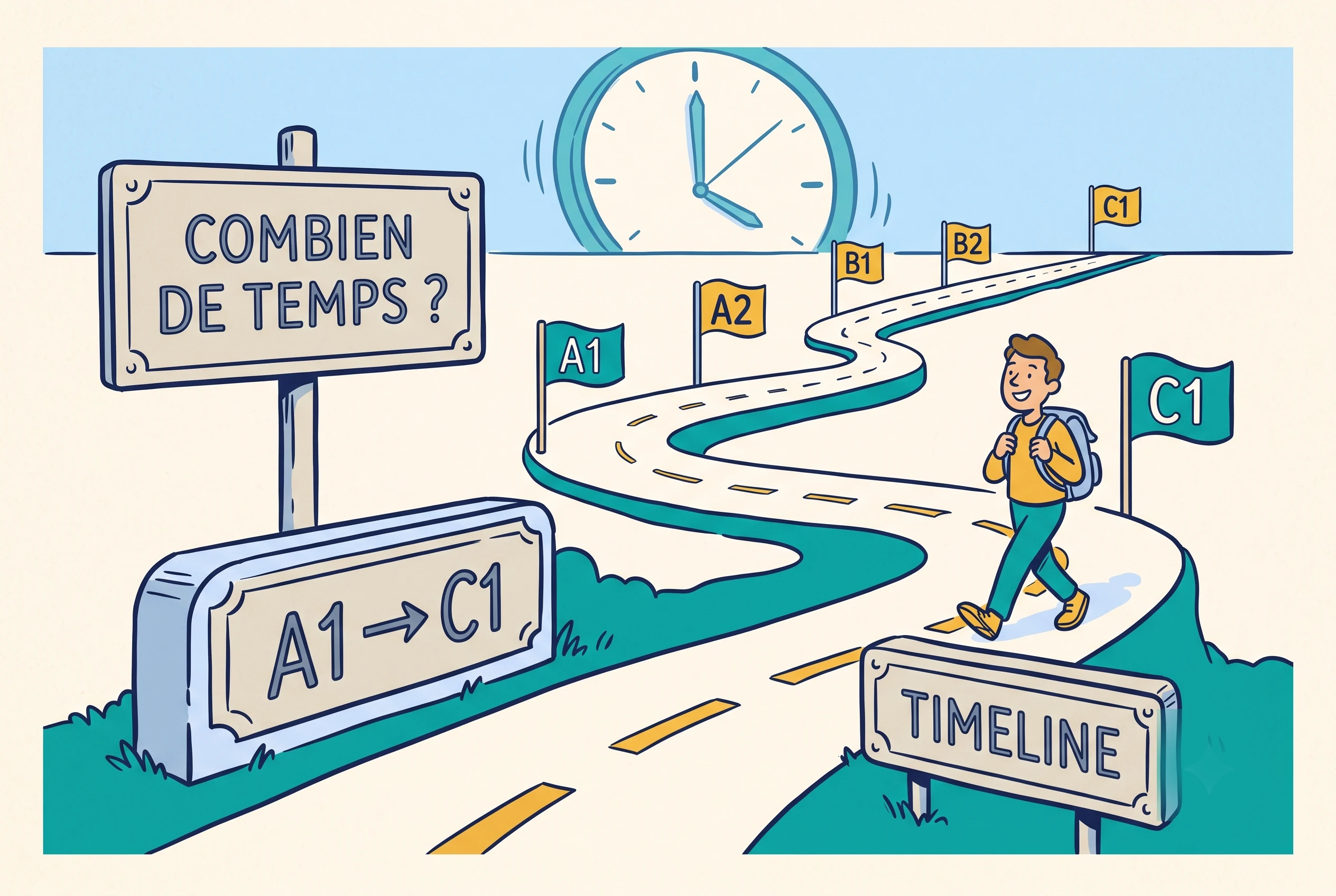
There is no single timeline for every learner or meaning of fluency. Begin with a practical goal, estimate the time you can sustain and use the milestones as planning references rather than guaranteed completion dates.
- The method — the four-part system that works at every level
- The 3-month sprint — what an intensive quarter can realistically reach
- The hour-by-hour timeline — CEFR levels and the study hours each one takes (you’re reading this)
For an English speaker studying consistently, conversational French (CEFR B1) takes roughly 350 to 450 hours, about 8 to 10 months at an hour a day. Survival level (A2) arrives near 200 hours, while professional fluency (C1) is a 700 to 1,000-hour, two-to-three-year project. Your first language, study intensity, method, and immersion can each halve or double these numbers.
The CEFR levels: what each one actually lets you do in France
The CEFR framework splits language ability into six levels from A1 to C2. Most online guides list these levels with vague descriptions. The descriptions below tell you what each level means in practice: what you can do in France, what you can’t, and where frustration lives at each stage. The hour estimates assume focused, high-quality study with active practice. Passive app use or unfocused classroom time takes two to three times longer, and that’s the detail most timeline articles conveniently omit. English speakers have an advantage with French because roughly 30-40% of English vocabulary has French origins, but the grammar is a completely different system and that’s where the hours accumulate.
A1 is survival. You introduce yourself, order food, ask where the bathroom is, understand slow clear speech about familiar topics. You cannot follow a real conversation between French people. A1 takes 60-100 hours of focused study, which translates to two to three months at one hour per day.
A2 is functional basics. You describe your background, handle routine tasks, understand frequently used expressions. A2 takes 150-200 total hours from zero. This is the level where most people plateau if they rely exclusively on apps, because apps handle recognition well but don’t develop production.
B1 is the independence threshold. Travel, opinions, clear standard speech, on 350 to 400 hours. Citizenship has required the level above since January 2026:
B2 is conversational fluency. You understand complex texts on concrete and abstract topics, interact with native speakers with enough fluency that neither party feels strained. This is the level most French universities require for admission. B2 takes 600-750 total hours.
C1 is professional mastery. C1 takes 800-1000 total hours and typically requires sustained immersion. C2 (near-native mastery) takes 1000-1200+ hours and is realistically achievable only with years of immersion.
| Level | Total hours | Intensive (2h/day) | Moderate (1h/day) | Casual (3h/week) |
|---|---|---|---|---|
| A1 | 60-100 | 1-2 months | 2-3 months | 5-8 months |
| A2 | 150-200 | 3-4 months | 5-7 months | 12-16 months |
| B1 | 350-400 | 6-8 months | 12-14 months | 24-30 months |
| B2 | 600-750 | 12-15 months | 20-24 months | 36-48 months |
| C1 | 800-1000 | 18-24 months | 30-36 months | 50-60+ months |
The number that changes everything
Consistency beats intensity every time. Thirty minutes every single day produces faster results than three hours on Saturday. Daily exposure prevents the forgetting curve from erasing yesterday’s work. The most common failure pattern we see isn’t lack of hours. It’s sporadic hours.
Five factors that double or halve your French learning timeline
Generic timelines assume a generic learner. You’re not generic. Your linguistic background, your study intensity pattern, the quality of your method, your immersion level, and your specific goal each shift the timeline by 20-50% in either direction. Stacking two or three positive factors compounds the effect, which is why some people reach B2 in twelve months while others take four years with the same number of total hours. The difference is never talent. It’s always the combination of factors below.
Your linguistic background
English speakers already have a significant structural advantage with French that speakers of Mandarin, Arabic, or Japanese do not share. Roughly 30-40% of English vocabulary has French or Latin roots, which means thousands of words are immediately recognisable. Romance language speakers (Spanish, Italian, Portuguese) have an even larger advantage: 60-80% vocabulary overlap, similar verb conjugation systems, and gendered nouns they’ve already internalised. A Spanish speaker reaching B1 in French takes roughly 25-40% less time than a monolingual English speaker.
Study intensity and consistency pattern
The relationship between study hours and progress is not linear. Thirty minutes daily (the minimum effective dose) produces steady progress because it maintains neural pathways. One hour daily is the sweet spot for most adults. Two to three hours daily accelerates progress significantly but requires structured variation to prevent fatigue. Beyond three hours daily, returns diminish sharply unless the extra time is immersion rather than study.
The students who reach B2 fastest share one habit that has nothing to do with talent. Not more hours. Different consistency. They never skip a day. Not one. The streak matters more than the session length.
Learning method quality
Not all study hours are equal, and this is the factor most people underestimate. One hour of targeted practice on your specific weak points with immediate feedback produces more progress than three hours of generic app exercises that drill vocabulary you already know. The difference between high-efficiency and low-efficiency methods is a 2-3x multiplier on time to reach any given level.
The app ceiling: Apps work well at A1 and parts of A2. After that, they create a specific bad habit: confusing recognition with production. You recognise “je voudrais” when you see it on screen. You cannot produce it spontaneously in conversation. Different cognitive skill. Different training required. If your timeline matters, add speaking practice before A2, not after B1 when the gap has become structural.
Immersion and environment
Living in France with deliberate French practice accelerates the timeline by 40-60%. Living in France inside an English-speaking bubble accelerates it barely at all. Active immersion means forcing yourself to speak French when English is easier, reading French news instead of English news, handling your administrative life in French instead of asking an English-speaking friend to call for you, and accepting the daily discomfort of functioning below your intellectual level in a second language.
Your specific goal and definition of “learned”
“How long to learn French” is meaningless without specifying what “learn” means for you. Tourist survival requires A1-A2 and 60-200 hours. Conversational fluency requires B1-B2 and 350-750 hours. Professional fluency requires B2-C1 and 600-1000 hours. Academic or literary fluency requires C1-C2 and 800-1200+ hours. Choosing your goal before starting determines your timeline, your method, your investment, and your realistic expectations.
This is the rung almost nobody needs, and the one that costs the most hours to reach.
The goal-first rule: Define your finish line before calculating your timeline. “I want to handle my visa appointment at the préfecture without a translator” is a B1 goal. “I want to lead strategy meetings in French” is a C1 goal. The difference is 400-600 hours. Knowing which one you need prevents both under-investment and over-investment.
Timeline myths that waste your time and money
“Fluent in 3 months” programs define fluent as A2: basic transactions, simple conversations, survival French. That’s valuable but it’s not what most people mean by fluent. Genuine conversational fluency (B2) requires 600-750 hours of quality study. In three months at three hours daily, you accumulate roughly 270 hours. That’s solidly A2, possibly early B1 with exceptional focus. Calling that “fluent” is marketing, not linguistics.
“I’m too old to learn French quickly” confuses two different skills. Pronunciation and accent acquisition do slow with age. Grammar acquisition, vocabulary learning, reading ability, and strategic communication do not slow in the same way. Adults learn systematically, recognise patterns faster than children, and can apply metacognitive strategies that children lack.
“Living in France makes you fluent automatically” is the most expensive myth because it costs people not money but years. Passive immersion without deliberate practice produces minimal results. We consistently see expats who have lived in France five, eight, ten years with A2-B1 French because they never pushed past comfort zones.
The app myth and the production gap
Apps alone cannot make you fluent. Maximum app-only achievement: A2, possibly low B1 with exceptional dedication. Apps build vocabulary recognition and basic grammar awareness. They do not develop speaking fluency, listening comprehension of native-speed speech, production under pressure, or the ability to repair misunderstandings in real time. To reach B2 and beyond, you need interaction with humans who provide feedback, correction, and unpredictable conversational input that no algorithm can simulate.
The foundation your first hours need
You now know what each level costs in hours and which factors move the number, so the real question becomes what to study first. That is exactly what the free cheat sheet pack covers: nine printable sheets on the essential verbs, the past tenses, articles and gender, survival phrases, pronunciation, and numbers, dates and time, the foundation your first hundred hours should land on. Enter your email and the free cheat sheet pack downloads right away.
Acceleration strategies that actually compress the timeline
The strategies below are not productivity hacks. They’re evidence-based approaches that reduce the hours-per-level ratio by eliminating waste, targeting weak points, and converting passive time into active acquisition.
This is the single most important acceleration principle, and it works because of how memory consolidation functions during sleep. Daily exposure, even brief, gives the brain material to consolidate overnight. Sporadic intensive sessions produce material that decays before consolidation occurs. Thirty minutes every day beats three hours every Sunday. Every study on language acquisition confirms this.
The first 1,000 words give you 85% comprehension in everyday contexts. The next 1,000 add only 5%. Focus your first 100-200 study hours on high-frequency vocabulary and the grammar patterns that connect them.
The active media method: take a ten-minute French video and stop it whenever a phrase slips past you, rewind, and listen again. Then note three to five new words, look them up, and write a sentence with each. This twenty-minute active session produces more acquisition than two hours of passive background French.
Speak from day one: Don’t wait until you “know enough grammar.” Speaking practice from the beginning builds confidence, reveals gaps that study alone misses, and develops automaticity faster than any passive method. The students who hesitate to speak until B1 spend months at B1 learning to produce what they already recognise. The students who speak from A1 arrive at B1 already producing. Same knowledge, different readiness.
The error correction multiplier
Generic feedback (“that’s wrong”) teaches nothing. Pattern-based correction prevents the same error across multiple contexts. When a student says “je suis allé au docteur,” generic correction says “no, it’s chez le docteur.” Pattern-based correction explains: “French uses ‘chez’ + person for going to someone’s place: chez le docteur, chez le coiffeur, chez mes parents. English uses ‘to the doctor’ but French thinks of it as going to their location.” One correction prevents ten future errors.
Students who stop translating and start thinking in French report a specific acceleration point where sentences start forming without the English intermediate step. That transition typically happens around B1-B2, and it’s the moment when fluency stops being a goal and starts being a reality.
An hour a night reaches B1 in twelve to fourteen months. The same hours poured into one Sunday block decay before the brain consolidates them overnight, which is why the streak does more work than the session length. What the arithmetic cannot decide is where you stop. That was settled by the finish line you picked before the first hour: the préfecture appointment without a translator, or the strategy meeting you have to lead.
Study glossary: learning timeline vocabulary
| 🇫🇷 French | 🇺🇸 English | 💡 Usage context |
|---|---|---|
| Apprendre | To learn | “J’apprends le français depuis un an” |
| La maîtrise | Mastery / fluency | “Atteindre la maîtrise du français” |
| Le niveau | The level | “Mon niveau est B1” |
| Progresser | To progress | “Je progresse rapidement” |
| Pratiquer | To practise | “Il faut pratiquer tous les jours” |
| La régularité | Consistency | “La régularité est essentielle” |
| L’immersion | Immersion | “L’immersion accélère l’apprentissage” |
| Un(e) débutant(e) | A beginner | “Je suis débutant en français” |
| Intermédiaire | Intermediate | “Niveau intermédiaire” |
| Avancé(e) | Advanced | “Un apprenant avancé” |
| La fluidité | Fluency | “La fluidité vient avec la pratique” |
| Combien de temps ? | How long? | “Combien de temps pour apprendre ?” |
Prefer to keep it free today? Read the French Briefing →
The French Gamebook
Check the small slips in otherwise good French.
For English speakers practising French
Use the Gamebook to revisit common mistakes, spot a gap and practise the point again. A review of the fundamentals to sit alongside your advanced reading and conversation.
- 21 lessons with explanations
- 40 practice rounds · 2,000 questions
300 pages · Play on your computer or print
Get the Gamebook · $9 Read a preview before you buyOne payment · Instant PDF download
Try the French with someone who can reply.
Bring a sentence you found difficult. Ask a tutor to help you say it naturally, then try it in a short conversation.
Find a French tutor →Paid lessons. Compare tutors and prices before booking.
Affiliate link: we may earn a commission when you book.
📚 Keep building in the Learning Center
French Learning Games for Adults: Pick a Format That Fits Your Life
French games for adults work best when the task feels useful and everyone can participate. Plan cooperative or…
Read →Learn French with a Game: Turn One Round into a Useful Study Session
To learn French with a game, choose one small language goal and make the rules serve it. Build…
Read →Speaking French as a Shy Beginner: Practical Steps
Practise speaking French through small, manageable exchanges. Find starter phrases, rehearsal methods and a gradual plan for shy…
Read →