
Updated on September 26, 2026
DELF Exam Day Tips: Prepare Your Session and Rehearse B1 Tasks
DELF exam day is easier to manage when you know your own level’s instructions, arrival arrangements and task sequence. Prepare the practical details, rehearse useful French and use the dedicated B1 practice section for a focused final run-through.
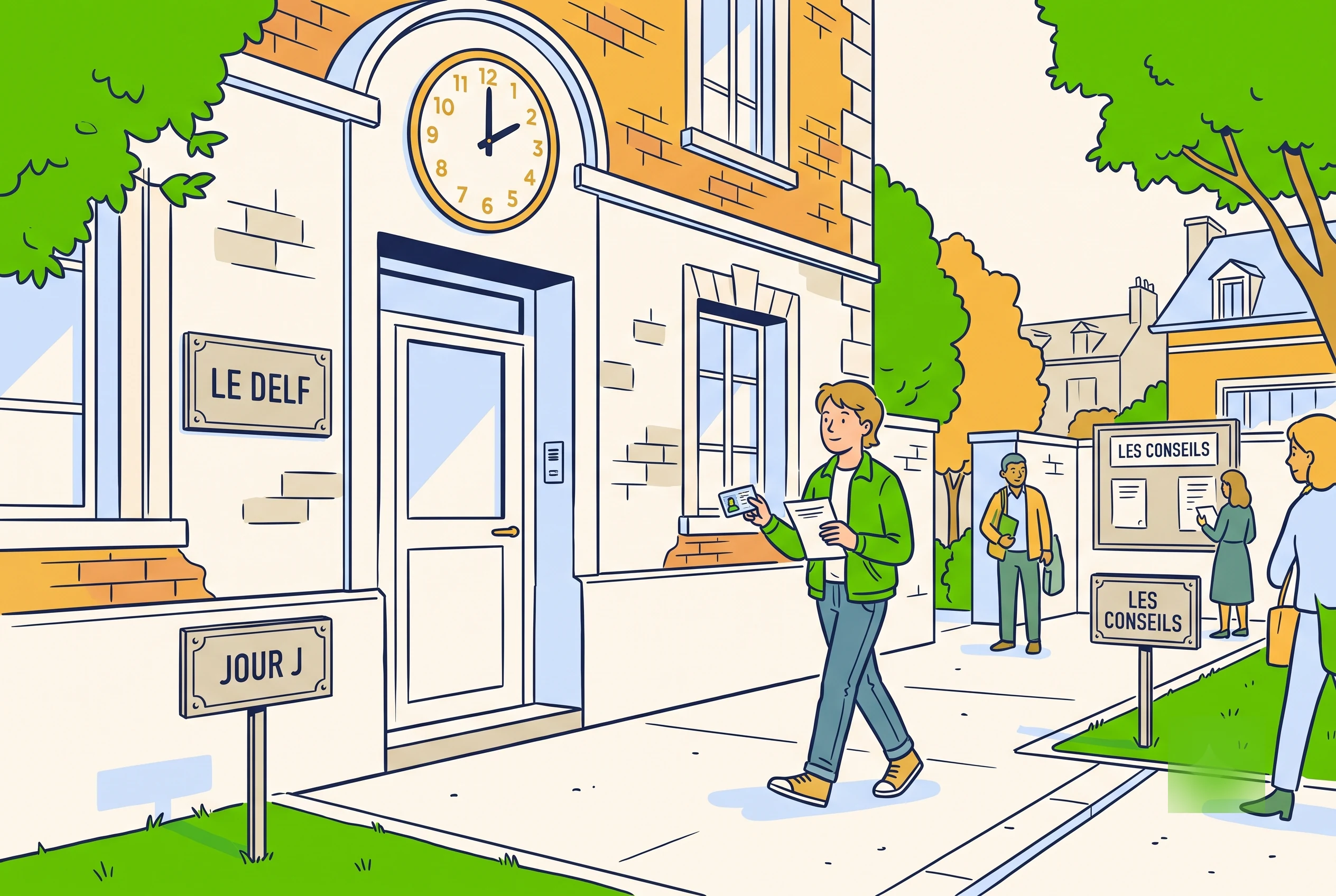
The night before the DELF exam: what actually helps
The night before DELF is where a lot of candidates sabotage themselves quietly. Not by doing something dramatic, but by doing something that feels responsible and is actually counterproductive. They reopen grammar notes, skim an entire prep book, panic about irregular verbs, and keep telling themselves that one more hour might save them. It usually does not. The only thing an extra hour can still change at that point is how much sleep you lose. The French you know tonight is almost certainly the French you will take into the exam room tomorrow. The job now is to protect access to it.
That means your first priority is preparing the boring things that suddenly become huge if forgotten: valid photo ID, exam confirmation, pens, water, travel plan, backup alarm, and enough timing margin that a small transport problem does not become a full disaster. DELF centres are not generous with lateness.
Your DELF night-before checklist
- Valid photo ID
- Printed or accessible exam confirmation
- Two working blue or black pens
- Pencils and eraser if your centre allows them for notes
- Sealed bottle of water
- Simple snack for the break if needed
- Phone charger, but phone fully switched off during the exam
- Transport route checked in advance
- Two alarms, not one
⚠️ The bad "serious student" move: trying to learn new content at 11:30 PM. A tired brain does not consolidate well and often arrives the next morning more anxious, less rested, and less fluid.
💡 Best rule for the evening: close the books earlier than your panic wants. Pack, check the route, set alarms, and sleep. Rest is not laziness the night before DELF. Rest is a score-protection strategy.
Check the level and session on your booking well before exam week. A general level quiz can guide study, but it does not replace an assessment against the exam tasks or confirmation from the exam centre.
Arriving at the test center: why early matters more than you think
Follow the arrival time on your convocation. Check the address, entrance and travel route beforehand, and leave enough margin for local transport delays. The exam centre determines when you must report and what happens if you are late.
At check-in, instructions may be given in French, quickly, and with the assumption that adults can follow administrative routine without emotional coaching. That is normal. Listen for room numbers, written versus oral schedule, breaks, candidate numbers, and anything related to identification or seating.
DELF exam culture often feels more formal and less motivational than many anglophone exam environments. There may be no cheerful "you'll all do great." Neutral professional behaviour is standard. Do not read emotion into it.
Comprehension orale: managing panic before it manages you
The listening section is where many English speakers feel the biggest exam-day shock because it combines three problems at once: no control over pace, no chance to ask the recording to slow down, and peak early nerves. The solution is not mystical confidence. It is procedure. You need to know what your brain should do during the first listen, the second listen, and the tiny pauses in between.
One minute is short and it will feel short. It is still enough to get oriented, and orientation is what matters here: the brain handles partial comprehension much better when it knows what kind of information it is hunting.
First listen
Who is speaking, what is happening, what is the general situation, and what seems emotionally or practically important.
Second listen
Numbers, exact reasons, corrections to your first impression, and question-by-question confirmation.
⚠️ Fatal timing mistake: getting stuck emotionally on one missed answer and then missing the next audio segment mentally because you are still arguing with the previous one in your head.
If listening stays your weakest section, what moves it is contact with audio: controlled recordings first, then real spoken French at full speed. French podcasts on Spotify that match your level do that work between now and exam day, one episode at a time.
Compréhension écrite: do not translate, track
Reading comprehension feels safer to many English speakers because the text waits for you. That is real, but it creates a different danger: false control. Because the page does not disappear, candidates often slow down too much, over-translate, and spend excessive time trying to understand every word before answering anything. The paper is scored on answers found, and the clock runs while you polish a translation nobody asked for.
💡 Strong reading rule: if a word is unfamiliar but the sentence still works globally, keep moving. Dictionary-style obsession destroys timing and often comprehension too.
If you still try to build French meaning through English word-by-word conversion, reading under pressure becomes slower and shakier than it needs to be. That translation bottleneck links directly to the bigger skill of thinking in French instead of translating everything first. DELF rewards readers who can stay inside French longer.
Production écrite: structure wins points under stress
The writing section is where many English speakers discover that "my French is okay" and "my French exam writing is correctly framed" are not the same thing. On DELF, grammar and vocabulary are the floor. Register, structure, task completion and textual organisation are what the marking rewards. Five to seven minutes of real planning often save much more than that in confused drafting and repair.
Leave this line out and the text simply stops, which reads as an abandoned task rather than a finished argument.
These signposts can feel heavier than the transitions many English-speaking writers prefer. DELF does not mind that. In fact, visible structure often helps. The examiner should never have to guess where your second idea starts or whether you are still answering the question.
⚠️ Repeated writing error: aiming for the exact minimum word count. For DELF B1, the minimum is 160 words; for B2, it is 250, as specified in the official B2 candidate handbook. Follow the instruction printed on your own paper and leave a modest margin. Coming in under by accident is a pointless way to lose marks.
If your overall DELF writing still feels unstable, the right fix is rarely "memorise more random expressions." It is usually a more systematic understanding of what each exam level expects. That understanding is what the comparison of the TCF and DELF formats is for, and it is worth reading well before the final days. The French Briefing also helps daily by exposing you to real written French structures.
Keep your grammar floor solid
You just saw that DELF writing treats grammar and vocabulary as the floor, and the speaking test asks you to hold that floor while you think on your feet. The free pack is nine one-page cheat sheets on exactly those foundations: verb tenses, gender and agreement, articles, numbers and dates, and the everyday phrases you reach for under pressure. Enter your email and the free cheat sheet pack downloads right away.
Production orale: use the preparation time for your level
The oral exam feels different because the stress changes shape. During the written papers, the anxiety is spread across time. During the oral, it concentrates. You wait, you are called, the room becomes very small, and the preparation period can feel very short. B1 provides ten minutes to prepare the expression-of-a-viewpoint task; other levels have different formats and timings. Follow the instructions for your booked level.
-
1Read the task twiceIdentify exactly what you must do: give an opinion, compare, justify, explain, argue, recommend, narrate.
-
2Build three simple pointsOne point is thin, five points are chaos. Three is usually the safest exam-day number.
-
3Add examples, not scriptsSpecific examples make the presentation sound real. Full memorised paragraphs make it fragile.
-
4Prepare your opening sentenceStarting calmly matters because the first twenty seconds set the rhythm for the rest.
After your presentation, the interaction phase begins. The examiner asks something and half of it lands. Repair it in French. That is the communication behaviour real language use requires.
⚠️ Hard stop: do not switch to English when stuck, whether for a word gap, a joke, or a rescue. Stay in French and paraphrase instead.
What to do right after the DELF exam
When the oral exam ends, your brain will usually replay the worst ten seconds far more vividly than the forty minutes that were actually fine. That is normal. Post-exam memory is biased toward mistakes, gaps, awkward moments, and questions you wish you had answered differently. The smart post-exam move is very simple. Leave. Eat. Rest. Your brain has just spent hours doing focused comprehension, controlled production, monitoring, retrieval, self-correction, and stress regulation in a second language. That is cognitively expensive.
💡 Good post-exam rule: no forensic analysis in the first hour after the oral. Your brain is tired, not objective.
A focused DELF B1 rehearsal
The following practice is specifically for B1. The arrival and organisation advice above applies more broadly; task lengths and assessment rules must match your booked level.
Knowing the language is one part of being ready for a DELF B1 sitting. You also need to know where to go, when to arrive, what your centre requires and how the speaking appointment is arranged. Resolve those questions from your actual registration documents, not from another candidate's account.
This guide concentrates on the practical rehearsal. For the exam components and published scoring rules, use the DELF B1 overview. Keep language study and logistics on separate lists so progress in one does not hide a missing detail in the other.
Read your centre's instructions
Check the date, venue, reporting time, identification requirements and permitted materials. Read any separate information about the individual oral appointment. If a detail is unclear, ask the centre while there is time to receive an answer.
Include your registration reference through the centre's designated contact channel. Do not assume that a general webpage overrides the instructions issued for your session. Save the reply with the confirmation.
Make a confirmation sheet from actual documents
Use your registration confirmation, centre messages and any later updates as the sources. Record the examination version, date, venue and reporting instructions exactly enough that you can identify the correct event. Keep the original messages available so your summary can be checked against them.
Separate the time you must report from any published start time if the centre distinguishes them. Do not substitute a generic arrival recommendation for the instruction issued to you. If the wording is unclear, ask the centre which time applies and save the reply with the confirmation.
Use a private reference field for registration details, but do not reproduce sensitive identifiers in a general study worksheet. You can practise the French enquiry with placeholders. When contacting the centre, use its appropriate channel and the information it requests to identify your registration.
Confirm the individual oral arrangements separately
Do not assume that the speaking appointment shares every detail with the collective papers. Check the actual information issued for your session. Record its date, location and reporting time as a distinct entry when the centre supplies them separately.
If you have not received a detail you need, ask a focused question. State which appointment you mean and what is missing. A message asking the centre to confirm the oral location is easier to answer than a broad enquiry saying that all the examination information is confusing.
Once you receive a reply, update the calendar and remove outdated provisional entries. Keep the source beside the final entry. This prevents a correct email from coexisting with an old reminder that sends you to the wrong place or at the wrong time.
Check permitted and required items through the centre
Use the centre's instructions to prepare identification, registration evidence and materials. Do not copy another candidate's packing list as though it were a rule for your session. If a requirement seems to conflict with another message, ask which instruction is current rather than choosing the more convenient one.
Make two lists: required items and questions still unresolved. A tick should mean that you have checked and prepared the item, not merely that you have heard of it. Keep any permitted-material question with the centre's answer so you do not rely on memory on the day.
For a language exercise, ask how to clarify an item without using your real document details. The skill is stating what you need to confirm. The actual rule must come from the responsible examination centre or official candidate instructions, not from the wording of the practice question.
Raise access or accommodation questions early
If you need information about access arrangements or a personal requirement, contact the centre through its designated process while there is time to clarify it. Ask which steps and evidence apply rather than assuming an informal request guarantees an arrangement.
Keep the request, response and any confirmed arrangement together. Distinguish a question submitted from an arrangement approved or confirmed. This is the same organisational principle used elsewhere in the guide: the status should reflect the evidence you actually have.
This article does not determine eligibility for accommodations or the centre's procedure. Its practical advice is to identify the question early and obtain the relevant instructions. You can prepare the language of the enquiry, but the decision belongs to the competent organisation.
Check the route using current information
Identify the correct building and entrance from the centre's instructions. Then plan how you will reach it using current transport or route information. A general address may not identify the precise reporting point, so ask if a missing detail could affect your arrival.
Keep the route plan separate from the examination time. Add a personal travel margin appropriate to your situation without presenting it as an official requirement. If transport arrangements change, update the plan and consult the relevant provider's current information.
Save the centre's verified contact details where you can find them. If a real problem arises, follow its instructions for communication. A language rehearsal can help you explain a delay, but it cannot establish what the centre will permit in an individual situation.
Rehearse the conditions
Use an official sample and follow its instructions. Keep dictionaries, translations and pauses out of a timed simulation unless the material explicitly permits them. If you use support during a learning session, record that separately rather than calling it an exam-condition result.
Notice practical difficulties: losing your place, spending too long on one item or leaving no time to review. These observations can guide a second rehearsal. You do not need to repeat the same paper until the answers are familiar.
For writing, practise reading the prompt and identifying recipient, purpose and required content before drafting. For speaking, practise responding to another person's actual contribution rather than delivering a memorised answer regardless of the question.
Decide whether the session is learning or simulation
Before starting, write the purpose at the top of your sheet. In a learning session, you may deliberately use a transcript, pause to inspect a phrase or consult a reference. In a simulation, follow the task's stated conditions and record any deviation. Both forms of work can be useful, but they answer different questions.
Do not relabel a heavily supported attempt as an exam-condition result because the final answers are correct. Keep the conditions visible beside the result. This makes later comparisons more honest and prevents a polished corrected version from replacing the evidence of the first attempt.
If the session is interrupted, note what happened. You can still review the language and learn from the work. You simply should not draw the same timing conclusion as you would from an uninterrupted attempt under the stated conditions.
Prepare the material without revealing the answers
Check that the candidate paper and matching audio are accessible before the rehearsal. Keep the correction and transcript closed until the review phase. File names or folders should make the roles clear so you do not accidentally open the answer material while trying to start the task.
Use a source register to mark whether the paper is unfamiliar. A sample you have already studied can support review, but memory of its answers changes what a later score means. Label that familiarity rather than trying to ignore it.
The official FEI B1 candidate resources provide the appropriate starting point for sample tasks. Follow the instructions attached to the material you use. Original exercises on this site are supplementary practice, not replacements for those official samples.
Rehearse the transition between reading and answering
Notice how you move from the source material to the response area. Do you lose your place, skip a question or forget which item you were answering? These are practical observations worth recording because a language gap is not the only possible cause of an incorrect response.
During review, reconstruct one error carefully. Compare the question you intended to answer with the answer you actually recorded. If they do not match, the next rehearsal can focus on a clearer checking habit. Avoid inventing a procedural rule that conflicts with the sample's instructions; work within the task as presented.
A short targeted exercise may be enough to investigate the issue. You do not always need another complete paper to check whether you can keep question references aligned. Choose the smallest appropriate task that reveals whether the habit has changed.
Practise a writing plan under a clear time boundary
Use an original practice prompt or suitable sample and identify the recipient, purpose and requested points. Make a short plan before drafting. In rehearsal, observe how long that takes and whether it prevents omissions. The plan is a suggested method, not an official mandatory layout.
When the draft is complete, check that each requested point appears in the text. Then inspect organisation and recurring language errors. If you spend the entire review polishing one sentence while another required point is missing, the revision order may need adjustment.
Keep the first draft and revised version separately. The difference shows what you could produce initially and what you improved with review. Both are valuable records, but the revised version should not be presented as the unassisted performance if you later ask a teacher to assess the attempt.
Practise speaking with a reply you cannot predict exactly
Prepare a narrow topic and ask a partner to choose from a few possible follow-ups. Your task is to respond to the question asked. The partner should keep the language manageable enough that the exchange can be reviewed, rather than making every turn unexpectedly complex.
If you do not understand, use a clarification phrase and listen to the reformulation. Then explain afterwards which information changed your response. This checks whether the repair helped you recover the task instead of functioning only as a memorised pause.
For feedback, review the actual exchange against the task and current official criteria where appropriate. A friend can help with practice, while a suitably qualified teacher can provide more informed assessment. Keep informal impressions distinct from official examination marks.
Prepare your response to uncertainty
A misunderstanding does not need to end an exchange. Practise a concise request to repeat or reformulate. Use it when needed, then listen to the answer and respond to that information.
Do not use a clarification phrase as a memorised delay every time you speak. Practise it with a real uncertainty: a date you missed, an unfamiliar word or a condition you need to check.
Name the part you missed
If you understood the general topic but missed one word or condition, ask about that part. A targeted clarification can be easier to answer than a request to repeat everything. Practise identifying the missing detail in simple language before adding more elaborate phrasing.
For an original exercise, a partner proposes an alternative meeting time. You understand the day but not the hour. Ask for the hour, repeat it and continue. The uncertainty is concrete, so you can check whether your question resolved it.
Do not assume that clarification will always produce the exact wording you prepared. The other person may rephrase. Listen for meaning and respond to the new information. The practice should make the repair flexible enough to support an exchange, not another script that breaks when the answer changes.
Recover from a missing word with a simpler description
When a word is unavailable, try explaining the idea with language you know. You might describe an object by its use or a place by what happens there. Keep the description accurate and concise so the listener can follow the intended meaning.
For practice, choose a familiar word and forbid it for one round. Explain it without using the target, then ask the listener what helped them understand. If the description was ambiguous, revise it. This creates a practical response to a vocabulary gap without pretending you can avoid learning words altogether.
After the exercise, check the missing word and a useful phrase containing it. Circumlocution helps you continue in the moment; later review can address the vocabulary itself. The two activities support different parts of the learning process.
Pause to organise an answer without abandoning the task
In practice, give yourself a brief moment to identify the question and choose a relevant idea. A simple answer that addresses the task is more useful than immediately launching into a memorised paragraph about a different topic. Keep the response connected to the actual prompt.
Use a small structure: position, reason and example. For a practical interaction, use problem, constraint and proposed next step. These are optional planning aids, not universal scripts required by the examination. Choose the structure that fits the task rather than forcing every response into the same shape.
Ask a partner to change one condition and try again. If your answer remains identical despite the changed situation, inspect which part should have adapted. The exercise trains attention to meaning, which is easily hidden when you rehearse only one predictable version.
Respond to an alternative rather than restating your opening
Suppose the other person proposes a time that does not suit the fictional situation. Acknowledge the proposal, explain the relevant constraint and ask about another option. Repeating your original request without addressing the proposal can make the exchange feel disconnected.
Change the constraint in the next round. The response should still be accurate for the new facts. Practise agreeing as well as disagreeing, since a conversation may call for accepting a workable option rather than defending your initial preference automatically.
Keep a difficult moment in proportion
After a practice exchange, identify the specific difficulty and the next exercise it suggests. Avoid turning one missed word into a judgement about the entire performance. Equally, do not dismiss it without review if it repeatedly blocks the task.
For the real examination, follow the instructions and attend to the next task in front of you. This guide cannot predict how an individual moment will affect the final assessment. That depends on the complete performance and official marking, not a feeling immediately after one answer.
In preparation, the useful habit is accurate observation. Record what you know happened, distinguish it from speculation and use the evidence when planning further practice. This makes rehearsal constructive without claiming to control every uncertainty on the day.
Use the final study sessions carefully
Choose a small number of known difficulties to review. If your writing repeatedly omits a requested point, practise prompt analysis. If you struggle to justify an opinion, produce a reason and an example for several familiar topics.
Avoid turning the final session into a search for a universal script. A prepared structure can help organise a response, but the content must answer the task in front of you. Practise changing your position or example so the structure remains flexible.
The sample-paper guide explains how to preserve unfamiliar material for checks. The practice-test review guide helps interpret what a rehearsal can and cannot show.
Select a short list from recurring evidence
Review your recent notes and identify two or three difficulties that recur. Choose tasks with a clear purpose: covering every requested writing point, identifying a spoken contrast or giving an example that supports an opinion. Avoid adding a large new syllabus simply because the date is approaching.
Use checked material and explanations. The final sessions are a poor place to build an elaborate routine around uncertain rules you have not verified. If a question remains unresolved, seek an appropriate explanation and keep the rest of the practice within language you understand.
After each small exercise, record the result precisely. A phrase retrieved without a model or a prompt analysed correctly is useful evidence. Do not inflate it into a guaranteed outcome, but do not overlook the practical improvement either.
Practise flexibility instead of one universal speech
Take a familiar opinion and change the example, audience or condition. Then revise the response so the parts still fit. This tests whether you understand the structure rather than merely recite a paragraph whose content never changes.
For an original topic, consider a club changing its meeting time. Explain one preference and a reason, then respond to a different proposal. In the next round, change your availability so the earlier answer no longer fits. The task is to produce a coherent response to the new situation.
Keep useful connectors attached to actual relationships. Because should introduce a reason; for example should support the point you just made. A long list of connectors is less useful than a few expressions you can apply accurately to the idea you want to communicate.
Use feedback to revise one response, then move to another
If a teacher has reviewed a response, make the relevant changes and explain why they improve it. Then try a different prompt that calls for the same skill. This checks whether the feedback can guide another attempt rather than only produce one polished text.
Preserve the original and revised versions. When comparing, focus on the identified issue: a missing point added, an unclear reason made explicit or a repeated language error corrected. You do not need to rewrite everything merely to make the second version look different.
If a correction remains unclear, ask about the complete sentence and intended meaning. Do not practise an uncertain replacement because it sounds more sophisticated. A simpler checked expression may be more useful than language you cannot explain or adapt.
Keep logistics and revision on separate lists
One list contains the confirmed practical arrangements; the other contains language tasks. Completing a practice paper does not settle a missing identification question. Checking the route does not replace speaking practice. Separate lists make both kinds of preparation visible.
Give each unresolved practical question a recipient and next action. Give each language task a model or material and a way to review it. This avoids a single vague reminder to “prepare for DELF” that hides several different responsibilities.
Before the day, return to the centre's latest instructions and your confirmation sheet. If something has changed, update the summary. The practical plan should reflect the current information, while the revision plan remains focused on manageable tasks supported by your recent evidence.
Useful phrases to keep
Keep a practical day sheet
Write the confirmed venue, reporting time, travel plan and required items on one page. Add the centre's contact details and the oral appointment information if separate. Use your actual instructions to fill it in.
Prepare the route and materials in advance. A language revision list cannot solve a missing address on the morning of the exam. Keep the final review modest enough that you can also attend to those practical details.
After a rehearsal, record one change you will make next time. After the real sitting, avoid converting a feeling about one answer into a predicted result. The assessment depends on the complete performance and official marking.
Use a three-part day sheet
The first part contains confirmed facts: date, reporting point, time and required items. The second contains your travel plan and the centre's verified contact route. The third contains any separate oral arrangement and the source that confirms it. Keep the sheet concise enough to read quickly.
Label personal planning choices as such. A departure time or travel margin you selected is different from a reporting requirement issued by the centre. Keeping the distinction clear helps you adjust the plan if travel information changes without accidentally changing the official instruction in your notes.
Do not add unverified tips from forums to the confirmed-facts section. If a suggestion raises a useful question, ask the centre where appropriate. Advice about another session may not describe yours, even when the candidate took the same level of examination.
Review the sheet with a fictional check
Before using your real information, practise the format with an invented date and venue. Ask another person to locate the reporting time, oral appointment and required-item source. If they cannot find them quickly, simplify the layout. The exercise checks the sheet's clarity, not examination rules.
Then complete your actual private version from the confirmed documents. Read each entry against its source once. This catches copying errors that can remain invisible when you repeatedly reread only your own summary. Save the latest version where you can access it when needed.
Keep confidential registration details out of any copy used for language practice. You can rehearse a clarification message with placeholders and insert the necessary real information only through the centre's appropriate contact channel.
After the sitting, separate impressions from results
You may remember an uncertain answer more vividly than the parts that went smoothly. Record any practical lesson you want to retain, but avoid turning those impressions into an unofficial prediction presented as fact. The examination result comes through the official process.
If you continue studying while waiting, choose useful language tasks rather than trying to reconstruct every question from memory. This guide's original exercises and your own checked practice can support that work without reproducing confidential examination content.
Use the experience to improve future preparation where relevant: clearer logistics, more realistic interaction practice or a better review routine. The immediate feeling after a sitting is only one impression, while the actual assessment and later learning evidence provide a firmer basis for deciding what comes next.
Work through a fictional final-week review
Imagine that a candidate, Casey, has completed several language sessions but has not checked whether the speaking appointment uses the same reporting point as the collective papers. Casey's next practical task is to read the centre's message and ask about the missing detail if necessary. Another grammar round would not resolve that question.
Once the location is confirmed, Casey updates the day sheet and calendar. The original message remains available as the source. Casey then returns to language practice with a specific target from the last rehearsal: giving an example that actually supports an opinion. The two tasks are both useful, but their completion evidence differs.
During a short speaking exercise, Casey gives a relevant reason but an unrelated example. A partner points out the mismatch. Casey revises the example and tries a changed topic. This is a focused final-session improvement, not an attempt to memorise a universal answer for every possible subject.
Later, Casey checks the practical sheet against the latest centre instructions. One provisional entry is removed because a confirmed time is now available. The final plan contains fewer uncertainties and a clearer next action. The example illustrates organisation; it does not predict Casey's result or establish rules for another centre.
Prepare a question when instructions appear inconsistent
If two messages seem to give different information, identify the exact discrepancy. State the dates or titles of the messages and the detail that differs. Ask which instruction applies to your registration. This gives the centre something concrete to resolve instead of a general complaint that its information is unclear.
Use a neutral tone and avoid deciding in advance which message must be wrong. The difference may concern separate appointments or an updated arrangement. Read the reply for that distinction and update your notes accordingly. If a point remains unresolved, ask the follow-up that addresses it.
For a language exercise, invent two harmless appointment notices with different locations. Practise explaining the discrepancy and requesting confirmation. Keep real registration details out of the role-play. The skill is precise clarification, while the real answer must come from the centre handling your session.
Keep a rehearsal observation sheet separate from the answer sheet
After a timed practice, write observations before opening the correction. Note where you felt rushed, which instruction you reread and whether a technical or environmental interruption occurred. These details are easy to forget once the correct answers make the task seem clearer in retrospect.
Then review the answers using the matching material. Compare your initial impressions with the evidence. A section that felt difficult may contain several correct answers, while a confident response may reveal a misunderstood condition. Keep both observations rather than choosing whichever version fits your first feeling.
Select one change for the next rehearsal. It might concern reading the complete prompt, preserving review time or checking a changed detail. The observation sheet should lead to a concrete task, not become an expanding list of everything that could possibly go wrong.
Prepare a compact language warm-up if it suits you
Some learners like a brief familiar activity before a demanding task. If you use one in preparation, keep it simple: say a few checked phrases, explain one opinion with a relevant example or read a short familiar passage. Treat it as a personal routine, not an official recommendation or a guarantee of better performance.
Avoid introducing an unfamiliar grammar problem at the last moment and expecting to resolve it fully before the sitting. If a question arises, note it for later unless it is necessary to clarify an immediate instruction. Your preparation plan should already contain the substantive study work.
Follow the centre's rules about devices, materials and conduct at the venue. A routine used at home does not automatically become permitted in the examination setting. The relevant instructions determine what you may do there.
Close the preparation file with clear statuses
Before the sitting, each practical item should be confirmed, prepared or explicitly unresolved with a next action. Avoid a single tick that could mean any of these. If an item depends on a reply, keep that dependency visible rather than marking it complete because you sent a message.
For language study, identify what you have practised and what remains a future learning goal. No short checklist can certify that every possible task will be easy. Its role is to organise the preparation you can actually complete and keep the practical information accurate.
Keep the final sheet concise and the supporting documents accessible. You have then turned a broad concern about exam day into a set of verified arrangements and rehearsed communication skills, while leaving the assessment itself to the official process.
Useful phrases to keep
| 🇫🇷 French | 🇺🇸 English | 💡 Context |
|---|---|---|
| Je vais donner un exemple. | I am going to give an example. | Supporting your response |
| Je voudrais ajouter une idée. | I would like to add an idea. | Extending an oral answer |
| Cette proposition me semble possible. | This suggestion seems possible to me. | Considering a proposed solution |
| Je comprends votre point de vue. | I understand your point of view. | Acknowledging another viewpoint |
| Pour ma part, je préfère… | For my part, I prefer… | Stating a personal preference |
| la convocation | exam confirmation / summons | The document proving your registration and schedule |
| le surveillant / la surveillante | proctor / supervisor | The person managing the written exam room |
| l’épreuve | exam section / paper | A DELF component such as listening or writing |
| la comprehension orale | listening comprehension | The section where you listen to audio recordings |
| la compréhension écrite | reading comprehension | The section based on written texts and questions |
| la production écrite | written production | The section where you write a response or essay |
| la production orale | oral production | The speaking exam |
| tirer au sort | to draw randomly | Used when receiving a speaking topic |
| le brouillon | draft / rough notes | Your preparation notes before the final answer |
| repasser l'examen | to retake the exam | To sit DELF again after an unsuccessful attempt |
| réussir / échouer | to pass / to fail | The result outcome for the exam |
| le jury | examining panel | The examiners in the speaking section |
DELF B1 Adventure Prep Kit
Open your B1 plan. Start a mission.
For learners with A2 foundations aiming for B1
Follow a six-month plan with 26 missions, 156 practice questions and speaking and writing challenges. Try a task, check the explanation and use your next session to work on what needs another go.
- 26 missions across a six-month plan
- 156 practice questions + speaking and writing challenges
About 300 pages per edition · Interactive + Print A4 included
Get the B1 kit · $9 Read a preview before you buyOne payment · Instant PDF download
Rehearse your B1 speaking task aloud.
Choose a tutor who prepares candidates for DELF B1. Bring a speaking prompt, try it under a time limit and ask for feedback on your response.
Find a French tutor →Paid lessons. Compare tutors and prices before booking.
Affiliate link: we may earn a commission when you book.
📚 Keep building in the Learning Center
DELF B1 Exam Preparation: A 26-Session Framework You Can Adapt
A DELF B1 preparation plan should connect your available time with the four exam skills. Use a flexible…
Read →DELF B1 Practice Test: Find the Next Task Behind the Score
A DELF B1 practice test is most useful when you know what it measures and how to review…
Read →TCF vs DELF: Format, Validity and Which to Choose
Compare TCF and DELF by purpose, format and validity. Check which qualification your application accepts before choosing a…
Read →