
Updated on September 15, 2026
Introduce Yourself in French: Phrases for Real Situations
Learn French introductions for social and professional situations. Compare formal and informal wording, follow-up questions and example templates.
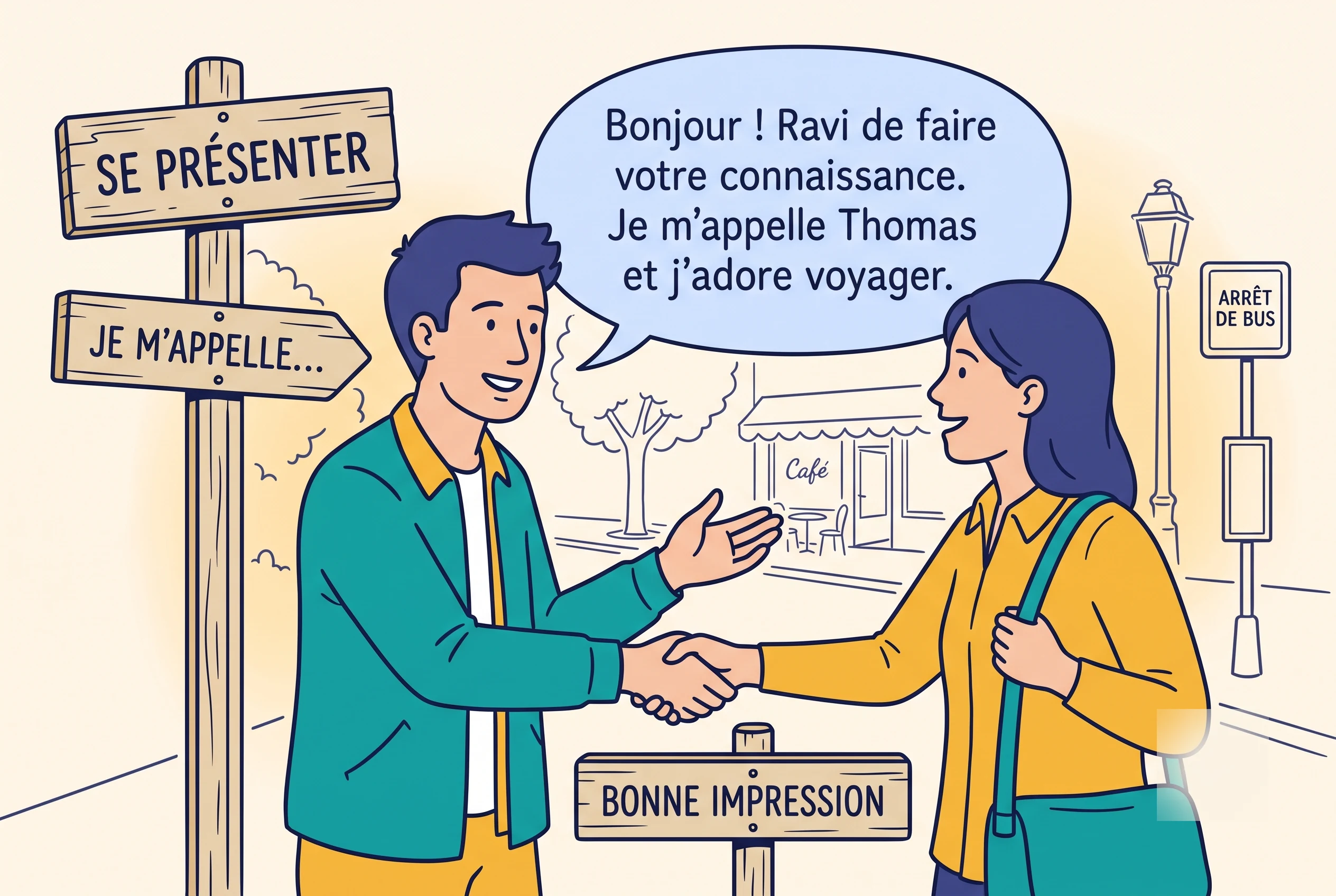
A good introduction gives the other person enough information to continue the conversation. Start with your name, then choose details that suit the setting. The examples show how to expand beyond a memorised sentence.
The trouble with “je m’appelle”: correct, and rarely the best choice
Je m’appelle is not wrong. The sentence is correct, polite, and fully understandable. The real issue is not correctness. It is fit. French introductions shift more with context than English speakers expect. What sounds fine in a classroom or formal presentation can sound slightly stiff in a casual social interaction. That is why learners often feel disappointed after using a sentence they know is correct and still hearing themselves sound more textbook than natural.
The correct, slightly formal option:
The natural, relaxed option:
The clean, neutral option:
Three ways to say the same thing. Three different social signals. The right one depends entirely on where you are and who you are talking to.
The formality scale: three levels that cover everything
| Situation | Best structure | Effect |
|---|---|---|
| Casual social | Moi, c’est… / Salut, moi c’est… | Relaxed, natural, low-stiffness |
| Neutral everyday | Je suis… / Bonjour, je suis… | Clear, simple, broadly usable |
| Formal or official | Je m’appelle… / Je me présente… | Structured, respectful, professional |
Do not ask “What is the perfect French introduction?” Ask “How formal is this moment?” That is the better question. If the situation is relaxed, lean toward moi, c’est…. If the situation is professional or official, je m’appelle… becomes more natural again.
Eight real situations, eight different introductions
This is where the article stops being theoretical. Each situation below has a different social code, a different expected length, and a different register. Using the wrong one does not cause a language error. It causes a social one.
1. Dinner party or social gathering (friend of a friend)
Three seconds is the whole budget. Short name, one anchor, then a question that hands the floor straight back:
Do not deliver a prepared monologue. Do not explain your entire life story. Drop your name, add one anchor (city, job, or connection to the host), and hand the conversation back. French dinner parties move fast. If you talk too long in your introduction, people stop listening.
2. Professional networking event or conference
Same shape, one register up, and “vous” by default until someone offers otherwise.
At a networking event, je suis works better than moi, c’est because the register is slightly higher. Use vous until someone offers tu. Mention your company or field immediately because that is the social currency of the room. Skip the redirect question (et vous ?) and the exchange stalls on your name.
3. Job interview
Here the textbook sentence is the right one, said with both names, to someone who is deciding about you:
In a job interview, je m’appelle is the correct choice. Moi, c’est David would sound too casual. Use first name + last name. Then wait for the recruiter to direct the conversation. Do not launch into your pitch before being asked. The full interview register is covered in the French job interview vocabulary guide.
4. At the préfecture, the bank, or any administrative counter
A numbered ticket, a glass window, a queue behind you. Name, appointment, reason for the visit, nothing social.
At the préfecture or at a bank appointment, the introduction is pure transaction. State your name, state why you are there, present your documents. The person behind the counter does not want to know where you are from or what you do. They want your dossier number. That is not rudeness. That is the register. The same admin vocabulary shows up in opening a French bank account and renting an apartment.
5. On the phone (calling a doctor, an agency, a landlord)
Leave your name until later here and the other person spends the whole call guessing who they have.
Phone introductions in French are more formulaic than face-to-face ones. Je suis [name] or [name] à l’appareil for professional calls. State the reason for calling in the same breath. Do not wait for the other person to guess why you are calling. The phone register overlaps directly with the first French phone call guide.
6. In a class, a workshop, or a group activity (tour de table)
Four sentences instead of one. Every person at the table will do the same, in turn, so the length is expected.
A tour de table (round-the-table introduction) is the one context where you are explicitly asked to give more than your name. Prepare 3-4 sentences. Name, where you are from, what you do or study, and why you are in this class/group. Do not go beyond that unless the instructor asks. Everyone else is waiting for their turn and will not forgive a two-minute monologue.
7. Dating or romantic context (in person or on an app)
What do you lead with when the whole point is to sound like a person and not a form being filled in?
Dating French is the most informal end of the register. Moi, c’est… works perfectly. Je m’appelle sounds strangely formal. Tu is standard between people of similar age in this context. On apps, the introduction is often even shorter: just a first name, a question, and something that shows you read their profile. The social rule is the same as in person: light, specific, curious.
8. Moving into a new building (meeting neighbours)
The one introduction where which floor you live on matters more than your job, and a warm closing word is expected:
Neighbour introductions in France are brief and slightly formal at first. Bonjour is mandatory (not salut, which is too casual for someone you have never met). Mention which floor you live on because that is the relevant information in a building. Over time, the register will relax. But the first interaction sets the tone. Get it right and the relationship starts well. Skip the greeting entirely and you have created a social debt that compounds every time you cross paths in the stairwell.
The common thread across all eight situations
Every introduction above follows the same logic: match the formality of the moment, say your name in the form that fits, add one relevant detail, and redirect. The difference is never the grammar. It is the register, the length, and the social expectation.
What to say after your name so the conversation does not die
This is where learners run out of road. They know how to say their name, then they either stop too abruptly or dump too much information. The better move is to add one or two natural pieces and then hand the conversation back.
Talking about where you are from
Asked early, usually before anyone gets to your job, and the answer can be a country, a city, or both.
Talking about what you do
English puts an article in front of a job title. French drops it, and putting it back is the giveaway:
Handing the conversation back
Without a question at the end, an introduction closes on itself and leaves nothing for anyone to pick up.
Tu or vous during introductions
Use vous in professional contexts, with older people, with authority figures, in service interactions, and whenever the setting feels formal or you are unsure. Use tu with peers in clearly casual settings, with friends, and when someone moves the interaction there naturally. When in doubt, start with vous. Moving from vous to tu is easy. The reverse is awkward.
The clean way to switch from formal to informal, once the relationship allows it:
English-speaker mistakes that make introductions sound strange
Mon nom est Pierre. Technically understandable, but nobody says it in normal French conversation, because it belongs on a form. Use je m’appelle, je suis, or moi, c’est instead.
Over-sharing too fast. Americans especially tend to front-load personal detail, while a French introduction stays deliberately narrow at the start: name, origin, work. Not the full life story, not in the first thirty seconds.
Forgetting gender agreement. Je suis américain (male) vs je suis américaine (female). Same with professions: étudiant / étudiante, avocat / avocate. Small detail, very visible in introductions.
Sounding too textbook in casual settings. The sentence may be grammatically correct and still not fit the room. If everyone is saying moi c’est and you deliver je me présente, je m’appelle Claire Bernard, the room hears a classroom.
Three templates you can memorize tonight
- 1CasualMoi, c’est Sarah. Je viens de Londres. Et toi ?
- 2NeutralBonjour, je suis David. Je travaille dans le marketing. J’habite à Paris depuis six mois.
- 3FormalBonjour, je m’appelle Claire Martin. Je suis avocate. Enchantée de vous rencontrer.
That is already enough to sound dramatically more natural than many learners do after months of study. Three sentences, matched to the room.
Study glossary: French introduction phrases
| 🇫🇷 French | 🇺🇸 English | 💡 When to use it |
|---|---|---|
| Moi, c’est… | I’m… | Casual social: parties, friends, dating |
| Je suis… | I’m… | Neutral: everyday, networking, neighbours |
| Je m’appelle… | My name is… | Formal: interviews, admin, presentations |
| Enchanté(e) | Pleased to meet you | Polite close in many situations |
| Ravi(e) de vous rencontrer | Delighted to meet you | More formal, professional |
| Je viens de… | I come from… | Origin or hometown |
| J’habite à… | I live in… | Current residence |
| Je travaille dans… | I work in… | Profession by field |
| Je suis ici pour… | I’m here for… | Reason for being there |
| Et toi ? / Et vous ? | And you? | Redirect the conversation |
| On peut se tutoyer ? | Can we use tu? | Switching from formal to informal |
| [name] à l’appareil | [name] speaking (on the phone) | Professional phone introduction |
| Je viens d’emménager | I just moved in | Neighbour introduction |
Prefer to keep it free today? Read the French Briefing →
The French Gamebook
Practise the French behind everyday exchanges.
For English speakers practising French
Work on common mistakes before your next conversation. Play a Gamebook round, check the answers and try saying a few corrected sentences aloud.
- 21 lessons with explanations
- 40 practice rounds · 2,000 questions
300 pages · Play on your computer or print
Get the Gamebook · $9 Read a preview before you buyOne payment · Instant PDF download
Try the French with someone who can reply.
Bring a sentence you found difficult. Ask a tutor to help you say it naturally, then try it in a short conversation.
Find a French tutor →Paid lessons. Compare tutors and prices before booking.
Affiliate link: we may earn a commission when you book.
📚 Keep building in the Learning Center
French Travel Phrases for Hotels, Shops and Cafés
Practise French travel phrases for hotels, cafés, shops and transport. Learn follow-up replies and polite ways to ask…
Read →French Phone Call Phrases: Answer, Ask and Clarify
Prepare for French phone calls with phrases for answering, asking for repetition, leaving voicemail and ending a call,…
Read →Order Drinks in French: Bar Phrases and Apéro Vocabulary
Order drinks in French, ask about sizes and ingredients, and request the bill. Learn bar vocabulary and regional…
Read →