
Updated on September 15, 2026
French Countryside Vocabulary: Farms and Village Life
Learn French countryside vocabulary for landscapes, farm buildings, animals, seasons and village life, with translated examples and a glossary.
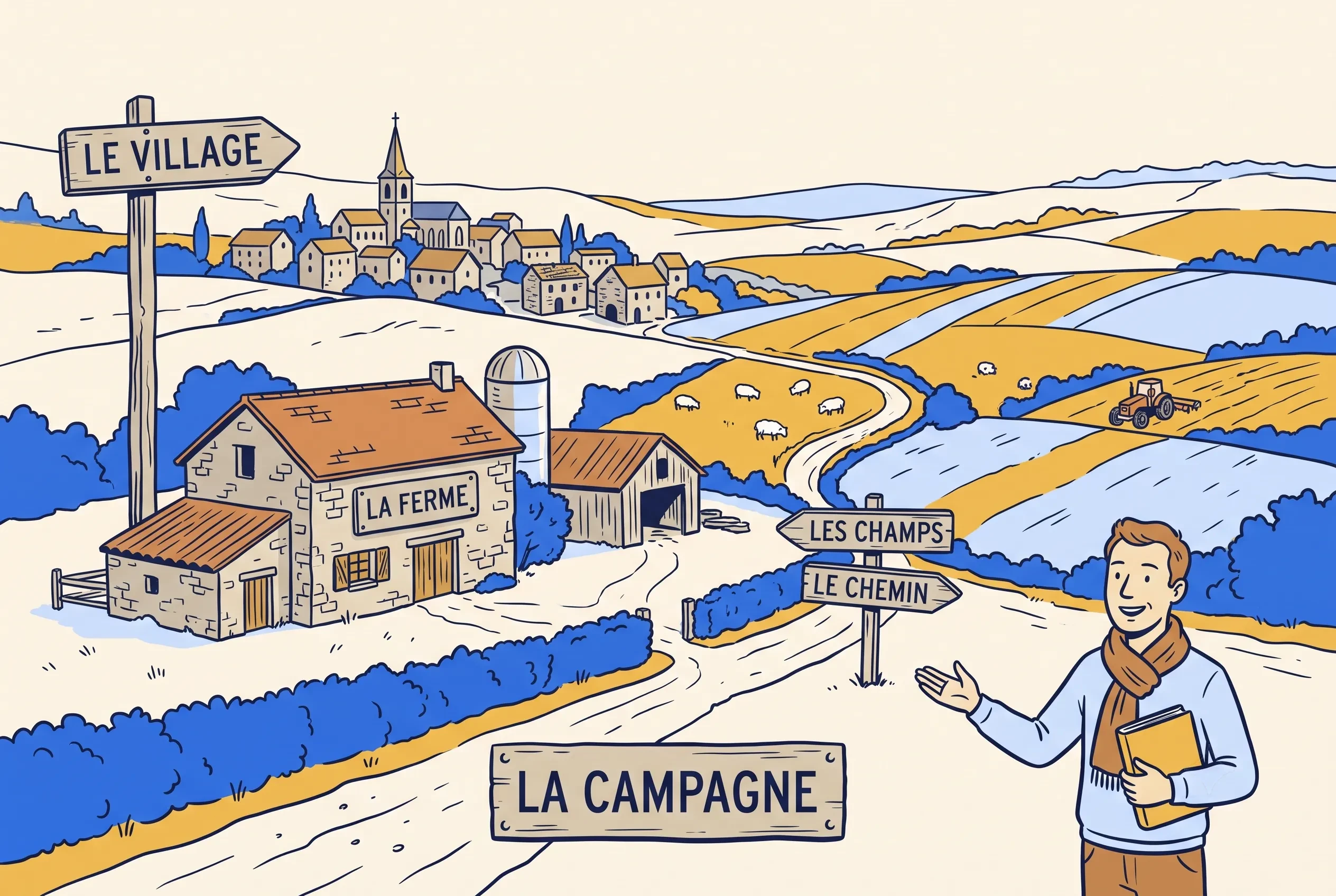
Countryside vocabulary becomes easier to remember when linked to a place or activity. Move from landscapes and buildings to animals and seasons, using the examples to describe a walk or a village scene.
Landscape and terrain: the countryside French you see from the car
Most French textbooks skip countryside vocabulary entirely because they assume you are in a city. But France is rural. Roughly 80% of the land surface sits outside urban areas, and the people living there do not talk about their environment the way Parisians talk about theirs. The landscape vocabulary below appears in every property listing, every weather report, every conversation with a neighbour about what is growing where, and every Sunday drive where someone in the back seat points at the view and says something you cannot quite follow.
Not just “rural area.” In French culture, “la campagne” carries romantic weight that the English word does not. It is the soul of French identity, the counterpart to Paris, the place where food has a postcode and silence has a reputation. When a French person says “j’habite à la campagne,” they are making a lifestyle statement. When a Parisian says “on part à la campagne ce weekend,” they mean something closer to a pilgrimage than a road trip.
The difference matters. “Champ” is cultivated: wheat, corn, sunflowers. “Pré” is grass for animals. Mixing them up in conversation is like calling a parking lot a garden. Both are flat, but only one has a purpose your neighbour respects.
“Vignoble” is the entire vineyard estate. “La vigne” is the individual grapevine or the vine row. The distinction matters in wine conversations, and wine conversations are where half of rural social life happens. In Bordeaux, Burgundy, the Loire, Alsace, the Rhône Valley, or Languedoc, that vocabulary is the local language of economy, pride, and weather anxiety.
Same valley, one scale down, and only one of these two is meant for feet.
“Sentier” is a walking path. “Chemin” is a rural road, often unpaved. Your GPS says “chemin.” Your hiking guide says “sentier.” Property listings assume you know the difference: “accès par chemin” means unpaved access road, which in winter means mud, and in August means dust. “Accès par route” means tarmac. That single word changes what your car needs and what your insurance covers.
Hedges define the Norman bocage landscape the way stone walls define the English Cotswolds. A property described as “entouré de haies” is enclosed by hedgerows, which means privacy, windbreak, and a particular kind of rural aesthetic that photographs well and costs money to maintain.
Why this vocabulary matters for expats
Property listings in rural France use these words constantly. “Terrain avec vue sur les collines, entouré de vignobles, accès par chemin privé.” If you cannot read that sentence fluently, you cannot evaluate the property. Students moving to Provence, Dordogne, or Normandy hit this wall in week one. The vocabulary is not advanced. It is just absent from every course that assumes your life will happen inside a city.
Regions where this vocabulary matters most:
- Le Périgord Noir (Dordogne) — châteaux, oak forests, truffle country. Sarlat Tourisme
- Le Luberon (Provence) — lavender, hilltop villages, Peter Mayle territory. Parc Naturel Régional du Luberon
- Les Alpilles (Bouches-du-Rhône) — olive groves, Van Gogh landscapes. Parc Naturel Régional des Alpilles
- Le Pays d’Auge (Normandy) — bocage, pommiers, calvados, colombages. Calvados Tourisme
Farm structures, buildings, and animals
Rural France is not a museum. People still work the land, raise animals, and maintain buildings whose names have not changed in centuries. The farm vocabulary below is what you hear when your neighbours are the ones producing the food you buy at the market on Saturday morning, and when the estate agent walks you through a property that used to be a working farm and still smells like it remembers.
“Grange rénovée” is one of the most searched terms in French rural property. Anglophone buyers love barn conversions: the stone walls, the exposed beams, the volume. Estate agents know this. The word alone adds thousands to the listing price.
Which corner of a rural property tells your neighbours more about you than anything you say?
“Cultiver son potager” (to tend your vegetable garden) is the rural French hobby that crosses every social class. The retired doctor does it. The farmer’s wife does it. The British couple who moved to the Lot does it. Your potager is your credibility. It proves you actually live here, not just visit.
Farm animals and countryside wildlife
The animals below are what you hear at dawn and discuss over apéro. They are also menu vocabulary, which is the part that makes visiting carnivores uncomfortable and vegetarians relieved.
Animal sounds differ between languages. French roosters say “cocorico.” The sound is also a nationalist exclamation, a sporting chant, and a cultural cliché. The rooster is the unofficial symbol of France, and hearing one at 5am is the unofficial alarm clock of rural France. Nobody warned you. Now you know.
“Fromage de chèvre” (goat cheese) is the countryside cheese. Every market has it. Every neighbour either makes it or knows someone who does. The quality difference between industrial chèvre and the one your neighbour wraps in a vine leaf is the difference between knowing a word and understanding a culture.
These are also menu vocabulary. “Veau” on a restaurant menu means veal. “Agneau” means lamb. Farm to table, one word. Rural France does not sentimentalise this transition the way anglophone culture sometimes does. The animal has a name in the field and a name on the plate, and both appear in the same conversation without cognitive dissonance.
The hunting season warning: “La chasse” (hunting) runs from September to February. Wear bright colours when walking in rural areas during this period. “Attention, chasse en cours” signs mean active hunting. This is not a vocabulary note. It is a safety one. Every year, accidents involve people who did not take the signs seriously.
Seasons and agricultural activities: the rural calendar
Rural France runs on an agricultural calendar that textbooks never mention because textbooks assume you care about verb conjugation more than what your neighbours are doing in September. They are wrong. The agricultural calendar is the social calendar. “Les vendanges” in September structures the entire south. “Les moissons” in July structures the north. Knowing which season brings which activity is knowing how your neighbours think about time, plan their weeks, and decide whether this is a good year or a bad one.
The defining event of wine regions. Entire communities mobilise. Students, seasonal workers, and neighbours show up to pick grapes. “C’est les vendanges” explains everything from traffic delays to cancelled appointments to why the entire village smells like fermenting fruit for three weeks. In Burgundy and Bordeaux, the quality of the vendanges determines the economic mood of the region for the next twelve months.
Major vendanges regions:
- Bordeaux — 111,000 hectares, the world’s largest fine wine region. Bordeaux Tourisme
- Bourgogne — Côte de Nuits, Côte de Beaune, Chablis. Bourgogne Tourisme
- Champagne — Reims and Épernay. Comité Champagne
- Vallée du Rhône — from Côte-Rôtie to Châteauneuf-du-Pape. Vins du Rhône
The work that comes after the harvest and before the next sowing, when the fields go dark and bare:
The smell of freshly plowed earth in October is the countryside equivalent of the first coffee smell in a city kitchen. It means the season turned. Live in rural France long enough and you start dating your year by the fields: plowing, sowing, the harvest, the vendanges.
A word you will hear every July on every news channel. France has taken heatwaves seriously since 2003, when a canicule killed roughly 15,000 people, most of them elderly and isolated in rural areas. The word carries weight. “Vigilance canicule” is not a weather forecast. It is a public health alert.
Late frost in April can destroy an entire wine or fruit harvest. When your neighbour checks the weather obsessively in spring, this is why. “Les gelées tardives” (late frosts) is the phrase that makes winemakers lose sleep and insurance companies adjust premiums.
“Ramasser des champignons” (picking mushrooms) is the autumn obsession of rural France. It starts in September, peaks in October, and involves family outings, secret spots that nobody shares, baskets lined with newspaper, and a trip to the pharmacist who identifies your species for free. That last part is not a joke. French pharmacists are trained in mushroom identification, and every autumn people walk in with baskets full of things they found under an oak tree and need someone to confirm will not kill them.
Americans moving to rural Provence consistently ask the same question in month two. Not about language. About the market. Where is it, which day, and what is the vocabulary for the produce they do not recognise. The answer is always the same: go, point, ask “c’est quoi ?” and listen. The market teaches faster than any app because the feedback is immediate and the stakes are dinner.
Terroir in practice: “Ce fromage a un goût de terroir” means this cheese tastes of where it was made. The word “terroir” connects land, climate, tradition, and identity into a single concept that English does not have. Understanding terroir is understanding how rural France thinks about food, wine, and the relationship between a product and the ground it comes from. It is a worldview you can buy by the slice.
Village life: the structures and traditions that organise rural France
French villages are not quaint decorations. They are administrative units, social ecosystems, and the places where most of non-urban France actually happens. Every village has a mayor, a town hall, a church (used or not), and some version of a public square where life concentrates. Understanding village vocabulary is understanding the smallest functional unit of French society, which is also the unit where integration happens or does not happen, depending on whether you show up.
A hameau is too small for a mairie. It is administratively attached to a commune but socially it is its own world. Living in a hameau means your nearest neighbour might be 200 metres away and your nearest boulangerie might be 8 kilometres away. That is not isolation. That is the point.
The centre of rural French life. Market day, pétanque, apéro, gossip. If the village has a heart, it is the place. The same square hosts the 14 juillet fireworks, the autumn brocante, the Sunday boules tournament, and the awkward silence when two neighbours who are not speaking to each other end up at the same café table.
Where you register, vote, complain, and meet the mayor. In small villages, the maire (mayor) knows everyone. Including you, even before you introduce yourself. Especially if you are the anglophone who just bought the old house on the chemin above the vignoble. The mairie is also where you get married in France, because civil ceremonies happen at the town hall, not the church. The church is optional. The mairie is not.
Saturday morning on the square, three conversations happen before the first tomato is bought. You go to be seen, to catch up, to judge the quality of this year’s tomatoes compared to last year’s, and to have the same conversation about weather that your neighbour will have with six other people before lunch. Skipping market day when you are new is a missed integration opportunity that takes weeks to recover from.
Famous rural markets:
- Marché de Sarlat (Dordogne, Saturday) — foie gras, truffles, noix du Périgord. Sarlat markets
- Marché de L’Isle-sur-la-Sorgue (Provence, Sunday) — antiques + food, largest brocante after Paris. Isle-sur-la-Sorgue Tourisme
- Marché de Saint-Jean-de-Luz (Pays Basque, Tuesday/Saturday) — piment d’Espelette, fromage de brebis. Saint-Jean-de-Luz Tourisme
Annual event. Music, food, fireworks, dancing, and a level of community warmth that makes the rest of the year’s social distance feel temporary. Miss it and you miss the village. Attend it and you are invited to things for the next twelve months. The fête du village is the single best return-on-investment social event in rural France.
Regional vocabulary: Provence vs Normandy
Provence: “le mas” (Provençal farmhouse), “la garrigue” (Mediterranean scrubland), “les cigales” (cicadas), “les oliviers” (olive trees), “les champs de lavande” (lavender fields). Normandy: “le bocage” (hedged farmland), “les pommiers” (apple trees), “le cidre” (cider), “le calvados” (apple brandy), “la chaumière” (thatched cottage). Different regions, different vocabulary, different landscapes. Saying “le mas” in Normandy or “le bocage” in Provence is geographically illiterate in a way French people notice and find funny.
Villages to know by name:
- Gordes (Luberon) — stone village perched on a cliff, lavender panorama. gordes-village.com
- Saint-Cirq-Lapopie (Lot) — medieval village above the Lot river. saint-cirqlapopie.com
- Beuvron-en-Auge (Calvados) — half-timbered Norman village on the cidre route. Calvados Tourisme
- Eguisheim (Alsace) — circular medieval village, vineyards, Christmas markets. eguisheim.fr
- Collonges-la-Rouge (Corrèze) — red sandstone, “Plus Beau Village de France.” Les Plus Beaux Villages
Students who understand French bakery culture already know “la boulangerie.” In villages, it is the last shop standing. When the boulangerie closes, the village dies. That is not metaphor. That is demography. The boulangerie is simultaneously a business, a social institution, and a vital sign.
Countryside expressions: the phrases that make you sound local
The expressions below are not vocabulary drills. They are identity markers. Using them correctly tells your neighbours that you pay attention, that you are settling in, and that you understand the rhythm of the place, not just the words.
On the eight o’clock news and at the neighbour’s gate, in the same flat tone. Villagers use it about themselves. “La France profonde” is the France that votes differently, eats differently, speaks differently, and lives at a pace that Paris forgot decades ago. It is also where most of the food Paris eats comes from, which creates an economic dependency that neither side likes to discuss at dinner.
English hunts for a silver lining. This one just names the weather and lets you do the rest.
These two proverbs are among the most commonly quoted in rural France. The first one, people actually follow. The second one, people say while staring at a flooded field and wondering whether optimism is a strategy or a coping mechanism.
The cultural weight of “la campagne”
French people romanticise rural life in ways Americans do not. Weekend houses in the countryside, farmers’ markets as social events, terroir as identity. Even urban French maintain connections to rural origins through family, vacation homes, or regional foods they insist taste better than anything a supermarket sells. Understanding countryside vocabulary means participating in conversations that define French identity at a level deeper than politics or fashion. When a French colleague says “mes grands-parents avaient une ferme en Corrèze,” they are not sharing a fact. They are sharing a credential.
Study glossary: essential countryside vocabulary
| 🇫🇷 French | 🇺🇸 English | 💡 Usage context |
|---|---|---|
| La campagne | The countryside | “J’habite à la campagne” |
| Le champ / le pré | The field / the meadow | Cultivated vs pasture |
| La ferme | The farm | “Visiter une ferme” |
| La grange | The barn | “Grange rénovée” in listings |
| Le fermier / l’agriculteur | The farmer | “Le fermier cultive la terre” |
| Le potager | The vegetable garden | “Cultiver son potager” |
| Le troupeau | The herd/flock | “Un troupeau de vaches” |
| La récolte | The harvest | “C’est la saison de la récolte” |
| Les vendanges | The grape harvest | September event, wine regions |
| Les moissons | The grain harvest | July-August, northern France |
| Le village / le hameau | The village / the hamlet | Size distinction |
| La mairie | The town hall | Admin centre, weddings, voting |
| Le marché | The market | Weekly social and food event |
| La fête du village | The village festival | Annual social highlight |
| Le terroir | Terroir / regional character | “Les produits du terroir” |
| Le vignoble / la vigne | The vineyard / the vine | Estate vs individual plant |
| Le paysage | The landscape | “Un beau paysage rural” |
| La France profonde | Deep France | Rural, traditional France |
Prefer to keep it free today? Read the French Briefing →
The French Gamebook
Check the small slips in otherwise good French.
For English speakers practising French
Use the Gamebook to revisit common mistakes, spot a gap and practise the point again. A review of the fundamentals to sit alongside your advanced reading and conversation.
- 21 lessons with explanations
- 40 practice rounds · 2,000 questions
300 pages · Play on your computer or print
Get the Gamebook · $9 Read a preview before you buyOne payment · Instant PDF download
Try the French with someone who can reply.
Bring a sentence you found difficult. Ask a tutor to help you say it naturally, then try it in a short conversation.
Find a French tutor →Paid lessons. Compare tutors and prices before booking.
Affiliate link: we may earn a commission when you book.
📚 Keep building in the Learning Center
French Reflexive Verbs: Daily Routine and Word Order
Build a daily routine in French with reflexive pronouns, negatives and infinitives. Compare translated examples, listen and practise.
Read →Futur Proche vs Futur Simple: Examples and Practice
Compare futur proche and futur simple in French plans, promises and announcements. Learn the forms and practise choosing…
Read →French Prepositions of Place: À, En, Au and Chez
Choose French prepositions for cities, countries and people’s homes. Compare à, en, au, chez and return journeys with…
Read →