French Cheese Culture: Complete Guide for Americans

French Cheese Culture Explained for Americans: Complete Guide

French cheese culture is not just food. It is vocabulary, regional identity, meal ritual, buying etiquette, and an entire social logic most Americans never learned.
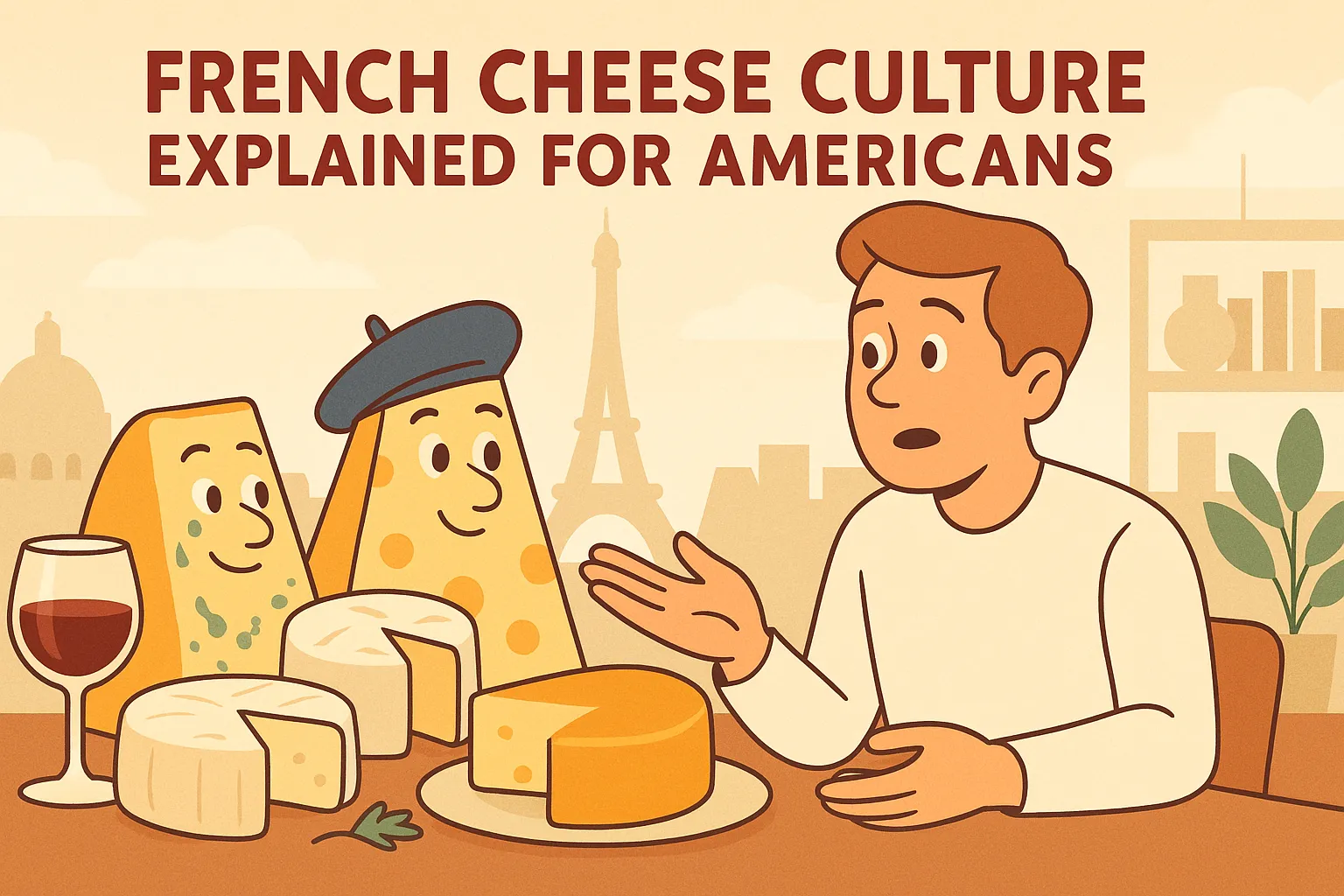
French cheese culture explained for Americans with varieties and etiquette
French cheese is not just a product category. It is a cultural system with vocabulary, etiquette, geography, and strong opinions.
🍷 Society & Pop Culture 🌱 Beginner to Upper-Intermediate (A1-B2)

Why cheese matters so much in French culture

Americans often use cheese as support food. It melts into things, covers things, gets shredded onto things, or disappears into sandwiches and pasta dishes without demanding much attention on its own. In France, cheese can certainly be cooked with, but the deeper cultural role is different. Cheese is also eaten as itself, discussed as itself, bought with intention, served with order, and treated as a distinct moment in the meal rather than just a functional ingredient. That shift is the first cultural gap most Americans feel when they try to understand why French people talk about cheese with a seriousness that can sound exaggerated from the outside.

The answer is not simply “because they like it.” French cheese carries region, season, technique, memory, and identity. A cheese can indicate a place, a local dairy tradition, a mountain economy, a style of aging, and a family habit of serving it after the main course rather than before dinner or as a snack. The French meal structure itself helps explain the difference. Cheese is often a separate course between the main dish and dessert, not an afterthought. That means people taste it with more attention and speak about it in more detailed ways.

🇫🇷 On prend le fromage apres le plat principal.🇺🇸 We have cheese after the main course.

That single sentence already explains why cheese feels culturally heavier in France. When something has its own place in the order of the meal, it gains its own etiquette, pairings, expectations, and ritual. The bread basket matters again. Wine pairings matter again. Portion size matters. Selection matters. And because this is France, language matters too. Once you understand that cheese is not just a dairy item but also a cultural course, a lot of French behavior starts making more sense.

What shocks Americans first In the United States, cheese often arrives pre-sliced, pre-shredded, or trapped in plastic. In France, cheese often arrives with rind, smell, texture, and an actual opinion attached to it.

The fastest way to understand French cheese culture is to stop thinking of cheese as a topping and start thinking of it as a conversation.

This broader shift matters beyond food. Cheese culture is one of the clearest introductions to how French people think about quality, terroir, regional identity, and everyday ritual. That is why it connects so well with other cultural habits newcomers often find confusing, including how French meals are structured and why ordinary shopping is often more interactive than Americans expect. The same pattern of “ask, discuss, choose properly” appears again in places like the bakery, the produce market, and the butcher. It even carries into practical conversations such as surviving a first French phone call, where formula, tone, and social ritual matter more than the average American expects at first.

The pasteurization divide: why Americans and French people think differently about cheese safety

Few topics create more immediate confusion between American habits and French cheese culture than raw milk. Americans are trained to think of pasteurization primarily as safety. French cheese culture often frames raw milk cheese as depth, authenticity, and flavor. That does not mean French people ignore hygiene. It means the cultural balance between safety and taste is drawn differently. For many French people, unpasteurized cheese is not a risky eccentricity but the normal standard for certain great cheeses. In that system, pasteurized versions can be seen as flatter, safer, and somehow less alive.

That can feel extreme if you grew up with heavily standardized supermarket cheese. But from the French perspective, pasteurization changes the sensory character of the product. The issue is not only whether the cheese is safe to eat, but whether it still tastes like the place and method it claims to represent. Which is why labels such as lait cru carry prestige in many contexts rather than fear.

🇫🇷 Vous preferez le fromage au lait cru ou pasteurise ?🇺🇸 Do you prefer raw milk or pasteurized cheese?

For an American in a fromagerie, that question can feel loaded. In France, it is normal. The answer depends on health situation, personal comfort, and the specific cheese. Pregnant women and people with certain medical vulnerabilities are often directed toward pasteurized choices, but for many healthy adults, raw milk cheese is simply part of everyday food culture. If you need the safer option, ask directly and calmly.

🇫🇷 Est-ce que c’est au lait pasteurise ?🇺🇸 Is this made from pasteurized milk?

⚠️ Common American misunderstanding: thinking all soft French cheeses are automatically forbidden or unsafe. The real distinction is often raw milk versus pasteurized milk, not “soft” versus “hard” in the abstract.

“For sure.” This is also a perfect example of how French food vocabulary matters in real life. Knowing a few exact phrases protects you far more than vague cultural familiarity. That is why food culture articles on this site often overlap with practical survival French. If you want to function in France, food is not just pleasure. It is everyday communication.

You’re learning how French food culture actually works.
The Briefing covers everyday cultural patterns like this daily. Real context, not clichés.
📰 Read The French Briefing
Free. No account.

Understanding the main French cheese families

American cheese categories are usually broad and practical: cheddar, Swiss, mozzarella, goat cheese, shredded, sliced, soft, hard. French cheese culture sorts the world differently. A French person talking seriously about cheese often thinks in terms of rind, texture, production method, milk, and aging style. That is why the fromagerie counter can feel so intimidating at first. It is not chaos. It is a classification system you have not learned yet.

Once you understand the main families, the display becomes much easier to read. You stop seeing an overwhelming wall of dairy and start seeing patterns. Soft bloomy rind cheeses. Washed rind cheeses. Blue cheeses. Pressed cheeses. Goat cheeses. Fresh cheeses. Each family has predictable visual clues, likely flavor direction, and typical serving uses.

Fresh cheeses

These are mild, moist, young cheeses with little or no aging. They are closer to freshness than transformation. Think of fromage blanc, faisselle, or similar soft styles that can lean savory or sweet depending on what they are served with. These are approachable for Americans because they feel less intense and less culturally theatrical than riper cheeses.

Soft cheeses with bloomy rind

This is where many American beginners meet famous names like Brie and Camembert. The white outer coat, creamy texture, and increasing softness as the cheese ripens make this family central to beginner French cheese education. These cheeses often look more familiar than washed-rind cheeses, but their ripeness is crucial. A bloomy-rind cheese can be chalky when under-ripe, beautifully creamy when ready, or overwhelming when too far gone. Timing matters.

Soft cheeses with washed rind

This is the family that often scares Americans visually and aromatically. Orange, sticky, intensely fragrant, sometimes bordering on aggressive in smell, these cheeses are proof that French cheese culture does not worship blandness. They are not beginner cheeses in the emotional sense, even if some are delicious. Strong aroma is not considered a defect here. Quite the opposite.

Blue cheeses

Americans usually know blue cheese in a narrow way, often as salad dressing flavor or a sharp crumbled product. French blue cheeses occupy a much wider space, from milder examples to deeply salty or pungent versions. This family teaches a very important French lesson: intensity is not the enemy. It simply requires the right portion size and pairing.

Pressed cheeses

These are firmer cheeses, often easier for Americans to approach because the texture feels structurally familiar. But French pressed cheeses are not just “hard cheese.” Their aging, nuttiness, mountain origins, and serving uses vary enormously. Comte alone can teach you that what Americans casually call a hard cheese can actually contain huge differences in aroma, age, and complexity.

Goat cheeses

Goat cheese in American supermarkets usually means a soft log in plastic. In France, goat cheese opens into a much wider world of shapes, maturities, textures, and ripeness stages. A fresh young goat cheese and a more matured chevre are almost different experiences, and French people treat them that way.

🇫🇷 Je cherche un fromage a pate molle pour ce soir.🇺🇸 I’m looking for a soft cheese for tonight.

That kind of request already sounds far more natural in a French cheese shop than asking blindly for “something good.” The more your request fits the French classification logic, the easier the whole interaction becomes.

How to buy cheese in a French fromagerie without looking completely lost

The American supermarket habit is mostly silent and self-directed. You walk in, choose, and pay. A French fromagerie often works differently. Yes, you can browse. But the space expects dialogue. The fromager is not just standing there as a human barcode scanner. The fromager is part seller, part guide, part educator, and part guardian of ripeness. Which means the quality of your interaction affects the quality of what you leave with.

Start with the greeting. Always. In France, walking into a specialty food shop and failing to greet the person behind the counter immediately creates friction for no reason.

🇫🇷 Bonjour madame / Bonjour monsieur.🇺🇸 Hello ma’am / Hello sir.

Then state your purpose. Not your abstract love of cheese. Your actual need. Is it for tonight, tomorrow, a dinner party, a cheese board, a gift, or simple curiosity? Timing matters because cheese ripeness changes. A cheese that is perfect tonight may be disappointing or overripe tomorrow.

🇫🇷 Je cherche un fromage pour un plateau ce soir.🇺🇸 I’m looking for cheese for a cheese board tonight.
🇫🇷 C’est pour combien de personnes ?🇺🇸 How many people is it for?
🇫🇷 Qu’est-ce que vous me conseillez ?🇺🇸 What do you recommend?
🇫🇷 Je ne connais pas tres bien les fromages francais.🇺🇸 I don’t know French cheeses very well.

That admission does not make you weak. It usually improves the help you receive. French specialty shops often respond well when you show respect for expertise instead of pretending. The French Briefing covers this kind of everyday interaction code daily.

💡 Best first-fromagerie strategy: say what the cheese is for, how many people, when you will eat it, and whether you want something mild or stronger. That is enough to get real guidance.

This is one of the most useful beginner cultural exercises in France because it trains exactly the same skills you need elsewhere: greeting, asking for recommendations, describing preferences, clarifying details, and accepting specialist advice. That is why it connects naturally with broader practical French like handling stressful live interactions in French or navigating formal everyday systems in France.

The French cheese course: how it works and what Americans usually get wrong

The cheese course often confuses Americans because it disrupts their expectations about meal logic. In the United States, cheese appears before the meal, on the meal, in the meal, or at a party table. In France, cheese often arrives after the main course and before dessert. That positioning changes everything. It gives cheese a defined ritual role instead of a casual supporting role.

That means the cheese board is not treated like an all-you-can-grab grazing surface. It has order, pacing, and small rules that reflect a broader French instinct: even relaxed pleasure often has a form. The first rule is portion size. Americans often take too much. French cheese service after dinner is usually about tasting several cheeses in modest amounts, not building a second full meal from dairy.

🇫🇷 On commence par les fromages doux et on finit par les plus forts.🇺🇸 We start with the mild cheeses and finish with the stronger ones.

That sequence matters because flavor accumulates. If you begin with the most aggressive washed-rind or blue cheese, the more delicate cheeses that follow can seem flat. The French order is not snobbery. It is palate management.

How to cut cheese properly

Cheese cutting is one of those tiny French rituals that suddenly reveals whether you know the culture or not. The basic principle is simple: respect the geometry of the cheese so that everyone can have a fair balance of rind and interior.

🇫🇷 Il ne faut jamais couper le nez du fromage.🇺🇸 You must never cut the nose of the cheese.

That rule is especially important for wedge-shaped cheeses. The narrow tip is often the prized part. Taking it all for yourself is a small but very visible act of selfishness in French cheese logic. For round cheeses, cut from the center outward. For logs, cut clean slices. For blocks, take a fair surface portion.

⚠️ Major table mistake: using your own used bread or personal knife to go back into communal cheese. Serve the portion onto your plate first, then eat from your own plate.

Regional identity, terroir, and why French cheese is never just “French cheese”

Americans often speak about French cheese as if it were one giant national category. The French usually do not. They think regionally. A cheese is not only French. It is Norman, Savoyard, Auvergnat, Basque, Jura, Burgundian, Alpine, and so on. That regional instinct matters because French food culture is deeply tied to terroir: the idea that place, climate, feed, method, and tradition create something specific that cannot simply be copied anywhere else without loss.

This is why regional names matter so much, and why origin labels carry legal and cultural force. To understand French cheese culture properly, you have to understand that many cheeses are also compressed geography. A mountain cheese tastes like altitude, grass, season, storage practice, and a centuries-old economic pattern.

🇫🇷 Quels sont les fromages de la region ?🇺🇸 What are the regional cheeses?

This is one of the best questions you can ask while traveling in France. It signals that you understand cheese as local culture, not just merchandise. Protected origin systems such as AOC or AOP matter here because they formalize what the culture already feels intuitively: certain cheeses belong to certain places and certain methods.

How bread and wine fit into French cheese culture

Americans often arrive with the idea that cheese pairing means “red wine, always” and maybe some fancy crackers. French practice is subtler. Not every cheese wants red wine. Not every cheese wants the same bread. The purpose of bread in the cheese course is usually structural and balancing, not decorative. Neutral bread such as baguette or country bread supports the cheese without competing with it.

Wine follows intensity more than stereotype. Delicate fresh goat cheeses may sing with crisp whites. Rich bloomy-rind cheeses can work with lighter reds or sparkling wine. Blues often behave differently again. The point is not to memorize every pairing law. The point is to understand that the French tend to treat pairing as a conversation between products, not as a fixed cliche.

What Americans often do

Choose a strong red wine automatically, put out random crackers, and assume all cheese will somehow work with all of it.

What French logic tends to do

Match intensity, preserve the character of the cheese, and use bread as support rather than as a competing snack flavor.

How to start learning French cheese culture without pretending to be an expert

The smartest way into French cheese culture is not to perform expertise you do not have. It is to enter honestly, with curiosity and structure. Start with categories you can tolerate. Learn how to describe what you like. Ask for a recommendation for tonight rather than trying to master the entire cheese universe in one visit. Try one new family at a time. Pay attention to ripeness.

  1. 1
    Start with a purposeBuy for tonight, for two people, for a cheese board, for after dinner.
  2. 2
    Ask for guidance honestlyMild or strong, tonight or tomorrow, beginner or adventurous.
  3. 3
    Learn one new family at a timeDo not try to conquer washed-rind, blue, chevre, and mountain cheeses all at once.
  4. 4
    Watch how French people cut and serveSmall details reveal big cultural habits.
  5. 5
    Repeat the experienceCheese confidence, like conversation confidence, comes from repeated live contact.

Where to actually buy French cheese wherever you live

Reading about French cheese culture is one thing. Tasting it is another. The good news: you do not need to be in France to access real French cheese anymore. Whether you live in New York, Austin, London, or rural Canada, the options are better than most learners realize. The key is knowing where to look and what to prioritize: real French origin, proper handling, and ideally a source that treats cheese as a living product rather than a shelf-stable commodity.

If you live in the USA

The American market for imported French cheese has exploded. These are the best places to order real French cheese online with proper cold shipping.

  • Murray’s Cheese (New York): the gold standard. Hand-selected by expert cheesemongers, cave-aged on-site, nationwide shipping. Their monthly subscription box is one of the best ways to discover French cheese systematically.
  • iGourmet: massive French cheese selection, reasonable prices, ships nationwide. Their French Cheese Assortment is a perfect first order if you want to taste several families at once.
  • Gourmet Food Store: imports fresh every two weeks. Deep catalog of Brie, Comté, chèvre, washed-rind, and blue. Good search filters by milk type and texture.
  • Gourmet Food World: curated selection from Rodolphe Le Meunier, France’s most awarded affineur. If you want to taste what a master cheesemaker selects, start here.
  • Cured & Cultivated: French cheese gift box with 5-6 handpicked cheeses (~2.5 lbs). Free shipping. Excellent first sampler if you want variety without choosing blindly.
  • Ideal Cheese Shop via Goldbelly: named “World’s Best Cheese Shop” by Forbes. Ships a curated French assortment nationwide with crackers. Premium but worth it for a special occasion.

If you live in the UK

The UK has the advantage of proximity to France and strong cheese retail culture. These deliver real French cheese to your door.

  • Fromagerie Beillevaire: a real French fromagerie shipping to the UK. Monthly subscription: 5 seasonal cheeses, ~900g. This is the closest thing to walking into a fromagerie in Nantes without leaving your house.
  • The Cheese Geek: monthly cheese subscription with a no-repeat guarantee. Includes French selections alongside British artisan cheeses. Tasting notes included.
  • Paxton & Whitfield: London’s oldest cheese shop (est. 1797). Strong French selection online. If you want the establishment approach to French cheese in the UK, this is it.

If you live anywhere and want French cheese shipped internationally

  • Fromages.com: ships from France to the USA and internationally. PDO and PGI certified. Monthly cheese boxes (4 or 6 cheeses), individual slices, gift boxes. Isothermal packaging. This is the real deal: actual French cheese, cut in France, shipped cold.
  • Gouda Cheese Shop (Netherlands): ships worldwide. Vacuum-sealed, stays fresh 7-8 weeks. Good selection of Comté, Reblochon, Saint-Nectaire, Beaufort. Competitive prices for Europe.

Monthly cheese subscriptions worth trying

If you want French cheese to show up regularly without thinking about it, these subscriptions do the work for you.

  • Murray’s Cheese of the Month (USA): 3-4 cheeses hand-selected at peak ripeness. Frequently includes French selections. The best ongoing cheese education money can buy.
  • iGourmet International Cheese Subscription (USA): 3-4 cheeses monthly from rotating countries. France features heavily. Tasting notes included.
  • Cheese of the Month Club (USA): The Rare Cheese Club option goes deep into artisan French selections. 2-12 month memberships.
  • Fromages.com Cheese Boxes (ships from France): BOX Plaisir (4 cheeses) or BOX Gourmande (6 cheeses). Selection changes monthly with seasons. The most authentically French option on this list.

💡 First order strategy: start with a sampler or gift box (iGourmet, Cured & Cultivated, or Fromages.com). Taste 4-6 cheeses from different families. Write down which ones you liked. Then order more of those families next time. That is how French cheese confidence builds: one real tasting at a time. “For sure.”

Study glossary: essential French cheese vocabulary

French termEnglish translationUsage context
le fromagecheeseThe general word for cheese
la fromageriecheese shopA specialist cheese store
le fromager / la fromagerecheesemonger / cheese specialistThe person selling and advising on cheese
le lait cruraw milkImportant label for many traditional cheeses
le lait pasteurisepasteurized milkUseful when asking about safer options
la crouterindThe outer layer of the cheese
affineaged / ripenedUsed for cheese maturity and aging
doux / corsemild / strongUseful for describing taste preference
un plateau de fromagesa cheese boardThe cheese selection served at table
couper le fromageto cut the cheeseImportant because cutting has etiquette rules
AOC / AOPprotected origin designationLabels linked to region and traditional production

French cheese culture is really a lesson in how French culture works

French cheese culture intimidates Americans because it concentrates so many French habits in one place: expertise, ritual, regional pride, food vocabulary, social rules, and the expectation that you will engage with the person selling you something instead of drifting past them anonymously. But that is also why it is such a useful cultural entry point. Once you understand how cheese works in France, a lot of other things become easier to decode.

The goal is not to become a cheese intellectual overnight. The goal is to become comfortable enough that a fromagerie no longer feels like hostile territory. Once that happens, cheese stops being an intimidating symbol of French complexity and becomes what it is for millions of French people: a normal, pleasurable, culturally meaningful part of life. “For sure.” 🕶️

📈 French Progress Pass

You just decoded french, cheese, culture. We turn this into a weekly habit.

You just learned how French cheese culture actually works. The Pass puts that kind of cultural depth into weekly audio with real situations, CEFR tracking, and structured progress.

✓ Weekly native audio ✓ CEFR tracking ✓ Full archives ✓ Structured practice
$19/mo
Cancel anytime
See the Pass →
📰 Free · Daily

Or start free with The Briefing.

One French news story every morning, picked at your level. Tax letters, prefecture vocabulary, political quotes: the institutional French decoded in three minutes, glossary built in.

Read today’s edition →
🐭 Free · 3 min
Take the Level Quiz

Instant CEFR score. Stop guessing if you’re A2 or B1.

Start →
📚 Free · 60+ guides
Browse the Learning Center

Grammar, culture, expat life, gastronomy. Organised by goal.

Open the hub →
📖 Free · 10 books
Browse the Library

Hand-picked textbooks and readers. Tested over 13 years.

See picks →

How to Survive Your First French Phone Call: Essential Guide

How to Survive Your First French Phone Call: Essential Guide

Your first French phone call strips away every visual safety net. No lips, no gestures, no facial expressions. Just fast audio and your survival phrases.

How to survive your first French phone call with essential phrases and strategies
French phone calls feel brutal at first because the visual safety nets disappear. The right phrases give you control back almost immediately.
☕ Travel & Everyday 🌿 Elementary to Intermediate (A2-B1)

Why French phone calls feel worse than normal French conversations

A French phone call feels disproportionately hard because it removes the supports you normally do not notice you are using. In person, you read faces, watch lips, track body language, and often infer meaning even when the French itself is partly blurry. On the phone, all of that disappears. Your brain has to do the entire job from audio alone. For English speakers, that is especially difficult because French already compresses words together in ways that make speech boundaries feel less obvious than in English. Once phone audio quality reduces the sound even further, what was already hard can suddenly feel impossible.

The psychological part matters too. A phone call creates urgency. Silence feels longer. Misunderstandings feel riskier. You cannot rely on a smile, a raised eyebrow, or a hand gesture to soften the moment where you did not understand. That is why even learners who are decent in person often panic on the phone. The problem is not that their French vanished. The problem is that the format became harsher.

What usually happens The phone rings, you answer, the other person speaks at normal speed, you catch maybe thirty percent, and within ten seconds your brain is trying to survive instead of process.

Your first French phone call does not feel hard because you are weak. It feels hard because phone conversations are a stripped-down version of language where every missing support suddenly matters.

The reassuring part is that phone calls are also more repetitive than they seem. Most French phone interactions are not open-ended philosophical debates. They are reservations, appointments, confirmations, missed-call follow-ups, information requests, schedule changes, business hours, directions, or simple personal logistics. Once you learn the scripts, the experience changes fast. If listening under pressure is one of your broader weak spots, that often connects directly to the same underlying issue explored in French pronunciation and listening at A1-B1, where the ear needs better contact with real spoken French, not just grammar knowledge.

How to answer the phone in French without sounding lost

The opening matters because it sets the tone of the call immediately. English speakers often answer with a hesitant “Hello?” and wait to see who is there. French phone etiquette is usually more direct and slightly more formal, especially when the number is unknown or the context is practical rather than intimate.

🇫🇷 Allo, [your name] a l’appareil.🇺🇸 Hello, [your name] speaking.

This sounds natural, clear, and serious without sounding stiff. It also gives the other person useful information immediately. If you are calling someone else rather than receiving a call, the opening changes slightly:

🇫🇷 Bonjour, je suis [name]. Je voudrais parler a Monsieur Dupont, s’il vous plait.🇺🇸 Hello, I am [name]. I would like to speak to Mr Dupont, please.
🇫🇷 C’est de la part de qui ?🇺🇸 Who is calling?
🇫🇷 C’est de la part de [your name].🇺🇸 This is [your name] calling.

That question is standard. It is not rude. It is just part of the phone ritual. The faster you stop treating these formulas as personal and start treating them as routine, the easier French phone calls become. The same tension shows up in French politeness rules English speakers misread, where “cold” is often just structured politeness rather than actual distance.

The essential repair phrases when you do not understand

The single most important shift in French phone confidence is this: stop thinking of not understanding as the crisis. The crisis is pretending to understand when you do not. Once you accept that repetition and clarification are normal tools, the phone becomes less threatening.

🇫🇷 Pourriez-vous repeter, s’il vous plait ?🇺🇸 Could you repeat that, please?

This is the lifeline phrase. Use it immediately, calmly, and without apology theatre. Sometimes the other person simply repeats the same sentence at the same speed. Then you need a slower or different version:

🇫🇷 Excusez-moi, pourriez-vous parler plus lentement ?🇺🇸 Excuse me, could you speak more slowly?
🇫🇷 Je n’ai pas bien compris. Pouvez-vous reformuler ?🇺🇸 I didn’t understand well. Can you rephrase that?

💡 Best survival principle: if the information matters, ask again. Times, dates, prices, addresses, names, conditions, and meeting points are never the place to fake understanding.

Sometimes you understood almost everything except one detail. That is when targeted confirmation becomes better than full repetition:

🇫🇷 C’est bien a 15h, c’est ca ?🇺🇸 It’s at 3 PM, right?
🇫🇷 Vous avez dit rue de Rivoli ou rue de Reuilly ?🇺🇸 Did you say rue de Rivoli or rue de Reuilly?

⚠️ Dangerous reflex: saying “oui, oui, d’accord” when you are actually lost. This feels like escape in the moment and often creates a bigger problem ten minutes or ten hours later.

You’re building scripts for real French phone pressure.
The Briefing trains the same ear for fast spoken French. Daily. Quiz included.
📰 Read The French Briefing
Free. No account.

Common French phone situations and the scripts behind them

The reason French phone calls become manageable surprisingly fast is that the range of common real-life situations is narrow. The same structures come back constantly. A restaurant reservation. A doctor’s appointment. A hairdresser. A landlord. A late arrival. A cancellation. A callback request. A shop inquiry. A confirmation. Once you know the standard language for those situations, most calls stop feeling like improvisation.

Making a reservation

🇫🇷 Bonjour, je voudrais reserver une table pour deux personnes pour ce soir a 20h.🇺🇸 Hello, I would like to book a table for two people for tonight at 8 PM.
🇫🇷 Donc c’est pour deux personnes ce soir a 20h. C’est bien ca ?🇺🇸 So that’s for two people tonight at 8 PM. Is that right?
🇫🇷 Oui, c’est parfait. Merci beaucoup.🇺🇸 Yes, that’s perfect. Thank you very much.

Making an appointment

🇫🇷 Je voudrais prendre rendez-vous. Quand avez-vous de la disponibilite ?🇺🇸 I would like to make an appointment. When do you have availability?
🇫🇷 Un instant, je regarde mon agenda.🇺🇸 One moment, I’m checking my calendar.

Calling because you are late

🇫🇷 Bonjour, j’ai un rendez-vous a 14h mais je vais avoir dix minutes de retard. Est-ce que c’est possible de maintenir le rendez-vous ?🇺🇸 Hello, I have an appointment at 2 PM but I am going to be ten minutes late. Is it possible to keep the appointment?

Calling to cancel or reschedule

🇫🇷 Bonjour, j’ai un rendez-vous demain a 15h mais je dois l’annuler. Est-ce que je peux reporter ?🇺🇸 Hello, I have an appointment tomorrow at 3 PM but I need to cancel it. Can I reschedule?

Asking for opening hours

🇫🇷 Bonjour, je voudrais connaitre vos horaires d’ouverture, s’il vous plait.🇺🇸 Hello, I would like to know your opening hours, please.

When the person is unavailable

🇫🇷 D’accord, je peux laisser un message ?🇺🇸 Okay, can I leave a message?
🇫🇷 Est-ce que vous pouvez lui demander de me rappeler ?🇺🇸 Can you ask them to call me back?

Learning these as reusable chunks helps much more than trying to build every phone call from scratch. This is exactly the kind of pattern-based survival language that also makes thinking in French instead of translating much easier, because chunks reduce the amount of live sentence construction your brain has to do under pressure.

How to control the pace instead of being dragged by it

One of the most important phone skills in French is not vocabulary. It is pace management. Many English speakers feel trapped by the momentum of the call. That is usually false. You have more control than you think. You can pause, ask for repetition, ask for slower speech, confirm details, say you are checking something, and take notes.

🇫🇷 D’accord, laissez-moi verifier… Donc vous dites que…🇺🇸 Okay, let me check… So you’re saying that…

That kind of bridge phrase is excellent because it buys you a few seconds without sounding panicked. Taking notes is another massive advantage:

🇫🇷 Je note.🇺🇸 I’m writing that down.
🇫🇷 Donc c’est bien 15 rue de Rivoli, c’est ca ? Je note.🇺🇸 So it is indeed 15 rue de Rivoli, right? I’m noting that down.

💡 Pre-call system: before any important call, write one sentence explaining why you are calling, list the information you need, keep a pen ready, and decide your opening phrase in advance. Five minutes of prep changes the whole call.

How French phone calls end and why English speakers cut them off too fast

Phone closings are another place where English-speaking instincts can create awkwardness. In English, many calls end quite abruptly once the practical purpose is done. In French, the closing often has a more visible sequence. First, the essential information is summarised or confirmed. Then gratitude appears. Then a final courtesy phrase. Then au revoir.

🇫🇷 Donc on se retrouve jeudi a 14h. C’est note.🇺🇸 So we will meet on Thursday at 2 PM. It is noted.
🇫🇷 Tres bien. Merci beaucoup et bonne journee.🇺🇸 Very good. Thank you very much and have a good day.
🇫🇷 Bonne journee a vous aussi. Au revoir.🇺🇸 Have a good day too. Goodbye.

⚠️ Common awkward ending: solving the practical issue, saying one quick “merci” and hanging up before the other person has actually entered the closing ritual.

How to leave a voicemail in French without collapsing

Voicemail sounds safer because the other person is not there live. In reality, many learners panic harder because they hear the beep and suddenly feel they must produce a complete coherent mini-speech alone. The good news: French voicemail messages are extremely formulaic.

🇫🇷 Bonjour, c’est [your name]. Je vous appelle concernant [reason]. Pourriez-vous me rappeler au [your number] ? Merci. Bonne journee.🇺🇸 Hello, this is [your name]. I am calling regarding [reason]. Could you call me back at [your number]? Thank you. Have a good day.

Phone numbers matter because French speakers usually say them in pairs. Slow down and group it the French way:

🇫🇷 Mon numero, c’est le zero-six, vingt-trois, quarante-cinq, soixante-sept, quatre-vingt-neuf.🇺🇸 My number is 06, 23, 45, 67, 89.

⚠️ Voicemail trap: hanging up midway because you made one mistake. Finish the message. One imperfect complete voicemail is more useful than three abandoned fragments.

What to practice before your first real French phone call

The best preparation is not abstract fluency work alone. It is targeted rehearsal. Practice saying your opening phrase out loud until it sounds automatic. Practice asking for repetition. Practice confirming times, dates, and addresses. Practice leaving a voicemail. You do not need a giant library of phone dialogues. You need a compact set of high-value phrases you can deploy without freezing.

It also helps to lower the emotional stakes of the first calls. Do not begin with the most important administrative conversation of your month if you can avoid it. Start with low-risk real calls. Ask a shop about opening hours. Call a restaurant to ask whether they are open on Sunday. Each successful call teaches your nervous system that a French phone call is survivable. The French Briefing trains the same ear for real spoken French daily.

  1. 1
    Prepare your openingKnow exactly how you will answer or start the call.
  2. 2
    Prepare your purpose in one sentenceIf you cannot state the reason for the call simply, the call will feel more chaotic.
  3. 3
    Keep repair phrases visibleRepetition, slower speech, rephrasing, confirmation.
  4. 4
    Take notes during the callDo not trust stressed memory with important details.
  5. 5
    End properlyConfirm, thank, close, and let the final goodbye happen fully.

If your general spoken French still feels fragile, it also helps to reinforce the broader everyday interaction layer around phone calls. That is why articles like opening a French bank account in French or reducing the translation reflex tend to help with phone calls too. “For sure.”

Study glossary: French phone call vocabulary

French termEnglish translationUsage context
allohello on the phonePhone-specific greeting used when answering
a l’appareilspeakingUsed after your name when identifying yourself
c’est de la part de qui ?who is calling?Standard question when screening a call
ne quittez pashold on / don’t hang upUsed when the person is putting you through
je vous le passeI’m putting you throughUsed when connecting you to someone else
laisser un messageto leave a messageUseful when the person is unavailable
rappelerto call backUsed for return calls or callback requests
la messagerievoicemailUsed in automated or personal answering systems
prendre rendez-vousto make an appointmentOne of the most common phone call purposes
reserverto reserve / bookRestaurants, hotels, tickets, appointments
pouvez-vous repeter ?can you repeat?Core repair phrase when comprehension breaks down

Your first French phone call does not need to be pretty to be successful

The most important truth about your first French phone call is that success and elegance are not the same thing. A successful first call may include several repetitions, one or two awkward pauses, slow note-taking, a request for clarification, and a slightly clumsy ending. That still counts as success if you achieved the practical goal of the conversation.

That is how phone confidence is built. Not by waiting until you feel fearless, but by making a series of slightly uncomfortable calls until the structure becomes familiar and the discomfort stops feeling exceptional. The first call is the hardest because it is unknown. The fifth is easier because you start hearing the patterns. The twentieth feels ordinary because the phone has stopped being a special French battlefield and become just another place where French happens. That is the real shift you are aiming for. “For sure.” 🕶️

📈 French Progress Pass

You just decoded survive, first, french. We turn this into a weekly habit.

You just learned the scripts that make French phone calls survivable. The Pass builds that same confidence weekly: real audio, real situations, CEFR tracking, and no guesswork.

✓ Weekly native audio ✓ CEFR tracking ✓ Full archives ✓ Structured practice
$19/mo
Cancel anytime
See the Pass →
📰 Free · Daily

Or start free with The Briefing.

One French news story every morning, picked at your level. Tax letters, prefecture vocabulary, political quotes: the institutional French decoded in three minutes, glossary built in.

Read today’s edition →
🐭 Free · 3 min
Take the Level Quiz

Instant CEFR score. Stop guessing if you’re A2 or B1.

Start →
📚 Free · 60+ guides
Browse the Learning Center

Grammar, culture, expat life, gastronomy. Organised by goal.

Open the hub →
📖 Free · 10 books
Browse the Library

Hand-picked textbooks and readers. Tested over 13 years.

See picks →

DELF Exam Day Tips for English Speakers: Complete Guide

DELF Exam Day Tips for English Speakers: Complete Guide

DELF exam day is not about last-minute French. It is about logistics, timing, stress management, and protecting the score you already trained for.

DELF exam day tips and strategies for English speakers preparing for French certification
DELF success on exam day is rarely about learning something new at the last minute. It is about executing calmly, protecting time, and avoiding preventable mistakes.
💼 Professional & Expat Life 🌿 Beginner to Upper-Intermediate (A2-B2)

The night before the DELF exam: what actually helps

The night before DELF is where a lot of candidates sabotage themselves quietly. Not by doing something dramatic, but by doing something that feels responsible and is actually counterproductive. They reopen grammar notes, skim an entire prep book, panic about irregular verbs, and keep telling themselves that one more hour might save them. It usually does not. At that point, the highest-value gains are logistical and mental, not linguistic. The French you know tonight is almost certainly the French you will take into the exam room tomorrow. The job now is to protect access to it.

That means your first priority is preparing the boring things that suddenly become huge if forgotten: valid photo ID, exam confirmation, pens, water, travel plan, backup alarm, and enough timing margin that a small transport problem does not become a full disaster. DELF centres are not generous with lateness.

🇫🇷 Bonjour, je viens pour l’examen DELF B1. Voici ma convocation.🇺🇸 Hello, I’m here for the DELF B1 exam. Here is my confirmation.

Your DELF night-before checklist

  • Valid photo ID
  • Printed or accessible exam confirmation
  • Two working blue or black pens
  • Pencils and eraser if your centre allows them for notes
  • Sealed bottle of water
  • Simple snack for the break if needed
  • Phone charger, but phone fully switched off during the exam
  • Transport route checked in advance
  • Two alarms, not one

⚠️ The bad “serious student” move: trying to learn new content at 11:30 PM. A tired brain does not consolidate well and often arrives the next morning more anxious, less rested, and less fluid.

💡 Best rule for the evening: close the books earlier than your panic wants. Pack, check the route, set alarms, and sleep. Rest is not laziness the night before DELF. Rest is a score-protection strategy.

If you are still unsure whether your level really matches the exam you booked, that doubt needs to be resolved before exam week, not at midnight the evening before. That broader calibration question is exactly why candidates often benefit from checking where they really stand with a fast French level quiz or from building a more structured exam rhythm through the DELF prep membership long before exam day arrives.

Arriving at the test center: why early matters more than you think

Arrive earlier than feels socially normal. Not dramatically early, but early enough that a wrong entrance, a missing sign, a queue at the desk, or simple nerves do not start the day by stealing control from you. Aiming for around forty-five minutes early is usually much smarter than aiming for fifteen.

At check-in, instructions may be given in French, quickly, and with the assumption that adults can follow administrative routine without emotional coaching. That is normal. Listen for room numbers, written versus oral schedule, breaks, candidate numbers, and anything related to identification or seating.

🇫🇷 Excusez-moi, pourriez-vous repeter l’heure de l’oral ?🇺🇸 Excuse me, could you repeat the oral exam time?
What catches English speakers off guard DELF exam culture often feels more formal and less motivational than many anglophone exam environments. There may be no cheerful “you’ll all do great.” Neutral professional behaviour is standard. Do not read emotion into it.
You’re preparing for a high-stakes French exam.
The Briefing trains your ear on real French news daily. Same pressure, lower stakes. Quiz included.
📰 Read The French Briefing
Free. No account.

Comprehension orale: managing panic before it manages you

The listening section is where many English speakers feel the biggest exam-day shock because it combines three problems at once: no control over pace, no chance to ask the recording to slow down, and peak early nerves. The solution is not mystical confidence. It is procedure. You need to know what your brain should do during the first listen, the second listen, and the tiny pauses in between.

🇫🇷 Vous aurez une minute pour lire les questions avant chaque ecoute.🇺🇸 You will have one minute to read the questions before each listening.

That minute is not enough to feel comfortable. It is enough to become oriented. Orientation matters because the brain handles partial comprehension much better when it knows what kind of information it is hunting.

First listen

Who is speaking, what is happening, what is the general situation, and what seems emotionally or practically important.

Second listen

Numbers, exact reasons, corrections to your first impression, and question-by-question confirmation.

⚠️ Fatal timing mistake: getting stuck emotionally on one missed answer and then missing the next audio segment mentally because you are still arguing with the previous one in your head.

If listening remains your weakest section overall, the work that changes it is usually not more grammar, but more contact with controlled audio and real spoken French. That is exactly why so many candidates combine exam preparation with French podcasts on Spotify that match their level, because the ear improves through repeated exposure, not through theory alone.

Comprehension ecrite: do not translate, track

Reading comprehension feels safer to many English speakers because the text waits for you. That is real, but it creates a different danger: false control. Because the page does not disappear, candidates often slow down too much, over-translate, and spend excessive time trying to understand every word before answering anything. DELF reading is not a literary translation exam. It is a structured comprehension task.

🇫🇷 Selon le texte, l’auteur pense que…🇺🇸 According to the text, the author thinks that…

💡 Strong reading rule: if a word is unfamiliar but the sentence still works globally, keep moving. Dictionary-style obsession destroys timing and often comprehension too.

If you still try to build French meaning through English word-by-word conversion, reading under pressure becomes slower and shakier than it needs to be. That translation bottleneck links directly to the bigger skill of thinking in French instead of translating everything first. DELF rewards readers who can stay inside French longer.

Production ecrite: structure wins points under stress

The writing section is where many English speakers discover that “my French is okay” and “my French exam writing is correctly framed” are not the same thing. On DELF, writing is not only about grammar and vocabulary. It is about register, structure, task completion, and textual organisation. Five to seven minutes of real planning often save much more than that in confused drafting and repair.

🇫🇷 Madame, Monsieur,🇺🇸 Dear Sir or Madam,
🇫🇷 Tout d’abord, il faut considerer…🇺🇸 First of all, we must consider…
🇫🇷 En outre, on peut remarquer que…🇺🇸 Furthermore, we can note that…
🇫🇷 Pour conclure, il est evident que…🇺🇸 To conclude, it is obvious that…

These signposts can feel heavier than the transitions many English-speaking writers prefer. DELF does not mind that. In fact, visible structure often helps. The examiner should never have to guess where your second idea starts or whether you are still answering the question.

⚠️ Repeated writing error: aiming for the exact minimum word count. If the task says 250 words minimum, give yourself safety margin. Coming in under by accident is a pointless way to lose marks.

If your overall DELF writing still feels unstable, the right fix is rarely “memorise more random expressions.” It is usually a more systematic understanding of what each exam level expects. That is exactly the kind of structure the DELF prep membership supports week after week instead of leaving everything to the final days. The French Briefing also helps daily by exposing you to real written French structures.

Production orale: the ten preparation minutes that disappear instantly

The oral exam feels different because the stress changes shape. During the written papers, the anxiety is spread across time. During the oral, it concentrates. You wait, you are called, the room becomes very small, and suddenly ten minutes of preparation feel shorter than one paragraph of writing.

🇫🇷 Vous avez dix minutes pour preparer votre presentation. Vous pouvez prendre des notes.🇺🇸 You have ten minutes to prepare your presentation. You may take notes.
  1. 1
    Read the task twiceIdentify exactly what you must do: give an opinion, compare, justify, explain, argue, recommend, narrate.
  2. 2
    Build three simple pointsOne point is thin, five points are chaos. Three is usually the safest exam-day number.
  3. 3
    Add examples, not scriptsSpecific examples make the presentation sound real. Full memorised paragraphs make it fragile.
  4. 4
    Prepare your opening sentenceStarting calmly matters because the first twenty seconds set the rhythm for the rest.
🇫🇷 Le sujet que j’ai tire est… Je vais d’abord parler de…, ensuite de…, et enfin de…🇺🇸 The topic I drew is… I will first talk about…, then…, and finally…

After your presentation, the interaction phase begins. If you do not understand a question, repair it in French. That is not weakness. It is exactly the kind of communication behaviour real language use requires.

🇫🇷 Excusez-moi, pourriez-vous repeter la question ?🇺🇸 Excuse me, could you repeat the question?
🇫🇷 Si je comprends bien, vous me demandez si…🇺🇸 If I understand correctly, you are asking me whether…
🇫🇷 C’est une question interessante. Je pense que…🇺🇸 That’s an interesting question. I think that…

⚠️ Hard stop: do not switch to English when stuck. Not to explain a word gap, not to joke, not to rescue yourself. Stay in French and paraphrase instead.

What to do right after the DELF exam

When the oral exam ends, your brain will usually replay the worst ten seconds far more vividly than the forty minutes that were actually fine. That is normal. Post-exam memory is biased toward mistakes, gaps, awkward moments, and questions you wish you had answered differently. The smart post-exam move is very simple. Leave. Eat. Rest. Your brain has just spent hours doing focused comprehension, controlled production, monitoring, retrieval, self-correction, and stress regulation in a second language. That is cognitively expensive.

🇫🇷 Qu’est-ce qui s’est bien passe aujourd’hui ?🇺🇸 What went well today?
🇫🇷 Qu’est-ce que je ferais differemment la prochaine fois ?🇺🇸 What would I do differently next time?

💡 Good post-exam rule: no forensic analysis in the first hour after the oral. Your brain is tired, not objective.

Study glossary: DELF exam vocabulary

French termEnglish translationUsage context
la convocationexam confirmation / summonsThe document proving your registration and schedule
le surveillant / la surveillanteproctor / supervisorThe person managing the written exam room
l’epreuveexam section / paperA DELF component such as listening or writing
la comprehension oralelistening comprehensionThe section where you listen to audio recordings
la comprehension ecritereading comprehensionThe section based on written texts and questions
la production ecritewritten productionThe section where you write a response or essay
la production oraleoral productionThe speaking exam
tirer au sortto draw randomlyUsed when receiving a speaking topic
le brouillondraft / rough notesYour preparation notes before the final answer
repasser l’examento retake the examTo sit DELF again after an unsuccessful attempt
reussir / echouerto pass / to failThe result outcome for the exam
le juryexamining panelThe examiners in the speaking section

Walk into DELF with a plan, not just hope

DELF exam day rewards candidates who can do two things at once: use their French and manage the format intelligently. The strongest candidates are not always the ones with the biggest vocabulary or the cleanest grammar in theory. They are often the ones who protect their energy the night before, arrive early, follow procedure under stress, respect timing, structure their writing clearly, and keep speaking in French even when a gap appears. That is what turns preparation into scoreable performance. “For sure.”

If you have already done the language work, exam day is not about becoming suddenly better at French. It is about not getting in your own way. Logistics, timing, structure, and calm repair strategies matter because they keep your actual level visible. When those elements fail, candidates can look worse than they really are. When those elements hold, even imperfect French often scores solidly because it remains communicative, organised, and appropriate to the task. That is the real DELF target. “For sure.” 🕶️

📈 French Progress Pass

You just decoded delf, exam, day. We turn this into a weekly habit.

You just mapped every DELF exam day trap. The Pass builds the weekly rhythm that keeps your French stable under pressure: real audio, CEFR tracking, structured progress.

✓ Weekly native audio ✓ CEFR tracking ✓ Full archives ✓ Structured practice
$19/mo
Cancel anytime
See the Pass →
📰 Free · Daily

Or start free with The Briefing.

One French news story every morning, picked at your level. Tax letters, prefecture vocabulary, political quotes: the institutional French decoded in three minutes, glossary built in.

Read today’s edition →
🐭 Free · 3 min
Take the Level Quiz

Instant CEFR score. Stop guessing if you’re A2 or B1.

Start →
📚 Free · 60+ guides
Browse the Learning Center

Grammar, culture, expat life, gastronomy. Organised by goal.

Open the hub →
📖 Free · 10 books
Browse the Library

Hand-picked textbooks and readers. Tested over 13 years.

See picks →

French Bande Dessinée: History & Best BD for Language Learners

Best French Comics for Language Learners: Bande Dessinee, Manga and What to Read First

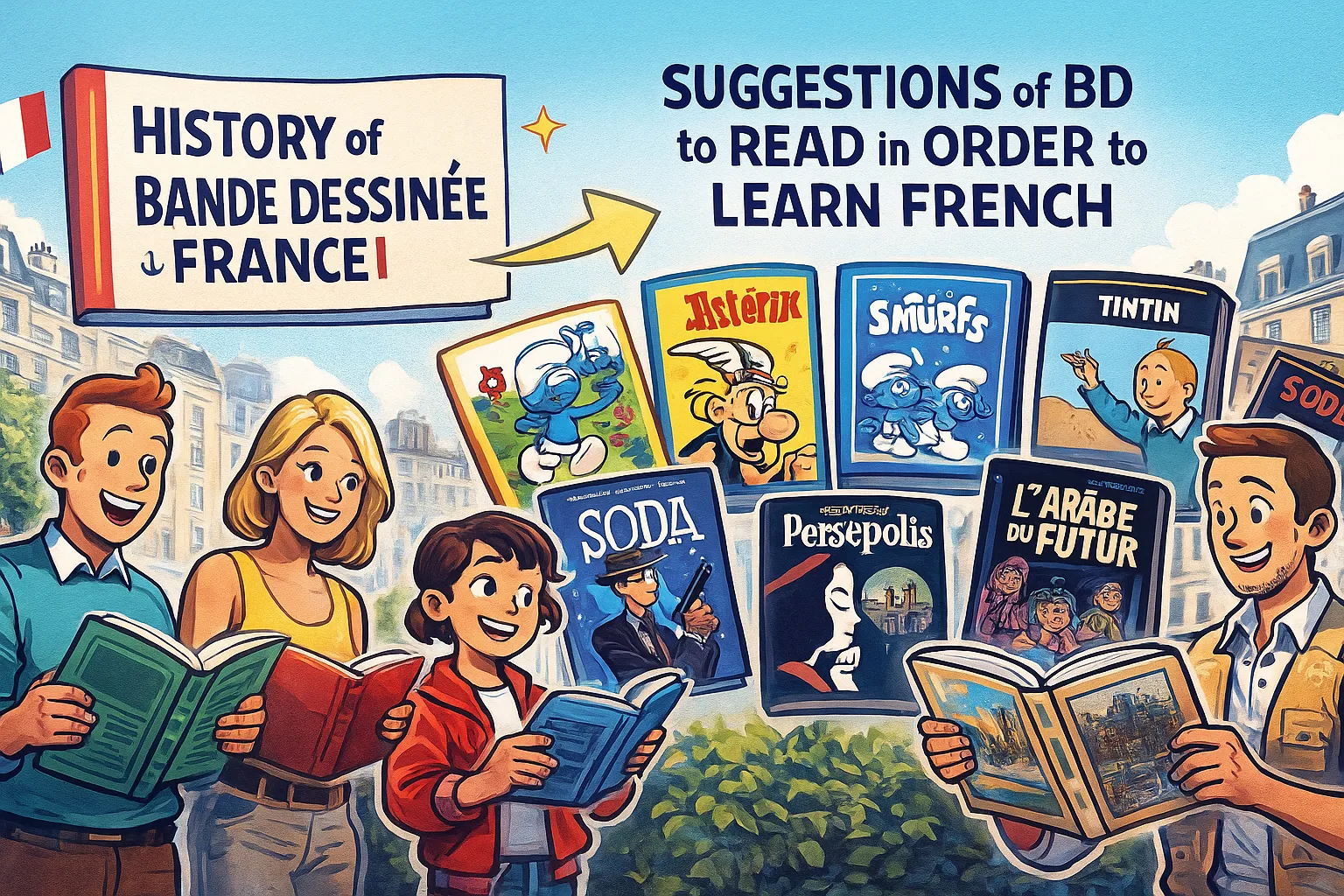
French comics give you visual context, natural dialogue, and cultural immersion without the wall-of-text fatigue that makes most learners quit novels after eight pages.

Best French comics and French comic books for language learners reading bande dessinee
French comics are not just lighter reading. For many learners, they are the missing bridge between classroom French and real reading fluency.
🍷 Society & Pop Culture 🌿 Beginner to Upper-Intermediate (A2-B2)

Why French comics matter more than most learners think

Most English speakers looking for French reading material make the same mistake early. They assume “real progress” means moving as fast as possible toward novels, essays, or dense nonfiction. That sounds serious. It also kills momentum for a huge number of learners. The problem is not intelligence. The problem is friction. A page of French prose gives you no visual support, no pacing relief, and no immediate context if a sentence goes opaque. French comics change that. Not by making French childish, but by making French readable at the exact stage where too many learners lose confidence.

That is why French comics, French comic books, and bande dessinee deserve far more respect in language learning than they usually get in anglophone study culture. In France and Belgium, comics are not treated as a guilty side hobby for children. They are treated as a major artistic medium. That difference matters because it changes what the medium contains. You are not limited to kid-friendly joke strips. French comics include history, crime, philosophy, autobiography, satire, politics, science fiction, war, fantasy, social issues, and literary experimentation.

🇫🇷 La bande dessinee est consideree comme le neuvieme art en France.🇺🇸 Bande dessinee is considered the ninth art in France.
The real learner problem Textbooks feel dead. Novels feel heavy. Graded readers often feel fake. French comics sit in the middle: real stories, real dialogue, real reading, but with enough support that you can keep turning pages instead of stopping every four lines.

People say they want more French exposure. What they usually mean is exposure they can survive consistently. “For sure.” French comics are one of the rare reading formats that make consistency easier instead of harder.

Comics teach a very specific kind of French that many learners badly need: dialogue, reaction language, informal rhythm, repeated descriptors, and vocabulary anchored to visible action. That is also why French comics pair so well with broader media study. The same learners who improve through bande dessinee often benefit from adding audio through French podcasts on Spotify that fit their level.

What makes French comics different from manga and English-language comics

French comics are not just “French manga,” and they are not simply European versions of American comics. The traditions overlap, but they are not built the same way. French comics occupy a different space. They are usually album-based rather than issue-based, often released as complete hardcover volumes, and deeply tied to the Franco-Belgian bande dessinee tradition.

FormatWhat it usually gives learnersMain strengthMain risk
French comics / BDStable page design, visible context, rich dialogue, cultural depthBest bridge between textbook French and real readingWordplay and cultural references can hit harder than expected
Manga in FrenchHigh motivation, strong serial pull, modern speech patternsExcellent if you already love manga and will read consistentlySome series move too fast or rely on niche genre language
American comics in FrenchFamiliar stories with French textComfort through known characters and plotsTranslation choices can feel less culturally French than native BD

💡 Honest rule: if you already love manga, use that advantage. But do not confuse “I like manga” with “manga is automatically the best French reading tool.” Native French comics often teach broader everyday French faster.

You’re finding French reading material that actually sticks.
The Briefing adds daily written French at your level. Real stories, not textbook extracts.
📰 Read The French Briefing
Free. No account.

Why French comic books are so effective for learning French

French comics work because they reduce one specific kind of cognitive load while preserving another. The visual layer helps you stay oriented when words fail. You can keep reading instead of crashing out of the page. But the language is still real enough to teach you something useful. Good French comic books sit between the extremes of trivial and discouraging. They let you infer. Inference is where a lot of real reading growth happens.

Another major advantage is dialogue. Comics give you speech patterns that are closer to how people actually sound than most beginner reading material. That also quietly strengthens listening and speaking, because you start internalising the shape of spoken French phrasing. If your ear still struggles with connected French, that connects directly to French pronunciation and listening at A1-B1.

🇫🇷 Les images aident a comprendre les mots inconnus.🇺🇸 Pictures help you understand unknown words.
🇫🇷 Les dialogues des BD utilisent le francais de tous les jours.🇺🇸 BD dialogue uses everyday French.

⚠️ One trap: some learners rely on the pictures so heavily that they stop reading carefully. The visual support should keep you moving, not replace the language entirely.

Best French comics for beginners (A2-B1)

Asterix

Authors: Rene Goscinny (writer) & Albert Uderzo (artist), 1959. Published by Hachette (Dargaud originally). 40 albums, translated into 100+ languages. Currently drawn by Didier Conrad, written by Jean-Yves Ferri.
Level: A2-B1 | Genre: Historical adventure comedy
🛒 Find on Amazon.fr

🇫🇷 Nous sommes en 50 avant Jesus-Christ. Toute la Gaule est occupee par les Romains… Toute ? Non !🇺🇸 The year is 50 BC. All of Gaul is occupied by the Romans… All of it? No!

Asterix is useful because the difficulty is survivable. You get repetitive settings, recurrent characters, predictable dynamics, and action that keeps the story legible even when the jokes go above your head. Some wordplay will absolutely escape you. That is normal.

Best starting albums: Asterix le Gaulois, Asterix et Cleopatre, Asterix chez les Bretons.

Tintin

Author: Herge (Georges Remi), 1929. Published by Casterman. 24 albums. Rights held by Moulinsart SA (Studio Herge). The ligne claire visual style defined an entire school of Franco-Belgian comics.
Level: A2-B1 | Genre: Adventure mystery
🛒 Find on Amazon.fr

🇫🇷 Mille millions de mille sabords !🇺🇸 Billions of blistering barnacles!

Tintin works well because the art is exceptionally clear. Herge’s famous ligne claire style reduces visual noise, which makes the page easier to read and process.

Best starting albums: Tintin au Tibet, L’Ile Noire, Le Secret de la Licorne.

Lucky Luke

Authors: Morris (artist) & Rene Goscinny (writer, 1955-1977). Published by Dupuis, then Dargaud, now Lucky Comics. 80+ albums. Currently written by Jul, drawn by Achdé.
Level: A2-B1 | Genre: Western comedy
🛒 Find on Amazon.fr

🇫🇷 Lucky Luke est l’homme qui tire plus vite que son ombre.🇺🇸 Lucky Luke is the man who shoots faster than his shadow.

Petit Poilu

Authors: Pierre Bailly (artist) & Celine Fraipont (writer), 2007. Published by Dupuis. 25+ albums. Wordless format, ideal for narration exercises.
Level: A2 (especially low A2) | Genre: Wordless children’s adventure
🛒 Find on Amazon.fr

Wordless comics are excellent for building descriptive thinking in French. You read the visual story, then narrate what happened in simple French. That forces active language production.

💡 Best beginner method: first pass for the story, second pass for 5 to 10 useful words, third pass reading out loud or retelling the page. That gives you reading, vocabulary, and speaking from one album.

Best French comics for intermediate learners (B1-B2)

Spirou et Fantasio

Authors: Created by Rob-Vel (1938), most famous era by Franquin (1946-1968). Published by Dupuis. 55+ albums. Currently written by Fabien Vehlmann, drawn by Yoann.
Level: B1 | Genre: Adventure comedy
🛒 Find on Amazon.fr

Le Petit Nicolas

Authors: Rene Goscinny (writer) & Jean-Jacques Sempe (illustrator), 1959. Published by Denoël then IMAV Editions. 5 original volumes + posthumous collections. Not a traditional BD format but illustrated short stories, often shelved alongside comics.
Level: B1 | Genre: Childhood humour
🛒 Find on Amazon.fr

🇫🇷 Le Petit Nicolas raconte ses aventures a l’ecole et a la maison.🇺🇸 Little Nicolas tells about his adventures at school and at home.

Particularly valuable for first-person narrative and everyday childhood-social vocabulary.

Persepolis

Author: Marjane Satrapi, 2000-2003. Published by L’Association. 4 volumes (often sold as 2 collected editions). Adapted into an Oscar-nominated animated film (2007). Rights held by the author.
Level: B1-B2 | Genre: Autobiographical graphic novel
🛒 Find on Amazon.fr

🇫🇷 Persepolis raconte l’enfance de Marjane Satrapi en Iran pendant la revolution islamique.🇺🇸 Persepolis tells Marjane Satrapi’s childhood in Iran during the Islamic revolution.

Shows that French comics can also be serious literary reading. The black-and-white visuals reduce distraction. The personal narrative voice creates continuity.

Titeuf

Author: Zep (Philippe Chappuis), 1992. Published by Glenat. 17+ albums. One of the best-selling BD series in France. Contemporary kid slang, informal phrasing, embarrassment, and the texture of young spoken French.
🛒 Find on Amazon.fr

Gaston Lagaffe

Author: Andre Franquin, 1957. Published by Dupuis then Marsu Productions. 20+ albums. Recently revived with a new album by Delaf (2023, controversial among purists).
Level: B1 | Genre: Office humour
🛒 Find on Amazon.fr

If your motivation tends to collapse under too much material, the smartest move is often “simplify the total number of resources and use better ones.” The same minimalist logic is exactly what sits behind building a smaller French reading stack that you actually finish. The French Briefing adds daily reading practice that fits alongside your comics habit.

Best French comics for advanced learners (B2-C1)

Blacksad

Authors: Juan Diaz Canales (writer) & Juanjo Guarnido (artist), 2000. Published by Dargaud. 7 albums. Spanish-born creators writing directly in French. Multiple Angouleme prizes. Visually one of the most accomplished BD series ever produced.
Level: B2-C1 | Genre: Noir detective
🛒 Find on Amazon.fr, richer descriptive language, and strong narrative pull. Noir vocabulary, interrogation, mood, corruption, tension.

Le Chat du Rabbin

Author: Joann Sfar, 2002. Published by Dargaud. 6 albums + collected editions. Set in 1930s Algeria. Adapted into an animated film (2011). One of the most intellectually rich BD series in the modern catalogue.
Level: B2 | Genre: Philosophical comedy
🛒 Find on Amazon.fr. Intellectual humour, religious discourse, North African context, philosophical questioning.

La Guerre des Lulus

Authors: Regis Hautiere (writer) & Hardoc (artist), 2013. Published by Casterman. 7 albums in the main series. Set in occupied Picardy, 1914-1918. Strong educational value alongside emotional storytelling.
Level: B2 | Genre: Historical adventure
🛒 Find on Amazon.fr

XIII

Authors: Jean Van Hamme (writer) & William Vance (artist), 1984. Published by Dargaud. 26 albums in the original run + spin-offs. One of the defining Franco-Belgian thriller series. Currently continued by Yves Sente and Iouri Jigounov.
Level: B2-C1 | Genre: Political thriller
🛒 Find on Amazon.fr, political and investigative vocabulary, longer series commitment.

⚠️ Advanced does not mean “start here.” A difficult French comic you admire from a distance teaches less than a slightly easier one you actually finish.

French comics by genre: choose the comics you will actually keep reading

Science fiction comics

Valerian et Laureline, Les Cites Obscures. Excellent for world-building and highly descriptive French.

Fantasy comics

Thorgal, Lanfeust de Troy, De Cape et de Crocs. Genre love keeps you motivated.

Contemporary life comics

Penelope Bagieu, Les Cahiers d’Esther. Modern daily life, identity, relationships, current social language.

Humour and satire comics

Les Profs, Tamara, Gaston. Reaction language, tone, social patterns through comedy.

How to use French comics to learn faster instead of just reading passively

  1. 1
    Read the first pass for momentumUse the images. Skip most unknown words. Stay with the story.
  2. 2
    Mark only a few high-value expressionsNot every new word matters. Keep the list small and useful.
  3. 3
    Read again with those gaps reducedThe second pass is where comprehension often jumps unexpectedly.
  4. 4
    Read dialogue out loudComics are one of the best ways to make spoken French visible before you produce it yourself.
  5. 5
    Retell one scene simply in FrenchThat turns passive reading into active language.

💡 Best anti-burnout rule: stop the dictionary before it stops the story. If you are looking up every second balloon, you are studying vocabulary badly and reading badly at the same time.

Where to find the best French comics and French comic books

If you are in France, the answer is easy: bookstores, comic shops, larger cultural chains, libraries, and festival spaces all carry substantial BD sections. Outside France, you still have options. Specialized comic stores sometimes carry Franco-Belgian albums. Digital comic platforms can help if print access is weak. Libraries with foreign-language sections sometimes surprise people.

Digital reading is better than no reading, but print often wins for language learners because the page stays visually memorable in a different way. You remember where something was on the page, which panel carried a phrase, which speech balloon helped you infer a word. That spatial memory is underrated. If you are mixing comics with visual immersion, streaming options in French TV and passive immersion media can keep your exposure wide.

Study glossary: French comics and BD vocabulary

French termEnglish translationUsage context
une bande dessineea comic book / comicThe standard French term, often shortened to BD
une BDa comic / graphic albumEveryday short form
un albuma comic volumeCommon Franco-Belgian format
une planchea comic pagePage composition or artwork
une casea panelThe basic visual unit on the page
une bullea speech bubbleWhere spoken dialogue appears
le dessinateur / la dessinatriceartist / illustratorThe person responsible for the drawings
le scenariste / la scenaristewriterThe person who writes the comic script
le neuvieme artthe ninth artHow French culture refers to BD
la ligne claireclear line styleClassic Franco-Belgian drawing style
franco-belgeFranco-BelgianThe historic tradition of French and Belgian comics
une seriea seriesA recurring comic universe with multiple albums

Best French comics for language learners: what to do next

If your reading in French keeps stalling, French comics are probably not the detour you were avoiding. They are probably the route you needed earlier. Comics give you support without infantilising you, dialogue without artificial classroom stiffness, and culture without the wall-of-text pressure that makes so many learners quit too soon. Whether you start with Asterix, Tintin, Lucky Luke, Persepolis, Blacksad, or another series that genuinely fits your taste, the principle stays the same: choose French comics you can actually finish, not French books you admire abstractly.

The best French comics for language learners are the ones that keep you reading long enough for the medium to do its work. Once that happens, the gains spread. Vocabulary grows. Dialogue starts sounding more familiar. Humour becomes less opaque. Cultural references begin to land. And for many learners, reading stops feeling like a test and starts feeling like contact with a real living language. That is the point. Not just more words, but more time inside French without wanting to escape from it. “For sure.” 🕶️

📈 French Progress Pass

You just decoded french, bande, dessinée. We turn this into a weekly habit.

You just found the French reading format that actually sticks. The Pass adds weekly audio with real stories, CEFR tracking, and structured progress alongside your comics.

✓ Weekly native audio ✓ CEFR tracking ✓ Full archives ✓ Structured practice
$19/mo
Cancel anytime
See the Pass →
📰 Free · Daily

Or start free with The Briefing.

One French news story every morning, picked at your level. Tax letters, prefecture vocabulary, political quotes: the institutional French decoded in three minutes, glossary built in.

Read today’s edition →
🐭 Free · 3 min
Take the Level Quiz

Instant CEFR score. Stop guessing if you’re A2 or B1.

Start →
📚 Free · 60+ guides
Browse the Learning Center

Grammar, culture, expat life, gastronomy. Organised by goal.

Open the hub →
📖 Free · 10 books
Browse the Library

Hand-picked textbooks and readers. Tested over 13 years.

See picks →

Best French Podcasts on Spotify for Language Learners

Best French Podcasts on Spotify for Language Learners

Most learners do not need more random podcast names. They need French podcasts on Spotify that match their actual level and stay interesting enough to become a daily habit.

Best French podcasts on Spotify for language learners
French podcasts on Spotify can build real listening fluency, but only if the content matches your level and your listening method matches the goal.
🍷 Society & Pop Culture 🌿 Beginner to Upper-Intermediate (A2-B2)

Why the best French podcasts for learners are the ones made for French people

Guillaume Pley’s LEGEND is the most listened-to French-language podcast on the planet. It reached 34th in the global Spotify charts in 2025 with nothing but long, unscripted, one-on-one interviews in French. No subtitles. No slow mode. No vocabulary list at the end. Just a host and a guest, talking for ninety minutes about a life that turned out to be extraordinary. Millions of French listeners come back every week. And if you are learning French, that matters far more than it might seem at first.

Most podcast guides for learners point you toward shows that were built specifically for language students. Slow audio, controlled grammar, English explanations, vocabulary segments. Those resources have a role, especially at the very beginning. But they create a problem nobody warns you about: they train your ear for a version of French that does not exist in the real world. The host speaks for you. The grammar is curated. The pace is artificial. Then when you try to listen to anything a French person would actually listen to, you discover that your “intermediate listening” barely survives the first thirty seconds of a real conversation.

That is the gap this guide exists to close. Every podcast recommended here is a real French show with a real French audience. Not content made for students. Content made for people who happen to speak French. Some of these shows are easier to follow than others, and we have organised them by the level where they start making sense. Instead of starting with the easiest possible audio and hoping you eventually graduate to real content, we start with real content and help you find the entry point that matches your ear right now. The difference matters because the habits you build early tend to stick. If you only ever train with slow, curated audio, your ear adapts to slow, curated audio. Then real French feels like a different language. But if you start with real French at the right difficulty, your ear adapts to the thing you actually need to understand.

🇫🇷 Écouter ce que les Français écoutent vraiment est le raccourci que personne n’enseigne.🇺🇸 Listening to what French people actually listen to is the shortcut nobody teaches.

The best French podcast for your level is not the one designed for your level. It is the real show where you understand just enough to stay curious and come back tomorrow.

This is also why podcast listening connects so directly to broader listening work. If your French still feels slippery at the sound level, even well-chosen native shows can feel unnecessarily hard. That is the same bottleneck explored in French pronunciation and listening at A1-B1, where the issue is often not intelligence or grammar but the simple fact that the ear has not yet had enough structured contact with real French audio.

How to choose the right French podcast on Spotify for your level

The biggest weakness of most podcast recommendation pages is that they list shows without helping you understand which one matches your ear right now. The rule is simple: choose podcasts by sustainable comprehension, not by aspiration alone. If you understand almost nothing and lose the thread after two minutes, the show is too hard right now. If you understand nearly everything, it is useful for confidence but should not be your only listening source. The ideal zone is where you follow the general meaning, catch repeated phrases, and stay oriented even while missing details.

This matters because listening is psychological as well as linguistic. When learners repeatedly choose material far above their level, they train frustration, not fluency. The opposite mistake also exists: staying too long with content that never stretches the ear. The target is not “easy” and not “hard.” It is stretchable.

Good fit

You follow the main idea, recognize recurring expressions, and can stay curious even when some lines go by too fast. You finish a little tired, not defeated.

Bad fit

You spend the whole episode trying to reconstruct what the topic even is. That is not “immersion.” It is mostly noise.

The usual mistake A learner searches “best French podcast Spotify,” clicks LEGEND because it sounds impressive, understands almost nothing for ninety minutes, and decides French podcasts are too hard. The real problem is not talent or motivation. It is level mismatch combined with unrealistic expectations. The same learner starting with HugoDécrypte would have understood 60 percent on day one and 80 percent within two weeks.

💡 Simple benchmark: if you understand less than about 30% and feel disoriented, go easier. If you understand enough to stay with the topic and catch more on the second listen, you are probably in the right zone.

You’re building a real French listening habit.
The Briefing gives you daily written French news with a comprehension quiz. Same principle, different format.
📰 Read The French Briefing
Free. No account.

Best French news and daily podcasts on Spotify (B1-B2)

News podcasts are one of the best entry points into real French audio because they combine authenticity with structure. The host introduces the topic clearly, transitions are easier to track, and certain words return constantly: government, election, measure, report, announce, investigate, inflation, president, minister, decision. The French Briefing uses exactly this principle daily with real French news and a comprehension quiz built for anglophone learners.

HugoDécrypte (Actus du Jour)

Level: B1-B2 | Host: Hugo Travers | Episode length: 5-10 minutes | Monthly audience: ~2.5 million streams
🎧 Listen: Spotify | Website

🇫🇷 HugoDécrypte résume l’actualité du jour en quelques minutes, sans jargon.🇺🇸 HugoDécrypte summarises the day’s news in a few minutes, without jargon.

HugoDécrypte is probably the single most efficient French news podcast for learners, even though it was never designed for them. Hugo Travers speaks clearly, stays on topic, avoids the compressed delivery of traditional radio journalism, and covers mainstream French and world news in episodes short enough to replay immediately.

Choses à Savoir

Level: B1-B2 | Host: Louis-Guillaume Kan-Lacas | Episode length: 2-5 minutes
🎧 Listen: Spotify | Website

🇫🇷 Choses à Savoir explique des faits intéressants en quelques minutes.🇺🇸 Choses à Savoir explains interesting facts in a few minutes.

One of the most useful French podcasts on Spotify for learners who need short, dense, repeatable episodes. Because the format is so brief, you can listen once for general understanding, again for details, and a third time without committing your whole evening.

Best French storytelling and true crime podcasts on Spotify (B1-B2)

Storytelling podcasts are where listening starts to become addictive instead of dutiful. When you care what happens next, your brain stays with the audio longer and tolerates uncertainty better.

Hondelatte Raconte (Europe 1)

Level: B1-B2 | Host: Christophe Hondelatte | Episode length: 20-40 minutes | Monthly audience: ~5.4 million streams
🎧 Listen: Spotify | Europe 1

🇫🇷 Hondelatte Raconte narre des affaires criminelles et des histoires vraies avec une voix captivante.🇺🇸 Hondelatte Raconte narrates criminal cases and true stories with a captivating voice.

Over 5 million streams per month. Christophe Hondelatte has one of the most recognisable voices in French media, and his narration style is deliberate, almost theatrical, which makes it significantly easier to follow than fast conversational speech. If you want one single podcast that trains your ear on sustained French narration while being genuinely compelling, this is the strongest entry point.

Chroniques Criminelles

Level: B2 | Episode length: 40-60 minutes
🎧 Listen: Spotify

🇫🇷 Chroniques Criminelles plonge dans les grandes affaires judiciaires françaises.🇺🇸 Chroniques Criminelles dives into major French judicial cases.

Top-5 podcast on Spotify France. Documentary-style, multiple voices, archival audio, detailed reconstruction. Excellent for B2 learners who want to train sustained attention.

Affaires Sensibles (France Inter)

Level: B2 | Host: Fabrice Drouelle | Episode length: 50-60 minutes
🎧 Listen: Spotify | France Inter

🇫🇷 Affaires Sensibles raconte les grandes affaires criminelles et historiques françaises.🇺🇸 Affaires Sensibles tells major French criminal and historical cases.

Fabrice Drouelle’s voice is measured and literary. The stories often reach into political history, espionage, and public scandal. Excellent stamina training at B2.

Les Pieds sur Terre (France Culture)

Level: B1-B2 | Host: Sonia Kronlund | Episode length: 30 minutes
🎧 Listen: Spotify | France Culture

🇫🇷 Les Pieds sur Terre présente des témoignages authentiques de gens ordinaires.🇺🇸 Les Pieds sur Terre presents authentic testimonies from ordinary people.

Especially valuable because it brings you closer to real spoken French as real people actually use it. You hear personal testimony, emotional pacing, hesitation, emphasis, and a wider variety of speech textures than in any polished production.

Transfert (Slate.fr)

Level: B1-B2 | Host: Charlotte Pudlowski | Episode length: 30-40 minutes | Monthly audience: ~1.1 million streams
🎧 Listen: Spotify | Slate.fr

🇫🇷 Transfert partage des histoires personnelles racontées à la première personne.🇺🇸 Transfert shares personal stories told in first person.

Personal storytelling is emotionally sticky. The first-person format gives you repeated exposure to the most useful structures in spoken French: remembering, realising, doubting, confessing, regretting, explaining, shifting perspective.

⚠️ Normal intermediate experience: with authentic French podcasts, you may understand only 30 to 50 percent at first and still learn a lot. If the topic holds you and the general story remains visible, the episode is not a failure.

Best French interview and conversation podcasts on Spotify (B2)

Long-form conversation is the final frontier of listening fluency. Everything else feels manageable once you can follow two French people talking freely for an hour.

LEGEND (Guillaume Pley)

Level: B2 | Host: Guillaume Pley | Episode length: 60-120 minutes | Monthly audience: #1 French podcast on Spotify, 34th worldwide
🎧 Listen: Spotify

🇫🇷 LEGEND est le podcast le plus écouté en France, avec des interviews longues et sans filtre.🇺🇸 LEGEND is the most listened-to podcast in France, with long unfiltered interviews.

LEGEND is the elephant in the room of French podcasts. Guillaume Pley interviews celebrities, athletes, entrepreneurs, and public figures in conversations that run ninety minutes or longer. The speech is fast, informal, full of slang, interruptions, and cultural references. At B2, start with episodes where you already know the guest or the topic. After five or six episodes, the speed starts feeling normal. “For sure.”

Zack en Roue Libre

Level: B2 | Host: Zack Nani | Episode length: 60-120 minutes
🎧 Listen: Spotify

🇫🇷 Zack en Roue Libre propose des interviews longues, souvent avec des personnalités médiatiques.🇺🇸 Zack en Roue Libre offers long interviews, often with media personalities.

Top-5 Spotify France podcast. Zack Nani’s style is more confrontational and debate-oriented than Pley’s, which means faster exchanges, more interruptions, and more reactive language. If LEGEND trains you to follow stories, Zack trains you to follow debates.

Floodcast

Level: B2 | Hosts: Daphné Bürki and guests | Episode length: 60-90 minutes
🎧 Listen: Spotify | Website

🇫🇷 Floodcast propose des conversations détendues et humoristiques avec des invités variés.🇺🇸 Floodcast offers relaxed and humorous conversations with diverse guests.

Conversational looseness, humour, shared cultural references, and the kind of speech that makes formal educational French suddenly feel very far away.

Best French science and educational podcasts on Spotify

Choses à Savoir: Science

Level: B1-B2 | Episode length: 2-3 minutes
🎧 Listen: Spotify | Website

🇫🇷 Choses à Savoir Science explique des découvertes scientifiques de manière accessible.🇺🇸 Choses à Savoir Science explains scientific discoveries accessibly.

La Méthode Scientifique (France Culture)

Level: B2-C1 | Host: Nicolas Martin | Episode length: 60 minutes
🎧 Listen: Spotify | France Culture

🇫🇷 La Méthode Scientifique explore des sujets scientifiques en profondeur avec des experts.🇺🇸 La Méthode Scientifique explores scientific topics in depth with experts.

Best French culture and society podcasts on Spotify

Culture 2000

Level: B2 | Episode length: 3 minutes
🎧 Listen: France Inter

🇫🇷 Culture 2000 explore l’actualité culturelle française en quelques minutes.🇺🇸 Culture 2000 explores French cultural news in a few minutes.

Un Podcast à Soi (Binge Audio)

Level: B2 | Episode length: 50 minutes
🎧 Listen: Spotify | Binge Audio

🇫🇷 Un Podcast à Soi traite de questions de société et de genre.🇺🇸 Un Podcast à Soi addresses social and gender issues.

How to use French podcasts on Spotify to improve faster

Good podcast choice matters, but method matters almost as much. A lot of learners assume that if French audio is playing somewhere near them, progress is happening at full speed. Some progress is happening. But the difference between slow and fast progress comes down to how you listen, how often you repeat, whether you use transcripts, and whether you turn any input back into active language.

💡 Strong podcast method: combine an easier show for daily confidence with a harder show for growth. Short replay for detail. Occasional active reuse so phrases do not stay passive forever.

  1. 1
    Choose one daily show and one stretch showChoses à Savoir or HugoDécrypte for daily habit. LEGEND, Hondelatte, or Transfert for deeper weekly listening.
  2. 2
    Use the first listen for the main idea onlyStop trying to catch every word immediately. Train yourself to hold onto topic, tone, and structure first.
  3. 3
    Replay shorter sections strategicallyA second listen often reveals far more than learners expect.
  4. 4
    Use transcripts selectively when availableNot as a substitute for listening, but to confirm what your ear missed.
  5. 5
    Recycle a few expressions activelyWrite a short summary, say one idea aloud, or bring a phrase into conversation.

This is also where many learners discover that their listening problem is partly a translation problem. That bottleneck connects directly to the broader issue in learning to think in French instead of translating everything first.

Common mistakes when learning French with real podcasts

  • Staying only with learner audio: comfortable, but it trains you for a version of French that does not exist in real conversations
  • Jumping straight to LEGEND at A2: ambitious, but mostly noise at that stage. Start with HugoDécrypte or Choses à Savoir
  • No repetition: replay is where recognition growth actually happens
  • No topic variety: one podcast field builds one slice of vocabulary
  • Too much guilt: missing parts of an episode is normal, not proof you are failing

⚠️ The worst podcast habit: quitting a show after one hard episode. Every new voice is harder at first. Your ear usually needs several episodes before the real level becomes clear.

Study glossary: French podcast listening vocabulary

French termEnglish translationUsage example
un podcasta podcastÉcouter un podcast français
un épisodean episodeLe dernier épisode était excellent
s’abonnerto subscribeJe me suis abonné à ce podcast
la compréhension oralelistening comprehensionAméliorer la compréhension orale
un invité / une invitéea guestL’invité du jour est un scientifique
une transcriptiona transcriptLa transcription est disponible
le vocabulairevocabularyEnrichir son vocabulaire
un sujet / un thèmea topic / a themeCe podcast traite de sujets variés
l’actualitécurrent events / newsUn podcast sur l’actualité
un témoignagea testimony / accountÉcouter des témoignages réels
passionnant(e)fascinatingCet épisode était passionnant
la prononciationpronunciationAméliorer sa prononciation

The real conclusion: stop listening to French made for learners

The best French podcasts on Spotify are not the ones designed for language students. They are the shows that millions of French people actually choose to listen to every day. LEGEND, HugoDécrypte, Hondelatte Raconte, Transfert, Affaires Sensibles, Les Pieds sur Terre: these are the voices and rhythms your ear needs to absorb if you want to understand French as it actually sounds, not as it sounds in a classroom.

That does not mean you should throw yourself into the hardest podcast on day one. Start with shorter, clearer shows like HugoDécrypte and Choses à Savoir. Build daily habits. Then gradually add longer formats. Let your listening routine widen instead of jumping chaotically from one impossible show to another. The progression is: short daily news, then narrative and testimony, then long unscripted conversation. Each stage prepares the next. And the one thing that ties all of these stages together is consistency. Fifteen minutes of French audio every day does more for your listening than a three-hour session once a month.

French podcast listening works because it gives your brain repeated contact with connected speech. Over time, words stop arriving one by one, phrases become familiar, discourse markers start carrying meaning, and whole segments of audio become understandable before you have consciously translated them. That is the shift learners are really searching for when they type “best French podcasts on Spotify.” Not just recommendations. A way into real listening fluency. “For sure.” 🕶️

📈 French Progress Pass

You just decoded best, french, podcasts. We turn this into a weekly habit.

You just found the podcasts that match your level. The Pass adds structured weekly audio, CEFR tracking, and real progress you can measure alongside your listening habit.

✓ Weekly native audio ✓ CEFR tracking ✓ Full archives ✓ Structured practice
$19/mo
Cancel anytime
See the Pass →
📰 Free · Daily

Or start free with The Briefing.

One French news story every morning, picked at your level. Tax letters, prefecture vocabulary, political quotes: the institutional French decoded in three minutes, glossary built in.

Read today’s edition →
🐭 Free · 3 min
Take the Level Quiz

Instant CEFR score. Stop guessing if you’re A2 or B1.

Start →
📚 Free · 60+ guides
Browse the Learning Center

Grammar, culture, expat life, gastronomy. Organised by goal.

Open the hub →
📖 Free · 10 books
Browse the Library

Hand-picked textbooks and readers. Tested over 13 years.

See picks →

10 Common French Mistakes English Speakers Make (And How to Fix Them)

10 Common French Mistakes English Speakers Make (And How to Fix Them)

You know hundreds of French words and still keep making the same mistakes. The problem is not vocabulary: English keeps interfering in predictable places.

10 common French mistakes English speakers make and how to fix them
The most common French mistakes are not random. They come from English habits colliding with French structure in the same places again and again.
🧱 Language Foundations 🌿 Elementary to Intermediate (A2-B1)

Why English speakers keep making the same French mistakes

English speakers do not make random mistakes in French. They make systematic mistakes. That is the good news and the bad news. The good news is that once you identify the pattern, you can fix it faster. The bad news is that the same pattern tends to reappear across dozens of different topics, so one wrong reflex can contaminate your grammar, pronunciation, listening, and confidence all at once.

The main reason is simple: English and French organise meaning differently. English relies heavily on word order, fewer visible agreement markers, and simpler everyday tense choices. French asks you to track gender, agreement, register, verb structure, liaison, and prepositions that often do not map cleanly onto English.

What this feels like in real life You say something that sounds correct in your head because every word is real French, but the person in front of you pauses for half a second, smiles strangely, or corrects one tiny part. That half-second is where most learners lose confidence.
🇫🇷 Les anglophones ne manquent pas d’intelligence, ils manquent surtout de nouveaux reflexes.🇺🇸 English speakers do not lack intelligence, they mostly lack new reflexes.

“For sure.” The learners who improve fastest are not the ones who never make mistakes. They are the ones who start recognising their own mistake patterns early enough to interrupt them before they become part of their identity in French.

This article focuses on the mistakes that create the most confusion and the biggest gap between “I know French” and “I can actually sound normal in French.” Several overlap directly with bigger issues in learning to stop translating from English while you speak, because translation is the hidden engine behind a lot of these errors.

Mistake #1: mixing up masculine and feminine nouns

This is one of the first mistakes English speakers meet and one of the last they fully stop making. The problem is not that French gender is “hard” in some mystical way. The problem is that English gives you almost no grammatical habit for it.

🇫🇷 ❌ La probleme est complique. ✅ Le probleme est complique.🇺🇸 The problem is complicated.
🇫🇷 ❌ Un universite francaise. ✅ Une universite francaise.🇺🇸 A French university.

💡 Best habit: store nouns as chunks, not isolated words. Treat the article as part of the noun, not decoration around it.

There are patterns, of course. Words ending in -tion are often feminine. Words ending in -age are often masculine. But “often” is not “always.” The safer long-term strategy is repeated exposure plus active recall. That same method becomes even more important in faux amis and deceptive familiar-looking French words.

Mistake #2: trusting false friends too much

False friends are dangerous because they reward confidence. You see a French word that looks like English, assume meaning, use it immediately, and often do not realise the problem until the reaction arrives.

🇫🇷 ❌ Je suis actuellement tres fatigue. ✅ Je suis en fait tres fatigue.🇺🇸 Actuellement means currently, not actually.
🇫🇷 ❌ Je vais assister mon ami. ✅ Je vais aider mon ami.🇺🇸 Assister usually means to attend, not to assist.
🇫🇷 ❌ Je suis excite pour la fete. ✅ J’ai hate d’aller a la fete.🇺🇸 Excite can sound sexually charged. Learners remember this word forever for a reason.

⚠️ High-confidence mistakes are the hardest to fix. False friends survive because learners say them with conviction. That conviction delays correction.

Mistake #3: using tu and vous badly

English gives you only one everyday “you.” French does not. So English speakers arrive in French with no instinctive feel for distance, formality, hierarchy, or social caution encoded inside pronouns.

🇫🇷 ❌ Bonjour Monsieur, tu peux m’aider ? ✅ Bonjour Monsieur, vous pouvez m’aider ?🇺🇸 Using tu with a stranger in a formal context sounds disrespectful.

Use tu first with

Family, close friends, children, many classmates, many younger people in informal settings, and people who clearly invite it.

Use vous first with

Strangers, older adults, teachers, bosses, doctors, police, officials, shop staff in formal interactions, and basically any unclear situation.

This is not just about grammar. It is social positioning. The wrong pronoun overlaps heavily with the broader issue in French politeness rules that English speakers misread.

You’re identifying the patterns that break your French.
The Briefing exposes you to correct French structures daily. Same patterns, real context. Quiz included.
📰 Read The French Briefing
Free. No account.

Mistake #4: dropping the full negation too early

🇫🇷 ❌ Je veux pas aller. ✅ Je ne veux pas aller.🇺🇸 I do not want to go.
🇫🇷 ❌ J’ai jamais vu ce film. ✅ Je n’ai jamais vu ce film.🇺🇸 I have never seen this film.

💡 Simple memory trick: French negation is a two-part structure. Do not memorise the second half only. Build the whole frame until it feels boring.

Mistake #5: using the wrong preposition because English logic feels obvious

🇫🇷 ❌ Je vais a France. ✅ Je vais en France.🇺🇸 English “to France” feels universal but is wrong in French.
🇫🇷 ❌ J’habite en Paris. ✅ J’habite a Paris.🇺🇸 Countries use en, cities use a. Learners overgeneralise.
PatternWrong reflexCorrect chunkWhy English speakers slip
Countriesa Franceen FranceEnglish “to France” feels universal
Citiesen Parisa ParisLearners overgeneralise en
Avoir besoinbesoin abesoin deEnglish “need” does not force an equivalent pattern
Penserpenser de toipenser a toiLiteral English mapping feels more reasonable than it is

Mistake #6: using etre where French wants avoir

🇫🇷 ❌ Je suis froid. ✅ J’ai froid.🇺🇸 I am cold. (French uses “have” not “am”)
🇫🇷 ❌ Elle est 25 ans. ✅ Elle a 25 ans.🇺🇸 She is 25. (French uses “have” for age)
🇫🇷 ❌ Je suis peur des araignees. ✅ J’ai peur des araignees.🇺🇸 I am afraid of spiders. (French uses “have fear”)

💡 Useful reset: learn whole everyday states as fixed French expressions: avoir faim, avoir peur, avoir chaud, avoir … ans. Do not build them from English every time.

Mistake #7: putting adjectives in the wrong place

🇫🇷 ❌ Une rouge voiture. ✅ Une voiture rouge.🇺🇸 A red car. (Color adjectives go after the noun)
🇫🇷 Une belle maison. (BAGS exceptions: beauty, age, goodness, size before the noun)🇺🇸 A beautiful house.

Mistake #8: confusing passe compose and imparfait

🇫🇷 ❌ Quand j’ai ete jeune, j’ai joue au football. ✅ Quand j’etais jeune, je jouais au football.🇺🇸 When I was young, I used to play football. (Background state + habit = imparfait)
🇫🇷 Je dormais quand le telephone a sonne.🇺🇸 I was sleeping when the phone rang. (Background process interrupted by completed event)

Use passe compose for

Completed actions, one-time events, narrative steps, and moments that move the story forward.

Use imparfait for

Descriptions, repeated habits, ongoing background, emotional or physical states, and context around completed actions.

If this still feels unstable, that is normal. Past tense choice becomes much easier once you see it as viewpoint instead of translation. The full breakdown is in the timeline method for imparfait vs passe compose. The French Briefing uses both tenses in every story, so the pattern becomes visible through daily exposure.

Mistake #9: translating English idioms literally

🇫🇷 ❌ Il pleut des chats et des chiens. ✅ Il pleut des cordes.🇺🇸 It’s raining cats and dogs. (French uses “ropes”)
🇫🇷 ❌ Casser une jambe ! ✅ Merde !🇺🇸 Break a leg! (French just says the obvious word)
🇫🇷 ❌ Ca coute un bras et une jambe. ✅ Ca coute les yeux de la tete.🇺🇸 It costs an arm and a leg. (French uses “the eyes of the head”)

Mistake #10: pronouncing letters French does not want you to pronounce

🇫🇷 ❌ Paris pronounced with a final S. ✅ Paris pronounced without the final S.🇺🇸 Silent final consonants are standard in French.
🇫🇷 Vous etes: pronounced with liaison. Vous parlez: no liaison on the final consonant.🇺🇸 French reactivates some silent consonants before vowels (liaison).

Pronunciation is where reading-only learners often discover the price of avoiding audio for too long. This is exactly why targeted work on French pronunciation and listening at A1-B1 changes more than just accent. It changes comprehension.

How to fix these French mistakes without becoming afraid to speak

  1. 1
    Track recurring mistakes, not every mistakeOne accidental error matters less than the pattern you repeat ten times a week. Your recurring mistakes are your real curriculum.
  2. 2
    Replace, do not just “notice”Noticing that excite is dangerous is not enough. You need a replacement ready: j’ai hate, je suis impatient.
  3. 3
    Practice the correct chunk in real contextsFixing one sentence in isolation is weak. Reusing the correct form across five real situations is what builds a reflex.
  4. 4
    Keep speaking while you repairAccuracy matters. So does momentum. If correction destroys spontaneity, you are solving one problem by creating another.

💡 Best mindset: treat correction as pattern training, not as personal failure. French is not punishing you. It is exposing where English still has too much control.

Study glossary: common French mistake patterns

Mistake typeWrongCorrectWhat to remember
Gender❌ une probleme✅ un problemeLearn nouns with articles, never alone
False friend❌ actuellement = actually✅ en fait = actuallyFamiliar-looking words are the most dangerous
Formality❌ tu with strangers✅ vous firstStart formal when unsure
Negation❌ je veux pas✅ je ne veux pasBuild the full structure before dropping anything
Preposition❌ a France✅ en FranceMemorise full chunks, not isolated words
Etre vs avoir❌ je suis froid✅ j’ai froidMany everyday states use avoir
Adjective order❌ une rouge voiture✅ une voiture rougeMost adjectives come after the noun
Past tense❌ quand j’ai ete jeune✅ quand j’etais jeuneImparfait handles background and repeated past
Idiom❌ literal English idiom✅ French equivalentDo not trust direct translation
Pronunciation❌ pronounce final consonants✅ respect silent endingsFrench sound and spelling do not map like English

The real goal is not perfection. It is reducing the number of mistakes that keep repeating after you already know better. That is what makes your French sound more stable, more natural, and more confident faster than another random list of new words ever will. “For sure.” 🕶️

📈 French Progress Pass

You just decoded common, french, mistakes. We turn this into a weekly habit.

You just identified the ten mistakes that keep breaking your French. The Pass tracks whether you actually stop repeating them: weekly audio, real context, CEFR progress.

✓ Weekly native audio ✓ CEFR tracking ✓ Full archives ✓ Structured practice
$19/mo
Cancel anytime
See the Pass →
📰 Free · Daily

Or start free with The Briefing.

One French news story every morning, picked at your level. Tax letters, prefecture vocabulary, political quotes: the institutional French decoded in three minutes, glossary built in.

Read today’s edition →
🐭 Free · 3 min
Take the Level Quiz

Instant CEFR score. Stop guessing if you’re A2 or B1.

Start →
📚 Free · 60+ guides
Browse the Learning Center

Grammar, culture, expat life, gastronomy. Organised by goal.

Open the hub →
📖 Free · 10 books
Browse the Library

Hand-picked textbooks and readers. Tested over 13 years.

See picks →

How to Open a French Bank Account (2026 Guide)

How to Open a French Bank Account: The Complete Guide for English Speakers

Every English speaker moving to France hits the same wall: the bank account that should take one appointment but somehow requires three. This guide walks you through the entire process from choosing the right bank to getting your first RIB into your landlord’s hands.

Opening a French bank account key phrases and vocabulary guide
French banking French is not difficult because the words are rare. It is difficult because the process is formal, indirect, and full of terms nobody teaches early enough.
💼 Professional & Expat Life 🌳 Intermediate to Upper-Intermediate (B1-B2)

Why the bank account is the first real test for English speakers in France

Most anglophone expats arrive in France expecting the hard part to be legal status, housing, or work paperwork. Then the bank account becomes the real bottleneck. Not because banks are impossible, and not because French banking vocabulary is advanced finance language, but because the whole process sits in that annoying middle zone where everyday French stops being enough and true administrative fluency has not arrived yet. You understand the nouns, miss the implication, and walk out thinking the appointment went fine when it actually produced nothing.

That is the first distinction worth making. Opening a French bank account is not an intellectual problem. It is a systems problem. The adviser wants identity, proof of address, legal status, tax traceability, contact details, and enough confidence that you understand what you are signing. You want an IBAN, a card, and a fast route to normal life. Both sides are being reasonable. The friction comes from the fact that France wraps reasonable requirements in formal language, implied rules, and a level of procedural caution that feels excessive if you come from a country where you can open an account in twelve minutes on your phone while sitting in a kitchen.

What this usually looks like You arrive with a passport, a smile, a work contract, and the vague idea that money should have somewhere to go. The adviser asks for a justificatif de domicile, your salary details, maybe your visa documents, and a French phone number for security codes. Suddenly the bank account is no longer one task. It is five unfinished tasks pretending to be one.
🇫🇷 Ouvrir un compte bancaire en France demande moins de courage que de précision.🇺🇸 Opening a bank account in France requires less courage than precision.

That sentence captures the whole mood. Learners often expect the challenge to be speaking French quickly. It is not. The real challenge is understanding which document is non-negotiable, which phrase signals a refusal without saying “no,” and which part of the process you should solve first. And that matters beyond the bank itself, because once the account is open, everything else begins to move.

The most common mistake we see is not “bad French.” It is showing up with conversational confidence and administrative vagueness. Bank appointments punish vagueness fast. If your file is incomplete, nobody argues. The process simply stops.

That is also why this topic links so naturally to the rest of expat French. The bank account sits in the same chain as housing, phone setup, residency, salary, utilities, and every other piece of adult life that only looks separate on paper. The moment the account exists, rent becomes easier, salary can land, direct debits start to make sense, and your paperwork begins to look like it belongs to one actual person instead of three partial identities floating around France.

Step by step: the real order that works when you open a bank account in France

Most guides list what you need. Few explain the sequence that actually prevents wasted appointments. This is the order that works for English-speaking newcomers in practice, from the very first decision to the moment the account is fully operational.

  1. 1
    Get a French phone number firstMany banks require SMS verification for app activation, login security, and adviser contact. A prepaid SIM from a bureau de tabac or a monthly plan from Free, Orange, SFR, or Bouygues works. Without a French mobile number, the bank process stalls at the security step.
  2. 2
    Gather your documents before contacting any bankPassport or EU ID, proof of address less than 3 months old (utility bill, rental contract, or attestation d’hébergement), proof of income or activity (work contract, student enrollment, payslips), and your visa or titre de séjour if non-EU. Bring originals and photocopies.
  3. 3
    Choose your bank based on your current situationIf your file is clean and stable: any traditional bank or online bank works. If your file is messy (no stable address, no income proof, fresh arrival): start with a traditional bank or Nickel as a bridge. If you want zero fees and your documents are in order: BoursoBank, Fortuneo, or Hello bank! are strong options. See the full comparison below.
  4. 4
    Book the appointment (in branch)Call or visit the branch. Say: “Je souhaiterais prendre rendez-vous pour ouvrir un compte bancaire.” Ask what documents they need for your specific situation as a foreign applicant. Write down the answer.
  5. 5
    Attend the appointment with everythingArrive on time. Greet the adviser formally. State your need: salary, rent, daily life. Before leaving, ask: “Est-ce qu’il manque quelque chose à mon dossier ?” If something is missing, ask exactly what format and deadline they need.
  6. 6
    Sign the convention de compteThis is the account contract. Ask about fees (frais de tenue de compte), card type, overdraft terms (découvert autorisé), and any package they are proposing. You are allowed to refuse extras.
  7. 7
    Wait for activation (3 to 10 business days)Card arrives by post (5-7 days). PIN arrives separately. Online access credentials arrive by email or post. The app may not work on day one.
  8. 8
    Download your RIB immediatelyAs soon as online access works, download the PDF. Email it to yourself. Save it on your phone. You will need it for salary, rent, insurance, utilities, and every administrative step that follows.
  9. 9
    Set up the mobile app and securityActivate the app, enable authentification forte (two-factor authentication), set balance and transaction alerts.
  10. 10
    Send your RIB to employer, landlord, and service providersSalary, rent, utilities, phone, insurance: they all need your bank details. This is where the bank account stops being a document problem and starts being your life in France.

Opening a French bank account online: when it works and when it does not

Online opening works well when your profile is clean: French or EU fiscal residence, valid ID, stable proof of address, and no unusual legal status. BoursoBank, Fortuneo, Hello bank!, and BforBank accept fully digital applications. The process typically takes 5 to 15 minutes of form-filling, identity verification (selfie video or photo), a first deposit from an existing EU bank account (usually €50-300), and activation within a few hours to a few days.

The conditions that trip up English-speaking newcomers are usually: needing to be a French fiscal resident (most online banks require this), needing an existing EU bank account for the first deposit (a catch-22 for first arrivals), and automated rejection without explanation if the system flags your file. Traditional banks are slower but more flexible on edge cases. Online banks are faster but less forgiving on incomplete profiles.

💡 The practical sequence for newcomers: French SIM card first, then Nickel or a traditional bank for your first IBAN, then an online bank for lower fees once your address and income are stable. Do not try to optimise fees before you have a working account.

Which French bank should you choose? The honest comparison

The key decision depends on whether you care most about branch access, expat friendliness, fees, app quality, ease of opening, or how reassuring the bank looks to landlords and employers. Here is every major name that matters for English speakers in France.

Traditional banks (branch network, in-person advisers)

Crédit Agricole Traditional

~7,700 branches · From ~€2-4/mo · Branch appointment for foreigners

The biggest branch network alongside La Banque Postale. Deeply embedded in French daily life, built for ordinary banking. Strong for people who want in-person advisers and a profile that looks instantly legible to landlords and employers.

credit-agricole.fr →

BNP Paribas Traditional

~1,700 branches · From ~€2.50/mo · International desk in major cities

The most internationally recognisable French bank. One of the few that also lends to non-residents. Often the default for expats with international financial ties, bilingual expectations, or incoming salary from abroad.

mabanque.bnpparibas →

Société Générale Traditional

~2,200 branches · From ~€2/mo · Online opening for FR residents

Major historical name. Visible, established, serious. Free mobility service to transfer your prélèvements from your old bank. A normal large-bank option that nobody has to explain to anyone.

particuliers.sg.fr →

Crédit Mutuel / CIC Traditional

~5,500 branches combined · From ~€1-3/mo · Mutualist model

Solid, relationship-based. Particularly attractive if you want a stable adviser and a bank you imagine keeping for years rather than treating as a temporary administrative bridge.

creditmutuel.fr · cic.fr →

Caisse d’Épargne Traditional

~4,200 branches · From ~€2/mo · BPCE group

Unexciting but credible. Often exactly what you want for housing files, salary setup, and administrative stability. Online opening available for French residents.

caisse-epargne.fr →

La Banque Postale Traditional

~7,300 locations · From ~€1.50/mo · Postal network

Widest physical network in France. Strong accessibility for people without other banking history. Especially relevant for newcomers who value presence everywhere ordinary France exists.

labanquepostale.fr →

Banque Populaire Traditional

~3,200 branches · Fees vary · BPCE group

Historically strong with professionals and small business owners. Sits comfortably between personal and professional banking. Branch appointment for foreign applicants.

banquepopulaire.fr →

Online banks (no branch, lower fees, digital-first)

BoursoBank Online

~6M clients · Card from €0/mo · SG subsidiary

The dominant online bank in France. No income condition on basic cards (Welcome, Ultim). Requires a French or EU bank account for first deposit. Accepts non-US foreign residents. Aggressive fee structure. Digital speed can collapse into digital refusal if your file is still messy.

boursobank.com →

Fortuneo Online

Card from €0/mo · Crédit Mutuel Arkéa subsidiary

Strong online alternative. No income condition on basic card (Fosfo). Must be French fiscal resident. Serious online bank, not gimmick fintech. Strong app and low fees.

fortuneo.fr →

Hello bank! Online

Card from €0/mo · BNP Paribas subsidiary

Online convenience with BNP Paribas backing. Can use BNP ATMs. No income condition on Hello One card. Must be French fiscal resident. Also accepts DOM-COM residents.

hellobank.fr →

Nickel Neobank

€25/year · BNP Paribas group · Opens in 5 min

Opens at a bureau de tabac or online. Accepts foreign passports, no income condition, no credit check. French IBAN provided. Not a full bank (no chequebook, no overdraft, no lending). Best as a first foothold or bridge account.

nickel.eu →

What documents you actually need (and the one that blocks everyone)

The first rule is boring and absolute: bring more proof than you think you need. French banks rarely reward optimism. If the website says one ID document, one proof of address, and one proof of activity, bring those plus backups. A process like this does not fail because you misunderstood the word document. It fails because the version you brought is too old, too foreign, not in your name, or not considered “sufficiently recent” by the person in front of you.

🇫🇷 Une pièce d’identité en cours de validité.🇺🇸 A valid identity document.

Usually that means a passport. Sometimes a national ID card works. A driving licence may support your file, but it is rarely the safest primary document for a foreign applicant.

🇫🇷 Un justificatif de domicile de moins de trois mois.🇺🇸 Proof of address less than three months old.

This is where many first files break. France loves recent proof of address. Utility bills, internet bills, tax notices, official rental documents, and some insurance papers can work. Screenshots and vague booking confirmations often do not.

🇫🇷 Un titre de séjour ou un visa long séjour, si nécessaire.🇺🇸 A residence permit or long-stay visa, if required.

EU citizens and non-EU citizens do not face exactly the same administrative expectations. Even when a bank could technically open the account without one specific paper, staff may still treat your residence status as central to the file. That is not always elegant. It is common.

🇫🇷 Un justificatif de revenus ou d’activité.🇺🇸 Proof of income or professional activity.

A work contract, payslips, self-employed documentation, or student enrollment papers can all serve here depending on your situation. The bank is not just opening a drawer for your money. It is classifying your profile.

🇫🇷 Un numéro de téléphone et une adresse e-mail valides.🇺🇸 A valid phone number and email address.

Security systems, app activation, SMS verification, and adviser follow-up depend on this more than many newcomers expect. If you are still improvising your French mobile setup, that delay can spill into banking faster than it should. That is why many people discover that setting up a French SIM card and mobile plan is not a side task at all. It quietly underpins banking, delivery, utilities, and every security code France wants to send you.

⚠️ Proof of address is where the file usually stalls. If you are between addresses, staying with friends, or living in temporary accommodation, solve this before the appointment. Banks do not admire creativity here.

The classic trap is the housing loop. You need a bank account to look stable to some landlords, but you need housing documents to open the bank account. France is perfectly capable of creating this kind of circular logic and then acting surprised when foreigners find it absurd. The workaround is not elegance. It is documentation.

🇫🇷 Une attestation d’hébergement.🇺🇸 A hosting certificate from the person you are staying with.

If you are living with friends, family, or a partner, this letter can save the situation. It usually needs to be paired with that person’s own proof of address and a copy of their ID. On paper, that sounds simple. In real life, it is one of those moments where your social integration suddenly becomes administrative infrastructure.

Students and new arrivals often report that the emotional difficulty is not the bank vocabulary itself. It is the sense that each institution assumes the others have already accepted you. The bank wants proof the rest of your French life exists. The rest of your French life wants proof the bank already exists. “For sure.” That contradiction does eventually resolve, but not because the system becomes logical. It resolves because you learn the right order.

Which type of account to open first

Most newcomers do not need a tour of the French banking universe. They need the correct basic account and enough vocabulary not to agree to extras blindly. If your goal is salary, rent, direct debits, card payments, and normal domestic life, the key term is usually compte courant. Some people say compte chèque, and you may still hear both depending on context, age, and bank habits, but compte courant is the core term you should recognise and be able to use with confidence.

🇫🇷 Je voudrais ouvrir un compte courant.🇺🇸 I would like to open a current account.

That sentence is clean, direct, and enough to frame the appointment. Do not overcomplicate the opening request. Your file will provide the complexity anyway.

🇫🇷 Un livret d’épargne.🇺🇸 A savings account.

This matters later, not first. Learners often get distracted by French savings products because they sound specific and official. They are. They are also not the urgent part if you still cannot receive your salary.

🇫🇷 Un compte joint.🇺🇸 A joint account.

Relevant for couples, but again not the standard first move for most arrivals. Shared accounts can simplify rent and bills, but they also multiply the document logic because now the file concerns two people, not one.

🇫🇷 Un compte professionnel.🇺🇸 A business account.

If you are self-employed or launching an activity in France, this distinction becomes important quickly. The personal account is not always the account the administration or your business structure expects. That is where many new arrivals realise their banking French overlaps directly with the language of visas, work structures, and legal status. If that larger move still feels blurry, the broader map in moving to France from the USA for work or long-stay admin helps clarify why one missing paper at the bank is often the symptom of a bigger setup issue, not a random inconvenience.

The practical answer is still simple. Most foreign employees and students need a basic current account first. Build the foundation, then add savings products or specialised services later. France loves packages. You do not need to love them back in the first appointment.

The bank appointment: what to say and what to expect

The language of the first contact matters more than learners often think. Not because the adviser expects perfect French, but because formality in France functions like lubrication. A slightly formal opening phrase can make the whole interaction feel clearer and calmer. In banking, casual English-style directness can sound abrupt if your French level is still uneven. Better to sound a little more formal than a little too loose.

🇫🇷 Je souhaiterais prendre rendez-vous pour ouvrir un compte bancaire.🇺🇸 I would like to make an appointment to open a bank account.

This is classic formal French. It works on the phone, by email, and face to face. If your spoken French still freezes under pressure, practice this line until it becomes automatic. It buys you control in the first ten seconds, which matters more than people admit. Administrative French usually goes wrong at the start, not the end. Once the opening is shaky, everything after it feels shakier too. That same pattern shows up in first French phone calls that unravel before the real question even starts, because the stress is rarely the vocabulary itself. It is the interactional setup.

🇫🇷 Quels sont les documents nécessaires pour ouvrir un compte ?🇺🇸 What documents are required to open an account?

Ask this even if you already checked online. Website lists are not always the final word. Branch habits vary, staff vary, and your status as a foreign applicant changes the practical answer.

🇫🇷 Je viens d’arriver en France et j’ai besoin d’un compte pour recevoir mon salaire.🇺🇸 I have just arrived in France and I need an account to receive my salary.

This line is useful because it gives context without oversharing. Advisers tend to process the request faster when they understand the practical need behind it.

🇫🇷 Est-ce qu’il manque quelque chose à mon dossier ?🇺🇸 Is anything missing from my file?

This is one of the best questions in the whole process. It turns vague discomfort into a clear inventory. Ask it before leaving, not after the silence of an unanswered follow-up email.

🇫🇷 Quand est-ce que le compte sera activé ?🇺🇸 When will the account be activated?

Important because “the account exists” and “the account is fully usable” are not always the same thing. The card, app access, transfer permissions, and full online functionality may arrive in stages.

Students at B1 often understand individual banking words but miss the tone of the interaction. French advisers rarely dramatise refusal. They soften it, delay it, or bury it inside procedure. If you only listen for a direct “no,” you miss the real message.

This is also where cultural tone matters. A polite French banking interaction is not warm in the same way an American service interaction is warm. It can sound more restrained, less smile-forward, and more procedural. That does not mean hostile. It means professional by French standards. Misreading that tone wastes energy. The real task is understanding what the adviser needs next, not whether they “seem nice.”

Banking French you will use every week after opening day

Once the account is open, a new problem begins. You stop dealing with the appointment and start dealing with recurring banking vocabulary that appears in apps, forms, bills, rent paperwork, salary onboarding, and random administrative requests. This is where the famous French RIB enters your life and quietly becomes one of the most important objects in your expat existence.

🇫🇷 Le RIB, relevé d’identité bancaire.🇺🇸 The French bank details document.

The RIB contains the core bank information people and institutions need to pay you or set up authorised withdrawals. Employers want it, landlords want it, utility providers want it, insurance companies want it, and sometimes other French institutions ask for it with such confidence that you briefly wonder whether the country would prefer your RIB to your face.

🇫🇷 L’IBAN.🇺🇸 The international bank account number.

This is part of the RIB and often the line people actually mean when they ask for your bank details. If you have ever asked yourself whether sending an IBAN is “safe,” welcome to Europe. It is normal. The caution belongs elsewhere.

🇫🇷 Le code BIC ou SWIFT.🇺🇸 The bank identifier code for international transfers.

You will not need it as often as the IBAN for domestic French admin, but it still appears often enough to be worth recognising immediately.

🇫🇷 Le solde du compte.🇺🇸 The account balance.

Simple, but essential. Banking apps bury this in plain sight and then surround it with transaction labels that are less obvious than they should be.

🇫🇷 Un relevé de compte.🇺🇸 A bank statement.

Important for visas, rentals, tax matters, and proving normal financial life. Do not wait until you need one urgently to learn where your bank hides the PDF download.

🇫🇷 Le titulaire du compte.🇺🇸 The account holder.

In France, the precision of names matters. Hyphens, middle names, married names, and inconsistent spelling across documents can create unnecessary friction, especially when your bank file must match residence or employment paperwork.

💡 Download your RIB the same day you get online access. Keep a PDF copy, email one to yourself, and know exactly where to find it in the banking app. French admin asks for it constantly and never when you are feeling relaxed.

There is a secondary problem here that most textbooks ignore completely. The translation is not the difficulty. The frequency is. Once a term becomes part of weekly life, slow recognition stops being acceptable. If you still have to think hard every time you see relevé, solde, bénéficiaire, or prélèvement, the process stays tiring. That is why the premium rhythm in the French Progress Pass helps people at this stage so much. Not because it teaches banking as a separate course, but because repeated exposure to real adult French is what turns high-friction words into low-friction reflexes.

You’re learning the admin French that makes life in France actually work.
The Briefing builds that same fluency daily. Real stories, real structures, quiz included.
📰 Read The French Briefing
Free. No account.

Transfers, direct debits, and the payment words that cause real confusion

This is one of the most important distinctions in the whole article because English speakers flatten too many payment ideas into one vague mental category. French does not. And when you are setting up rent, utilities, phone bills, subscriptions, or salary transfers, that distinction becomes practical very fast.

🇫🇷 Faire un virement.🇺🇸 To make a bank transfer.

This means you are sending money. You initiate it. You control the amount and the timing unless you create a recurring version yourself.

🇫🇷 Recevoir un virement.🇺🇸 To receive a bank transfer.

This is how salary commonly arrives, and sometimes how landlords or individuals prefer to receive rent or reimbursement.

🇫🇷 Un prélèvement automatique.🇺🇸 A direct debit.

This means an organisation takes money from your account once you authorise it. Utilities, insurance, subscriptions, internet bills, and many recurring services use this system.

🇫🇷 Mettre en place un prélèvement.🇺🇸 To set up a direct debit.

Here is the key logic. With a transfer, you send. With a direct debit, they take. If you blur that distinction, conversations with landlords, energy providers, and telecom companies become much more confusing than they need to be.

Payment termWho starts itBest use caseCommon misunderstanding
VirementYouRent, one-off payments, sending money to another accountPeople assume any recurring payment is automatically a prélèvement
Virement permanentYouFixed monthly rent or regular personal transfersConfused with subscriptions where the amount changes
Prélèvement automatiqueThe company after your authorisationUtilities, phone, internet, insurance, subscriptionsPeople think it is safer because it is automatic, then forget to monitor it
DépôtYouCash or cheque depositNew arrivals forget some banks make this easier in branch than online-only banks

The mistake is rarely academic. It shows up when someone says your rent can be paid by virement and you assume they mean they will pull it automatically from your account. Or when you authorise a prélèvement for a variable bill and then act surprised that the amount changes every month. French banking is not especially mysterious here. It is precise. Precision just feels hostile when nobody warned you in advance.

⚠️ Automatic does not mean harmless. Direct debits are convenient, but they deserve monitoring. New arrivals often trust the setup more than the follow-through and only notice a problem after several billing cycles.

And because France still preserves systems many anglophone newcomers use less often at home, you may also encounter cheques, branch deposits, and card settings that feel oddly old-fashioned beside a slick mobile app. The country is very capable of mixing 2026 user experience with 1998 paperwork logic in the same institution.

Managing your account: the app vocabulary nobody warns you about

French banks love security steps, customer spaces, and multi-layer validation. Some apps are good. Some are not. Many are perfectly usable once you know the key terms. The issue again is not high-level complexity. It is small repeated friction. A login problem, an unfamiliar menu label, a payee activation delay, a card setting buried in the wrong tab. Each one is minor. Together they make the app feel more intimidating than it is.

🇫🇷 Se connecter à son espace client.🇺🇸 To log into your customer area.
🇫🇷 L’identifiant.🇺🇸 The login or user ID.
🇫🇷 L’authentification forte.🇺🇸 Strong authentication or two-factor authentication.
🇫🇷 Ajouter un bénéficiaire.🇺🇸 To add a payee or transfer recipient.
🇫🇷 Télécharger un RIB.🇺🇸 To download a bank details document.
🇫🇷 Faire opposition à la carte.🇺🇸 To block the card.

Those are not glamorous phrases, but they are the ones that keep adult life moving. And just like with the bank appointment itself, confidence comes from preloading the exact language before you need it. Nobody wants to learn the phrase for blocking a lost card while already standing on a platform, hungry, stressed, and discovering their wallet is gone.

💡 Set up the mobile app and alerts immediately. Balance alerts, card notifications, and secure login recovery matter more than customising your dashboard. Build the safety net before you need the rescue.

There is also a more subtle point here. Administrative French often feels harder on a screen than in a conversation because there is no human repair mechanism. A person can repeat or simplify. An app cannot. That is why many B1 learners who seem “fine” in conversation still struggle disproportionately with banking, utilities, and admin portals. Their French is real, but it is not yet friction-resistant.

When something goes wrong: the French you need fast

No one moves country hoping to learn fraud vocabulary. Unfortunately, this is part of real competence. If your card fails, a transfer does not arrive, or a strange payment appears, you need language that is factual, calm, and precise. Panic English translated badly into French is not efficient here.

🇫🇷 Ma carte ne fonctionne plus.🇺🇸 My card is no longer working.
🇫🇷 Je voudrais faire opposition à ma carte.🇺🇸 I would like to block my card.
🇫🇷 Je ne reconnais pas cette opération.🇺🇸 I do not recognise this transaction.
🇫🇷 Je voudrais contester un paiement.🇺🇸 I would like to dispute a payment.
🇫🇷 Je n’ai pas reçu le virement.🇺🇸 I have not received the transfer.
🇫🇷 Pouvez-vous vérifier le statut de l’opération ?🇺🇸 Can you check the status of the transaction?

The deeper issue is that French admin conversations reward factual sequence. What happened, when, how much, which account, which card, which operation. If your story is emotionally vivid but structurally messy, the other side has more work to do and usually less patience than you would prefer. That does not mean you should sound robotic. It means you should organise the facts before you speak.

  1. 1
    State the problem in one lineSay what failed first: the card, the transfer, the transaction, the login, or the direct debit. Do not begin with the whole backstory.
  2. 2
    Give the relevant detailsDate, amount, merchant or sender, and the action already taken. Administrative French works better when the facts arrive in order.
  3. 3
    Ask for the next procedural stepWhether that means blocking the card, disputing the charge, or verifying a transfer, end with the concrete action you want.

That structure sounds almost obvious on paper. Under stress, people abandon it instantly. Then the conversation feels chaotic, which leads many learners to conclude their French is the real issue when in fact the missing piece was sequence, not grammar.

Complete French banking glossary

French termEnglish translationUsage context
un compte courantcurrent accountMain daily account for salary, bills, rent, and card payments
un justificatif de domicileproof of addressRequired to open the account and often the first document that causes delay
une pièce d’identitéidentity documentPassport or official ID used to verify your identity
un titre de séjourresidence permitRelevant for many non-EU applicants
un RIBbank details documentUsed for salary, direct debits, rent setup, and admin paperwork
un IBANinternational bank account numberMain detail shared for transfers and payment setup
un virementbank transferYou send money to another account
un prélèvement automatiquedirect debitA company or organisation takes money after authorisation
un bénéficiairepayee or recipientPerson or account you add in order to make transfers
le soldebalanceAmount currently available in the account
un relevé de comptebank statementDownloaded or printed proof of account activity
une carte bancairebank cardStandard French card for payments and withdrawals
faire oppositionto block the cardUsed if the card is lost, stolen, or compromised
un découvert autoriséauthorised overdraftAllowed negative balance under agreed conditions
les agiosoverdraft chargesFees or interest related to negative balance
les frais de tenue de compteaccount maintenance feesRecurring charges linked to the account itself

The real value of this vocabulary is not memorising it for its own sake. It is recognising it fast enough that banking stops feeling like a series of small ambushes. Once that happens, the process becomes what it always should have been: not fun, not elegant, but manageable. “For sure.” 🕶️

📈 French Progress Pass

You just decoded open, french, bank. We turn this into a weekly habit.

You just walked through the complete guide to French banking. The Pass turns that kind of admin confidence into weekly progress: real audio, CEFR tracking, and a system that makes France less alien.

✓ Weekly native audio ✓ CEFR tracking ✓ Full archives ✓ Structured practice
$19/mo
Cancel anytime
See the Pass →
📰 Free · Daily

Or start free with The Briefing.

One French news story every morning, picked at your level. Tax letters, prefecture vocabulary, political quotes: the institutional French decoded in three minutes, glossary built in.

Read today’s edition →
🐭 Free · 3 min
Take the Level Quiz

Instant CEFR score. Stop guessing if you’re A2 or B1.

Start →
📚 Free · 60+ guides
Browse the Learning Center

Grammar, culture, expat life, gastronomy. Organised by goal.

Open the hub →
📖 Free · 10 books
Browse the Library

Hand-picked textbooks and readers. Tested over 13 years.

See picks →

Belgian French Expressions That Confuse France French Speakers

Belgian French Expressions That Confuse France French Speakers

Belgian French expressions look close enough to France French until they suddenly do not. Numbers become easier, meal names shift, and tantot stops meaning what you thought.

Belgian French expressions that confuse France French speakers guide
Belgian French keeps the same core language as France French, but everyday expressions, numbers, and meal vocabulary can shift fast.
🧱 Language Foundations 🌿 Elementary to Intermediate (A2-B1)

Why Belgian French expressions feel familiar, then suddenly strange

Belgian French is not a separate language. It is French with regional norms, local vocabulary, and a few habits that make immediate sense inside Belgium and very little sense outside it. That is why France French speakers do not usually fail to understand Belgian French. They hesitate, misread the meaning, then catch up half a second later.

The main trap at A2 or B1 is confidence. You hear recognisable French, so you assume the next word will behave the way it does in France. Then you hit septante, drache, brol, or tantot. Same language, different map.

Real-life situation You arrive in Brussels, hear clear French, relax, then someone says they will call you tantot and invites you to eat un pistolet. Nothing is grammatically difficult. The problem is assumption. You think you know the code. You do not, not quite.
🇫🇷 Le francais belge reste du francais, mais avec ses propres reflexes.🇺🇸 Belgian French is still French, but it comes with its own habits.

That distinction matters. These are not mistakes, and they are not cute local errors. They are stable regional forms. Most learners do better once they stop treating Belgian French as “wrong French” and start treating it like British versus American English. Close enough to communicate, different enough to trip you up.

What we see with learners: the hardest part is rarely grammar. It is overconfidence with familiar-looking words. Belgian French punishes that reflex quickly, which is useful. Once you expect variation, your listening gets better. “For sure.”

Belgian French numbers are simpler than France French numbers

This is the part everyone notices first, because the Belgian system is cleaner. France French uses a base twenty pattern for 70 to 99. Belgian French mostly does not. Which is funny, because the “regional” system is often the more logical one.

🇫🇷 France: soixante-dix, soixante et onze, soixante-douze.🇺🇸 Seventy, seventy-one, seventy-two.
🇫🇷 France: quatre-vingt-dix, quatre-vingt-onze, quatre-vingt-douze.🇺🇸 Ninety, ninety-one, ninety-two.
NumberBelgian FrenchFrance FrenchWhat usually happens
70septantesoixante-dixLearners find the Belgian form easier immediately.
71septante et unsoixante et onzeThe France form is correct, just less transparent.
90nonantequatre-vingt-dixThis is where France French starts feeling like a puzzle.
92nonante-deuxquatre-vingt-douzeSame meaning, very different processing load.

Historically, both systems existed. Standard French in France kept the northern forms. Belgium preserved the decimal logic for 70 and 90. One more detail: Belgium usually keeps quatre-vingts for 80, unlike Swiss French, where you may hear huitante.

Practical takeaway: learn both systems for listening. Keep France French for exams unless you know your target context is Belgium. Recognition matters more than production here.

You’re mapping where French variants diverge.
The Briefing uses standard French daily. Real stories, real structures, quiz included.
📰 Read The French Briefing
Free. No account.

Why une fois sounds bizarre in Belgian French expressions

For France French speakers, une fois should mean “once” or “one time.” In Belgium, it often does not. It can soften a request, add emphasis, or simply sit in the sentence as a discourse particle.

🇫🇷 Venez manger. / Allez, venez manger.🇺🇸 Come eat, go on.
🇫🇷 Regardez. / Regardez un peu.🇺🇸 Just look for a second, will you.
🇫🇷 C’est bon, je vous assure.🇺🇸 It is good, honestly.

The usual explanation is contact with Dutch and Flemish patterns, where a word meaning “once” can work as a softener. Belgian French copied the function more than the literal meaning.

Do not over-copy this one. Learners love it because it sounds memorable. Used in the wrong context, it feels like costume French. Recognition first, imitation later.

Tantot is the Belgian French expression that causes the worst timing mistakes

Tantot is dangerous because it looks ordinary. No slang marker, no weird spelling, no warning sign. Yet the meaning can move enough to break a plan.

In Belgium

Tantot often means this afternoon. It points to a specific part of the day.

🇧🇪 On se voit tantot ? 🇺🇸 See you this afternoon?

In France

Tantot can mean soon or earlier, depending on context. It is usually vaguer.

🇫🇷 Je te rappelle tantot.🇺🇸 I will call you back later.

That difference is small on paper, huge in real life. A Belgian hears “this afternoon.” A person from France may hear “later, at some point.” Same sentence, different clock. Most textbooks skip this kind of collision because it is not tidy. But it matters more than a list of rare verb forms. The same trap shows up in French words that look familiar and still send you in the wrong direction, where recognition is high and meaning is just slightly off.

Safest option: say cet apres-midi if you mean this afternoon, and bientot or tout a l’heure if you mean later. Clear French beats region-specific ambiguity when precision matters.

Belgian French vocabulary changes ordinary life words first

Regional variants usually show up in daily nouns before they show up in abstract grammar. Belgian French follows that pattern. You can have a full conversation with standard French and still get stuck buying bread or talking about rain.

Food and meal names

🇫🇷 Un petit pain.🇺🇸 A bread roll. In Belgium, not a gun.
🇫🇷 Un pain au chocolat.🇺🇸 A chocolate pastry.
🇫🇷 Le petit-dejeuner, le dejeuner, le diner.🇺🇸 Breakfast, lunch, dinner. Same words, shifted by one meal.

This one can genuinely derail plans. If you learned France French, dejeuner is lunch and diner is dinner. In Belgian usage, those labels often shift earlier.

Objects, mess, and weather

🇫🇷 Il y a du bazar partout.🇺🇸 There is junk or clutter everywhere.
🇫🇷 Quelle averse. / Il pleut des cordes.🇺🇸 What a downpour.
🇫🇷 Passe-moi la serpilliere.🇺🇸 Pass me the floor cloth or mop.

Household vocabulary is often where learners realise regional French is not just accent. It is domestic language, the kind people use without thinking. The most common issue we see at this stage is not memorising the word once, it is hearing it fast enough to react. That is exactly where French pronunciation and listening under pressure starts mattering more than another vocabulary list. The French Briefing trains this daily.

Belgian French pronunciation sounds softer, clearer, and less Paris-centered

Accent stereotypes are messy, but one point comes up often: Belgian French can sound clearer to learners than fast Parisian French. Not because it is “better,” and not because all Belgian speakers sound the same. The rhythm is often a little more open, a little less compressed, and some contrasts feel easier to catch.

  • The overall intonation can feel more melodic, especially to ears trained on media French from Paris.
  • The r is still a French r, but it may sound less harsh in some Belgian accents.
  • Some learners report that Belgian speakers keep vowel distinctions clearer in casual speech.

What learners usually notice first: Belgian French is not slower in any magical way. It just gives them fewer of the clipped urban cues they associate with Parisian speech. Same language, different texture.

This matters because comprehension is emotional as well as technical. When the rhythm feels less aggressive, learners panic less. When they panic less, they understand more. For many B1 learners, the real bottleneck is the reflex of running every sentence through English before they process what they heard.

Which Belgian French expressions are worth learning first

You do not need a giant list. You need the high-frequency forms that create the biggest misunderstanding.

  1. 1
    Learn the numbers for listeningRecognise septante and nonante immediately. They appear in prices, times, addresses, and phone numbers.
  2. 2
    Fix the timing wordsPut tantot high on the list. It creates more real confusion than obscure slang.
  3. 3
    Memorise meal vocabularyIf dejeuner, diner, and souper move, your whole day moves with them.
  4. 4
    Recognise a few iconic nounsBrol, drache, pistolet, and wassingue give you a fast Belgian radar.

Exam note: for DELF, DALF, TCF, or general textbook French, standard France-oriented production is still the safer default. Regional comprehension is a bonus, not the baseline target.

Should you learn Belgian French expressions or stay with France French

If your goals are general travel, exams, and broad international comprehension, build your foundation in standard France French first. It is the form you will see in most courses, apps, and exam prep. That choice is not ideological. It is efficient.

If you live in Brussels, work with Belgian colleagues, follow Belgian media, or spend time in Wallonia, then Belgian French stops being optional background noise. It becomes daily listening. In that case, adding the regional layer early is practical.

Stay with France French first if

You want one stable model, you are still below B1, or your main goal is exam readiness and broad recognition.

Add Belgian French now if

You work, study, travel, or date in Belgium, especially in Brussels or Wallonia, and real conversations already expose the gap.

The reassuring part is this: Belgian French and France French remain mutually intelligible. Communication does not collapse. It just gets sticky in specific places. Numbers. Timing. Meals. A few domestic words. A few discourse habits. Once you know where the traps are, the whole variant becomes much easier to navigate.

Study glossary: Belgium versus France French

🇧🇪 Belgian FrenchEnglishUsage context
septanteseventyStandard in Belgian French
nonanteninetyStandard in Belgian French
pistoletbread rollBakery and food vocabulary
couque au chocolatchocolate pastryBakery term in Belgium
broljunk, clutter, messEveryday informal noun
dracheheavy rainWeather vocabulary
wassinguefloor cloth, mopHousehold vocabulary
tantotthis afternoonCommon Belgian time reference
dejeunerbreakfastMeal naming in many Belgian contexts
dinerlunchMeal naming in many Belgian contexts
souperdinnerEvening meal in Belgium
faire la fileto queueBelgium and Quebec usage
parkerto parkEveryday spoken usage
une foissoftener, emphasis particleConversation, not literal counting

That is the useful core. Not every Belgian expression, just the ones most likely to confuse a learner who started with France French. Once those are familiar, the rest stops feeling chaotic. “For sure.” 🕶️

📈 French Progress Pass

You just decoded belgian, french, expressions. We turn this into a weekly habit.

You just mapped where Belgian French diverges from France French. The Pass builds weekly confidence with real audio, CEFR tracking, and structured progress across all variants.

✓ Weekly native audio ✓ CEFR tracking ✓ Full archives ✓ Structured practice
$19/mo
Cancel anytime
See the Pass →
📰 Free · Daily

Or start free with The Briefing.

One French news story every morning, picked at your level. Tax letters, prefecture vocabulary, political quotes: the institutional French decoded in three minutes, glossary built in.

Read today’s edition →
🐭 Free · 3 min
Take the Level Quiz

Instant CEFR score. Stop guessing if you’re A2 or B1.

Start →
📚 Free · 60+ guides
Browse the Learning Center

Grammar, culture, expat life, gastronomy. Organised by goal.

Open the hub →
📖 Free · 10 books
Browse the Library

Hand-picked textbooks and readers. Tested over 13 years.

See picks →

Québec French vs France French: Key Differences for Learners

Quebec French vs France French: Key Differences for Learners (B1-B2)

Quebec French vs France French becomes a real problem at B1-B2, not because the grammar changes, but because everything around the grammar starts moving. The accent shifts. Basic words stop matching what most textbooks taught first. Meal names reverse. Casual questions sound unfamiliar even when every word is technically simple. That does not mean you need two separate versions of French in your head. It means you need a precise map of what changes between them, what stays stable, and which variety makes the most sense for your actual goals if you want stronger listening, clearer conversations, and fewer regional misunderstandings.

Quebec French vs France French key differences guide
Quebec French and France French share the same language base, but pronunciation, vocabulary, social register, and everyday phrasing can diverge enough to confuse intermediate learners fast.
🧱 Language Foundations 🌿 Intermediate to Upper-Intermediate (B1-B2)

Most learners think this topic is about accent. That is the visible part, not the hard part. The real friction comes from what happens when familiar grammar arrives inside unfamiliar sound patterns, local vocabulary, and a different social rhythm. That is why learners who do well with standard French materials can still feel destabilized in Quebec after two minutes of normal conversation. The grammar they know is still there. It is the packaging that changed.

The mistake learners make first

They treat regional French as a small pronunciation detour. Wrong scale. The actual issue is stacked variation: accent, daily vocabulary, question patterns, formality, and culture all moving at once. That pile-up is what makes comprehension drop.

That is also why the usual online advice is weak. “Just get used to the accent” explains almost nothing. Accent is only one layer. Which brings up the part nobody mentions: the words you already know can be the ones that mislead you most because they look familiar while meaning something else locally.

Why Quebec French and France French diverged in the first place

The split is historical before it is pedagogical. French settlers brought older forms of French to North America in the seventeenth century. France kept evolving under centralization, schooling, and the spread of metropolitan norms. Quebec French developed under different pressure: distance from France, centuries of English contact, local cultural continuity, and its own rules of linguistic prestige. The result is not “broken French” and not a collection of slang exceptions. It is a regional variety with coherent habits and a stable oral identity.

Students who move to Montreal after learning textbook French usually report the same thing in the first week: “I understand the grammar. I just don’t understand what people are doing with it.” That reaction is accurate. The base is the same. The surface is not.

Observed repeatedly at the B1-B2 stage

That history matters for learners because it changes how you should respond. If Quebec French were just “informal French,” the right strategy would be polishing your standard French. That is not enough. You need exposure to a different sound system and different lexical choices. The goal is not choosing a side forever. The goal is building a base strong enough to survive regional variation without collapsing into guesswork.

You’re mapping where French variants split apart.
The Briefing uses standard French daily. Real news, real structures. Quiz included.
📰 Read The French Briefing
Free. No account.

Quebec French pronunciation: what actually blocks comprehension

Pronunciation advice online is mostly useless. Not wrong, useless. The obsession with sounding native misses the real problem, which is decoding a stream of speech fast enough to keep the sentence alive in your head. Quebec French often sounds harder at first because several features arrive together: vowels move more, some consonants come out more sharply, and the rhythm feels further from the “international classroom French” most learners hear first.

FeatureFrance French tendencyQuebec French tendencyWhy learners stumble
Long vowelsMore stable, flatterMore movement, sometimes diphthong-likeThe word sounds longer than expected
t / d before high vowelsCleaner releaseAffrication more audibletu or dire can sound like different words
Final consonantsOften lighter in flowMore often heardEndings sound unexpectedly strong
Overall rhythmCloser to standard broadcast FrenchBroader regional melodyYou recognize the sentence too late
🇫🇷 père / fête / tu / dire / plus🇺🇸 father / party / you / to say / more

In standard France-oriented listening, these often land as relatively flat vowels and clean consonants. In many Quebec voices, the same words can feel more open, more mobile, or carry a slight “ts” effect on tu and dire. The meaning has not changed. Your ear just has not been trained for that shape yet. Quebec French more often makes the final s in plus audible in contexts where learners expect it to disappear. One difference like that is easy. Ten in thirty seconds is where the listening load spikes.

Best rule for learners: do not try to imitate Quebec pronunciation first. Train recognition first. Comprehension before imitation. Always. Accent work becomes useful only after the sound system stops disrupting sentence tracking.

That is the theory. The practice is messier. Once the accent gap starts shrinking, vocabulary becomes the real trap because the words that cause the most confusion are often the ones you think you already know.

Quebec French vocabulary differences that change daily life

This is where regional variation becomes practical instead of academic. Transport, meals, relationships, shopping, and time expressions are full of words that diverge between Quebec French and France French. These are not niche literary differences. They affect the simplest interactions.

The most dangerous words are the familiar ones

Unknown words are manageable because your brain marks them as unknown immediately. Familiar-looking words are worse because you assign the wrong meaning too fast. That is how learners miss the whole sentence while feeling falsely confident for the first two seconds.

🇫🇷 une voiture → 🇨🇦 un char🇺🇸 a car
🇫🇷 essence → 🇨🇦 gaz🇺🇸 fuel / gasoline
🇫🇷 parking → 🇨🇦 stationnement🇺🇸 parking lot

And this is where the cliché breaks. In some domains, Quebec is actually more institutionally French than France.

🇫🇷 une copine → 🇨🇦 une blonde🇺🇸 girlfriend

In Quebec, blonde can signal the relationship directly. In France, it mostly signals hair color. Same language. Very different inference path.

🇫🇷 un copain → 🇨🇦 un chum🇺🇸 boyfriend
🇫🇷 le petit-déjeuner → 🇨🇦 le déjeuner🇺🇸 breakfast
🇫🇷 le déjeuner → 🇨🇦 le dîner🇺🇸 lunch
🇫🇷 le dîner → 🇨🇦 le souper🇺🇸 dinner

Never trust meal vocabulary by shape alone. If someone in Quebec says On se voit pour dîner ?, that usually means lunch. Learners who answer based on France French meaning often organize the wrong half of the day.

🇫🇷 maintenant → 🇨🇦 asteure / à c’t’heure🇺🇸 now

Quebec keeps forms that can sound completely new even when the idea is basic. Those are the moments where learners panic unnecessarily.

Regional French is never just a local word list. It changes what your ear predicts next. That is why literal translation habits make the whole problem worse. That same mechanism is exactly why direct translation creates specific mistakes that intermediate learners keep repeating.

Expressions and grammar: where Quebec French feels like “another French”

This is the part learners remember emotionally. Not because the grammar is radically different, but because casual interaction starts sounding like a version of French they were never trained to decode fast.

Real-life scene You arrive in Montreal after learning standard textbook French and hear: Ça va-tu ? Tu viens-tu ce soir ? C’est le fun ici. None of that is advanced. The difficulty is not grammar level. The difficulty is that everything familiar is wearing regional clothes at full speed.
🇫🇷 Ça va ? → 🇨🇦 Ça va-tu ?🇺🇸 How’s it going?

The famous Quebec -tu question particle is one of the first markers learners notice. Not because it is difficult, but because nobody prepared them for it.

🇫🇷 Ça marche ? → 🇨🇦 Ça marche-tu ?🇺🇸 Does that work?
🇫🇷 C’est super. → 🇨🇦 C’est le fun.🇺🇸 That’s great.
🇫🇷 Tu viens ? → 🇨🇦 Tu viens-tu ?🇺🇸 Are you coming?
🇫🇷 Bonjour Madame, comment allez-vous ? → 🇨🇦 Salut, comment tu vas ?🇺🇸 Hello / Hi, how are you?

Quebec often lowers the threshold for informal interaction faster in daily life. Not always. Often enough that learners notice it immediately.

Tu/vous is not about formality. It is about relationship status. The wrong choice does not just sound “less polite.” It changes what you think the relationship is. That is why regional shifts in register matter so much.

Core interaction principle for intermediate learners

If that social logic still feels unstable, it is the same problem from another angle. That is where the real logic of tu and vous becomes more useful than memorizing “formal” versus “informal.”

So which variant should you learn first?

For most learners, the best default is still France French. Not because it is superior. Because it is the most widely taught, most widely distributed in learning materials, and the easiest base for broad international use. If you do not yet know where French will matter most in your life, France-oriented standard French gives you the highest utility per hour invested.

Start with France French if…

Your goals are broad, academic, professional, or still undefined. It dominates textbooks, apps, exams, subtitles, and international teaching resources.

Prioritize Quebec exposure early if…

Your real life is in Quebec: work, study, family, relocation, or day-to-day services. Waiting until later creates a false sense of readiness.

Daily practice is overrated if the input is wrong. Twenty minutes of the right thing beats two hours of the wrong thing. Every time. If your future is in Quebec, “later” is the wrong plan for regional listening. You do not need full Quebec production from day one. You do need Quebec input early enough that local speech does not feel like a second language when it finally matters.

  1. 1
    Pick one stable baseFrance French is the best default for broad use. Quebec-focused exposure should start early if Quebec is your real destination.
  2. 2
    Split the problem into layersAccent, vocabulary, and register are different listening problems. Treating them as one vague “dialect issue” slows progress.
  3. 3
    Train recognition before imitationSounding local is optional early on. Understanding local speech is not.
  4. 4
    Track the recurring blockersBuild a separate note page for regional sound shifts, lexical traps, and question patterns. That turns exposure into pattern recognition.

Can speakers from France and Quebec understand each other?

Yes. They can. But that answer is too soft to be useful. Mutual understanding exists, yet it depends heavily on speed, topic, register, and exposure. Careful speech, news-style delivery, and formal settings are easier. Fast casual conversation is where the gap becomes noticeable, especially for learners who are still building automatic listening and who rely too heavily on standard reference French.

The bottom line

Quebec French and France French are not separate languages. They are two high-exposure regional varieties of the same language. The right strategy is not choosing one forever. It is building one stable base and enough repeated exposure to the other variety that it stops sounding alien.

If your broader issue is not just Quebec but authentic French more generally, the right continuation path is the Learning Center, where the same listening, grammar, and meaning shifts connect across topics instead of appearing as isolated problems. And if regional variety itself is what keeps pulling your comprehension off track, a parallel example sits in another French variety that creates the same kind of confusion for speakers from France.

📈 French Progress Pass

You just decoded québec, french, france. We turn this into a weekly habit.

You just mapped where Quebec French and France French split. The Pass keeps your ear trained on real French weekly: audio, CEFR tracking, structured progress across all variants.

✓ Weekly native audio ✓ CEFR tracking ✓ Full archives ✓ Structured practice
$19/mo
Cancel anytime
See the Pass →
📰 Free · Daily

Or start free with The Briefing.

One French news story every morning, picked at your level. Tax letters, prefecture vocabulary, political quotes: the institutional French decoded in three minutes, glossary built in.

Read today’s edition →
🐭 Free · 3 min
Take the Level Quiz

Instant CEFR score. Stop guessing if you’re A2 or B1.

Start →
📚 Free · 60+ guides
Browse the Learning Center

Grammar, culture, expat life, gastronomy. Organised by goal.

Open the hub →
📖 Free · 10 books
Browse the Library

Hand-picked textbooks and readers. Tested over 13 years.

See picks →

How to Rent an Apartment in France: Essential Vocabulary

How to Rent an Apartment in France: The Complete Guide for English Speakers

Every English speaker renting in France hits the same traps: T2 does not mean two bedrooms, charges comprises changes the real price by 200 euros, and the dossier demands documents that do not exist in your country. This is the complete guide.

How to rent an apartment in France complete guide for English speakers
The French rental system has its own vocabulary, its own logic, and its own traps. This guide covers all of them.
💼 Professional & Expat Life 🌳 Intermediate to Upper-Intermediate (B1-B2)

Why renting in France is the hardest admin step after the bank account

Most anglophone expats assume the bank account is the worst French admin hurdle. Then they try to rent an apartment and discover that banking was a warm-up. The French rental system demands a complete application file before anyone even considers your candidacy. It uses a room classification system that does not match English conventions. It requires a guarantor with French income. It expects you to know legal vocabulary that protects you but nobody teaches you. And it operates in a market where good apartments disappear within hours, which means slow preparation equals no apartment.

That is the core tension this guide exists to solve. Not just the vocabulary, although you will find every term you need here. The real problem is the system itself. It assumes you already know the rules, the order of operations, the documents, the formulas, and the cultural signals that separate a serious applicant from one who will never hear back. English speakers who arrive in France with good French and no knowledge of the rental system lose apartments to applicants with worse French but better dossiers. This guide makes sure that does not happen to you.

What this usually looks like You find a perfect T2 on Le Bon Coin. You message the landlord. No response. You message ten more. Two respond. One offers a viewing tomorrow at 18h. You arrive. Twelve other candidates are there. The agent speaks fast. You catch “dossier complet” and “garant.” You do not have a garant. You do not have a dossier. You lose the apartment before the viewing ends. The next one you lose the same way. The problem is never your French. It is your preparation.
🇫🇷 Trouver un appartement en France demande moins de chance que de préparation.🇺🇸 Finding an apartment in France takes less luck than preparation.

The most common mistake we see is not bad French. It is showing up to a competitive rental market with an incomplete dossier and no guarantor. The language barrier is real, but the preparation gap is what actually costs people apartments.

The bank account and the apartment are the two pillars of French admin life, and they use the same logic: formal vocabulary, proof-of-everything, institutional patience, and a system that rewards precision over enthusiasm. If you have already navigated opening a French bank account, the mental framework is identical. If you have not, start there, because several rental steps require an active French bank account.

Step by step: how the French rental process actually works

Most guides list vocabulary. Few explain the order that prevents wasted viewings and lost apartments. This is the sequence that works for English-speaking renters in competitive French cities, from the first search to the signed lease.

  1. 1
    Build your dossier before you searchCollect every document landlords require: ID, last three payslips, tax return, employment contract, proof of current address. Assemble everything in a single clean PDF labelled in French. In competitive markets, you submit your dossier at the viewing or within hours. If it is not ready, you lose.
  2. 2
    Solve the guarantor problem earlyIf you do not earn three times the rent, you need a garant. If you are a student, employee under 30, or new arrival: apply for Visale (government guarantee) at visale.fr before you start searching. If Visale does not apply: arrange a bank guarantee (blocking 6-12 months rent) or find a French resident willing to guarantee. This single step blocks more anglophone renters than any other.
  3. 3
    Get renter’s insurance lined upMandatory by French law. You cannot sign a lease or receive keys without an attestation d’assurance habitation. Online providers like Luko, MAIF, or MACIF issue certificates within minutes. Cost: €10-30/month. Do this before your first viewing so it never becomes the reason you lose a signing slot.
  4. 4
    Search on the right platformsLe Bon Coin, SeLoger, PAP, Bien’ici, Facebook housing groups. Each channel has different costs, speed, and French requirements. See the full comparison below. Set alerts. Check hourly. Good apartments in Paris, Lyon, and Bordeaux disappear within hours of listing.
  5. 5
    Contact landlords in correct FrenchFirst message formula: “Bonjour, je suis intéressé(e) par votre annonce pour le T2 situé [adresse]. Je dispose d’un dossier complet et d’un garant. Serait-il possible de visiter cette semaine ?” Mention CDI if you have one. Attach your dossier PDF. This format gets responses because it answers the landlord’s three questions immediately: can you pay, do you have a guarantor, and is your file complete.
  6. 6
    Attend the viewing with your dossier in handArrive on time. Ask the diagnostic questions (heating type, charges, humidity, why the previous tenant left). Submit your dossier on the spot or within the hour. In competitive markets, speed is the deciding factor between identical candidates.
  7. 7
    Sign the lease and complete the état des lieuxRead the bail before signing. Check rent amount, charges, deposit, notice period, and lease duration. During the état des lieux d’entrée (move-in inspection), photograph everything. Note every scratch, stain, and malfunction. This document determines whether you get your deposit back.
  8. 8
    Set up utilities and register your addressElectricity (EDF/Engie), internet (Free, Orange, SFR, Bouygues), and update your address with your bank, employer, and any administrative bodies. Your new justificatif de domicile (proof of address) will come from these utility bills, which you will need for every other piece of French admin.

The T/F classification: why T2 does not mean two bedrooms

The single most common mistake anglophone apartment hunters make in France is misreading the numbering system. In English-speaking countries, a “2-bedroom apartment” has two bedrooms. In France, a “T2” or “F2” has two main rooms: one living room and one bedroom. The number counts all habitable rooms excluding kitchen and bathroom. A T3 has two bedrooms plus a living room. A T4 has three bedrooms plus a living room. Getting this wrong means viewing apartments that are one bedroom smaller than you expected, wasting time in a market where good apartments disappear within hours.

🇫🇷 Un studio / un T1 / un F1🇺🇸 A studio (one main room combining bedroom and living area)
🇫🇷 Un T2 / un F2 / un deux-pièces🇺🇸 A one-bedroom apartment (1 bedroom + 1 living room = 2 rooms)
🇫🇷 Un T3 / un F3 / un trois-pièces🇺🇸 A two-bedroom apartment (2 bedrooms + 1 living room = 3 rooms)
🇫🇷 Un T4 / un F4 / un quatre-pièces🇺🇸 A three-bedroom apartment (3 bedrooms + 1 living room = 4 rooms)
French termRoom countEnglish equivalent
Studio / T11 main roomStudio / efficiency
T2 / F22 main roomsOne-bedroom
T3 / F33 main roomsTwo-bedroom
T4 / F44 main roomsThree-bedroom
🇫🇷 Une chambre de bonne🇺🇸 A small room under the roof (originally maid’s quarters, now tiny studios)

These rooftop rooms are common in Paris, typically 8-15 square metres, often without private bathroom. They are the cheapest option in expensive arrondissements and frequently the first housing many foreign students and young workers secure. Do not dismiss them: in the 5e, 6e, or 7e arrondissement, a chambre de bonne at 500 euros puts you in a neighbourhood that would cost 1,500 for a proper T2.

🇫🇷 Un logement meublé / un logement vide (non-meublé)🇺🇸 A furnished apartment / an unfurnished apartment

The distinction matters legally and financially. Furnished leases are one year (renewable). Unfurnished leases are three years. Furnished costs more per month but requires less upfront investment. Unfurnished means truly empty: no light fixtures, no curtain rods, sometimes no kitchen appliances. “Unfurnished” in France is more unfurnished than anglophone renters expect.

The charges comprises trap: Landlords advertise with the lowest number possible. “800€ hors charges” means 800€ plus 100-200€ monthly utilities on top. “800€ charges comprises” means 800€ total. Always ask: “Les charges sont comprises ou non comprises ?” before calculating whether you can afford the apartment. The difference between CC and HC is the difference between your budget working and not working.

Where to search: agencies, direct owners, and the Airbnb bridge

The French rental market splits into three channels, and each one has a different cost structure, a different speed, a different level of French required, and a different risk profile. Most anglophone renters default to one channel without realising the others exist. That is a strategic mistake, because the right channel depends on your timeline, your budget, and how stable your administrative situation is right now.

Rental agencies (agences immobilières)

🇫🇷 Passer par une agence immobilière.🇺🇸 To go through a rental agency.

Agencies manage the listing, the viewing, the dossier review, the lease, and the état des lieux. They handle the paperwork and provide a legal framework that protects both sides. In return, they charge agency fees (honoraires d’agence) that are legally capped per square metre but still add several hundred euros to your move-in cost. In Paris, expect roughly €10-15 per square metre for the tenant’s share. On a 40m² T2, that means €400-600 on top of your first month and deposit.

The main platforms for agency listings are SeLoger (seloger.com), Bien’ici (bienici.com), and Logic-Immo (logic-immo.com). Some agencies also list on Le Bon Coin with the “professionnel” tag.

✅ Agency advantages

Legal structure protects you. Lease contract follows standard templates. État des lieux is usually done professionally. Disputes go through the agency, not directly with the owner. Useful when your French is not yet strong enough to handle a private landlord alone. Some agencies have English-speaking staff in Paris and major cities.

⚠️ Agency disadvantages

Agency fees add €300-800 to move-in costs. Dossier requirements are strict and standardised (harder to negotiate). Competition is intense on agency listings because they are widely advertised. Some agencies are slow to respond to foreign applicants. You rarely meet the actual owner before signing.

Direct from owner (de particulier à particulier)

🇫🇷 Louer directement auprès du propriétaire, sans agence.🇺🇸 Renting directly from the owner, without an agency.

Renting direct means no agency fees. The main platforms are Le Bon Coin (leboncoin.fr), which is the largest classified ads site in France and where most private landlords list, and PAP (pap.fr, De Particulier à Particulier), which is entirely direct-from-owner with no agencies allowed. Facebook housing groups for your city are also active, especially for short-notice moves, sublets, and informal arrangements.

The trade-off is clear: you save money but you need better French, more confidence, and more vigilance. Private landlords write their own leases (sometimes incorrectly), set their own viewing schedules (sometimes inconveniently), and handle the état des lieux themselves (sometimes carelessly). The experience ranges from a friendly retiree who maintains the apartment beautifully to a disorganised owner who forgets to return your deposit. Your French level and administrative knowledge are your protection.

✅ Direct-from-owner advantages

Zero agency fees (saves €300-800). More flexibility on dossier requirements: some private landlords accept profiles that agencies reject. Personal relationship with the owner can make maintenance faster. Negotiation is possible on rent, deposit, or move-in date. Listings on Le Bon Coin and PAP move faster than agency pipelines.

⚠️ Direct-from-owner disadvantages

Lease may not follow standard legal templates. État des lieux quality varies. Scams exist on Le Bon Coin (never pay before visiting in person). Disputes go directly to the owner, who may be difficult. Higher French fluency required for all interactions. No intermediary if things go wrong.

Le Bon Coin scam rule: Never send money, a deposit, or personal documents before visiting the apartment in person and meeting the owner or agent face to face. If a listing asks for a payment to “reserve” the apartment before a viewing, it is a scam. Every time. No exceptions. Legitimate landlords never ask for money before you have seen the apartment and signed a lease.

Airbnb and short-term rentals as a bridge

🇫🇷 Un meublé de tourisme / une location courte durée.🇺🇸 A short-term furnished rental / tourist accommodation.

Airbnb is not a rental strategy. It is a landing pad. Many English speakers arriving in France book an Airbnb for the first two to four weeks while they search for a real apartment. This is often the smartest move for newcomers because it solves three problems at once: you have a stable address to start other admin (bank, phone, paperwork), you have time to visit apartments without the pressure of sleeping in a hotel, and you can learn the neighbourhood before committing to a lease.

Some landlords on Airbnb also offer medium-term stays (1-6 months) at discounted rates. These can work as transitional housing, especially in cities where the long-term rental market moves slowly or where your dossier is not yet strong enough to compete. The cost is significantly higher than a normal lease, but the flexibility and zero-dossier requirement can be worth it during the settlement phase.

✅ Airbnb bridge advantages

No dossier, no garant, no French admin required. Immediate availability. Furnished and equipped. Provides a stable address for other admin steps (bank account, SIM card). Medium-term discounts available. Useful if your dossier is not ready yet or your visa is still processing.

⚠️ Airbnb bridge disadvantages

2-3x more expensive than a normal lease for the same surface. Not a real address for all admin purposes (some institutions reject Airbnb addresses). No tenant rights or protection. Cancellation risk if the host changes plans. Not sustainable beyond 1-2 months for most budgets. Does not build rental history in France.

The practical sequence for newcomers: Airbnb for 2-4 weeks on arrival (landing pad + address for bank/phone). During that time: build your dossier, apply for Visale, search Le Bon Coin + SeLoger daily. Target: signed lease before the Airbnb period ends. This sequence works because it separates the “arrive and stabilise” phase from the “compete for an apartment” phase instead of trying to do both simultaneously under pressure.

The dossier de location: documents French landlords demand

French landlords require a complete application file before even considering your candidacy. In competitive cities like Paris, Lyon, and Bordeaux, multiple candidates submit dossiers for the same apartment, and landlords review them like hiring managers review CVs. An incomplete dossier is rejected without discussion. A well-organised dossier signals reliability, seriousness, and administrative competence. Preparing it before you start viewing is not optional. It is the difference between securing housing in days and searching for months.

🇫🇷 Une pièce d’identité (passeport, carte de séjour)🇺🇸 An ID document (passport, residence permit for foreigners)
🇫🇷 Les trois dernières fiches de paie🇺🇸 The last three pay stubs (salary proof)
🇫🇷 Le dernier avis d’imposition🇺🇸 The last tax return (shows annual income to verify salary claims)
🇫🇷 Un contrat de travail / une attestation d’emploi🇺🇸 An employment contract / proof of employment
🇫🇷 Un justificatif de domicile🇺🇸 Proof of current address (utility bill, previous lease)
🇫🇷 Un garant / une caution solidaire🇺🇸 A guarantor (person who guarantees your rent with their own income)

The guarantor problem and how foreigners actually solve it

French landlords require tenants to earn at least three times the monthly rent. If you earn 2,500 euros, your maximum rent is roughly 830 euros. If your income is insufficient, or if you are self-employed, a student, or recently arrived without French income history, you need a garant: a person living in France with stable income who legally guarantees your rent if you default.

Finding a French guarantor as a foreigner is the single most challenging step in the rental process. But solutions exist, and knowing them before you start searching changes everything:

  • Visale (visale.fr): Free government guarantee for employees under 30, students of any age, and employees in their first months of a new job. Covers up to €1,500/month rent in Paris, €1,300 elsewhere. Apply online. Approval takes 24-48 hours. This is the first solution to try.
  • Bank guarantee (caution bancaire): Your French bank freezes 6-12 months of rent in a blocked account. Expensive but effective for self-employed applicants or those without Visale eligibility. Requires an active French bank account with sufficient funds.
  • Garantme / Smartgarant: Private guarantee services that act as your garant for a monthly fee (3-4% of rent). Useful when Visale does not apply and no personal guarantor exists.
  • Employer guarantee: Some companies, especially international ones, provide rental guarantees for relocating employees. Ask your HR department before searching independently.
  • Advance payment: Offering to pay 6-12 months upfront can convince some private landlords to waive the guarantor requirement. Not always accepted, but worth proposing if other options fail.

Dossier preparation strategy: Create a single PDF file with all documents in order. Label each section clearly in French: “Pièce d’identité,” “Fiches de paie,” “Avis d’imposition,” “Contrat de travail,” “Garant.” Agents and landlords who receive a clean, organised dossier treat your application more seriously than candidates who arrive with loose papers. The format signals competence before they read a single document. “For sure.” 🕶️

Essential rental vocabulary: every term from listing to lease

French rental vocabulary uses specific legal terms that do not have direct English equivalents because the French system works differently. “La caution” is a security deposit but its amount is legally capped (one month for unfurnished, two for furnished). “Le préavis” is the notice period but its duration depends on the lease type, the city, and your circumstances. “Les charges” includes building maintenance, communal heating, water, and elevator costs but not electricity, internet, or personal insurance. Learning these terms is not vocabulary practice. It is financial self-defence in a system designed for people who already know the rules.

🇫🇷 Le loyer🇺🇸 The rent (monthly payment to landlord)
🇫🇷 Les charges🇺🇸 Building charges (water, heating, maintenance, elevator, not electricity/internet)
🇫🇷 La caution / le dépôt de garantie🇺🇸 Security deposit (1 month unfurnished, 2 months furnished, legally capped)
🇫🇷 Les frais d’agence / les honoraires d’agence🇺🇸 Agency fees (tenant’s share, legally capped per square metre)
🇫🇷 Le bail / le contrat de location🇺🇸 The lease / rental contract
🇫🇷 Le propriétaire / la propriétaire🇺🇸 The landlord / the owner
🇫🇷 Le locataire / la locataire🇺🇸 The tenant / the renter
🇫🇷 L’état des lieux d’entrée / de sortie🇺🇸 Move-in / move-out inspection report

The état des lieux is a room-by-room condition report completed jointly by landlord and tenant. The entry report is compared to the exit report when you leave, and any damage beyond normal wear triggers deductions from your deposit. Be meticulous during the entry inspection. Photograph everything. Note every scratch, stain, and malfunction. The most common dispute between landlords and foreign tenants is over the état des lieux, and the tenant who documented the entry condition thoroughly always wins.

🇫🇷 Le préavis🇺🇸 Notice period (3 months unfurnished, 1 month furnished in tense housing zones)
🇫🇷 L’assurance habitation (obligatoire)🇺🇸 Renter’s insurance (mandatory by law in France)

You cannot legally occupy a French apartment without renter’s insurance. Your landlord will ask for the attestation d’assurance habitation before handing over keys. Cost: 10-30 euros per month through providers like MAIF, MACIF, or online through Luko. No attestation, no keys. No exceptions.

There is a secondary problem most textbooks completely ignore. The translation is not the difficulty. The frequency is. Once you live in France, charges, bail, préavis, caution, and état des lieux stop being study vocabulary and become words you need to process instantly in phone calls, emails, and face-to-face meetings with landlords who are not going to slow down for you. That is why the systematic exposure in the French Progress Pass helps people at this stage: not because it teaches rental as a separate topic, but because repeated contact with real administrative French is what turns high-friction words into low-friction reflexes.

You’re learning the admin French that decides whether you get the apartment.
The Briefing builds that same fluency daily. Real stories, real structures, quiz included.
📰 Read The French Briefing
Free. No account.

Apartment viewing: the questions that reveal problems before you sign

French apartment viewings move fast, especially in competitive markets. You have fifteen to twenty minutes to evaluate the apartment, ask the right questions, and decide whether to submit your dossier. The questions below are not small talk. They are diagnostic tools that reveal heating costs, building problems, neighbour issues, and contractual traps that do not appear in the listing. Asking them in correct French signals that you understand the system, which makes agents and landlords more likely to take your candidacy seriously.

🇫🇷 Quel est le montant du loyer charges comprises ?🇺🇸 What is the rent including utilities?
🇫🇷 Le chauffage est individuel ou collectif ?🇺🇸 Is the heating individual or communal?

This question changes your budget. Individual electric heating in a poorly insulated apartment can cost 150-200 euros per month in winter. Communal gas heating is usually included in the charges. The difference is significant and not always visible during a summer viewing.

🇫🇷 Y a-t-il la fibre / une connexion internet ?🇺🇸 Is there fiber / internet connection?
🇫🇷 Y a-t-il eu des problèmes d’humidité ou de moisissure ?🇺🇸 Have there been humidity or mold problems?
🇫🇷 Pourquoi le locataire actuel part-il ?🇺🇸 Why is the current tenant leaving?

This question reveals problems the listing does not mention: noisy neighbours, planned construction nearby, management issues. The agent’s hesitation or evasion is as informative as their answer.

🇫🇷 Quelle est la durée du préavis si je veux partir ?🇺🇸 What is the notice period if I want to leave?
🇫🇷 Quand l’appartement est-il disponible ?🇺🇸 When is the apartment available?
🇫🇷 Le DPE est à combien ? (Diagnostic de Performance Énergétique)🇺🇸 What is the energy rating? (Energy Performance Certificate)

Since 2023, apartments rated F or G on the DPE scale face rental restrictions in France. A bad DPE rating means higher heating bills and potential legal issues for the landlord. Asking this question shows you know current French housing law.

Students who prepare specifically for French phone calls find that the same formulas work for calling landlords and agencies: conditional tense for requests, formal register throughout, and specific questions that signal knowledge of the system.

Lease terms and tenant rights: the legal vocabulary that protects you

French tenant protection law is significantly stronger than American or British equivalents, and understanding the vocabulary of these protections prevents landlords from imposing conditions that are actually illegal. Rent increases are capped by the IRL index (Indice de Référence des Loyers). Security deposit return timelines are fixed by law. Eviction procedures are long and require court orders. The “trêve hivernale” (winter truce) prohibits evictions between November and March. Knowing these terms does not just help you read your lease. It tells landlords that you know your rights, which prevents the overreach that some landlords attempt with tenants they perceive as uninformed foreigners.

🇫🇷 La durée du bail : 3 ans (vide) / 1 an (meublé)🇺🇸 Lease duration: 3 years (unfurnished) / 1 year (furnished)
🇫🇷 L’IRL (Indice de Référence des Loyers)🇺🇸 Rent Reference Index (legal cap on annual rent increases)
🇫🇷 La restitution de la caution (1-2 mois après sortie)🇺🇸 Security deposit return (legally within 1-2 months after move-out)
🇫🇷 Les réparations locatives (à la charge du locataire)🇺🇸 Tenant maintenance obligations (minor repairs: lightbulbs, fixtures, drains)
🇫🇷 La trêve hivernale (pas d’expulsion de novembre à mars)🇺🇸 Winter truce (no evictions from November to March)

Furnished: flexibility, higher cost

1-year lease. 1-month notice period. 2-month deposit. Higher monthly rent but no furniture investment. Best for expats unsure how long they will stay. The flexibility premium is worth paying when your timeline is uncertain.

Unfurnished: lower rent, longer commitment

3-year lease. 3-month notice (1 month in tense housing zones like Paris). 1-month deposit. Lower rent but truly empty: no light fixtures, no curtain rods, sometimes no kitchen. Best for settled residents building a longer-term life.

The état des lieux: your most important document

The move-in inspection report determines whether you get your deposit back. French landlords use the entry état des lieux as the baseline for the exit inspection. Every scratch, stain, or malfunction not noted at entry becomes damage attributed to you at exit. Take photos of every room, every surface, every appliance. Test every faucet, every light switch, every window mechanism. Note everything in writing on the document. The fifteen minutes you invest in a thorough entry inspection save you hundreds of euros at exit. This is not paranoia. This is standard practice for experienced French tenants. “For sure.”

What makes French housing rules different from anywhere else

APL: the housing aid most foreigners miss

🇫🇷 Les aides au logement (APL / ALS / ALF)🇺🇸 Housing benefits paid by the CAF (social security family branch)

France provides housing aid to tenants based on income, rent, location, and family situation. This is not a welfare programme reserved for French citizens. Legal foreign residents with a valid titre de séjour can apply. Students, low-income workers, and families are the most common beneficiaries. The monthly amount ranges from €50 to €300+ depending on your situation and location. You apply online at caf.fr after signing your lease. Processing takes 1-2 months but payments are retroactive from your application date. Many anglophone renters discover APL exists only after months of paying full rent, because nobody told them.

Apply for APL the same week you sign your lease. Go to caf.fr, create an account, and start the application. You will need your lease, your RIB, and your titre de séjour or passport. The earlier you apply, the earlier the retroactive payments begin. There is no penalty for applying and receiving €0. There is a real cost to not applying and missing months of aid you were entitled to.

Encadrement des loyers: rent caps in 69 cities

🇫🇷 L’encadrement des loyers / le plafonnement des loyers🇺🇸 Rent control / rent caps (legal ceiling on what landlords can charge)

In 69 French cities, landlords cannot charge whatever they want. A legal ceiling called the loyer de référence majoré caps the rent per square metre based on neighbourhood, building age, and furnished/unfurnished status. The affected cities include Paris, Lyon, Lille, Bordeaux, Montpellier, Grenoble, and dozens of communes in the Paris suburbs and Pays Basque. The Assemblée Nationale voted in December 2025 to make this device permanent after years of experimentation. Marseille and Annemasse are expected to join in 2026-2027.

This matters directly for English-speaking renters because many landlords still set rents above the legal ceiling, especially in listings targeted at foreigners who may not know the rules. In 2024, 28% of listings in regulated cities exceeded the cap. You can check the legal maximum for any address using the simulator at pap.fr/encadrement-loyers or on the Service-Public.fr rent control page. If your rent exceeds the cap, you can legally demand a reduction.

Diagnostics obligatoires: what the landlord must show you

🇫🇷 Le dossier de diagnostics techniques (DDT)🇺🇸 The mandatory technical diagnostics file (legally required before signing)

Before signing any lease, the landlord must provide a file containing several mandatory diagnostic reports. These are not optional extras. They are legal requirements, and their absence can invalidate clauses of your lease. The key diagnostics include:

  • DPE (Diagnostic de Performance Énergétique): energy performance rating from A to G. Since 2025, apartments rated G are banned from rental. F-rated apartments face the same ban from 2028. A bad DPE means high heating bills and a landlord who may be forced to renovate or withdraw the apartment from the market.
  • CREP (Constat de Risque d’Exposition au Plomb): lead paint risk assessment, mandatory for buildings constructed before 1949.
  • État des risques: natural, mining, and technological risk assessment based on location. Flood zones, industrial proximity, seismic risk.
  • Diagnostic amiante: asbestos report for buildings with construction permits issued before July 1997.
  • Diagnostic électricité et gaz: safety reports for electrical and gas installations older than 15 years.

You have the legal right to see these documents before signing the lease. If the landlord cannot produce them, that is a red flag. The DPE rating in particular should influence your decision because it directly predicts your heating costs.

Taxe d’habitation: abolished but not entirely gone

🇫🇷 La taxe d’habitation🇺🇸 The residence tax (abolished for main residences since 2023)

France abolished the taxe d’habitation for main residences in 2023. If the apartment is your primary home, you do not pay this tax. However, the tax still exists for secondary residences and furnished tourist rentals. If you rent a second apartment (a résidence secondaire), you will receive a tax notice. This catches some expats who maintain a pied-à-terre in a different city. The taxe foncière (property tax) is paid by the owner, not the tenant, so it should never appear on your charges.

Quittance de loyer: the receipt you must request

🇫🇷 La quittance de loyer🇺🇸 Rent receipt (landlord must provide it upon request, free of charge)

French law obliges your landlord to provide a rent receipt (quittance de loyer) every month if you ask for one, at no charge. This document is not a formality. It serves as proof of payment for other administrative steps: visa renewals, housing aid applications, dossier preparation for your next apartment, and tax documentation. Many landlords forget or avoid issuing quittances unless you ask. Always ask. The phrase is: “Pourriez-vous me fournir une quittance de loyer chaque mois ?”

Colocation: shared housing has its own rules

🇫🇷 Une colocation / un bail en colocation🇺🇸 A shared rental / a co-tenancy lease

Shared housing in France works differently depending on whether you sign a single joint lease (bail solidaire) or individual leases for each room. With a joint lease and clause de solidarité, every tenant is financially responsible for the entire rent, not just their share. If your flatmate stops paying, the landlord can legally demand the full amount from you. Individual leases protect you from this but are less common. If you are signing a colocation lease, check for the solidarity clause and understand what it means before you sign. The CAF can provide APL for colocation tenants, but the calculation is based on your individual share of the rent, not the total.

The conciliation commission: free dispute resolution

🇫🇷 La commission départementale de conciliation (CDC)🇺🇸 The departmental conciliation commission (free tenant-landlord mediation)

If you have a dispute with your landlord over rent, deposit return, charges, or repairs, France provides a free mediation service before you need a lawyer. The commission départementale de conciliation handles disputes between tenants and landlords at no cost. You can find your local commission through service-public.fr or your local ADIL (Agence Départementale d’Information sur le Logement). This is an underused resource that many foreign tenants never discover because they assume French legal processes are always expensive and slow. The conciliation commission is neither.

Communicating with landlords: the formulas that get responses

French landlords and rental agencies receive dozens of enquiries per listing in competitive markets. The enquiry that uses correct French, demonstrates knowledge of the system, and presents the applicant as serious gets a response. The enquiry that reads like a translated English email gets ignored. The formulas below are the specific sentence structures that French rental professionals expect.

🇫🇷 Je suis intéressé(e) par votre annonce pour le T2 situé au [adresse].🇺🇸 I am interested in your listing for the one-bedroom at [address].
🇫🇷 Serait-il possible de visiter l’appartement cette semaine ?🇺🇸 Would it be possible to visit the apartment this week?
🇫🇷 Je dispose d’un dossier complet et d’un garant.🇺🇸 I have a complete application file and a guarantor.
🇫🇷 J’ai un CDI depuis [durée] avec un salaire de [montant].🇺🇸 I have a permanent contract for [duration] with a salary of [amount].

“CDI” (Contrat à Durée Indéterminée) is the magic word in French rental applications. Landlords heavily favour CDI holders because the contract is harder to terminate, making rent payment more predictable. “CDD” (fixed-term contract) weakens your application. Self-employment raises questions. Mentioning your CDI in the first contact is a strategic advantage.

🇫🇷 Il y a un problème avec [sujet], pourriez-vous le faire réparer ?🇺🇸 There is a problem with [issue], could you have it repaired?
🇫🇷 Je vous informe que je souhaite quitter l’appartement. Voici mon préavis.🇺🇸 I am informing you that I wish to leave the apartment. Here is my notice.

The CDI advantage: If you have a CDI, mention it in the subject line of your first email to the landlord: “Demande de visite: T2 rue X, CDI.” In competitive markets, this single word moves your email from the maybe pile to the respond-today pile. French landlords scan for CDI the way recruiters scan for qualifications.

Complete French rental glossary

French termEnglishContext
LouerTo rent“Je cherche à louer un T2”
Le loyerThe rent“Le loyer est de 900€ par mois”
Les chargesBuilding charges“Charges comprises ou non ?”
La cautionSecurity deposit“La caution est d’un mois”
Le bailThe lease“Signer le bail”
Le préavisNotice period“Donner son préavis”
Le propriétaireThe landlord“Contacter le propriétaire”
Le locataireThe tenant“Les droits du locataire”
Un garantA guarantor“Avoir un garant en France”
L’état des lieuxInspection report“Faire l’état des lieux”
Meublé / videFurnished / unfurnished“Un T2 meublé”
Les frais d’agenceAgency fees“Les frais sont plafonnés”
CDI / CDDPermanent / fixed-term“J’ai un CDI depuis 2 ans”
L’assurance habitationRenter’s insurance“Obligatoire par la loi”
Le DPEEnergy performance rating“Le DPE est à combien ?”
La trêve hivernaleWinter eviction ban“Nov-Mars, pas d’expulsion”
L’IRLRent increase index“Encadrement des loyers”
Chambre de bonneRooftop maid’s room“Studio sous les toits”
Hors charges / CCExcl. / incl. utilities“800€ CC ou HC ?”
De particulier à particulierDirect from owner“Sans frais d’agence”
Agence immobilièreRental agency“Passer par une agence”
Location courte duréeShort-term rental“Airbnb, meublé touristique”
APL / ALSHousing aid (CAF)“Faire sa demande d’APL”
Encadrement des loyersRent control / cap“Le loyer dépasse le plafond”
Quittance de loyerRent receipt“Fournir une quittance”
ColocationShared rental“Un bail en colocation”
Clause de solidaritéJoint liability clause“Chaque colocataire est responsable”
La CDCConciliation commission“Saisir la commission”
📈 French Progress Pass

You just decoded rent, apartment, france. We turn this into a weekly habit.

You just walked through the complete guide to renting in France. The same administrative French shows up in banking, préfecture visits, and workplace emails every week.

✓ Weekly native audio ✓ CEFR tracking ✓ Full archives ✓ Structured practice
$19/mo
Cancel anytime
See the Pass →
📰 Free · Daily

Or start free with The Briefing.

One French news story every morning, picked at your level. Tax letters, prefecture vocabulary, political quotes: the institutional French decoded in three minutes, glossary built in.

Read today’s edition →
🐭 Free · 3 min
Take the Level Quiz

Instant CEFR score. Stop guessing if you’re A2 or B1.

Start →
📚 Free · 60+ guides
Browse the Learning Center

Grammar, culture, expat life, gastronomy. Organised by goal.

Open the hub →
📖 Free · 10 books
Browse the Library

Hand-picked textbooks and readers. Tested over 13 years.

See picks →