
Updated on September 15, 2026
French Pharmacy Phrases: Symptoms and Asking for Advice
Explain symptoms at a French pharmacy and ask about instructions, allergies and medicine use. Practise with translated phrases and audio.
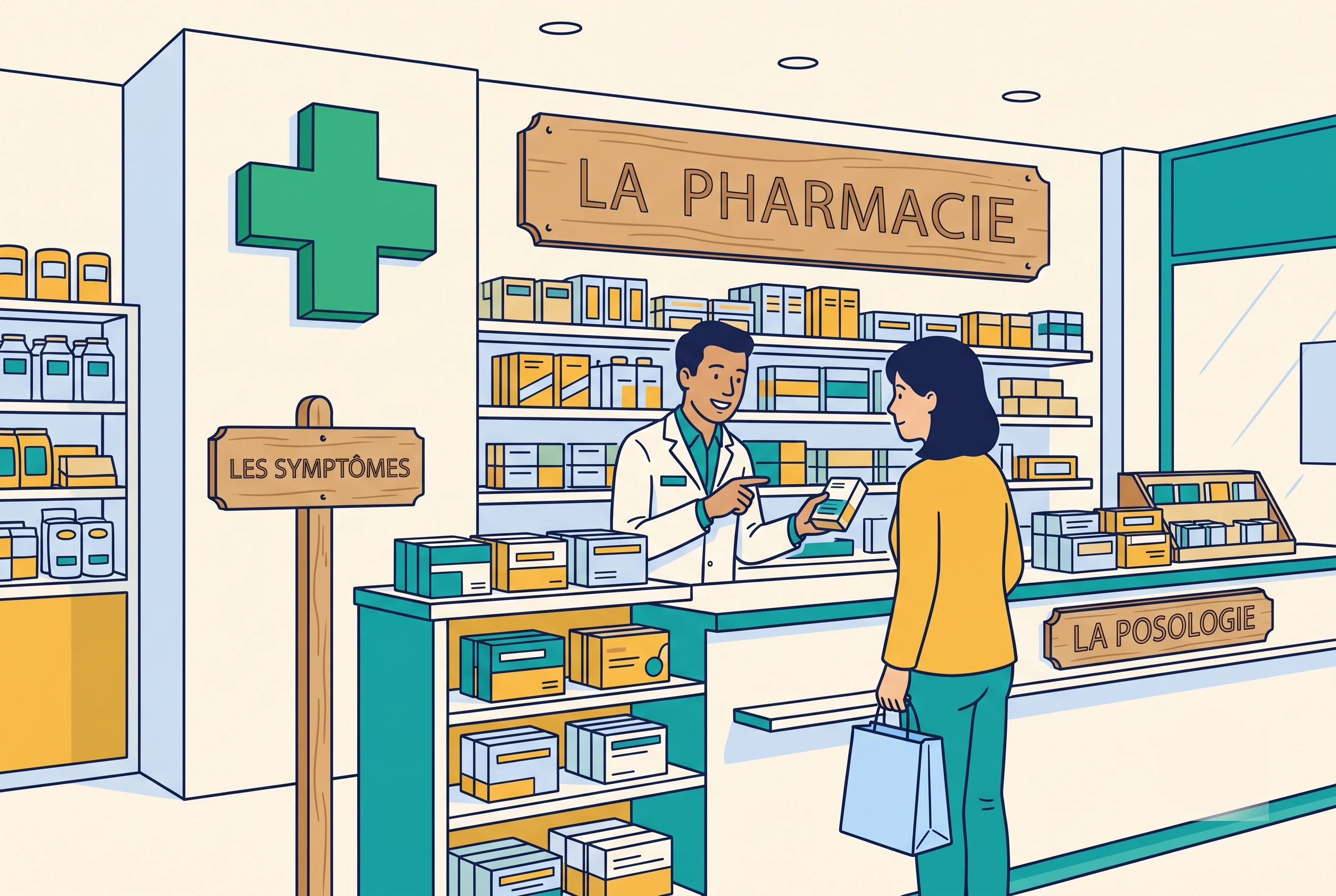
This guide helps you communicate with a pharmacist; the phrases do not determine a diagnosis or treatment. Describe the situation clearly and ask the professional to explain any instructions you do not understand.
Your opening line at the pharmacie
Begin with a greeting and explain the symptom or question. Mention relevant medication, allergies and other information the pharmacist asks for. They can advise within their professional scope and may refer you to another service. Ask for clarification whenever an instruction is unclear.
Everything before the body part stays fixed, and only the little word in front of it changes with what hurts:
Skip this and you may walk out with nothing but the address of a doctor.
The dose depends on who is taking it, so this comes before the pharmacist has to ask:
The pharmacist will ask you questions
Expect: “Depuis quand ?” (since when?), “Vous prenez un traitement ?” (are you on medication?), “Des allergies ?” (any allergies?). Prepare one-word answers: “Depuis hier” (since yesterday), “Non,” “Aux noix” (to nuts). On the page, three easy questions. Spoken, one sound. Why does the gap open? The answer is in how French spreads its syllables. Not speed.
Describe symptoms: one symptom per sentence
Keep it short. One symptom per sentence. Duration if you know it. The pharmacist will ask follow-ups. Students living in rural France consistently report that pharmacy visits are the first real-world test of their French, not because the vocabulary is hard, but because you feel terrible, the pressure is real, and there is no English fallback in a village pharmacie.
“Depuis” + a time gives duration, and it works for everything: depuis ce matin, depuis trois jours:
Fever rarely arrives alone. One small linking word lets you add the second symptom without starting a new sentence.
Mal and maux are singular and plural forms used in several expressions. The plural does not by itself establish that a symptom is recurring; describe its duration and frequency separately.
English sprains your ankle. French sprains the ankle and leaves the ownership to the pronoun at the front.
This one jumps ahead of everything else you had prepared, and it is worth saying loudly enough to be heard:
Confirm dosage: the safety net
Always repeat the dose back. French pharmacists expect it and correct you on the spot, which is the safety net. It holds only if the words mean what you think: sensible on a French box means sensitive, and un préservatif is not a preservative. Twenty pairs do most of the damage, and this is the place to meet them.
Listen back for “fois par jour” (times a day) and “comprimé(s)” (tablet/s):
Listen for “somnolence” (drowsiness) and “éviter” (avoid):
Some medicines need an empty stomach, others need food, and the box will not always say which:
The pharmacist writes on the box
French pharmacists often write dosage instructions directly on the medicine box in marker. “2x/jour” (twice daily), “matin et soir” (morning and evening). If they do not, ask: “Pouvez-vous l’écrire sur la boîte ?” This visual backup prevents dosage errors when your French memory fades at 2 AM.
OTC purchases and service phrases
For an over-the-counter product, ask the pharmacist whether it is suitable for the person who will use it. Knowing the name helps you ask a clear question, but does not replace advice about use.
Ask for “bonbons” and you get sugar. So what do you ask for when your throat needs the medicated kind?
Nasal sprays sit behind the counter, so you have to ask:
“Pansements” are plasters or bandages:
Ask the pharmacist to explain any proposed substitution, including how to take it and whether there are relevant differences for you.
Sunday night, every green cross switched off, and one address posted on each closed door in the neighbourhood:
Do not assume that a medicine has the same availability or prescription requirements as in another country. Ask the pharmacist what is required in France.
Emergencies: when the pharmacist becomes triage
If symptoms are serious the pharmacist stops selling and starts triaging: a doctor’s number, a walk-in address, or SAMU on 15. Your job is to make the urgency audible, which is harder down a phone line, where the face and the gestures are gone.
You will feel rude cutting in with this, and cutting in is the correct choice here:
Pharmacists keep lists of nearby walk-in doctors:
Same conversation, one step further, and the answer you get back is real medical triage.
SAMU: the number to know
For a medical emergency in France, call 15; 112 is also an emergency number. The 114 service supports people who have difficulty hearing or speaking. Give your location and explain the situation as clearly as you can, then follow the operator's instructions.
Study glossary: French pharmacy vocabulary
| 🇫🇷 French | 🇺🇸 English | 💡 Context |
|---|---|---|
| Pharmacie | Pharmacy | Look for the green cross |
| Sans ordonnance | Over the counter | “Je cherche quelque chose sans ordonnance” |
| Ordonnance | Prescription | Required for antibiotics, codeine, etc. |
| Posologie | Dosage | Always confirm before leaving |
| Effets secondaires | Side effects | Ask about drowsiness and interactions |
| Antalgique | Painkiller | Paracetamol, ibuprofen |
| Pommade | Ointment/cream | Medical cream, not cosmetic |
| Sirop | Syrup | “Sans sucre” for sugar-free |
| Pastilles | Lozenges | Medicated, not candy |
| Pansement | Plaster/bandage | “Adhésif” for stick-on |
| Fièvre | Fever | “J’ai de la fièvre depuis…” |
| Pharmacie de garde | On-call pharmacy | Night/weekend emergencies |
| Générique | Generic | Cheaper. Pharmacist must offer it. |
No menu here, no departure board, nothing to point at but your sentence. Ordering dinner and buying a train ticket are gentler drills. What fails is never the vocabulary. It is the second your mouth stops, and that second is trainable. Nobody escapes it.
No menu here, no departure board, nothing to point at but your sentence. What fails is never the vocabulary. It is the second your mouth stops, and that second is trainable. The pharmacist is already reaching for the marker to write the dose on the box; the only thing missing is your half of it.
Prefer to keep it free today? Read the French Briefing →
Your First 90 Days in France
Prepare the words for a pharmacy or doctor visit.
For English speakers getting settled in France
Practise describing how you feel, asking someone to repeat and checking that you understood. Use the healthcare situations to prepare your French questions.
- Healthcare vocabulary and practice situations
- Useful questions to prepare before an appointment
About 180 pages per edition · Interactive + Print A4 included
Get the 90-day guide · $9 Try the pharmacy conversationOne payment · Instant PDF download
Practise describing a problem in French.
Rehearse your symptoms and questions with a tutor. Focus on the language for the visit; medical advice belongs with your healthcare professional.
Find a French tutor →Paid lessons. Compare tutors and prices before booking.
Affiliate link: we may earn a commission when you book.
📚 Keep building in the Learning Center
French Travel Phrases for Hotels, Shops and Cafés
Practise French travel phrases for hotels, cafés, shops and transport. Learn follow-up replies and polite ways to ask…
Read →French Phone Call Phrases: Answer, Ask and Clarify
Prepare for French phone calls with phrases for answering, asking for repetition, leaving voicemail and ending a call,…
Read →French Café Etiquette: Ordering, Prices and the Bill
Learn how to order in a French café, read service-area prices and ask for the bill. Compare practical…
Read →