
Updated on September 15, 2026
Buy Train Tickets in French: Phrases and Station Words
Buy train tickets in French, use a ticket machine and ask about seats or platforms. Practise common questions and phrases for changed plans.
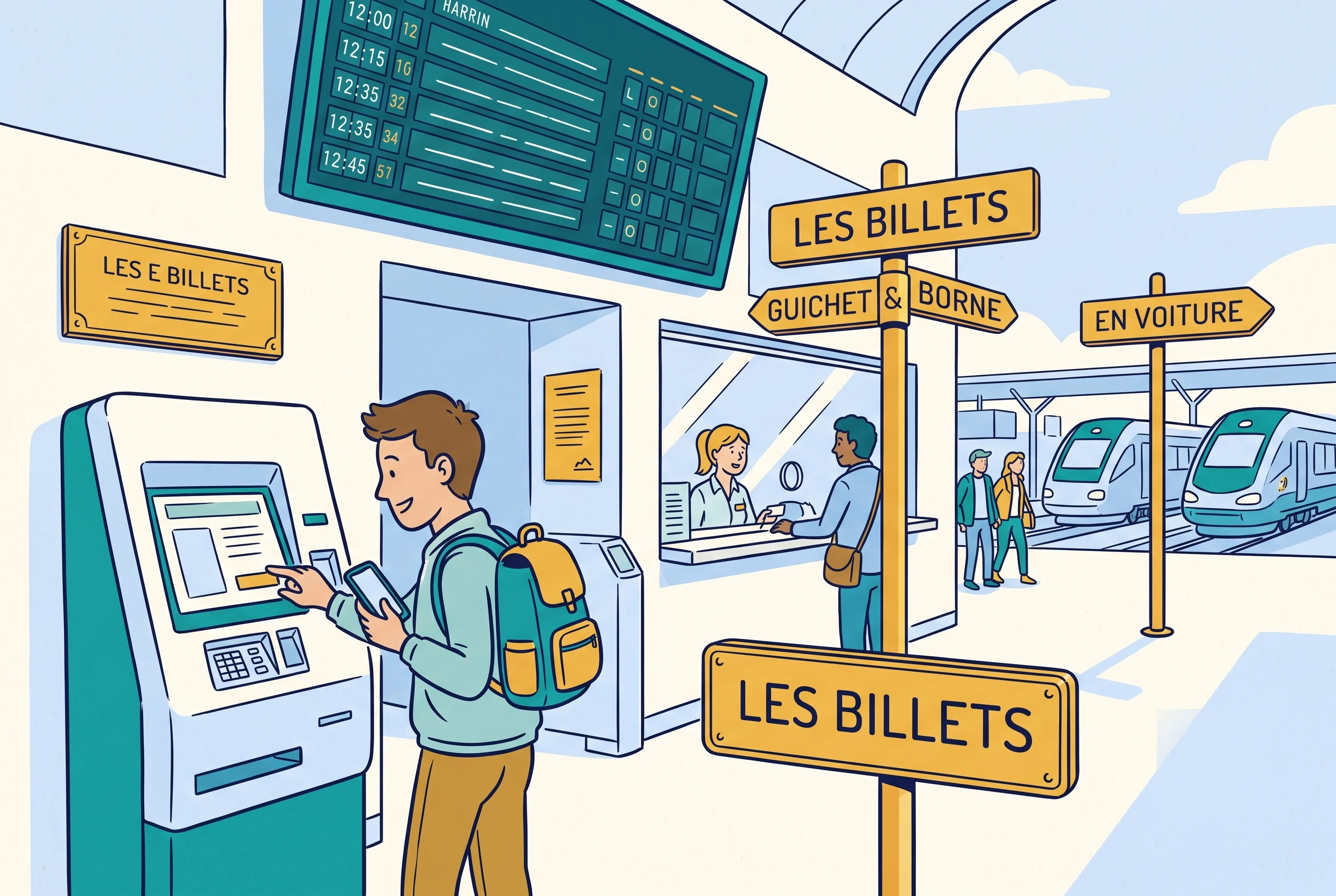
The phrases help you ask about a journey and understand station information. Ticket conditions differ, so confirm the fare rules before paying and check live departure information when travelling.
Put the whole request in one sentence: destination, date, one-way or return, class, seat, then s’il vous plaît. “Je voudrais un aller simple pour Lyon demain matin, s’il vous plaît.” The agent replies with a departure time and a price, and the only follow-up questions are usually your discount card and your seat preference.
On the machine the entire interface runs on six words: aller simple, aller-retour, départ, arrivée, valider, annuler. And since 2022 you no longer have to validate a paper ticket in the yellow box on the national network.
At the guichet: one sentence, everything inside
The counter agent expects your full request in a single phrase. Destination, date, one-way or return, class, seat. End with “s’il vous plaît.” That is not politeness decoration. Skip it and the interaction changes tone immediately. The politeness guide explains why this matters across every French interaction, not just trains.
Pack it into one line — destination, time and ticket type — and the agent only has to confirm the train:
On a TGV, “avec réservation” costs a few euros — skip it and you risk standing for three hours:
State the quantity first — agents default to “un” if you don’t:
What phrasebooks skip
Most guides teach “Je voudrais un billet” as the opener. Real agents do not wait for it. They see you approach and say “Bonjour, où allez-vous ?” Your rehearsed script just became irrelevant. Prepare to answer directly: “Lyon, demain matin, aller simple.” That is the real A1 skill. The shy beginners guide covers the freeze response this produces.
Ticket machine vocabulary: the buttons in French
Most SNCF machines offer English. But pressing the Union Jack feels like giving up, and the French menus teach you more than any textbook. The vocabulary is consistent across every borne in the country.
The first two buttons on the machine — “simple” is your friend at A1:
The machine asks for your departure first — type three letters and pick from the list:
Green confirms, red cancels — “Annuler” resets everything:
No discount card? Tap “Tarif normal” — choosing “réduit” without one just loops you back:
Newer machines are contactless; older ones want the chip inserted:
Speed tip. Use the physical keyboard below the screen to type your destination. Three times faster than the touchscreen letters. Most travelers do not notice it exists.
Which train you are actually buying: TGV INOUI, OUIGO, INTERCITÉS, TER
The sentence you say at the counter barely changes. The ticket behind it changes a lot. France runs four different products on the same rails, and the one you pick decides whether your seat is guaranteed, whether the price moves between now and Friday, and how much luggage you can carry before somebody charges you again.
| Train | What it is | Reservation | Price behaviour |
|---|---|---|---|
| TGV INOUI | The standard high-speed service, full comfort, bar coach, power at every seat | Mandatory, coach and seat printed on the ticket | Climbs as the train fills. Booking early is the whole strategy. |
| OUIGO | The low-cost high-speed brand. Same tracks, same speed, service stripped out | Mandatory, with strict luggage limits | Very cheap early. Extras add up fast. |
| INTERCITÉS | Classic long distance on conventional lines, often the only option to smaller cities | Mandatory on most routes | Moderate and far less volatile than TGV. |
| TER | Regional trains, run by each région, the workhorse of everyday France | None. Sit where you like | Fixed. The same price on the day as a month ahead. |
This is the question that quietly saves you money, and almost no phrasebook teaches it:
And the follow-up, because a TER never needs booking and a TGV always does:
OUIGO is not a discount TGV, it is a different contract. One cabin bag and one small personal item travel free. Anything beyond that carries a supplement, and staff do check it at the platform door. With two suitcases on a long trip, the OUIGO you chose can finish more expensive than the INOUI you skipped. The French SIM card guide covers the same trap in mobile plans: the headline price is rarely the price you pay.
Discount cards: which one pays for itself
SNCF sells two national cards and the arithmetic is simple enough to do standing in the station. The Carte Avantage costs 49 euros a year in all three versions, Jeune for 12 to 27, Adulte for 27 to 59, Senior for 60 and over. It takes 30% off TGV INOUI and INTERCITÉS fares and caps the price on long journeys. Two return trips usually cover the cost, which is why so many French travellers carry one without thinking about it.
The Carte Liberté costs 349 euros a year and is built for people who travel for work. It buys flexibility rather than a discount: exchange and refund without penalty, and a large reduction on the flexible fares that otherwise cost a fortune. If nobody is reimbursing your travel, it is almost never the right card.
The agent asks this before quoting a price, so have the answer ready rather than assembling it mid-sentence:
If you do not, say it plainly. “Tarif normal” is the exact phrase used on the machine and at the window:
Neither national card works on OUIGO. OUIGO prices sit outside the discount system entirely. Separately, each région runs its own TER cards and monthly passes, which are worth asking about if you are staying put for a season rather than crossing the country.
Buying online in French: the five fields that trip people up
SNCF Connect will switch to English in one tap, and switching costs you the vocabulary you are going to need at the station anyway. The form is short. Five fields do all the work, and two of them are where English speakers stall.
- 1Départ / Arrivée Type three letters and pick from the list. “Paris (toutes gares)” means every Paris station, which is what you want unless a specific terminus matters to you.
- 2Aller simple / Aller-retour One-way or return. On regional trains a return is often cheaper than two singles. On TGV the two are usually identical.
- 3Voyageurs The passenger block, where you declare ages and any discount card. Declare it here or the price you are shown will not include it, and the counter cannot retroactively fix a ticket you have already bought.
- 4Échangeable / non échangeable The fare condition, printed next to the price. The cheapest fares are locked. This single word is the difference between rebooking for free and buying a second ticket.
- 5Billet électronique The e-ticket. Download it before you leave wifi. Station signal is unreliable and a flat battery is not an argument the controller accepts.
If the site refuses your foreign card, and it happens often enough to plan for, this is the sentence you take to the window:
Seats and coaches: côté fenêtre, côté couloir
Seat preference uses “côté” (side). Window is côté fenêtre. Aisle is côté couloir. That is the entire system. No complicated grammar. The tu/vous guide applies here: use vous with the agent, always.
At the counter, ask for the seat you want — on a TGV Duplex the upper deck has the better views:
Prefer the aisle? “Couloir” is pronounced /kulwaʁ/, not “cool-war”:
Say “seconde”, not “deuxième”, for a train class — “deuxième” marks you as a textbook speaker:
The TGV needs a reservation; the TER doesn’t — knowing which saves you money:
Platform numbers and ticket validation
The departure board says voie 14. The platform sometimes changes ten minutes before departure, announced in French only. The pronunciation guide covers the liaison and chunking skills that make station announcements comprehensible.
Ask for the “voie” (track), the number shown on the board — not the “quai” (the physical platform):
Double-check on the platform — French commuters answer this reflexively:
Your ticket says “voiture 12, place 43” — “voiture” is the coach, “place” the seat:
Composter: the rule changed, and most guides did not
Validating your ticket in the yellow box is no longer required on the national network. SNCF dropped the obligation in 2022 and has been pulling the machines out since, because a regional ticket is now valid for the day it is bought and the controller’s check counts as the validation. E-tickets and QR codes never needed it at all. Two exceptions survive: a few regional networks kept the habit, and Transilien tickets around Paris still have to be validated at the gates. If you are holding paper and there is a working yellow box in front of you, using it costs three seconds and settles the question. The moving to France guide covers the wider administrative vocabulary where outdated rules survive in guidebooks the same way.
On board: the contrôleur and the four exchanges you will actually have
Ticket checks happen mid-journey without warning, and the vocabulary is small enough to learn in one sitting. The controller walks the aisle repeating one phrase, and that phrase is your cue to get your phone out.
This is what you hear, usually twice, moving down the coach:
Say this while you unlock the screen. It buys you the four seconds you need:
If somebody is sitting in your reserved seat, this is the entire confrontation. It stays civil because the ticket settles it:
And the sentence that turns a fine into a conversation, which is worth more than any other phrase here:
Brisk is not hostile
A French controller says “merci” flatly, hands the ticket back, and has moved on before you finish smiling. English speakers read this as coldness roughly every time. It is the same neutral service register you meet at the bakery counter and the post office, and it applies to everyone in the coach equally. The guide on why French people do not smile at strangers unpacks where that register comes from and why it is not about you.
When plans break: delays, changes, missed connections
Trains get delayed. Connections get missed. This is where A1 vocabulary meets real pressure. The phone call guide covers the same pressure in voice-only situations.
Drop the inversion and just let your intonation rise — it sounds more natural:
“Puis-je” is formal, and formal is right with a busy, stressed agent:
It depends on the fare — Prem’s tickets aren’t refundable, flexible ones are:
Miss a connection because of a delay? This one line gets you rebooked free at the guichet — the SNCF owes you the next train:
The SNCF Connect app shows delays and platform changes in real time. Set it to French. The notification vocabulary reinforces exactly what you hear in the station. The café guide covers the waiting time between trains.
Study glossary: French train vocabulary
| 🇫🇷 French | 🇺🇸 English | 💡 Context |
|---|---|---|
| Guichet | Ticket counter | Full request in one sentence |
| Borne | Ticket machine | Self-service, 24/7 |
| Aller simple / aller-retour | One-way / return | Counter, machine, or app |
| Première / seconde | First / second class | “Seconde” not “deuxième” on trains |
| Réservation | Reservation | Mandatory TGV, optional TER |
| Tarif normal / réduit | Full price / discount | Need a valid card for réduit |
| Voie | Platform/track | Can change late. Check the board. |
| Voiture / place | Coach / seat | “Voiture 12, place 43” |
| Côté fenêtre / couloir | Window / aisle | The only seat preference system |
| Composter | Validate | Paper TER only. E-tickets never. |
| Retard | Delay | “Le train est en retard ?” |
| Correspondance | Connection | “Ma correspondance est ratée” |
| Échanger / remboursement | Exchange / refund | Depends on fare type |
| Contrôleur | Ticket inspector | “Contrôle des billets s’il vous plaît” |
| Carte Avantage | Discount card | 49 euros a year, 30% off TGV |
| Échangeable | Exchangeable | The fare condition that matters most |
| Supplément | Surcharge | OUIGO luggage, late reservations |
| Grève | Strike | “Il y a une grève demain ?” |
The guichet is one interaction. The restaurant guide covers the seated version. The bakery guide covers the fastest version. The Paris survival guide covers all of them together.
Questions people ask before their first French station
What is the one sentence I need at the SNCF counter?
“Je voudrais un aller simple pour [city] [day], s’il vous plaît.” That covers destination, ticket type and date, which is everything the agent needs to run the search. They come back with a time and a price, then ask about your discount card and your seat. If you only memorise one line, memorise that one and let their questions pull the rest of the information out of you.
Do I still need to composter my ticket?
Not on the national network. The obligation ended in 2022 and the yellow machines are being removed. A regional ticket is valid for the day it is bought, and the controller checking it counts as the validation. Around Paris, Transilien tickets still have to be validated at the barriers, and a small number of regional networks kept the rule. Digital tickets have never needed it.
Is the Carte Avantage worth it for a two-week trip?
Often yes, and it is easy to check before you buy. The card costs 49 euros and takes 30% off TGV INOUI and INTERCITÉS. If your planned high-speed trips add up to more than roughly 165 euros at full fare, the card has paid for itself. Two returns between big cities usually clear that. It does nothing on OUIGO and nothing on regional TER fares, so a trip built around cheap regional trains will not benefit.
Can I buy tickets without speaking any French?
Yes. Every machine offers English, the app offers English, and counter agents in large stations generally manage. The reason to use French is not necessity, it is that the station is the easiest place in the country to practise. The exchange is short, scripted, and the other person wants it over quickly too. Nobody is grading your accent while a queue builds behind you.
What is the difference between voie and quai?
The voie is the track number, and that is the number on the departure board and in the announcements. The quai is the physical platform, which can serve two tracks. Ask for the voie. It is the number that identifies your train, and it can change ten minutes before departure with the change announced in French only.
My train was late and I missed my connection. What do I do?
Go to the counter rather than the machine and say “Ma correspondance est ratée à cause du retard.” When the delay is SNCF’s, you are rebooked onto the next available train at no cost, and this is routine rather than a favour you are asking for. Keep your original ticket, because it is the proof that puts you in that category.
Prefer to keep it free today? Read the French Briefing →
The French Gamebook
Practise the French behind everyday exchanges.
For English speakers practising French
Work on common mistakes before your next conversation. Play a Gamebook round, check the answers and try saying a few corrected sentences aloud.
- 21 lessons with explanations
- 40 practice rounds · 2,000 questions
300 pages · Play on your computer or print
Get the Gamebook · $9 Read a preview before you buyOne payment · Instant PDF download
Try the French with someone who can reply.
Bring a sentence you found difficult. Ask a tutor to help you say it naturally, then try it in a short conversation.
Find a French tutor →Paid lessons. Compare tutors and prices before booking.
Affiliate link: we may earn a commission when you book.
📚 Keep building in the Learning Center
French Travel Phrases for Hotels, Shops and Cafés
Practise French travel phrases for hotels, cafés, shops and transport. Learn follow-up replies and polite ways to ask…
Read →French Phone Call Phrases: Answer, Ask and Clarify
Prepare for French phone calls with phrases for answering, asking for repetition, leaving voicemail and ending a call,…
Read →French Café Etiquette: Ordering, Prices and the Bill
Learn how to order in a French café, read service-area prices and ask for the bill. Compare practical…
Read →