
Updated on September 15, 2026
Québec French vs France French: Key Differences
Compare Québec and France French pronunciation, vocabulary and everyday expressions. Learn what changes and choose practice for your destination.
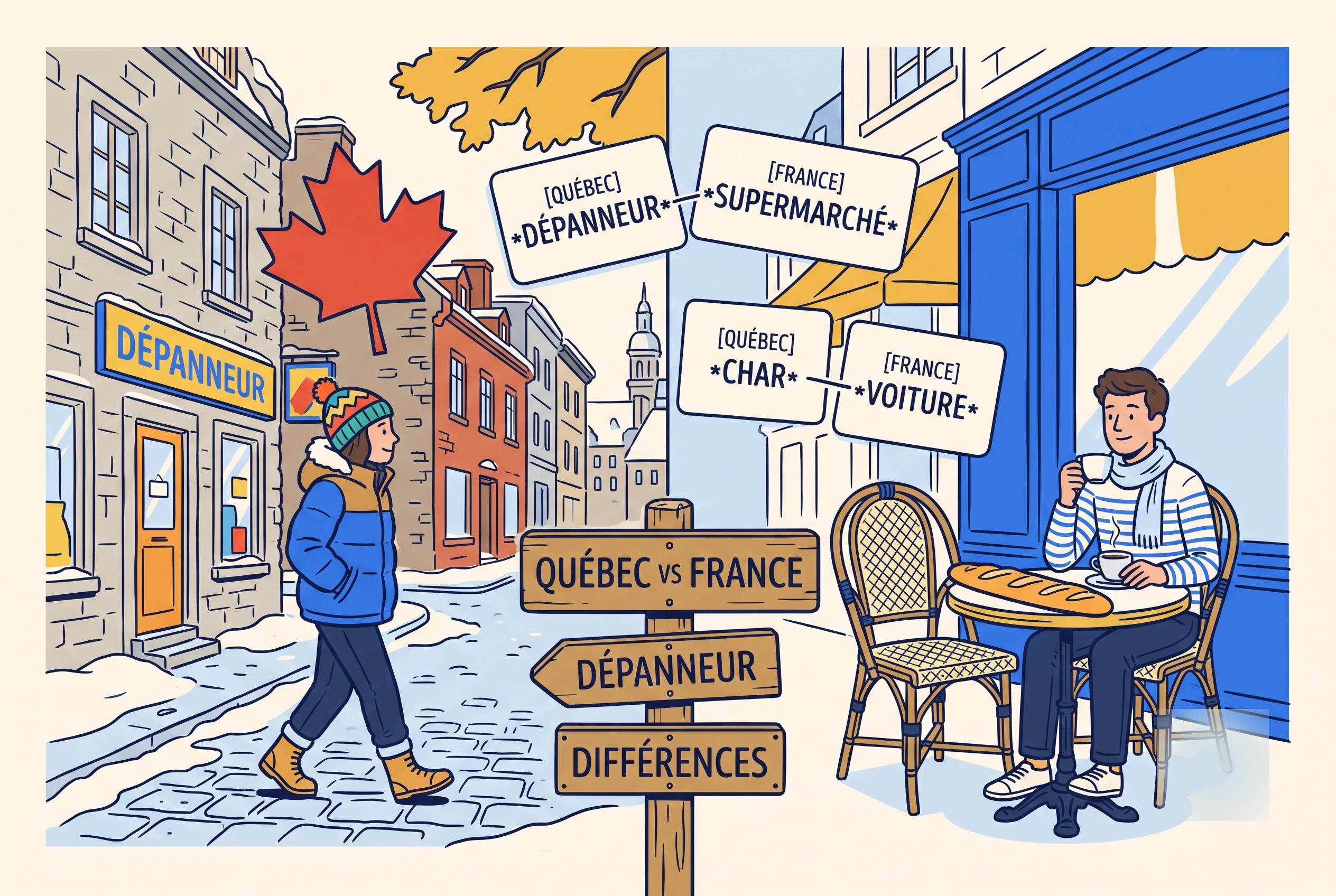
The most useful differences depend on where and with whom you will speak. Start with the sound and vocabulary comparisons, then listen to people from your destination rather than trying to imitate every feature at once.
Most learners assume the topic is really about accent. Accent is the part you notice, but it is not the part that trips you. The friction comes from familiar grammar arriving inside unfamiliar sounds, local words, and a different social rhythm all at once. That is why someone who handles standard French materials comfortably can still feel lost in Quebec after two minutes of ordinary conversation. The grammar they learned is all still there. What changed is everything wrapped around it.
The mistake learners make first
They treat regional French as a small pronunciation detour. Wrong scale. The actual issue is stacked variation: accent, daily vocabulary, question patterns, formality, and culture all moving at once. That pile-up is what makes comprehension drop.
It also explains why the usual advice to “just get used to the accent” does so little. Accent is only one layer, and often the easiest to adjust to. The layer nobody warns you about is vocabulary: the words you already know are the ones most likely to mislead you, because they look familiar while meaning something else on the ground in Quebec.
Quebec French and France French have been diverging since the seventeenth century
The split is historical before it is pedagogical. French settlers brought older forms of French to North America in the seventeenth century. France kept evolving under centralization, schooling, and the spread of metropolitan norms. Quebec French developed under different pressure: distance from France, centuries of English contact, local cultural continuity, and its own rules of linguistic prestige. The result is not “broken French” and not a collection of slang exceptions. It is a regional variety with coherent habits and a stable oral identity.
Learners who move to Montreal with solid textbook French tend to say the same thing in week one: “I understand the grammar, I just can’t tell what people are doing with it.” They are right. The base is identical. It is the surface that has moved.
That history matters for learners because it changes how you should respond. If Quebec French were just “informal French,” the right strategy would be polishing your standard French. That is not enough. You need exposure to a different sound system and different lexical choices. The goal is not choosing a side forever. The goal is building a base strong enough to survive regional variation without collapsing into guesswork.
Quebec French pronunciation: what actually blocks comprehension
Most pronunciation advice online aims at the wrong target. It fixates on sounding native, when the real problem for a learner is decoding a stream of speech fast enough to keep the sentence alive in your head. Quebec French sounds harder at first because several features land at once: the vowels move more, some consonants come out sharper, and the rhythm sits further from the “international classroom French” most learners meet first.
| Feature | France French tendency | Quebec French tendency | Why learners stumble |
|---|---|---|---|
| Long vowels | More stable, flatter | More movement, sometimes diphthong-like | The word sounds longer than expected |
| t / d before high vowels | Cleaner release | Affrication more audible | tu or dire can sound like different words |
| Final consonants | Often lighter in flow | More often heard | Endings sound unexpectedly strong |
| Overall rhythm | Closer to standard broadcast French | Broader regional melody | You recognize the sentence too late |
In standard France-oriented listening, these often land as relatively flat vowels and clean consonants. In many Quebec voices, the same words can feel more open, more mobile, or carry a slight “ts” effect on tu and dire. The meaning has not changed. Your ear just has not been trained for that shape yet. Quebec French more often makes the final s in plus audible in contexts where learners expect it to disappear. One difference like that is easy. Ten in thirty seconds is where the listening load spikes.
Best rule for learners: do not try to imitate Quebec pronunciation first. Train recognition first. Comprehension before imitation. Always. Accent work becomes useful only after the sound system stops disrupting sentence tracking.
Once the accent gap starts to shrink, vocabulary becomes the real trap, because the words that cause the most confusion are usually the ones you were sure you already knew.
Quebec French vocabulary differences that change daily life
This is where regional variation becomes practical instead of academic. Transport, meals, relationships, shopping, and time expressions are full of words that diverge between Quebec French and France French. These are not niche literary differences. They affect the simplest interactions.
The most dangerous words are the familiar ones
Unknown words are manageable because your brain marks them as unknown immediately. Familiar-looking words are worse because you assign the wrong meaning too fast. That is how learners miss the whole sentence while feeling falsely confident for the first two seconds.
Here the cliché breaks down. In some areas Quebec is actually more institutionally French than France, having replaced borrowings that France simply kept.
In Quebec, blonde can signal the relationship directly. In France, it mostly signals hair color. Same language. Very different inference path.
The shift keeps going, one meal further down the day.
Never trust meal vocabulary by shape alone. If someone in Quebec says On se voit pour dîner ?, that usually means lunch. Learners who answer based on France French meaning often organize the wrong half of the day.
Quebec keeps forms that can sound completely new even when the idea is basic. Those are the moments where learners panic unnecessarily.
Regional French is never just a local word list. It changes what your ear predicts next. That is why literal translation habits make the whole problem worse. That same mechanism is exactly why direct translation creates specific mistakes that intermediate learners keep repeating.
Keep the core French on one page
You just saw how far everyday vocabulary shifts between Quebec and France, from cars to meals to greetings. Whichever variant you chase next, the shared foundations make the difference easier to hear: pronunciation, core tenses, numbers, and the tu versus vous logic both sides rely on. Enter your email and the free cheat sheet pack (nine printable sheets) downloads right away.
Expressions and grammar: where Quebec French feels like “another French”
This is the part learners remember emotionally. Not because the grammar is radically different, but because casual interaction starts sounding like a version of French they were never trained to decode fast.
The famous Quebec -tu question particle is one of the first markers learners notice. Not because it is difficult, but because nobody prepared them for it.
A counter in Montreal, first thing in the morning, and the greeting you rehearsed lands one register too high:
Quebec often lowers the threshold for informal interaction faster in daily life. Not always. Often enough that learners notice it immediately.
Tu and vous track relationship status more than politeness. Picking the wrong one does not just sound less formal; it quietly signals that you read the relationship differently than the other person does. That is why a regional shift in register lands harder than it looks.
If that social logic still feels unstable, it is the same problem from another angle. That is where the real logic of tu and vous becomes more useful than memorizing “formal” versus “informal.”
So which variant should you learn first?
For most learners, the best default is still France French. Not because it is superior. Because it is the most widely taught, most widely distributed in learning materials, and the easiest base for broad international use. If you do not yet know where French will matter most in your life, France-oriented standard French gives you the highest utility per hour invested.
Start with France French if…
Your goals are broad, academic, professional, or still undefined. It dominates textbooks, apps, exams, subtitles, and international teaching resources.
Prioritize Quebec exposure early if…
Your real life is in Quebec: work, study, family, relocation, or day-to-day services. Waiting until later creates a false sense of readiness.
Practice only pays off when the input matches the goal. Twenty minutes of Quebec listening does more for a future in Montreal than two hours of Parisian podcasts. You do not need to produce Quebec French from day one, but you do need Quebec input early enough that, when it finally matters, local speech does not feel like a second language you never studied.
- 1Pick one stable baseFrance French is the best default for broad use. Quebec-focused exposure should start early if Quebec is your real destination.
- 2Split the problem into layersAccent, vocabulary, and register are different listening problems. Treating them as one vague “dialect issue” slows progress.
- 3Train recognition before imitationSounding local is optional early on. Understanding local speech is not.
- 4Track the recurring blockersBuild a separate note page for regional sound shifts, lexical traps, and question patterns. That turns exposure into pattern recognition.
Can speakers from France and Quebec understand each other?
They can, but the plain “yes” hides the part that helps. Mutual understanding holds up well in careful speech, news delivery, and formal settings, and it frays in fast, casual conversation. That gap hits learners hardest, because they are still building automatic listening and leaning on standard reference French to fill in whatever they miss.
The bottom line
Quebec French and France French are not separate languages. They are two high-exposure regional varieties of the same language. The right strategy is not choosing one forever. It is building one stable base and enough repeated exposure to the other variety that it stops sounding alien.
If your broader issue is not just Quebec but authentic French more generally, the right continuation path is the Learning Center, where the same listening, grammar, and meaning shifts connect across topics instead of appearing as isolated problems. And if regional variety itself is what keeps pulling your comprehension off track, a parallel example sits in another French variety that creates the same kind of confusion for speakers from France.
Quebec French: quick questions
Is Quebec French hard to understand for France French speakers?
Not in careful or formal speech, where the two are easily mutually intelligible. The friction appears in fast, casual conversation, where the accent, local vocabulary, and the -tu question particle stack up at once. Learners feel it more than native speakers from France do, because they are still building automatic listening.
Is Quebec French just an accent?
No, and that is the usual mistake. Accent is the visible layer. The harder part is vocabulary (char, blonde, chum), the shifted meal names, and casual question patterns like Ça va-tu ?. Treating it as “just an accent” is why comprehension drops even when every individual word is simple.
Should I learn Quebec French or France French first?
For most learners, France French is the better default: it dominates textbooks, apps, exams, and international materials, so it gives the most use per hour. Start with Quebec exposure early only if your real life is in Quebec through work, study, family, or relocation.
Why does Quebec say déjeuner for breakfast?
Quebec kept the older meal names, so each one points one meal earlier than France French: déjeuner is breakfast, dîner is lunch, and souper is dinner. Belgium and much of Switzerland use the same system. If you answer on dîne ? on the France French meaning, you can plan the wrong half of the day.
Is Quebec French “worse” or “broken” French?
No. It is a full regional variety with its own coherent habits and a stable oral identity, shaped by older French forms, distance from France, and centuries of English contact. In some areas it is even more institutionally French than France, using stationnement where France borrowed parking.
Prefer to keep it free today? Read the French Briefing →
The French Gamebook
Catch the French mistakes you keep making.
For English speakers practising French
Work through a short lesson, choose your answers and check the explanations. Use a practice round to see which basics need another try.
- 21 lessons with explanations
- 40 practice rounds · 2,000 questions
300 pages · Play on your computer or print
Get the Gamebook · $9 Read a preview before you buyOne payment · Instant PDF download
Try the French with someone who can reply.
Bring a sentence you found difficult. Ask a tutor to help you say it naturally, then try it in a short conversation.
Find a French tutor →Paid lessons. Compare tutors and prices before booking.
Affiliate link: we may earn a commission when you book.
📚 Keep building in the Learning Center
French Reflexive Verbs: Daily Routine and Word Order
Build a daily routine in French with reflexive pronouns, negatives and infinitives. Compare translated examples, listen and practise.
Read →Futur Proche vs Futur Simple: Examples and Practice
Compare futur proche and futur simple in French plans, promises and announcements. Learn the forms and practise choosing…
Read →French Reported Speech: Tenses, Pronouns and Time
Report speech in French while keeping the speaker and time clear. Compare tense shifts, indirect questions and requests…
Read →