
Updated on September 15, 2026
French Travel Phrases for Hotels, Shops and Cafés
Practise French travel phrases for hotels, cafés, shops and transport. Learn follow-up replies and polite ways to ask for help, with audio.
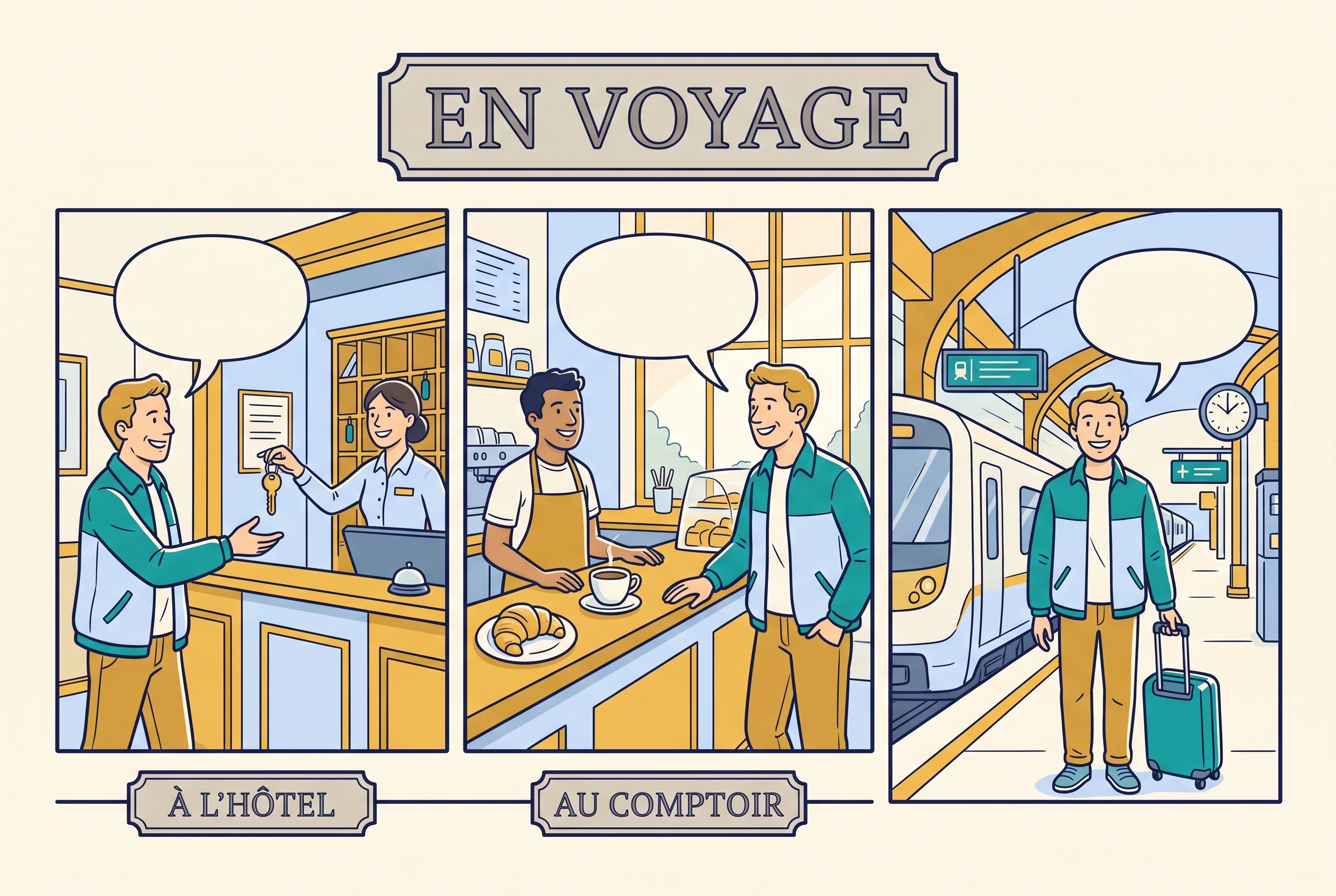
Knowing your first sentence is only part of a travel exchange. Work through the situations you expect to encounter, including the reply and a way to ask for clarification when you miss something.
The gap between textbook French and what regulars actually say
In an American hotel lobby you walk up to the desk and state what you need, plainly. Clear, quick, friendly. The sentence works because efficiency reads as respect. Move that same sentence into French, word for word, and it lands as an instruction, which is the second the person behind the desk decides to answer you in English. They switched because of the shape of the sentence, not the accent.
Three habits separate a traveller who gets answered in French from one who gets answered in English. None of them is a word you are missing.
The first is the softener. French requests travel in the conditional, and that conditional is doing real work: it turns a declaration of what you want into a question the other person is allowed to answer. Drop it and you have not been rude, exactly. You have been abrupt, in a country where abrupt is expensive.
Here is the same check-in said two ways, thirty seconds apart, at the same desk:
The second habit is that the greeting is welded to the request rather than added to the end of it. That rule already has a page of its own here, written for a first trip to the capital, and this article deliberately starts where it stops: the survival phrases for visiting Paris get you understood. What follows is the next problem, and it is not a Paris problem. It is a hotel in Colmar, a market in Sète, a station counter in Nantes.
The third habit is size. Regulars speak in fragments, and the complete grammatical sentence you were taught is the thing that marks you out fastest:
So why does a sentence that is technically correct still get answered in English, in a country that supposedly rewards the effort? Give it a second. It is the length. A regular asking for a table spends six words and one conditional, which is why this works in any brasserie in the country:
One small mechanical thing changes everything about how you sound. Spoken French swapped nous for on a long time ago. Say nous pouvons payer par carte and you sound like a printed document. Say this and you sound like the couple at the next table.
Context beats grammar. Every time.
Checking in without sounding like a form
Hotel French is the easiest of the six situations here and the one travellers rehearse least, because the booking was made online and everything feels already said. It is not. The desk still asks you three things, and the difference between a fine room and a good one is usually settled in the first minute after you walk in.
Start with the name, never with the paperwork:
Then the question almost nobody asks, the one that moves you off the street side of the building. Ask it while the plan is still open on the screen, before the key reaches your hand.
French hotels describe their rooms by which way they face. Côté cour is the courtyard. Côté rue is the street with the scooters on it.
Two other lines carry the rest of the stay. The first buys you the afternoon of your departure day. The second is the honest way to say that something is broken:
Un petit souci is the most useful noun in French hospitality. It downgrades a complaint into a shared inconvenience and keeps the person hearing it on your side. Un problème puts them on the defensive before you have said what is wrong.
The messages that reach us every September are never about vocabulary. They are about one moment: the second the receptionist turned, and the sentence came out in the wrong order.
Test it on a Tuesday, not on arrival day
Pick one ordinary morning of the trip and run three of these lines before noon: the check-in line, the café line, the one that asks for the bill. Arrival day is a terrible judge, because you are tired and everyone at the airport speaks English anyway. What you want on that Tuesday is one page you can hold in one hand, which is what the survival phrases sheet is: hotel, café, shop, station and pharmacy lines on a single sheet, in your inbox the moment you ask for it.
Ordering at a café or a restaurant like someone who comes back
Ordering is where most phrase lists stop being useful, because they teach the transaction and skip the sequence. A café has its own etiquette, set out in the rules that decide whether you stand at the counter or sit in the room, and a restaurant table has another. The lines below work in both.
Je voudrais is correct and slightly formal. A regular announces a decision instead of expressing a wish, and the difference is audible.
Water next, and this is the line that quietly saves money on every trip. Since January 2022, any place serving food or drink on the premises has to give its customers drinking water at no charge, in a carafe, with glasses, and say so on the menu or on a visible sign. Une carafe d’eau is not a downgrade. It is the default, and nobody at the next table reads it as thrift.
Then the false friend that has ruined more meals than bad cooking. Fini attached to a person means finished in the terminal sense, and the waiter hears exactly that:
It belongs to a whole family of words that look English and are not, and the ones that misfire at a table are the most memorable of the lot.
The bill does not arrive on its own, and nothing is pending while you sit there. Service has been inside the displayed price since a 1987 order on price display in places serving meals and drinks, so the table stays yours until you ask for it. Six words do the asking.
Booking ahead is a separate script with its own traps, and the reservation call is where most of them live. In the room itself, one line lands better than the coins you were about to leave, and both are optional:
Shops, markets, and the polite way to complain
A French shop is not self-service in the social sense. You are greeted on the way in, the greeting requires an answer, and silent browsing is the point where a visitor becomes rude without ever being told. The answer is three words long.
At a market stall the quantity travels with an instruction, because the person is about to cut it in front of you and would rather not guess:
Complaining is a register problem before it is a vocabulary problem. The English reflex states the fault and asks for money back. The French sequence names the issue, proposes the smallest possible remedy, and lets the shop offer more of its own accord.
Opening hours are the other thing to ask out loud, especially away from the cities, where a shop can shut at midday and reopen once you have driven to the next town:
Getting around: the travel phrases that work at a station counter
Counter French is fast, and it is the only situation here where the person you are speaking to is also measuring the queue behind you. Destination first, ticket type second, then stop talking. The full ticket window script has the variants; this is the sentence that opens it.
Two follow-ups handle the rest of the journey. One is for the moment the board has not decided yet. The other is what you say on a bus so the driver actually stops:
In a taxi, only one line is worth rehearsing, and it is the one that ends the ride where you meant it to end:
Emergencies and the small humiliations nobody prepares you for
Most of what goes wrong on a trip is not an emergency. It is a moment of not understanding, in public, with someone waiting. Two sentences handle nearly all of it, and the gap between them is the gap between closing a conversation and keeping it open.
Je ne comprends pas is a full stop. It tells the person that French has failed and English is next. This one asks for a repair instead, and it buys you a second attempt.
Same logic when you introduce your own French. Announcing that you do not speak it hands the entire exchange to the other person, permanently:
Then the real ones. The European emergency number 112 works from any phone in France and reaches an operator who routes the call to the right service. Below that threshold, the pharmacy is the first door to try, and the counter vocabulary for describing a symptom is worth reading before you need it rather than during.
The apology system is the other thing that catches Americans, because it runs on frequency rather than warmth, and the instincts that misfire hardest are the generous ones. Same mechanism as the greeting: sequence first, accuracy afterwards.
Bumping someone, interrupting, taking the wrong seat. Say pardon and move on. Not fluency. Sequence.
None of that starts a conversation, though, and the conversation is the part travellers come home wishing they had managed.
Starting a conversation you did not have to start
Everything above is transactional. The trip changes at the point where you say something nobody required, and French makes that easier than English does, because the openers are short and formulaic. Nobody is expecting a paragraph from you.
This one works anywhere, from a market stall to a chairlift queue:
And this one works on anyone who makes the thing they are selling. It is a compliment disguised as a question, which is how a two-minute bakery stop turns into four minutes about flour.
A reader driving through the Cantal last spring counted four exchanges in one day where the switch to English arrived before his second word. On the fifth he opened with the weather instead of his order, and it did not happen again.
Introductions have far more range than the single line everyone learns, and what you say straight after your name decides whether the conversation continues or politely dies.
Leaving has its own line, and it is the one people remember you by:
Between trips the vocabulary goes stale, which is the honest limit of any phrase list including this one. The daily French Briefing runs on real stories instead of travel scripts, and that is where this kind of language keeps renewing itself.
Your French travel phrases cheat sheet
Thirty lines, in the order the trip hands them to you: the desk, the table, the shop, the counter, the moment something goes wrong. Each French line stands on its own, because nothing that needs assembling under pressure survives it.
| 🇫🇷 French | 🇺🇸 English | 💡 Context |
|---|---|---|
| Bonjour | Hello | First, always, before anything else you intend to say |
| Bonne journée | Have a good day | Closes a daytime exchange; bonne soirée once the evening has started |
| Je voudrais | I would like | The conditional that turns an order into a request |
| Je vais prendre | I will have | What a regular says when the decision is already made |
| Vous auriez | Would you have | Leaves the other person room to say no |
| C’est possible de | Is it possible to | The softest way to ask for a favour |
| On peut | Can we | Spoken French uses on, not nous |
| Pardon | Sorry, excuse me | For bumping into someone and for interrupting one |
| Excusez-moi de vous déranger | Sorry to bother you | Opens a question to a stranger who is busy |
| J’ai une réservation | I have a booking | The hotel desk opener, before the passport comes out |
| Une chambre pour deux nuits | A room for two nights | France counts nights, not days |
| Côté cour | Courtyard side | The quiet side; côté rue faces the traffic |
| Le petit déjeuner est compris ? | Is breakfast included? | Compris means already inside the price |
| Un petit souci | A small issue | How a complaint stays a request |
| La clé, s’il vous plaît | The key, please | Ask at the desk; many hotels keep it behind the counter |
| Le plat du jour | The dish of the day | Usually the fastest thing to arrive at lunch |
| Une carafe d’eau | A carafe of tap water | Free by law for customers eating or drinking in |
| Sur place ou à emporter ? | Eat in or take away? | You will be asked this; one word is a full answer |
| L’addition | The bill | It never comes until you ask for it |
| Service compris | Service included | Already in the displayed price, so a tip is a gesture |
| J’ai terminé, merci | I have finished, thank you | Never je suis fini, which means something far worse |
| Je regarde, merci | I am just looking, thank you | The required answer when a shop assistant greets you |
| Vous fermez à quelle heure ? | What time do you close? | Small-town shops often shut for a stretch at midday |
| Est-ce que je peux l’échanger ? | Can I exchange it? | The polite complaint, without the word refund in it |
| Un aller simple | A one-way ticket | Un aller-retour is the return |
| Quel quai ? | Which platform? | Quai on the ground, voie on some departure boards |
| Je descends au prochain arrêt | I am getting off at the next stop | Said out loud on a bus or a tram |
| La gare | The train station | Une station is a metro or bus stop, never a train station |
| Je n’ai pas compris | I did not catch that | Keeps the exchange alive, unlike je ne comprends pas |
| Vous pouvez répéter plus lentement ? | Could you say that again more slowly? | The single most useful sentence of the whole trip |
Late afternoon in a village in the Aveyron, the shop is minutes from closing and the woman behind the till is counting coins into the drawer. You come in, say bonjour, ask for two peaches and what time she shuts. She answers in French, at normal speed, and puts a third peach in the bag without mentioning it.
Prefer to keep it free today? Read the French Briefing →
The French Gamebook
Practise the French behind everyday exchanges.
For English speakers practising French
Work on common mistakes before your next conversation. Play a Gamebook round, check the answers and try saying a few corrected sentences aloud.
- 21 lessons with explanations
- 40 practice rounds · 2,000 questions
300 pages · Play on your computer or print
Get the Gamebook · $9 Read a preview before you buyOne payment · Instant PDF download
Try the French with someone who can reply.
Bring a sentence you found difficult. Ask a tutor to help you say it naturally, then try it in a short conversation.
Find a French tutor →Paid lessons. Compare tutors and prices before booking.
Affiliate link: we may earn a commission when you book.
📚 Keep building in the Learning Center
French Phone Call Phrases: Answer, Ask and Clarify
Prepare for French phone calls with phrases for answering, asking for repetition, leaving voicemail and ending a call,…
Read →Introduce Yourself in French: Phrases for Real Situations
Learn French introductions for social and professional situations. Compare formal and informal wording, follow-up questions and example templates.…
Read →Montmartre in French: Walks, Cafés and Useful Phrases
Explore Montmartre with French phrases for directions, cafés and art. Follow a walking outline and learn vocabulary for…
Read →