
Updated on September 15, 2026
Where to Retire in France: Five Regions Compared
Compare five French regions for retirement by daily life, transport, climate and language. Find questions to ask before choosing an area.
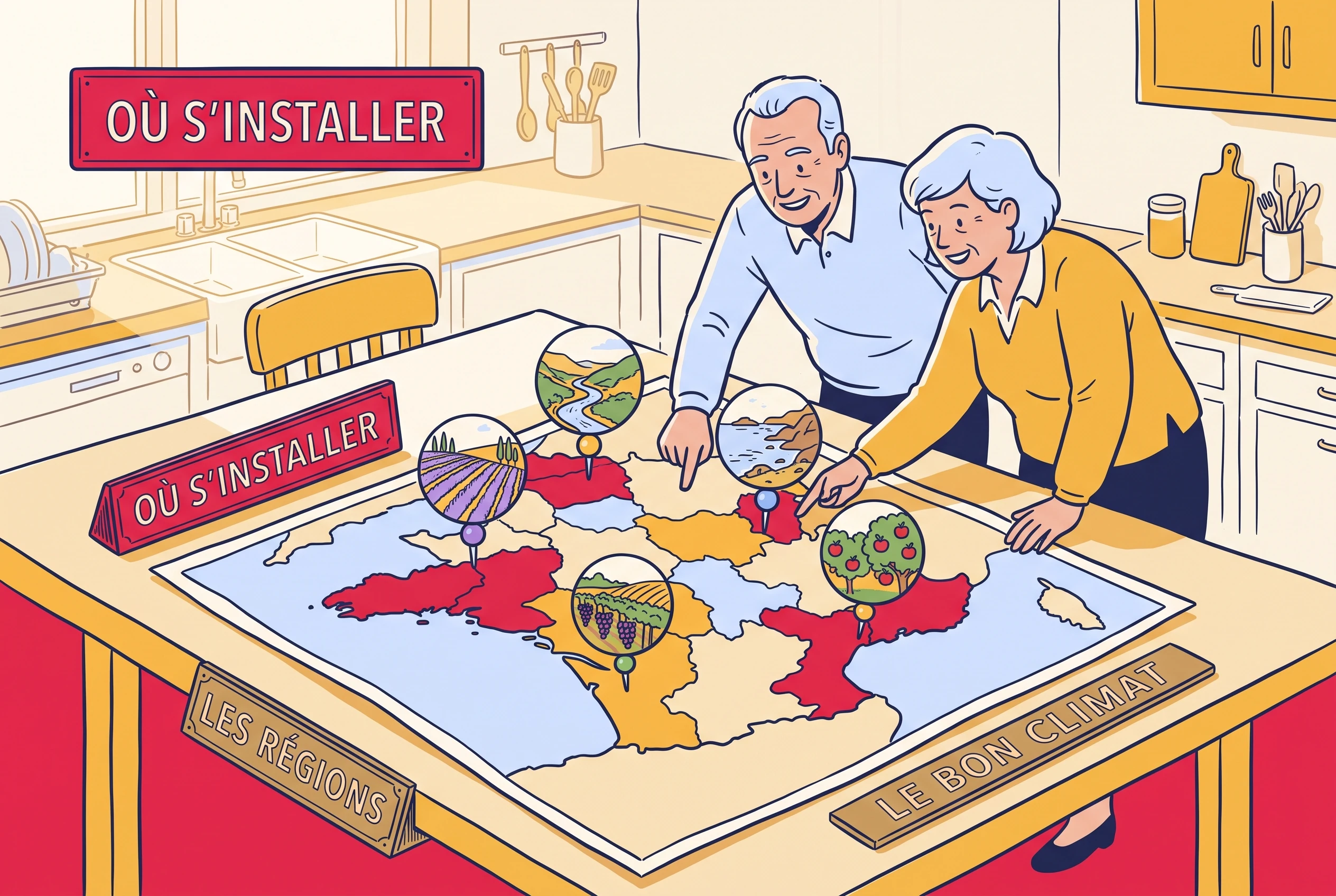
A region that suits a holiday may be less convenient for everyday life. Compare practical trade-offs first, then use the language notes to prepare questions for a visit outside the tourist season.
Four criteria that decide the best places to retire in France
Every regional ranking written in English runs the same three columns: sunshine, price per square metre, and how many retired anglophones got there first. A fourth column decides more than those three combined and appears in none of them. Which French is spoken here, at what speed, and whether the speaker switches to English the moment they hear your vowels.
Cost filters everything else, so it goes first. The national rent map published by the housing ministry and the ANIL estimates an advertised rent per square metre for every commune in France, charges included, autumn 2024. On the ninety-two square metre house it uses as a yardstick, that runs from roughly ten dollars a square metre a month in Bayeux or Eymet to roughly twenty-two in Aix-en-Provence, at $1.16 to the euro. Nine hundred and fifty dollars a month against two thousand, same country, same doctors, same trains.
Second, the French itself. France has one official language and a shelf of regional ones, and none of them competes with French at the bakery counter. What they leave is residue: in the vowels, in the rhythm, in the place names you say out loud to a taxi driver at eleven at night. A retiree in the Aude and a retiree in the Manche learn the same grammar and hear two different soundtracks.
Third, who else lives there. INSEE counted 148,300 British residents in France in 2016, 43 percent of them in Nouvelle-Aquitaine or Occitanie, more than a third retired. No equivalent map exists for Americans, which is worth saying plainly: when a guide promises a big expat community, the community counted is British, and the count is a decade old.
Fourth, the two distances that start to matter after seventy: the nearest university hospital, and the nearest airport that can put you on a plane to your grandchildren. Outside Paris, Nice is the only French airport with regular nonstop service to the United States, so for everybody else the question is how long the first leg takes.
Agents expect the hospital question, and it settles more than the kitchen does.
Ask it in the office rather than in the car. An agent with a screen gives you kilometres. An agent at the wheel gives you a shrug.
The budget line lands better with a second half attached to it.
Same budget, different pile of keys on the desk. Twice a year somebody writes to tell us they bought in a village of four hundred people and found out afterwards that the doctor had retired in March.
Your French should serve your life. Which makes the region the one part of the syllabus you cannot swap out later.
Provence: where every syllable is still pronounced
Southern French keeps what northern French throws away. The final e that Paris swallows is still spoken across the Midi, nasal vowels end on an audible consonant, stressed vowels are stretched. Linguists have measured it: the realised schwa is the single most characteristic trait of the meridional accent. At A2 that is a gift, and no guide sells it as one. «Une petite maison» reaches you as seven separate syllables instead of four. You get time.
It is also going. The same research records younger speakers drifting towards the northern rate, which makes the gift generational rather than geographical: your neighbour of seventy-five hands it to you, her grandson does not.
Provence is the expensive end of this page. A house in Aix-en-Provence comes out near twenty-two dollars a square metre a month, Arles near fourteen, and forty minutes of driving separates those two figures. Marseille has one of the largest hospital groups in the country, an airport half an hour out, and a TGV that reaches Paris in about three hours.
Shade is a specification here rather than a preference, and it belongs in the brief you give an agent.
Plain-pied means no stairs, and it is the one word that shortens a French property search after seventy. Half the listings that match it never reach the English-language portals.
Then the sentence you will hear before you can parse it, on the first hard wind of October.
Shutters closed at two in the afternoon is not a village asleep. It is a village doing arithmetic on its electricity bill.
Village social life runs on one fixed appointment, and it happens in daylight.
Miss three Saturdays running and you have not been rude. You have quietly stopped existing, and reappearing takes a month.
In the Midi, «adieu» is how a conversation opens
Occitan uses adiu at both ends of a meeting and southern French kept the habit, so somebody calls «Adieu !» across a market stall and it means hello. That is the friendly version of a regional trap. The ordinary ones are duller and cost more: dates said out loud, the vous decision on a first doorstep, the numbers a viewing runs on. Our free cheat sheet pack puts nine reference sheets behind exactly those moments. Type an address and it downloads.
Dordogne, where the second language is English
So which of these regions actually teaches you French? Hold the question for a paragraph. The Dordogne answers it first, and the answer is uncomfortable.
INSEE counted 7,198 British residents in the department in 2016, one and three quarter percent of the population, and in absolute numbers second only to Paris. Around Eymet the share reaches nine percent of the bassin de vie.
The community is real, it is documented, and it is exactly the reason to think twice. There is a Saturday market in the Bergeracois where the queue conducts its business in English and nobody finds that odd. If your plan involves learning the language, a place where you never have to is a very pleasant trap with a view over a river.
The objection reaches us every February in the same words: the neighbours are lovely, the house is finished, eighteen months in and the French has not moved. That is rarely a study problem. It is the reflex of switching, and what actually stops beginners from opening their mouths is worth reading before you sign anything here.
Which leaves one sentence to rehearse, since in this department it decides whether you learn anything at all.
Nobody takes offence. What you get is relief on both sides and a slower conversation, which was the entire point.
Distances here are described in minutes. Kilometres are for forms.
Fifteen minutes to the bourg means fifteen minutes to bread and a chemist. It also means fifteen minutes back, in January, in the dark.
Then the sentence that empties a village faster than any statistic.
The Dordogne has no university hospital at all. Périgueux hospital publishes its own distances: one hundred kilometres to the CHU in Limoges, one hundred and thirty to Bordeaux. No direct train to Paris either, roughly three and a half hours with a change at Bordeaux or Libourne.
What the isolation buys is space and a low bill: a house prices out near eleven dollars a square metre a month in Périgueux, near ten in Bergerac and Eymet. Whether a pension stretches that far is a separate arithmetic, and the income an American household has to show sets the floor before any region does.
Languedoc and Occitanie, cheaper, and audibly Occitan
Carcassonne comes out near ten dollars a square metre a month for a house, Béziers near thirteen, Montpellier near sixteen. This is where a modest pension stops feeling tight, the coast still forty minutes away at coastal prices.
The second language is more visible here than anywhere except Brittany. In 2020 the Office public de la langue occitane surveyed eight thousand people across Occitanie, the Occitan-speaking part of Nouvelle-Aquitaine and the Val d’Aran. Seven percent said they could hold a simple conversation in Occitan. Inside Toulouse Métropole the figure drops to two percent; in some departments it passes twenty.
Two percent is not a language you need. It is a language you see, and occasionally hear: on village signs carrying both names, in the Toulouse metro, where announcements run in French and then in Occitan, in words your neighbours use without flagging them. The accent is meridional, so the syllable bonus from Provence applies here too.
Regional French rewires small things and leaves the grammar alone, exactly the way the vocabulary that shifts once you cross into Belgium does. Nobody in Béziers will correct your conjugation. They will look puzzled at your word for a bread roll.
The word an agent uses for the inland half of a department has no clean English equivalent, and it moves the price by a third.
Arrière-pays is the hill country behind the beach towns, and it is where the arithmetic on this page works best.
One question settles a listing before you drive two hours to look at it.
That bill moves the real cost of a house more than the rent map suggests, and how French property tax is assessed and who owes it is the calculation to run before an offer, not after the notice lands in the autumn.
Some villages put the old name back on the sign underneath the French one, and new arrivals read it as decoration.
It is a municipal council vote, usually a contested one. Knowing that is worth more at a village dinner than a perfect subjunctive.
Brittany makes you pronounce Breton before French
The first Breton problem is not conversational. It is your own address. Plougastel-Daoulas, Locmariaquer, Trébeurden: French pronunciation rules decode none of those, because they are not French words, and the woman at the town hall will say yours at full speed.
Breton is Celtic rather than Romance, so nothing you know from Latin helps you guess. The Office public de la langue bretonne puts active speakers at around 225,000, plus 125,000 who understand without speaking, and the survey behind those numbers found the average speaker aged seventy. At the other end, 19,978 pupils were in bilingual streams in 2025, and in Finistère that is 22.3 percent of primary children.
Which reads like a language you will have to learn. You will not. Every counter, every surgery and every mairie works in French, and a retiree can spend thirty years in Quimper without one Breton sentence. What Breton occupies is the signage, the school gate and the names, and that tells you what the numbers cannot: here the second language is a live project rather than a heritage exhibit.
The French you actually hear is northern French at northern speed, schwas dropped, endings clipped. Harder listening than the Midi, and better training.
One question saves you from mispronouncing your own village for a year.
Ask a neighbour rather than a search engine. The neighbour also tells you which of the two local pronunciations marks a newcomer.
At the school gate, one sentence explains the bilingual signs faster than any leaflet.
Rennes is the expensive corner at around seventeen dollars a square metre a month for a house, Quimper and Brest near thirteen. Both have a university hospital, and the fastest TGV puts Rennes an hour and twenty-five minutes from Paris, the shortest link on this page by a wide margin.
Then the weather, which everybody mentions and nobody quantifies honestly.
Tide, weather and terrain come up in ordinary conversation far more than they do inland, and the French for what is actually outside the window earns its place in the first winter.
Normandy is two hours from Paris and used to Americans
Normandy is the one region here where the locals have been hearing American English every summer since 1945. The Normandy American Cemetery at Colleville-sur-Mer is the most visited of all the American Battle Monuments Commission sites, more than a million visitors a year, and the towns along that coast are organised around them.
Which cuts both ways, hard. In Bayeux or Sainte-Mère-Église a shopkeeper hears your accent and answers in English out of habit and courtesy. Twenty minutes inland nobody does, because nobody ever had to.
The anglophone population is thin by comparison with the south-west. INSEE counted 7,300 British residents across the whole of Normandy, 3,300 of them in the Manche and 1,500 in the Orne, against 1,400 in Calvados. One department in Nouvelle-Aquitaine holds roughly as many as five Norman departments combined.
No rival language competes for your ear. Norman survives in vocabulary and in place-name endings, and what reaches you in the street is standard northern French at speed, schwa gone, word endings swallowed. Nothing helps you and nothing distracts you.
Daily exposure is the only fix, and the cheapest version costs nothing: the free French Briefing puts one real French story in front of you every morning at a level you can hold.
Which makes one line worth carrying along that coast.
Said with a smile it works. Said flatly it sounds like a complaint about the service.
And the local distinction that decides whether an afternoon happens.
Bruine has its own rules. Rain cancels the garden, bruine does not, and saying so out loud is how you stop being a visitor.
Money and hospitals both favour Normandy. A house is near ten dollars a square metre a month in Bayeux and in Saint-Lô, near thirteen in Caen. Caen and Rouen both have a university hospital, and Caen reaches Paris Saint-Lazare in about two hours.
Two hours to Paris is two hours to a transatlantic departure board, which is the figure that matters when the telephone rings at six in the morning.
The best place to retire in France, five options side by side
Rents are the ministry and ANIL estimates for a reference house, advertised prices with charges included, autumn 2024, at $1.16 to the euro. Train times are the fastest scheduled services.
| Region | House, $ per m² per month | University hospital | Fastest train to Paris | What it does to your ear |
|---|---|---|---|---|
| Provence | $14 Arles to $22 Aix | Marseille, Nîmes, Montpellier | About 3 h from Marseille | Schwa pronounced, syllables separated: the gentlest listening in France, and fading |
| Dordogne | $10 Bergerac and Eymet, $11 Périgueux | None in the department, 100 km to Limoges | About 3 h 40, change at Bordeaux | Occitan underneath, but the working second language of the valley is English |
| Languedoc and Occitanie | $10 Carcassonne to $16 Montpellier | Montpellier, Nîmes, Toulouse | About 3 h 30 from Montpellier | Occitan on the signs and in the metro, seven percent speak it, southern accent |
| Brittany | $13 Quimper and Brest to $17 Rennes | Rennes and Brest | 1 h 25 from Rennes | Breton in the place names and the schools, French at northern speed |
| Normandy | $10 Bayeux and Saint-Lô, $13 Caen | Caen and Rouen | About 2 h from Caen | No rival language, fastest delivery here, English reflex along the landing beaches |
Which of the five is cheapest depends on whether you are pricing a rent, a property tax notice or a tank of diesel, and those three do not rank in the same order. That question deserves its own arithmetic on its own page.
None of this decides whether you are allowed to come. The pension statements, the private cover and the annual resources figure sit in what a retirement file has to show a consulate, the mechanics of the sticker in how a visitor visa is issued and then validated. Choose the region second and the file already knows its prefecture.
Every viewing trip ends on the same question, usually in the car park, usually with the keys back in the agent’s hand.
Answer it in French, badly, on the spot. The answer matters less than not reaching for English to give it.
The words a house hunt runs on
| 🇫🇷 French | 🇺🇸 English | 💡 Context |
|---|---|---|
| un plain-pied | a single-storey house | the word that shortens a search after seventy |
| l’arrière-pays | the inland country | said from the Mediterranean coast, never in the north |
| le bourg | the village centre | where the bakery, the chemist and the mairie are |
| une maison de village | a terraced village house | shared walls, no garden, cheapest to heat |
| un mas | a Provençal farmhouse | Provence only, and priced for the word |
| une longère | a long low farmhouse | Brittany and Normandy, one room deep |
| l’exposition | which way the house faces | the first thing a French buyer asks about |
| le viager | a sale against a life annuity | a French way of buying that startles Americans |
| la taxe foncière | the owner’s property tax | owed by whoever owns on the first of January |
| les charges | the service charges | quoted apart from the rent, and often forgotten |
| un désert médical | an area short of doctors | the phrase the local paper uses every spring |
| le pays | the local district | smaller than a department, older than the map |
| une résidence secondaire | a second home | in some villages, most of the street |
| le bassin de vie | the catchment area for daily life | the unit INSEE counts population by |
| la gare la plus proche | the nearest station | the figure that ages best of all of them |
A viewing in the Aude, the last week of February, three days of rain behind it. The agent works a shutter loose, says «une petite maison» into the cold, and all seven syllables land one after another with room between them. Outside, the canal is the colour of the sky and a man is repainting a boat that will not move before April. Nobody has said the price yet.
Prefer to keep it free today? Read the French Briefing →
The French Gamebook
Practise the basics behind clearer French.
For English speakers practising French
Review the common mistakes that can slip into your sentences. Use the Gamebook explanations and rounds alongside practice with your own emails and conversations.
- 21 lessons with explanations
- 40 practice rounds · 2,000 questions
300 pages · Play on your computer or print
Get the Gamebook · $9 Read a preview before you buyOne payment · Instant PDF download
Try the French with someone who can reply.
Bring a sentence you found difficult. Ask a tutor to help you say it naturally, then try it in a short conversation.
Find a French tutor →Paid lessons. Compare tutors and prices before booking.
Affiliate link: we may earn a commission when you book.
📚 Keep building in the Learning Center
Moving to France from the US: A Practical First-90-Days Plan
Your first 90 days in France involve overlapping tasks, from housing and banking to everyday conversations. Use this…
Read →French Health Insurance for Expats: The Vocabulary Behind the Paperwork
French health insurance arrangements for expats depend on status and circumstances. Distinguish eligibility, registration, evidence of cover and…
Read →Health Insurance for a France Long-Stay Visa: Read the Certificate and Ask Better Questions
Insurance for a French long-stay visa needs to match the instructions for your application. Compare certificates, dates and…
Read →