
Updated on September 15, 2026
French Texting Slang: 57 Codes and How to Reply
Decode 57 French texting slang terms and learn how to reply. Compare shorthand, emoji and register with translated messages and examples.
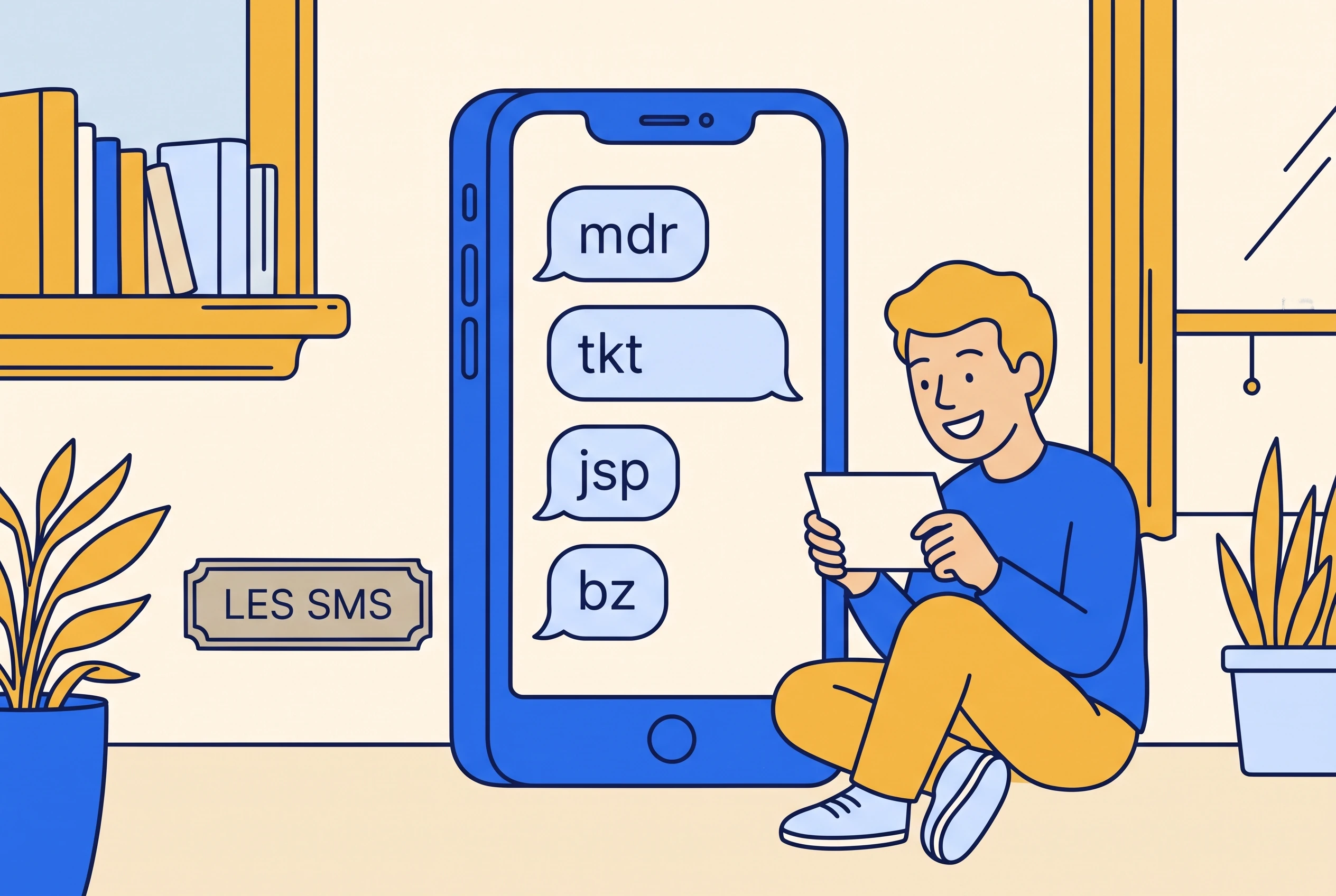
French messages often shorten sounds as well as words. Use the themed lists as a reference, then read the reply examples to see how the same code works in a conversation.
French texting slang is French written by ear
Open a French thread and the first thing missing is the vowel. « slt », « bcp », « tjrs », « rdv ». The accent goes next, and that one carries further than it looks: « ca va » and « ça va » are the same message, and only one is spelled the way the word sounds.
Two operations do most of the work. Vowels come out until a skeleton of consonants is left. Then letters get used for the sound of their name, which is where French leaves English behind. « c » is c’est, « g » is j’ai, « t » is t’es, and « keske » does the job of a whole question opener in five characters.
The habit is older than the smartphone. A message was a hundred and sixty characters, the second one cost as much as the first, and people wrote to fit the box. Unlimited plans arrived, the box stopped mattering, the spelling stayed.
Here is the part the vocabulary lists leave out. A French adult does not have one texting register. They have two, and the line between them is not age: it is whether the person at the other end is a friend or someone they pay.
So which side does the plumber sit on? Give it a second. He opens with Bonjour, keeps vous the whole way, and still writes « jsp » in the middle of a sentence about your boiler.
The single most common adult message is a time and nothing else. Sent as « chui dispo ap 18h », it reads out like this.
And what does a friend send on a Friday afternoon, before anything has been decided? Four words, spelled as « keske tu fé ce soir ».
Decoding all of that is the easy half of the job. The half that decides how you come across is the message you send back.
The text abbreviations adults send every day
This article will not do the teenage lexicon. That layer turns over fast and has its own page, our guide to the abbreviations French teenagers actually use. What follows is the adult layer: the codes that turn up between colleagues, neighbours and parents, and that stay put for years.
Sort them by function and the list stops looking like noise. Greetings shrink first: bjr, bsr, slt, cc. Logistics shrink hardest, because logistics is what texting is for: rdv, dispo, auj, dmn, mtn, tt. Politeness shrinks and never vanishes: stp, svp, dsl. Laughter has its own family, led by mdr, which Le Robert now lists as an interjection: it stopped being an abbreviation and became a word.
Accents are the first casualty, for a mechanical reason. They cost a long press on a phone, and on a computer they need the layout the French use, which is not the one under your fingers. In a text nobody minds. In an email to a rental agency, a missing cédille gets noticed.
English shortens by clipping the end of a word. French removes the middle, which is why « slt, t libre jeudi pr un rdv ? » parses instantly for a native and looks like a pile-up to you.
Drop the softener when you turn something down and you land as annoyed, so it survives even at three letters. « dsl, jpeux pas auj » is a complete apology, and nobody reads it as curt.
Two of these will catch you specifically, because both look like something you already know. « cc » is coucou, not a carbon copy. « pb » is problème, usually inside « pas de pb ». The expensive near misses are the words that look English and mean something else, which we sorted out in the false friends list.
« tkt » is easy to read and hard to answer
You can now decode the last three messages in your thread, and that is the half a dictionary handles. What decides how you come across is the line you type back, and that one is a register call before a vocabulary call. The tu and vous decision, the false friends, the survival lines of week one: the nine reference sheets in the cheat sheet pack hold all of it, and the download lands the moment you send your email.
Words that exist only inside a text message
Some of these shorten nothing you would find in a book. They were assembled inside a message and then walked back out into speech, which is the interesting direction of travel: osef, jpp, askip, tmtc, trkl. A French thirty year old says « askip » out loud now, with no irony at all.
Two of them are pure initials that turned into pronounceable words. « osef » is on s’en fout, and it is blunter in a message than most English speakers expect.
Nothing in English maps cleanly onto « jpp », which is j’en peux plus: exhaustion and comedy at once, sent by a colleague at seven in the evening.
« askip » compresses à ce qu’il paraît, so it flags gossip and quietly signals that the sender is not standing behind the claim.
Every year a few get picked up by the dictionaries, the closest thing French has to a scoreboard of what stuck. We went through the words the French dictionaries added for 2026 one by one.
Emoji do a job that French words used to do
French messages end. That sounds obvious until you notice that yours probably do not. A thread between adults closes with something, and that something is often a picture standing in for a phrase.
The substitutions are consistent enough to learn as vocabulary. 🙏 is merci d’avance at the end of an ask. 👍 is ça marche, and in a French thread it reads as an acknowledgement rather than a shrug. 😘 is bises, the standard sign off between friends and between colleagues who know each other. 😂 does the work of mdr, and « mdrrrr » stretches the laugh the way extra letters do in English.
The politeness inside an emoji is the same politeness that governs the rest of the exchange, which we mapped out in the rules Americans keep misreading. It explains why a bare request lands badly even in shorthand.
If the emoji makes you uneasy, one written sign off carries the same warmth with no picture at all, and it works with anyone you would kiss on the cheek.
How to reply to French texting slang without sounding cold
Every autumn the same screenshot arrives in our inbox. Two words, sometimes one, always from a French colleague or a French in-law, always with the same question underneath: is he angry with me? He is not. He sent « ok. » and went back to work.
The problem is real even if the anger is imaginary. A one word reply in French reads as closed, and a full stop after it closes the door twice. The fix is one extra beat, which costs three characters and changes the temperature.
Same mechanism on agreement. Bare yes is technically correct and socially thin, and the beat that fixes it is an adverb.
It runs the other way too. Writing a full, correctly punctuated, accent perfect sentence to a close friend is not neutral in French: it reads as distance, or as controlled anger, the way a parent using your full name reads in English. So what do you do with the plumber, who opened with vous and writes « jsp »? Mirror what you receive, and add one notch of formality whenever money is involved. That settles most cases before the tu and vous question arrives, and when it does, the call is less about politeness than about what you are to each other.
Context beats grammar. Every time.
Which is why a professional exchange stays in full French even on a phone, greeting included, in a message of two lines.
You might object that this is only email etiquette on a smaller screen, and for the professional half of your contacts that is close to true. The conventions are the ones your colleagues apply to the mail they send at nine in the morning, minus the formula at the end. The close gets shorter, never absent.
Teenagers and adults are not texting the same language
The teenage layer is a different dialect wearing the same alphabet. Verlan supplies a lot of it, so louche becomes chelou and lourd becomes relou. Gaming supplies « gg ». « wesh » comes from neither: the Wiktionnaire traces it to Arabic, from a phrase meaning how are you, and it serves as a greeting or an exclamation depending on the tone behind it.
Adults keep the codes they learned in the two thousands and mostly stopped adding. They also punctuate. A parent in a school group starts with a capital and closes politely, and that pair of habits dates a screenshot faster than any word in it.
There is a use for all this beyond fitting in. Phonetic spelling is a transcription of what French sounds like when nobody is being careful. Reading « chui », « ya » and « keske » out loud is a pronunciation exercise, aimed at the reductions that make spoken French hard to follow in the first year of listening. Reading real French daily is the same idea one level up.
One habit closes more French threads than any other, and it commits to nothing at all.
All 57 French texting slang codes in one table
Screenshot this one. The last column matters most: sending a teenage code to a client is a worse mistake than not knowing it. Codes marked for friends are safe with anyone you tutoie, nowhere else.
| Texted | In full | English | Who sends it |
|---|---|---|---|
| bjr | bonjour | hello | Everyone, strangers included |
| bsr | bonsoir | good evening | Everyone, after about six |
| slt | salut | hi | Friends, colleagues you tutoie |
| cc | coucou | hey there | Friends and family, never a stranger |
| bz | bises | kisses, as a sign off | Friends, most colleagues |
| bsx | bisous | kisses, warmer | Close friends, family, couples |
| a+ | à plus | see you | Everyone |
| à tte | à tout à l’heure | see you later today | Friends |
| stp | s’il te plaît | please | Anyone you tutoie |
| svp | s’il vous plaît | please | Anyone you vouvoie |
| dsl | désolé | sorry | Everyone |
| mrc | merci | thanks | Friends, informal threads |
| pb | problème | problem, usually in pas de pb | Everyone |
| rdv | rendez-vous | appointment, meeting | Everyone, professionals included |
| dispo | disponible | free, available | Everyone |
| auj | aujourd’hui | today | Everyone |
| dmn | demain | tomorrow | Friends |
| mtn | maintenant | right now | Friends |
| tjrs | toujours | always, still | Everyone |
| jms | jamais | never | Everyone |
| tt | tout | everything, all | Friends |
| bcp | beaucoup | a lot | Everyone |
| msg | message | message | Everyone |
| tel | téléphone | phone, or to call | Everyone |
| pk | pourquoi | why | Friends |
| pcq | parce que | because | Friends |
| qqn | quelqu’un | someone | Everyone |
| qqch | quelque chose | something | Everyone |
| vrmt | vraiment | really | Friends |
| nn | non | no | Friends |
| mdr | mort de rire | dying laughing, the French lol | Everyone under sixty |
| ptdr | pété de rire | same, one notch louder | Friends |
| lol | imported whole from English | lol | Everyone, less than mdr |
| c | c’est | it is, this is | Friends |
| g | j’ai | I have | Friends |
| t | t’es | you are | Friends |
| ya | il y a | there is, there are | Friends |
| koi | quoi | what | Friends |
| ki | qui | who | Friends |
| keske | qu’est-ce que | what is it that | Friends |
| chui | je suis | I am | Friends |
| ap | après | after | Friends |
| jtm | je t’aime | I love you | Couples, parents to children |
| jsp | je sais pas | no idea | Everyone |
| tkt | t’inquiète | don’t worry about it | Friends, informal colleagues |
| jpp | j’en peux plus | I’m done, I can’t take it | Friends |
| osef | on s’en fout | nobody cares | Friends, and it is blunt |
| askip | à ce qu’il paraît | apparently, so they say | Friends |
| tmtc | toi-même tu sais | you know exactly | Younger senders |
| jdc jdr | je dis ça, je dis rien | just saying | Friends |
| trkl | tranquille | all good, no stress | Friends |
| srx | sérieux | seriously | Friends |
| bg | beau gosse | good looking | Friends, teasing |
| wesh | from Arabic, roughly how are you | hey, what’s up | Teenagers |
| relou | lourd, in verlan | annoying, a pain | Teenagers and adults |
| chelou | louche, in verlan | shady, weird | Teenagers and adults |
| gg | good game | well played | Gamers, teenagers |
Say these out loud before you send them
Reading shorthand is recognition. Producing it under pressure is another skill, and it is built on the full spoken form behind each code, the version you need the day the conversation happens out loud. Press play on each line and say it after the voice.
| 🇫🇷 French | 🇺🇸 English | 💡 Context |
|---|---|---|
| je ne sais pas | I have no idea | Arrives as jsp |
| ne t’inquiète pas | don’t worry about it | Arrives as tkt, sometimes tqt |
| mort de rire | dying laughing | Arrives as mdr, the French lol |
| je suis disponible | I’m free | Arrives as chui dispo |
| à tout à l’heure | see you later today | Arrives as à tte, same day only |
| à plus tard | see you around | Arrives as a+, no time implied |
| s’il te plaît | please, to someone you tutoie | Arrives as stp |
| s’il vous plaît | please, to someone you vouvoie | Arrives as svp, keep it with clients |
| je suis désolé | I’m sorry | Arrives as dsl, softens a refusal |
| ça marche | works for me | The warm yes, three characters longer than ok |
| c’est quand tu veux | whenever suits you | Typed in full even by fast texters |
| je te tiens au courant | I’ll keep you posted | Arrives as jte tiens o courant |
| on s’en fout | nobody cares | Arrives as osef, blunter than it looks |
| j’en peux plus | I’m done | Arrives as jpp, half complaint half joke |
| à ce qu’il paraît | apparently | Arrives as askip, flags second hand news |
| qu’est-ce que tu fais ? | what are you up to? | Arrives as keske tu fé |
| tu es libre jeudi ? | are you free Thursday? | Arrives as t libre jeudi |
| merci d’avance | thanks in advance | Often replaced by the folded hands |
| je t’embrasse | warm written sign off | The adult alternative to an emoji |
| bonne soirée | have a good evening | Ends a thread without cutting it short |
Unlimited messaging killed the hundred and sixty character limit in France more than a decade ago. Nobody put the vowels back.
Prefer to keep it free today? Read the French Briefing →
The French Gamebook
Catch the French mistakes you keep making.
For English speakers practising French
Work through a short lesson, choose your answers and check the explanations. Use a practice round to see which basics need another try.
- 21 lessons with explanations
- 40 practice rounds · 2,000 questions
300 pages · Play on your computer or print
Get the Gamebook · $9 Read a preview before you buyOne payment · Instant PDF download
Try the French with someone who can reply.
Bring a sentence you found difficult. Ask a tutor to help you say it naturally, then try it in a short conversation.
Find a French tutor →Paid lessons. Compare tutors and prices before booking.
Affiliate link: we may earn a commission when you book.
📚 Keep building in the Learning Center
French Reflexive Verbs: Daily Routine and Word Order
Build a daily routine in French with reflexive pronouns, negatives and infinitives. Compare translated examples, listen and practise.
Read →Futur Proche vs Futur Simple: Examples and Practice
Compare futur proche and futur simple in French plans, promises and announcements. Learn the forms and practise choosing…
Read →French Countryside Vocabulary: Farms and Village Life
Learn French countryside vocabulary for landscapes, farm buildings, animals, seasons and village life, with translated examples and a…
Read →