Updated on September 15, 2026
Order at a French Bakery: Bread, Pastries and Phrases
Order bread and pastries in French, ask about types and slicing, and handle payment. Listen to practical bakery phrases with translations.
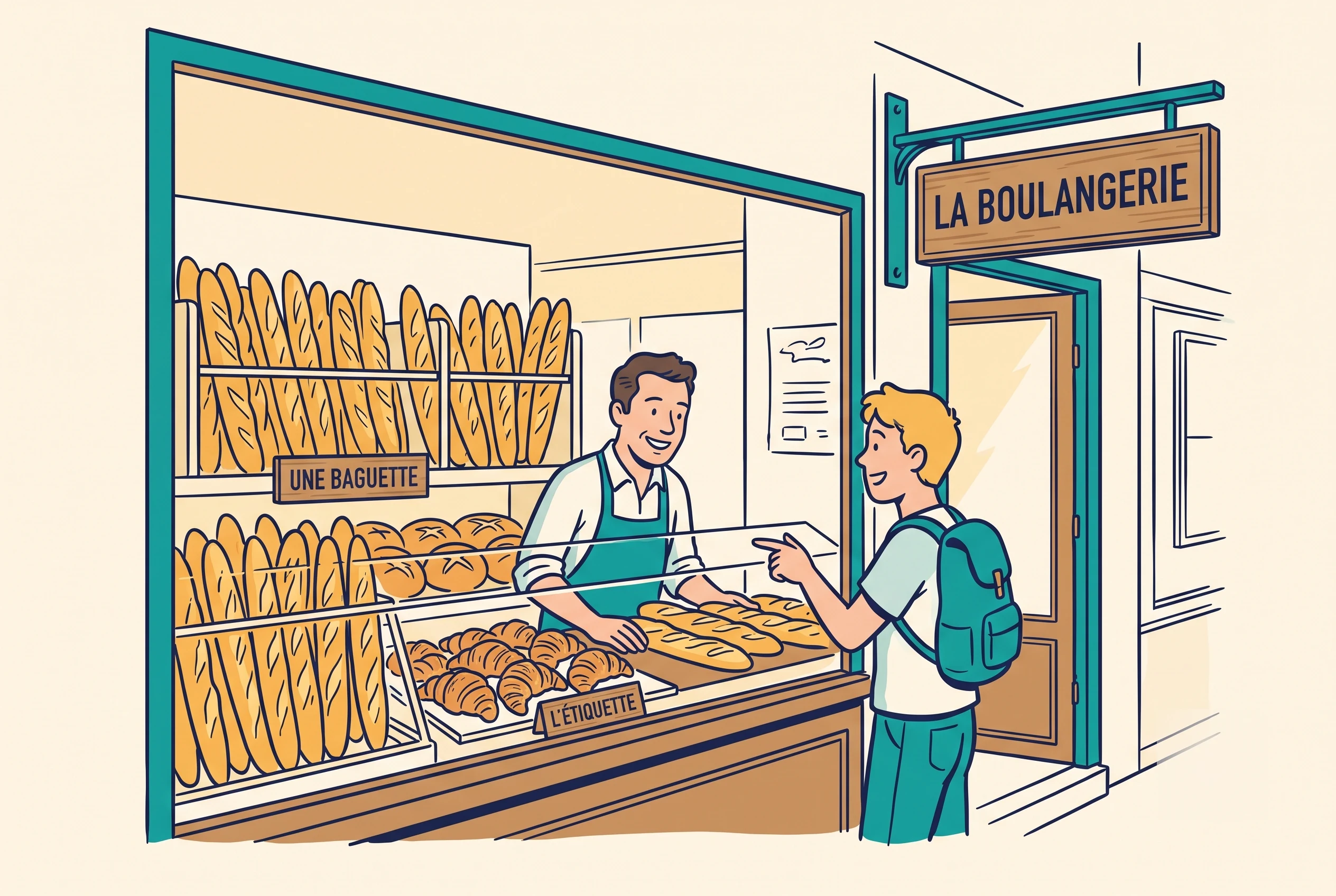
Start with a greeting and the item you want, then prepare for a question about quantity or preparation. The examples move through the bakery exchange so you can practise a complete order.
Greet first, order second: the rule nobody explains
Every bakery visit in France starts with “Bonjour.” Not the order. Not a wave. “Bonjour.” Skip it and the baker’s tone shifts. The greeting is not politeness decoration. It is a social handshake that signals you know the protocol. Bread is the easy case: the same handshake opens the pharmacy counter, the post office window and the lift in your own building, and that is where Americans hear coldness instead of a rule.
Have it ready before the door shuts behind you, because the greeting, the order and the politeness ride on one breath:
The closing matters as much as the opening; leave without it and you’ve broken the ritual:
The queue nobody manages
French bakeries have no visible queue. Everyone tracks arrival order in their head; if you lose count, gesture and ask “C’est à vous ?” Then the baker looks up: “C’est à qui ?” (whose turn?). And yes, you meant to answer, until three faces turn and your mouth does nothing. The guide to that half-second is written for people whose French is fine and whose nerve is not.
Bread types: the choices that matter
Saying “une baguette” is like saying “a coffee” in Italy. Which one? Every boulangerie carries at least four, and the baker expects you to pick. In 2022, UNESCO added the artisanal know-how and culture of the baguette to its Intangible Cultural Heritage list; the “baguette de tradition française” is legally defined too, four ingredients only (flour, water, salt, yeast), no additives, and a level of craft that separates a real boulangerie from a mediocre one. Order “un verre de vin” at a French bar and you get the same reply in a different register, which is why the drinks vocabulary is worth learning region by region before you are standing at the zinc.
Thirty cents more than the plain one. The flour is better and the dough has had longer to work.
Prefer a dark, crackly crust? Ask for it and the baker will nod in approval:
Less time in the oven means a paler crust and a softer crumb, which is what sandwiches and most children want.
Living alone or just want less? Not every bakery offers it, so ask:
For something denser and darker that keeps longer and suits cheese or soup:
Wholemeal, multigrain and gluten-free are increasingly common, even in small bakeries:
Slicing. Say “Vous pouvez la couper ?” and the baker runs it through the machine. Free. Saves you from mangling the loaf at home. The reply comes back at full speed, and hearing French that fast is a separate skill from saying it.
Pastries: where the vocabulary and the budget expand
Viennoiseries are the buttery morning pastries, and quality swings wildly between bakeries. Golden colour, visible flaky layers, butter in the air: fresh and properly made. Industrial ones look flat and smell of nothing. Buy the croissant here and you eat it walking. Order it at a café table instead, and the price triples, the vocabulary changes, and nobody rushes you.
A good croissant shatters when you bite it; if it bends, the bakery is using frozen dough:
This name works in most of France and gets you cheerfully corrected to “chocolatine” the moment you cross into the south-west.
The spiral one with custard inside, less sweet than it looks and a solid breakfast:
The question that separates artisan from industrial; real bakers answer it proudly:
Let the baker steer you toward whatever just came out of the oven:
Adding an item as you go? “Je prends” sounds more natural here than “je voudrais”:
Never touch the products. Point clearly. Let the baker handle everything. Reaching into the display is a hygiene violation that gets you a sharp correction. The same rule waits at a restaurant table, where the phrases do the reaching for you.
Small talk, Sunday queues, and payment
Regulars build real rapport with their baker: a word about the bread, a word about the weather. That is how a French neighbourhood holds together. Doing the same at the pharmacy or the ticket hall needs more phrases than a page about bread can carry, so the rest of Paris got its own phrasebook.
A small, genuine compliment turns you from tourist into regular:
Late morning, the croissant basket thinned out, and a fresh tray waiting somewhere behind the counter.
Sunday morning is a battlefield
The Sunday bakery run is a French institution. Families buy bread for brunch, croissants disappear by 9:30, and the queue extends out the door. Arrive early. Know your order before you reach the counter. This is not the moment to practise slow, careful pronunciation.
Ask before they ring you up; some bakeries still keep a €5–10 card minimum:
Why walk the loaf home and saw at it, when the machine behind the counter does it for nothing?
Miss the closing day once and you walk over for nothing, usually on a Monday or a Tuesday:
The baguette quality test
Experienced customers test quality by squeezing gently. The crust should crack, not bend. Golden-brown, dusted with flour, slightly irregular: hand-shaped. Uniform industrial baguettes look perfect and taste of nothing. Which raises a question English cannot answer: two bakeries four hundred metres apart, four identical ingredients, two completely different loaves. The French settled it with one word, terroir, and we took that word apart with the others that refuse to cross into English.
Study glossary: French bakery vocabulary
| 🇫🇷 French | 🇺🇸 English | 💡 Context |
|---|---|---|
| Boulangerie | Bakery | Look for the official sign |
| Baguette tradition | Traditional baguette | Better flour, UNESCO heritage |
| Bien cuite / pas trop cuite | Well-baked / not too baked | Crust preference |
| Pain de campagne | Country loaf | Denser, lasts longer |
| Pain complet / aux céréales | Wholemeal / multigrain | Increasingly common |
| Croissant | Croissant | Should shatter, not bend |
| Pain au chocolat | Chocolate pastry | “Chocolatine” in the south |
| Viennoiserie | Buttery pastry category | Croissant, brioche, pain aux raisins |
| Fait maison | Homemade | Artisan vs industrial check |
| Couper | To slice | “Vous pouvez la couper?” Free. |
| Demi-baguette | Half-baguette | Not always available. Ask. |
| C’est à qui ? | Whose turn? | The baker’s queue question |
| Monnaie | Change (coins) | Carry coins for small purchases |
Two minutes and you are out again. A coffee sitting down, a table booked for three courses, a ticket window with a queue behind you: each one slower, each one more words. Nothing in French daily life is faster.
Tomorrow the same door, the same bonjour, the same two seconds to choose. Sooner or later the baker starts the sentence before you do, and one morning you answer C’est à qui without having decided to. The bread is the same bread. What changed is that nobody in the queue turned around.
Prefer to keep it free today? Read the French Briefing →
Use your French in a real conversation.
Bring a question from a guide to a French tutor. Try it aloud, ask for feedback and leave with something to practise.
Find a French tutor →Paid lessons. Compare tutors and prices before booking.
Affiliate link: we may earn a commission when you book.
📚 Keep building in the Learning Center
French Travel Phrases for Hotels, Shops and Cafés
Practise French travel phrases for hotels, cafés, shops and transport. Learn follow-up replies and polite ways to ask…
Read →French Phone Call Phrases: Answer, Ask and Clarify
Prepare for French phone calls with phrases for answering, asking for repetition, leaving voicemail and ending a call,…
Read →Buy Train Tickets in French: Phrases and Station Words
Buy train tickets in French, use a ticket machine and ask about seats or platforms. Practise common questions…
Read →