Updated on September 15, 2026
Learn French in 3 Months: Goals and a Study Plan
Set realistic goals for three months of French study. Compare time commitments, priorities and milestones, then plan how to continue learning.
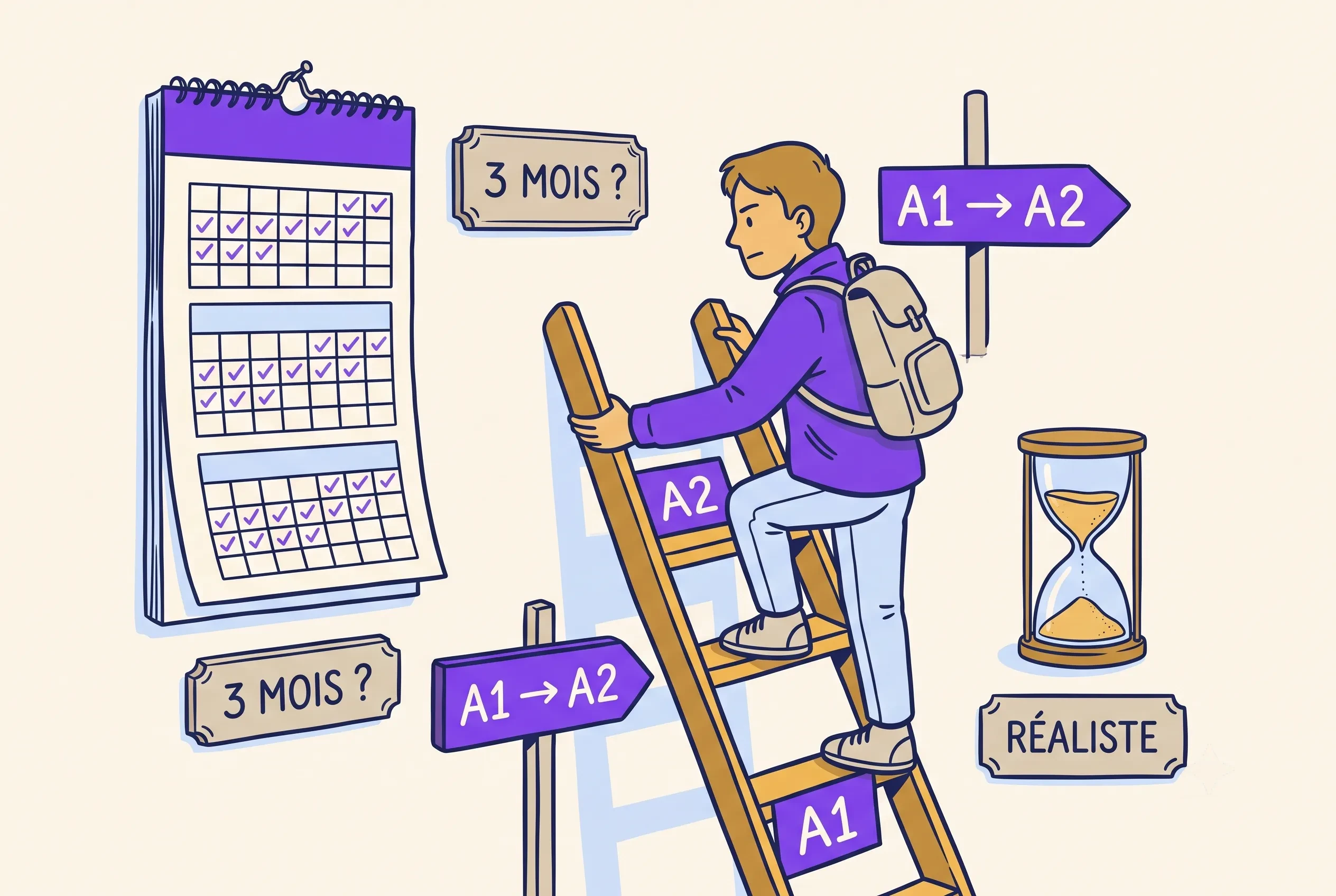
Three months is a planning period, not a promise of fluency. Choose a limited set of situations to handle, match the workload to your available time and use the checkpoints to decide what to study next.
- The method — the four-part system that works at every level
- The 3-month sprint — what an intensive quarter can realistically reach (you’re reading this)
- The hour-by-hour timeline — CEFR levels and the study hours each one takes
The math: what three months actually contains
Training-hour estimates describe particular programmes and learners; they are not a conversion from study hours to a guaranteed CEFR level. For a three-month plan, begin with the hours you can sustain and the practical tasks you want to perform.
| Time budget | Total practice time | Example use of the time |
|---|---|---|
| 30 minutes a day | 45 hours in 90 days | Short listening, recall and one speaking task |
| 1–2 hours a day | 90–180 hours in 90 days | Combine structured study with reading and conversation |
| 3–4 hours a day | 270–360 hours in 90 days | Plan varied tasks and breaks; review progress regularly |
The fluency redefinition trick
Define your goal in observable terms, such as handling an introduction or understanding a short familiar exchange. A single successful task does not demonstrate an entire CEFR level. Use the milestones below as practice goals rather than predictions.
Some familiar-looking vocabulary can help an English speaker get started. Check meaning in context, however, because false friends can mislead you. Grammar, listening and the ability to retrieve words also need regular practice.
What to prioritize when time is the constraint
With unlimited time you study everything. With ninety days you triage, so this page will not build a full method. That system, four parts and the schedule that runs them, has its own page. Here, the compressed version.
- 1Top 1000 words first They cover ~85% of daily conversation. Être, avoir, faire, aller before literary vocabulary. Frequency beats breadth.
- 2Pronunciation from day one Not week four. Day one. Nasal vowels, the French R, liaison patterns, silent letters. The pronunciation guide exists because bad habits at A1 become permanent at B1.
- 3Speak before you are ready Which means now. The shy beginners guide gives you the techniques if speaking terrifies you.
- 4Active production over passive consumption Watching French Netflix with English subtitles teaches zero French. The film guide explains the subtitle method that works.
- 5One structured resource, not five random ones Switching apps every week = restarting every week. The books minimalist guide tells you exactly what you need.
- 6Daily consistency over weekend marathons 30 min × 6 days beats 3 hours × 1 day. The 15-minute routine shows the absolute minimum viable daily practice.
Apps can support vocabulary review and structured exercises. Add listening and opportunities to produce French so that your routine practises the skills needed for your goal; no app-only outcome can be predicted from the tool alone.
The 30-minute split that works. 10 minutes vocabulary (spaced repetition). 10 minutes listening (podcast clip from the podcast guide). 10 minutes production (record a sentence, write three lines, text someone in French). Balanced. Sustainable. Compounding.
Month-by-month milestones: how to know if you are on track
Vague goals produce vague results. These milestones are testable. If you can do the thing, you are on track. If you cannot, something in your method needs changing. Where do you stand right now? The Level Quiz takes three minutes.
Month 1: survival
Test: order a meal in French without switching to English.
“Bonjour ! Je voudrais un café crème et un croissant, s’il vous plaît.”
Pass/fail. No ambiguity. The café culture guide gives you every phrase you need for this milestone.
Month 2: description
Test: describe your job and daily routine for 2 minutes without stopping.
“Je travaille dans le marketing. Le matin, je prends le métro…”
This task practises present-tense verbs and basic connectors. Record a short version, listen for clarity and add detail as the language becomes easier to retrieve.
Month 3: narration
Test: tell a story about something that happened yesterday.
“Hier, je suis allée au marché et j’ai acheté des fruits. C’était intéressant parce que j’ai parlé avec le vendeur en français.”
This task practises past-tense choices and narrative connectors. Start with a short sequence of events, then add background or a reason. One connector alone does not establish a CEFR level.
The month 2 plateau. Month 1 everything is new and progress is visible daily. Month 2 you understand more than you can produce, conversations feel harder than they should, and the gap between what you want to say and what you can say becomes frustrating. This is normal. This is where most people quit. The ones who push through start accelerating in month 3.
After three months: the real decision
After three months, review what you can now do and which tasks still need support. Choose a sustainable routine for the next stage rather than treating the end of the plan as the end of learning.
The concrete goal that compresses time: register for DELF A2. Put a test date on the calendar. Deadlines compress timelines because you study for a specific, testable outcome instead of a vague feeling of improvement. The exam you can actually take inside ninety days is the level below, and the A1 prep guide lays out its format.
Study glossary
| 🇫🇷 French | 🇺🇸 English | 💡 Context |
|---|---|---|
| Apprendre | To learn | “J’apprends le français” |
| Débutant | Beginner | A1 stage |
| Objectif / progrès | Goal / progress | “Je fais des progrès” |
| Pratiquer / réviser | To practice / to review | Daily habits |
| Immersion | Immersion | Active, not passive residence |
| Répétition espacée | Spaced repetition | Anki, vocabulary retention |
| Plateau / percée | Plateau / breakthrough | Month 2 wall → month 3 acceleration |
| Rythme durable | Sustainable pace | Post-sprint maintenance |
| Aisance | Fluency / ease | The real goal, not the marketing one |
| Étude intensive | Intensive study | 2+ hours daily |
Three months is a beginning, not a deadline. The full timeline guide shows what comes next. The method guide builds the system that survives beyond the sprint.
Three months is also exactly the horizon where your choice of course starts to matter. Our guide to French courses in 2026 matches each format to a goal, a level and a budget.
Before the plan ends, schedule a review and choose the next goal. Regular opportunities to use French help you maintain the skills you have practised.
Prefer to keep it free today? Read the French Briefing →
Use your French in a real conversation.
Bring a question from a guide to a French tutor. Try it aloud, ask for feedback and leave with something to practise.
Find a French tutor →Paid lessons. Compare tutors and prices before booking.
Affiliate link: we may earn a commission when you book.
📚 Keep building in the Learning Center
italki vs Preply for French: Lessons and Costs Compared
Compare italki and Preply for French lessons: payment models, tutor choice, trials and cancellation rules. Choose according to…
Read →French Learning Apps Compared: Choose by Your Goal
Compare French learning apps for drills, listening, conversation and feedback. Understand their limits and choose a tool that…
Read →How Long Does It Take to Learn French? A Planning Guide
Plan your French learning timeline around your goals, weekly study time and practice. Understand CEFR milestones without fixed…
Read →