
Updated on September 26, 2026
Long-Stay Visa France: Plan Your Application and Understand the French
A French long-stay visa application begins with your reason for travelling and the rules that apply to your situation. Compare routes, organise evidence and understand the French used in document requests, appointments and arrival instructions.
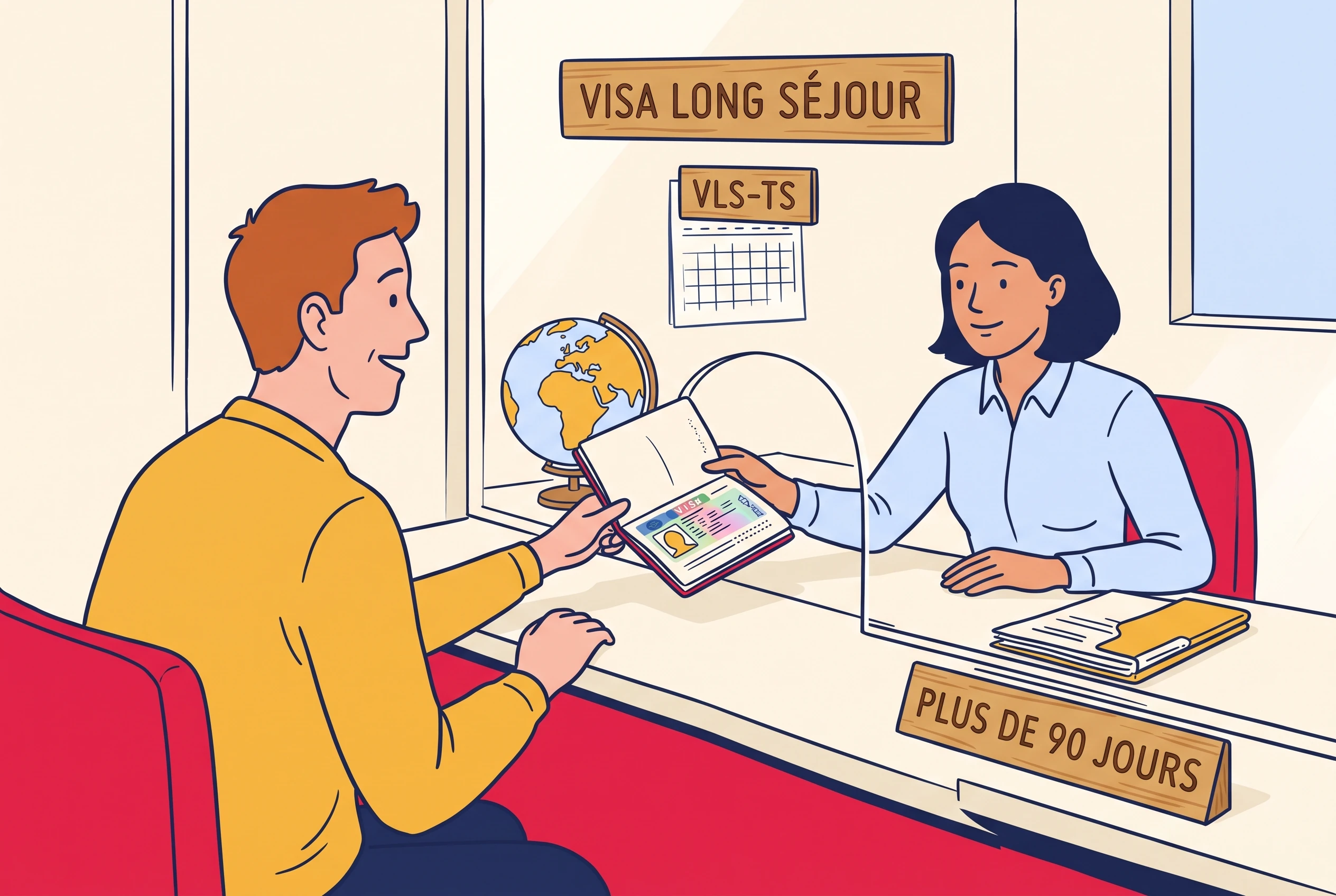
A long-stay visa for France starts with a description of your plans. How long will you stay? Will you work, study, join family or live from existing resources? Where do you currently reside? The answers determine which official instructions you need. They also determine which advice you can safely ignore.
Searching for a single checklist too early creates unnecessary work. A student admission document does not explain a visitor application. A successful application posted by someone online does not establish what your own consulate will request. Begin with your situation, then build a file around the instructions that apply to it.
This guide helps English speakers organise that work and understand the French surrounding it. It introduces the decisions, the document vocabulary and the questions worth asking. Your personalised official checklist remains the reference for what to submit. The sample messages below are language exercises: change the details and use only statements that accurately describe your circumstances.
You can do useful preparation before you speak much French. Learn to recognise who is writing, what they want, when they want it and where the response belongs. Those four details matter more than translating every line beautifully. Keep the French wording of an unfamiliar request beside your English notes so you can quote it precisely when asking for clarification.
Describe the stay before choosing the route
Write the plain-English version first
Before entering information into an application, describe your intended stay in five sentences. State your nationality or nationalities, your country of legal residence, the purpose of your stay, its intended dates and how you will support yourself. If another person is moving with you, prepare the same outline for them. A family can share a moving date without every member having the same administrative route.
The exercise sounds basic until two sentences contradict each other. “I am moving for a year without working” and “I will continue my consulting business from my apartment” describe a question that needs resolving. Rewording the second sentence does not resolve it. You need to establish the appropriate permission for the activity you actually intend to perform.
Keep an uncertainty list beside the outline. “I have not yet decided whether to extend” is an uncertainty. “My partner has a different nationality” is a fact. “I think we can use the same procedure” is an assumption. Marking these separately prevents an assumption from quietly turning into something you treat as settled.
For an overview of the categories and their scope, use the official France-Visas long-stay information. Its visa assistant is the starting point for identifying your own route. Do not choose a category simply because its name sounds easier or because a friend received it quickly.
Keep nationality, residence and destination separate
A US passport and a US application location are different pieces of information. An American legally resident elsewhere may need instructions for that country of application. A non-American living in the United States may have different nationality-related requirements. In a mixed-nationality household, each person needs an individual check.
Destination matters too. This article concerns preparation for mainland France. If your destination is an overseas territory, do not assume that every rule for mainland France carries over unchanged. Describe the place accurately when using the official assistant or contacting the relevant service.
These sentences make the distinction visible. Avoid the vague “We are applying from America” if the service needs to know citizenship, residence and family relationships separately. Specific facts invite a more useful answer than a broad description of the move.
Treat work as a question about the activity
The word “remote” describes how you work. It does not by itself answer which immigration permission covers that work. An employer located abroad, customers located abroad and money paid into an overseas account are facts to disclose when seeking advice, not reasons to assume that permission is unnecessary.
Write a factual description: employee or self-employed, expected hours, employer or client location, where the work will physically take place and the intended duration. Ask the competent service or an appropriately qualified adviser which route fits. Do not rely on a discussion thread that uses “tourist”, “visitor” and “resident” interchangeably.
This sentence asks for classification without suggesting an answer. Follow it with the actual facts. If you receive a reply that refers to a category you do not understand, ask for its exact name and the official page describing it. Keep that link in your file rather than a paraphrase from memory.
Separate the visa project from the moving project
You can research neighbourhoods while your route is unresolved. You can practise French while gathering documents. But a useful housing shortlist is not proof that your immigration plan works. Keep the two projects connected without allowing progress on one to conceal an unanswered question in the other.
Use three headings in your notes: decisions to settle, documents to obtain and practical arrangements to prepare. “Confirm route” belongs in the first. “Request a replacement document” belongs in the second. “Research transport from the airport” belongs in the third. Finish the decisions that determine the documents before spending heavily on the arrangements.
The distinction also makes conversations with a partner easier. One person may feel that nothing is happening because there are no boxes packed. Another may have spent a week resolving a document issue that affects the whole application. A visible task list makes that work tangible without pretending the application outcome is already known.
Turn instructions into a working document file
Build a requirement register
A folder full of PDFs is storage. A requirement register explains why each file is there. For every item requested in your official instructions, record the wording of the requirement, the document you propose to supply, the name appearing on it, the relevant dates and any question still unresolved.
Use a simple table rather than a complicated app. The useful part is the relationship between the request and the evidence. A column headed “done” cannot show whether a document has been obtained, checked, translated when required or actually submitted. Give those stages separate marks.
| Requested item | Proposed evidence | Check to complete | Current state |
|---|---|---|---|
| Identity document | Current passport | Match spelling and dates | Ready to review |
| Accommodation evidence | Document appropriate to your situation | Confirm period and named person | Question outstanding |
| Resources evidence | Records required for your route | Check names, periods and readability | Gathering |
| Insurance evidence | Certificate for the intended cover | Check wording against instructions | Awaiting issuer reply |
This is an organisation example, not a universal submission checklist. Add or remove rows according to your own official requirements. An empty row does not mean your application is incomplete if that item does not apply; a full table does not establish that the evidence is acceptable.
Review names before file formats
Names often appear differently across documents. An initial may replace a middle name. A previous surname may appear on an older record. A document may use a different order or omit an accent. Make a note of differences early and establish whether any explanation or supporting document is required.
Do not alter an official document to make it match another. Keep the original intact. If a discrepancy needs explaining, use the procedure or supporting evidence requested by the competent service. A neat-looking file is less valuable than an accurate one whose history you can explain.
Notice the question asks what evidence to provide. It does not announce that a particular document will be accepted. That distinction is useful whenever you are translating your own situation into an administrative request.
Compare dates across the file
Read date ranges together. The dates entered in a form, mentioned in a letter and shown on supporting evidence should tell a coherent story. If your intended schedule changes, revisit every affected item. Updating a flight plan in your notes does not update an insurance certificate or a statement already downloaded.
Create a change log with the old date, the new date, the reason and the documents affected. This takes minutes when the change happens and saves reconstructing it later. Mark documents that need reissuing so an outdated version does not remain in the submission folder because its filename looked familiar.
For a detailed review method, continue with the site's long-stay visa document checklist. Use one working checklist for your own application; several overlapping lists tend to create more uncertainty than protection.
Keep originals, working copies and submitted copies apart
Use three folders with plain names. “Originals” contains the files as received. “Working” contains scans, translations where relevant and documents being prepared. “Submitted” contains the exact versions actually sent, alongside the confirmation showing when and where they were sent.
A clear filename can include the document type, the applicant's initials and a date written as year-month-day. Avoid putting full passport numbers or other unnecessary sensitive details into filenames. Those names may appear in email previews or shared screens even when the file itself remains closed.
Open the final file before submitting it. Check that every page is present, the text is readable, the orientation is correct and no unrelated document has been included. A file that opens on your computer may still contain a cropped edge or an unreadable stamp. Look at the contents, not just the successful upload indicator.
Translate the request before translating documents
“Translation required” raises several questions: which document, which language, which type of translator and which submission form? Resolve those questions before ordering work. Do not assume a machine translation, a bilingual friend or a translation accepted for a different procedure meets the present requirement.
If the reply links to a policy, save the link and the date you consulted it. If your case has a particular complication, quote that complication in a follow-up. Avoid asking the same broad question repeatedly when what you really need is an answer about one document.
Read insurance evidence as evidence
An insurance quotation, a policy and a certificate are not interchangeable documents. Identify what you currently hold and what your checklist asks for. Check the insured person's name, geographical scope, dates and relevant cover wording. Questions about exclusions or eligibility belong with the insurer and the competent authority.
The companion article on insurance language for a long-stay visa helps you formulate those questions. It does not rank insurers or claim that a particular purchase guarantees acceptance. Keep any written clarification beside the policy version it concerns.
Read the French in requests and replies
Find the action verb
Administrative sentences often place the task after a polite introduction. “Veuillez” usually introduces something the writer wants you to do. The useful next word may be transmettre, joindre, compléter, signer or déposer. Underline that verb, then identify its object.
In a practice sentence such as “Veuillez joindre le document signé”, the task is to attach the signed document. The word “signed” changes the action. Having the document is not enough if the requested version requires a signature. Learning to spot these small conditions is more useful than memorising a long list of nouns in isolation.
After reading either sentence, say the action in your own words: “Attach the signed version” or “Complete the address section.” Then check whether the full message adds a deadline, a file-format instruction or a specific destination. Do not let the short summary erase those conditions.
Distinguish a request from a decision
A message asking for further information is not the same kind of message as a decision. Read its actual wording before labelling it “approved” or “refused” in your notes. Equally, a receipt showing that something was uploaded does not tell you how the application will be assessed.
Build a vocabulary list around stages: received, being processed, additional information requested, decision notified. Keep the French phrase from your actual correspondence next to the stage. If a message is unclear, ask what it means for the next action rather than trying to infer an outcome from its tone.
These are deliberately narrow questions. They make it easier for the recipient to explain the status without being asked to predict a decision. Include the reference and date of the message you are asking about when the official contact channel permits it.
Practise with an original sample request
Here is a fictional message for language practice. It is not an extract from an official application and does not establish requirements for your case.
There are three useful details. The problem is readability, not necessarily the document's substance. The requested destination is the account space. The requested check concerns every page. Replying by email with one sharper page might fail to address two of the three points.
Before acting, identify which document the surrounding message refers to. If that is missing or ambiguous, ask. Do not replace several files at random in the hope that one is the right one. That can make your submission history harder to follow.
Once clarified, create the improved copy, open it, check all pages, use the designated channel and retain the confirmation. Your personal task list can now contain a completed action with a date, not just the reassuring but vague phrase “replied to email”.
Write a reply around one clear purpose
A short administrative reply usually needs a reference, a statement of what you have done and one precise question if something remains unresolved. Avoid adding a long account of how stressful the move has been. That may be entirely true, but it makes the practical request harder to find.
Use this original template only when its statements match what you have actually done:
The names, dates and reference numbers in this spoken example are fictional. Adapt the wording to your actual situation.
Replace every bracketed field. Check that the chosen channel is appropriate and that a separate reply is useful. A template is a starting point for accurate communication, not an instruction to send additional messages where none are requested.
Useful phrases to keep
Practise the phrases as questions with a specific object. Change “ce document” to the name of the relevant document. Say the date aloud. Ask a partner to respond with a detail you were not expecting, then repeat that detail back. This turns vocabulary review into preparation for a real exchange.
Prepare the appointment and track the next step
Work backwards from dependencies
A calendar is most useful when it shows what depends on what. You cannot finish checking a document you have not received. You cannot confidently plan an application around an appointment that has not been confirmed. Put uncertain dates in a different style from confirmed ones so the distinction remains visible.
Record who controls each step. You control requesting a record and checking the resulting scan. The issuer controls when the record arrives. The appointment provider controls availability. The authority controls assessment. This prevents a delay outside your control from leading you to repeat an action that was already completed correctly.
For US-specific application logistics, use the official France-Visas United States page and the site's guide for US citizens. Follow current contact and appointment instructions rather than a provider name remembered from an old article.
Make a one-page appointment sheet
Write the confirmed date, time, address, booking reference and official instructions in one place. Add the documents you need to bring and the location of each within your folder. Include travel time and a practical contact number where appropriate. This sheet should help you navigate the day, not replace the official confirmation.
Practise saying your name and appointment time. Spell your surname clearly. If you use a different name in everyday life, prepare the name that matches the booking. Small communication tasks become disproportionately difficult when you are trying to find an entrance and keep several documents together.
The names, dates and reference numbers in this spoken example are fictional. Adapt the wording to your actual situation.
Say the sentences without looking at the English translation. Then change the time. If you cannot comfortably distinguish two similar numbers when listening, ask for the time to be repeated or written. Understanding the correct detail matters more than appearing fluent.
Keep a record of requests without recording unnecessary data
After an interaction, note the date, channel, reference and action requested. Write down the deadline exactly as communicated. If you are unsure whether you understood, seek clarification through the appropriate channel. Memory tends to preserve the general meaning while losing the condition that matters.
Store sensitive documents securely and share only what the recipient needs through the designated route. Avoid placing an entire application folder into a broadly accessible link just to answer a question about one item. Organisation should make the file easier to use without increasing unnecessary exposure.
Make follow-ups specific
Before following up, check the published instructions and any timeframe given in your correspondence. Your next message should identify the earlier request and explain the unresolved issue. Sending the same broad question through several unrelated channels can make the conversation harder to track.
The names, dates and reference numbers in this spoken example are fictional. Adapt the wording to your actual situation.
Add one question. If the issue is receipt, ask about receipt. If the issue is which document is required, ask about that document. A message asking simultaneously about appointment availability, processing, insurance and renewal is likely to need several different answers from different sources.
Keep the reply with the question that produced it. A screenshot of an answer without the original question can later appear to say something broader than it did. Context is part of your administrative record.
Read your visa and organise arrival
Inspect the document you actually receive
Once a visa is issued, compare its details with your identity and plans. Read the dates and any endorsement or accompanying instructions. If something appears wrong or unclear, contact the issuing channel before assuming it can be corrected after travel. The category you hoped for is less useful than the document actually issued.
Keep a readable copy for your records, stored securely. Do not let a moving checklist reduce the result to a single box marked “visa done”. There may be an arrival action attached to that result, and it belongs on a separate line with its own source and deadline.
Identify the arrival procedure from the endorsement
France-Visas states that a VLS-TS must be validated online within three months of arrival. Other long-stay endorsements can involve different formalities. Read the official arrival guidance for the document you hold rather than applying one procedure to every visa.
Put the answer in your calendar with a link to the official process. Save the resulting confirmation when you complete the action. If a further appointment or document request follows, treat it as a new task instead of assuming that the first confirmation concludes every formality.
Plan practical support around your first week
Make sure you can access the email account used in your application, receive necessary messages and retrieve your documents after travel. Consider what happens if your usual phone number is temporarily unavailable. Keep essential contact details somewhere you can reach without relying on a single device.
Arrival also brings ordinary tasks: obtaining keys, confirming an address, arranging appointments and asking people to repeat information. The language for these tasks overlaps with application French, but the objective changes. You are now trying to complete an everyday exchange while establishing a routine.
For that stage, use the first-90-days moving guide. Keep application preparation and settlement practice connected without assuming that buying one resource automatically includes the other.
Review the file after the move
Schedule a short review once the immediate arrival tasks settle. Which formalities are complete? Which confirmations are saved? Which dates will matter later? Which address or contact details have changed? A review makes the next stage easier because you are working from a record rather than reconstructing the move months afterwards.
Keep language notes too. Write down the questions you successfully asked and the words you repeatedly missed. If “pièce”, “dépôt” and “attestation” caused confusion, practise them in the context where you encountered them. That is a more useful next French lesson than starting an unrelated vocabulary list.
A final five-minute practice
Explain your next administrative action aloud in English, then say one French sentence you might use to complete it. Identify the document involved, the destination and the deadline. If you cannot name one of those details, it becomes a question to resolve rather than something to guess.
Try this sequence with a fictional example: you need clarification about a certificate's dates. State which certificate it is. Ask which period it must show. Repeat the answer. Note where the corrected certificate should be submitted. You have practised an exchange, a check and a follow-up, all around one small task.
The goal is not to sound like a legal professional. It is to understand enough to act accurately, recognise when something remains unclear and ask a question that moves the file forward.
Decide what to leave out of your next study session
Preparation improves when you limit the task. If tomorrow's job is to ask whether a scan is readable, you do not need to master every word connected with immigration tonight. Practise the document name, the question and the likely replies. Put broader vocabulary on a later list so it does not displace the immediate action.
The same principle applies to researching the move. A page about a future residence application may be useful background, but it should not silently become the checklist for your present visa application. Label notes by stage: before application, submission, after decision, arrival and later stay. Return each piece of advice to the stage it actually concerns.
If you are preparing with someone else, exchange roles for five minutes. One person describes an unresolved task; the other asks which source supports it, which document is involved and what confirmation will show completion. This is a practical check, not an examination. Its purpose is to expose the missing detail while there is time to clarify it.
End the session by writing one next action you can actually take. “Understand everything about French visas” will remain unfinished. “Ask whether the certificate needs a different date range” has a clear recipient, a clear question and a possible answer.
Keep a useful handover note
If someone helps you prepare the file, write a short handover note before they review it. Explain which route you are checking, where the official instructions are saved and which questions remain unresolved. Identify the versions you want them to examine. Otherwise, a helpful person may spend an hour reviewing an older attachment or answering a question that has already been settled.
Separate their observations from confirmed requirements. “This scan is hard to read” is a useful practical observation. “You definitely need this additional certificate” is a claim that should be checked against the appropriate source. The person helping you may know a great deal about their own experience without knowing the details of your current procedure.
When the review ends, write down the agreed next actions and who will take them. If you are requesting a document, note that you are responsible for contacting the issuer. If your helper is checking a translation requirement, record the source they will consult. Avoid a task that belongs vaguely to everyone and therefore to nobody.
You can use the same method with your future self. A clear note saying which question is open, which source you used and where the latest file sits makes it easier to resume after a busy week. It also reduces the temptation to start searching from scratch and replace a documented answer with the first new opinion you encounter.
Useful phrases to keep
| 🇫🇷 French | 🇺🇸 English | 💡 Context |
|---|---|---|
| Quel document manque à mon dossier ? | Which document is missing from my file? | Identify the missing item |
| Où dois-je déposer cette pièce ? | Where should I upload or submit this document? | Confirm the channel |
| Cette copie est-elle suffisamment lisible ? | Is this copy clear enough to read? | Check image quality |
| Quelle période doit figurer sur l’attestation ? | What period must appear on the certificate? | Clarify dates |
| Pouvez-vous préciser la date limite ? | Could you specify the deadline? | Confirm timing |
| J’ai conservé la confirmation de dépôt. | I have kept the submission confirmation. | Describe your record |
| Dois-je fournir l’original ou une copie ? | Should I provide the original or a copy? | Clarify the format |
| Je souhaite corriger une information. | I would like to correct some information. | Start an accurate correction |
| un visa de long séjour | a long-stay visa | the umbrella term used across France-Visas |
| valant titre de séjour | serving as a residence permit | the wording that means no prefecture visit in year one |
| la mention « visiteur » | the "visitor" endorsement | printed on the sticker, and it bans paid activity |
| un justificatif de ressources | proof of income | pensions, rents and dividends all qualify |
| une attestation d'assurance maladie | a health insurance certificate | must run the whole stay, repatriation included |
| un justificatif de domicile | proof of address | asked for again at validation and at every renewal |
| un timbre fiscal électronique | an electronic tax stamp | bought online while validating the visa |
| le formulaire Cerfa | the Cerfa form | printed and signed for the appointment |
| un récépissé | a receipt of application | proof your file is being processed |
| une pièce manquante | a missing document | the commonest reason a file stalls |
| la préfecture | the prefecture | handles everything after the first year |
| le renouvellement | renewal | filed before the card expires, never after |
| une carte de séjour pluriannuelle | a multi-year residence card | first card with a language condition, at A2 |
| la carte de résident | the ten-year resident card | B1 since January 2026, up from A2 |
| la naturalisation | naturalisation | B2 since January 2026, up from B1 |
| un recours | an appeal | the formal step after a refusal |

Long-Stay Visa Language Pack
Know what belongs in your visa file.
For US citizens planning a long stay
Start with the route that fits your plans. Use the document checklists to organise your file, decode the French on forms and check the official instructions before you apply.
- Document checklists and a file organiser
- Useful French for forms and appointments
About 170 pages · Fillable and printable PDF
Get the Visa pack · $9 Read a preview before you buyOne payment · Instant PDF download
Practise explaining your plans in French.
Tell a tutor why you are moving and which forms or messages you find hard to understand. Rehearse the language you need for your own situation.
Find a French tutor →Paid lessons. Compare tutors and prices before booking.
Affiliate link: we may earn a commission when you book.
📚 Keep building in the Learning Center
Moving to France from the US: A Practical First-90-Days Plan
Your first 90 days in France involve overlapping tasks, from housing and banking to everyday conversations. Use this…
Read →French Health Insurance for Expats: The Vocabulary Behind the Paperwork
French health insurance arrangements for expats depend on status and circumstances. Distinguish eligibility, registration, evidence of cover and…
Read →Moving to France from the USA: Work and Visa Planning
Plan a move from the USA to France with work-visa routes, job-search vocabulary and relocation steps. Use official…
Read →