
French Health Insurance for Expats: The Vocabulary Behind the Paperwork
French health insurance arrangements for expats depend on status and circumstances. Distinguish eligibility, registration, evidence of cover and complementary insurance, then prepare the French questions needed to clarify your situation with the appropriate organisation.
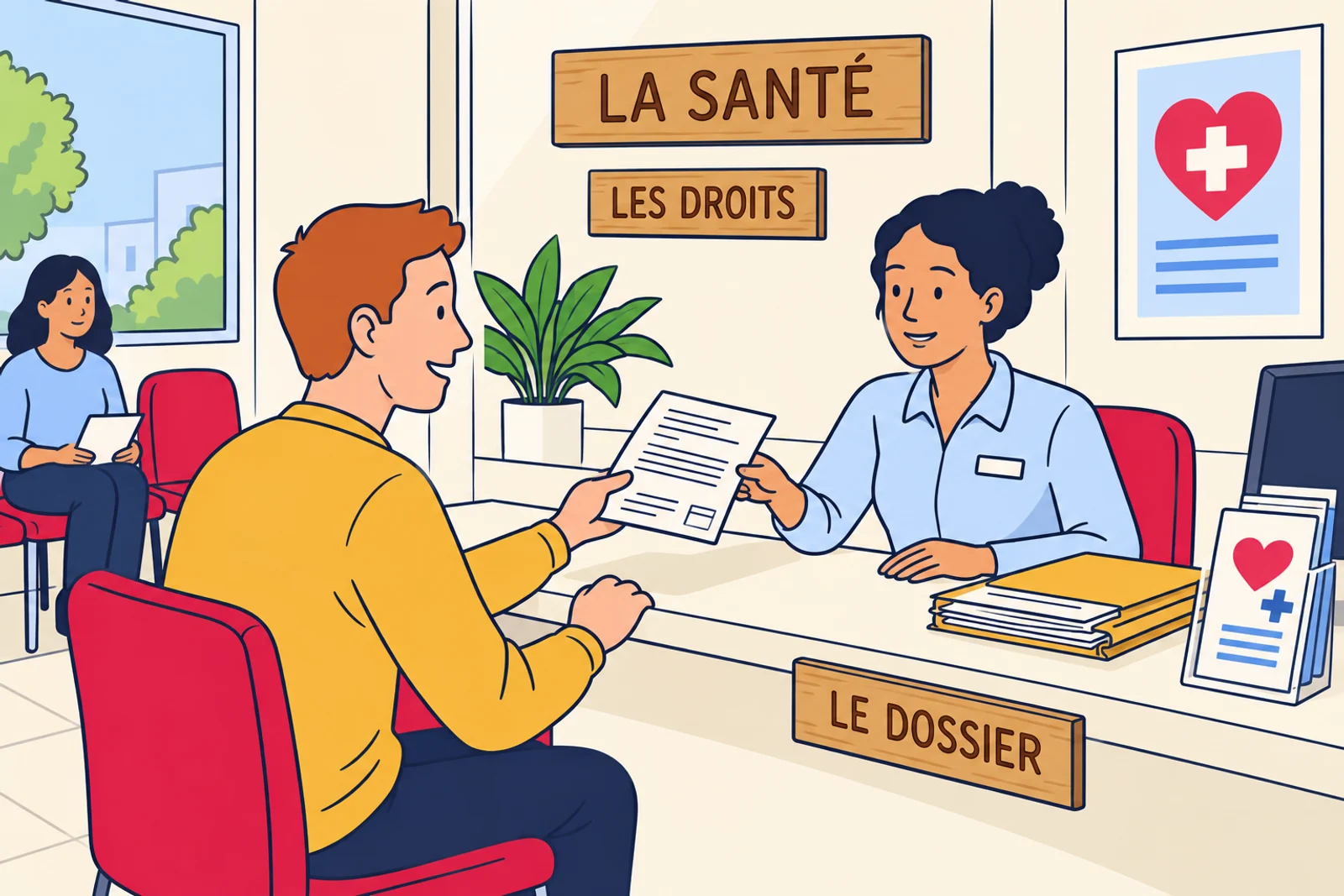
Understanding a healthcare letter begins with identifying which organisation wrote it and what stage it describes. A request for evidence, confirmation of affiliation and a reimbursement statement are different documents. Translating them all as “insurance paperwork” hides the action you need to take.
This guide helps newcomers ask clearer questions. It does not determine your entitlement, select a policy or interpret a medical situation. Your work, residence and other circumstances affect the relevant procedure. The Assurance Maladie overview of PUMa explains the broad framework; follow the instructions applicable to your own case.
For the wider settlement plan, read your first 90 days in France.
Identify the organisation and document
Assurance Maladie, an insurer and a complementary-cover provider may send documents with different purposes. Read the sender and the heading before acting. Keep each document with the arrangement it concerns, even if several organisations ask for similar information.
“Affiliation” concerns being attached to a scheme. “Attestation de droits” refers to a certificate of entitlement. “Remboursement” concerns repayment of eligible costs. “Complémentaire santé” concerns additional cover under its own conditions. These working definitions help you form a question; the document itself determines the detail.
Do not assume that receiving a letter means every step is complete. Look for verbs such as compléter, transmettre and confirmer. They indicate whether a further action is expected.
Start with the question you actually need answered
“How does French health insurance work?” is too broad for most service conversations. A person handling applications may be able to explain a requested document but not the conditions of your private contract. An insurer may explain its own policy without being able to determine your position under a public scheme. Identify the decision or uncertainty behind your question before choosing the recipient.
For example, you might need to know whether a file has arrived, what a phrase on a statement means, or which date appears in your record. Write that purpose in one sentence. You can then supply the minimum context needed for the recipient to understand it. This is more effective than beginning with the complete story of your move and hoping the other person identifies the relevant issue.
If you do not know who handles the question, make routing the first task. Ask which service can answer, how to contact it and what reference to use. Do not treat a referral as an answer about coverage. It is progress because it identifies a recipient, but the substantive question remains open.
Build a document map from the papers you have
Take a blank sheet and make four columns: sender, document title, date and requested action. Use the actual title rather than your own broad label. A document described as an attestation, a contrat or a décompte serves a different purpose, even if all three refer to healthcare.
In the action column, distinguish “keep for reference” from “reply” and “ask for clarification”. Sometimes the document tells you explicitly what to do. Sometimes it records an event without asking for anything. When the purpose is unclear, write a question instead of inventing an action. The uncertainty should remain visible until the relevant organisation answers it.
Keep this map separate from a general French vocabulary notebook. The map may contain personal references and belongs with your private records. Your notebook can use invented names and amounts. You can learn how to discuss paperwork without repeatedly copying sensitive information into exercises or messages shared with a tutor.
Read the action words before translating every sentence
Administrative letters often become easier to navigate when you first locate the verbs. “Veuillez transmettre” asks you to send something. “Nous avons reçu” records receipt. “Votre demande est en cours d'examen” describes a review in progress. These sentences do not say the same thing, even if a translation app makes the whole letter sound reassuring.
Underline the object of the verb next. What must be sent, received or reviewed? Then find any condition attached to it: a date, a signature, a missing page or a particular transmission method. Understanding the noun alone may not tell you enough to act.
As a practice exercise, write three fictional English notes: “received”, “being reviewed” and “please send the missing page”. Match each to a French sentence you understand. Explain the next action in English. If your explanation gives the same action for all three, return to the verbs and identify what changed.
Treat similar words as separate entries
The everyday word “insurance” can hide useful distinctions. Assurance may describe insurance generally, while an attestation is evidence of a stated situation and a cotisation is a contribution or premium in context. A numéro de dossier identifies a file; it is not automatically the same identifier as another number on a different document.
Record each unfamiliar term with the sentence where you encountered it. A dictionary definition becomes more useful when you know whether the term appears in an application, a contract or a payment statement. Avoid replacing every unfamiliar noun with a broad English label such as “paper” or “number”.
For pronunciation, practise the complete short expression rather than the noun alone. “Une pièce jointe” and “une pièce manquante” share a noun but point to different things. Hearing the adjective helps you understand whether someone is discussing an attachment already sent or evidence still absent from the file.
Ask what your current status means
An application submitted, a document received and rights confirmed are separate stages. Ask which stage applies and what evidence shows it. If a date matters, request the date explicitly instead of inferring it from when you opened the envelope.
Keep any answer with the relevant reference. Before changing existing cover, establish your actual position with the organisations concerned. An expectation that a process will finish soon is not the same as confirmation that cover applies.
If your immediate question concerns evidence for a visa application, use the separate long-stay visa insurance guide. That is a different task from understanding settlement-stage correspondence.
Keep a timeline with separate events
Create a simple record of what happened: you submitted an application, received a request, sent a reply and obtained a later confirmation. Each event gets its own date. This prevents a common reasoning error: treating the date you sent something as the date an organisation completed its review.
Next to each event, record the evidence you actually have. A sent-email copy establishes what you sent. An acknowledgement establishes receipt of the message or submission described in it. A decision or certificate may establish something further. Read its wording rather than assuming every automatic acknowledgement is a decision.
If two dates seem inconsistent, ask about the precise discrepancy. “My letter is dated Monday, but the date shown in this field is Friday; which event does each date refer to?” is a clearer question than “Why are the dates wrong?” It leaves room for the possibility that the dates describe different events.
Use the official framework without turning it into a personal conclusion
The PUMa overview describes coverage principles connected to work or stable, lawful residence. It also directs applicants to provide evidence appropriate to their situation. That broad framework does not mean that every newcomer should follow an identical timeline or that a personal file is complete merely because a certain number of days has passed. Consult the current Assurance Maladie guidance and the organisation handling your case.
When preparing a question, describe the relevant facts accurately rather than choosing a category because it seems quicker. If the form asks about work, residence or a change of circumstances, those are factual questions. Language support can help you understand the wording; it cannot substitute for truthful answers or an assessment by the responsible body.
A useful practice task is to separate three statements: “I believe this route may apply”, “I have submitted the requested form”, and “I have received confirmation of the following position”. Each expresses a different level of certainty. Choose the one supported by your actual information.
Ask what is still needed without guessing the answer
Suppose a reply says your file is incomplete. Your first goal is to identify the missing item and the requirement it must satisfy. It may be tempting to resend the whole folder, but that does not necessarily resolve the specific issue. Ask whether the problem is an absent document, an unreadable copy or information missing from a document already supplied.
Once you understand the issue, repeat the next action. If the recipient asks for both sides of a document, your note should say both sides. If the recipient asks for a signed version, “send again” is not a complete reminder. The condition belongs in the task description.
Before sending a replacement, check that it addresses the stated problem. Opening the file yourself can reveal a blank page or an incomplete scan. This practical check does not determine whether the organisation will accept the evidence, but it reduces avoidable confusion about what you provided.
Keep a change of circumstances specific
If your address or another relevant fact changes, identify which organisation's record you are discussing. Updating one record should not be assumed to update every other organisation automatically. Ask the relevant body what it needs for the change and how you can confirm that the record reflects it.
For practice, invent a move from one fictional street to another. Explain the old and new information without using real identity details. Then ask your partner to repeat the new address. The exercise trains both the language of a change and the habit of checking that the crucial detail was heard.
If the response says that a change will be processed later, preserve that future tense in your notes. “Change requested” and “change completed” belong in different status categories. A clear record helps when a later letter still displays the old information and you need to ask what happened.
Read costs and cover carefully
When a document mentions a reimbursement, identify what the amount relates to. A quoted percentage is incomplete without its reference basis and any conditions. Ask the provider to explain the actual example you are trying to understand rather than assuming it represents the same percentage of any bill.
Use a written estimate or document when asking. A conversation about a hypothetical cost becomes more useful when both people are referring to the same figures. For individual decisions, seek an explanation from the relevant professional or organisation.
Separate the amount paid from the amount used in a calculation
Imagine an entirely fictional example: a page shows a charge of 80 units and another line shows a reference amount of 50 units. A percentage appears beside the reference amount. You cannot work out the final payment simply by applying that percentage to 80 unless the document explicitly tells you to use that figure.
This example is a reading exercise, not a representation of a French reimbursement rule. Its purpose is to make you ask which amount each calculation uses. On a real estimate or statement, identify the labels, dates and conditions before attempting the arithmetic. If you are unsure, ask the organisation to walk through the specific lines.
The most useful answer may be a worked example using the document you are discussing. Ask what is paid by whom, what remains payable by you and what assumptions the explanation uses. Keep the answer with the estimate. If the estimate later changes, check whether the explanation still applies.
Learn the vocabulary of uncertainty in an estimate
Words such as estimé, prévisionnel, sous réserve and selon les conditions signal that a figure or outcome may have qualifications. Do not omit those expressions when summarising a document in English. “Estimated reimbursement” and “reimbursement confirmed” make different claims.
Try this exercise with a fictional sentence: “The amount is estimated, subject to the documents supplied.” Identify both the estimate and the condition. Then rewrite it as a question asking which documents are still required. Your task is to preserve the uncertainty while making the next action concrete.
In conversation, you can ask whether the explanation is an estimate or a confirmed statement about the item in question. If the person cannot confirm the final amount, ask what information is missing. This gives you a clearer understanding than repeatedly asking for a yes-or-no answer that the available facts do not support.
Read a comparison as a set of questions
If you are comparing arrangements, use the same questions for each one. Which document describes the cover? Which dates and people does it concern? What is excluded? Where are the conditions for reimbursement explained? Which contact handles questions about the contract? Record the source of each answer, not just a tick beside “covered”.
Keep price and scope on separate lines. A lower quoted price does not tell you whether two arrangements cover the same circumstances. Likewise, a familiar brand name does not answer the question about a specific clause. Ask the provider about the relevant terms and obtain individual advice where needed for a decision.
This article does not rank insurers or recommend a policy. Its useful role is linguistic: helping you formulate the questions and understand the structure of the replies. If you need a product comparison or a decision about your own circumstances, take the actual documents to an appropriate professional rather than treating vocabulary practice as a substitute.
Distinguish payment language from reimbursement language
“Payer” describes paying. “Rembourser” describes reimbursing. “Facturer” describes billing. “Prélever” can describe debiting an account in a payment context. Listening for the verb helps you understand whether someone is discussing a bill, an amount already paid or a later repayment.
Build four fictional sentences about the same amount, changing only the verb. Explain the difference in English. Then add a date: a past payment and a future debit are different events even if the amount is identical. The dates and verb tenses belong in your notes together.
If a message mentions a payment you do not recognise, use the organisation's verified contact route to ask about it. Describe the reference and date from the message without assuming the explanation. A precise question gives the recipient something to identify; a general complaint about “insurance money” may require several extra exchanges before anyone knows which transaction you mean.
Practise a missing-document reply
Here is an original practice message for a request you do not fully understand:
The names, dates and reference numbers in this spoken example are fictional. Adapt the wording to your actual situation.
Use the organisation's appropriate contact channel and include only the information it asks you to provide. Do not send sensitive health or identity records to an unverified address simply because a message appears urgent.
Turn the model into your own message
Start with the reference supplied by the organisation, if one is appropriate for its contact channel. State which request you are answering and ask one clear question. If you have two unrelated issues, separate them so the recipient can answer each without guessing how they connect.
Replace every bracketed field before sending. A template is useful only when it accurately describes your situation. Remove sentences that do not apply. If you have not yet attached a document, do not leave a sentence saying that it is attached. This small check prevents a polite, fluent message from conveying the wrong facts.
Read the finished version as if you were the recipient. Can you identify the file, the issue and the requested answer? If not, shorten the background and make the question more specific. A clear message does not need complicated grammar; it needs the right details in an understandable order.
Reply to a request for a clearer copy
Here is another original practice message. Use it only when it matches what happened:
Notice what the message does not claim: it does not announce that the application is approved. It asks whether the replacement resolves the document issue. The distinction matters because a clearer copy may allow the process to continue without determining its outcome.
For practice, change “clearer copy” to “signed version” or “missing page”. Check that your English explanation changes with the French. You are learning a message pattern that adapts to facts, not a fixed paragraph to send regardless of the request.
Handle a reply you only partly understand
Suppose you understand the requested document but not where to send it. Quote or name the unclear part and ask a targeted question. There is no need to say that you understood nothing. Identifying what you did understand helps the other person avoid repeating information you already have.
Now practise the opposite case: you know the channel but not the document. Keep the first sentence short and put the unknown item in the question. A tutor or partner can answer with one of two fictional options, requiring you to listen for the difference.
Afterwards, write a one-line task from the answer. It should contain the action, object and channel. If one of those remains unknown, leave a question mark rather than completing the line with a guess.
Follow up without rewriting the whole history
A follow-up can refer to the earlier exchange by date and purpose. State the unresolved point and ask for the next information you need. Repeating several pages of background may make the current question harder to find, especially if the file already contains those details.
In an original fictional example, a learner sent a replacement page on Monday and received an acknowledgement. On a later date, the learner asks whether any further evidence is required. The message should distinguish the acknowledged upload from the review outcome. “You received my upload” is supported; “you completed my application” is not.
When a deadline appears in a real request, use that actual deadline in your planning. Do not import a turnaround time from a language exercise. Practice dialogues contain invented dates to teach the exchange, not predictions about how quickly an organisation will respond.
Useful phrases to keep
Prepare the next conversation
Bring three questions, each connected to one document. For example: What stage is my application at? Which item remains missing? What confirmation should I expect once it is processed? Write down the answers with the date and reference.
For spoken practice, ask a partner to answer with one unexpected condition. Your task is to repeat that condition accurately. “You need the reverse side as well” and “you need a more recent copy” require different actions even though both mean more work.
Add the next action to your settlement register. Avoid an indefinite entry reading “sort healthcare”. A task such as “ask which certificate is required” has a recipient and a clear completion point.
Rehearse a three-minute service conversation
Use invented documents and take turns as the newcomer and the staff member. The newcomer explains the purpose of the call, gives a fictional reference and asks one question. The staff member answers with a condition, such as needing the reverse side of a page. The newcomer repeats the condition and confirms the next action.
Keep the first round simple. In the second round, change only one detail: the document, the date or the channel. This lets you practise listening rather than performing the same memorised script. If the newcomer gives the original answer despite the changed detail, stop and repeat the reply more slowly.
At the end, compare the newcomer's note with the staff member's instructions. Check accuracy before fluency. A smooth conversation that records the wrong document is less useful for this task than a slower exchange that establishes exactly what is required.
Practise numbers without using private information
Write five fictional references and read them aloud to a partner. Ask the partner to repeat them, then compare the written versions. Change the grouping if necessary. This is a language exercise: do not use a real social-security number, bank reference or identity record when a harmless invented string serves the same learning purpose.
Next, practise dates and amounts separately. Say a fictional date, ask whether the listener heard the day correctly and confirm it in writing. For amounts, include the relevant unit and specify whether you are discussing an estimate, a bill or a reimbursement. The noun gives the number its meaning.
Keep a short list of sounds or number combinations you confuse. Rehearse those before a real call, then keep a pen ready to write the reply. You do not need to memorise every possible number; you need a reliable way to ask for repetition and verify the one being discussed.
Prepare a compact appointment sheet
Use one page with the purpose at the top, three questions in the middle and space for answers below. Bring the documents relevant to those questions through the appropriate secure route. Avoid turning the sheet into a complete medical or administrative history when the appointment concerns one narrow issue.
For each question, write what would count as an answer. “Which document should I send?” needs a document description and any conditions. “What stage is the file at?” needs a status and possibly a next step. This preparation helps you recognise when a reply sounds helpful but has not yet resolved your actual question.
After the appointment, read your notes while the exchange is fresh. Separate instructions from your own interpretations. If you cannot tell which is which, ask for clarification through the designated channel. Accurate notes support the next conversation and reduce the need to start again from memory.
Keep language progress distinct from administrative progress
You may understand a letter more easily this week even though the underlying process is still ongoing. That is language progress. Conversely, a process may finish because an organisation reviewed the file while you still struggle to explain it in French. Do not use one as a perfect measure of the other.
Choose one language goal for the next exchange: identify the action verb, repeat a date accurately or ask which item is missing. Review that goal afterwards. Small, observable skills are easier to practise than the broad ambition to “understand the French healthcare system” in a single lesson.
For the administrative side, continue to use the relevant organisation's guidance and your actual correspondence. The combination is practical: official information determines the procedure, while focused language practice helps you ask, listen and keep an accurate record of the answer.
Work through a complete fictional case
Maya is a fictional newcomer who receives a message asking for a document she believes she already sent. She initially writes “application rejected” in her notebook. On rereading, she notices that the message asks for a replacement copy and says nothing about rejection. Her first correction is therefore to her own summary.
She checks the copy in her private folder and sees that part of the page is cut off. In the exercise, Maya prepares a complete fictional replacement and asks whether it resolves the readability problem. She records the submission separately from the outcome. When an acknowledgement arrives, she marks the replacement as received, leaving the review status unchanged until she has further information.
Now change the case. This time the copy is readable, but the message asks for a different type of evidence. Maya's previous reply no longer fits. She needs to ask which document is expected and what it must show. The lesson is not to send more papers automatically; it is to identify the actual reason for the request.
For a third version, imagine that the message concerns a reimbursement rather than an application. Maya first identifies the date and reference of the item being discussed. She asks about the calculation shown on that statement, not about the status of an unrelated application. The same vocabulary notebook helps, but the purpose of the conversation has changed.
After each version, answer four questions in English: who wrote, what happened, what remains uncertain and what is the next action? Then say the clarification question in French. This combines document reading with practical speaking while keeping the exercise safely fictional.
Decide what a language resource can usefully provide
A settlement phrasebook can give you scenarios, reusable questions and a manageable place to practise. It cannot tell you that an individual application will succeed, make an insurer interpret a clause in a particular way or replace the documents issued by the responsible organisation. Check that a resource matches the language task you want to practise before buying it.
For this page, the useful purchase question is whether you want more structured French for everyday settlement situations. If your only unresolved need is a decision about a contract or entitlement, contact the appropriate organisation or adviser first. A language product is most useful when the facts are being established through the right channel and you want help understanding or expressing the questions.
You can also use the free exercises here without purchasing anything. Choose one message, replace its fictional details, rehearse a reply and note what you still cannot express. That small result gives you a concrete basis for deciding whether you need more written practice, a tutor or a specific official explanation.
Read an administrative reply precisely
Take a fictional reply saying that a registration document is missing. Write down what it establishes: a document has been requested. Then list what it does not establish, such as a coverage start date, reimbursement amount or decision on eligibility.
Prepare two separate follow-up questions. Ask which document and submission channel are required, then ask how to confirm the current status of your cover and which document proves it. An acknowledgement and an insurance certificate serve different purposes.
Use the answer to update your record of dates, submissions and outstanding requests. When your employment or country of insurance affiliation changes, check which organisation needs to know. Refer individual treatment and reimbursement questions to the appropriate professional or insurer. Another newcomer's registration experience can suggest a question to ask, but cannot determine the answer for your own circumstances.
Useful phrases to keep
| 🇫🇷 French | 🇺🇸 English | 💡 Context |
|---|---|---|
| une demande en cours | an application in progress | Asking about application status |
| une attestation de droits | a certificate of entitlement | Identifying evidence of entitlement |
| une pièce manquante | a missing document | Responding to a document request |
| le montant remboursé | the amount reimbursed | Reading a reimbursement statement |
| le reste à charge | the amount remaining payable by you | Asking about unreimbursed costs |
| une confirmation de réception | confirmation of receipt | Checking whether documents arrived |
Your First 90 Days in France
Prepare the French for your first weeks.
For English speakers getting settled in France
A viewing, a bank appointment, a phone call: start with the situation you face next. Read the steps in English, rehearse the French dialogue and adapt a message before you use it.
- 30 everyday situations to rehearse
- 90 practice questions with explanations
About 180 pages per edition · Interactive + Print A4 included
Get the 90-day guide · $9 Read a preview before you buyOne payment · Instant PDF download
Rehearse the conversation before the appointment.
Tell a tutor what you need to do in France. Practise the questions, try an unexpected reply and ask for the words you were missing.
Find a French tutor →Paid lessons. Compare tutors and prices before booking.
Affiliate link: we may earn a commission when you book.
📚 Keep building in the Learning Center
French Self Study for Expats: Build Your Routine Around the Next Conversation
French self study for expats works best when practice follows the conversations you need next. Build a manageable…
Read →Health Insurance for a France Long-Stay Visa: Read the Certificate and Ask Better Questions
Insurance for a French long-stay visa needs to match the instructions for your application. Compare certificates, dates and…
Read →Long-Stay Visa France for US Citizens: Prepare Each Application Step
US citizens planning a long stay in France need instructions matching their purpose of stay and place of…
Read →